Dr Ambedkar Institute of
Technology
Electronics and Communication branch
Submitted by 1DA19EC016-Anusha H
1DA19EC017-Anusha K
1DA19EC019-Arushi M
1DA19EC023-Bhavana G S
1DA19EC025-Bhoomika K R
1DA20EC402-Aradhana S
BLOCK
CONVOLUTION BY
I)OVERLAP ADD
METHOD
II)OVERLAP SAVE
METHOD USING
MATLAB
Submitted to:
Nagarathana H S mam
Overlap add method
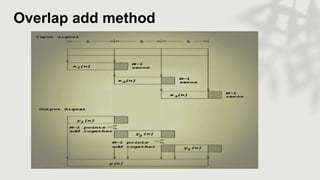
• The overlap-add method allows us to use the DFT-based method
when calculating the convolution of very long sequences.
• It is used to break long signals into smaller segments for easier
processing.
• There are many DSP applications where a long signal must be
filtered in segments . There are also systems that process segment-
by-segment because they operate in real time .
• In still other applications, the processing may require that the signal
be segmented.
• The overlap-add method is based on the fundamental
technique in DSP:
(1) decompose the signal into simple components,
(2) process each of the components in some useful way, and
(3) recombine the processed components into the final
signal.
Overlap add method
MATLAB code
clc;
clear all;
x = input('Enter the sequence X(n) = ‘);
printf('This sequence should be a
integral multiple of 2*n n’);
h = input('Enter the sequence H(n) = ‘);
n1 = length(x);n2 = length(h);
N = n1+n2-1;y = zeros(1,N);
h1 = [h zeros(1,n2-1)]n3 = length(h1);
y = zeros(1,N+n3-n2);
H = fft(h1);
for i = 1:n2:n1if i<=(n1+n2-1)x1 =
[x(i:i+n3-n2) zeros(1,n3-n2)];
else
x1 = [x(i:n1) zeros(1,n3-n2)];
end
x2 = fft(x1);
x3 = x2.*H;
x4 = round(ifft(x3));
If (i==1) y(1:n3) = x4(1:n3);
else
y(i:i+n3-1) = y(i:i+n3-1)+x4(1:n3);
end
subplot(3,1,1);
stem(x(1:n1),'black’);
grid on;
title('X(n)’);xlabel('n---
>’);ylabel('Amplitude --->’);
subplot(3,1,2);
stem(h(1:n2),'red');grid on;
title('H(n)’);xlabel('n---
>’);ylabel('Amplitude --->’);
subplot(3,1,3);
disp(y(1:N));stem(y(1:N));
grid on;
title('Convolved Singal’);
xlabel('n--->');ylabel('Amplitude --->’);
ha = axes ('Position',[0 0 1 1],'Xlim',[0
1],'Ylim',[0
1],'Box','off','Visible','off','Units','normaliz
ed', 'clipping' , 'off’);
text (0.5, 1,'bf Block Convolution using
Overlap Add Method
','HorizontalAlignment','center','VerticalA
lignment', 'top')
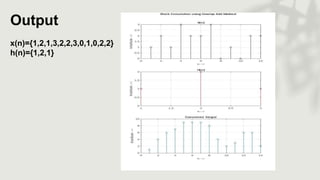
Output
x(n)={1,2,1,3,2,2,3,0,1,0,2,2}
h(n)={1,2,1}
Overlap save method
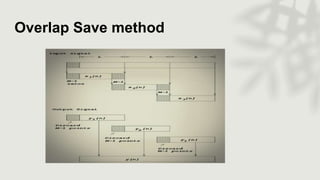
• In this method, the size of the input data blocks is N=L+M-1 and the DFTs
and the IDFTs are of length L. Each Data Block consists of the last M-1 data
points of the previous block followed by L new data points to form a data
sequence of length N=L+M-1.
• An N point DFT is computed for each data block. The impulse response of
the FIR filter is increased in length by appending L-1 zeros and an N-point
DFT of the sequence is computed once and stored. The multiplication of the
N-point DFTs for the mth block of data yields: y(k)=h(k)x(k).
• Since the data record is of length N, the first M-1 points of (n)are corrupted
by aliasing and must be discarded. The last L points of Ym(n) are exactly the
same as the result from linear convolution.
• To avoid loss of data due to aliasing, the last M-1 points of each
data record are saved and these points become the first M-1 data
points of the subsequent record.
• To begin the processing, the first M-1 point of the first record is set
to zero.
• The resulting data sequence from the IDFT are given where the
first M-1 points are discarded due to aliasing and the remaining L
points constitute the desired result from the linear convolution.
• This segmentation of the input data and the fitting of the output
data blocks together form the output sequence.
Overlap Save method
MATLAB code
clc;clear all;
x = input('Enter the sequence X(n) = ‘);
h = input('Enter the sequence H(n) = ‘);
n1 = length(x);
n2 = length(h);
N = n1+n2-1;
h1 = [h zeros(1,N-n1)];n3 = length(h1);y
= zeros(1,N);
x1 = [zeros(1,n3-n2) x zeros(1,n3)];
H = fft(h1);
for i = 1:n2:Ny1 = x1(i:i+(2*(n3-n2)));
y2 = fft(y1);
y3 = y2.*H;
y4 round(ifft(y3));
y(i:(i+n3-n2)) = y4(n2:n3);
end
X(n)subplot(3,1,1);
stem(x(1:n1),'black’);
grid on;
title('X(n)');xlabel('n---
>');ylabel('Amplitude --->’);
H(n)subplot(3,1,2);
stem(h(1:n2),'red’);
grid on;title(' H(n)’);
xlabel('n--->’);
ylabel('Amplitude --->’);
subplot(3,1,3);
disp(y(1:N));
stem(y(1:N));
grid on
;title('Convolved Signal’);
xlabel('n--->’);
ylabel('Amplitude --->');
ha = axes ('Position',[0 0 1 1],'Xlim',[0
1],'Ylim',[0
1],'Box','off','Visible','off','Units','normaliz
ed', 'clipping' , 'off’);
text (0.5, 1,'bf Block Convolution using
Overlap Save Method
','HorizontalAlignment','center','Vertical
Alignment', 'top')
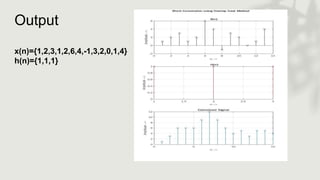
Output
x(n)={1,2,3,1,2,6,4,-1,3,2,0,1,4}
h(n)={1,1,1}
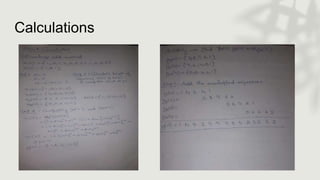
Calculations
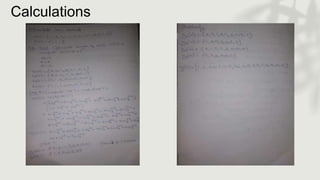
Calculations
Conclusion
In this presentation we explained about the block convolution of
long sequences using overlap add and overlap save method Here
we conclude our presentation .
Thank you

Dsp GA (1).pptx

  • 1.
    Dr Ambedkar Instituteof Technology Electronics and Communication branch
  • 2.
    Submitted by 1DA19EC016-AnushaH 1DA19EC017-Anusha K 1DA19EC019-Arushi M 1DA19EC023-Bhavana G S 1DA19EC025-Bhoomika K R 1DA20EC402-Aradhana S
  • 3.
    BLOCK CONVOLUTION BY I)OVERLAP ADD METHOD II)OVERLAPSAVE METHOD USING MATLAB Submitted to: Nagarathana H S mam
  • 4.
    Overlap add method •The overlap-add method allows us to use the DFT-based method when calculating the convolution of very long sequences. • It is used to break long signals into smaller segments for easier processing. • There are many DSP applications where a long signal must be filtered in segments . There are also systems that process segment- by-segment because they operate in real time . • In still other applications, the processing may require that the signal be segmented.
  • 5.
    • The overlap-addmethod is based on the fundamental technique in DSP: (1) decompose the signal into simple components, (2) process each of the components in some useful way, and (3) recombine the processed components into the final signal.
  • 6.
  • 7.
    MATLAB code clc; clear all; x= input('Enter the sequence X(n) = ‘); printf('This sequence should be a integral multiple of 2*n n’); h = input('Enter the sequence H(n) = ‘); n1 = length(x);n2 = length(h); N = n1+n2-1;y = zeros(1,N); h1 = [h zeros(1,n2-1)]n3 = length(h1); y = zeros(1,N+n3-n2); H = fft(h1); for i = 1:n2:n1if i<=(n1+n2-1)x1 = [x(i:i+n3-n2) zeros(1,n3-n2)]; else x1 = [x(i:n1) zeros(1,n3-n2)]; end x2 = fft(x1); x3 = x2.*H; x4 = round(ifft(x3)); If (i==1) y(1:n3) = x4(1:n3);
  • 8.
    else y(i:i+n3-1) = y(i:i+n3-1)+x4(1:n3); end subplot(3,1,1); stem(x(1:n1),'black’); gridon; title('X(n)’);xlabel('n--- >’);ylabel('Amplitude --->’); subplot(3,1,2); stem(h(1:n2),'red');grid on; title('H(n)’);xlabel('n--- >’);ylabel('Amplitude --->’); subplot(3,1,3); disp(y(1:N));stem(y(1:N)); grid on; title('Convolved Singal’); xlabel('n--->');ylabel('Amplitude --->’); ha = axes ('Position',[0 0 1 1],'Xlim',[0 1],'Ylim',[0 1],'Box','off','Visible','off','Units','normaliz ed', 'clipping' , 'off’); text (0.5, 1,'bf Block Convolution using Overlap Add Method ','HorizontalAlignment','center','VerticalA lignment', 'top')
  • 9.
  • 10.
    Overlap save method •In this method, the size of the input data blocks is N=L+M-1 and the DFTs and the IDFTs are of length L. Each Data Block consists of the last M-1 data points of the previous block followed by L new data points to form a data sequence of length N=L+M-1. • An N point DFT is computed for each data block. The impulse response of the FIR filter is increased in length by appending L-1 zeros and an N-point DFT of the sequence is computed once and stored. The multiplication of the N-point DFTs for the mth block of data yields: y(k)=h(k)x(k). • Since the data record is of length N, the first M-1 points of (n)are corrupted by aliasing and must be discarded. The last L points of Ym(n) are exactly the same as the result from linear convolution.
  • 11.
    • To avoidloss of data due to aliasing, the last M-1 points of each data record are saved and these points become the first M-1 data points of the subsequent record. • To begin the processing, the first M-1 point of the first record is set to zero. • The resulting data sequence from the IDFT are given where the first M-1 points are discarded due to aliasing and the remaining L points constitute the desired result from the linear convolution. • This segmentation of the input data and the fitting of the output data blocks together form the output sequence.
  • 12.
  • 13.
    MATLAB code clc;clear all; x= input('Enter the sequence X(n) = ‘); h = input('Enter the sequence H(n) = ‘); n1 = length(x); n2 = length(h); N = n1+n2-1; h1 = [h zeros(1,N-n1)];n3 = length(h1);y = zeros(1,N); x1 = [zeros(1,n3-n2) x zeros(1,n3)]; H = fft(h1); for i = 1:n2:Ny1 = x1(i:i+(2*(n3-n2))); y2 = fft(y1); y3 = y2.*H; y4 round(ifft(y3)); y(i:(i+n3-n2)) = y4(n2:n3); end X(n)subplot(3,1,1); stem(x(1:n1),'black’); grid on; title('X(n)');xlabel('n--- >');ylabel('Amplitude --->’);
  • 14.
    H(n)subplot(3,1,2); stem(h(1:n2),'red’); grid on;title(' H(n)’); xlabel('n--->’); ylabel('Amplitude--->’); subplot(3,1,3); disp(y(1:N)); stem(y(1:N)); grid on ;title('Convolved Signal’); xlabel('n--->’); ylabel('Amplitude --->'); ha = axes ('Position',[0 0 1 1],'Xlim',[0 1],'Ylim',[0 1],'Box','off','Visible','off','Units','normaliz ed', 'clipping' , 'off’); text (0.5, 1,'bf Block Convolution using Overlap Save Method ','HorizontalAlignment','center','Vertical Alignment', 'top')
  • 15.
  • 16.
  • 17.
  • 18.
    Conclusion In this presentationwe explained about the block convolution of long sequences using overlap add and overlap save method Here we conclude our presentation .
  • 19.