DIGITAL SIGNAL PROCESSING

    OVERLAP-ADD METHOD &
    OVERLAP-SAVE METHOD
Contents

   Filtering Long Duration Sequences


   Overlap-Save Method
Filtering Long Duration
Sequences
     An input sequence x(n) is of long duration
      is to be processed with a system having
      impulse response of finite duration by
      convolving two sequences. Because of the
      length of the input sequences, it’s not
      practical to store it all before performing
      linear convolution. Therefore input
      sequences are divided into blocks. Two
      methods commonly used for filtering the
      sectioned data and combining results are
      the overlap-save method and overlap–add
      method.
Overlap-Save Method
   Let the length of input sequence is LS and the
    length of the impulse response is M. Here the
    input is divided into blocks of data of size N=L+M-
    1. Each block consists of last (M-1) data points of
    previous block followed by L new data points to
    form data sequence of N=L+M-1. For first block of
    data the first M-1points are set to zero. The blocks
    of data sequence are

    x1(n)= {0,0,0,….,0,x(0),x(n),…..,x(L-1)}

           (M-1)Zeros
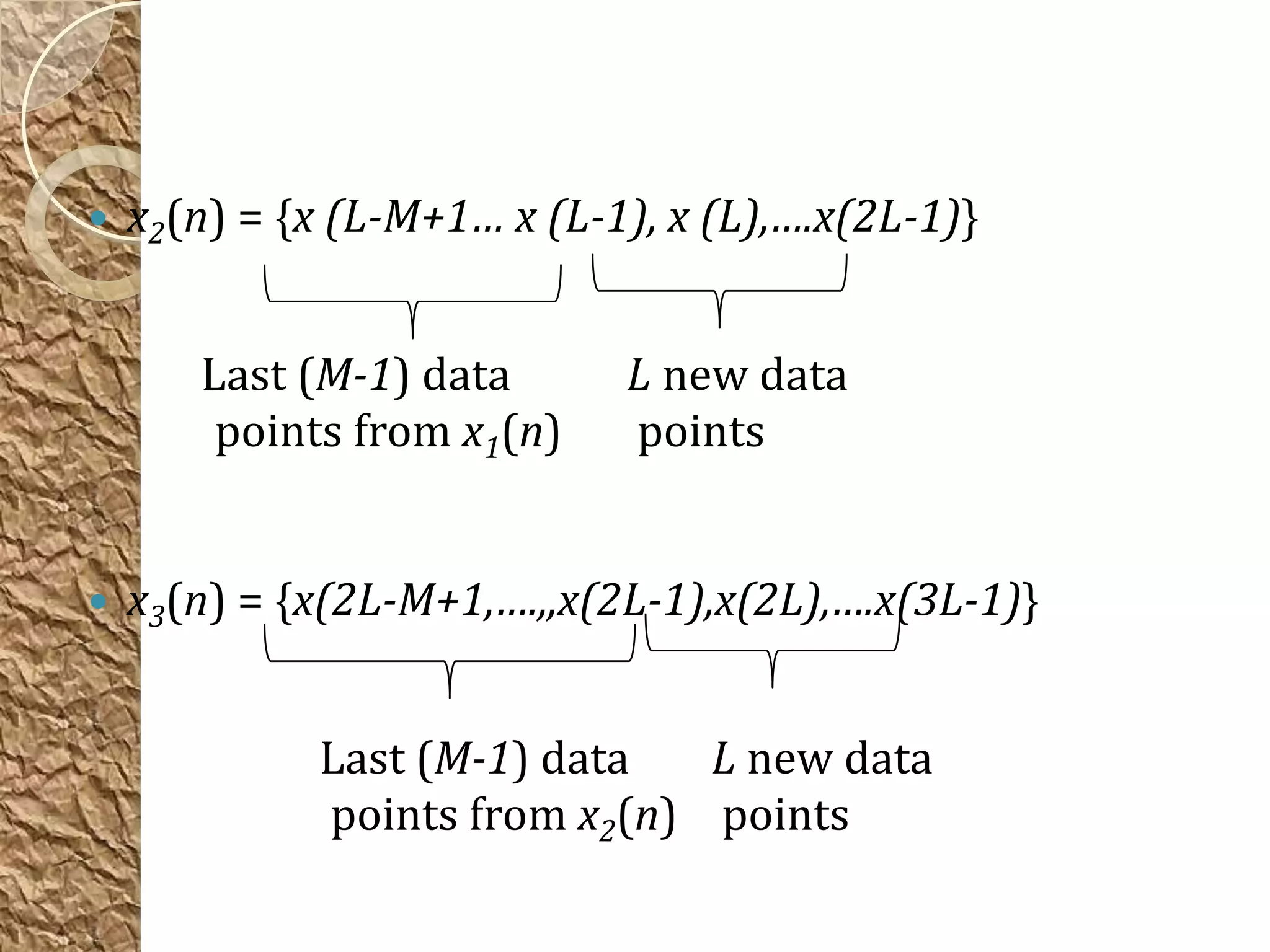
   x2(n) = {x (L-M+1… x (L-1), x (L),….x(2L-1)}


       Last (M-1) data       L new data
        points from x1(n)    points


   x3(n) = {x(2L-M+1,….,,x(2L-1),x(2L),….x(3L-1)}


             Last (M-1) data   L new data
             points from x2(n) points
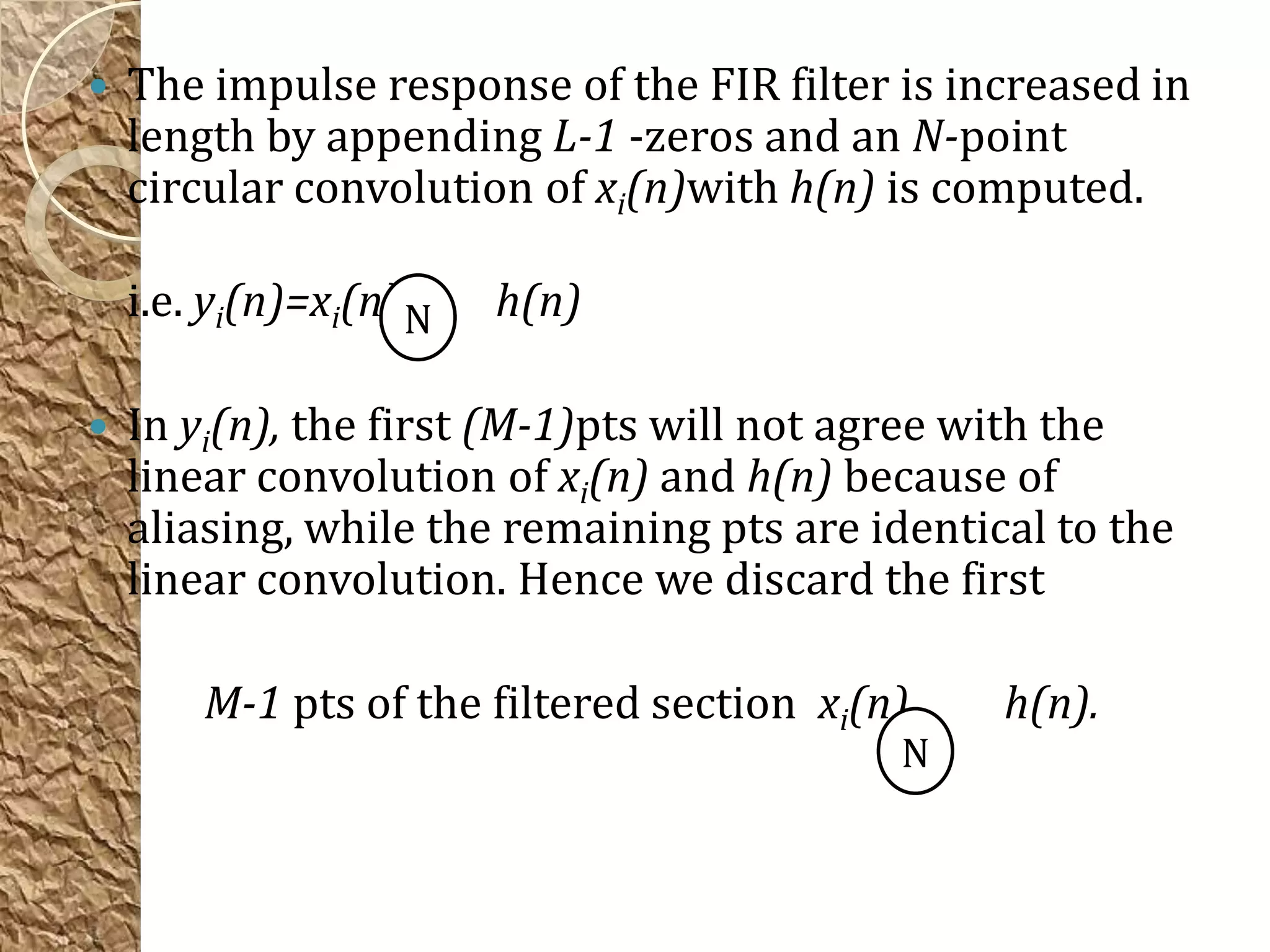
   The impulse response of the FIR filter is increased in
    length by appending L-1 -zeros and an N-point
    circular convolution of xi(n)with h(n) is computed.

    i.e. yi(n)=xi(n) N   h(n)

   In yi(n), the first (M-1)pts will not agree with the
    linear convolution of xi(n) and h(n) because of
    aliasing, while the remaining pts are identical to the
    linear convolution. Hence we discard the first

        M-1 pts of the filtered section xi(n)    h(n).
                                            N
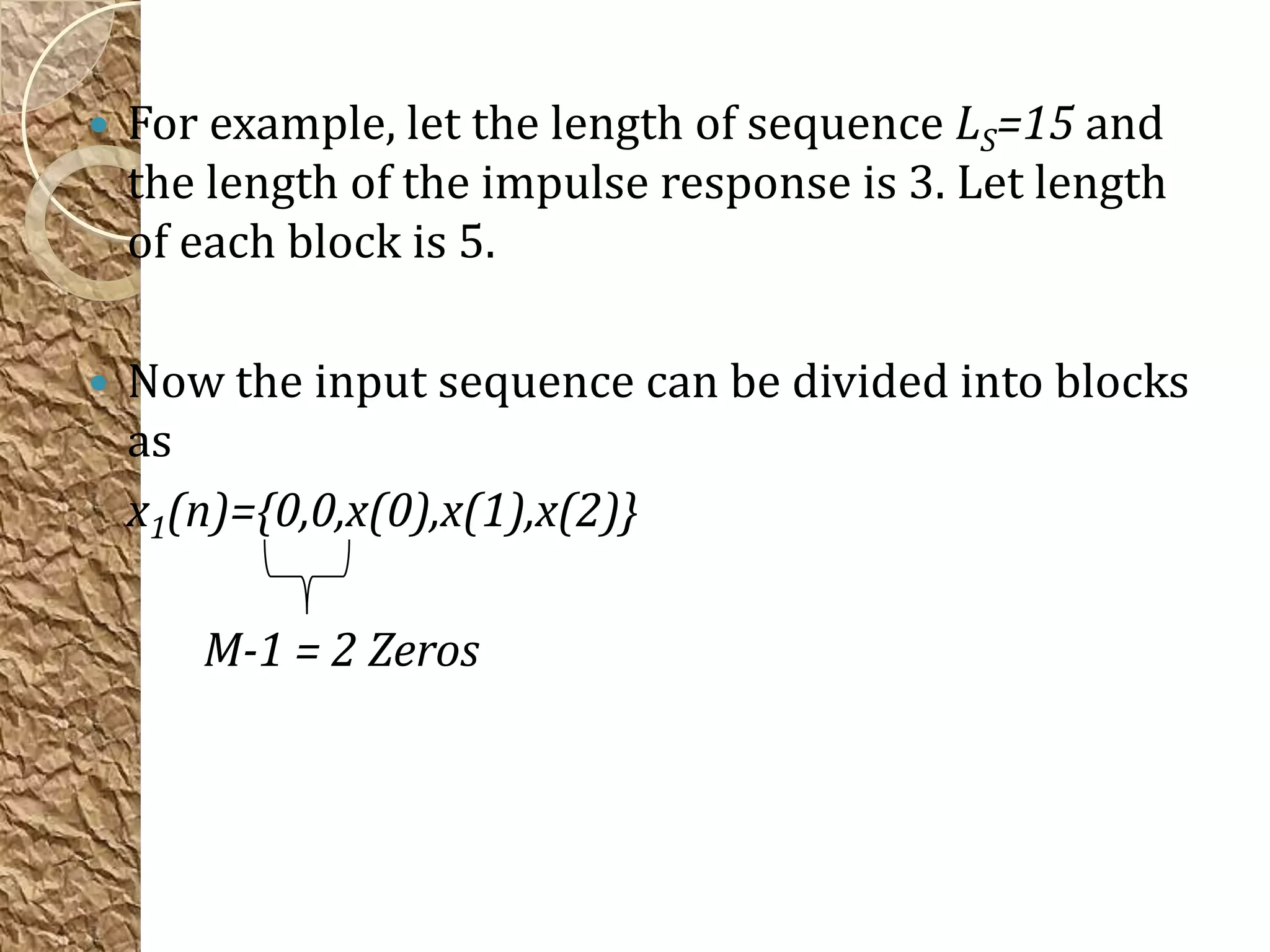
   For example, let the length of sequence LS=15 and
    the length of the impulse response is 3. Let length
    of each block is 5.

   Now the input sequence can be divided into blocks
    as
    x1(n)={0,0,x(0),x(1),x(2)}

       M-1 = 2 Zeros
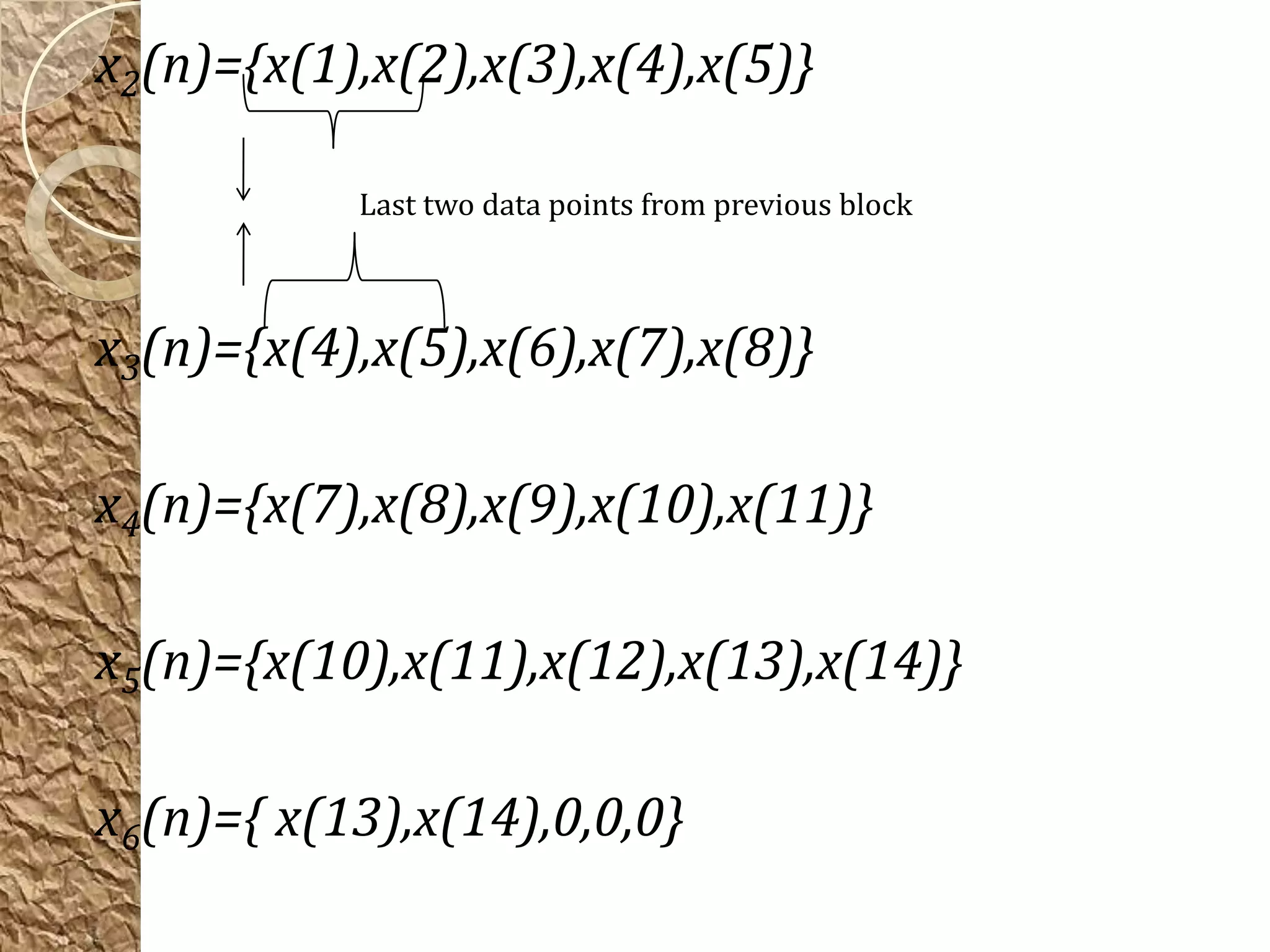
x2(n)={x(1),x(2),x(3),x(4),x(5)}

           Last two data points from previous block


x3(n)={x(4),x(5),x(6),x(7),x(8)}

x4(n)={x(7),x(8),x(9),x(10),x(11)}

x5(n)={x(10),x(11),x(12),x(13),x(14)}

x6(n)={ x(13),x(14),0,0,0}
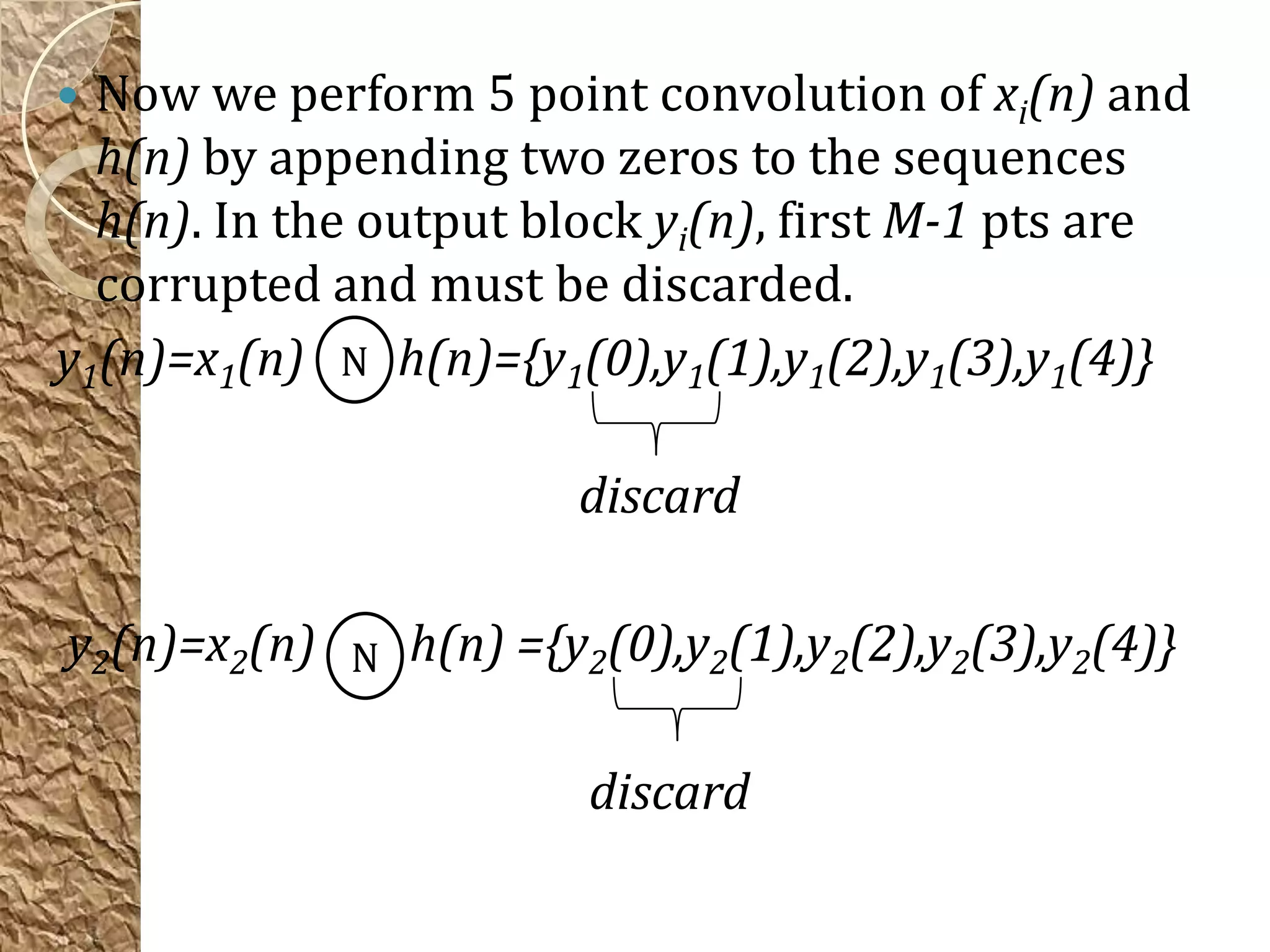
 Now we perform 5 point convolution of xi(n) and
  h(n) by appending two zeros to the sequences
  h(n). In the output block yi(n), first M-1 pts are
  corrupted and must be discarded.
y1(n)=x1(n) N h(n)={y1(0),y1(1),y1(2),y1(3),y1(4)}

                       discard

y2(n)=x2(n) N h(n) ={y2(0),y2(1),y2(2),y2(3),y2(4)}

                        discard
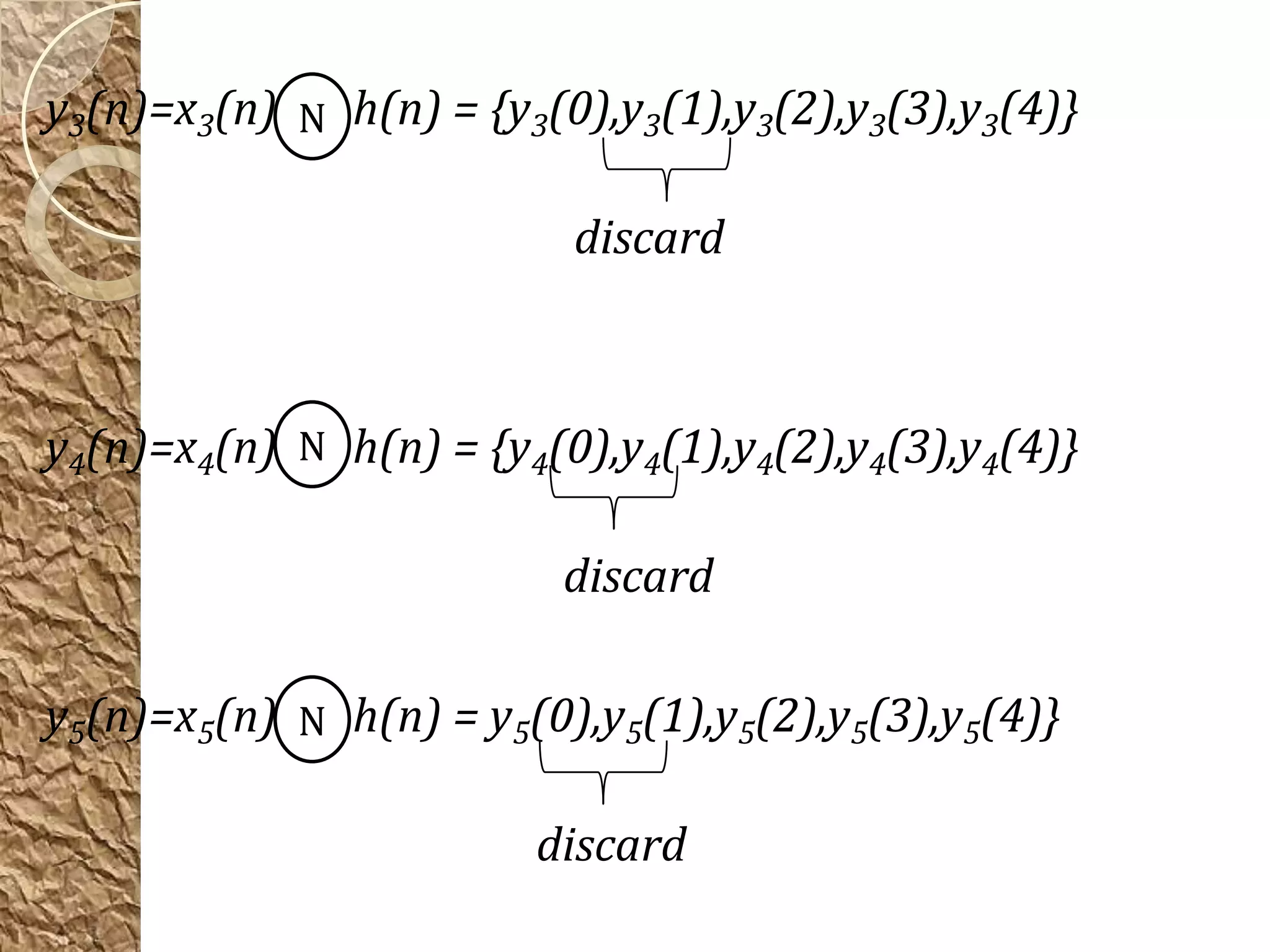
y3(n)=x3(n) N h(n) = {y3(0),y3(1),y3(2),y3(3),y3(4)}

                          discard


y4(n)=x4(n) N h(n) = {y4(0),y4(1),y4(2),y4(3),y4(4)}

                          discard

y5(n)=x5(n) N h(n) = y5(0),y5(1),y5(2),y5(3),y5(4)}

                        discard
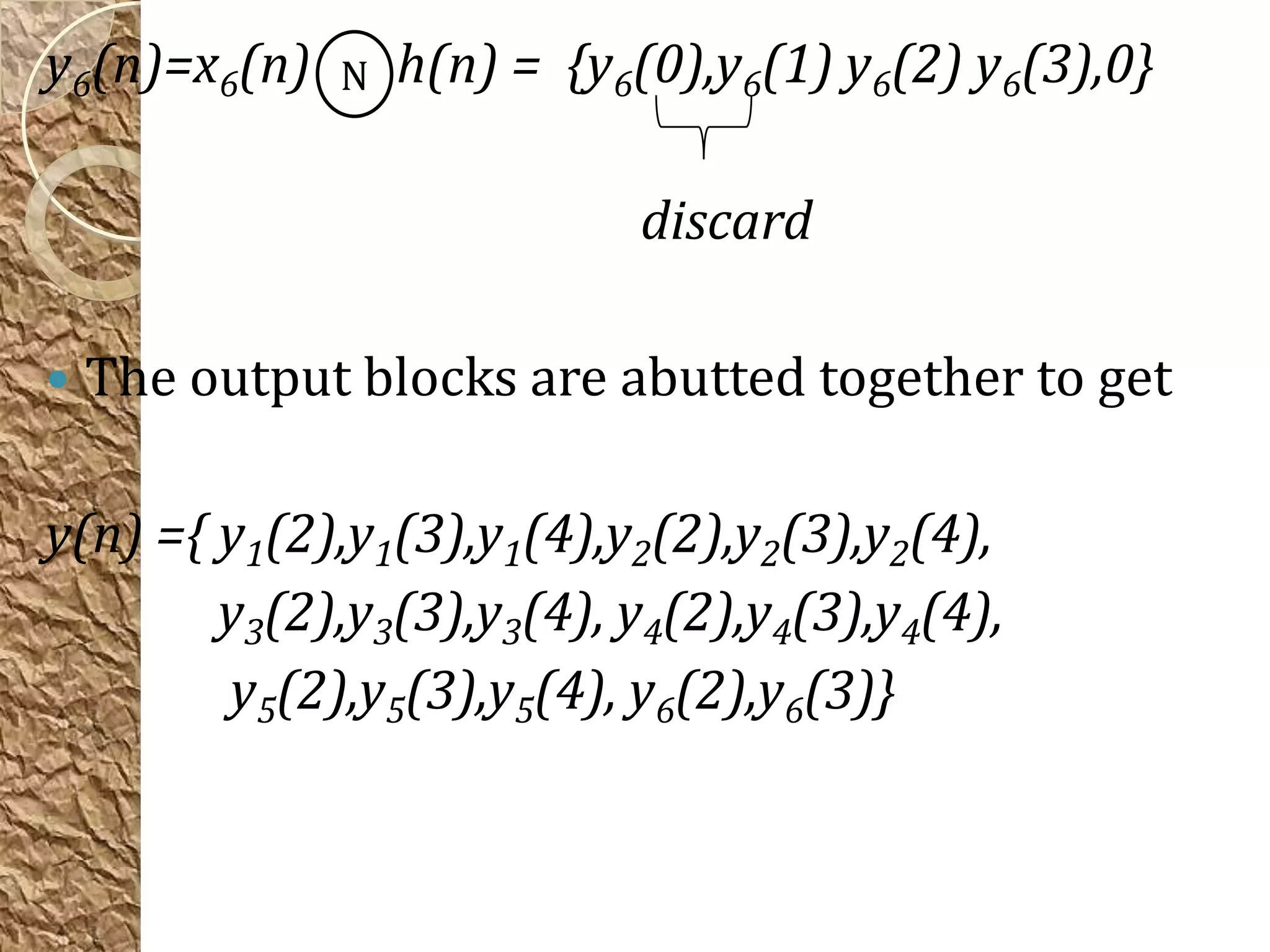
y6(n)=x6(n)   N   h(n) = {y6(0),y6(1) y6(2) y6(3),0}

                            discard

   The output blocks are abutted together to get

y(n) ={ y1(2),y1(3),y1(4),y2(2),y2(3),y2(4),
        y3(2),y3(3),y3(4), y4(2),y4(3),y4(4),
        y5(2),y5(3),y5(4), y6(2),y6(3)}
Digital signal processing

Digital signal processing

  • 1.
    DIGITAL SIGNAL PROCESSING OVERLAP-ADD METHOD & OVERLAP-SAVE METHOD
  • 2.
    Contents  Filtering Long Duration Sequences  Overlap-Save Method
  • 3.
    Filtering Long Duration Sequences  An input sequence x(n) is of long duration is to be processed with a system having impulse response of finite duration by convolving two sequences. Because of the length of the input sequences, it’s not practical to store it all before performing linear convolution. Therefore input sequences are divided into blocks. Two methods commonly used for filtering the sectioned data and combining results are the overlap-save method and overlap–add method.
  • 4.
    Overlap-Save Method  Let the length of input sequence is LS and the length of the impulse response is M. Here the input is divided into blocks of data of size N=L+M- 1. Each block consists of last (M-1) data points of previous block followed by L new data points to form data sequence of N=L+M-1. For first block of data the first M-1points are set to zero. The blocks of data sequence are x1(n)= {0,0,0,….,0,x(0),x(n),…..,x(L-1)} (M-1)Zeros
  • 5.
    x2(n) = {x (L-M+1… x (L-1), x (L),….x(2L-1)} Last (M-1) data L new data points from x1(n) points  x3(n) = {x(2L-M+1,….,,x(2L-1),x(2L),….x(3L-1)} Last (M-1) data L new data points from x2(n) points
  • 6.
    The impulse response of the FIR filter is increased in length by appending L-1 -zeros and an N-point circular convolution of xi(n)with h(n) is computed. i.e. yi(n)=xi(n) N h(n)  In yi(n), the first (M-1)pts will not agree with the linear convolution of xi(n) and h(n) because of aliasing, while the remaining pts are identical to the linear convolution. Hence we discard the first M-1 pts of the filtered section xi(n) h(n). N
  • 7.
    For example, let the length of sequence LS=15 and the length of the impulse response is 3. Let length of each block is 5.  Now the input sequence can be divided into blocks as x1(n)={0,0,x(0),x(1),x(2)} M-1 = 2 Zeros
  • 8.
    x2(n)={x(1),x(2),x(3),x(4),x(5)} Last two data points from previous block x3(n)={x(4),x(5),x(6),x(7),x(8)} x4(n)={x(7),x(8),x(9),x(10),x(11)} x5(n)={x(10),x(11),x(12),x(13),x(14)} x6(n)={ x(13),x(14),0,0,0}
  • 9.
     Now weperform 5 point convolution of xi(n) and h(n) by appending two zeros to the sequences h(n). In the output block yi(n), first M-1 pts are corrupted and must be discarded. y1(n)=x1(n) N h(n)={y1(0),y1(1),y1(2),y1(3),y1(4)} discard y2(n)=x2(n) N h(n) ={y2(0),y2(1),y2(2),y2(3),y2(4)} discard
  • 10.
    y3(n)=x3(n) N h(n)= {y3(0),y3(1),y3(2),y3(3),y3(4)} discard y4(n)=x4(n) N h(n) = {y4(0),y4(1),y4(2),y4(3),y4(4)} discard y5(n)=x5(n) N h(n) = y5(0),y5(1),y5(2),y5(3),y5(4)} discard
  • 11.
    y6(n)=x6(n) N h(n) = {y6(0),y6(1) y6(2) y6(3),0} discard  The output blocks are abutted together to get y(n) ={ y1(2),y1(3),y1(4),y2(2),y2(3),y2(4), y3(2),y3(3),y3(4), y4(2),y4(3),y4(4), y5(2),y5(3),y5(4), y6(2),y6(3)}