Arpan Deyasi
Dept of ECE, RCCIIT, Kolkata, India
Course: MCE203A
Sun Transit Outage
5/18/2020 1Arpan Deyasi, RCCIIT, MCE203A
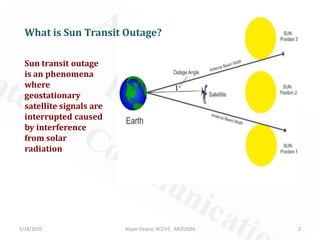
Sun transit outage
is an phenomena
where
geostationary
satellite signals are
interrupted caused
by interference
from solar
radiation
What is Sun Transit Outage?
5/18/2020 2Arpan Deyasi, RCCIIT, MCE203A
Features of Sun Transit Outage
This effect lasts for 6 days around the equinoxes
This effect occurs for a maximum period of 10 minutes
Generally, sun outages occur in February, March,
September, October
5/18/2020 3Arpan Deyasi, RCCIIT, MCE203A
Solar Eclipse on Satellite
5/18/2020 4Arpan Deyasi, RCCIIT, MCE203A
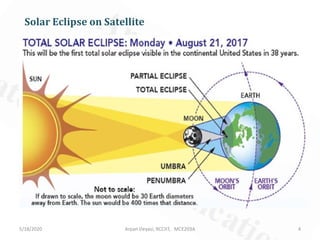
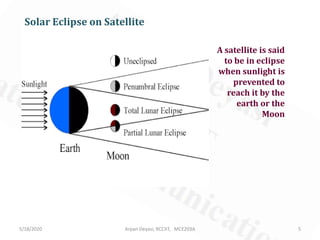
A satellite is said
to be in eclipse
when sunlight is
prevented to
reach it by the
earth or the
Moon
Solar Eclipse on Satellite
5/18/2020 5Arpan Deyasi, RCCIIT, MCE203A
If Earth’s orbital plane around Sun coincides with
Earth’s equatorial plane, then geostationary orbit will
be eclipsed by the earth. This is called the earth
eclipse of satellite.
Solar Eclipse on Satellite
5/18/2020 6Arpan Deyasi, RCCIIT, MCE203A
For geostationary satellite, the Solar eclipse due to
Earth occurs during two periods
begins 23 days before equinox
and
ends 23 days after equinox
Features of Solar Eclipse
During eclipse, satellite receives no power from its solar
panels and it has to operate on its onboard standby
batteries which reduce satellite life
5/18/2020 7Arpan Deyasi, RCCIIT, MCE203A
Mathematical formulation of Solar eclipse
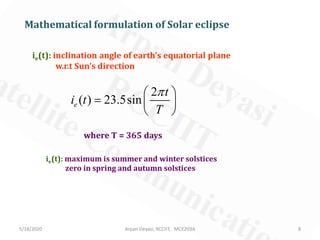
ie(t): inclination angle of earth’s equatorial plane
w.r.t Sun’s direction
2
( ) 23.5sine
t
i t
T
π 
=  
 
where T = 365 days
ie(t): maximum is summer and winter solstices
zero in spring and autumn solstices
5/18/2020 8Arpan Deyasi, RCCIIT, MCE203A
Mathematical formulation of Solar eclipse
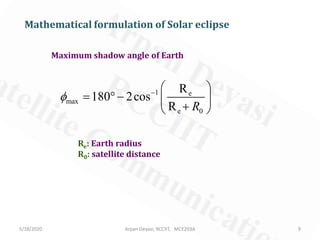
Maximum shadow angle of Earth
1 e
max
e 0
R
180 2cos
R R
φ −  
= °−  
+ 
Re: Earth radius
R0: satellite distance
5/18/2020 9Arpan Deyasi, RCCIIT, MCE203A
Mathematical formulation of Solar eclipse
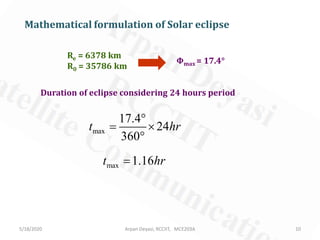
Re = 6378 km
R0 = 35786 km
Φmax = 17.4°
Duration of eclipse considering 24 hours period
max
17.4
24
360
t hr
°
= ×
°
max 1.16t hr=
5/18/2020 10Arpan Deyasi, RCCIIT, MCE203A
Mathematical formulation of Solar eclipse
Relative position of Sun is calculated from first eclipse day
before equinox and last day after equinox
max( ) 0.5 8.7ei t φ= = °
Corresponding time ‘t’ is
1365 87
sin
23.5
t
π
−  
=  
 
21t days
5/18/2020 11Arpan Deyasi, RCCIIT, MCE203A
Features of Solar Eclipse
5/18/2020 12Arpan Deyasi, RCCIIT, MCE203A
5/18/2020 13Arpan Deyasi, RCCIIT, MCE203A
When moon passes in front of sun, moon eclipse
occurs
It is less important as it takes place for short
duration (twice in every 24 hours for an average of
few minutes)
Lunar Eclipse
5/18/2020 14Arpan Deyasi, RCCIIT, MCE203A
Way to avoid eclipse during satellite lifetime
When satellite longitude is East of the Earth station, then it enters
in the eclipse during daylight and early morning
This is undesirable if the satellite has to operate on reduced battery
power
Conclusion: Satellite longitudes should be set at
West of Earth station
When satellite longitude is West of the earth station, eclipse does
not occur until the Earth station is in darkness when usage is
likely to be low
5/18/2020 15Arpan Deyasi, RCCIIT, MCE203A
Doppler frequency shift
LEO satellite is in relative motion w.r.t Earth station terminal
GEO satellite appears stationary w.r.t Earth station terminal
5/18/2020 16Arpan Deyasi, RCCIIT, MCE203A
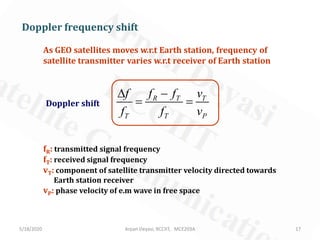
Doppler frequency shift
As GEO satellites moves w.r.t Earth station, frequency of
satellite transmitter varies w.r.t receiver of Earth station
Doppler shift
R T T
T T P
f f f v
f f v
∆ −
= =
fR: transmitted signal frequency
fT: received signal frequency
vT: component of satellite transmitter velocity directed towards
Earth station receiver
vP: phase velocity of e.m wave in free space
5/18/2020 17Arpan Deyasi, RCCIIT, MCE203A
http://archive.mu.ac.in/myweb_test/Satelight%20Comm..pdf
A. K. Maini, V. Agarawal, “Satellite Communications”, Wiley, 1st Ed.,
2019
References
S. Katiyar, “Satellite Communication”, S. K. Kataria & Sons, 1st Ed., 2007
5/18/2020 18Arpan Deyasi, RCCIIT, MCE203A

Sun transit outage

  • 1.
    Arpan Deyasi Dept ofECE, RCCIIT, Kolkata, India Course: MCE203A Sun Transit Outage 5/18/2020 1Arpan Deyasi, RCCIIT, MCE203A
  • 2.
    Sun transit outage isan phenomena where geostationary satellite signals are interrupted caused by interference from solar radiation What is Sun Transit Outage? 5/18/2020 2Arpan Deyasi, RCCIIT, MCE203A
  • 3.
    Features of SunTransit Outage This effect lasts for 6 days around the equinoxes This effect occurs for a maximum period of 10 minutes Generally, sun outages occur in February, March, September, October 5/18/2020 3Arpan Deyasi, RCCIIT, MCE203A
  • 4.
    Solar Eclipse onSatellite 5/18/2020 4Arpan Deyasi, RCCIIT, MCE203A
  • 5.
    A satellite issaid to be in eclipse when sunlight is prevented to reach it by the earth or the Moon Solar Eclipse on Satellite 5/18/2020 5Arpan Deyasi, RCCIIT, MCE203A
  • 6.
    If Earth’s orbitalplane around Sun coincides with Earth’s equatorial plane, then geostationary orbit will be eclipsed by the earth. This is called the earth eclipse of satellite. Solar Eclipse on Satellite 5/18/2020 6Arpan Deyasi, RCCIIT, MCE203A
  • 7.
    For geostationary satellite,the Solar eclipse due to Earth occurs during two periods begins 23 days before equinox and ends 23 days after equinox Features of Solar Eclipse During eclipse, satellite receives no power from its solar panels and it has to operate on its onboard standby batteries which reduce satellite life 5/18/2020 7Arpan Deyasi, RCCIIT, MCE203A
  • 8.
    Mathematical formulation ofSolar eclipse ie(t): inclination angle of earth’s equatorial plane w.r.t Sun’s direction 2 ( ) 23.5sine t i t T π  =     where T = 365 days ie(t): maximum is summer and winter solstices zero in spring and autumn solstices 5/18/2020 8Arpan Deyasi, RCCIIT, MCE203A
  • 9.
    Mathematical formulation ofSolar eclipse Maximum shadow angle of Earth 1 e max e 0 R 180 2cos R R φ −   = °−   +  Re: Earth radius R0: satellite distance 5/18/2020 9Arpan Deyasi, RCCIIT, MCE203A
  • 10.
    Mathematical formulation ofSolar eclipse Re = 6378 km R0 = 35786 km Φmax = 17.4° Duration of eclipse considering 24 hours period max 17.4 24 360 t hr ° = × ° max 1.16t hr= 5/18/2020 10Arpan Deyasi, RCCIIT, MCE203A
  • 11.
    Mathematical formulation ofSolar eclipse Relative position of Sun is calculated from first eclipse day before equinox and last day after equinox max( ) 0.5 8.7ei t φ= = ° Corresponding time ‘t’ is 1365 87 sin 23.5 t π −   =     21t days 5/18/2020 11Arpan Deyasi, RCCIIT, MCE203A
  • 12.
    Features of SolarEclipse 5/18/2020 12Arpan Deyasi, RCCIIT, MCE203A
  • 13.
  • 14.
    When moon passesin front of sun, moon eclipse occurs It is less important as it takes place for short duration (twice in every 24 hours for an average of few minutes) Lunar Eclipse 5/18/2020 14Arpan Deyasi, RCCIIT, MCE203A
  • 15.
    Way to avoideclipse during satellite lifetime When satellite longitude is East of the Earth station, then it enters in the eclipse during daylight and early morning This is undesirable if the satellite has to operate on reduced battery power Conclusion: Satellite longitudes should be set at West of Earth station When satellite longitude is West of the earth station, eclipse does not occur until the Earth station is in darkness when usage is likely to be low 5/18/2020 15Arpan Deyasi, RCCIIT, MCE203A
  • 16.
    Doppler frequency shift LEOsatellite is in relative motion w.r.t Earth station terminal GEO satellite appears stationary w.r.t Earth station terminal 5/18/2020 16Arpan Deyasi, RCCIIT, MCE203A
  • 17.
    Doppler frequency shift AsGEO satellites moves w.r.t Earth station, frequency of satellite transmitter varies w.r.t receiver of Earth station Doppler shift R T T T T P f f f v f f v ∆ − = = fR: transmitted signal frequency fT: received signal frequency vT: component of satellite transmitter velocity directed towards Earth station receiver vP: phase velocity of e.m wave in free space 5/18/2020 17Arpan Deyasi, RCCIIT, MCE203A
  • 18.
    http://archive.mu.ac.in/myweb_test/Satelight%20Comm..pdf A. K. Maini,V. Agarawal, “Satellite Communications”, Wiley, 1st Ed., 2019 References S. Katiyar, “Satellite Communication”, S. K. Kataria & Sons, 1st Ed., 2007 5/18/2020 18Arpan Deyasi, RCCIIT, MCE203A