Osteoporosis
Dr. Uday Pawar
Junior Spine Consultant
DNB Orthopaedic
Hinduja Hospital, Mahim, Mumbai
http://www.hindujahospital.com/dr-uday-pawar/
With age comes wisdom………..
and Osteoporosis
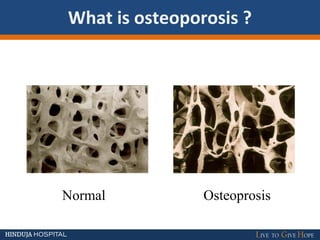
What is osteoporosis ?
Normal Osteoprosis
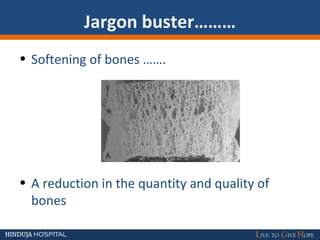
Jargon buster………
• Softening of bones …….
• A reduction in the quantity and quality of
bones
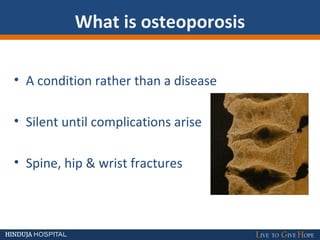
What is osteoporosis
• A condition rather than a disease
• Silent until complications arise
• Spine, hip & wrist fractures
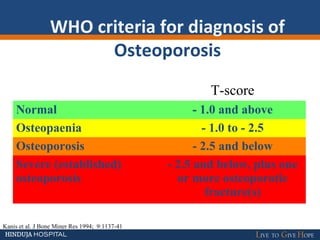
WHO criteria for diagnosis of
Osteoporosis
Kanis et al. J Bone Miner Res 1994; 9:1137-41
T-score
Normal - 1.0 and above
Osteopaenia - 1.0 to - 2.5
Osteoporosis - 2.5 and below
Severe (established)
osteoporosis
- 2.5 and below, plus one
or more osteoporotic
fracture(s)
Food for thought…..
1. Osteoporosis ≠ Calcium deficiency
• So, calcium is NOT the treatment of
osteoporosis
• Bone mineral v/s bone mass
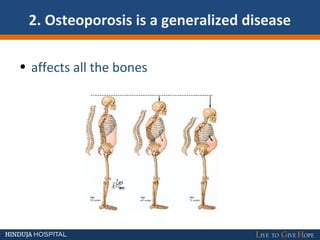
2. Osteoporosis is a generalized disease
• affects all the bones
3. Treating osteoporosis
• Prevention is the only treatment of
osteoporosis
• Hence early diagnosis is the most important
step in treating osteoporosis !
Size of the Problem in India
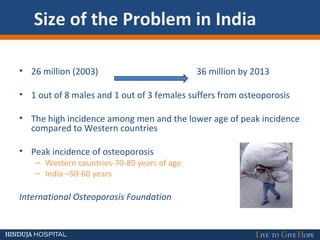
• 26 million (2003) 36 million by 2013
• 1 out of 8 males and 1 out of 3 females suffers from osteoporosis
• The high incidence among men and the lower age of peak incidence
compared to Western countries
• Peak incidence of osteoporosis
– Western countries-70-80 years of age
– India –50-60 years
International Osteoporosis Foundation
The Magnitude Of The Problem
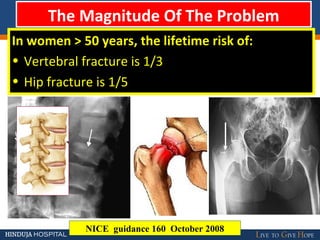
In women > 50 years, the lifetime risk of:
• Vertebral fracture is 1/3
• Hip fracture is 1/5
NICE guidance 160 October 2008
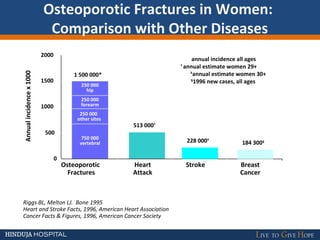
Osteoporotic Fractures in Women:
Comparison with Other Diseases
1 500 000*
0
500
1000
1500
2000
Osteoporotic
Fractures
*
annual incidence all ages
†
annual estimate women 29+
‡
annual estimate women 30+
§
1996 new cases, all ages
513 000†
228 000‡
184 300§
750 000
vertebral
250 000
other sites
250 000
forearm
250 000
hip
Heart
Attack
Stroke Breast
Cancer
Annualincidencex1000
Riggs BL, Melton LJ. Bone 1995
Heart and Stroke Facts, 1996, American Heart Association
Cancer Facts & Figures, 1996, American Cancer Society
Osteoporosis affects entire skeleton
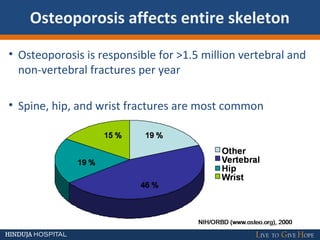
• Osteoporosis is responsible for >1.5 million vertebral and
non-vertebral fractures per year
• Spine, hip, and wrist fractures are most common
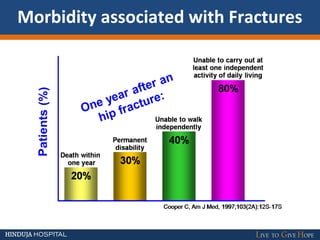
Morbidity associated with Fractures
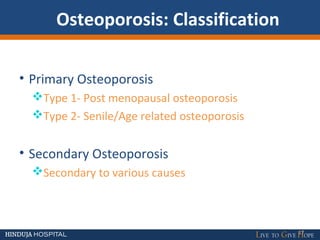
Osteoporosis: Classification
• Primary Osteoporosis
Type 1- Post menopausal osteoporosis
Type 2- Senile/Age related osteoporosis
• Secondary Osteoporosis
Secondary to various causes
17
Consequences
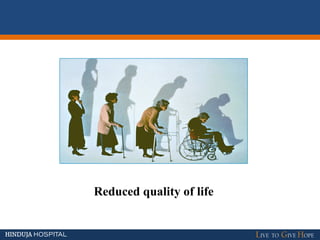
Reduced quality of life
How is osteoporosis diagnosed
Diagnosis is made on the basis of-
• Detailed medical history
• Examination
• Blood and other tests
Early diagnosis of Osteoporosis
• Clinical parameters
– ‘at risk’ subject
– Bone pains
– Generalized tiredness
– Progressive kyphosis
• Investigations
– Radiographs
– DEXA
– QCT, MRI, Bone scan
– Blood markers
Clinical Risk Fractures (CRF)
Predictors of low bone mass-
• Female
• Advanced age
• Low bone mineral density
• Gonadal hormone deficiency ( estrogen or testosterone )
• White race
• Low body weight & BMI
• Family history of osteoporosis
• Low calcium intake
• Smoking / excessive alcohol intake
• Low level of physical activity
• Chronic glucocorticoid use
• Prior fragility fracture
National Osteoporosis Foundation (NOF)
Clinical Presentation
• Severe backache after minor injury
• Pain worse on sneezing, coughing , standing
erect, changing positions.
• Limited to wheelchair
• Stooped Posture
• Weakness in legs
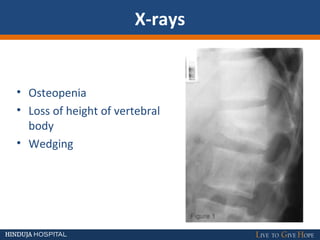
X-rays
• Osteopenia
• Loss of height of vertebral
body
• Wedging
Osteoporosis – RadiographicOsteoporosis – Radiographic
Differential DiagnosisDifferential Diagnosis
• Osteomalacia
• Hyperparathyroidism
• Hypercortisolism
• Hyperthyroidism
• Renal insufficiency
• Chronic immobilization
• Osteogenesis imperfecta
• Hepatic insufficiency
• Diabetes mellitus
• Multiple myeloma
• Metastatic disease
• Drug induced
Osteoporosis other causesOsteoporosis other causes
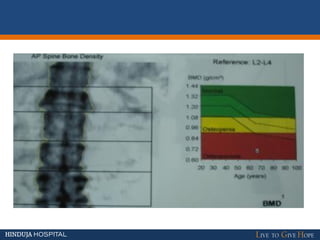
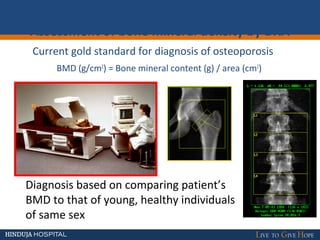
Assessment of bone mineral density by DXA
Current gold standard for diagnosis of osteoporosis
BMD (g/cm2
) = Bone mineral content (g) / area (cm2
)
Diagnosis based on comparing patient’s
BMD to that of young, healthy individuals
of same sex
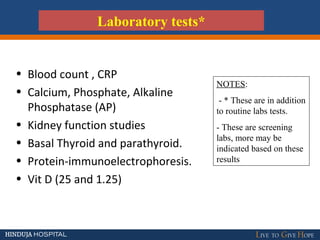
• Blood count , CRP
• Calcium, Phosphate, Alkaline
Phosphatase (AP)
• Kidney function studies
• Basal Thyroid and parathyroid.
• Protein-immunoelectrophoresis.
• Vit D (25 and 1.25)
Laboratory tests*
NOTES:
- * These are in addition
to routine labs tests.
- These are screening
labs, more may be
indicated based on these
results
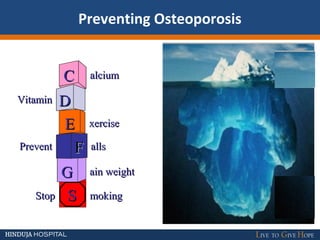
Preventing Osteoporosis
alciumalciumCC
DDVitaminVitamin
xercisexerciseEE
FFPreventPrevent allsalls
ain weightain weightGG
StopStop mokingmokingSS
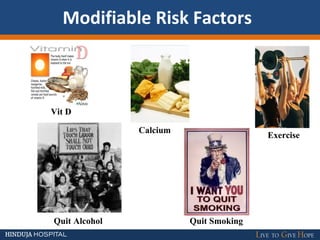
Modifiable Risk Factors
Vit D
Calcium
Exercise
Quit Alcohol Quit Smoking
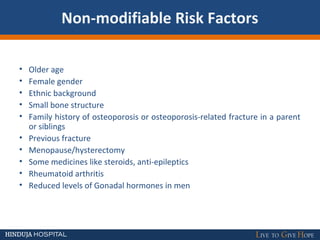
Non-modifiable Risk Factors
• Older age
• Female gender
• Ethnic background
• Small bone structure
• Family history of osteoporosis or osteoporosis-related fracture in a parent
or siblings
• Previous fracture
• Menopause/hysterectomy
• Some medicines like steroids, anti-epileptics
• Rheumatoid arthritis
• Reduced levels of Gonadal hormones in men
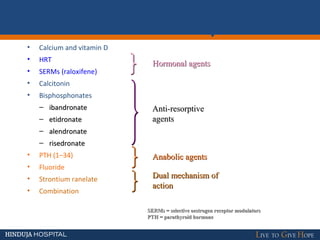
Treatments of osteoporosis
• Calcium and vitamin D
• HRT
• SERMs (raloxifene)
• Calcitonin
• Bisphosphonates
– ibandronateibandronate
– etidronateetidronate
– alendronatealendronate
– risedronaterisedronate
• PTH (1–34)
• Fluoride
• Strontium ranelate
• Combination
Hormonal agentsHormonal agents
Anti-resorptiveAnti-resorptive
agentsagents
Anabolic agentsAnabolic agents
Dual mechanism ofDual mechanism of
actionaction
SERMs = selective oestrogen receptor modulatorsSERMs = selective oestrogen receptor modulators
PTH = parathyroid hormonePTH = parathyroid hormone
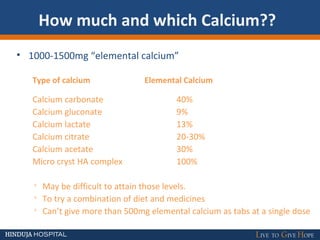
How much and which Calcium??
• 1000-1500mg “elemental calcium”
Type of calcium Elemental Calcium
Calcium carbonate 40%
Calcium gluconate 9%
Calcium lactate 13%
Calcium citrate 20-30%
Calcium acetate 30%
Micro cryst HA complex 100%
◦ May be difficult to attain those levels.
◦ To try a combination of diet and medicines
◦ Can’t give more than 500mg elemental calcium as tabs at a single dose
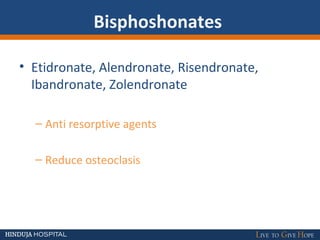
Bisphoshonates
• Etidronate, Alendronate, Risendronate,
Ibandronate, Zolendronate
– Anti resorptive agents
– Reduce osteoclasis
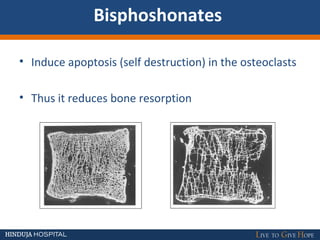
Bisphoshonates
• Induce apoptosis (self destruction) in the osteoclasts
• Thus it reduces bone resorption
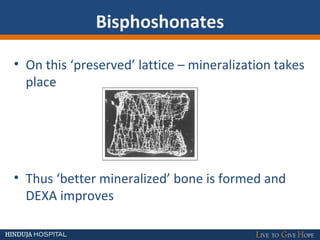
Bisphoshonates
• On this ‘preserved’ lattice – mineralization takes
place
• Thus ‘better mineralized’ bone is formed and
DEXA improves
Teriparatide (PTH)
• In small / pulse doses, is a powerful stimulant for
bone formation
• The only drug that can induce osteogenesis
Teriparatide
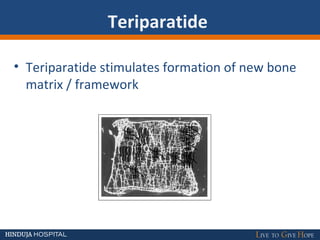
• Teriparatide stimulates formation of new bone
matrix / framework
Teriparatide
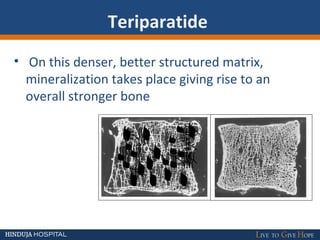
• On this denser, better structured matrix,
mineralization takes place giving rise to an
overall stronger bone
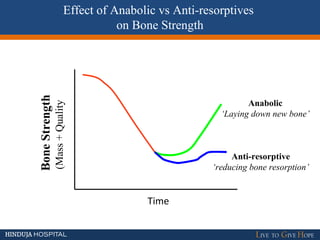
BoneStrength
(Mass+Quality)
Time
Effect of Anabolic vs Anti-resorptives
on Bone Strength
Anabolic
‘Laying down new bone’
Anti-resorptive
‘reducing bone resorption’
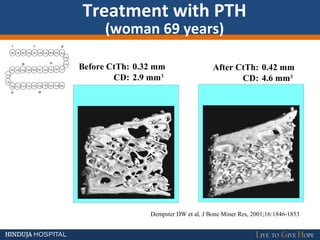
Treatment with PTH
(woman 69 years)
Dempster DW et al, J Bone Miner Res, 2001;16:1846-1853
Before CtTh: 0.32 mm
CD: 2.9 mm3
After CtTh: 0.42 mm
CD: 4.6 mm3
1 5 10
1520
25 30
Ser Val Ser Glu Ile Gln Leu Met His Asn
Leu
Gly
LysHisLeuAsnSerMetGluArgValGlu
Trp
Leu
Arg Lys Lys Leu Gln Asp Val His Asn Phe
Take home points…
• No longer a problem of the WEST
• Awareness essential amongst general public
• Prevention is the best treatment
• Moms and grandmoms vulnerable group
OPD Schedule: Tue- 1500 to 1600 hours, Thu- 0900 to 1100
hours, Sat- 1100 to 1300 hours
Appointment Helpline: 022-39818181/67668181/24451515
For any Queries, please write us on: info@hindujahospital.com
Thank You

Webinar on Osteoporosis by Hinduja Hospital

  • 1.
    Osteoporosis Dr. Uday Pawar JuniorSpine Consultant DNB Orthopaedic Hinduja Hospital, Mahim, Mumbai http://www.hindujahospital.com/dr-uday-pawar/
  • 2.
    With age comeswisdom……….. and Osteoporosis
  • 3.
    What is osteoporosis? Normal Osteoprosis
  • 4.
    Jargon buster……… • Softeningof bones ……. • A reduction in the quantity and quality of bones
  • 5.
    What is osteoporosis •A condition rather than a disease • Silent until complications arise • Spine, hip & wrist fractures
  • 6.
    WHO criteria fordiagnosis of Osteoporosis Kanis et al. J Bone Miner Res 1994; 9:1137-41 T-score Normal - 1.0 and above Osteopaenia - 1.0 to - 2.5 Osteoporosis - 2.5 and below Severe (established) osteoporosis - 2.5 and below, plus one or more osteoporotic fracture(s)
  • 8.
  • 9.
    1. Osteoporosis ≠Calcium deficiency • So, calcium is NOT the treatment of osteoporosis • Bone mineral v/s bone mass
  • 10.
    2. Osteoporosis isa generalized disease • affects all the bones
  • 11.
    3. Treating osteoporosis •Prevention is the only treatment of osteoporosis • Hence early diagnosis is the most important step in treating osteoporosis !
  • 12.
    Size of theProblem in India • 26 million (2003) 36 million by 2013 • 1 out of 8 males and 1 out of 3 females suffers from osteoporosis • The high incidence among men and the lower age of peak incidence compared to Western countries • Peak incidence of osteoporosis – Western countries-70-80 years of age – India –50-60 years International Osteoporosis Foundation
  • 13.
    The Magnitude OfThe Problem In women > 50 years, the lifetime risk of: • Vertebral fracture is 1/3 • Hip fracture is 1/5 NICE guidance 160 October 2008
  • 14.
    Osteoporotic Fractures inWomen: Comparison with Other Diseases 1 500 000* 0 500 1000 1500 2000 Osteoporotic Fractures * annual incidence all ages † annual estimate women 29+ ‡ annual estimate women 30+ § 1996 new cases, all ages 513 000† 228 000‡ 184 300§ 750 000 vertebral 250 000 other sites 250 000 forearm 250 000 hip Heart Attack Stroke Breast Cancer Annualincidencex1000 Riggs BL, Melton LJ. Bone 1995 Heart and Stroke Facts, 1996, American Heart Association Cancer Facts & Figures, 1996, American Cancer Society
  • 15.
    Osteoporosis affects entireskeleton • Osteoporosis is responsible for >1.5 million vertebral and non-vertebral fractures per year • Spine, hip, and wrist fractures are most common
  • 16.
  • 17.
    Osteoporosis: Classification • PrimaryOsteoporosis Type 1- Post menopausal osteoporosis Type 2- Senile/Age related osteoporosis • Secondary Osteoporosis Secondary to various causes 17
  • 18.
  • 19.
    How is osteoporosisdiagnosed Diagnosis is made on the basis of- • Detailed medical history • Examination • Blood and other tests
  • 20.
    Early diagnosis ofOsteoporosis • Clinical parameters – ‘at risk’ subject – Bone pains – Generalized tiredness – Progressive kyphosis • Investigations – Radiographs – DEXA – QCT, MRI, Bone scan – Blood markers
  • 21.
    Clinical Risk Fractures(CRF) Predictors of low bone mass- • Female • Advanced age • Low bone mineral density • Gonadal hormone deficiency ( estrogen or testosterone ) • White race • Low body weight & BMI • Family history of osteoporosis • Low calcium intake • Smoking / excessive alcohol intake • Low level of physical activity • Chronic glucocorticoid use • Prior fragility fracture National Osteoporosis Foundation (NOF)
  • 22.
    Clinical Presentation • Severebackache after minor injury • Pain worse on sneezing, coughing , standing erect, changing positions. • Limited to wheelchair • Stooped Posture • Weakness in legs
  • 23.
    X-rays • Osteopenia • Lossof height of vertebral body • Wedging
  • 24.
    Osteoporosis – RadiographicOsteoporosis– Radiographic Differential DiagnosisDifferential Diagnosis • Osteomalacia • Hyperparathyroidism • Hypercortisolism • Hyperthyroidism • Renal insufficiency • Chronic immobilization
  • 25.
    • Osteogenesis imperfecta •Hepatic insufficiency • Diabetes mellitus • Multiple myeloma • Metastatic disease • Drug induced Osteoporosis other causesOsteoporosis other causes
  • 26.
    Assessment of bonemineral density by DXA Current gold standard for diagnosis of osteoporosis BMD (g/cm2 ) = Bone mineral content (g) / area (cm2 ) Diagnosis based on comparing patient’s BMD to that of young, healthy individuals of same sex
  • 29.
    • Blood count, CRP • Calcium, Phosphate, Alkaline Phosphatase (AP) • Kidney function studies • Basal Thyroid and parathyroid. • Protein-immunoelectrophoresis. • Vit D (25 and 1.25) Laboratory tests* NOTES: - * These are in addition to routine labs tests. - These are screening labs, more may be indicated based on these results
  • 30.
  • 31.
    Modifiable Risk Factors VitD Calcium Exercise Quit Alcohol Quit Smoking
  • 32.
    Non-modifiable Risk Factors •Older age • Female gender • Ethnic background • Small bone structure • Family history of osteoporosis or osteoporosis-related fracture in a parent or siblings • Previous fracture • Menopause/hysterectomy • Some medicines like steroids, anti-epileptics • Rheumatoid arthritis • Reduced levels of Gonadal hormones in men
  • 33.
    Treatments of osteoporosis •Calcium and vitamin D • HRT • SERMs (raloxifene) • Calcitonin • Bisphosphonates – ibandronateibandronate – etidronateetidronate – alendronatealendronate – risedronaterisedronate • PTH (1–34) • Fluoride • Strontium ranelate • Combination Hormonal agentsHormonal agents Anti-resorptiveAnti-resorptive agentsagents Anabolic agentsAnabolic agents Dual mechanism ofDual mechanism of actionaction SERMs = selective oestrogen receptor modulatorsSERMs = selective oestrogen receptor modulators PTH = parathyroid hormonePTH = parathyroid hormone
  • 34.
    How much andwhich Calcium?? • 1000-1500mg “elemental calcium” Type of calcium Elemental Calcium Calcium carbonate 40% Calcium gluconate 9% Calcium lactate 13% Calcium citrate 20-30% Calcium acetate 30% Micro cryst HA complex 100% ◦ May be difficult to attain those levels. ◦ To try a combination of diet and medicines ◦ Can’t give more than 500mg elemental calcium as tabs at a single dose
  • 35.
    Bisphoshonates • Etidronate, Alendronate,Risendronate, Ibandronate, Zolendronate – Anti resorptive agents – Reduce osteoclasis
  • 36.
    Bisphoshonates • Induce apoptosis(self destruction) in the osteoclasts • Thus it reduces bone resorption
  • 37.
    Bisphoshonates • On this‘preserved’ lattice – mineralization takes place • Thus ‘better mineralized’ bone is formed and DEXA improves
  • 38.
    Teriparatide (PTH) • Insmall / pulse doses, is a powerful stimulant for bone formation • The only drug that can induce osteogenesis
  • 39.
    Teriparatide • Teriparatide stimulatesformation of new bone matrix / framework
  • 40.
    Teriparatide • On thisdenser, better structured matrix, mineralization takes place giving rise to an overall stronger bone
  • 41.
    BoneStrength (Mass+Quality) Time Effect of Anabolicvs Anti-resorptives on Bone Strength Anabolic ‘Laying down new bone’ Anti-resorptive ‘reducing bone resorption’
  • 42.
    Treatment with PTH (woman69 years) Dempster DW et al, J Bone Miner Res, 2001;16:1846-1853 Before CtTh: 0.32 mm CD: 2.9 mm3 After CtTh: 0.42 mm CD: 4.6 mm3 1 5 10 1520 25 30 Ser Val Ser Glu Ile Gln Leu Met His Asn Leu Gly LysHisLeuAsnSerMetGluArgValGlu Trp Leu Arg Lys Lys Leu Gln Asp Val His Asn Phe
  • 43.
    Take home points… •No longer a problem of the WEST • Awareness essential amongst general public • Prevention is the best treatment • Moms and grandmoms vulnerable group
  • 44.
    OPD Schedule: Tue-1500 to 1600 hours, Thu- 0900 to 1100 hours, Sat- 1100 to 1300 hours Appointment Helpline: 022-39818181/67668181/24451515 For any Queries, please write us on: info@hindujahospital.com Thank You

Editor's Notes

  • #31 Treatment and prevention (7) One of the most important preventive strategies is to encourage the achievement of optimal peak bone mass in the young, since this has a major impact on bone mass and the risk of osteoporosis after the menopause. Although peak bone mass is largely determined by genetics and diet (calcium and vitamin D intake), it can also be influenced by physical activity, smoking and alcohol consumption. It is, therefore, important to encourage both children and adolescents to adopt a healthy lifestyle.
  • #34 Treatment and prevention (8) For those patients at particularly high risk of osteoporosis, or who have developed osteoporosis, there are a number of pharmacological interventions available for the prevention and management of osteoporosis. The aim of these interventions should be to reduce the frequency of fractures, which are responsible for the high levels of morbidity associated with the disease.