Osteoporosis
Definition
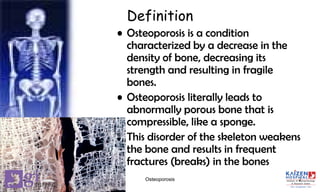
• Osteoporosis is a condition
characterized by a decrease in the
density of bone, decreasing its
strength and resulting in fragile
bones.
• Osteoporosis literally leads to
abnormally porous bone that is
compressible, like a sponge.
• This disorder of the skeleton weakens
the bone and results in frequent
fractures (breaks) in the bones
2Osteoporosis
Definition
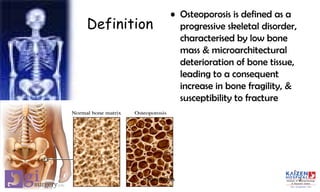
• Osteoporosis is defined as a
progressive skeletal disorder,
characterised by low bone
mass & microarchitectural
deterioration of bone tissue,
leading to a consequent
increase in bone fragility, &
susceptibility to fracture
3Osteoporosis
Definition
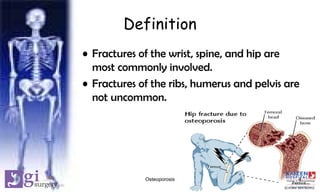
• Fractures of the wrist, spine, and hip are
most commonly involved.
• Fractures of the ribs, humerus and pelvis are
not uncommon.
4Osteoporosis
Definition
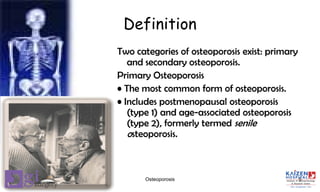
Two categories of osteoporosis exist: primary
and secondary osteoporosis.
Primary Osteoporosis
• The most common form of osteoporosis.
• Includes postmenopausal osteoporosis
(type 1) and age-associated osteoporosis
(type 2), formerly termed senile
osteoporosis.
5Osteoporosis
Definition
Secondary Osteoporosis
• Loss of bone is caused by an identifiable agent or
disease process such as an inflammatory disorder,
bone marrow cellularity disorder, and corticosteroid
use.
• steroids decrease the amount of calcium absorbed
by the intestine
• steroids increase calcium excretion through the
kidneys
6Osteoporosis
Risk Factors
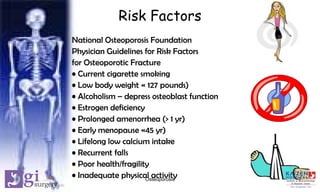
National Osteoporosis Foundation
Physician Guidelines for Risk Factors
for Osteoporotic Fracture
• Current cigarette smoking
• Low body weight « 127 pounds)
• Alcoholism – depress osteoblast function
• Estrogen deficiency
• Prolonged amenorrhea (> 1 yr)
• Early menopause «45 yr)
• Lifelong low calcium intake
• Recurrent falls
• Poor health/fragility
• Inadequate physical activity 7Osteoporosis
Risk Factors
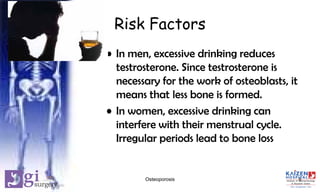
• In men, excessive drinking reduces
testrosterone. Since testrosterone is
necessary for the work of osteoblasts, it
means that less bone is formed.
• In women, excessive drinking can
interfere with their menstrual cycle.
Irregular periods lead to bone loss
8Osteoporosis
Risk Factors
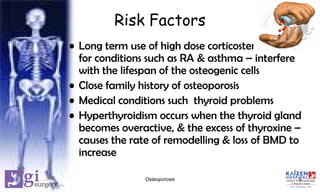
• Long term use of high dose corticosteroid tablets
for conditions such as RA & asthma – interfere
with the lifespan of the osteogenic cells
• Close family history of osteoporosis
• Medical conditions such thyroid problems
• Hyperthyroidism occurs when the thyroid gland
becomes overactive, & the excess of thyroxine –
causes the rate of remodelling & loss of BMD to
increase
9Osteoporosis
Risk Factors
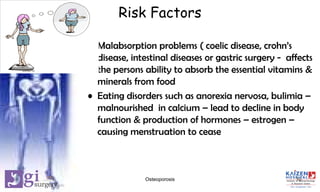
• Malabsorption problems ( coelic disease, crohn’s
disease, intestinal diseases or gastric surgery - affects
the persons ability to absorb the essential vitamins &
minerals from food
• Eating disorders such as anorexia nervosa, bulimia –
malnourished in calcium – lead to decline in body
function & production of hormones – estrogen –
causing menstruation to cease
10Osteoporosis
Symptoms & Clinical
Features
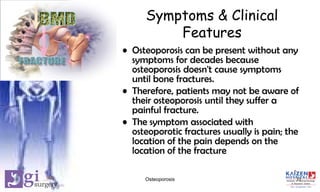
• Osteoporosis can be present without any
symptoms for decades because
osteoporosis doesn't cause symptoms
until bone fractures.
• Therefore, patients may not be aware of
their osteoporosis until they suffer a
painful fracture.
• The symptom associated with
osteoporotic fractures usually is pain; the
location of the pain depends on the
location of the fracture
11Osteoporosis
Symptoms & Clinical
Features
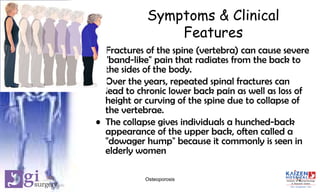
• Fractures of the spine (vertebra) can cause severe
"band-like" pain that radiates from the back to
the sides of the body.
• Over the years, repeated spinal fractures can
lead to chronic lower back pain as well as loss of
height or curving of the spine due to collapse of
the vertebrae.
• The collapse gives individuals a hunched-back
appearance of the upper back, often called a
"dowager hump" because it commonly is seen in
elderly women
12Osteoporosis
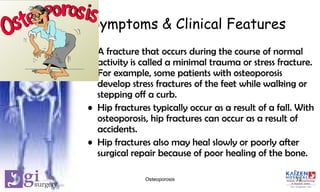
Symptoms & Clinical Features
• A fracture that occurs during the course of normal
activity is called a minimal trauma or stress fracture.
For example, some patients with osteoporosis
develop stress fractures of the feet while walking or
stepping off a curb.
• Hip fractures typically occur as a result of a fall. With
osteoporosis, hip fractures can occur as a result of
accidents.
• Hip fractures also may heal slowly or poorly after
surgical repair because of poor healing of the bone.
13Osteoporosis
Osteoporosis: The Diagnosis
X-Ray Tests
• If you have back pain, your doctor may order an
x ray of your spine to determine whether you
have had a fracture.
• An x ray also may be appropriate if you have
experienced a loss of height or a change in
posture.
• However, because an x ray can detect bone loss
only after 30 percent of the skeleton has been
depleted, the presence of osteoporosis may be
missed
14Osteoporosis
Osteoporosis: The
Diagnosis
BMD test is called a dual-energy x-ray
absorptiometry, or DXA test.
• BMD tests provide doctors with a
measurement called a T-score, a number
value that results from comparing your
bone density to optimal bone density.
• When a T-score appears as a negative
number (such as –1, –2 or –2.5), it indicates
low bone mass. The greater the negative
the number, the greater is the risk of
fracture.
15Osteoporosis
Osteoporosis: The
Diagnosis
Bone Scans
• For some people, the doctor may order a bone scan.
• A bone scan is different from the BMD test, although
the term "bone scan" often is used incorrectly to
describe a bone density test.
• A bone scan involves injecting the patient with a dye
that allows a scanner to identify differences in the
conditions of various areas of bone tissue. A bone
scan can show the doctor changes in bone tissue that
may indicate cancer, bone lesions, inflammation, or
new fractures
16Osteoporosis
Osteoporosis: The Diagnosis
The most common blood tests evaluate:
• blood calcium levels
• blood vitamin D levels
• thyroid function
• parathyroid hormone levels
• To measure estrogen (in women)
• testosterone levels (in men)
17Osteoporosis
Preventive Measures
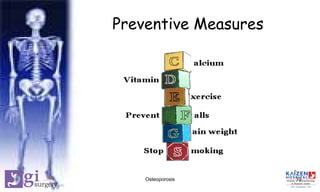
• Adequate weight-bearing physical activity for
3-4 hr a wk.
• Avoid low body weight or excessive thinness.
• Avoid excess alcohol intake.
• Lifelong appropriate calcium and vitamin D
intake.
18Osteoporosis
Preventive Measures
19Osteoporosis
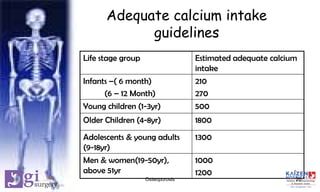
Adequate calcium intake
guidelines
Life stage group Estimated adequate calcium
intake
Infants –( 6 month)
(6 – 12 Month)
210
270
Young children (1-3yr) 500
Older Children (4-8yr) 1800
Adolescents & young adults
(9-18yr)
1300
Men & women(19-50yr),
above 51yr
1000
1200
20Osteoporosis
Prevention of falls in osteoporotic
patients
• Night lights in bathrooms and hallways.
• Nonskid soles for shoes.
• Nonslip mats under rug.
• Equip tub, shower, and toilet areas with grab bars.
• Rise cautiously from a supine position.
• Ensure stairway rails are sturdy.
• Keep a flashlight by the bedside.
21Osteoporosis
Exercise for osteoporosis
Three types of exercise for osteoporosis are:
• Weight-bearing
• Resistance
• Flexibility
22Osteoporosis
Exercise for osteoporosis
• Exercises designed to prevent or treat
osteoporosis by strengthening your muscles and
bones and improving your posture and
balance.
23Osteoporosis

Osteoporosis - Preventive Measures

  • 1.
  • 2.
    Definition • Osteoporosis isa condition characterized by a decrease in the density of bone, decreasing its strength and resulting in fragile bones. • Osteoporosis literally leads to abnormally porous bone that is compressible, like a sponge. • This disorder of the skeleton weakens the bone and results in frequent fractures (breaks) in the bones 2Osteoporosis
  • 3.
    Definition • Osteoporosis isdefined as a progressive skeletal disorder, characterised by low bone mass & microarchitectural deterioration of bone tissue, leading to a consequent increase in bone fragility, & susceptibility to fracture 3Osteoporosis
  • 4.
    Definition • Fractures ofthe wrist, spine, and hip are most commonly involved. • Fractures of the ribs, humerus and pelvis are not uncommon. 4Osteoporosis
  • 5.
    Definition Two categories ofosteoporosis exist: primary and secondary osteoporosis. Primary Osteoporosis • The most common form of osteoporosis. • Includes postmenopausal osteoporosis (type 1) and age-associated osteoporosis (type 2), formerly termed senile osteoporosis. 5Osteoporosis
  • 6.
    Definition Secondary Osteoporosis • Lossof bone is caused by an identifiable agent or disease process such as an inflammatory disorder, bone marrow cellularity disorder, and corticosteroid use. • steroids decrease the amount of calcium absorbed by the intestine • steroids increase calcium excretion through the kidneys 6Osteoporosis
  • 7.
    Risk Factors National OsteoporosisFoundation Physician Guidelines for Risk Factors for Osteoporotic Fracture • Current cigarette smoking • Low body weight « 127 pounds) • Alcoholism – depress osteoblast function • Estrogen deficiency • Prolonged amenorrhea (> 1 yr) • Early menopause «45 yr) • Lifelong low calcium intake • Recurrent falls • Poor health/fragility • Inadequate physical activity 7Osteoporosis
  • 8.
    Risk Factors • Inmen, excessive drinking reduces testrosterone. Since testrosterone is necessary for the work of osteoblasts, it means that less bone is formed. • In women, excessive drinking can interfere with their menstrual cycle. Irregular periods lead to bone loss 8Osteoporosis
  • 9.
    Risk Factors • Longterm use of high dose corticosteroid tablets for conditions such as RA & asthma – interfere with the lifespan of the osteogenic cells • Close family history of osteoporosis • Medical conditions such thyroid problems • Hyperthyroidism occurs when the thyroid gland becomes overactive, & the excess of thyroxine – causes the rate of remodelling & loss of BMD to increase 9Osteoporosis
  • 10.
    Risk Factors • Malabsorptionproblems ( coelic disease, crohn’s disease, intestinal diseases or gastric surgery - affects the persons ability to absorb the essential vitamins & minerals from food • Eating disorders such as anorexia nervosa, bulimia – malnourished in calcium – lead to decline in body function & production of hormones – estrogen – causing menstruation to cease 10Osteoporosis
  • 11.
    Symptoms & Clinical Features •Osteoporosis can be present without any symptoms for decades because osteoporosis doesn't cause symptoms until bone fractures. • Therefore, patients may not be aware of their osteoporosis until they suffer a painful fracture. • The symptom associated with osteoporotic fractures usually is pain; the location of the pain depends on the location of the fracture 11Osteoporosis
  • 12.
    Symptoms & Clinical Features •Fractures of the spine (vertebra) can cause severe "band-like" pain that radiates from the back to the sides of the body. • Over the years, repeated spinal fractures can lead to chronic lower back pain as well as loss of height or curving of the spine due to collapse of the vertebrae. • The collapse gives individuals a hunched-back appearance of the upper back, often called a "dowager hump" because it commonly is seen in elderly women 12Osteoporosis
  • 13.
    Symptoms & ClinicalFeatures • A fracture that occurs during the course of normal activity is called a minimal trauma or stress fracture. For example, some patients with osteoporosis develop stress fractures of the feet while walking or stepping off a curb. • Hip fractures typically occur as a result of a fall. With osteoporosis, hip fractures can occur as a result of accidents. • Hip fractures also may heal slowly or poorly after surgical repair because of poor healing of the bone. 13Osteoporosis
  • 14.
    Osteoporosis: The Diagnosis X-RayTests • If you have back pain, your doctor may order an x ray of your spine to determine whether you have had a fracture. • An x ray also may be appropriate if you have experienced a loss of height or a change in posture. • However, because an x ray can detect bone loss only after 30 percent of the skeleton has been depleted, the presence of osteoporosis may be missed 14Osteoporosis
  • 15.
    Osteoporosis: The Diagnosis BMD testis called a dual-energy x-ray absorptiometry, or DXA test. • BMD tests provide doctors with a measurement called a T-score, a number value that results from comparing your bone density to optimal bone density. • When a T-score appears as a negative number (such as –1, –2 or –2.5), it indicates low bone mass. The greater the negative the number, the greater is the risk of fracture. 15Osteoporosis
  • 16.
    Osteoporosis: The Diagnosis Bone Scans •For some people, the doctor may order a bone scan. • A bone scan is different from the BMD test, although the term "bone scan" often is used incorrectly to describe a bone density test. • A bone scan involves injecting the patient with a dye that allows a scanner to identify differences in the conditions of various areas of bone tissue. A bone scan can show the doctor changes in bone tissue that may indicate cancer, bone lesions, inflammation, or new fractures 16Osteoporosis
  • 17.
    Osteoporosis: The Diagnosis Themost common blood tests evaluate: • blood calcium levels • blood vitamin D levels • thyroid function • parathyroid hormone levels • To measure estrogen (in women) • testosterone levels (in men) 17Osteoporosis
  • 18.
    Preventive Measures • Adequateweight-bearing physical activity for 3-4 hr a wk. • Avoid low body weight or excessive thinness. • Avoid excess alcohol intake. • Lifelong appropriate calcium and vitamin D intake. 18Osteoporosis
  • 19.
  • 20.
    Adequate calcium intake guidelines Lifestage group Estimated adequate calcium intake Infants –( 6 month) (6 – 12 Month) 210 270 Young children (1-3yr) 500 Older Children (4-8yr) 1800 Adolescents & young adults (9-18yr) 1300 Men & women(19-50yr), above 51yr 1000 1200 20Osteoporosis
  • 21.
    Prevention of fallsin osteoporotic patients • Night lights in bathrooms and hallways. • Nonskid soles for shoes. • Nonslip mats under rug. • Equip tub, shower, and toilet areas with grab bars. • Rise cautiously from a supine position. • Ensure stairway rails are sturdy. • Keep a flashlight by the bedside. 21Osteoporosis
  • 22.
    Exercise for osteoporosis Threetypes of exercise for osteoporosis are: • Weight-bearing • Resistance • Flexibility 22Osteoporosis
  • 23.
    Exercise for osteoporosis •Exercises designed to prevent or treat osteoporosis by strengthening your muscles and bones and improving your posture and balance. 23Osteoporosis