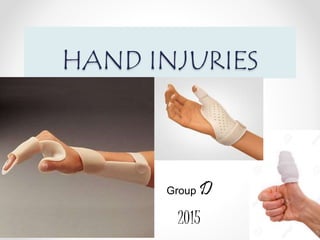
HAND INJURIES
Group D
2015
HAND INJURIES
• The hands as the human executing organs are in the
center of daily life activities’, thus are always exposed to
injuries and overuse .
• We are more aware of our hands than any part of the
body
• Are important out of all proportion to their apparent
severity ,because of the need for perfect functions .
• Local edema and stiffness of the joints –common
accompaniments of all injuries- are more threatening in
the hand than anywhere else .
HAND INJURIES
• Problems of hand arise for 3 reasons :
1- the defect may be unacceptable
2- function is impaired
3- deformed part becomes nuisance during
daily activities
HAND INJURIES
• Superficial injuries and severe fracture are obvious but
deeper injuries are often poorly disclosed ,so it is
important in the initial examination to assess the
• circulation
• soft tissue cover
• bones
• joints and tendon
• nerves
• X-rays should include at least 3 views PA ,Lateral and
oblique
HAND INJURIES
• Hand injuries the commonest of all injuries .
• in avarage the hand injuries account for 14-30% of all pt
in ED .
• Fractures 46% , tendon injuries 29% and skin lesions .
HAND INJURIES
general principle of treatment
• ABC
• Most hand injuries can be dealt with under local or
regional anaesthesia .
• Definitive treatment is dictated by the nature of the injury
, but common to all injuries are
• safe splintage
• prevention of swelling
• dedicated rehabilitation
HAND INJURIES
general principle of treatment
• Safe splintage
_ incorrect splintage is a potent cause of stiffness
so must be appropriate and kept to a minimum
-if the whole hand is splinted or bandage this must be in
‘’the position of safe immobilization’’
Anatomy of the hand
• Bones
• Areas
• Zones
• Arches
• Ligaments
• Muscles
• Innervation
⥤is a prehensile, multi-fingered extremity located at the
end of an arm or forelimb .
⥤...& are the richest source of tactile feedback, and have
the greatest positioning capability of the body; thus the
sense of touch is intimately associated with hands.
PALMAR DORSAL
ZONES
Extensor Zones of
Hand
Flexor Zones:
Flexor Zones: The hand is divided into following 5 zones, which would determine the prognosis and approach to
treatment.
Zone 1:
Only FDP involved
Loss of flx of DIP joint
Instability in pinch
Loss of grip strength
Good prognosis
Zone 2:
“No man’s land”
Pulleys present (prevent bow stringing) A2 and A4
Vincula in area–provide vascular supply. Injury thus causes decreased tendon vascular nutrition.
Poor prognosis
Zone 3:
Good prognosis
Good vascularity and no pulleys
Zone 4:
Carpal tunnel
Usually more than 1 tendon involved
Intendinous adhesions (close proximity of tendons)
Relatively good prognosis
Zone 5:
Usually presents with nerve involvement (ulnar / median nerve)
Tendons superficial, thus adhesions to skin probable
The hand is divided into 8 zones when dealing with extensor tendon injuries.
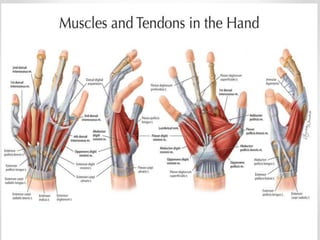
Muscles & tendons
* Extensor tendons of fingers :
-of the long extrinsic muscles .
-attaches to the middle phalanx in
central slip .
* system of flexor tendons of fingers :
-functional unit of tendons, tendon sheath and
pulleys .
- flexor digitorum profundus .
- flexor digitorum superficial .
- flexor pollicis longus of the thumb .
FLEXORSEXTENSORS
ligaments
• Tow important structures called collateral ligaments are
found in either sides of each finger joint .
• Volar plate is the strongest ligament .
Blood Supply
1. Ulnar A.
 Forms the
superficial palmar
arch ?with
superficial palmar
br. of radial artery
 Gives 4 common
palmar digital art.
2. Radial A.
 Forms the Deep
palmar arch with
deep br. of ulnar ar. 1
cm proximal to
Superficial arch
Nerve supply
Nerve supply
Median
Nerve
Ulnar
Nerve
Radial
Nerve
Bone & joints
injuries
Metacarpal Fractures
 The metacarpal bones are vulnerable to blows and falls
upon the hands or the force of the boxer’s punch .
 Injuries are common
 Agulatory deformity is usually not very marked
,rotational deformity is serious .
2)Metacarpal Fractures
 Head
 Intraarticular
 Neck
 Usually unstable
 Forwards tilting of distal
fragement
 Shaft
 Direct blow
 Transverse or oblique #
 Base
 Associated carpal bone injury
 Impacted #
 1st metacarpal
 Usually occurs at base
Presentation
 Pain/Tenderness
 Swelling
 Discoloration
 Sensation
 Circulation
 ROM
 Plain Films
 Deformity of hand
Localized tenderness
Swelling of hand
Discoloration
Decreased movement
Numbness
Unequal temperatures
What next?
 Midshaft vs. Base vs.
Neck
 Complete vs.
Incomplete vs.
Comminuted
 Dorsal vs. Volar
Angulation
 Transverse vs. Oblique
vs. Spiral
 Unstable vs. Stable
Management of metacarpal #
 A- undispalced # :
require only a firm crepe-bandage for comfort
2-3 wks
Management of metacarpal #
 B- dispalced # :
1-of the shaft
- reducion by traction and pressure hand then
held by plaster slap for 3 wks .
-ORIF with small plates and screws
or by percutaneous K-ware
is the best because these
unstable #
Management of metacarpal #
 B- dispalced # :
2- of the neck (boxer’s fracture )
* usually of the 5th finger
* angulation of upto 40 degrees can be accepted as
long as there is no rotational deformity .
* reduction traction and pressure then held by
plaster slap 1-2wks
* fixation with percutaneous
intramedullary wires
usually preferred
Metacarpal Neck Fractures
(Boxer’s Fracture)
 Common
 Direct impact with closed fist
 Dorsal angulation
 Unstable
 Treatment
 Reduction (90-90 method)
 Splint
 Follow-up within 1 week
 Complications
 Malunion with volar angulation
 Pain
 Rotational deformity
 Stiffness
Metacarpal Base Fractures
 Stable
 Infrequent
 Associated injury
 Ulnar nerve
 Carpal bone injury
 Treatment
 Volar splint
 Complications
 Tendon damage
 Stiffness
Thumb Metacarpal Fractures
 Uncommon
 Most involve the base
 Extraarticular
 Direct trauma or impaction
 20-30 degrees of angulation is
tolerated
 Intraarticular
 Bennett’s Fracture
 Rolando’s Fracture
 Treatment
 Thumb spica
 Complications
 Malunion and arthritis
Bennett’s Fracture:
 At base of first metacarpal
bone
 Oblique intra-articular #
 Unstable
 Due to punching .
 X-ray show that a small
triangular fragment has
remained in contact with
the medial edge of the
trapezium , while the
remainder of the thumb has
proximally pulled upon by
the abductor pollicis longus
tendon .
Bennett’s Fracture:
 Perfect reduction is essential by pulling on the thumb
,abducting it and extending it .and then held by
plaster or internal fixation
 Surgical fixation is achieved by passing a k-ware across
the metacarpal base into the carpus
a)Bennett’s Fracture:
 Intraarticular fracture
 Dislocation/Subluxation
 CMC joint
 Fragment pulled
dorsally
 Abductor pollicis longus
 Adductor pollicis
 Ligament disruption
 Treatment
 Thumb spica
 Early referral
b)Rolando’s Fracture
 Comminuted
intraarticular
fracture
 Less common than
Bennett’s Fracture
 Worse prognosis
 Treatment
 Thumb spica
 Early referral
 Complications
 Malunion and pain
fractures of phalanges
 Phalangeal # usually result from direct trauma and
therefore any part may be affected .
 Management :
 A) undisplaced # :
 functional splintage (buddy splintage )
for 2-3 wks .
- movement are encouraged from the outset .
fractures of phalanges
 B) – displaced fractures
1- of the proximal or the middle phalanx :
* the bone # reduced and immobilized under
local anaesthesia , carefully avoiding
malrotation , then splintaed leaving the other
fingers free 3 wks .
fractures of phalanges
 B) – displaced fractures
1- of the distal phalanx :
distal phalangeal # are usually due to crushing
injuries or a blow from a hammer .
- the soft tissue damage must be treated .
-The majority of fractures can be treated
conservatively, and it is normally the initial repair
of the surrounding soft tissues that is most
important .
3) Phalanx Fractures
 15-30% of hand fxs
 Tuft
 Nail bed injury
 Shaft
 Intraarticular
 Tendon injury
 Complications
 Pain, hyperesthesia, cold
sensitivity, osteomyelitis
1)Distal Phalanx Fractures
Mechanism:
No Problem Refer!
 Treatment: padded or “C”
splint; extend past the tip
 Refer: transverse, angulated
 Healing Time: 3-4 weeks
 Return to Work/Sport: okay
with splint as tolerated
 exception: transverse fx –
needs longer protection
from potential re-injury
activity
•Mechanism: direct blow or
twisting
•Sxs & Exam: local swelling;
examine for deformity or
malrotation; check PIP and DIP
fxn
2)Middle Phalanx Fractures
•Transverse Fx or short oblique: Low risk
•Nondisplaced fx’s do well with buddy taping
•Healing Time: 4-6 weeks (buddy tape for 3-4 wk)
•Return to Work/Sport: okay as long as you have some
protection via splint or buddy tape
•Refer: displaced, long oblique, spiral or intra-
articular fx
•Mechanism:
direct blow: transverse; often unstable
due to tendon insertions
twisting: oblique or spiral; may be more
stable
Sxs & Exam: local
swelling; examine
for deformity or
malrotation
3)Proximal Phalanx Fractures
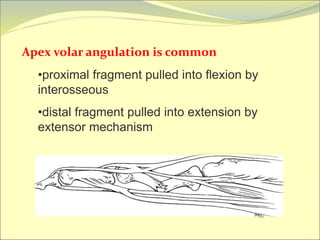
Apex volar angulation is common
•proximal fragment pulled into flexion by
interosseous
•distal fragment pulled into extension by
extensor mechanism
•Nondisplaced fx’s do well with buddy taping; use
gutter splint for additional stability
•Healing Time: 4-6 weeks (buddy tape for 3-4
wk)
•Return to Work/Sport: okay as long as you have
some protection via splint or buddy tape
•Refer: angulated, displaced, intra-articular fx
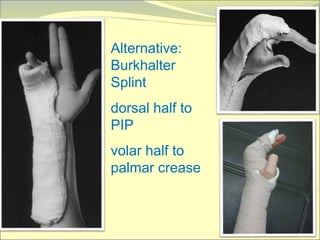
Proximal Phalanx Fx: Treatment
Alternative:
Burkhalter
Splint
dorsal half to
PIP
volar half to
palmar crease
Joints
CMC joint dislocation:
 Mechanism :forceful dorsiflexion of the wrist
combined with longitudinal impact ,
 Seen typically in boxers and in motorcyclists .
 Dx : X-rays
 After regional anaesthesia , the dislocation is reduced
by traction , manipulation, and pressure on the
metacarpal base , then protective slap is worn for 6
wks .
CMC joint dislocation
Carpometacarpal
(CMC) dislocation
(a) Thumb
dislocation.
(b) Dislocation of the
fourth and
fifth CMC joints
treated by closed
reduction and
Kirschner wires (c).
Complete CMC
dislocation (d).
 Thumb CMC dislocation :
 Isolated dislocation is rare
compared to the more common
Bennett fracture dislocation.
 Easy to reduce but unstable after
reduction.
 Apply thumb spica splint after
reduction.
 Need surgical referral.
Dislocation of MCP joint
Metacarpophalangeal Joint
 Relatively rare injury
 Dorsal displacement
 Hyperextension forces
 Dorsal displacement
 Volar plate can enter joint
space
 Volar dislocations
 Usually surgical
 Treatment
 Reduce
 Splint in flexion
Dislocation of MCP joint
 The thumb is most frequently affected and clinically
the injury resembles a BENNETT’ fracture –dislocation
 Dx : by Xrays
 The displaced is easily reduced by traction &
hyperpronation , but reduction is unstable and can be
held by a K-wire for 5 wks and then protective splint
for 8 wks because risk of instability .
MCP of the Thumb
 Strong but vulnerable
 5 times more likely to be injured
 Difficult reduction
 Volar plate entrapment
 Ulnar collateral ligament
injury
 Gamekeeper’s or Skier’s thumb
 Radial collateral ligament
injury
 Less common
 Forced adduction with or
without hyperextension
Skier’s Thumb
 Scottish gamekeeper’s
 Repeated twisting
 Forced radial deviation
 Associated avulsion fracture
 Valgus stress testing
 Extension and flexion
 Complete ligament tears
 >35 degrees of laxity
 Treatment
 Thumb spica
Dislocation Interphalangeal
Joint
1)Proximal Interphalangeal Joint
 Dislocation pattern
 Dorsal
 Most common ligamentous hand injury
 Lateral
 Volar
 Associated fracture
 > 33% of articular surface = unstable
 Violent twist with finger
flexed (palmer) or extended
(dorsal)
 SHARP, deformity, disability
 RICE, splint, meds,
reduction/surgery, protect
• Nondisplaced Fx: Initially use extension block
splint for first 2-3 weeks followed by buddy
taping in sight flexion. Work on restoring ROM.
• Healing Time: 6-12 weeks; monitor progress
every 2-3 weeks
2)Distal Interphalangeal Joint
 Most are dorsal
 Often open
 Reduction
 Traction
 Hyperextension
 Dorsal pressure
 Irreducible
 Avulsion fracture
 Buttonhole tear
 Open dislocation
 Irrigation
 Antibiotics
Tendons
Injuries
Tendon injuries
• Are the second most common injuries of the hand
• After clinical examination , ultrasound and MRI imaging
have provide to be important diagnostic tools .
• Treated by conservative or surgical
• For later case where the joint is still passively correctable
, treated by is to divide the extensor tendon in just
proximal to its insertion into the distal phalanx .
• long standing fixed deformity may be better left alone .
Carpal Tunnel Syndrome
pressure in carpal tunnel (swelling, inflammation) via
trauma, rep flexion
Pressure on median n
Sensory (lat palm), motor (wrist, finger flex) deficits
A. Mechanism: overuse, congenital, trauma
B. Pathology: Compression of the median nerve in the
tunnel
, surgical decompression
Signs and Symptoms:
Pain in wrist
Numbness and tingling in the thumb and first two fingers
Positive Phalen’s test
Positive tap test
Treatment
Conservative: Immobilization and Rest ice
.NSAIDS, corticosteroid injection
Radical: Surgery to increase space in the tunnel
‫الجميع‬ ‫هللا‬ ‫وفق‬
‫عبدالستار‬ ‫محمد‬GD

Hand injuries

  • 1.
  • 2.
    HAND INJURIES • Thehands as the human executing organs are in the center of daily life activities’, thus are always exposed to injuries and overuse . • We are more aware of our hands than any part of the body • Are important out of all proportion to their apparent severity ,because of the need for perfect functions . • Local edema and stiffness of the joints –common accompaniments of all injuries- are more threatening in the hand than anywhere else .
  • 3.
    HAND INJURIES • Problemsof hand arise for 3 reasons : 1- the defect may be unacceptable 2- function is impaired 3- deformed part becomes nuisance during daily activities
  • 4.
    HAND INJURIES • Superficialinjuries and severe fracture are obvious but deeper injuries are often poorly disclosed ,so it is important in the initial examination to assess the • circulation • soft tissue cover • bones • joints and tendon • nerves • X-rays should include at least 3 views PA ,Lateral and oblique
  • 5.
    HAND INJURIES • Handinjuries the commonest of all injuries . • in avarage the hand injuries account for 14-30% of all pt in ED . • Fractures 46% , tendon injuries 29% and skin lesions .
  • 6.
    HAND INJURIES general principleof treatment • ABC • Most hand injuries can be dealt with under local or regional anaesthesia . • Definitive treatment is dictated by the nature of the injury , but common to all injuries are • safe splintage • prevention of swelling • dedicated rehabilitation
  • 7.
    HAND INJURIES general principleof treatment • Safe splintage _ incorrect splintage is a potent cause of stiffness so must be appropriate and kept to a minimum -if the whole hand is splinted or bandage this must be in ‘’the position of safe immobilization’’
  • 8.
    Anatomy of thehand • Bones • Areas • Zones • Arches • Ligaments • Muscles • Innervation ⥤is a prehensile, multi-fingered extremity located at the end of an arm or forelimb . ⥤...& are the richest source of tactile feedback, and have the greatest positioning capability of the body; thus the sense of touch is intimately associated with hands. PALMAR DORSAL
  • 10.
  • 11.
    Flexor Zones: Flexor Zones:The hand is divided into following 5 zones, which would determine the prognosis and approach to treatment. Zone 1: Only FDP involved Loss of flx of DIP joint Instability in pinch Loss of grip strength Good prognosis Zone 2: “No man’s land” Pulleys present (prevent bow stringing) A2 and A4 Vincula in area–provide vascular supply. Injury thus causes decreased tendon vascular nutrition. Poor prognosis Zone 3: Good prognosis Good vascularity and no pulleys Zone 4: Carpal tunnel Usually more than 1 tendon involved Intendinous adhesions (close proximity of tendons) Relatively good prognosis Zone 5: Usually presents with nerve involvement (ulnar / median nerve) Tendons superficial, thus adhesions to skin probable The hand is divided into 8 zones when dealing with extensor tendon injuries.
  • 14.
    Muscles & tendons *Extensor tendons of fingers : -of the long extrinsic muscles . -attaches to the middle phalanx in central slip . * system of flexor tendons of fingers : -functional unit of tendons, tendon sheath and pulleys . - flexor digitorum profundus . - flexor digitorum superficial . - flexor pollicis longus of the thumb .
  • 15.
  • 20.
    ligaments • Tow importantstructures called collateral ligaments are found in either sides of each finger joint . • Volar plate is the strongest ligament .
  • 21.
    Blood Supply 1. UlnarA.  Forms the superficial palmar arch ?with superficial palmar br. of radial artery  Gives 4 common palmar digital art. 2. Radial A.  Forms the Deep palmar arch with deep br. of ulnar ar. 1 cm proximal to Superficial arch
  • 23.
  • 24.
  • 25.
  • 26.
  • 27.
    Metacarpal Fractures  Themetacarpal bones are vulnerable to blows and falls upon the hands or the force of the boxer’s punch .  Injuries are common  Agulatory deformity is usually not very marked ,rotational deformity is serious .
  • 28.
    2)Metacarpal Fractures  Head Intraarticular  Neck  Usually unstable  Forwards tilting of distal fragement  Shaft  Direct blow  Transverse or oblique #  Base  Associated carpal bone injury  Impacted #  1st metacarpal  Usually occurs at base
  • 29.
    Presentation  Pain/Tenderness  Swelling Discoloration  Sensation  Circulation  ROM  Plain Films  Deformity of hand Localized tenderness Swelling of hand Discoloration Decreased movement Numbness Unequal temperatures What next?
  • 30.
     Midshaft vs.Base vs. Neck  Complete vs. Incomplete vs. Comminuted  Dorsal vs. Volar Angulation  Transverse vs. Oblique vs. Spiral  Unstable vs. Stable
  • 31.
    Management of metacarpal#  A- undispalced # : require only a firm crepe-bandage for comfort 2-3 wks
  • 32.
    Management of metacarpal#  B- dispalced # : 1-of the shaft - reducion by traction and pressure hand then held by plaster slap for 3 wks . -ORIF with small plates and screws or by percutaneous K-ware is the best because these unstable #
  • 33.
    Management of metacarpal#  B- dispalced # : 2- of the neck (boxer’s fracture ) * usually of the 5th finger * angulation of upto 40 degrees can be accepted as long as there is no rotational deformity . * reduction traction and pressure then held by plaster slap 1-2wks * fixation with percutaneous intramedullary wires usually preferred
  • 34.
    Metacarpal Neck Fractures (Boxer’sFracture)  Common  Direct impact with closed fist  Dorsal angulation  Unstable  Treatment  Reduction (90-90 method)  Splint  Follow-up within 1 week  Complications  Malunion with volar angulation  Pain  Rotational deformity  Stiffness
  • 35.
    Metacarpal Base Fractures Stable  Infrequent  Associated injury  Ulnar nerve  Carpal bone injury  Treatment  Volar splint  Complications  Tendon damage  Stiffness
  • 36.
    Thumb Metacarpal Fractures Uncommon  Most involve the base  Extraarticular  Direct trauma or impaction  20-30 degrees of angulation is tolerated  Intraarticular  Bennett’s Fracture  Rolando’s Fracture  Treatment  Thumb spica  Complications  Malunion and arthritis
  • 37.
    Bennett’s Fracture:  Atbase of first metacarpal bone  Oblique intra-articular #  Unstable  Due to punching .  X-ray show that a small triangular fragment has remained in contact with the medial edge of the trapezium , while the remainder of the thumb has proximally pulled upon by the abductor pollicis longus tendon .
  • 38.
    Bennett’s Fracture:  Perfectreduction is essential by pulling on the thumb ,abducting it and extending it .and then held by plaster or internal fixation  Surgical fixation is achieved by passing a k-ware across the metacarpal base into the carpus
  • 39.
    a)Bennett’s Fracture:  Intraarticularfracture  Dislocation/Subluxation  CMC joint  Fragment pulled dorsally  Abductor pollicis longus  Adductor pollicis  Ligament disruption  Treatment  Thumb spica  Early referral
  • 40.
    b)Rolando’s Fracture  Comminuted intraarticular fracture Less common than Bennett’s Fracture  Worse prognosis  Treatment  Thumb spica  Early referral  Complications  Malunion and pain
  • 41.
    fractures of phalanges Phalangeal # usually result from direct trauma and therefore any part may be affected .  Management :  A) undisplaced # :  functional splintage (buddy splintage ) for 2-3 wks . - movement are encouraged from the outset .
  • 42.
    fractures of phalanges B) – displaced fractures 1- of the proximal or the middle phalanx : * the bone # reduced and immobilized under local anaesthesia , carefully avoiding malrotation , then splintaed leaving the other fingers free 3 wks .
  • 43.
    fractures of phalanges B) – displaced fractures 1- of the distal phalanx : distal phalangeal # are usually due to crushing injuries or a blow from a hammer . - the soft tissue damage must be treated . -The majority of fractures can be treated conservatively, and it is normally the initial repair of the surrounding soft tissues that is most important .
  • 44.
    3) Phalanx Fractures 15-30% of hand fxs  Tuft  Nail bed injury  Shaft  Intraarticular  Tendon injury  Complications  Pain, hyperesthesia, cold sensitivity, osteomyelitis 1)Distal Phalanx Fractures Mechanism:
  • 45.
    No Problem Refer! Treatment: padded or “C” splint; extend past the tip  Refer: transverse, angulated  Healing Time: 3-4 weeks  Return to Work/Sport: okay with splint as tolerated  exception: transverse fx – needs longer protection from potential re-injury activity
  • 46.
    •Mechanism: direct blowor twisting •Sxs & Exam: local swelling; examine for deformity or malrotation; check PIP and DIP fxn 2)Middle Phalanx Fractures •Transverse Fx or short oblique: Low risk
  • 47.
    •Nondisplaced fx’s dowell with buddy taping •Healing Time: 4-6 weeks (buddy tape for 3-4 wk) •Return to Work/Sport: okay as long as you have some protection via splint or buddy tape •Refer: displaced, long oblique, spiral or intra- articular fx
  • 48.
    •Mechanism: direct blow: transverse;often unstable due to tendon insertions twisting: oblique or spiral; may be more stable Sxs & Exam: local swelling; examine for deformity or malrotation 3)Proximal Phalanx Fractures
  • 49.
    Apex volar angulationis common •proximal fragment pulled into flexion by interosseous •distal fragment pulled into extension by extensor mechanism
  • 51.
    •Nondisplaced fx’s dowell with buddy taping; use gutter splint for additional stability •Healing Time: 4-6 weeks (buddy tape for 3-4 wk) •Return to Work/Sport: okay as long as you have some protection via splint or buddy tape •Refer: angulated, displaced, intra-articular fx Proximal Phalanx Fx: Treatment
  • 52.
  • 53.
  • 54.
    CMC joint dislocation: Mechanism :forceful dorsiflexion of the wrist combined with longitudinal impact ,  Seen typically in boxers and in motorcyclists .  Dx : X-rays  After regional anaesthesia , the dislocation is reduced by traction , manipulation, and pressure on the metacarpal base , then protective slap is worn for 6 wks .
  • 55.
    CMC joint dislocation Carpometacarpal (CMC)dislocation (a) Thumb dislocation. (b) Dislocation of the fourth and fifth CMC joints treated by closed reduction and Kirschner wires (c). Complete CMC dislocation (d).
  • 56.
     Thumb CMCdislocation :  Isolated dislocation is rare compared to the more common Bennett fracture dislocation.  Easy to reduce but unstable after reduction.  Apply thumb spica splint after reduction.  Need surgical referral.
  • 57.
  • 58.
    Metacarpophalangeal Joint  Relativelyrare injury  Dorsal displacement  Hyperextension forces  Dorsal displacement  Volar plate can enter joint space  Volar dislocations  Usually surgical  Treatment  Reduce  Splint in flexion
  • 59.
    Dislocation of MCPjoint  The thumb is most frequently affected and clinically the injury resembles a BENNETT’ fracture –dislocation  Dx : by Xrays  The displaced is easily reduced by traction & hyperpronation , but reduction is unstable and can be held by a K-wire for 5 wks and then protective splint for 8 wks because risk of instability .
  • 60.
    MCP of theThumb  Strong but vulnerable  5 times more likely to be injured  Difficult reduction  Volar plate entrapment  Ulnar collateral ligament injury  Gamekeeper’s or Skier’s thumb  Radial collateral ligament injury  Less common  Forced adduction with or without hyperextension
  • 61.
    Skier’s Thumb  Scottishgamekeeper’s  Repeated twisting  Forced radial deviation  Associated avulsion fracture  Valgus stress testing  Extension and flexion  Complete ligament tears  >35 degrees of laxity  Treatment  Thumb spica
  • 62.
  • 63.
    1)Proximal Interphalangeal Joint Dislocation pattern  Dorsal  Most common ligamentous hand injury  Lateral  Volar  Associated fracture  > 33% of articular surface = unstable  Violent twist with finger flexed (palmer) or extended (dorsal)  SHARP, deformity, disability  RICE, splint, meds, reduction/surgery, protect
  • 64.
    • Nondisplaced Fx:Initially use extension block splint for first 2-3 weeks followed by buddy taping in sight flexion. Work on restoring ROM. • Healing Time: 6-12 weeks; monitor progress every 2-3 weeks
  • 65.
    2)Distal Interphalangeal Joint Most are dorsal  Often open  Reduction  Traction  Hyperextension  Dorsal pressure  Irreducible  Avulsion fracture  Buttonhole tear  Open dislocation  Irrigation  Antibiotics
  • 66.
  • 67.
    Tendon injuries • Arethe second most common injuries of the hand • After clinical examination , ultrasound and MRI imaging have provide to be important diagnostic tools . • Treated by conservative or surgical
  • 81.
    • For latercase where the joint is still passively correctable , treated by is to divide the extensor tendon in just proximal to its insertion into the distal phalanx . • long standing fixed deformity may be better left alone .
  • 87.
    Carpal Tunnel Syndrome pressurein carpal tunnel (swelling, inflammation) via trauma, rep flexion Pressure on median n Sensory (lat palm), motor (wrist, finger flex) deficits A. Mechanism: overuse, congenital, trauma B. Pathology: Compression of the median nerve in the tunnel , surgical decompression
  • 88.
    Signs and Symptoms: Painin wrist Numbness and tingling in the thumb and first two fingers Positive Phalen’s test Positive tap test
  • 89.
    Treatment Conservative: Immobilization andRest ice .NSAIDS, corticosteroid injection Radical: Surgery to increase space in the tunnel
  • 90.