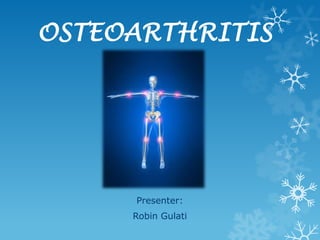
OSTEOARTHRITIS


     Presenter:
     Robin Gulati
CONTENTS
About Osteoarthritis
Occurrences
Causes
Symptoms
Etiopathogenesis
Diagnosis
Treatment & Management
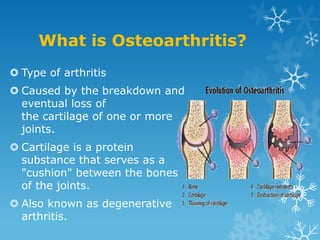
What is Osteoarthritis?
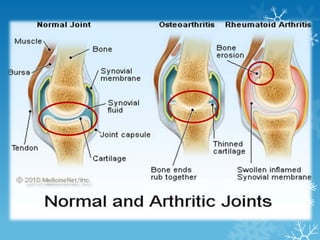
 Type of arthritis
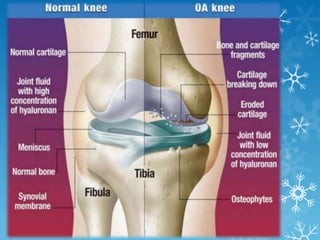
 Caused by the breakdown and
  eventual loss of
  the cartilage of one or more
  joints.
 Cartilage is a protein
  substance that serves as a
  "cushion" between the bones
  of the joints.
 Also known as degenerative
  arthritis.
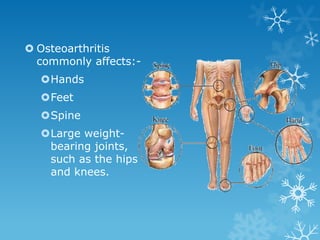
 Osteoarthritis
  commonly affects:-
  Hands
  Feet
  Spine
  Large weight-
   bearing joints,
   such as the hips
   and knees.
 As defined by the American College of
  Rheumatology (ACR), OA is a
  heterogeneous group of condition that
  leads to joint signs and symptoms which
  are associated with defective integrity of
  articular cartilage, in addition to related
  changes in the underlying bone at the
  joint margins.
OCCURENCES
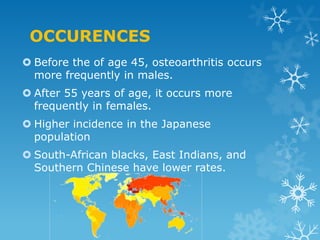
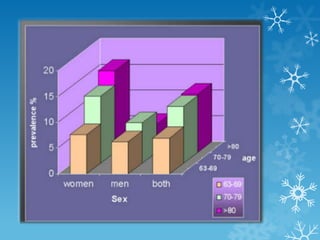
 Before the of age 45, osteoarthritis occurs
  more frequently in males.
 After 55 years of age, it occurs more
  frequently in females.
 Higher incidence in the Japanese
  population
 South-African blacks, East Indians, and
  Southern Chinese have lower rates.
Primary osteoarthritis:
  Have no known cause.

Secondary osteoarthritis:
   When the cause of the
  osteoarthritis is known.
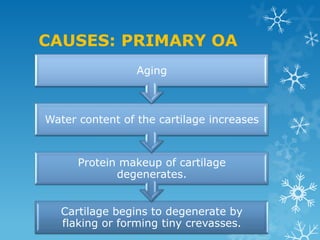
CAUSES: PRIMARY OA
                 Aging


Water content of the cartilage increases


      Protein makeup of cartilage
             degenerates.


   Cartilage begins to degenerate by
   flaking or forming tiny crevasses.
 Advanced cases: Total loss of cartilage
  cushion between the bones of the joints.
 Repetitive use of the worn joints over the
  years can irritate and inflame the
  cartilage, causing joint pain and swelling.
 Loss of the cartilage cushion causes
  friction between the bones, leading to pain
  and limitation of joint mobility.
 Inflammation of the cartilage can also
  stimulate new bone outgrowths
  (spurs, also referred to as osteophytes) to
  form around the joints.
 Can develop in multiple members of the
  same family, implying a hereditary
  (genetic) basis for this condition.
SECONDARY OA

Caused by another disease or
condition.

Conditions that can lead to secondary
OA include:
• Obesity
• Repeated trauma or surgery to the joint
  structures,
• Abnormal joints at birth (congenital
  abnormalities),
• Gout
• Diabetes
• Hormone disorders
Obesity: Increases the mechanical stress
on the cartilage.


The most powerful risk factor, next to
aging, for osteoarthritis of the knees.


Crystal deposits in the cartilage can cause
cartilage degeneration and OA.

Uric acid crystals cause arthritis in gout,
while calcium pyrophosphate crystals cause
arthritis in pseudogout.
Congenital abnormalities: Vulnerable to
mechanical wear, causing early
degeneration and loss of joint cartilage.


Structural abnormalities (Hips): Present
since birth.


Hormone disturbances: Such as diabetes
and growth hormone disorders, are also
associated with early cartilage wear and
secondary osteoarthritis.
SYMPTOMS

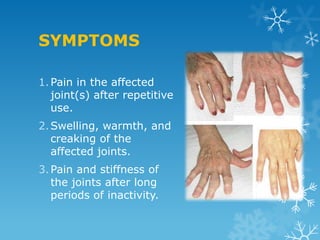
1. Pain in the affected
   joint(s) after repetitive
   use.
2. Swelling, warmth, and
   creaking of the
   affected joints.
3. Pain and stiffness of
   the joints after long
   periods of inactivity.
4. In severe OA, complete loss of the
   cartilage cushion causes friction
   between bones, causing pain at rest
   or pain with limited motion.
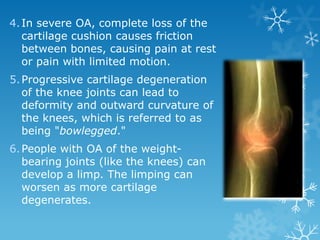
5. Progressive cartilage degeneration
   of the knee joints can lead to
   deformity and outward curvature of
   the knees, which is referred to as
   being "bowlegged."
6. People with OA of the weight-
   bearing joints (like the knees) can
   develop a limp. The limping can
   worsen as more cartilage
   degenerates.
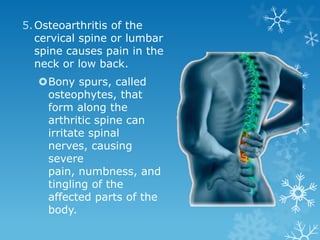
5. Osteoarthritis of the
   cervical spine or lumbar
   spine causes pain in the
   neck or low back.
   Bony spurs, called
    osteophytes, that
    form along the
    arthritic spine can
    irritate spinal
    nerves, causing
    severe
    pain, numbness, and
    tingling of the
    affected parts of the
    body.
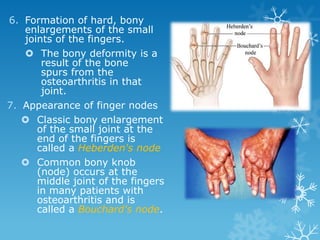
6. Formation of hard, bony
   enlargements of the small
   joints of the fingers.
    The bony deformity is a
       result of the bone
       spurs from the
       osteoarthritis in that
       joint.
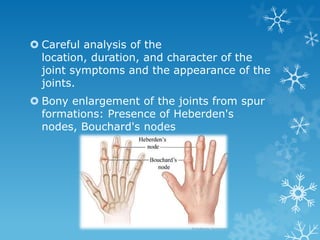
7. Appearance of finger nodes
    Classic bony enlargement
      of the small joint at the
      end of the fingers is
      called a Heberden's node
    Common bony knob
      (node) occurs at the
      middle joint of the fingers
      in many patients with
      osteoarthritis and is
      called a Bouchard's node.
ETIOPATHOGENESIS

 Cartilage matrix: made up of:-
  a. Proteoglycans (chondrotin sulfate)
  b. Glycosaminoglycans (carbohydrates
     that contain amino sugars found in
     proteoglycans)
  c. Chondrocytes
  d. Collagen
1. Proteoglycans


 Huge molecules made up of protein and
  sugars that are woven around and
  through collagen fibres forming a dense
  netting inside the cartilage.
 These molecules make cartilage so
  resilient that it can stretch and then
  bounce back when moved. They also trap
  water molecules much like a sponge.
2. Chondrocytes

 Special cells sprinkled throughout the
  matrix.
 They are the only cells found within the
  matrix and are continually producing new
  collagen and proteoglycan molecules.
 Also responsible for releasing enzymes
  that dispose off ageing collagen and
  proteoglycan molecules that have
  surpassed their usefulness.
3. Collagen


 Provides elasticity and the ability to
  absorb shock at the joints.
 Creates a framework to hold the
  proteoglycans in place and can be referred
  to as the "glue" that holds the cartilage
  matrix together.
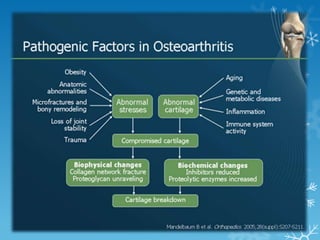
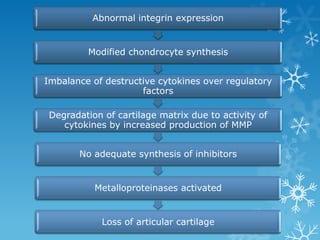
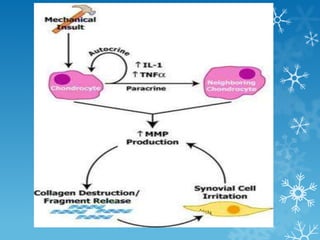
Abnormal integrin expression


         Modified chondrocyte synthesis


Imbalance of destructive cytokines over regulatory
                     factors

 Degradation of cartilage matrix due to activity of
    cytokines by increased production of MMP


       No adequate synthesis of inhibitors


           Metalloproteinases activated


             Loss of articular cartilage
 A key role is played by cell/extra-cellular
  matrix (ECM) interactions, which are
  mediated by cell surface integrins.
 Integrins modulate cell/ECM
  signalling, essential for regulating growth
  and differentiation and maintaining
  cartilage homeostasis.
 During OA, abnormal integrin expression
  alters cell/ECM signalling and modifies
  chondrocyte synthesis, with the following
  imbalance of destructive cytokines over
  regulatory factors.
 IL-1, TNF-alpha and other pro-catabolic
  cytokines activate the enzymatic
  degradation of cartilage matrix and are
  not counterbalanced by adequate
  synthesis of inhibitors.
 Enzymes involved in ECM breakdown:
  Metalloproteinases (MMPs), activated by
  an amplifying cascade.
 MMP activity is partially inhibited by the
  tissue inhibitors of MMPs (TIMPs), whose
  synthesis is low compared with MMP
  production in OA cartilage.
 Intriguing is the role of growth factors
  such as TGF-beta and others, which do
  not simply repair the tissue damage
  induced by catabolic factors, but play an
  important role in OA pathogenesis
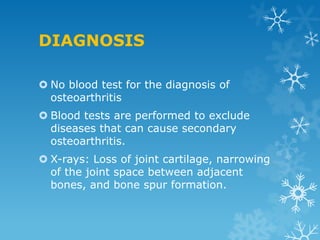
DIAGNOSIS

 No blood test for the diagnosis of
  osteoarthritis
 Blood tests are performed to exclude
  diseases that can cause secondary
  osteoarthritis.
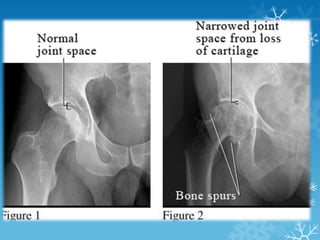
 X-rays: Loss of joint cartilage, narrowing
  of the joint space between adjacent
  bones, and bone spur formation.
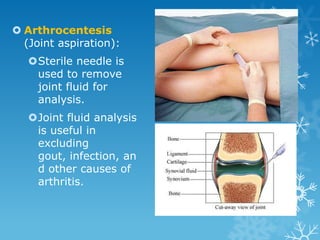
 Arthrocentesis
  (Joint aspiration):
   Sterile needle is
    used to remove
    joint fluid for
    analysis.
   Joint fluid analysis
    is useful in
    excluding
    gout, infection, an
    d other causes of
    arthritis.
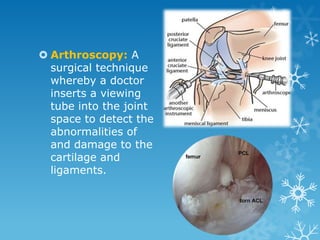
 Arthroscopy: A
  surgical technique
  whereby a doctor
  inserts a viewing
  tube into the joint
  space to detect the
  abnormalities of
  and damage to the
  cartilage and
  ligaments.
 Careful analysis of the
  location, duration, and character of the
  joint symptoms and the appearance of the
  joints.
 Bony enlargement of the joints from spur
  formations: Presence of Heberden's
  nodes, Bouchard's nodes
TREATMENT & MANAGEMENT


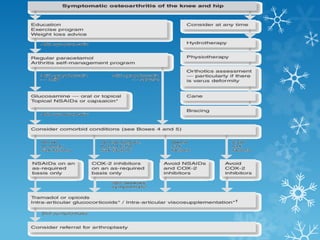
  Non-Pharmacological

    Pharmacological
NON-PHARMACOLOGICAL


 Diet control with weight reduction.
 Avoiding activities that exert excessive
  stress on the joint cartilage
 Rest, exercise, physical and occupational
  therapy, and mechanical support devices.
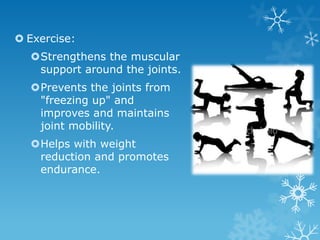
 Exercise:
  Strengthens the muscular
   support around the joints.
  Prevents the joints from
   "freezing up" and
   improves and maintains
   joint mobility.
  Helps with weight
   reduction and promotes
   endurance.
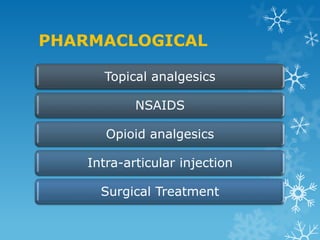
PHARMACLOGICAL

      Topical analgesics

            NSAIDS

       Opioid analgesics

    Intra-articular injection

      Surgical Treatment
TOPICAL ANALGESICS:
Capsiacin

For patients who cannot tolerate
 systemic therapy.
Pain relief
Recommended 4 times daily
Long term adherence: twice daily
NSAIDS
1. Paracetamol:
  First choice
  Divided doses, at regular intervals, with
   the total daily dose not exceeding 4 g.
  Should be used with caution in patients
   who have liver disease and those with a
   history of excessive alcohol
   consumption.
2.Cyclo-oxygenase-2-specific inhibitors


  Aspirin, Acetaminophen, Coxibs, Oxicams
  Choice between NSAIDs and COX-
   2 inhibitors should be made after carefully
   assessing the risk of serious upper-GI
   complications and discussing with patients
   the risk of serious thrombotic
   cardiovascular events.
 For patients with impaired renal
  function, NSAIDs and COX-2 inhibitors
  should only be prescribed after very
  careful consideration.
 Plasma sodium, potassium and creatinine
  levels, blood pressure and the presence of
  oedema should be checked at baseline
  and regular intervals.
OPIOID ANALGESICS


 Combination of codeine and paracetamol
  provides better analgesia than paracetamol
  alone.
 Nausea, vomiting, dizziness and
  constipation lead to discontinuation of this
  combination in up to a third of patients.
 Tramadol (centrally acting synthetic
  opioid) inhibits the reuptake of serotonin
  and noradrenaline.
 Generally well tolerated, but is
  contraindicated in seizure disorders, as it
  lowers the seizure threshold, and in
  combination with selective serotonin
  reuptake inhibitors because of the risk of
  serotoninergic syndrome.
Glucosamine and chondroitin:
 Glucosamine sulfate (GS) and chondroitin
  sulfate (CS) are derivatives of
  glycosaminoglycans found in articular
  cartilage.
 Oral GS confirm a 20%–25% reduction in
  pain in patients with mild to moderate
  primary knee OA but not so effective in
  severe cases.
 GS is contraindicated in seafood allergy.
 Topical application of GS and CS may be
  effective in reducing pain from knee OA
INTRA-ARTICULAR INJECTION


1. Viscosupplementation (Hyaluronate
   Injections):
  Hyaluronic acid helps in reconstitution
   of synovial fluid temporarily improving
   its elasticity and viscosity and
   enhancing joint function
  Given as a weekly intra-articular
   injection for 3 weeks
2.Glucocorticoids:
  A modest and short-lived reduction in
   pain.
  Some patients have a dramatic and
   sustained response.
  Iatrogenic infection is rare if aseptic
   technique is used.
  Common side effects include flushing
   (40%), worsening hyperglycaemia and
   post-injection flare (thought to be
   inflammation in response to
   glucocorticoid crystals).
  Single joint not be injected more than
   three times a year.
SURGICAL TREATMENT
 Patients must be medically fit and able to
  participate in a rehabilitation program
  postoperatively.
 Total joint arthroplasty relieves pain and
  improves function over at least 10 years.
 Total joint arthroplasties do deteriorate
  over time, and may require revision.
 Revision arthroplasty is a more
  complicated procedure, so arthroplasty
  may be best postponed in younger
  patients with OA.
HAPPY JOINTS
HAPPY HEALTH
Osteoarthritis

Osteoarthritis

  • 1.
    OSTEOARTHRITIS Presenter: Robin Gulati
  • 2.
  • 3.
    What is Osteoarthritis? Type of arthritis  Caused by the breakdown and eventual loss of the cartilage of one or more joints.  Cartilage is a protein substance that serves as a "cushion" between the bones of the joints.  Also known as degenerative arthritis.
  • 4.
     Osteoarthritis commonly affects:- Hands Feet Spine Large weight- bearing joints, such as the hips and knees.
  • 5.
     As definedby the American College of Rheumatology (ACR), OA is a heterogeneous group of condition that leads to joint signs and symptoms which are associated with defective integrity of articular cartilage, in addition to related changes in the underlying bone at the joint margins.
  • 6.
    OCCURENCES  Before theof age 45, osteoarthritis occurs more frequently in males.  After 55 years of age, it occurs more frequently in females.  Higher incidence in the Japanese population  South-African blacks, East Indians, and Southern Chinese have lower rates.
  • 8.
    Primary osteoarthritis: Have no known cause. Secondary osteoarthritis: When the cause of the osteoarthritis is known.
  • 9.
    CAUSES: PRIMARY OA Aging Water content of the cartilage increases Protein makeup of cartilage degenerates. Cartilage begins to degenerate by flaking or forming tiny crevasses.
  • 10.
     Advanced cases:Total loss of cartilage cushion between the bones of the joints.  Repetitive use of the worn joints over the years can irritate and inflame the cartilage, causing joint pain and swelling.  Loss of the cartilage cushion causes friction between the bones, leading to pain and limitation of joint mobility.
  • 11.
     Inflammation ofthe cartilage can also stimulate new bone outgrowths (spurs, also referred to as osteophytes) to form around the joints.  Can develop in multiple members of the same family, implying a hereditary (genetic) basis for this condition.
  • 13.
    SECONDARY OA Caused byanother disease or condition. Conditions that can lead to secondary OA include: • Obesity • Repeated trauma or surgery to the joint structures, • Abnormal joints at birth (congenital abnormalities), • Gout • Diabetes • Hormone disorders
  • 14.
    Obesity: Increases themechanical stress on the cartilage. The most powerful risk factor, next to aging, for osteoarthritis of the knees. Crystal deposits in the cartilage can cause cartilage degeneration and OA. Uric acid crystals cause arthritis in gout, while calcium pyrophosphate crystals cause arthritis in pseudogout.
  • 15.
    Congenital abnormalities: Vulnerableto mechanical wear, causing early degeneration and loss of joint cartilage. Structural abnormalities (Hips): Present since birth. Hormone disturbances: Such as diabetes and growth hormone disorders, are also associated with early cartilage wear and secondary osteoarthritis.
  • 17.
    SYMPTOMS 1. Pain inthe affected joint(s) after repetitive use. 2. Swelling, warmth, and creaking of the affected joints. 3. Pain and stiffness of the joints after long periods of inactivity.
  • 18.
    4. In severeOA, complete loss of the cartilage cushion causes friction between bones, causing pain at rest or pain with limited motion. 5. Progressive cartilage degeneration of the knee joints can lead to deformity and outward curvature of the knees, which is referred to as being "bowlegged." 6. People with OA of the weight- bearing joints (like the knees) can develop a limp. The limping can worsen as more cartilage degenerates.
  • 19.
    5. Osteoarthritis ofthe cervical spine or lumbar spine causes pain in the neck or low back. Bony spurs, called osteophytes, that form along the arthritic spine can irritate spinal nerves, causing severe pain, numbness, and tingling of the affected parts of the body.
  • 20.
    6. Formation ofhard, bony enlargements of the small joints of the fingers.  The bony deformity is a result of the bone spurs from the osteoarthritis in that joint. 7. Appearance of finger nodes  Classic bony enlargement of the small joint at the end of the fingers is called a Heberden's node  Common bony knob (node) occurs at the middle joint of the fingers in many patients with osteoarthritis and is called a Bouchard's node.
  • 21.
    ETIOPATHOGENESIS  Cartilage matrix:made up of:- a. Proteoglycans (chondrotin sulfate) b. Glycosaminoglycans (carbohydrates that contain amino sugars found in proteoglycans) c. Chondrocytes d. Collagen
  • 22.
    1. Proteoglycans  Hugemolecules made up of protein and sugars that are woven around and through collagen fibres forming a dense netting inside the cartilage.  These molecules make cartilage so resilient that it can stretch and then bounce back when moved. They also trap water molecules much like a sponge.
  • 23.
    2. Chondrocytes  Specialcells sprinkled throughout the matrix.  They are the only cells found within the matrix and are continually producing new collagen and proteoglycan molecules.  Also responsible for releasing enzymes that dispose off ageing collagen and proteoglycan molecules that have surpassed their usefulness.
  • 24.
    3. Collagen  Provideselasticity and the ability to absorb shock at the joints.  Creates a framework to hold the proteoglycans in place and can be referred to as the "glue" that holds the cartilage matrix together.
  • 25.
    Abnormal integrin expression Modified chondrocyte synthesis Imbalance of destructive cytokines over regulatory factors Degradation of cartilage matrix due to activity of cytokines by increased production of MMP No adequate synthesis of inhibitors Metalloproteinases activated Loss of articular cartilage
  • 26.
     A keyrole is played by cell/extra-cellular matrix (ECM) interactions, which are mediated by cell surface integrins.  Integrins modulate cell/ECM signalling, essential for regulating growth and differentiation and maintaining cartilage homeostasis.  During OA, abnormal integrin expression alters cell/ECM signalling and modifies chondrocyte synthesis, with the following imbalance of destructive cytokines over regulatory factors.
  • 27.
     IL-1, TNF-alphaand other pro-catabolic cytokines activate the enzymatic degradation of cartilage matrix and are not counterbalanced by adequate synthesis of inhibitors.  Enzymes involved in ECM breakdown: Metalloproteinases (MMPs), activated by an amplifying cascade.  MMP activity is partially inhibited by the tissue inhibitors of MMPs (TIMPs), whose synthesis is low compared with MMP production in OA cartilage.
  • 28.
     Intriguing isthe role of growth factors such as TGF-beta and others, which do not simply repair the tissue damage induced by catabolic factors, but play an important role in OA pathogenesis
  • 31.
    DIAGNOSIS  No bloodtest for the diagnosis of osteoarthritis  Blood tests are performed to exclude diseases that can cause secondary osteoarthritis.  X-rays: Loss of joint cartilage, narrowing of the joint space between adjacent bones, and bone spur formation.
  • 33.
     Arthrocentesis (Joint aspiration): Sterile needle is used to remove joint fluid for analysis. Joint fluid analysis is useful in excluding gout, infection, an d other causes of arthritis.
  • 34.
     Arthroscopy: A surgical technique whereby a doctor inserts a viewing tube into the joint space to detect the abnormalities of and damage to the cartilage and ligaments.
  • 35.
     Careful analysisof the location, duration, and character of the joint symptoms and the appearance of the joints.  Bony enlargement of the joints from spur formations: Presence of Heberden's nodes, Bouchard's nodes
  • 36.
    TREATMENT & MANAGEMENT Non-Pharmacological Pharmacological
  • 37.
    NON-PHARMACOLOGICAL  Diet controlwith weight reduction.  Avoiding activities that exert excessive stress on the joint cartilage  Rest, exercise, physical and occupational therapy, and mechanical support devices.
  • 38.
     Exercise: Strengthens the muscular support around the joints. Prevents the joints from "freezing up" and improves and maintains joint mobility. Helps with weight reduction and promotes endurance.
  • 39.
    PHARMACLOGICAL Topical analgesics NSAIDS Opioid analgesics Intra-articular injection Surgical Treatment
  • 40.
    TOPICAL ANALGESICS: Capsiacin For patientswho cannot tolerate systemic therapy. Pain relief Recommended 4 times daily Long term adherence: twice daily

  • 41.
    NSAIDS 1. Paracetamol: First choice Divided doses, at regular intervals, with the total daily dose not exceeding 4 g. Should be used with caution in patients who have liver disease and those with a history of excessive alcohol consumption.
  • 42.
    2.Cyclo-oxygenase-2-specific inhibitors Aspirin, Acetaminophen, Coxibs, Oxicams Choice between NSAIDs and COX- 2 inhibitors should be made after carefully assessing the risk of serious upper-GI complications and discussing with patients the risk of serious thrombotic cardiovascular events.
  • 43.
     For patientswith impaired renal function, NSAIDs and COX-2 inhibitors should only be prescribed after very careful consideration.  Plasma sodium, potassium and creatinine levels, blood pressure and the presence of oedema should be checked at baseline and regular intervals.
  • 44.
    OPIOID ANALGESICS  Combinationof codeine and paracetamol provides better analgesia than paracetamol alone.  Nausea, vomiting, dizziness and constipation lead to discontinuation of this combination in up to a third of patients.
  • 45.
     Tramadol (centrallyacting synthetic opioid) inhibits the reuptake of serotonin and noradrenaline.  Generally well tolerated, but is contraindicated in seizure disorders, as it lowers the seizure threshold, and in combination with selective serotonin reuptake inhibitors because of the risk of serotoninergic syndrome.
  • 46.
    Glucosamine and chondroitin: Glucosamine sulfate (GS) and chondroitin sulfate (CS) are derivatives of glycosaminoglycans found in articular cartilage.  Oral GS confirm a 20%–25% reduction in pain in patients with mild to moderate primary knee OA but not so effective in severe cases.  GS is contraindicated in seafood allergy.  Topical application of GS and CS may be effective in reducing pain from knee OA
  • 47.
    INTRA-ARTICULAR INJECTION 1. Viscosupplementation(Hyaluronate Injections): Hyaluronic acid helps in reconstitution of synovial fluid temporarily improving its elasticity and viscosity and enhancing joint function Given as a weekly intra-articular injection for 3 weeks
  • 48.
    2.Glucocorticoids: Amodest and short-lived reduction in pain. Some patients have a dramatic and sustained response. Iatrogenic infection is rare if aseptic technique is used. Common side effects include flushing (40%), worsening hyperglycaemia and post-injection flare (thought to be inflammation in response to glucocorticoid crystals). Single joint not be injected more than three times a year.
  • 49.
    SURGICAL TREATMENT  Patientsmust be medically fit and able to participate in a rehabilitation program postoperatively.  Total joint arthroplasty relieves pain and improves function over at least 10 years.  Total joint arthroplasties do deteriorate over time, and may require revision.  Revision arthroplasty is a more complicated procedure, so arthroplasty may be best postponed in younger patients with OA.
  • 51.