Discuss Tetanus And Tetanus
Prophylaxis
By
Dr Salihi Abdulmalik
National Orthopaedic Hospital, Dala
16th February 2018
 Introduction
 Microbiology
 Types
 Pathogenesis
 Prophylaxis
 Management
 Prognosis
 Differential diagnosis
 Complications
 ‘Tetanos’, meaning “taut” or “rigid”
 An acute infection that is characterized by spasms of
skeletal muscles ,rigidity and convulsion due to exotoxins
released by Clostridium tetani
 Important cause of death worldwide
 High mortality rate
15% in best of centers
50-60%
 1 million deaths worldwide 1992 (WHO)
 300 cases/year in South Africa
First described by Hippocrates
Etiology discovered in 1884 by Carle and Rattone
ATS used for treatment and prophylaxis during
World War I
TT first widely used during World War II
 Clostridium tetani is an anaerobic gram-positive, spore
forming bacteria
 Spores found in soil, dust, animal faeces, may persist for
months to years
 Clostridium tetani produces 2 forms of exotoxins
Tetanospamin (lethal dose 2.5ng/kg)
Tetanolysin
 Generalized
 Localized
 Cephalic
 Neonatal
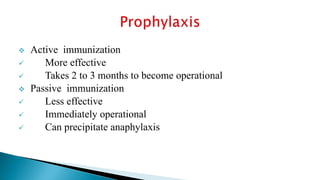
 Active immunization
 More effective
 Takes 2 to 3 months to become operational
 Passive immunization
 Less effective
 Immediately operational
 Can precipitate anaphylaxis
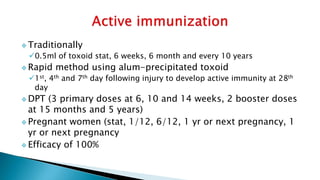
 Traditionally
0.5ml of toxoid stat, 6 weeks, 6 month and every 10 years
 Rapid method using alum-precipitated toxoid
1st, 4th and 7th day following injury to develop active immunity at 28th
day
 DPT (3 primary doses at 6, 10 and 14 weeks, 2 booster doses
at 15 months and 5 years)
 Pregnant women (stat, 1/12, 6/12, 1 yr or next pregnancy, 1
yr or next pregnancy
 Efficacy of 100%
 Human immunoglobulin
250 – 500IU stat
Protection for 4-6weeks
No serum sickness
 Equine immunoglobulin
1500 IU sat
Protection for 7-10 days
Test dose to prevent serum sickness
 Bovine immunoglobulin
 Fully immunized
 Had conventional doses, a booster dose every 10 years
with last dose being less than 5 years
 Partially immunized
 Completed toxoid with last booster dose greater 5 but less
than 10years
Unimmunized
 No immunization
 Can’t remember
 Last booster dose greater than 10 years
 Fully immunized + clean wound
 Nothing
 Fully immunized + dirty wound
 Debridement + antibiotics
 Partially immunized + clean wound
 Complete immunization
 Partially immunized + dirty wound
 Give TT and complete booster after + debridement +
antibiotics
 Unimmunized + clean wound
Give TT + and to complete immunization
 Unimmunized + dirty wound
Give TT and ATS
To complete TT dose
Wound debridement
Antibiotics
 Patient in shock
 Allergic reaction
To TT?, consider ATS
 In setting of moderate to severe acute illness
Differ vaccination
 Clinical emergency
 Multidisciplinary
Surgeons
Physicians
Anaesthesiologist
Nurses
 Best managed in ICU
 History of wound contamination
 Dysphagia, dysphonia
 Headache, delirium, sleeplessness
 Hesitancy in micturition, constipation
 Convulsion
 Can be triggered by touch, noise, light, movement
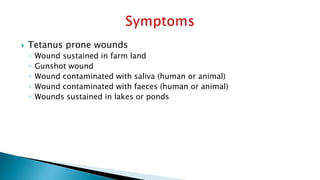
 Tetanus prone wounds
◦ Wound sustained in farm land
◦ Gunshot wound
◦ Wound contaminated with saliva (human or animal)
◦ Wound contaminated with faeces (human or animal)
◦ Wounds sustained in lakes or ponds
 Anxiousness, sweating
 Fixed and staring eyes
 Trismus
 Risus sardonicus
 Nuchal rigidity
 Spasm and rigidity of all muscles
 Opisthotonus/Orthotonus/
Emprosthotonus
 Fever, tachycardia
 Open injury
 Diagnosis is clinical
 Incubation period 6-10 days
 Onset period 3 days to 3 weeks
 Muscle rigidity and spasm 1st week
 Autonomic disturbance starts several days after spasm and
persist for 1-2 weeks
 Spasm reduces after 2-3 weeks
 Goals
 Neutralize toxins
 ATS
 Human Ig 500IU o.d X 6 days
 Equine Ig 15000 IU o.d X 10-12 days (after test dose)
 Prevent further toxin production by removing source of infection
 Antibiotics; Penicillin, Metronidazole, Erythromycin
 Wound debridement
 Controlling muscle spasms
 anticonvulsants
 Maintaining airway
 General supportive therapy
 Isolation
 Avoid noise, light
 IVF
 TPN
 Urethral catheterization
 NGT
 Regular suction of throat
 Oxygen
 Prevention of pressure sore
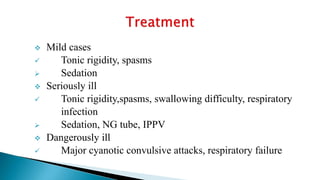
 Mild cases
 Tonic rigidity, spasms
 Sedation
 Seriously ill
 Tonic rigidity,spasms, swallowing difficulty, respiratory
infection
 Sedation, NG tube, IPPV
 Dangerously ill
 Major cyanotic convulsive attacks, respiratory failure
 Laryngospasm
 Fractures
 Hypertension
 Nosocomial infections
 Pulmonary embolism
 Aspiration
 Death
 High mortality
 Incubation period
 Onset period, if less than 48hours death is very likely
 Immune status of the patient
 Degree of wound contamination
 Entry point proximity to the brain
 Frequency of spasms
 Autonomic complication
 Neonate
 Trismus – dental, oral, tonsillar sepsis
 Strychnine poisoning
 Meningitis
 Convulsive disorder
 Torticolis
 Rabies
 A medical emergency
 Diagnosis is clinical
 Management is multidisciplinary and best done in ICU
 A very high mortality, hence the need for early diagnosis
and prompt treatment
 Tetanus prophylaxis has greatly reduced the incidence of
tetanus
 E. A. Badoe, E. Q. Archampong, J.T. da Rocha.Baja’s principles and
Practice of Surgery including pathology in the tropics, 5th ed. Dept.
of Surgery, University of Ghana Medical School: Repro India Ltd;
2015.p.17-20
 Sriram Bhat M, SRB’S Manual of Surgey, 4th ed., Department of
Surgery Kasturba Medical College Mangalore, Karnataka, India.
P49-52
 T. M. Cook, R.T Protheroe and J.M. Handel, Review Article, Tetanus:
a review of the literature, British Journal of Anaesthesia 87 (3):
p477-87 (2000)
 American Academy of Paediatric tetanus in pickering L,ed Red book
2003 26th edition 611-16

Tetanus

  • 1.
    Discuss Tetanus AndTetanus Prophylaxis By Dr Salihi Abdulmalik National Orthopaedic Hospital, Dala 16th February 2018
  • 2.
     Introduction  Microbiology Types  Pathogenesis  Prophylaxis  Management  Prognosis  Differential diagnosis  Complications
  • 3.
     ‘Tetanos’, meaning“taut” or “rigid”  An acute infection that is characterized by spasms of skeletal muscles ,rigidity and convulsion due to exotoxins released by Clostridium tetani  Important cause of death worldwide  High mortality rate 15% in best of centers 50-60%  1 million deaths worldwide 1992 (WHO)  300 cases/year in South Africa
  • 4.
    First described byHippocrates Etiology discovered in 1884 by Carle and Rattone ATS used for treatment and prophylaxis during World War I TT first widely used during World War II
  • 5.
     Clostridium tetaniis an anaerobic gram-positive, spore forming bacteria  Spores found in soil, dust, animal faeces, may persist for months to years  Clostridium tetani produces 2 forms of exotoxins Tetanospamin (lethal dose 2.5ng/kg) Tetanolysin
  • 6.
     Generalized  Localized Cephalic  Neonatal
  • 8.
     Active immunization More effective  Takes 2 to 3 months to become operational  Passive immunization  Less effective  Immediately operational  Can precipitate anaphylaxis
  • 9.
     Traditionally 0.5ml oftoxoid stat, 6 weeks, 6 month and every 10 years  Rapid method using alum-precipitated toxoid 1st, 4th and 7th day following injury to develop active immunity at 28th day  DPT (3 primary doses at 6, 10 and 14 weeks, 2 booster doses at 15 months and 5 years)  Pregnant women (stat, 1/12, 6/12, 1 yr or next pregnancy, 1 yr or next pregnancy  Efficacy of 100%
  • 10.
     Human immunoglobulin 250– 500IU stat Protection for 4-6weeks No serum sickness  Equine immunoglobulin 1500 IU sat Protection for 7-10 days Test dose to prevent serum sickness  Bovine immunoglobulin
  • 11.
     Fully immunized Had conventional doses, a booster dose every 10 years with last dose being less than 5 years  Partially immunized  Completed toxoid with last booster dose greater 5 but less than 10years Unimmunized  No immunization  Can’t remember  Last booster dose greater than 10 years
  • 12.
     Fully immunized+ clean wound  Nothing  Fully immunized + dirty wound  Debridement + antibiotics  Partially immunized + clean wound  Complete immunization  Partially immunized + dirty wound  Give TT and complete booster after + debridement + antibiotics
  • 13.
     Unimmunized +clean wound Give TT + and to complete immunization  Unimmunized + dirty wound Give TT and ATS To complete TT dose Wound debridement Antibiotics
  • 14.
     Patient inshock  Allergic reaction To TT?, consider ATS  In setting of moderate to severe acute illness Differ vaccination
  • 15.
     Clinical emergency Multidisciplinary Surgeons Physicians Anaesthesiologist Nurses  Best managed in ICU
  • 16.
     History ofwound contamination  Dysphagia, dysphonia  Headache, delirium, sleeplessness  Hesitancy in micturition, constipation  Convulsion  Can be triggered by touch, noise, light, movement
  • 17.
     Tetanus pronewounds ◦ Wound sustained in farm land ◦ Gunshot wound ◦ Wound contaminated with saliva (human or animal) ◦ Wound contaminated with faeces (human or animal) ◦ Wounds sustained in lakes or ponds
  • 18.
     Anxiousness, sweating Fixed and staring eyes  Trismus  Risus sardonicus  Nuchal rigidity  Spasm and rigidity of all muscles  Opisthotonus/Orthotonus/ Emprosthotonus  Fever, tachycardia  Open injury  Diagnosis is clinical
  • 19.
     Incubation period6-10 days  Onset period 3 days to 3 weeks  Muscle rigidity and spasm 1st week  Autonomic disturbance starts several days after spasm and persist for 1-2 weeks  Spasm reduces after 2-3 weeks
  • 20.
     Goals  Neutralizetoxins  ATS  Human Ig 500IU o.d X 6 days  Equine Ig 15000 IU o.d X 10-12 days (after test dose)  Prevent further toxin production by removing source of infection  Antibiotics; Penicillin, Metronidazole, Erythromycin  Wound debridement  Controlling muscle spasms  anticonvulsants  Maintaining airway  General supportive therapy
  • 21.
     Isolation  Avoidnoise, light  IVF  TPN  Urethral catheterization  NGT  Regular suction of throat  Oxygen  Prevention of pressure sore
  • 22.
     Mild cases Tonic rigidity, spasms  Sedation  Seriously ill  Tonic rigidity,spasms, swallowing difficulty, respiratory infection  Sedation, NG tube, IPPV  Dangerously ill  Major cyanotic convulsive attacks, respiratory failure
  • 23.
     Laryngospasm  Fractures Hypertension  Nosocomial infections  Pulmonary embolism  Aspiration  Death
  • 24.
     High mortality Incubation period  Onset period, if less than 48hours death is very likely  Immune status of the patient  Degree of wound contamination  Entry point proximity to the brain  Frequency of spasms  Autonomic complication  Neonate
  • 25.
     Trismus –dental, oral, tonsillar sepsis  Strychnine poisoning  Meningitis  Convulsive disorder  Torticolis  Rabies
  • 26.
     A medicalemergency  Diagnosis is clinical  Management is multidisciplinary and best done in ICU  A very high mortality, hence the need for early diagnosis and prompt treatment  Tetanus prophylaxis has greatly reduced the incidence of tetanus
  • 28.
     E. A.Badoe, E. Q. Archampong, J.T. da Rocha.Baja’s principles and Practice of Surgery including pathology in the tropics, 5th ed. Dept. of Surgery, University of Ghana Medical School: Repro India Ltd; 2015.p.17-20  Sriram Bhat M, SRB’S Manual of Surgey, 4th ed., Department of Surgery Kasturba Medical College Mangalore, Karnataka, India. P49-52  T. M. Cook, R.T Protheroe and J.M. Handel, Review Article, Tetanus: a review of the literature, British Journal of Anaesthesia 87 (3): p477-87 (2000)  American Academy of Paediatric tetanus in pickering L,ed Red book 2003 26th edition 611-16