FORMULATION PRODUCTION
     MANAGEMENT


        Presenter:
       ROBIN GULATI
CONTENTS:

ď‚› Plant location
   ď‚›Primary factors
   ď‚›Secondary factors
ď‚› Plant layout
   ď‚›Types of layout
   ď‚›Procedures of layout
   ď‚›Utilities and services
   ď‚›Industrial pollution and control
   ď‚›Industrial hazard and safety
ď‚› Selection: A vital decision
ď‚› Strong influence on the success of an
  industrial venture.
ď‚› Proper selection of plant size also
  important.
ď‚› Location: Where the cost of production
  and distribution is minimum.
ď‚› Room for expansion and general living
  conditions also important.
FACTORS INFLUENCING
  PLANT LOCATION


Fundamental (Primary)
      Factors

 Derived (Secondary)
       Factors
FUNDAMENTAL/ PRIMARY
        FACTORS

1.Raw materials:
  ď‚›Types of raw materials used:
    a) Crude drugs
    b) Inorganic chemicals
    c) Organic chemicals
  ď‚›Economical to locate the plant near the
   source.
ď‚›Increase in freight charges and
 risk of danger if not locally
 available.
ď‚›If stable raw materials: other
 factors to be considered also.
2.Market:
 ď‚›Strong influence on the establishment of
  industries.
 ď‚›The bulk industries are located nearer to
  the market.
 ď‚›Bulk drug industry located where drug
  formulation industries are located, since
  bulk drugs are the feed for the
  formulations and buyers are found nearby.
3.Energy availability:
  ď‚›Fuel and power
  ď‚›Can also create own power generation
   facility.
4. Transportation Facility:
  ď‚› For bringing raw materials and
    distribution of finished goods.
  ď‚› Railways, roads and seaport.
  ď‚› The kind and amount of products and
    raw materials determine the most
    suitable type of transportation facility.
  ď‚› Also a need for transportation for the
    personnel.
5.Labour Supply:
  ď‚›Low wages and abundant labour help in
   localization.
  ď‚›Skilled, better paid and highly mobile
   labour required.
DERIVED/ SECONDARY
             FACTORS

1.Climate and Soil:
ď‚› Important for agriculture based industries. E.g.:
  Ayurvedic drugs
ď‚› A location which is very hot during summers
  would not be suitable as it is subjected to dust
  storms and drying up of water supplies.
ď‚› Highly humid area will also not be suitable from
  the point of:
   ď‚› Cost,
   ď‚› Contamination,
   ď‚› Difficulties of maintaining laboratory animals
     in proper condition
   ď‚› Efficiency of labour
ď‚› Antibiotic industries: located in a place
  wherein the microbial contamination in
  the environment is low and the ambient
  temperatures throughout the year are
  cool.
ď‚› If in a cold climate: costs may be
  increased by the necessity of constructing
  protective shelters around the process
  equipment.
ď‚› If temp is high: special cooling towers or
  a/c equipment may be required.
2.Government concessions:
  ď‚›Govt. subsidies and concessions have
   been provided for the industries located
   in certain notified areas.
  ď‚›These areas have been declared as
   industrially backward and the govt.
   offers low wages, cheap power, tax
   concessions, etc.
3.Water supply
ď‚› Large quantities of water required for cooling,
  washing, steam generation and also as raw
  material (liquid orals).
ď‚› Study should be conducted regarding the
  supply position of underground water and/or
  surface water and their seasonal variation.
ď‚› Quality of water also important.
ď‚› Temperature, mineral content, silt or sand
  content, bacteriological content, cost of supply
  and purification treatment must also be
  considered while choosing a water supply.
ď‚› Detailed estimate of water requirements for
  the present and the future must be made.
4.Water Disposal:
  ď‚›Legal restrictions must be considered.
  ď‚›Site selected should have adequate
   capacity and facilities for correct waste
   disposal.
  ď‚›Attention should be given to potential
   requirements for additional waste
   treatment facilities.
5.Site Characteristics:
  ď‚›Topography of the land and soil should
   be considered since both may influence
   the construction cost.
  ď‚›Cost of land, local building costs and
   living conditions are also important.
  ď‚›Expansion of the plant in future should
   also be considered.
6. Flood and Fire protection:
  ď‚›A regional history of natural events like
   floods and hurricanes must be
   conducted if located near large bodies
   of water (river, sea, etc.).
  ď‚›Assistance from fire deptt. should be
   easily available.
  ď‚›Fire hazards in the immediate
   surrounding area of the plant site must
   not be overlooked.
Special provisions of Factory
     Premises- Location
ď‚› Should be located in a sanitary place away
  from filthy surroundings.
ď‚› Should be situated in a place which:
  a. Shall not be adjacent to an open
     sewage, drainage or public lavatories.
  b. Shall not be adjacent to a factory,
     which produces disagreeable or
     obnoxious odours or fumes.
  c. Shall not be adjacent to a factory,
     which emits large quantities of soot,
     dust or smoke.
ď‚› The factory should not constitute undue
  danger to adjacent life and property.
ď‚› State laws and other related laws should
  be consulted.
ď‚› Indian Factories Act and the D&C Act
  should be considered.
PLANT LAYOUT
ď‚› Plant layout is a coordinated effort to
  achieve the final objective to integrate
  machines, materials, and personnel for
  economic production.
ď‚› Layout can be described as location of
  different deptts and arrangement of
  machinery in a deptt.
ď‚› Proper layout has the advantage from the
  point of workers, labour costs, other
  production costs, supervision and capital
  investment.
TYPES OF LAYOUTS


 Process or Functional
        Layout

Product or Straight Line
        Layout
Process or functional Layout

ď‚› In this type, all machines of a particular
  class doing a particular type if work are
  arranged together in a separate deptt.
ď‚› Advantages of this type are:
   a. More effective supervision can be
      achieved.
   b. Division of labour or specialized work
      can be provided.
   c. Less disruption of production is
      possible.
   d. Good scope for expansion.
Product or Straight Line
             Layout
ď‚› All machines doing various operations are
  arranged in a line.
ď‚› Advantages:
   a. Facilitates quick and smooth processing of
      work.
   b. Reduces cost of material handling using
      conveyor.
   c. Reduces manufacturing time and speeds
      up the manufacturing cycle.
   d. Facilitates proper use of the floor.
   e. Reduces inventory in work of progress.
   f. Reduces inventory of finished goods.
Procedures of Layout


       Identification


 Drawing of plant layout
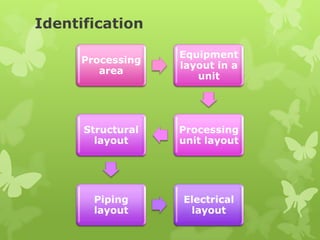
Identification

                   Equipment
      Processing
                   layout in a
         area
                      unit


      Structural   Processing
        layout     unit layout


        Piping     Electrical
        layout      layout
Identification


       Handling area


        Storage area
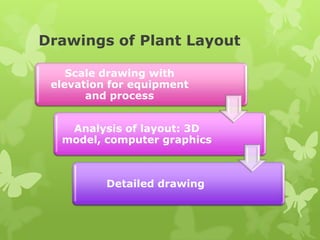
Drawings of Plant Layout

    Scale drawing with
 elevation for equipment
       and process


   Analysis of layout: 3D
  model, computer graphics


          Detailed drawing
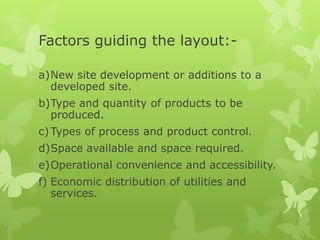
Factors guiding the layout:-

a)New site development or additions to a
  developed site.
b)Type and quantity of products to be
  produced.
c) Types of process and product control.
d)Space available and space required.
e)Operational convenience and accessibility.
f) Economic distribution of utilities and
   services.
g)Type of buildings and building code
  requirements.
h)Health and safety considerations.
i) Waste disposal problems.
j) Auxillary equipment.
k)Possible future expansion.
Some provisions of plant layout
 ď‚› The premises should be suitable for the
   purpose of drug manufacturing.
 ď‚› Measures should be taken to prevent
   mixing-up of substances or materials and
   contamination.
 ď‚› The building of the factory shall be
   constructed so as to permit the production
   under hygienic conditions.
 ď‚› They shall conform to the conditions laid
   down in Factories Act, 1948.
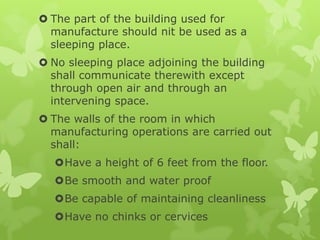
ď‚› The part of the building used for
  manufacture should nit be used as a
  sleeping place.
ď‚› No sleeping place adjoining the building
  shall communicate therewith except
  through open air and through an
  intervening space.
ď‚› The walls of the room in which
  manufacturing operations are carried out
  shall:
  ď‚›Have a height of 6 feet from the floor.
  ď‚›Be smooth and water proof
  ď‚›Be capable of maintaining cleanliness
  ď‚›Have no chinks or cervices
ď‚› The flooring shall:
   ď‚›Be smooth, even and washable.
   ď‚›Be in such a way as to permit any
    retention or accumulation of dust.
   ď‚›Have no chinks or cervices.
ď‚› The buildings are arranged to permit
  economic conditions.
ď‚› The routing of goods should be logical
  so that successive unit operations can
  be done in adjacent rooms with
  uninterrupted transportation.
ď‚› Adequate facilities should be maintained
  to provide safety and fire protection.
ď‚› Regulations controlling escape routes in
  case of fires, providing fire fighting
  equipment, fire alarms and measures to
  be taken for prevention of breaking of
  fires and their spreading should be
  complied.
ď‚› Devices should be installed in every room
  where process operations are carried on,
  so that in times of emergency the power
  supply can be immediately cut off from
  the transmission machinery.
ď‚› Building meant for storing and handling
  should be segregated and isolated.
Utilities and Services

Utilities:
ď‚› Basic utilities: Power and Water
ď‚› Decision must be made on either to use
  purchased power or to set up its own
  power unit.
ď‚› Different methods to transmit power
  (mechanical energy, heat energy and
  pressure energy) and the best one to suit
  the particular process should be chosen.
 Water can be obtained either from plant’s
  own source or from a municipal supply.
ď‚› Before going for the new project the
  company must ensure sufficient supply of
  water for all industrial, sanitary and safety
  demands for both present and future.
ď‚› Water used in manufacture shall be pure
  and of drinkable quality, free from
  pathogenic microorganisms.
Maintenance Services:
ď‚› Sufficient space and facilities for
  maintenance work must be provided.
ď‚› Instruments to measure temperature,
  pressure and density are used.
ď‚› Automatic control systems are best.
Storage:
ď‚› Adequate storage for raw materials,
  intermediates, recycle materials, rejected
  materials and fuels are essential.
ď‚› Bulk storage of liquids is generally
  handled by a closed cylindrical/ spherical
  tank so as to prevent the escape of
  volatile material and minimizing
  contamination.
ď‚› Liquids with vapour pressure above
  atmospheric pressure must be stored in
  vented tanks. Flame arrest mechanism
  must be installed in all the vents.
ď‚› Gases are stored at atmospheric pressure
  in a wet or dry sealed gas holders.
ď‚› Solid products and raw materials are
  either stored in weather tight tanks with
  sloping roofs or in outdoor bins and
  mounds.
Industrial Pollution and
         Control

  Thermal pollution and
        control

Water pollution abatement


   Air pollution control
1. Thermal Pollution Control:
ď‚›Various off-stream cooling systems
 are required to handle thermal
 discharges from processes because:
  a. Changes in temp cause potential
     damage to the aquatic environment.
  b. High temp causes reduction in the
     assimilative capacity of organic
     wastes.
  c. Federal enactments are more stringent
     regarding water temp standards.
2.Water Pollution Abatement
  ď‚›More complex than handling a waste
   gas effluent.
  ď‚›Waste liquid may contain dissolved
   gases/solids or it may be slurry in
   either conc. or diluted forms.
  ď‚›Better to install recovery facility rather
   than waste treatment equipment.
  ď‚›Best treatment process or combination
   of processes should identified.
ď‚› Depending upon the type of waste
  involved and the amount of removal
  necessary treatment could be:
  A.Physical
  B.Chemical
  C.Biological
A.Physical treatment:
  ď‚›Large floating or suspended particles
   are removed first.
  ď‚›Methods: sedimentation and gravity
   settling methods.
  ď‚›Adsorption process is employed using
   activated carbon for the removal of
   refractory organic substances, toxic
   substances and color.
  ď‚›Ultrafiltration, reverse osmosis and
   electro-dialysis are used as the final
   treatment for the in-plant recovery
   systems.
B.Chemical treatment:
  ď‚›Used to remove colloidal matter, color,
   odour, acids, alkali, heavy metals and
   oil.
  ď‚›Methods: coagulation, flocculation,
   emulsion breaking, precipitation and
   neutralization.
C.Biological treatment
  ď‚› If common bacteria are found in water,
    many organic materials will be oxidized to
    form carbon dioxide, water, sulphate and
    similar materials.
  ď‚› This treatment consumes oxygen that is
    dissolved in water and may cause a
    depletion of dissolved oxygen.
3.Air Pollution Control
  ď‚›Classified into 2 categories:
    a. Those suitable for removing
       particulate matter.
    b. Those associated with removing
       gaseous pollutants.
  ď‚›Air pollutants can be removed in the
   following manner:
     a. For coarse diameter particulate:
        with low energy devices such as
        settling chamber, cyclones and
        spray chambers.
b. Sub-micron particles: Removed with high
   energy units such as bag filters,
   electrostatic precipitators and venturi
   scrubbers.
c. Intermediate particles: Removed with
   impingement separators or low-energy
   wet collectors.
d. Gaseous pollutants: Removed from air
   streams either by absorption, adsorption,
   condensation or incineration.
Industrial Hazard and Safety

 Toxic and corrosive chemicals

             Fire

          Explosions

            Noise

       Plant personnel
1. Chemical hazards

ď‚› May bring about permanent impairment of
  health or even death.
ď‚› Chemical reactions with the tissue:
  ď‚›Dehydration by strong dehydrating
   agents.
  ď‚›Digestion by strong acids and bases.
  ď‚›Oxidation by strong oxidizing agents.
ď‚› Eyes and mucous membranes of the
  throat most susceptible to corrosive dust,
  mist and gases.
ď‚› Many chemicals are toxic, flammable and
  detonable.
ď‚› Solvents like Chloroform, benzene,
  chlorinated HC, low-boiling fractions of
  petroleum used in the extraction of plants,
  purification of synthetic drugs and in
  chemicals analysis should be handled with
  care.
ď‚› Protect skin and remove people from the
  area as soon as the first sign of skin
  reaction is noticed.
ď‚› Use of barrier creams can be useful.
ď‚› Dust evolved due to grinding of
  vegetables (capsicum, podophyllum, etc.)
  can be irritating to eyes.
ď‚› Goggles are to be worn.
ď‚› Good house-keeping practices and
  intelligent cooperation in the handling of
  dangerous chemicals and drugs should be
  practised.
2. Dust Explosion


ď‚› Methods to control dust:
  a. Filtration
  b. Inertial separation
  c. Electrostatic precipitation
a. Filtration
  ď‚›Dust sucked through a mechanical
   barrier whose pore size is sufficiently
   small to retain the particles.
  ď‚›Materials used: Paper, wool, cotton-
   wool and nylon.
b. Inertial separator
  ď‚› Separated by centrifugal force by
    circulating air in a spiral manner in a
    conical vessel (cyclone separator).
c. Electrostatic precipitators
  ď‚› Consists of a no. of earthed tubes.
  ď‚› Fine metal wires are stretched between
    the tubes and high voltage is applied.
  ď‚› High voltage ionizes the dust particles
    in the air and they thus deposit on
    metal plates which is collected
    periodically.
3. Fire and Explosion Hazards
  ď‚›Use of brick firewalls should be done.
  ď‚›Roof is designed to lift easily under an
   explosive force.
  ď‚›Adequate venting is necessary.
  ď‚›Elimination of ignition sources like
   matches, welding, cutting, etc.
  ď‚›Installation of fire alarms, temperature
   alarms, fire fighting equipment and
   sprinkler systems.
4. Noise abatement
ď‚› To attain efficient, effective and practical
  noise control, it is necessary to
  understand the noise sources, their
  acoustic properties and characteristics and
  how they interact to create the overall
  noise.
ď‚› E.g.- air coolers: fan blades,
  compressor: vibrations
5. Personnel Safety
  ď‚›Facilities for health and safety,
   protection of personnel in the plant
   design should be made.
  ď‚›All machineries must guarded with
   protective devices.
  ď‚›Medical devices and first aid must be
   readily available for all workers.
Plant site selection and layout

Plant site selection and layout

  • 1.
    FORMULATION PRODUCTION MANAGEMENT Presenter: ROBIN GULATI
  • 2.
    CONTENTS: ď‚› Plant location ď‚›Primary factors ď‚›Secondary factors ď‚› Plant layout ď‚›Types of layout ď‚›Procedures of layout ď‚›Utilities and services ď‚›Industrial pollution and control ď‚›Industrial hazard and safety
  • 3.
    ď‚› Selection: Avital decision ď‚› Strong influence on the success of an industrial venture. ď‚› Proper selection of plant size also important. ď‚› Location: Where the cost of production and distribution is minimum. ď‚› Room for expansion and general living conditions also important.
  • 4.
    FACTORS INFLUENCING PLANT LOCATION Fundamental (Primary) Factors Derived (Secondary) Factors
  • 5.
    FUNDAMENTAL/ PRIMARY FACTORS 1.Raw materials: ď‚›Types of raw materials used: a) Crude drugs b) Inorganic chemicals c) Organic chemicals ď‚›Economical to locate the plant near the source.
  • 6.
    ď‚›Increase in freightcharges and risk of danger if not locally available. ď‚›If stable raw materials: other factors to be considered also.
  • 7.
    2.Market: ď‚›Strong influenceon the establishment of industries. ď‚›The bulk industries are located nearer to the market. ď‚›Bulk drug industry located where drug formulation industries are located, since bulk drugs are the feed for the formulations and buyers are found nearby.
  • 8.
    3.Energy availability: ď‚›Fuel and power ď‚›Can also create own power generation facility. 4. Transportation Facility: ď‚› For bringing raw materials and distribution of finished goods. ď‚› Railways, roads and seaport. ď‚› The kind and amount of products and raw materials determine the most suitable type of transportation facility. ď‚› Also a need for transportation for the personnel.
  • 9.
    5.Labour Supply: ď‚›Low wages and abundant labour help in localization. ď‚›Skilled, better paid and highly mobile labour required.
  • 10.
    DERIVED/ SECONDARY FACTORS 1.Climate and Soil: ď‚› Important for agriculture based industries. E.g.: Ayurvedic drugs ď‚› A location which is very hot during summers would not be suitable as it is subjected to dust storms and drying up of water supplies. ď‚› Highly humid area will also not be suitable from the point of: ď‚› Cost, ď‚› Contamination, ď‚› Difficulties of maintaining laboratory animals in proper condition ď‚› Efficiency of labour
  • 11.
    ď‚› Antibiotic industries:located in a place wherein the microbial contamination in the environment is low and the ambient temperatures throughout the year are cool. ď‚› If in a cold climate: costs may be increased by the necessity of constructing protective shelters around the process equipment. ď‚› If temp is high: special cooling towers or a/c equipment may be required.
  • 12.
    2.Government concessions: ď‚›Govt. subsidies and concessions have been provided for the industries located in certain notified areas. ď‚›These areas have been declared as industrially backward and the govt. offers low wages, cheap power, tax concessions, etc.
  • 13.
    3.Water supply ď‚› Largequantities of water required for cooling, washing, steam generation and also as raw material (liquid orals). ď‚› Study should be conducted regarding the supply position of underground water and/or surface water and their seasonal variation. ď‚› Quality of water also important. ď‚› Temperature, mineral content, silt or sand content, bacteriological content, cost of supply and purification treatment must also be considered while choosing a water supply. ď‚› Detailed estimate of water requirements for the present and the future must be made.
  • 14.
    4.Water Disposal: ď‚›Legal restrictions must be considered. ď‚›Site selected should have adequate capacity and facilities for correct waste disposal. ď‚›Attention should be given to potential requirements for additional waste treatment facilities.
  • 15.
    5.Site Characteristics: ď‚›Topography of the land and soil should be considered since both may influence the construction cost. ď‚›Cost of land, local building costs and living conditions are also important. ď‚›Expansion of the plant in future should also be considered.
  • 16.
    6. Flood andFire protection: ď‚›A regional history of natural events like floods and hurricanes must be conducted if located near large bodies of water (river, sea, etc.). ď‚›Assistance from fire deptt. should be easily available. ď‚›Fire hazards in the immediate surrounding area of the plant site must not be overlooked.
  • 17.
    Special provisions ofFactory Premises- Location ď‚› Should be located in a sanitary place away from filthy surroundings. ď‚› Should be situated in a place which: a. Shall not be adjacent to an open sewage, drainage or public lavatories. b. Shall not be adjacent to a factory, which produces disagreeable or obnoxious odours or fumes. c. Shall not be adjacent to a factory, which emits large quantities of soot, dust or smoke.
  • 18.
    ď‚› The factoryshould not constitute undue danger to adjacent life and property. ď‚› State laws and other related laws should be consulted. ď‚› Indian Factories Act and the D&C Act should be considered.
  • 19.
    PLANT LAYOUT ď‚› Plantlayout is a coordinated effort to achieve the final objective to integrate machines, materials, and personnel for economic production. ď‚› Layout can be described as location of different deptts and arrangement of machinery in a deptt. ď‚› Proper layout has the advantage from the point of workers, labour costs, other production costs, supervision and capital investment.
  • 20.
    TYPES OF LAYOUTS Process or Functional Layout Product or Straight Line Layout
  • 21.
    Process or functionalLayout ď‚› In this type, all machines of a particular class doing a particular type if work are arranged together in a separate deptt. ď‚› Advantages of this type are: a. More effective supervision can be achieved. b. Division of labour or specialized work can be provided. c. Less disruption of production is possible. d. Good scope for expansion.
  • 22.
    Product or StraightLine Layout ď‚› All machines doing various operations are arranged in a line. ď‚› Advantages: a. Facilitates quick and smooth processing of work. b. Reduces cost of material handling using conveyor. c. Reduces manufacturing time and speeds up the manufacturing cycle. d. Facilitates proper use of the floor. e. Reduces inventory in work of progress. f. Reduces inventory of finished goods.
  • 23.
    Procedures of Layout Identification Drawing of plant layout
  • 24.
    Identification Equipment Processing layout in a area unit Structural Processing layout unit layout Piping Electrical layout layout
  • 25.
    Identification Handling area Storage area
  • 26.
    Drawings of PlantLayout Scale drawing with elevation for equipment and process Analysis of layout: 3D model, computer graphics Detailed drawing
  • 27.
    Factors guiding thelayout:- a)New site development or additions to a developed site. b)Type and quantity of products to be produced. c) Types of process and product control. d)Space available and space required. e)Operational convenience and accessibility. f) Economic distribution of utilities and services.
  • 28.
    g)Type of buildingsand building code requirements. h)Health and safety considerations. i) Waste disposal problems. j) Auxillary equipment. k)Possible future expansion.
  • 29.
    Some provisions ofplant layout ď‚› The premises should be suitable for the purpose of drug manufacturing. ď‚› Measures should be taken to prevent mixing-up of substances or materials and contamination. ď‚› The building of the factory shall be constructed so as to permit the production under hygienic conditions. ď‚› They shall conform to the conditions laid down in Factories Act, 1948.
  • 30.
    ď‚› The partof the building used for manufacture should nit be used as a sleeping place. ď‚› No sleeping place adjoining the building shall communicate therewith except through open air and through an intervening space. ď‚› The walls of the room in which manufacturing operations are carried out shall: ď‚›Have a height of 6 feet from the floor. ď‚›Be smooth and water proof ď‚›Be capable of maintaining cleanliness ď‚›Have no chinks or cervices
  • 31.
    ď‚› The flooringshall: ď‚›Be smooth, even and washable. ď‚›Be in such a way as to permit any retention or accumulation of dust. ď‚›Have no chinks or cervices. ď‚› The buildings are arranged to permit economic conditions. ď‚› The routing of goods should be logical so that successive unit operations can be done in adjacent rooms with uninterrupted transportation.
  • 32.
    ď‚› Adequate facilitiesshould be maintained to provide safety and fire protection. ď‚› Regulations controlling escape routes in case of fires, providing fire fighting equipment, fire alarms and measures to be taken for prevention of breaking of fires and their spreading should be complied. ď‚› Devices should be installed in every room where process operations are carried on, so that in times of emergency the power supply can be immediately cut off from the transmission machinery. ď‚› Building meant for storing and handling should be segregated and isolated.
  • 33.
    Utilities and Services Utilities: ď‚›Basic utilities: Power and Water ď‚› Decision must be made on either to use purchased power or to set up its own power unit. ď‚› Different methods to transmit power (mechanical energy, heat energy and pressure energy) and the best one to suit the particular process should be chosen.
  • 34.
     Water canbe obtained either from plant’s own source or from a municipal supply.  Before going for the new project the company must ensure sufficient supply of water for all industrial, sanitary and safety demands for both present and future.  Water used in manufacture shall be pure and of drinkable quality, free from pathogenic microorganisms.
  • 35.
    Maintenance Services: ď‚› Sufficientspace and facilities for maintenance work must be provided. ď‚› Instruments to measure temperature, pressure and density are used. ď‚› Automatic control systems are best.
  • 36.
    Storage: ď‚› Adequate storagefor raw materials, intermediates, recycle materials, rejected materials and fuels are essential. ď‚› Bulk storage of liquids is generally handled by a closed cylindrical/ spherical tank so as to prevent the escape of volatile material and minimizing contamination. ď‚› Liquids with vapour pressure above atmospheric pressure must be stored in vented tanks. Flame arrest mechanism must be installed in all the vents.
  • 37.
    ď‚› Gases arestored at atmospheric pressure in a wet or dry sealed gas holders. ď‚› Solid products and raw materials are either stored in weather tight tanks with sloping roofs or in outdoor bins and mounds.
  • 38.
    Industrial Pollution and Control Thermal pollution and control Water pollution abatement Air pollution control
  • 39.
    1. Thermal PollutionControl: ď‚›Various off-stream cooling systems are required to handle thermal discharges from processes because: a. Changes in temp cause potential damage to the aquatic environment. b. High temp causes reduction in the assimilative capacity of organic wastes. c. Federal enactments are more stringent regarding water temp standards.
  • 40.
    2.Water Pollution Abatement ď‚›More complex than handling a waste gas effluent. ď‚›Waste liquid may contain dissolved gases/solids or it may be slurry in either conc. or diluted forms. ď‚›Better to install recovery facility rather than waste treatment equipment. ď‚›Best treatment process or combination of processes should identified.
  • 41.
    ď‚› Depending uponthe type of waste involved and the amount of removal necessary treatment could be: A.Physical B.Chemical C.Biological
  • 42.
    A.Physical treatment: ď‚›Large floating or suspended particles are removed first. ď‚›Methods: sedimentation and gravity settling methods. ď‚›Adsorption process is employed using activated carbon for the removal of refractory organic substances, toxic substances and color. ď‚›Ultrafiltration, reverse osmosis and electro-dialysis are used as the final treatment for the in-plant recovery systems.
  • 43.
    B.Chemical treatment: ď‚›Used to remove colloidal matter, color, odour, acids, alkali, heavy metals and oil. ď‚›Methods: coagulation, flocculation, emulsion breaking, precipitation and neutralization.
  • 44.
    C.Biological treatment ď‚› If common bacteria are found in water, many organic materials will be oxidized to form carbon dioxide, water, sulphate and similar materials. ď‚› This treatment consumes oxygen that is dissolved in water and may cause a depletion of dissolved oxygen.
  • 45.
    3.Air Pollution Control ď‚›Classified into 2 categories: a. Those suitable for removing particulate matter. b. Those associated with removing gaseous pollutants. ď‚›Air pollutants can be removed in the following manner: a. For coarse diameter particulate: with low energy devices such as settling chamber, cyclones and spray chambers.
  • 46.
    b. Sub-micron particles:Removed with high energy units such as bag filters, electrostatic precipitators and venturi scrubbers. c. Intermediate particles: Removed with impingement separators or low-energy wet collectors. d. Gaseous pollutants: Removed from air streams either by absorption, adsorption, condensation or incineration.
  • 47.
    Industrial Hazard andSafety Toxic and corrosive chemicals Fire Explosions Noise Plant personnel
  • 48.
    1. Chemical hazards ď‚›May bring about permanent impairment of health or even death. ď‚› Chemical reactions with the tissue: ď‚›Dehydration by strong dehydrating agents. ď‚›Digestion by strong acids and bases. ď‚›Oxidation by strong oxidizing agents. ď‚› Eyes and mucous membranes of the throat most susceptible to corrosive dust, mist and gases.
  • 49.
    ď‚› Many chemicalsare toxic, flammable and detonable. ď‚› Solvents like Chloroform, benzene, chlorinated HC, low-boiling fractions of petroleum used in the extraction of plants, purification of synthetic drugs and in chemicals analysis should be handled with care. ď‚› Protect skin and remove people from the area as soon as the first sign of skin reaction is noticed. ď‚› Use of barrier creams can be useful.
  • 50.
    ď‚› Dust evolveddue to grinding of vegetables (capsicum, podophyllum, etc.) can be irritating to eyes. ď‚› Goggles are to be worn. ď‚› Good house-keeping practices and intelligent cooperation in the handling of dangerous chemicals and drugs should be practised.
  • 51.
    2. Dust Explosion ď‚›Methods to control dust: a. Filtration b. Inertial separation c. Electrostatic precipitation
  • 52.
    a. Filtration ď‚›Dust sucked through a mechanical barrier whose pore size is sufficiently small to retain the particles. ď‚›Materials used: Paper, wool, cotton- wool and nylon. b. Inertial separator ď‚› Separated by centrifugal force by circulating air in a spiral manner in a conical vessel (cyclone separator).
  • 53.
    c. Electrostatic precipitators ď‚› Consists of a no. of earthed tubes. ď‚› Fine metal wires are stretched between the tubes and high voltage is applied. ď‚› High voltage ionizes the dust particles in the air and they thus deposit on metal plates which is collected periodically.
  • 54.
    3. Fire andExplosion Hazards ď‚›Use of brick firewalls should be done. ď‚›Roof is designed to lift easily under an explosive force. ď‚›Adequate venting is necessary. ď‚›Elimination of ignition sources like matches, welding, cutting, etc. ď‚›Installation of fire alarms, temperature alarms, fire fighting equipment and sprinkler systems.
  • 55.
    4. Noise abatement ď‚›To attain efficient, effective and practical noise control, it is necessary to understand the noise sources, their acoustic properties and characteristics and how they interact to create the overall noise. ď‚› E.g.- air coolers: fan blades, compressor: vibrations
  • 56.
    5. Personnel Safety ď‚›Facilities for health and safety, protection of personnel in the plant design should be made. ď‚›All machineries must guarded with protective devices. ď‚›Medical devices and first aid must be readily available for all workers.