DIAGNOSIS OF
OSTEOPOROSIS

DR NITIN KAUSHIK
J.R. ORTHOPAEDICS
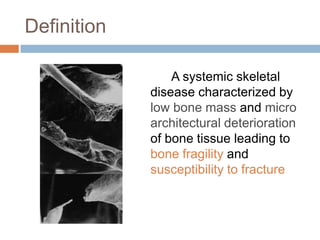
Definition

                 A systemic skeletal
             disease characterized by
             low bone mass and micro
             architectural deterioration
             of bone tissue leading to
             bone fragility and
             susceptibility to fracture
Who Gets Osteoporosis?
 Immobilization
 Hypogonadal states
 Endocrine disorders
 Malnutrition, parenteral nutrition and malabsorption
 rheumatologic disorders
 Renal insufficiency
 Hematologic disorders
 Several inherited disorders
Osteoporosis
   Mechanisms causing osteoporosis
     Imbalance   between rate of resorption and
      formation
     Failure to complete stages of remodeling

   Types of osteoporosis
     Type I
     Type II

     Secondary
Osteoporosis - Types
   Postmenopausal osteoporosis (type I)
     Caused by lack of estrogen
     Causes PTH to overstimulate osteoclast

   Age-associated osteoporosis (type II)
     Bone loss due to increased bone turnover
     Malabsorption

     Mineral and vitamin deficiency
Classification
   Primary
       Postmenopausal
           Bone loss – 2-3% per year of total bone mass
           Most common fx: vertebral, distal forearm
       Age related – 3rd decade of life starts slow decline in
        bone mass at rate of 0.5-1% per year
           Most common types of fx: hip and radius
           F>M
   Secondary
Secondary Osteoporosis
Disease states

   Acromegaly                Multiple myeloma
   Addison’s disease         Multiple sclerosis
   Amyloidosis               Rheumatoid arthritis
   Anorexia                  Sarcoidosis
   COPD                      Severe liver dz, esp.
   Hemochromatosis            PBC
   Hyperparathyroidism       Thalessemia
   Lymphoma and              Thyrotoxicosis
    leukemia
   Malabsorption states
Secondary Osteoporosis
Drugs
   Aluminum
   Anticonvulsants
   Excessive thyroxine
   Depo Provera (decreased bone mass
    reversible after stopping medication)
   Glucocorticoids
   GnRH agonists
   Heparin
   Lithium
Diagnosing Osteoporosis
   Outcome of interest: Fracture Risk!
   Outcome measured (surrogate): BMD
     Key: Older women at higher risk of fracture than
      younger women with SAME BMD!
     Other factors: risk of falling, bone fragility not all
      related to BMD
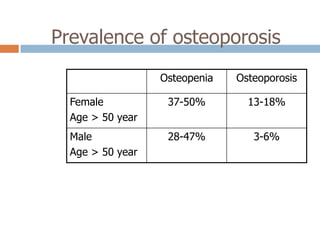
Prevalence of osteoporosis
                  Osteopenia   Osteoporosis

  Female           37-50%        13-18%
  Age > 50 year
  Male             28-47%         3-6%
  Age > 50 year
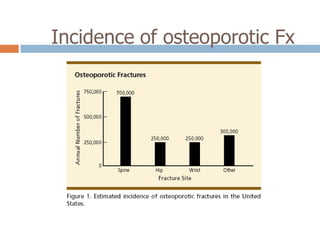
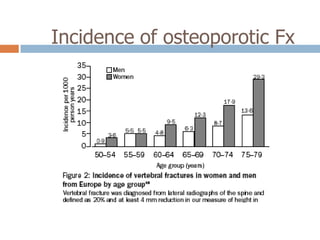
Incidence of osteoporotic Fx
Diagnosis of Osteoporosis

   Physical examination
   Measurement of bone mineral content
•   Dual X-ray absorptiometry (DXA)
•   Ultrasonic measurement of bone
•   CT scan
•   Radiography
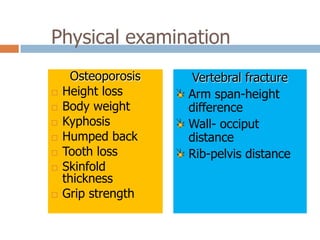
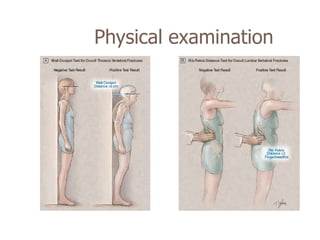
Physical examination
     Osteoporosis    Vertebral fracture
   Height loss     Arm span-height
   Body weight     difference
   Kyphosis        Wall- occiput
   Humped back     distance
   Tooth loss      Rib-pelvis distance
   Skinfold
    thickness
   Grip strength
Physical examination

    No single maneuver is sufficient to rule in or
rule out osteoporosis or vertebral fracture
without further testing
Diagnosing Osteoporosis
   Laboratory Data
     Limited value in diagnosis
     Markers of bone turnover (telopeptide) more useful in
      monitoring effects of treatment than in diagnosis
     Helpful to exclude secondary causes
           Hyperthyroidism
           Hyperparathyroidism
           Estrogen or testosterone deficiency
           Malignancy
           Multiple myeloma
           Calcium/Vitamin D deficiency
Work-up
Screen for secondary causes
    Serum calcium, phosphorus, alk phos

    PTH if calcium is high         (hyperparathyroidism)
    25-hydroxyvitamin D if low ca,

   low phos and high alk. phos      (osteomalacia)
    Thyroid function tests         (thyrotoxicosis)
    SPEP, UPEP                      (multiple myeloma)
    24-hour urinary calcium         (hyper or hypo calciuria)
    Serum testosterone               (hypogonadism)
Methods to evaluate for osteoporosis

   Quantitative Ultrasonography
   Quantitative computed tomography
   Dual Energy X-ray Absorptiometry (DEXA)
     ?”gold standard”
     Measurements vary by site
     Heel and forearm: easy but less reliable (outcome of
      interest is fracture of vertebra or hip!)
     Hip site: best correlation with future risk hip fracture
     Vertebral spine: predict vertebral fractures; risk of
      falsely HIGH scores if underlying OA/osteophytes
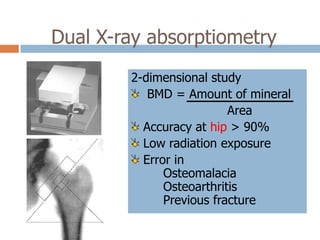
Dual X-ray absorptiometry
        2-dimensional study
           BMD = Amount of mineral
                          Area
          Accuracy at hip > 90%
          Low radiation exposure
          Error in
              Osteomalacia
              Osteoarthritis
              Previous fracture
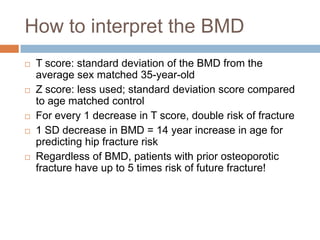
How to interpret the BMD
   T score: standard deviation of the BMD from the
    average sex matched 35-year-old
   Z score: less used; standard deviation score compared
    to age matched control
   For every 1 decrease in T score, double risk of fracture
   1 SD decrease in BMD = 14 year increase in age for
    predicting hip fracture risk
   Regardless of BMD, patients with prior osteoporotic
    fracture have up to 5 times risk of future fracture!
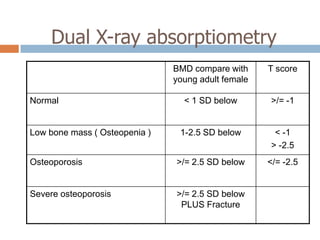
Dual X-ray absorptiometry
                               BMD compare with     T score
                               young adult female

Normal                           < 1 SD below       >/= -1


Low bone mass ( Osteopenia )    1-2.5 SD below       < -1
                                                    > -2.5
Osteoporosis                   >/= 2.5 SD below     </= -2.5


Severe osteoporosis            >/= 2.5 SD below
                                PLUS Fracture
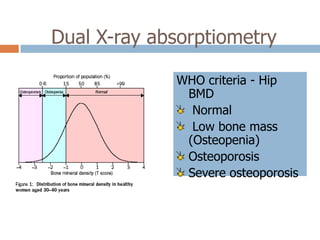
Dual X-ray absorptiometry

             WHO criteria - Hip
              BMD
               Normal
               Low bone mass
              (Osteopenia)
              Osteoporosis
              Severe osteoporosis
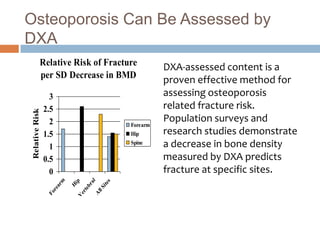
Osteoporosis Can Be Assessed by
DXA
             Relative Risk of Fracture                    DXA-assessed content is a
             per SD Decrease in BMD
                                                          proven effective method for
                   3                                      assessing osteoporosis
                 2.5                                      related fracture risk.
 Relative Risk


                   2                                      Population surveys and
                                                Forearm
                 1.5                            Hip       research studies demonstrate
                   1
                                                Spine     a decrease in bone density
                 0.5                                      measured by DXA predicts
                   0                                      fracture at specific sites.
                       m


                                     l
                              p


                                            s
                                  ra

                                         ite
                           Hi
                     ar


                                  b

                                        lS
                   re


                               rte
                  Fo


                                      Al
                             Ve
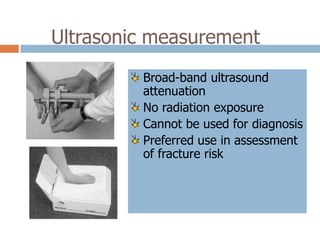
Ultrasonic measurement
         Broad-band ultrasound
         attenuation
         No radiation exposure
         Cannot be used for diagnosis
         Preferred use in assessment
         of fracture risk
The calcaneus is the most common skeletal site
 for quantitative ultrasound assessment
 because
  -It has a high percentage of trabecular bone
 that is replaced more often than cortical
 bone, providing early evidence of metabolic
 change.
  -Also, the calcaneus is fairly flat and
 parallel, reducing repositioning errors.
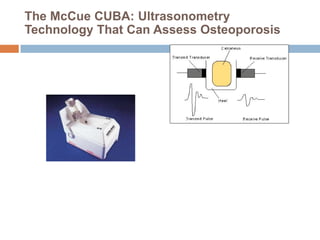
The McCue CUBA: Ultrasonometry
Technology That Can Assess Osteoporosis
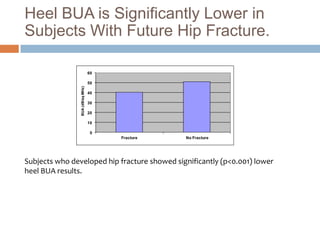
Heel BUA is Significantly Lower in
Subjects With Future Hip Fracture.

                                  60

                BUA (dB/sq MHz)   50

                                  40

                                  30

                                  20

                                  10

                                   0
                                       Fracture   No Fracture


Subjects who developed hip fracture showed significantly (p<0.001) lower
heel BUA results.
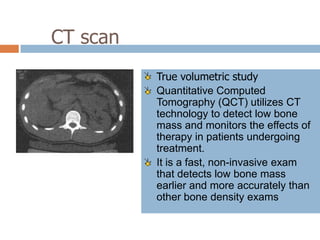
CT scan
          True volumetric study
          Quantitative Computed
          Tomography (QCT) utilizes CT
          technology to detect low bone
          mass and monitors the effects of
          therapy in patients undergoing
          treatment.
          It is a fast, non-invasive exam
          that detects low bone mass
          earlier and more accurately than
          other bone density exams
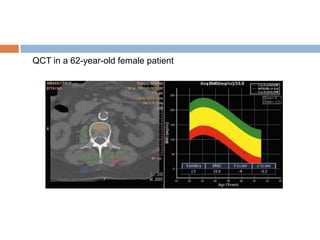
QCT in a 62-year-old female patient
    The trabecular BMD is indicated as the most
    important parameter, and interpreted using the
    Felsenberg classification, based on the
    following cut-off values:

    Normal BMD > 120 mg/cc
    Osteopenia < 120 mg/cc
    Osteoporosis < 80 mg/cc
    Very high fracture risk < 50 mg/cc
Advantages over DXA:

   Ability to separate cortical and trabecular bone

   Provides true volumetric density in units of mg/cc

   No errors due to spinal degenerative changes or
    aortic calcification
Clinicians and researchers favor DXA because

-scanners are readily available and relatively
inexpensive.

-The radiation dose is negligible

-The T-score scale, defined by the WHO specifically for
DXA, provides a standardized classification.
Plain radiography
     Low sensitivity
     High availability
     Subclinical vertebral fracture is a
     strong risk factor for subsequent
     fractures at new vertebral site and
     other sites
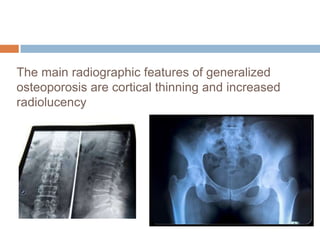
The main radiographic features of generalized
osteoporosis are cortical thinning and increased
radiolucency
Singh Index
   The Singh index describes the trabecular
    patterns in the bone at the top of the thighbone
    (femur).
    X-rays are graded 1 through 6 according to
    the disappearance of the normal trabecular
    pattern.
   Studies have shown a link between a Singh
    index of less than 3 and fractures of the hip,
    wrist, and spine.
ASSESSMENT OF
FRACTURE RISK
Assessment of fracture risk

   DXA and quantitative ultrasound
   Clinical risk factors
   Markers of bone turnover
        Bone formation
        Bone resorption
Assessment of fracture risk
   DXA
       Risk of fracture = 1.5-3.0 for each SD
    decrease in BMD
       Low sensitivity ( comparable to BP in
    predicting stroke )
       Screening is not recommended
   Quantitative ultrasound
        Risk of fracture = 1.5-2.0 for each SD
    decrease in BMD
Assessment of fracture risk

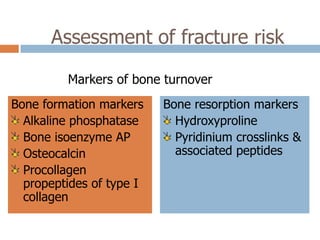
         Markers of bone turnover
Bone formation markers    Bone resorption markers
  Alkaline phosphatase      Hydroxyproline
  Bone isoenzyme AP         Pyridinium crosslinks &
  Osteocalcin               associated peptides
  Procollagen
  propeptides of type I
  collagen
Assessment of fracture risk

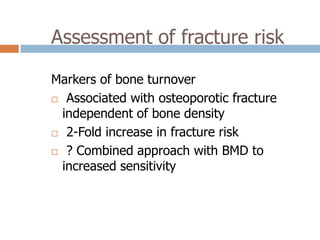
Markers of bone turnover
 Associated with osteoporotic fracture

  independent of bone density
 2-Fold increase in fracture risk

 ? Combined approach with BMD to

  increased sensitivity
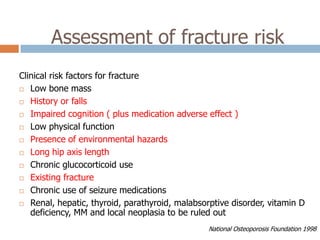
Assessment of fracture risk
Clinical risk factors for fracture
 Low bone mass

 History or falls

 Impaired cognition ( plus medication adverse effect )

 Low physical function

 Presence of environmental hazards

 Long hip axis length

 Chronic glucocorticoid use

 Existing fracture

 Chronic use of seizure medications

 Renal, hepatic, thyroid, parathyroid, malabsorptive disorder, vitamin D
   deficiency, MM and local neoplasia to be ruled out
                                                National Osteoporosis Foundation 1998
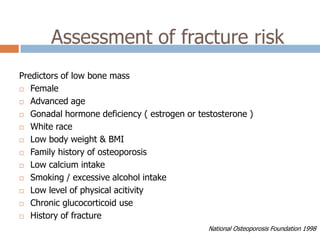
Assessment of fracture risk
Predictors of low bone mass
 Female

 Advanced age

 Gonadal hormone deficiency ( estrogen or testosterone )

 White race

 Low body weight & BMI

 Family history of osteoporosis

 Low calcium intake

 Smoking / excessive alcohol intake

 Low level of physical acitivity

 Chronic glucocorticoid use

 History of fracture

                                              National Osteoporosis Foundation 1998
When to Measure BMD in
Postmenopausal Women
   All women 65 years and older
   Postmenopausal women <65 years of age:
     Ifresult might influence decisions about
      intervention
     One or more risk factors

     History of fracture
When Measurement of BMD Is Not
Appropriate
   Healthy premenopausal women
   Healthy children and adolescents
   Women initiating ET/HT for menopausal
    symptom relief (other osteoporosis therapies
    should not be initiated without BMD
    measurement)
THANK YOU

Osteoporosis

  • 1.
    DIAGNOSIS OF OSTEOPOROSIS DR NITINKAUSHIK J.R. ORTHOPAEDICS
  • 2.
    Definition A systemic skeletal disease characterized by low bone mass and micro architectural deterioration of bone tissue leading to bone fragility and susceptibility to fracture
  • 3.
    Who Gets Osteoporosis? Immobilization Hypogonadal states Endocrine disorders Malnutrition, parenteral nutrition and malabsorption rheumatologic disorders Renal insufficiency Hematologic disorders Several inherited disorders
  • 4.
    Osteoporosis  Mechanisms causing osteoporosis  Imbalance between rate of resorption and formation  Failure to complete stages of remodeling  Types of osteoporosis  Type I  Type II  Secondary
  • 5.
    Osteoporosis - Types  Postmenopausal osteoporosis (type I)  Caused by lack of estrogen  Causes PTH to overstimulate osteoclast  Age-associated osteoporosis (type II)  Bone loss due to increased bone turnover  Malabsorption  Mineral and vitamin deficiency
  • 6.
    Classification  Primary  Postmenopausal  Bone loss – 2-3% per year of total bone mass  Most common fx: vertebral, distal forearm  Age related – 3rd decade of life starts slow decline in bone mass at rate of 0.5-1% per year  Most common types of fx: hip and radius  F>M  Secondary
  • 7.
    Secondary Osteoporosis Disease states  Acromegaly  Multiple myeloma  Addison’s disease  Multiple sclerosis  Amyloidosis  Rheumatoid arthritis  Anorexia  Sarcoidosis  COPD  Severe liver dz, esp.  Hemochromatosis PBC  Hyperparathyroidism  Thalessemia  Lymphoma and  Thyrotoxicosis leukemia  Malabsorption states
  • 8.
    Secondary Osteoporosis Drugs  Aluminum  Anticonvulsants  Excessive thyroxine  Depo Provera (decreased bone mass reversible after stopping medication)  Glucocorticoids  GnRH agonists  Heparin  Lithium
  • 9.
    Diagnosing Osteoporosis  Outcome of interest: Fracture Risk!  Outcome measured (surrogate): BMD  Key: Older women at higher risk of fracture than younger women with SAME BMD!  Other factors: risk of falling, bone fragility not all related to BMD
  • 10.
    Prevalence of osteoporosis Osteopenia Osteoporosis Female 37-50% 13-18% Age > 50 year Male 28-47% 3-6% Age > 50 year
  • 11.
  • 12.
  • 13.
    Diagnosis of Osteoporosis  Physical examination  Measurement of bone mineral content • Dual X-ray absorptiometry (DXA) • Ultrasonic measurement of bone • CT scan • Radiography
  • 14.
    Physical examination Osteoporosis Vertebral fracture  Height loss Arm span-height  Body weight difference  Kyphosis Wall- occiput  Humped back distance  Tooth loss Rib-pelvis distance  Skinfold thickness  Grip strength
  • 15.
  • 16.
    Physical examination No single maneuver is sufficient to rule in or rule out osteoporosis or vertebral fracture without further testing
  • 17.
    Diagnosing Osteoporosis  Laboratory Data  Limited value in diagnosis  Markers of bone turnover (telopeptide) more useful in monitoring effects of treatment than in diagnosis  Helpful to exclude secondary causes  Hyperthyroidism  Hyperparathyroidism  Estrogen or testosterone deficiency  Malignancy  Multiple myeloma  Calcium/Vitamin D deficiency
  • 18.
    Work-up Screen for secondarycauses  Serum calcium, phosphorus, alk phos  PTH if calcium is high (hyperparathyroidism)  25-hydroxyvitamin D if low ca, low phos and high alk. phos (osteomalacia)  Thyroid function tests (thyrotoxicosis)  SPEP, UPEP (multiple myeloma)  24-hour urinary calcium (hyper or hypo calciuria)  Serum testosterone (hypogonadism)
  • 19.
    Methods to evaluatefor osteoporosis  Quantitative Ultrasonography  Quantitative computed tomography  Dual Energy X-ray Absorptiometry (DEXA)  ?”gold standard”  Measurements vary by site  Heel and forearm: easy but less reliable (outcome of interest is fracture of vertebra or hip!)  Hip site: best correlation with future risk hip fracture  Vertebral spine: predict vertebral fractures; risk of falsely HIGH scores if underlying OA/osteophytes
  • 20.
    Dual X-ray absorptiometry 2-dimensional study BMD = Amount of mineral Area Accuracy at hip > 90% Low radiation exposure Error in Osteomalacia Osteoarthritis Previous fracture
  • 21.
    How to interpretthe BMD  T score: standard deviation of the BMD from the average sex matched 35-year-old  Z score: less used; standard deviation score compared to age matched control  For every 1 decrease in T score, double risk of fracture  1 SD decrease in BMD = 14 year increase in age for predicting hip fracture risk  Regardless of BMD, patients with prior osteoporotic fracture have up to 5 times risk of future fracture!
  • 22.
    Dual X-ray absorptiometry BMD compare with T score young adult female Normal < 1 SD below >/= -1 Low bone mass ( Osteopenia ) 1-2.5 SD below < -1 > -2.5 Osteoporosis >/= 2.5 SD below </= -2.5 Severe osteoporosis >/= 2.5 SD below PLUS Fracture
  • 23.
    Dual X-ray absorptiometry WHO criteria - Hip BMD Normal Low bone mass (Osteopenia) Osteoporosis Severe osteoporosis
  • 24.
    Osteoporosis Can BeAssessed by DXA Relative Risk of Fracture DXA-assessed content is a per SD Decrease in BMD proven effective method for 3 assessing osteoporosis 2.5 related fracture risk. Relative Risk 2 Population surveys and Forearm 1.5 Hip research studies demonstrate 1 Spine a decrease in bone density 0.5 measured by DXA predicts 0 fracture at specific sites. m l p s ra ite Hi ar b lS re rte Fo Al Ve
  • 25.
    Ultrasonic measurement Broad-band ultrasound attenuation No radiation exposure Cannot be used for diagnosis Preferred use in assessment of fracture risk
  • 26.
    The calcaneus isthe most common skeletal site for quantitative ultrasound assessment because -It has a high percentage of trabecular bone that is replaced more often than cortical bone, providing early evidence of metabolic change. -Also, the calcaneus is fairly flat and parallel, reducing repositioning errors.
  • 27.
    The McCue CUBA:Ultrasonometry Technology That Can Assess Osteoporosis
  • 28.
    Heel BUA isSignificantly Lower in Subjects With Future Hip Fracture. 60 BUA (dB/sq MHz) 50 40 30 20 10 0 Fracture No Fracture Subjects who developed hip fracture showed significantly (p<0.001) lower heel BUA results.
  • 29.
    CT scan True volumetric study Quantitative Computed Tomography (QCT) utilizes CT technology to detect low bone mass and monitors the effects of therapy in patients undergoing treatment. It is a fast, non-invasive exam that detects low bone mass earlier and more accurately than other bone density exams
  • 30.
    QCT in a62-year-old female patient
  • 31.
    The trabecular BMD is indicated as the most important parameter, and interpreted using the Felsenberg classification, based on the following cut-off values: Normal BMD > 120 mg/cc Osteopenia < 120 mg/cc Osteoporosis < 80 mg/cc Very high fracture risk < 50 mg/cc
  • 32.
    Advantages over DXA:  Ability to separate cortical and trabecular bone  Provides true volumetric density in units of mg/cc  No errors due to spinal degenerative changes or aortic calcification
  • 33.
    Clinicians and researchersfavor DXA because -scanners are readily available and relatively inexpensive. -The radiation dose is negligible -The T-score scale, defined by the WHO specifically for DXA, provides a standardized classification.
  • 34.
    Plain radiography Low sensitivity High availability Subclinical vertebral fracture is a strong risk factor for subsequent fractures at new vertebral site and other sites
  • 35.
    The main radiographicfeatures of generalized osteoporosis are cortical thinning and increased radiolucency
  • 36.
    Singh Index  The Singh index describes the trabecular patterns in the bone at the top of the thighbone (femur).  X-rays are graded 1 through 6 according to the disappearance of the normal trabecular pattern.  Studies have shown a link between a Singh index of less than 3 and fractures of the hip, wrist, and spine.
  • 37.
  • 38.
    Assessment of fracturerisk  DXA and quantitative ultrasound  Clinical risk factors  Markers of bone turnover Bone formation Bone resorption
  • 39.
    Assessment of fracturerisk  DXA Risk of fracture = 1.5-3.0 for each SD decrease in BMD Low sensitivity ( comparable to BP in predicting stroke ) Screening is not recommended  Quantitative ultrasound Risk of fracture = 1.5-2.0 for each SD decrease in BMD
  • 40.
    Assessment of fracturerisk Markers of bone turnover Bone formation markers Bone resorption markers Alkaline phosphatase Hydroxyproline Bone isoenzyme AP Pyridinium crosslinks & Osteocalcin associated peptides Procollagen propeptides of type I collagen
  • 41.
    Assessment of fracturerisk Markers of bone turnover  Associated with osteoporotic fracture independent of bone density  2-Fold increase in fracture risk  ? Combined approach with BMD to increased sensitivity
  • 42.
    Assessment of fracturerisk Clinical risk factors for fracture  Low bone mass  History or falls  Impaired cognition ( plus medication adverse effect )  Low physical function  Presence of environmental hazards  Long hip axis length  Chronic glucocorticoid use  Existing fracture  Chronic use of seizure medications  Renal, hepatic, thyroid, parathyroid, malabsorptive disorder, vitamin D deficiency, MM and local neoplasia to be ruled out National Osteoporosis Foundation 1998
  • 43.
    Assessment of fracturerisk Predictors of low bone mass  Female  Advanced age  Gonadal hormone deficiency ( estrogen or testosterone )  White race  Low body weight & BMI  Family history of osteoporosis  Low calcium intake  Smoking / excessive alcohol intake  Low level of physical acitivity  Chronic glucocorticoid use  History of fracture National Osteoporosis Foundation 1998
  • 44.
    When to MeasureBMD in Postmenopausal Women  All women 65 years and older  Postmenopausal women <65 years of age:  Ifresult might influence decisions about intervention  One or more risk factors  History of fracture
  • 45.
    When Measurement ofBMD Is Not Appropriate  Healthy premenopausal women  Healthy children and adolescents  Women initiating ET/HT for menopausal symptom relief (other osteoporosis therapies should not be initiated without BMD measurement)
  • 46.