SEGMENTAND SEQUENTIAL
STRATEGIES FOR SOLUTION
PHASE PEPTIDE SYNTHESIS
Presented by: Shubham Sharma
Pharmaceutical Chemistry
MpharmIIsem
Roll no. : 20029
Presented to : Dr. Ashok Yadav
Professor ,UIPS, Panjab University
1
Email : shubham00sharma70@gmail.com
Purification
(Reagent)
Substrate (product) +(reagent) (product)
CONTENTS
 PROTECTING GROUPS USED IN PEPTIDE SYNTHESIS
 DIFFERENCE BETWEEN SOLID AND SOLUTION PHASE PEPTIDE
SYNTHESIS
 SYNTHESIS OF PEPTIDE IN SOLUTION
 STRATEGIES USED IN PEPTIDE SYNTHESIS
 CASE STUDY
 APPLICATIONS
 REFERENCE
3
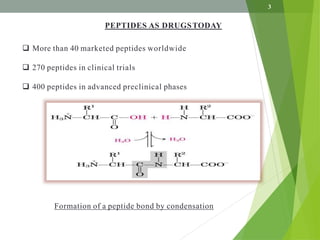
PEPTIDES AS DRUGSTODAY
 More than 40 marketed peptides worldwide
 270 peptides in clinical trials
 400 peptides in advanced preclinical phases
Formation of a peptide bond by condensation
4
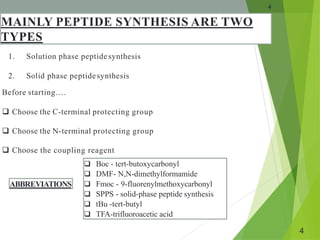
Before starting….
 Choose the C-terminal protecting group
 Choose the N-terminal protecting group
 Choose the coupling reagent
MAINLY PEPTIDE SYNTHESIS ARE TWO
TYPES
1. Solution phase peptidesynthesis
2. Solid phase peptidesynthesis
ABBREVIATIONS
4
 Boc - tert-butoxycarbonyl
 DMF- N,N-dimethylformamide
 Fmoc - 9-fluorenylmethoxycarbonyl
 SPPS - solid-phase peptide synthesis
 tBu -tert-butyl
 TFA-trifluoroacetic acid
5
OH
H2N
O
R
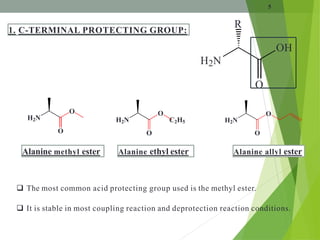
1. C-TERMINAL PROTECTING GROUP:
H2N
O
O
H2N
O
O
H2N
O
O
C2H5
Alanine methyl ester Alanine allyl ester
Alanine ethyl ester
 The most common acid protecting group used is the methyl ester.
 It is stable in most coupling reaction and deprotection reaction conditions.
6
H2N
OH
R
O
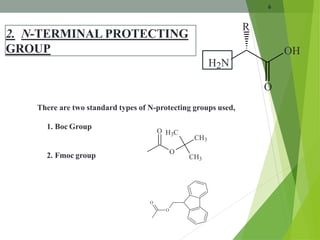
There are two standard types of N-protecting groups used,
2. N-TERMINAL PROTECTING
GROUP
1. Boc Group
2. Fmoc group O
O H3C
CH3
CH3
O
O
7
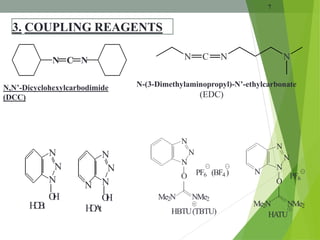
3. COUPLING REAGENTS
N-(3-Dimethylaminopropyl)-N’-ethylcarbonate
(EDC)
N C N
N,N’-Dicyclohexylcarbodimide
(DCC)
N C N N
N
N
N
O PF6 (BF4) N
N
N
N
O
Me2N NMe2
Me2N NMe2
HBTU(TBTU) HATU
PF6
N
N
N
O
H
H
O
B
t
N N
N
N
O
H
H
O
A
t
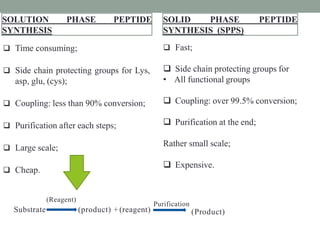
 Time consuming;
 Side chain protecting groups for Lys,
asp, glu, (cys);
 Coupling: less than 90% conversion;
 Purification after each steps;
 Large scale;
 Cheap.
 Fast;
 Side chain protecting groups for
• All functional groups
 Coupling: over 99.5% conversion;
 Purification at the end;
Rather small scale;
 Expensive.
SOLUTION PHASE PEPTIDE
SYNTHESIS
SOLID PHASE PEPTIDE
SYNTHESIS (SPPS)
Purification
(Reagent)
Substrate (product) +(reagent) (Product)
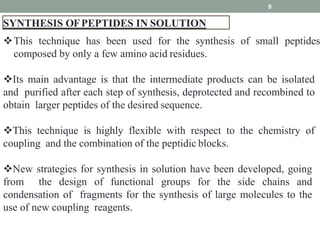
SYNTHESIS OFPEPTIDES IN SOLUTION
9
This technique has been used for the synthesis of small peptides
composed by only a few amino acid residues.
Its main advantage is that the intermediate products can be isolated
and purified after each step of synthesis, deprotected and recombined to
obtain larger peptides of the desired sequence.
This technique is highly flexible with respect to the chemistry of
coupling and the combination of the peptidic blocks.
New strategies for synthesis in solution have been developed, going
from the design of functional groups for the side chains and
condensation of fragments for the synthesis of large molecules to the
use of new coupling reagents.
10
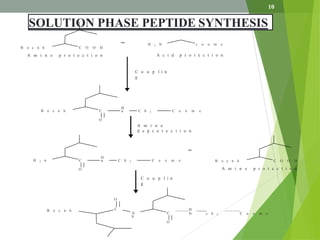
SOLUTION PHASE PEPTIDE SYNTHESIS
B o c n h C O O H
A m i n e p r o t e c t i o n
B o c n h C
O
H
n C h 2 C o o m e
H 2 n C
H
n C h 2 C o o m e
H 2 N c o o m e
A c i d p r o t e c t i o n
O
C o u p l i n
g
A m i n e
d e p r o t e c t i o n
B o c n h C O O H
A m i n e p r o t e c t i o n
C o u p l i n
g
N
h
C
H
N c h 2 C o o m e
O
C
O
B o c n h
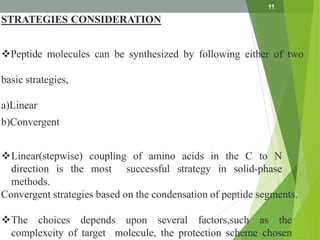
STRATEGIES CONSIDERATION
Peptide molecules can be synthesized by following either of two
basic strategies,
a)Linear
b)Convergent
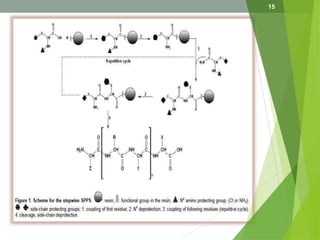
Linear(stepwise) coupling of amino acids in the C to N
direction is the most successful strategy in solid-phase
methods.
Convergent strategies based on the condensation of peptide segments.
The choices depends upon several factors,such as the
complexcity of target molecule, the protection scheme chosen
11
Convergent Strategies
12
Strategies in which peptide segments are coupled together to give the desired target molecule
appear, atleast at first sight, to be the most promising for the synthesis of long peptides, for
several reasons.
The difference between the desired condensation product and the segments themselves,in terms
of molecular size and chemical nature, should be sufficiently pronounced so as to permit their
separation relatively easily.
Linear Strategies
Separation Problem:
The addition of residues one at a time leads to only small differences in chemical character
between the various intermediate peptides of a long synthesis. In the synthesis of large peptides by
convergent strategies, team of workers can be assigned to different segments, which can be
prepared simultaneously.
A linear synthesis must, of necessary be carried out in a sequential manner and probably by one
person or at most by one team.
 A further advantage of convergent strategies is that workers are always closer to the starting
materials, so that it is easy to go back to the beginning ant to repeat a synthesis if difficulties are
encountered, if material is lost, or if it is realized that a change in the protection scheme is
necessary.
 If an advanced intermediate in a linear synthesis is lost, on the other hand, then the whole
molecule must be synthesized again from scratch.
 However, in spite of these seeming advantages, there are other, perhaps less obvious,
factors that militate against convergent synthesis.
 First and above all of larger segments, the low molar concentration of the components to be
coupled means that reaction kinetics are slow and that yields for the couping reaction can often
be low.
 Second, in order for the condensation of peptides segments to take place in an unambigious
manner, they must normally be protected at all reactive functionalities that are not involved
In the coupling reaction.
 This requirement leads to problems of solubility, again above all for large segments,
which are often only poorly soluble in the commonly used solvents.
13
 In severe cases of insolubility the chemical manipulation of protected peptide segments
may be rendered effectively impossible.
 In general, convergent strategies have tended to be those adopted for the
synthesis of complex peptides in solution , as many of the most important
synthesis demonstrate.
 The protected peptide segments used in a convergent strategy are, however, usually
synthesized in a stepwise manner although larger segments, of course, might be
made by the condensation of smaller ones.
 For smaller peptide target molecules,linear strategies have been used more often,
although not necessarily to the exclusion of convergent ones.
 The protected peptide segments used in convergent synthesis strategies can be
synthesized by conventional solution methods using appropriate modifications of the
chemistry involved.
 By the same token, segment condensations can be carried out either in solution or on
solid supports.
14
15
CASE STUDY
16
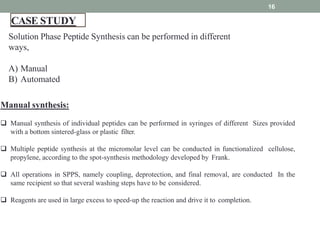
Solution Phase Peptide Synthesis can be performed in different
ways,
A) Manual
B) Automated
Manual synthesis:
 Manual synthesis of individual peptides can be performed in syringes of different Sizes provided
with a bottom sintered-glass or plastic filter.
 Multiple peptide synthesis at the micromolar level can be conducted in functionalized cellulose,
propylene, according to the spot-synthesis methodology developed by Frank.
 All operations in SPPS, namely coupling, deprotection, and final removal, are conducted In the
same recipient so that several washing steps have to be considered.
 Reagents are used in large excess to speed-up the reaction and drive it to completion.
AUTOMATED SYNTHESIS
1
7
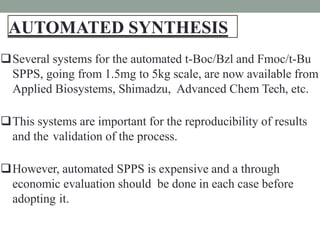
Several systems for the automated t-Boc/Bzl and Fmoc/t-Bu
SPPS, going from 1.5mg to 5kg scale, are now available from
Applied Biosystems, Shimadzu, Advanced Chem Tech, etc.
This systems are important for the reproducibility of results
and the validation of the process.
However, automated SPPS is expensive and a through
economic evaluation should be done in each case before
adopting it.
EXAMPLE
1
8
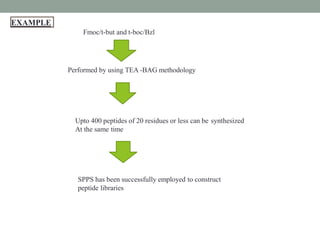
Fmoc/t-but and t-boc/Bzl
Performed by using TEA -BAG methodology
Upto 400 peptides of 20 residues or less can be synthesized
At the same time
SPPS has been successfully employed to construct
peptide libraries
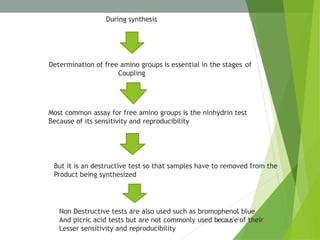
During synthesis
Determination of free amino groups is essential in the stages of
Coupling
Most common assay for free amino groups is the ninhydrin test
Because of its sensitivity and reproducibility
But it is an destructive test so that samples have to removed from the
Product being synthesized
Non Destructive tests are also used such as bromophenol blue
And picric acid tests but are not commonly used becaus1
e8
of their
Lesser sensitivity and reproducibility
Separation is based on hydrophobicity and mobile phase
gradients are used with polar solvents such as
ACETONITRILE
It is extremely rapid and hundreds of samples can be analysed
Sequentially over extremely small amounts of peptides.
2
0
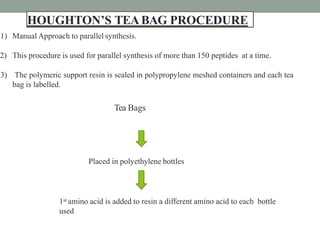
HOUGHTON’S TEABAG PROCEDURE
2
1
1) Manual Approach to parallel synthesis.
2) This procedure is used for parallel synthesis of more than 150 peptides at a time.
3) The polymeric support resin is sealed in polypropylene meshed containers and each tea
bag is labelled.
Tea Bags
Placed in polyethylene bottles
1st amino acid is added to resin a different amino acid to each bottle
used
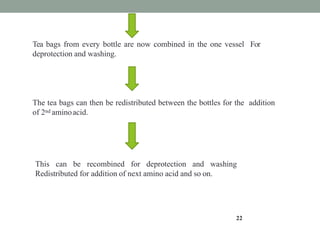
Tea bags from every bottle are now combined in the one vessel For
deprotection and washing.
22
The tea bags can then be redistributed between the bottles for the addition
of 2nd aminoacid.
This can be recombined for deprotection and washing
Redistributed for addition of next amino acid and so on.
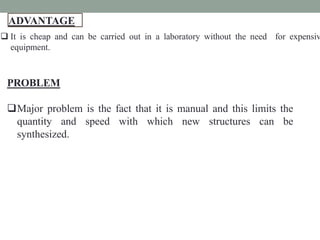
ADVANTAGE
23
 It is cheap and can be carried out in a laboratory without the need for expensiv
equipment.
PROBLEM
Major problem is the fact that it is manual and this limits the
quantity and speed with which new structures can be
synthesized.
APPLICATIONS
2
4
1) Reverse phase high performance liquid chromatography (HPLC), Using C-18 or C-8
columns, is the most used procedure for analysis and purification of peptides.
2) MALDI is used for molecular mass determination of peptides, since it produces no
fragmentation. Most used matrices for MALDI are 2-5 dihydroxy benzoic acid, 3-5
dimethoxy-4-hydroxy cinnamic acid.
3)Both MALDI and ESI are less sensitive for high molecular weight peptides (over
30,000 Da).
4) Determination of peptide structure can be done by Circular Dichroism and
NMR.
References
25
• Peptide Synthesis:Chemical or Enzymatic(review article)Vol.10 No.2,
Electronic Journal of Biotechnology ISSN: 0717-3458
• Principles of Peptide Synthesis by M.Bodanszky.
• Slideshare by Sameer Hadawale, Abhishek Sirsikar
•https://books.google.co.in/books?isbn=3642967639

Solution phase peptide synthesis

  • 1.
    SEGMENTAND SEQUENTIAL STRATEGIES FORSOLUTION PHASE PEPTIDE SYNTHESIS Presented by: Shubham Sharma Pharmaceutical Chemistry MpharmIIsem Roll no. : 20029 Presented to : Dr. Ashok Yadav Professor ,UIPS, Panjab University 1 Email : shubham00sharma70@gmail.com Purification (Reagent) Substrate (product) +(reagent) (product)
  • 2.
    CONTENTS  PROTECTING GROUPSUSED IN PEPTIDE SYNTHESIS  DIFFERENCE BETWEEN SOLID AND SOLUTION PHASE PEPTIDE SYNTHESIS  SYNTHESIS OF PEPTIDE IN SOLUTION  STRATEGIES USED IN PEPTIDE SYNTHESIS  CASE STUDY  APPLICATIONS  REFERENCE
  • 3.
    3 PEPTIDES AS DRUGSTODAY More than 40 marketed peptides worldwide  270 peptides in clinical trials  400 peptides in advanced preclinical phases Formation of a peptide bond by condensation
  • 4.
    4 Before starting….  Choosethe C-terminal protecting group  Choose the N-terminal protecting group  Choose the coupling reagent MAINLY PEPTIDE SYNTHESIS ARE TWO TYPES 1. Solution phase peptidesynthesis 2. Solid phase peptidesynthesis ABBREVIATIONS 4  Boc - tert-butoxycarbonyl  DMF- N,N-dimethylformamide  Fmoc - 9-fluorenylmethoxycarbonyl  SPPS - solid-phase peptide synthesis  tBu -tert-butyl  TFA-trifluoroacetic acid
  • 5.
    5 OH H2N O R 1. C-TERMINAL PROTECTINGGROUP: H2N O O H2N O O H2N O O C2H5 Alanine methyl ester Alanine allyl ester Alanine ethyl ester  The most common acid protecting group used is the methyl ester.  It is stable in most coupling reaction and deprotection reaction conditions.
  • 6.
    6 H2N OH R O There are twostandard types of N-protecting groups used, 2. N-TERMINAL PROTECTING GROUP 1. Boc Group 2. Fmoc group O O H3C CH3 CH3 O O
  • 7.
    7 3. COUPLING REAGENTS N-(3-Dimethylaminopropyl)-N’-ethylcarbonate (EDC) NC N N,N’-Dicyclohexylcarbodimide (DCC) N C N N N N N O PF6 (BF4) N N N N O Me2N NMe2 Me2N NMe2 HBTU(TBTU) HATU PF6 N N N O H H O B t N N N N O H H O A t
  • 8.
     Time consuming; Side chain protecting groups for Lys, asp, glu, (cys);  Coupling: less than 90% conversion;  Purification after each steps;  Large scale;  Cheap.  Fast;  Side chain protecting groups for • All functional groups  Coupling: over 99.5% conversion;  Purification at the end; Rather small scale;  Expensive. SOLUTION PHASE PEPTIDE SYNTHESIS SOLID PHASE PEPTIDE SYNTHESIS (SPPS) Purification (Reagent) Substrate (product) +(reagent) (Product)
  • 9.
    SYNTHESIS OFPEPTIDES INSOLUTION 9 This technique has been used for the synthesis of small peptides composed by only a few amino acid residues. Its main advantage is that the intermediate products can be isolated and purified after each step of synthesis, deprotected and recombined to obtain larger peptides of the desired sequence. This technique is highly flexible with respect to the chemistry of coupling and the combination of the peptidic blocks. New strategies for synthesis in solution have been developed, going from the design of functional groups for the side chains and condensation of fragments for the synthesis of large molecules to the use of new coupling reagents.
  • 10.
    10 SOLUTION PHASE PEPTIDESYNTHESIS B o c n h C O O H A m i n e p r o t e c t i o n B o c n h C O H n C h 2 C o o m e H 2 n C H n C h 2 C o o m e H 2 N c o o m e A c i d p r o t e c t i o n O C o u p l i n g A m i n e d e p r o t e c t i o n B o c n h C O O H A m i n e p r o t e c t i o n C o u p l i n g N h C H N c h 2 C o o m e O C O B o c n h
  • 11.
    STRATEGIES CONSIDERATION Peptide moleculescan be synthesized by following either of two basic strategies, a)Linear b)Convergent Linear(stepwise) coupling of amino acids in the C to N direction is the most successful strategy in solid-phase methods. Convergent strategies based on the condensation of peptide segments. The choices depends upon several factors,such as the complexcity of target molecule, the protection scheme chosen 11
  • 12.
    Convergent Strategies 12 Strategies inwhich peptide segments are coupled together to give the desired target molecule appear, atleast at first sight, to be the most promising for the synthesis of long peptides, for several reasons. The difference between the desired condensation product and the segments themselves,in terms of molecular size and chemical nature, should be sufficiently pronounced so as to permit their separation relatively easily. Linear Strategies Separation Problem: The addition of residues one at a time leads to only small differences in chemical character between the various intermediate peptides of a long synthesis. In the synthesis of large peptides by convergent strategies, team of workers can be assigned to different segments, which can be prepared simultaneously. A linear synthesis must, of necessary be carried out in a sequential manner and probably by one person or at most by one team.
  • 13.
     A furtheradvantage of convergent strategies is that workers are always closer to the starting materials, so that it is easy to go back to the beginning ant to repeat a synthesis if difficulties are encountered, if material is lost, or if it is realized that a change in the protection scheme is necessary.  If an advanced intermediate in a linear synthesis is lost, on the other hand, then the whole molecule must be synthesized again from scratch.  However, in spite of these seeming advantages, there are other, perhaps less obvious, factors that militate against convergent synthesis.  First and above all of larger segments, the low molar concentration of the components to be coupled means that reaction kinetics are slow and that yields for the couping reaction can often be low.  Second, in order for the condensation of peptides segments to take place in an unambigious manner, they must normally be protected at all reactive functionalities that are not involved In the coupling reaction.  This requirement leads to problems of solubility, again above all for large segments, which are often only poorly soluble in the commonly used solvents. 13
  • 14.
     In severecases of insolubility the chemical manipulation of protected peptide segments may be rendered effectively impossible.  In general, convergent strategies have tended to be those adopted for the synthesis of complex peptides in solution , as many of the most important synthesis demonstrate.  The protected peptide segments used in a convergent strategy are, however, usually synthesized in a stepwise manner although larger segments, of course, might be made by the condensation of smaller ones.  For smaller peptide target molecules,linear strategies have been used more often, although not necessarily to the exclusion of convergent ones.  The protected peptide segments used in convergent synthesis strategies can be synthesized by conventional solution methods using appropriate modifications of the chemistry involved.  By the same token, segment condensations can be carried out either in solution or on solid supports. 14
  • 15.
  • 16.
    CASE STUDY 16 Solution PhasePeptide Synthesis can be performed in different ways, A) Manual B) Automated Manual synthesis:  Manual synthesis of individual peptides can be performed in syringes of different Sizes provided with a bottom sintered-glass or plastic filter.  Multiple peptide synthesis at the micromolar level can be conducted in functionalized cellulose, propylene, according to the spot-synthesis methodology developed by Frank.  All operations in SPPS, namely coupling, deprotection, and final removal, are conducted In the same recipient so that several washing steps have to be considered.  Reagents are used in large excess to speed-up the reaction and drive it to completion.
  • 17.
    AUTOMATED SYNTHESIS 1 7 Several systemsfor the automated t-Boc/Bzl and Fmoc/t-Bu SPPS, going from 1.5mg to 5kg scale, are now available from Applied Biosystems, Shimadzu, Advanced Chem Tech, etc. This systems are important for the reproducibility of results and the validation of the process. However, automated SPPS is expensive and a through economic evaluation should be done in each case before adopting it.
  • 18.
    EXAMPLE 1 8 Fmoc/t-but and t-boc/Bzl Performedby using TEA -BAG methodology Upto 400 peptides of 20 residues or less can be synthesized At the same time SPPS has been successfully employed to construct peptide libraries
  • 19.
    During synthesis Determination offree amino groups is essential in the stages of Coupling Most common assay for free amino groups is the ninhydrin test Because of its sensitivity and reproducibility But it is an destructive test so that samples have to removed from the Product being synthesized Non Destructive tests are also used such as bromophenol blue And picric acid tests but are not commonly used becaus1 e8 of their Lesser sensitivity and reproducibility
  • 20.
    Separation is basedon hydrophobicity and mobile phase gradients are used with polar solvents such as ACETONITRILE It is extremely rapid and hundreds of samples can be analysed Sequentially over extremely small amounts of peptides. 2 0
  • 21.
    HOUGHTON’S TEABAG PROCEDURE 2 1 1)Manual Approach to parallel synthesis. 2) This procedure is used for parallel synthesis of more than 150 peptides at a time. 3) The polymeric support resin is sealed in polypropylene meshed containers and each tea bag is labelled. Tea Bags Placed in polyethylene bottles 1st amino acid is added to resin a different amino acid to each bottle used
  • 22.
    Tea bags fromevery bottle are now combined in the one vessel For deprotection and washing. 22 The tea bags can then be redistributed between the bottles for the addition of 2nd aminoacid. This can be recombined for deprotection and washing Redistributed for addition of next amino acid and so on.
  • 23.
    ADVANTAGE 23  It ischeap and can be carried out in a laboratory without the need for expensiv equipment. PROBLEM Major problem is the fact that it is manual and this limits the quantity and speed with which new structures can be synthesized.
  • 24.
    APPLICATIONS 2 4 1) Reverse phasehigh performance liquid chromatography (HPLC), Using C-18 or C-8 columns, is the most used procedure for analysis and purification of peptides. 2) MALDI is used for molecular mass determination of peptides, since it produces no fragmentation. Most used matrices for MALDI are 2-5 dihydroxy benzoic acid, 3-5 dimethoxy-4-hydroxy cinnamic acid. 3)Both MALDI and ESI are less sensitive for high molecular weight peptides (over 30,000 Da). 4) Determination of peptide structure can be done by Circular Dichroism and NMR.
  • 25.
    References 25 • Peptide Synthesis:Chemicalor Enzymatic(review article)Vol.10 No.2, Electronic Journal of Biotechnology ISSN: 0717-3458 • Principles of Peptide Synthesis by M.Bodanszky. • Slideshare by Sameer Hadawale, Abhishek Sirsikar •https://books.google.co.in/books?isbn=3642967639