
`
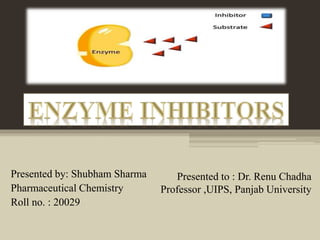
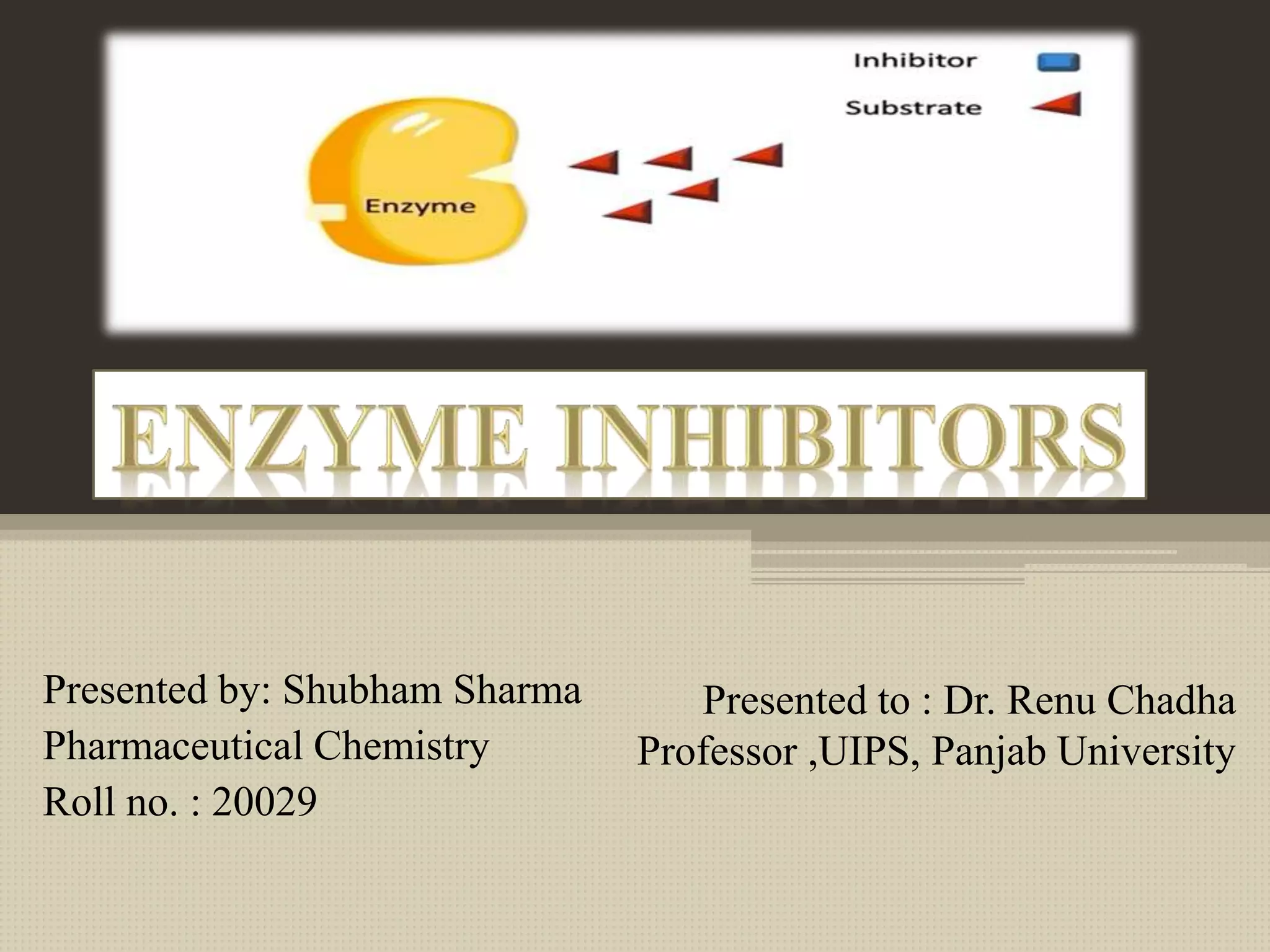
Presented by: Shubham Sharma
Pharmaceutical Chemistry
Roll no. : 20029
Presented to : Dr. Renu Chadha
Professor ,UIPS, Panjab University
CONTENTS
Enzyme
 Enzyme inhibition
 Classification of Enzyme inhibitors
Mechanism of enzyme inhibition
Enzyme inhibitors in medicine
Enzyme inhibitors in basic research.
 Enzymes are soluble, colloidal, organic catalysts, formed by living cells specific in
action, protein in nature, inactive at zero degree Celsius and destroyed by moist
heat at 100 degree Celsius.
 Enzymes are the specialized proteins which catalyze various biochemical reactions.
The concept of enzyme inhibition is routinely utilized to affect biosynthesis and
metabolic pattern of various hormones, autacoids, and neurotransmitters.
 In 1926, J.B. Sumner have isolated urease.
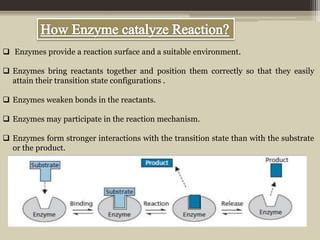
 Enzymes provide a reaction surface and a suitable environment.
 Enzymes bring reactants together and position them correctly so that they easily
attain their transition state configurations .
 Enzymes weaken bonds in the reactants.
 Enzymes may participate in the reaction mechanism.
 Enzymes form stronger interactions with the transition state than with the substrate
or the product.
 Inhibitors are the chemicals that reduces the rate of
enzymatic reactions.
 They are usually specific at work at low concentrations.
 They block the enzyme but they do not usually destroy it.
 Many drugs and poisons are inhibitors of enzymes in the
nervous system.
Enzyme Inhibitors
Enzyme inhibitors are the molecules that reduces the catalytic activity
of enzymes. Reducing of effective enzymatic activity or complete
blocking of enzymes may cause either complete death of cell or either
modifications in the pathways.
Drugs which cause complete inactivation of enzymes from essential
pathways may cause cell death and therefore such drugs can be used as
antibiotics.
 The inhibition of a suitably selected target enzyme leads to build up
in concentration of substrates and a corresponding decrease in the
concentration of the metabolites.
 Important parameters for selecting an enzyme inhibitor are:
1. Biochemical environment of the target enzyme.
2. Specificity of action.
3. The time period for which an enzyme is blocked.
Reversible inhibition
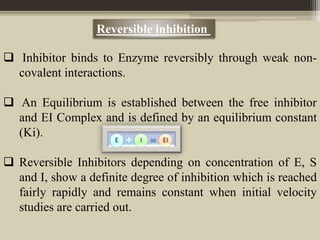
 Inhibitor binds to Enzyme reversibly through weak non-
covalent interactions.
 An Equilibrium is established between the free inhibitor
and EI Complex and is defined by an equilibrium constant
(Ki).
 Reversible Inhibitors depending on concentration of E, S
and I, show a definite degree of inhibition which is reached
fairly rapidly and remains constant when initial velocity
studies are carried out.
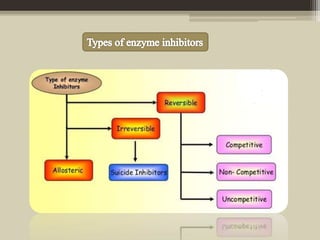
The reversible inhibition is further sub-divided into:
I. Competitive inhibition
II. Noncompetitive inhibition
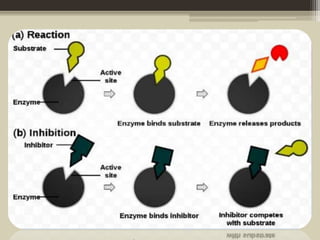
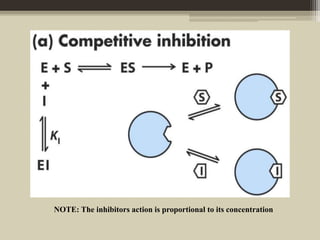
 The inhibitor which closely resembles the real substrate (S) is regarded as a substrate
analogue.
 The inhibitor competes with substrate and binds at the active site of the enzyme but does not
undergo any catalysis.
 As long as the competitive inhibitor holds the active site, the enzyme is not available for the
substrate to bind. During the reaction, ES and EI complexes are formed .
 The relative concentration of the substrate and inhibitor and their respective affinity with the
enzyme determines the degree of competitive inhibition.
 The inhibition could be overcome by a high substrate concentration. In competitive
inhibition, the Km value increases whereas Vmax remains unchanged .
NOTE: The inhibitors action is proportional to its concentration
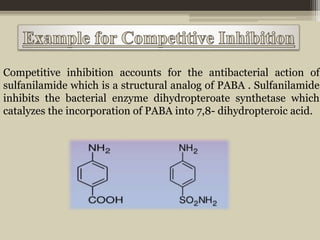
Competitive inhibition accounts for the antibacterial action of
sulfanilamide which is a structural analog of PABA . Sulfanilamide
inhibits the bacterial enzyme dihydropteroate synthetase which
catalyzes the incorporation of PABA into 7,8- dihydropteroic acid.
 The inhibitor binds at a site other than the active site on the enzyme surface. This
binding impairs the enzyme function.
 The inhibitor has no structural resemblance with the substrate. However, there usually
exists a strong affinity for the inhibitor to bind at the second site.
 In fact, the inhibitor does not interfere with the enzyme-substrate binding. But the
catalysis is prevented, possibly due to a distortion in the enzyme conformation.
 The inhibitor generally binds with the enzyme as well as the ES complex.
 For non-competitive inhibition, the Km value is unchanged while Vmax is lowered .
 Heavy metal ions (Ag+, Pb2+, Hg2+ etc.) can non-competitively inhibit the enzymes
by binding with cystienyl sulfhydryl groups.
Continued…
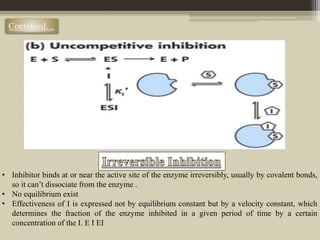
• Inhibitor binds at or near the active site of the enzyme irreversibly, usually by covalent bonds,
so it can’t dissociate from the enzyme .
• No equilibrium exist
• Effectiveness of I is expressed not by equilibrium constant but by a velocity constant, which
determines the fraction of the enzyme inhibited in a given period of time by a certain
concentration of the I. E I EI
Suicide inhibition
 Suicide inhibition is a specialized form of irreversible inhibition. In
this case, the original inhibitor (the structural analogue/competitive
inhibitor) is converted to a more potent form by the same enzyme that
ought to be inhibited.
 The so formed inhibitor binds irreversibly with the enzyme. This is in
contrast to the original inhibitor which binds reversibly.
 A good example of suicide inhibition is allopurinol an inhibitor of
xanthine oxidase, gets converted to alloxanthine, a more effective
inhibitor of this enzyme as well as penicillin's.
 The use of certain purine and pyrimidine analogues in cancer therapy
is also explained on the basis suicide inhibition. For instance, 5-
fluorouracil gets converted to fluorodeoxyuridylate which inhibits
the enzyme thymidylate synthase, and thus nucleotide synthesis.
Allosteric inhibition
 The details of this type of inhibition are given under allosteric
regulation as a part of the regulation of enzyme activity in the living
system.
 Enzyme inhibition by drugs Enzymes are the natural targets for
development of pharmacologic agents.
 Many of the drugs used in the treatment of diseases act as enzyme
inhibitors. Cholesterol lowering statin drugs (lovastatin) inhibit the
enzyme HMG CoA reductase.
 Drugs (tenofovir, emtricitabine) employed to block HIV replication
inhibit the enzyme viral reverse transcriptase. Hypertension is often
treated by the drugs (captopril, enalapril )which inhibit angiotensin
converting enzyme.
 A selective inhibitor may block either a single enzyme or a group of enzymes.
 This will results in either a decrease in the concentration of enzymatic products
or an increase in the concentration of enzymatic substrates.
 The effectiveness of an enzyme inhibitor as a therapeutic agent will depend on :
a. The potency of the inhibitor
b. Its specificity
c. The choice of a metabolic pathway
d. The inhibitor or derivative possessing appropriate pharmacokinetic
characteristics .
 Low dosage and high specificity combine to reduce the toxicity problems.
 High specificity can avoid depletion of the inhibitor concentrations in the host by
non-specific pathways.
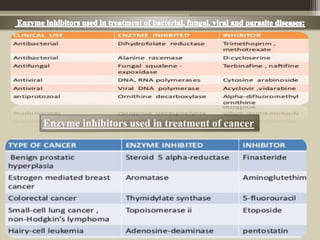
 Enzyme inhibitors used in treatment of bacterial, fungal, viral and parasite
diseases:
 Suicide enzyme inhibitors ( Kcat inhibitors ) : Irreversible enzyme inhibitor which utilizes
highly electrophilic species such as alpha-halogenated carbonyl compounds or other strong
alkylating agents which in turn irreversibly reacts with a nucleophile group on the enzyme.
 Suicide enzyme inhibitors are the compounds that possess agent reactive functional
groups which are unmasked by the catalytic action of the enzyme. e.g. Inhibition of
aldehyde dehydrogenase by cyclopropanone , a metabolite of coprine.
 Transition state analogs : An enzyme interacts with a substrate to form enzyme
substrate complex through a tetrahedral transition state . A transition state analog
binds more tightly to an enzyme than it does its substrate . e.g. penicillin is a
transition state analog which binds to the peptidoglycan trans peptidase.
 Multisubstrate analogs : A multisubstrate compound consists the features of
binding sites of two or more different substrates in the same molecule . e.g. pyridoxyl
alanine has more binding ability towards pyruvate transaminase than pyridoxal and
alanine
 The blockade of an enzyme , catalysing a particular biochemical reaction leads to
accumulation of the substrate. This results into a desired biological response .
 The inhibition of an enzyme that catalyzes the rate- limiting step decreases the production of a
metabolite (Multistep biochemical pathway).
 Most of the enzymes need co-factors to catalyze the biochemical pathway. Inhibitors can be
developed selectively for the co-factor involved .
 Two inhibitors may be employed simultaneously to achieve a great therapeutic effects . e.g.
co-trimoxazole ( trimethoprim and sulphamethoxazole ).
 If the metabolism of the endproduct is minimised , the accumulated end-product decreases the
activity of an enzyme on its substrate .
 Inhibition of metabolizing target enzyme permits higher plasma levels as well as an increase
in the plasma half-life of the drug .e.g. clavulanic acid inhibits beta-lactamase enzymes .
 Multisubstrate analogs : A multisubstrate compound consists the features of binding sites of
two or more different substrates in the same molecule . e.g. pyridoxyl alanine has more
binding ability towards pyruvate transaminase than pyridoxal and alanine.
Enzyme inhibitors used in treatment of cancer
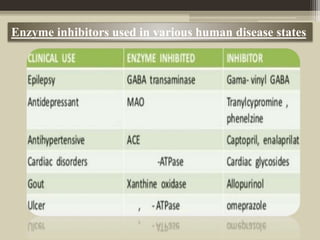
Enzyme inhibitors used in various human disease states
 Enzyme inhibitors have found a multitude of uses:
1. As useful tools for the elucidation of structure and function of
enzymes.
2. As probes for chemical and kinetic processes and in the detection of
short-lived reaction intermediates.
3. Product inhibition patterns provide information about an enzymes
kinetic mechanism and the order of substrate binding.
4. Covalently binding enzyme inhibitors have been used to identify
active-site amino acid residues.
5. Reversible enzyme inhibitors are used to facilitate enzyme
purification.
Enzyme inhibitors in basic research
References
 Drug design , by Dr.V.M.Kulkarni and Dr.K.G.Bothara ,4th
edition , page no:25-31.
 Medicinal chemistry and drug discovery ,by Burger , 6th
edition ,1st volume , page no :716-720.
THANK YOU

Enzyme inhibitors

  • 1.
    ` Presented by: ShubhamSharma Pharmaceutical Chemistry Roll no. : 20029 Presented to : Dr. Renu Chadha Professor ,UIPS, Panjab University
  • 2.
    CONTENTS Enzyme  Enzyme inhibition Classification of Enzyme inhibitors Mechanism of enzyme inhibition Enzyme inhibitors in medicine Enzyme inhibitors in basic research.
  • 3.
     Enzymes aresoluble, colloidal, organic catalysts, formed by living cells specific in action, protein in nature, inactive at zero degree Celsius and destroyed by moist heat at 100 degree Celsius.  Enzymes are the specialized proteins which catalyze various biochemical reactions. The concept of enzyme inhibition is routinely utilized to affect biosynthesis and metabolic pattern of various hormones, autacoids, and neurotransmitters.  In 1926, J.B. Sumner have isolated urease.
  • 4.
     Enzymes providea reaction surface and a suitable environment.  Enzymes bring reactants together and position them correctly so that they easily attain their transition state configurations .  Enzymes weaken bonds in the reactants.  Enzymes may participate in the reaction mechanism.  Enzymes form stronger interactions with the transition state than with the substrate or the product.
  • 5.
     Inhibitors arethe chemicals that reduces the rate of enzymatic reactions.  They are usually specific at work at low concentrations.  They block the enzyme but they do not usually destroy it.  Many drugs and poisons are inhibitors of enzymes in the nervous system.
  • 6.
    Enzyme Inhibitors Enzyme inhibitorsare the molecules that reduces the catalytic activity of enzymes. Reducing of effective enzymatic activity or complete blocking of enzymes may cause either complete death of cell or either modifications in the pathways. Drugs which cause complete inactivation of enzymes from essential pathways may cause cell death and therefore such drugs can be used as antibiotics.
  • 8.
     The inhibitionof a suitably selected target enzyme leads to build up in concentration of substrates and a corresponding decrease in the concentration of the metabolites.  Important parameters for selecting an enzyme inhibitor are: 1. Biochemical environment of the target enzyme. 2. Specificity of action. 3. The time period for which an enzyme is blocked.
  • 10.
    Reversible inhibition  Inhibitorbinds to Enzyme reversibly through weak non- covalent interactions.  An Equilibrium is established between the free inhibitor and EI Complex and is defined by an equilibrium constant (Ki).  Reversible Inhibitors depending on concentration of E, S and I, show a definite degree of inhibition which is reached fairly rapidly and remains constant when initial velocity studies are carried out.
  • 11.
    The reversible inhibitionis further sub-divided into: I. Competitive inhibition II. Noncompetitive inhibition  The inhibitor which closely resembles the real substrate (S) is regarded as a substrate analogue.  The inhibitor competes with substrate and binds at the active site of the enzyme but does not undergo any catalysis.  As long as the competitive inhibitor holds the active site, the enzyme is not available for the substrate to bind. During the reaction, ES and EI complexes are formed .  The relative concentration of the substrate and inhibitor and their respective affinity with the enzyme determines the degree of competitive inhibition.  The inhibition could be overcome by a high substrate concentration. In competitive inhibition, the Km value increases whereas Vmax remains unchanged .
  • 12.
    NOTE: The inhibitorsaction is proportional to its concentration
  • 13.
    Competitive inhibition accountsfor the antibacterial action of sulfanilamide which is a structural analog of PABA . Sulfanilamide inhibits the bacterial enzyme dihydropteroate synthetase which catalyzes the incorporation of PABA into 7,8- dihydropteroic acid.
  • 14.
     The inhibitorbinds at a site other than the active site on the enzyme surface. This binding impairs the enzyme function.  The inhibitor has no structural resemblance with the substrate. However, there usually exists a strong affinity for the inhibitor to bind at the second site.  In fact, the inhibitor does not interfere with the enzyme-substrate binding. But the catalysis is prevented, possibly due to a distortion in the enzyme conformation.  The inhibitor generally binds with the enzyme as well as the ES complex.  For non-competitive inhibition, the Km value is unchanged while Vmax is lowered .  Heavy metal ions (Ag+, Pb2+, Hg2+ etc.) can non-competitively inhibit the enzymes by binding with cystienyl sulfhydryl groups.
  • 15.
    Continued… • Inhibitor bindsat or near the active site of the enzyme irreversibly, usually by covalent bonds, so it can’t dissociate from the enzyme . • No equilibrium exist • Effectiveness of I is expressed not by equilibrium constant but by a velocity constant, which determines the fraction of the enzyme inhibited in a given period of time by a certain concentration of the I. E I EI
  • 16.
    Suicide inhibition  Suicideinhibition is a specialized form of irreversible inhibition. In this case, the original inhibitor (the structural analogue/competitive inhibitor) is converted to a more potent form by the same enzyme that ought to be inhibited.  The so formed inhibitor binds irreversibly with the enzyme. This is in contrast to the original inhibitor which binds reversibly.  A good example of suicide inhibition is allopurinol an inhibitor of xanthine oxidase, gets converted to alloxanthine, a more effective inhibitor of this enzyme as well as penicillin's.  The use of certain purine and pyrimidine analogues in cancer therapy is also explained on the basis suicide inhibition. For instance, 5- fluorouracil gets converted to fluorodeoxyuridylate which inhibits the enzyme thymidylate synthase, and thus nucleotide synthesis.
  • 17.
    Allosteric inhibition  Thedetails of this type of inhibition are given under allosteric regulation as a part of the regulation of enzyme activity in the living system.  Enzyme inhibition by drugs Enzymes are the natural targets for development of pharmacologic agents.  Many of the drugs used in the treatment of diseases act as enzyme inhibitors. Cholesterol lowering statin drugs (lovastatin) inhibit the enzyme HMG CoA reductase.  Drugs (tenofovir, emtricitabine) employed to block HIV replication inhibit the enzyme viral reverse transcriptase. Hypertension is often treated by the drugs (captopril, enalapril )which inhibit angiotensin converting enzyme.
  • 18.
     A selectiveinhibitor may block either a single enzyme or a group of enzymes.  This will results in either a decrease in the concentration of enzymatic products or an increase in the concentration of enzymatic substrates.  The effectiveness of an enzyme inhibitor as a therapeutic agent will depend on : a. The potency of the inhibitor b. Its specificity c. The choice of a metabolic pathway d. The inhibitor or derivative possessing appropriate pharmacokinetic characteristics .  Low dosage and high specificity combine to reduce the toxicity problems.  High specificity can avoid depletion of the inhibitor concentrations in the host by non-specific pathways.  Enzyme inhibitors used in treatment of bacterial, fungal, viral and parasite diseases:
  • 19.
     Suicide enzymeinhibitors ( Kcat inhibitors ) : Irreversible enzyme inhibitor which utilizes highly electrophilic species such as alpha-halogenated carbonyl compounds or other strong alkylating agents which in turn irreversibly reacts with a nucleophile group on the enzyme.  Suicide enzyme inhibitors are the compounds that possess agent reactive functional groups which are unmasked by the catalytic action of the enzyme. e.g. Inhibition of aldehyde dehydrogenase by cyclopropanone , a metabolite of coprine.  Transition state analogs : An enzyme interacts with a substrate to form enzyme substrate complex through a tetrahedral transition state . A transition state analog binds more tightly to an enzyme than it does its substrate . e.g. penicillin is a transition state analog which binds to the peptidoglycan trans peptidase.  Multisubstrate analogs : A multisubstrate compound consists the features of binding sites of two or more different substrates in the same molecule . e.g. pyridoxyl alanine has more binding ability towards pyruvate transaminase than pyridoxal and alanine
  • 20.
     The blockadeof an enzyme , catalysing a particular biochemical reaction leads to accumulation of the substrate. This results into a desired biological response .  The inhibition of an enzyme that catalyzes the rate- limiting step decreases the production of a metabolite (Multistep biochemical pathway).  Most of the enzymes need co-factors to catalyze the biochemical pathway. Inhibitors can be developed selectively for the co-factor involved .  Two inhibitors may be employed simultaneously to achieve a great therapeutic effects . e.g. co-trimoxazole ( trimethoprim and sulphamethoxazole ).  If the metabolism of the endproduct is minimised , the accumulated end-product decreases the activity of an enzyme on its substrate .  Inhibition of metabolizing target enzyme permits higher plasma levels as well as an increase in the plasma half-life of the drug .e.g. clavulanic acid inhibits beta-lactamase enzymes .  Multisubstrate analogs : A multisubstrate compound consists the features of binding sites of two or more different substrates in the same molecule . e.g. pyridoxyl alanine has more binding ability towards pyruvate transaminase than pyridoxal and alanine.
  • 21.
    Enzyme inhibitors usedin treatment of cancer
  • 22.
    Enzyme inhibitors usedin various human disease states
  • 23.
     Enzyme inhibitorshave found a multitude of uses: 1. As useful tools for the elucidation of structure and function of enzymes. 2. As probes for chemical and kinetic processes and in the detection of short-lived reaction intermediates. 3. Product inhibition patterns provide information about an enzymes kinetic mechanism and the order of substrate binding. 4. Covalently binding enzyme inhibitors have been used to identify active-site amino acid residues. 5. Reversible enzyme inhibitors are used to facilitate enzyme purification. Enzyme inhibitors in basic research
  • 24.
    References  Drug design, by Dr.V.M.Kulkarni and Dr.K.G.Bothara ,4th edition , page no:25-31.  Medicinal chemistry and drug discovery ,by Burger , 6th edition ,1st volume , page no :716-720.
  • 25.