ULLMANN COUPLING
REACTION
SUBMITTED BY- INDRAJIT SAMANTA
M.PHARMA, 1ST YEAR, 1ST SEM, DEPARTMENT OF
PHARMACEUTICAL CHEMISTRY,
SPER, JAMIA HAMDARD
CONTENTS
 INTRODUCTION
 GENERAL REACTION
 MECHANISM
 APPLICATIONS
 REFERENCES
INTRODUCTION
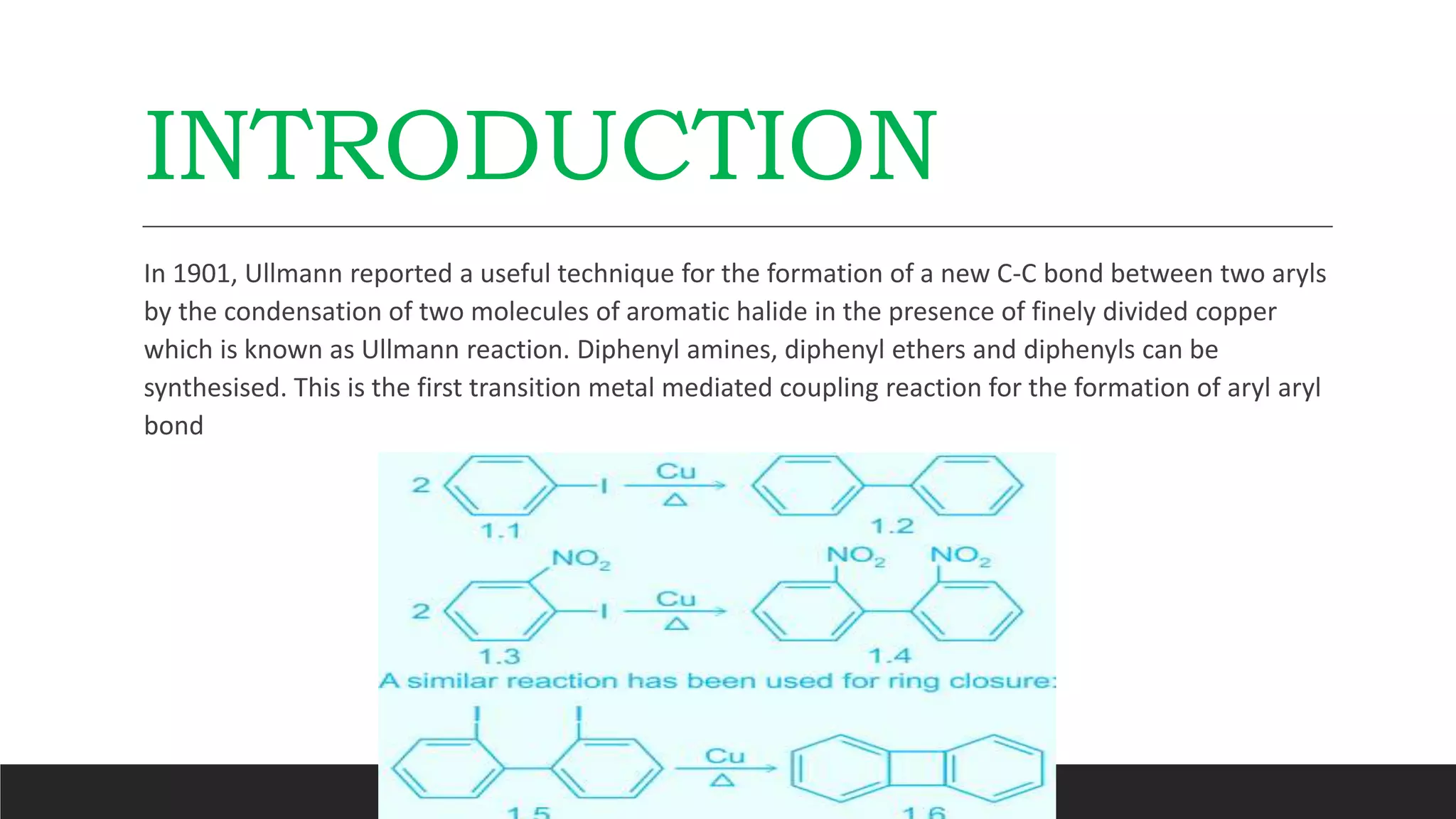
In 1901, Ullmann reported a useful technique for the formation of a new C-C bond between two aryls
by the condensation of two molecules of aromatic halide in the presence of finely divided copper
which is known as Ullmann reaction. Diphenyl amines, diphenyl ethers and diphenyls can be
synthesised. This is the first transition metal mediated coupling reaction for the formation of aryl aryl
bond
INTRODUCTION
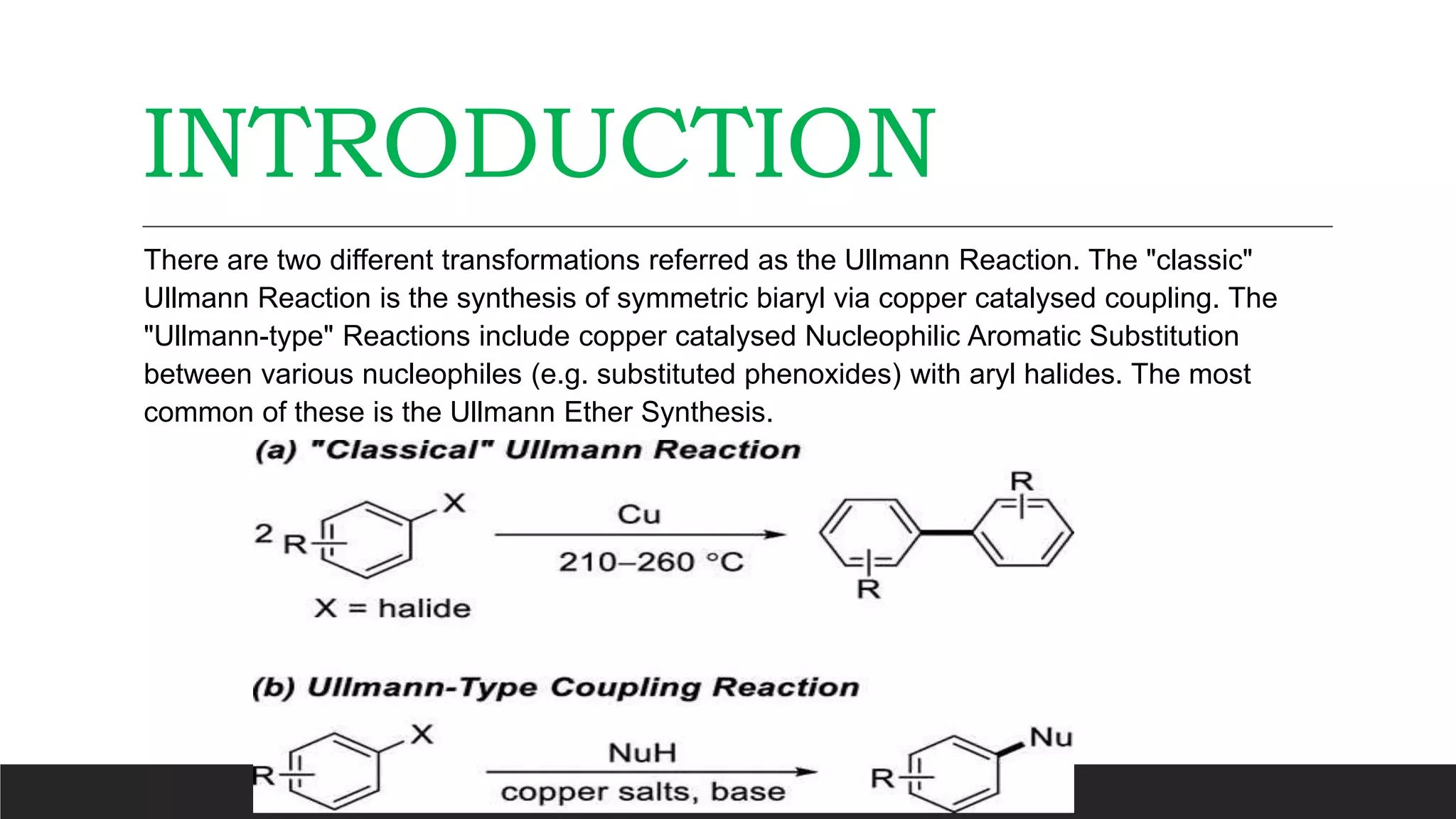
There are two different transformations referred as the Ullmann Reaction. The "classic"
Ullmann Reaction is the synthesis of symmetric biaryl via copper catalysed coupling. The
"Ullmann-type" Reactions include copper catalysed Nucleophilic Aromatic Substitution
between various nucleophiles (e.g. substituted phenoxides) with aryl halides. The most
common of these is the Ullmann Ether Synthesis.
INTRODUCTION
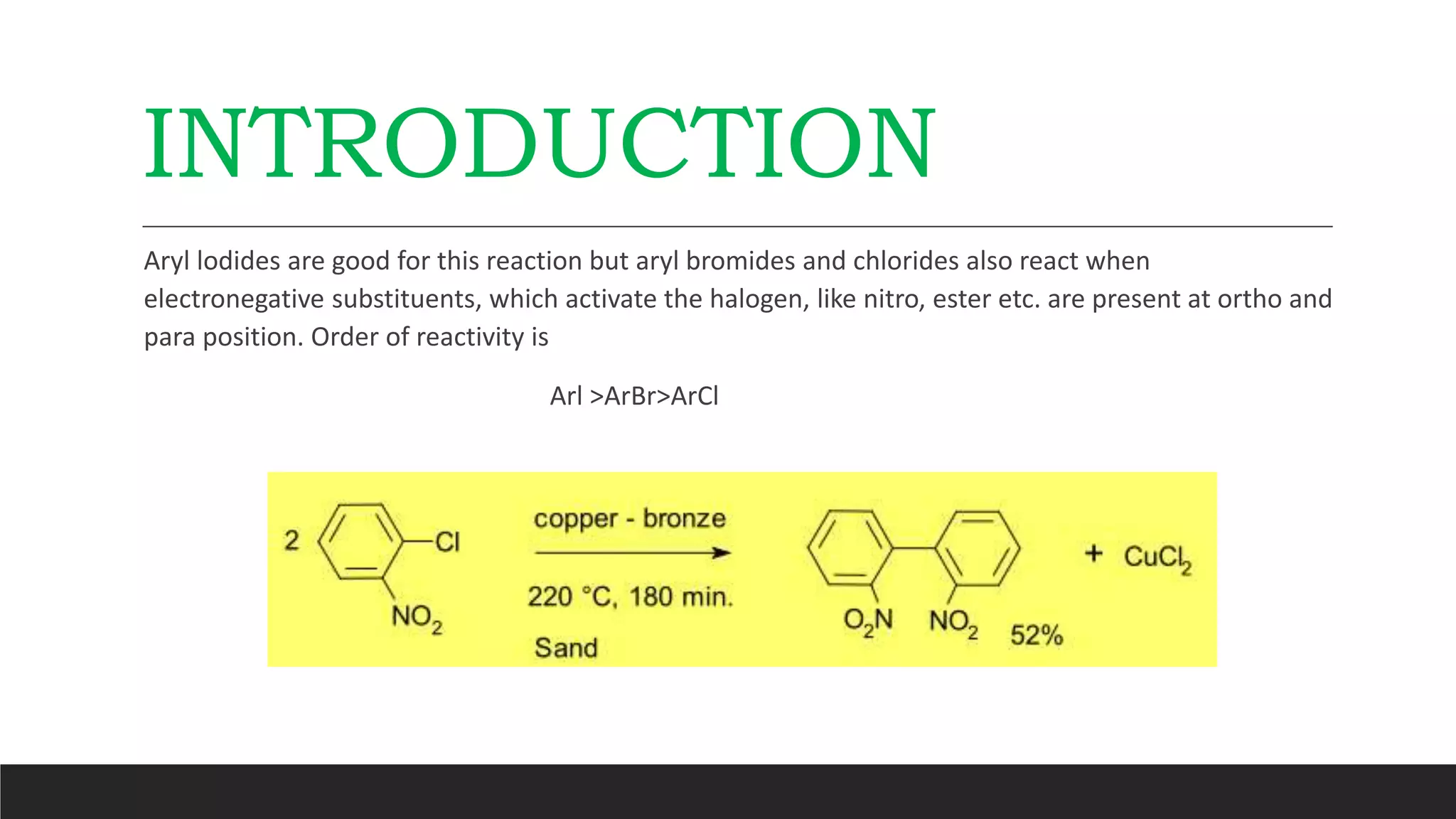
Aryl lodides are good for this reaction but aryl bromides and chlorides also react when
electronegative substituents, which activate the halogen, like nitro, ester etc. are present at ortho and
para position. Order of reactivity is
Arl >ArBr>ArCl
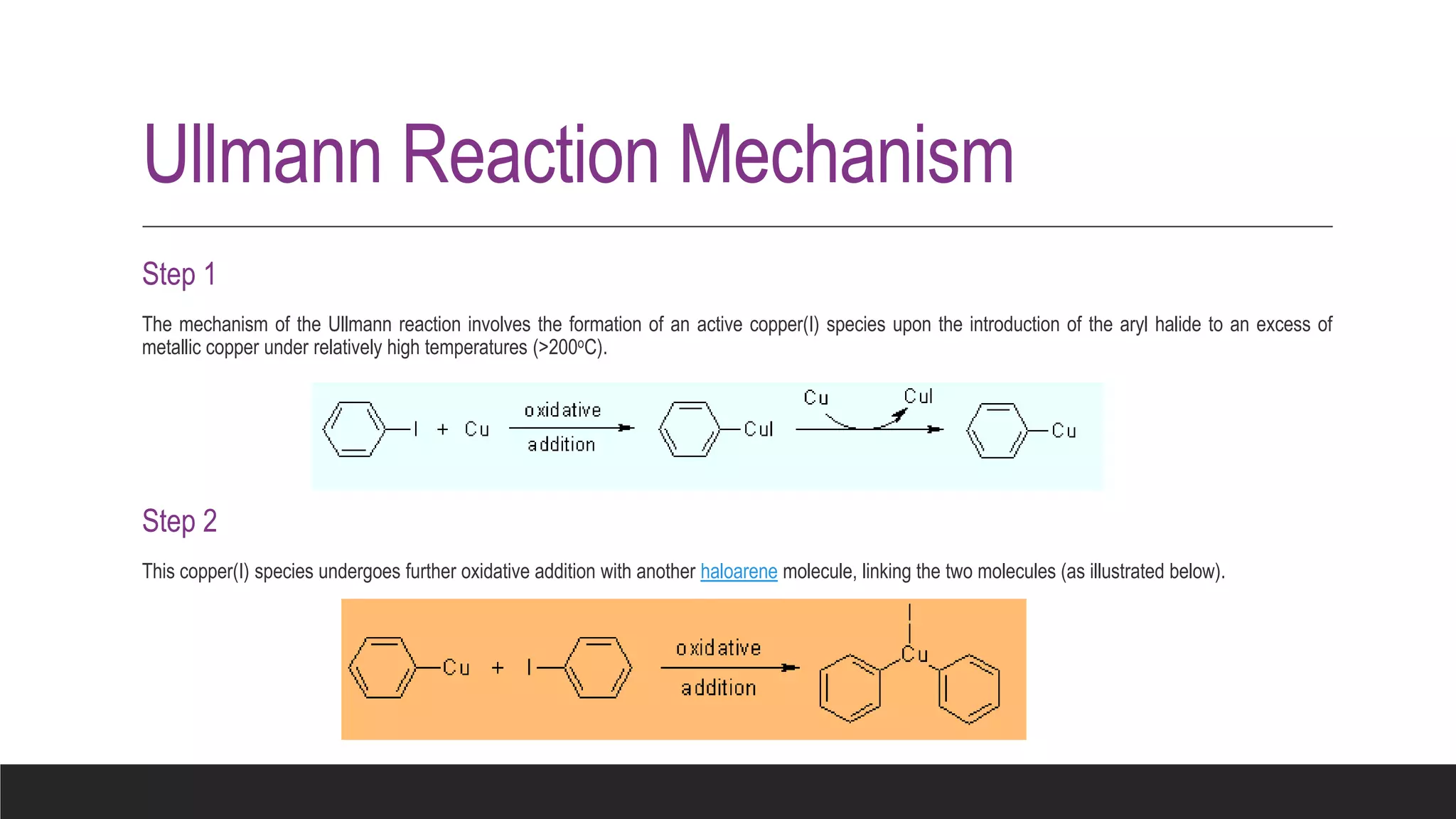
Ullmann Reaction Mechanism
Step 1
The mechanism of the Ullmann reaction involves the formation of an active copper(I) species upon the introduction of the aryl halide to an excess of
metallic copper under relatively high temperatures (>200oC).
Step 2
This copper(I) species undergoes further oxidative addition with another haloarene molecule, linking the two molecules (as illustrated below).
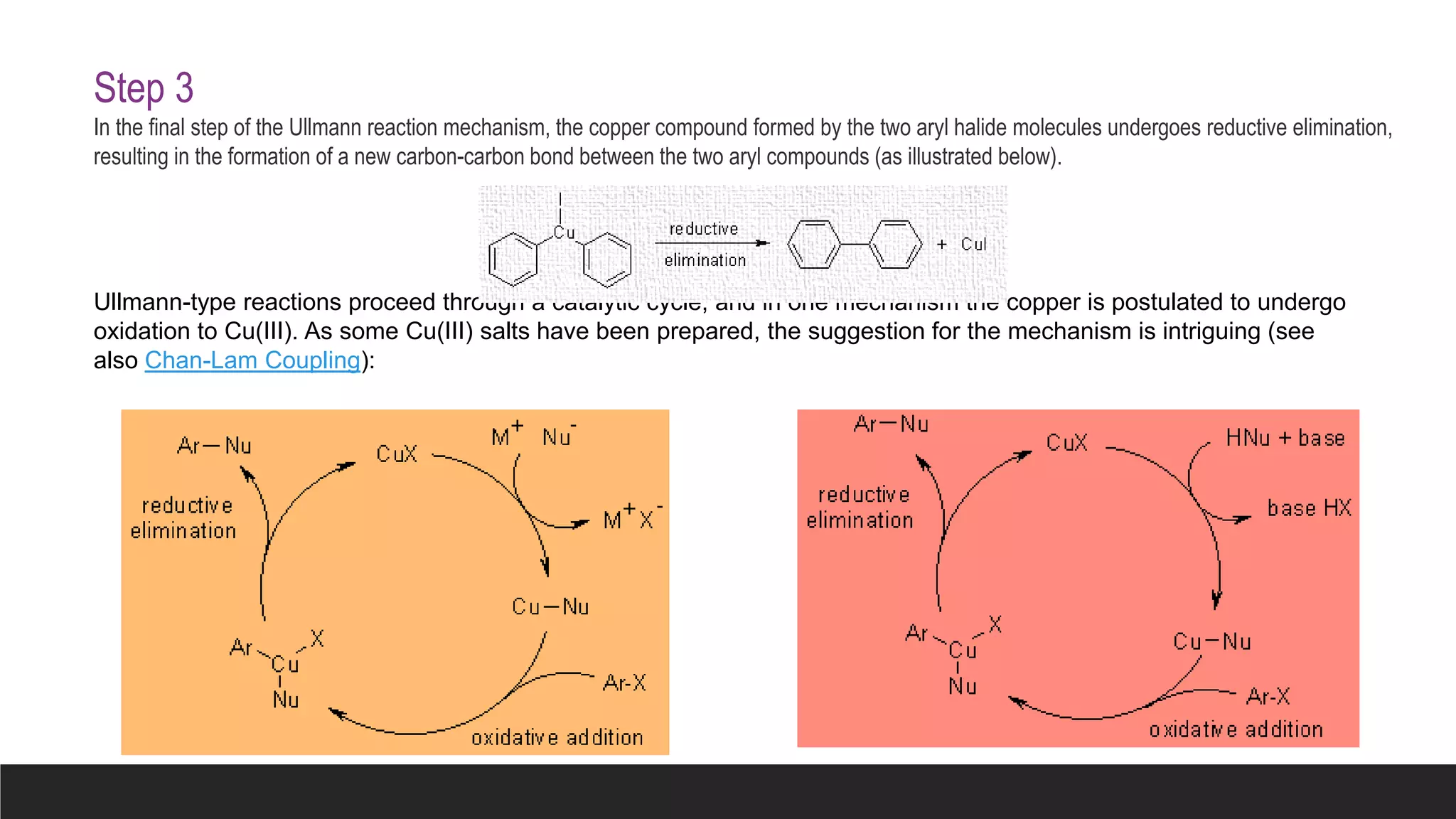
Step 3
In the final step of the Ullmann reaction mechanism, the copper compound formed by the two aryl halide molecules undergoes reductive elimination,
resulting in the formation of a new carbon-carbon bond between the two aryl compounds (as illustrated below).
Ullmann-type reactions proceed through a catalytic cycle, and in one mechanism the copper is postulated to undergo
oxidation to Cu(III). As some Cu(III) salts have been prepared, the suggestion for the mechanism is intriguing (see
also Chan-Lam Coupling):
Applications of the Ullmann Reaction
A. Synthesis of biaryls and polyaryls::
a. Symmetrical biaryls:
Applications of the Ullmann Reaction
b. Unsymmetrical diaryls:
With a mixture of two different aryl halides, three products are obtained which has poor synthetic
value for the yield of the desired product is low and difficult to isolate. In some cases, however, the
unsymmetrical product is only formed, e.g.
Applications of the Ullmann Reaction
c. Poly-aryl hydrocarbons:
Applications of the Ullmann Reaction
B. Synthesis of diarylamines:
An arylamine and an aryl halide are refluxed in the presence of anhydrous potassium carbonate and
copper powder.
Applications of the Ullmann Reaction
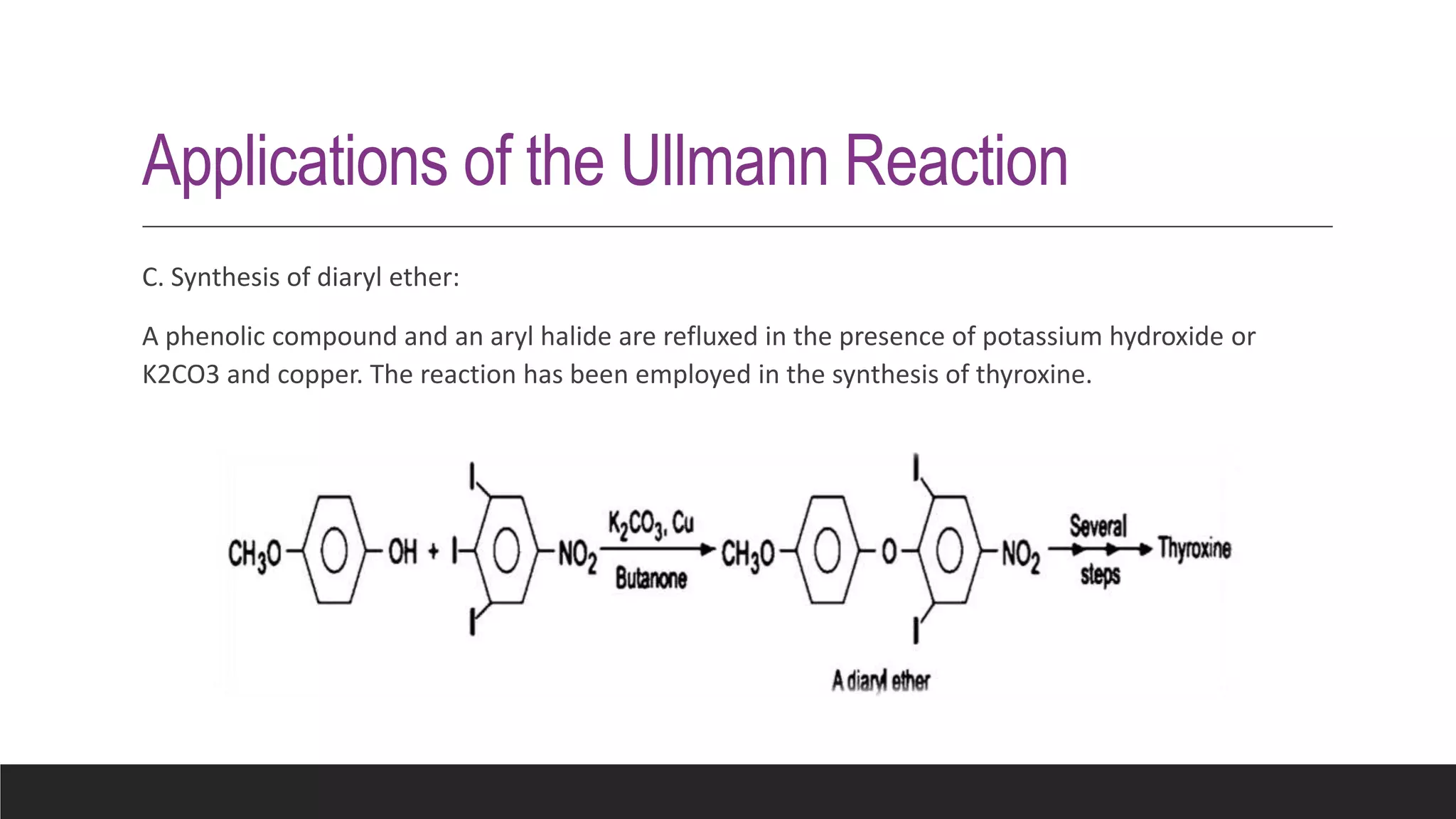
C. Synthesis of diaryl ether:
A phenolic compound and an aryl halide are refluxed in the presence of potassium hydroxide or
K2CO3 and copper. The reaction has been employed in the synthesis of thyroxine.
Applications of the Ullmann Reaction
D. Gossypol synthesis:
Meyers and Willemsen developed the first asymmetric synthesis of (S)-(+)-gossypol via a traditional
Ullmann coupling. Heating a 40% solution of bromonaphthyl oxazoline derivative in freshly distilled
DMF and activated copper at reflux for 1 h gave the binaphthyl derivative by Ullmann coupling in 80%
yield as a 17:1 diastereoisomeric mixture. This is the key step for the total synthesis of (S)-(+)
gossypol.
Gossypol has antimalarial activity and it is used in china as oral male contraceptive.
Applications of the Ullmann Reaction
D. Gossypol synthesis:
Applications of the Ullmann Reaction
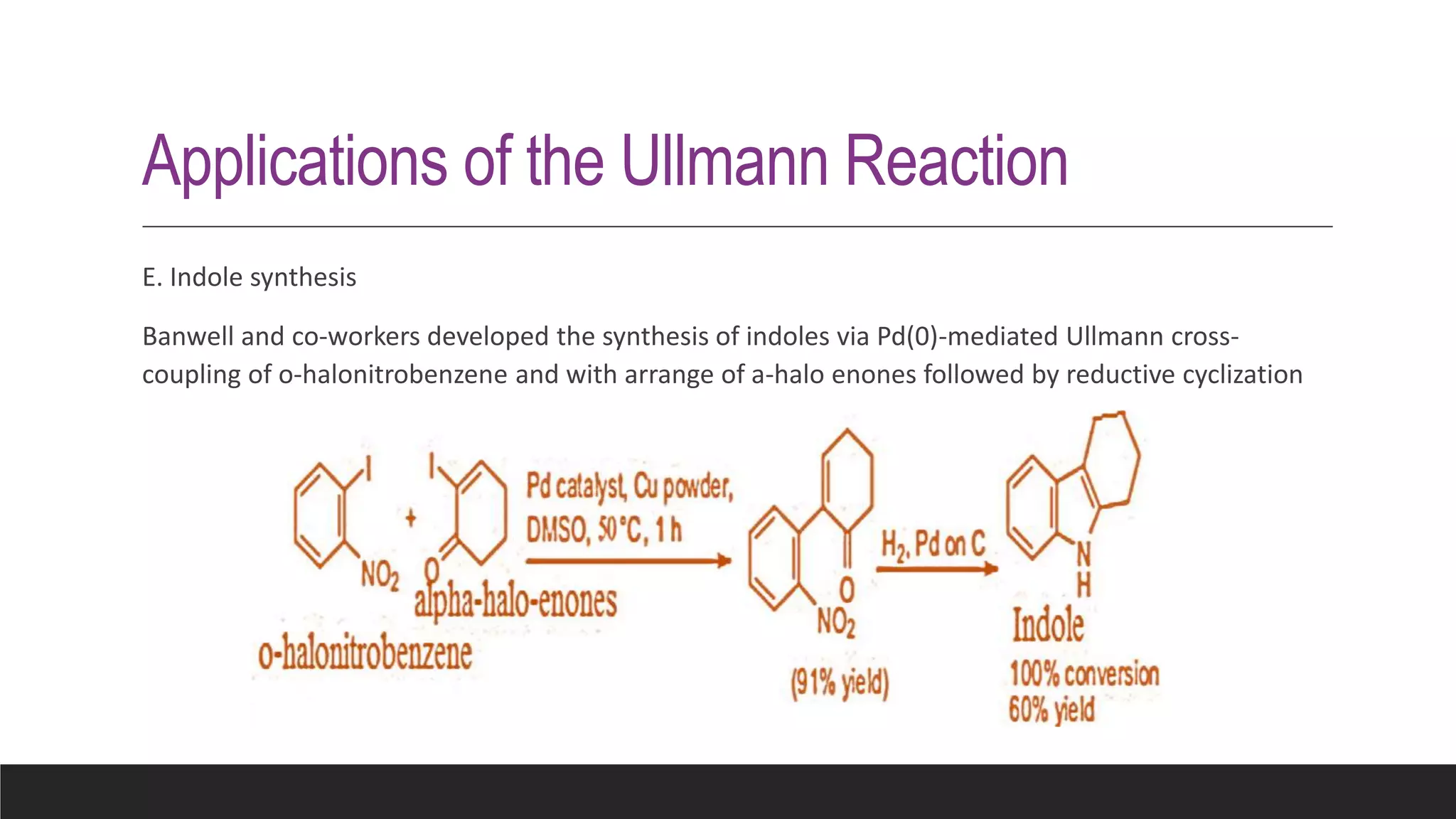
E. Indole synthesis
Banwell and co-workers developed the synthesis of indoles via Pd(0)-mediated Ullmann cross-
coupling of o-halonitrobenzene and with arrange of a-halo enones followed by reductive cyclization
REFERENCES
Sanyal,S.N.;Reactions,Rearrangementsand Reaents,Bharati bhawanP&D,pg-197-181
Mondal,S.;RecentadvancementofUllmanntype couplingreactionsintheformationofC Cbond, ChemTexts(2016) 2:17.
Yin;Liebscher,Jürgen(2007). "Carbon−CarbonCouplingReactionsCatalyzedbyHeterogeneousPalladiumCatalysts". Chemical
Reviews.107 (1):133–173.doi:10.1021/cr0505674. PMID17212474.
F.Ullmann;JeanBielecki(1901). "UeberSyntheseninderBiphenylreihe".ChemischeBerichte.34(2):2174–
2185.doi:10.1002/cber.190103402141.
Hartwig, J.F.Organotransition MetalChemistry,fromBondingto Catalysis; UniversityScienceBooks:NewYork, 2010. ISBN1-891389-
53-X
ReynoldC.Fuson,E.A.Cleveland(1940)."2,2'-Dinitrobiphenyl".Org.Synth.20:45.doi:10.15227/orgsyn.020.0045
ULLMANN REACTION.pptx

ULLMANN REACTION.pptx

  • 1.
    ULLMANN COUPLING REACTION SUBMITTED BY-INDRAJIT SAMANTA M.PHARMA, 1ST YEAR, 1ST SEM, DEPARTMENT OF PHARMACEUTICAL CHEMISTRY, SPER, JAMIA HAMDARD
  • 2.
    CONTENTS  INTRODUCTION  GENERALREACTION  MECHANISM  APPLICATIONS  REFERENCES
  • 3.
    INTRODUCTION In 1901, Ullmannreported a useful technique for the formation of a new C-C bond between two aryls by the condensation of two molecules of aromatic halide in the presence of finely divided copper which is known as Ullmann reaction. Diphenyl amines, diphenyl ethers and diphenyls can be synthesised. This is the first transition metal mediated coupling reaction for the formation of aryl aryl bond
  • 4.
    INTRODUCTION There are twodifferent transformations referred as the Ullmann Reaction. The "classic" Ullmann Reaction is the synthesis of symmetric biaryl via copper catalysed coupling. The "Ullmann-type" Reactions include copper catalysed Nucleophilic Aromatic Substitution between various nucleophiles (e.g. substituted phenoxides) with aryl halides. The most common of these is the Ullmann Ether Synthesis.
  • 5.
    INTRODUCTION Aryl lodides aregood for this reaction but aryl bromides and chlorides also react when electronegative substituents, which activate the halogen, like nitro, ester etc. are present at ortho and para position. Order of reactivity is Arl >ArBr>ArCl
  • 6.
    Ullmann Reaction Mechanism Step1 The mechanism of the Ullmann reaction involves the formation of an active copper(I) species upon the introduction of the aryl halide to an excess of metallic copper under relatively high temperatures (>200oC). Step 2 This copper(I) species undergoes further oxidative addition with another haloarene molecule, linking the two molecules (as illustrated below).
  • 7.
    Step 3 In thefinal step of the Ullmann reaction mechanism, the copper compound formed by the two aryl halide molecules undergoes reductive elimination, resulting in the formation of a new carbon-carbon bond between the two aryl compounds (as illustrated below). Ullmann-type reactions proceed through a catalytic cycle, and in one mechanism the copper is postulated to undergo oxidation to Cu(III). As some Cu(III) salts have been prepared, the suggestion for the mechanism is intriguing (see also Chan-Lam Coupling):
  • 8.
    Applications of theUllmann Reaction A. Synthesis of biaryls and polyaryls:: a. Symmetrical biaryls:
  • 9.
    Applications of theUllmann Reaction b. Unsymmetrical diaryls: With a mixture of two different aryl halides, three products are obtained which has poor synthetic value for the yield of the desired product is low and difficult to isolate. In some cases, however, the unsymmetrical product is only formed, e.g.
  • 10.
    Applications of theUllmann Reaction c. Poly-aryl hydrocarbons:
  • 11.
    Applications of theUllmann Reaction B. Synthesis of diarylamines: An arylamine and an aryl halide are refluxed in the presence of anhydrous potassium carbonate and copper powder.
  • 12.
    Applications of theUllmann Reaction C. Synthesis of diaryl ether: A phenolic compound and an aryl halide are refluxed in the presence of potassium hydroxide or K2CO3 and copper. The reaction has been employed in the synthesis of thyroxine.
  • 13.
    Applications of theUllmann Reaction D. Gossypol synthesis: Meyers and Willemsen developed the first asymmetric synthesis of (S)-(+)-gossypol via a traditional Ullmann coupling. Heating a 40% solution of bromonaphthyl oxazoline derivative in freshly distilled DMF and activated copper at reflux for 1 h gave the binaphthyl derivative by Ullmann coupling in 80% yield as a 17:1 diastereoisomeric mixture. This is the key step for the total synthesis of (S)-(+) gossypol. Gossypol has antimalarial activity and it is used in china as oral male contraceptive.
  • 14.
    Applications of theUllmann Reaction D. Gossypol synthesis:
  • 15.
    Applications of theUllmann Reaction E. Indole synthesis Banwell and co-workers developed the synthesis of indoles via Pd(0)-mediated Ullmann cross- coupling of o-halonitrobenzene and with arrange of a-halo enones followed by reductive cyclization
  • 16.
    REFERENCES Sanyal,S.N.;Reactions,Rearrangementsand Reaents,Bharati bhawanP&D,pg-197-181 Mondal,S.;RecentadvancementofUllmanntypecouplingreactionsintheformationofC Cbond, ChemTexts(2016) 2:17. Yin;Liebscher,Jürgen(2007). "Carbon−CarbonCouplingReactionsCatalyzedbyHeterogeneousPalladiumCatalysts". Chemical Reviews.107 (1):133–173.doi:10.1021/cr0505674. PMID17212474. F.Ullmann;JeanBielecki(1901). "UeberSyntheseninderBiphenylreihe".ChemischeBerichte.34(2):2174– 2185.doi:10.1002/cber.190103402141. Hartwig, J.F.Organotransition MetalChemistry,fromBondingto Catalysis; UniversityScienceBooks:NewYork, 2010. ISBN1-891389- 53-X ReynoldC.Fuson,E.A.Cleveland(1940)."2,2'-Dinitrobiphenyl".Org.Synth.20:45.doi:10.15227/orgsyn.020.0045