
By:
ORGANIZATIONS


 It is not easy to grasp the whole idea of an
  “organization” because they are abstract
entities. Nevertheless, they are real and can
             be considered “alive”.

 *Authors use metaphors to enhance the
     understanding of the concept.
What is an Organization?
Organizations are collectives of parts that
cannot accomplish their goals as effective if
          they operate separately.

    *It’s easier to understand why organizations exist
           than to precisely define what they are.
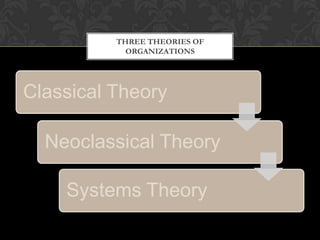
THREE THEORIES OF
            ORGANIZATIONS


Classical Theory

  Neoclassical Theory

    Systems Theory
CLASSICAL
   THEORY
- first few decades of 20 th century

           FOCUS:
       form and structure of organizations
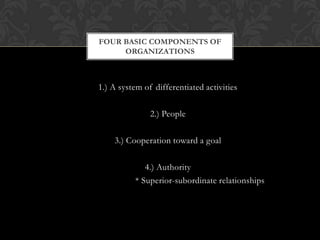
FOUR BASIC COMPONENTS OF
     ORGANIZATIONS


1.) A system of differentiated activities

               2.) People

    3.) Cooperation toward a goal

             4.) Authority
          * Superior-subordinate relationships
FUNCTIONAL
              PRINCIPLE
- Division of labor; organizations should be
divided into units that perform similar tasks

 -Work is broken down to provide areas of
               specialization
      *Horizontal growth of organization
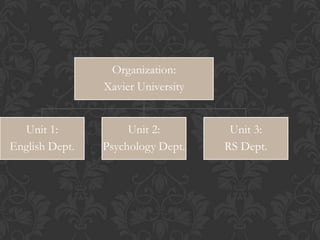
Organization:
                Xavier University


  Unit 1:            Unit 2:         Unit 3:
English Dept.   Psychology Dept.    RS Dept.
SCALAR
              PRINCIPLE
-Refers to the chain of command that grows
     with increasing levels of authority

            -Unity of command
         - each subordinate should be
     accountable to only one superior
        *Vertical growth of organization
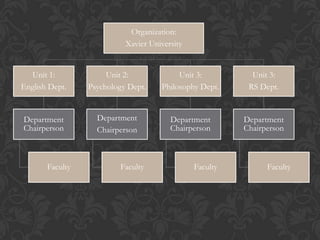
Organization:
                           Xavier University


  Unit 1:             Unit 2:             Unit 3:          Unit 3:
English Dept.    Psychology Dept.    Philosophy Dept.     RS Dept.


Department         Department           Department       Department
Chairperson        Chairperson          Chairperson      Chairperson


       Faculty           Faculty               Faculty         Faculty
LINE/ STAFF
            PRINCIPLE
             Line functions
       - primarily responsible for meeting
the major goals of the organization
             * production department
             Staff functions
         - support the line’s activities but
 are regarded as subsidiary in overall
               importance
SPAN-OF-
             CONTROL
             PRINCIPLE
-the number of subordinates a manager is
      responsible for supervising
  -May be “small” span or “large” span

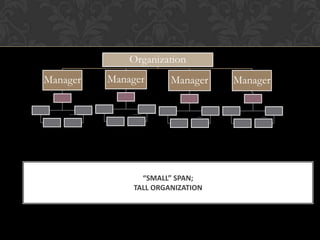
    “Small” span-> flat organization
        * 1 manager: 3 subordinates
    “Large” span-> tall organization
       * 1 manager: 10 subordinates
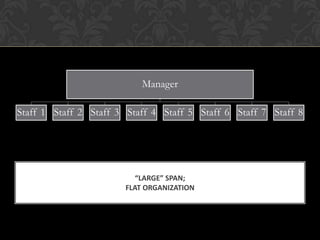
Manager

Staff 1 Staff 2 Staff 3 Staff 4 Staff 5 Staff 6 Staff 7 Staff 8


                          “LARGE” SPAN;
                       FLAT ORGANIZATION
Organization
Manager   Manager      Manager    Manager


                “SMALL” SPAN;
              TALL ORGANIZATION
NEOCLASSICAL THEORY


     There is really no theory; but rather a
  recognition of psychological and behavioral
issues that question the rigidity with which the
        classical theory originality stated.
ISSUES


Division of labor depersonalizes the activities of
the units, where a sense of alienation develops
from highly repetitive work, that the individual
      finds little meaning in their activities.

 *less rigid division of labor, more humanistic
                       work
Individuals are influenced by interpersonal
activities that extend well beyond the prescribed
          formal organizational structure.

 * Many sources operating in an organization
          influence the individual.
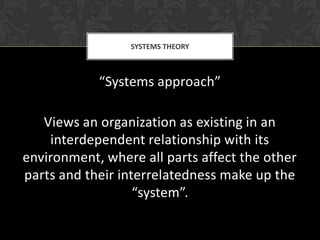
SYSTEMS THEORY


            “Systems approach”

   Views an organization as existing in an
    interdependent relationship with its
environment, where all parts affect the other
parts and their interrelatedness make up the
                   “system”.
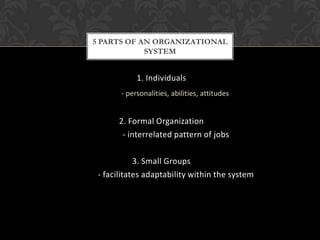
5 PARTS OF AN ORGANIZATIONAL
            SYSTEM


            1. Individuals
       - personalities, abilities, attitudes


      2. Formal Organization
       - interrelated pattern of jobs

            3. Small Groups
 - facilitates adaptability within the system
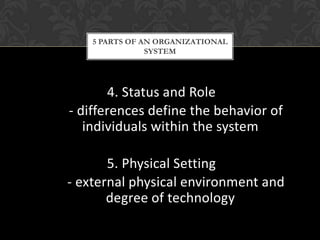
5 PARTS OF AN ORGANIZATIONAL
                SYSTEM


        4. Status and Role
- differences define the behavior of
   individuals within the system

       5. Physical Setting
- external physical environment and
       degree of technology
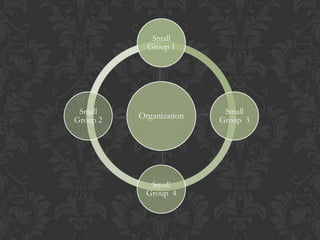
Small
            Group 1


 Small                    Small
Group 2   Organization   Group 3


             Small
            Group 4
Although the systems theory appears to be
     abstract, the systems perspective of
    organizations allows us to understand
phenomena of organizational life that earlier
         theories would not permit.
ORGANIZATIONAL
  STRUCTURE
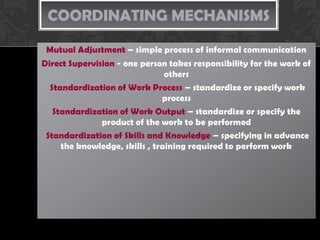
COORDINATING MECHANISMS
 Mutual Adjustment – simple process of informal communication
Direct Supervision - one person takes responsibility for the work of
                                others
  Standardization of Work Process – standardize or specify work
                               process
   Standardization of Work Output – standardize or specify the
               product of the work to be performed
 Standardization of Skills and Knowledge – specifying in advance
     the knowledge, skills , training required to perform work
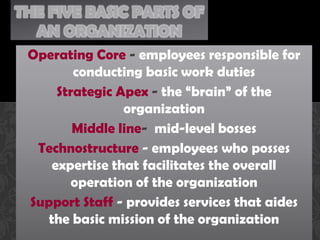
THE FIVE BASIC PARTS OF
  AN ORGANIZATION
 Operating Core - employees responsible for
         conducting basic work duties
      Strategic Apex - the “brain” of the
                 organization
         Middle line- mid-level bosses
  Technostructure - employees who posses
     expertise that facilitates the overall
         operation of the organization
 Support Staff - provides services that aides
    the basic mission of the organization
COMPONENTS OF SOCIAL
      SYSTEM

             Social System
        - the human components of a work
organization that influences the behavior of
            individuals and groups
    -it has no formal structure apart from its
                  functioning
   -when a social system stops functioning , no
       identifiable structure remains
COMPONENTS OF SOCIAL SYSTEM


    ROLES - a set of expectations about
    appropriate behavior in a position

NORMS - a set of shared group expectations
      about appropriate behavior

CULTURE - the language, values, attitudes
and beliefs and customs of an organization
THREE LAYERS OF CULTURE IN AN
             ORGANIZATION
Observable Artifacts - artifacts are the surface level actions that can be observed from
 which some deeper meaning or interpretation can be drawn about the organization.
                              e.g. legends, taboos and ceremonies


 Espoused Values- beliefs or concepts that are especially endorsed by management.
          e.g. “Safety is our top Priority” and “ We Respect the        Opinions of our
                                       Employees”


        Basic Assumptions- unobservable and are at the core of organization
THE END

I/O chapter 3

  • 1.
  • 2.
    ORGANIZATIONS It isnot easy to grasp the whole idea of an “organization” because they are abstract entities. Nevertheless, they are real and can be considered “alive”. *Authors use metaphors to enhance the understanding of the concept.
  • 3.
    What is anOrganization?
  • 4.
    Organizations are collectivesof parts that cannot accomplish their goals as effective if they operate separately. *It’s easier to understand why organizations exist than to precisely define what they are.
  • 5.
    THREE THEORIES OF ORGANIZATIONS Classical Theory Neoclassical Theory Systems Theory
  • 6.
    CLASSICAL THEORY - first few decades of 20 th century FOCUS: form and structure of organizations
  • 7.
    FOUR BASIC COMPONENTSOF ORGANIZATIONS 1.) A system of differentiated activities 2.) People 3.) Cooperation toward a goal 4.) Authority * Superior-subordinate relationships
  • 9.
    FUNCTIONAL PRINCIPLE - Division of labor; organizations should be divided into units that perform similar tasks -Work is broken down to provide areas of specialization *Horizontal growth of organization
  • 10.
    Organization: Xavier University Unit 1: Unit 2: Unit 3: English Dept. Psychology Dept. RS Dept.
  • 11.
    SCALAR PRINCIPLE -Refers to the chain of command that grows with increasing levels of authority -Unity of command - each subordinate should be accountable to only one superior *Vertical growth of organization
  • 12.
    Organization: Xavier University Unit 1: Unit 2: Unit 3: Unit 3: English Dept. Psychology Dept. Philosophy Dept. RS Dept. Department Department Department Department Chairperson Chairperson Chairperson Chairperson Faculty Faculty Faculty Faculty
  • 13.
    LINE/ STAFF PRINCIPLE Line functions - primarily responsible for meeting the major goals of the organization * production department Staff functions - support the line’s activities but are regarded as subsidiary in overall importance
  • 14.
    SPAN-OF- CONTROL PRINCIPLE -the number of subordinates a manager is responsible for supervising -May be “small” span or “large” span “Small” span-> flat organization * 1 manager: 3 subordinates “Large” span-> tall organization * 1 manager: 10 subordinates
  • 15.
    Manager Staff 1 Staff2 Staff 3 Staff 4 Staff 5 Staff 6 Staff 7 Staff 8 “LARGE” SPAN; FLAT ORGANIZATION
  • 16.
    Organization Manager Manager Manager Manager “SMALL” SPAN; TALL ORGANIZATION
  • 17.
    NEOCLASSICAL THEORY There is really no theory; but rather a recognition of psychological and behavioral issues that question the rigidity with which the classical theory originality stated.
  • 18.
    ISSUES Division of labordepersonalizes the activities of the units, where a sense of alienation develops from highly repetitive work, that the individual finds little meaning in their activities. *less rigid division of labor, more humanistic work
  • 19.
    Individuals are influencedby interpersonal activities that extend well beyond the prescribed formal organizational structure. * Many sources operating in an organization influence the individual.
  • 20.
    SYSTEMS THEORY “Systems approach” Views an organization as existing in an interdependent relationship with its environment, where all parts affect the other parts and their interrelatedness make up the “system”.
  • 21.
    5 PARTS OFAN ORGANIZATIONAL SYSTEM 1. Individuals - personalities, abilities, attitudes 2. Formal Organization - interrelated pattern of jobs 3. Small Groups - facilitates adaptability within the system
  • 22.
    5 PARTS OFAN ORGANIZATIONAL SYSTEM 4. Status and Role - differences define the behavior of individuals within the system 5. Physical Setting - external physical environment and degree of technology
  • 23.
    Small Group 1 Small Small Group 2 Organization Group 3 Small Group 4
  • 24.
    Although the systemstheory appears to be abstract, the systems perspective of organizations allows us to understand phenomena of organizational life that earlier theories would not permit.
  • 25.
  • 26.
    COORDINATING MECHANISMS MutualAdjustment – simple process of informal communication Direct Supervision - one person takes responsibility for the work of others Standardization of Work Process – standardize or specify work process Standardization of Work Output – standardize or specify the product of the work to be performed Standardization of Skills and Knowledge – specifying in advance the knowledge, skills , training required to perform work
  • 27.
    THE FIVE BASICPARTS OF AN ORGANIZATION Operating Core - employees responsible for conducting basic work duties Strategic Apex - the “brain” of the organization Middle line- mid-level bosses Technostructure - employees who posses expertise that facilitates the overall operation of the organization Support Staff - provides services that aides the basic mission of the organization
  • 28.
    COMPONENTS OF SOCIAL SYSTEM Social System - the human components of a work organization that influences the behavior of individuals and groups -it has no formal structure apart from its functioning -when a social system stops functioning , no identifiable structure remains
  • 29.
    COMPONENTS OF SOCIALSYSTEM ROLES - a set of expectations about appropriate behavior in a position NORMS - a set of shared group expectations about appropriate behavior CULTURE - the language, values, attitudes and beliefs and customs of an organization
  • 30.
    THREE LAYERS OFCULTURE IN AN ORGANIZATION Observable Artifacts - artifacts are the surface level actions that can be observed from which some deeper meaning or interpretation can be drawn about the organization. e.g. legends, taboos and ceremonies Espoused Values- beliefs or concepts that are especially endorsed by management. e.g. “Safety is our top Priority” and “ We Respect the Opinions of our Employees” Basic Assumptions- unobservable and are at the core of organization
  • 31.