11
Organizational Behaviour
Chapter -7
Motivation Concepts PRESENTED BY:
Moglichera Sirisha
Shrahi Singh Karnwal
Nethala Prithvi Prakash
Anshul Prasad
Ankur Mathur
2
Motivation
• Processes that account for an individual’s intensity, direction, and
persistence of effort towards attaining a goal.
• Intensity describes how hard a person tries.
• Internal and external factors that stimulate desire and energy in
people to be continually interested and committed to a job, role
or subject, or to make an effort to attain a goal.
• Motivation results from the interaction of both conscious and
unconscious factors such as the intensity of desire or need,
incentive or reward value of the goal, and expectations of the
individual and of his or her peers. These factors are the reasons
one has for behaving a certain way
The Definition
Goals Attitude Support Performance
The will to win, the desire to succeed, the urge to reach
your full potential... these are the keys that will unlock
the door to personal excellence.
-Confucius
Idea Success
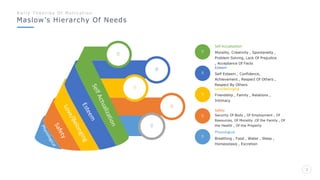
Maslow’s Hierarchy Of Needs
E a r l y T h e o r i e s O f M o t i v a t i o n
3
Morality, Creativity , Spontaneity ,
Problem Solving, Lack Of Prejudice
, Acceptance Of Facts
Self Actualization
Self Esteem , Confidence,
Achievement , Respect Of Others ,
Respect By Others
Esteem
Friendship , Family , Relations ,
Intimacy
Love/Belonging
Security Of Body , Of Employment , Of
Resources, Of Morality ,Of the Family , Of
the Health , Of the Property
Safety
Breathing , Food , Water , Sleep ,
Homeostasis , Excretion
Physiological
Theory X and Theory Y by Douglas McGregor
E a r l y T h e o r i e s O f M o t i v a t i o n
4
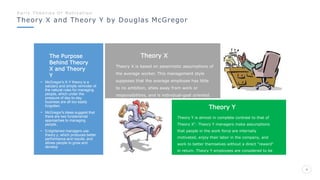
• McGregor's X-Y theory is a
salutary and simple reminder of
the natural rules for managing
people, which under the
pressure of day-to-day
business are all too easily
forgotten.
• McGregor's ideas suggest that
there are two fundamental
approaches to managing
people..
• Enlightened managers use
theory y, which produces better
performance and results, and
allows people to grow and
develop.
The Purpose
Behind Theory
X and Theory
Y
Theory X is based on pessimistic assumptions of
the average worker. This management style
supposes that the average employee has little
to no ambition, shies away from work or
responsibilities, and is individual-goal oriented
Theory X
Theory Y is almost in complete contrast to that of
Theory X". Theory Y managers make assumptions
that people in the work force are internally
motivated, enjoy their labor in the company, and
work to better themselves without a direct "reward"
in return. Theory Y employees are considered to be
one of the most valuable assets to the company,
and truly drive the internal workings of the
corporation
Theory Y
5
Herzberg Two-Factor Theory
H u m a n N e e d s
5
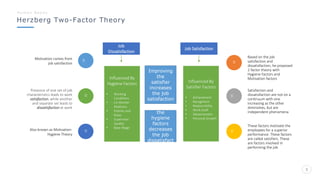
Based on the job
satisfaction and
dissatisfaction, he proposed
2 factor theory with
Hygiene Factors and
Motivation factors
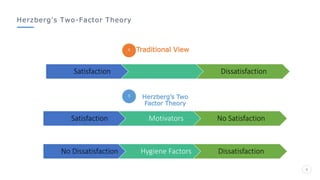
Satisfaction and
dissatisfaction are not on a
continuum with one
increasing as the other
diminishes, but are
independent phenomena
These factors motivate the
employees for a superior
performance. These factors
are called satisfiers. These
are factors involved in
performing the job
Motivation comes from
job satisfaction
Presence of one set of job
characteristics leads to work
satisfaction, while another
and separate set leads to
dissatisfaction at work
Also known as Motivation-
Hygiene Theory
Influenced By
Hygiene Factors
• Working
Conditions
• Co-Worker
Relations
• Policies and
Rules
• Supervisor
Quality
• Base Wage
Improving
the
satisfier
increases
the job
satisfaction
Improving
the
hygiene
factors
decreases
the job
dissatisfact
ion
Job
Dissatisfaction
Job Satisfaction
Influenced By
Satisfier Factors
• Achievement
• Recognition
• Responsibility
• Work Itself
• Advancement
• Personal Growth
Herzberg’s Two-Factor Theory
6
Herzberg’s Two
Factor Theory
Traditional View
Satisfaction Dissatisfaction
Satisfaction Motivators No Satisfaction
No Dissatisfaction Hygiene Factors Dissatisfaction
McClelland’s Theory of Needs
7
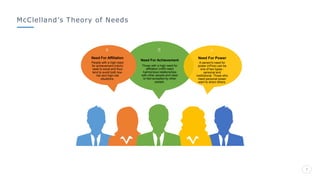
Those with a high need for
affiliation (nAff) need
harmonious relationships
with other people and need
to feel accepted by other
people.
Need For Achievement
A person's need for
power (nPow) can be
one of two types -
personal and
institutional. Those who
need personal power
want to direct others.
Need For Power
People with a high need
for achievement (nAch)
seek to excel and thus
tend to avoid both low-
risk and high-risk
situations.
Need For Affiliation
Lemon drops oat cake
oat cake sugar. Cake pie
sesame snaps.
Technology
Self Determination Theory
C o n t e m p o r a r y T h e o r y O f M o t i v a t i o n
8
CompetenceAutonomy
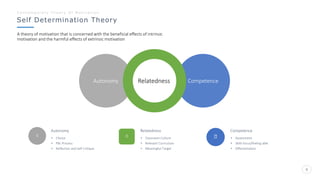
A theory of motivation that is concerned with the beneficial effects of intrinsic
motivation and the harmful effects of extrinsic motivation
• Choice
• PBL Process
• Reflection and Self Critique
Autonomy
• Classroom Culture
• Relevant Curriculum
• Meaningful Target
Relatedness
• Assessment
• Skills focus/feeling able
• Differentiation
Competence
Relatedness
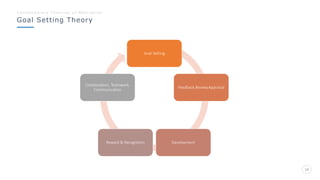
Goal Setting Theory
C o n t e m p o r a r y T h e o r i e s o f M o t i v a t i o n
9
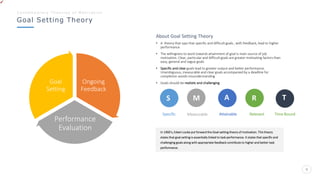
• A theory that says that specific and difficult goals , with feedback, lead to higher
performance
• The willingness to work towards attainment of goal is main source of job
motivation. Clear, particular and difficult goals are greater motivating factors than
easy, general and vague goals
• Specific and clear goals lead to greater output and better performance.
Unambiguous, measurable and clear goals accompanied by a deadline for
completion avoids misunderstanding
• Goals should be realistic and challenging
About Goal Setting Theory
Specific Measurable Attainable Relevant
In 1960’s, Edwin Locke put forward the Goal-setting theory of motivation. This theory
states that goal setting is essentially linked to task performance. It states that specific and
challenging goals along with appropriate feedback contribute to higher and better task
performance.
Ongoing
Feedback
Performance
Evaluation
Goal
Setting
Time Bound
S M A R T
Goal Setting Theory
C o n t e m p o r a r y T h e o r i e s o f M o t i v a t i o n
10
Goal Setting
Feedback,Review,Appraisal
DevelopmentReward & Recognition
Collaboration, Teamwork,
Communication
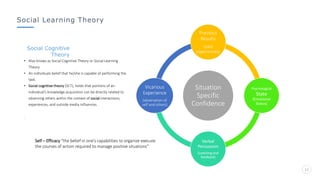
Social Learning Theory
11
Social Cognitive
Theory
• Also knows as Social Cognitive Theory or Social Learning
Theory
• An individuals belief that he/she is capable of performing the
task.
• Social cognitive theory (SCT), holds that portions of an
individual's knowledge acquisition can be directly related to
observing others within the context of social interactions,
experiences, and outside media influences.
.
Situation
Specific
Confidence
Previous
Results
(past
experiences)
Psychological
State
(Emotional
Status)
Verbal
Persuasion
(coaching and
feedback)
Vicarious
Experience
(observation of
self and others)
Self – Efficacy “the belief in one’s capabilities to organize execute
the courses of action required to manage positive situations”
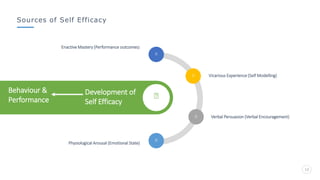
Sources of Self Efficacy
12
Verbal Persuasion (Verbal Encouragement)
Vicarious Experience (Self Modelling)
Enactive Mastery (Performance outcomes)
Physiological Arousal (Emotional State)
Development of
Self Efficacy
Behaviour &
Performance
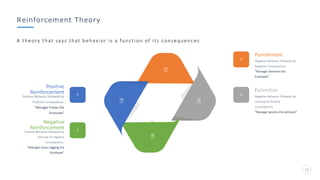
Reinforcement Theory
A theory that says that behavior is a function of its consequences
13
Punishment
Negative Behavior followed by
Negative Consequence.
“Manager demotes the
Employee”
Extinction
Negative Behavior followed by
removal of Positive
Consequence.
“Manager ignores the behavior”
Positive
Reinforcement
Positive Behavior followed by
Positive Consequence.
“Manager Praises the
Employee”
Negative
Reinforcement
Positive Behavior followed by
removal of negative
Consequence.
“Manager stops nagging the
Employee”
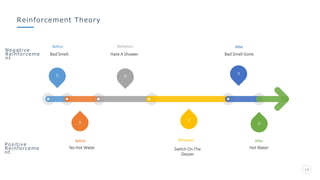
Reinforcement Theory
14
Bad Smell.
Before
Have A Shower.
Behaviour
Bad Smell Gone
After
No Hot Water
Before
Switch On The
Geyser
Behaviour
Hot Water
After
Negative
Reinforceme
nt
Positive
Reinforceme
nt
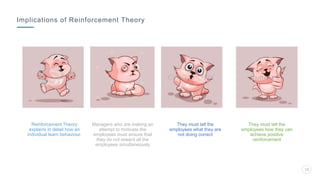
They must tell the
employees what they are
not doing correct
They must tell the
employees how they can
achieve positive
reinforcement
Implications of Reinforcement Theory
15
Reinforcement Theory
explains in detail how an
individual learn behaviour.
Managers who are making an
attempt to motivate the
employees must ensure that
they do not reward all the
employees simultaneously
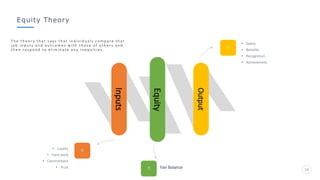
Equity Theory
16
Inputs
Equity
Output
• Salary
• Benefits
• Recognition
• Achievement
Fair Balance
• Loyalty
• Hard work
• Commitment
• Trust
T h e t h e o r y t h a t s a y s t h a t i n d i v i d u a l s c o m p a r e t h a t
j o b i n p u t s a n d o u t c o m e s w i t h t h o s e o f o t h e r s a n d
t h e n r e s p o n d t o e l i m i n a t e a n y i n e q u i t i e s .
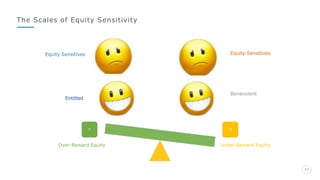
The Scales of Equity Sensitivity
17
Equity Sensitives
Benevolent
Under-Reward Equity
Equity Sensitives
Entitled
Over-Reward Equity
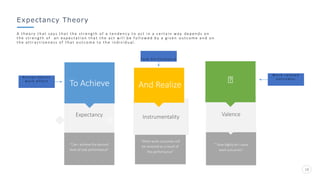
Expectancy Theory
A t h e o r y t h a t s a y s t h a t t h e s t r e n g t h o f a t e n d e n c y t o a c t i n a c e r t a i n w a y d e p e n d s o n
t h e s t r e n g t h o f a n e x p e c t a t i o n t h a t t h e a c t w i l l b e f o l l o w e d b y a g i v e n o u t c o m e a n d o n
t h e a t t r a c t i v e n e s s o f t h a t o u t c o m e t o t h e i n d i v i d u a l .
18
“Can I achieve the desired
level of task performance”
Expectancy
“What work outcomes will
be received as a result of
the performance”
“”How highly do I value
work outcomes”
Instrumentality Valence
To Achieve
P e r s o n e x e r t s
w o r k e f f o r t
T a s k P e r f o r m a n c e
W o r k - r e l a t e d
o u t c o m e s
And Realize
19
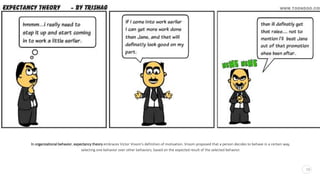
In organizational behavior, expectancy theory embraces Victor Vroom's definition of motivation. Vroom proposed that a person decides to behave in a certain way,
selecting one behavior over other behaviors, based on the expected result of the selected behavior.
Bharati Airtel Ltd India-Story and Motive of Airtel
C a s e S t u d y 1
20
The Indian telecom company and became the fifth largest telecom operator in the world with over
243.336 million customers across 23 countries, as of March 2012
“Our values are imbibed in what we do and how we do it”.
Alive Inclusive Respectful
Motivational Objective
C a s e S t u d y - 1
21
Flexibility
Easy Day
Concierge Desk
Food Court
Health Centre
Fun at Work
Sabbatical Policy
Career Growth Benefits
Mentoring Program
Social Events
Achievements
C a s e S t u d y - 1
22
As part of the motivational programs airtel stood as the leading
player in the subscriber base with 155,796,598 subscribers as
of January 2011
Not only that but also the leader position in terms of revenue
with a share market of 30.1% as of June 2011
23
McDonald's
C a s e S t u d y - 2
Improve McDonald’s reputation over the
Industry
Promote their new initiatives to new potential
customers
It began in 1940 and has 420,000 employees till date all
over the world.
Goals
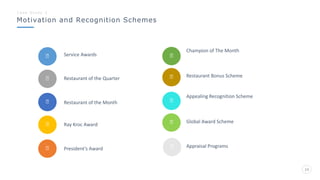
Motivation and Recognition Schemes
C a s e S t u d y - 2
24
Service Awards
Restaurant of the Quarter
Ray Kroc Award
President’s Award
Restaurant of the Month
Champion of The Month
Restaurant Bonus Scheme
Appealing Recognition Scheme
Global Award Scheme
Appraisal Programs
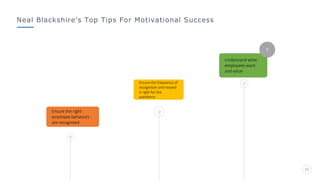
Neal Blackshire’s Top Tips For Motivational Success
25
Ensure the frequency of
recognition and reward
is right for the
workforce
Understand what
employees want
and value.
Ensure the right
employee behaviors
are recognized

Organizational Behavior

  • 1.
    11 Organizational Behaviour Chapter -7 MotivationConcepts PRESENTED BY: Moglichera Sirisha Shrahi Singh Karnwal Nethala Prithvi Prakash Anshul Prasad Ankur Mathur
  • 2.
    2 Motivation • Processes thataccount for an individual’s intensity, direction, and persistence of effort towards attaining a goal. • Intensity describes how hard a person tries. • Internal and external factors that stimulate desire and energy in people to be continually interested and committed to a job, role or subject, or to make an effort to attain a goal. • Motivation results from the interaction of both conscious and unconscious factors such as the intensity of desire or need, incentive or reward value of the goal, and expectations of the individual and of his or her peers. These factors are the reasons one has for behaving a certain way The Definition Goals Attitude Support Performance The will to win, the desire to succeed, the urge to reach your full potential... these are the keys that will unlock the door to personal excellence. -Confucius Idea Success
  • 3.
    Maslow’s Hierarchy OfNeeds E a r l y T h e o r i e s O f M o t i v a t i o n 3 Morality, Creativity , Spontaneity , Problem Solving, Lack Of Prejudice , Acceptance Of Facts Self Actualization Self Esteem , Confidence, Achievement , Respect Of Others , Respect By Others Esteem Friendship , Family , Relations , Intimacy Love/Belonging Security Of Body , Of Employment , Of Resources, Of Morality ,Of the Family , Of the Health , Of the Property Safety Breathing , Food , Water , Sleep , Homeostasis , Excretion Physiological
  • 4.
    Theory X andTheory Y by Douglas McGregor E a r l y T h e o r i e s O f M o t i v a t i o n 4 • McGregor's X-Y theory is a salutary and simple reminder of the natural rules for managing people, which under the pressure of day-to-day business are all too easily forgotten. • McGregor's ideas suggest that there are two fundamental approaches to managing people.. • Enlightened managers use theory y, which produces better performance and results, and allows people to grow and develop. The Purpose Behind Theory X and Theory Y Theory X is based on pessimistic assumptions of the average worker. This management style supposes that the average employee has little to no ambition, shies away from work or responsibilities, and is individual-goal oriented Theory X Theory Y is almost in complete contrast to that of Theory X". Theory Y managers make assumptions that people in the work force are internally motivated, enjoy their labor in the company, and work to better themselves without a direct "reward" in return. Theory Y employees are considered to be one of the most valuable assets to the company, and truly drive the internal workings of the corporation Theory Y
  • 5.
    5 Herzberg Two-Factor Theory Hu m a n N e e d s 5 Based on the job satisfaction and dissatisfaction, he proposed 2 factor theory with Hygiene Factors and Motivation factors Satisfaction and dissatisfaction are not on a continuum with one increasing as the other diminishes, but are independent phenomena These factors motivate the employees for a superior performance. These factors are called satisfiers. These are factors involved in performing the job Motivation comes from job satisfaction Presence of one set of job characteristics leads to work satisfaction, while another and separate set leads to dissatisfaction at work Also known as Motivation- Hygiene Theory Influenced By Hygiene Factors • Working Conditions • Co-Worker Relations • Policies and Rules • Supervisor Quality • Base Wage Improving the satisfier increases the job satisfaction Improving the hygiene factors decreases the job dissatisfact ion Job Dissatisfaction Job Satisfaction Influenced By Satisfier Factors • Achievement • Recognition • Responsibility • Work Itself • Advancement • Personal Growth
  • 6.
    Herzberg’s Two-Factor Theory 6 Herzberg’sTwo Factor Theory Traditional View Satisfaction Dissatisfaction Satisfaction Motivators No Satisfaction No Dissatisfaction Hygiene Factors Dissatisfaction
  • 7.
    McClelland’s Theory ofNeeds 7 Those with a high need for affiliation (nAff) need harmonious relationships with other people and need to feel accepted by other people. Need For Achievement A person's need for power (nPow) can be one of two types - personal and institutional. Those who need personal power want to direct others. Need For Power People with a high need for achievement (nAch) seek to excel and thus tend to avoid both low- risk and high-risk situations. Need For Affiliation Lemon drops oat cake oat cake sugar. Cake pie sesame snaps. Technology
  • 8.
    Self Determination Theory Co n t e m p o r a r y T h e o r y O f M o t i v a t i o n 8 CompetenceAutonomy A theory of motivation that is concerned with the beneficial effects of intrinsic motivation and the harmful effects of extrinsic motivation • Choice • PBL Process • Reflection and Self Critique Autonomy • Classroom Culture • Relevant Curriculum • Meaningful Target Relatedness • Assessment • Skills focus/feeling able • Differentiation Competence Relatedness
  • 9.
    Goal Setting Theory Co n t e m p o r a r y T h e o r i e s o f M o t i v a t i o n 9 • A theory that says that specific and difficult goals , with feedback, lead to higher performance • The willingness to work towards attainment of goal is main source of job motivation. Clear, particular and difficult goals are greater motivating factors than easy, general and vague goals • Specific and clear goals lead to greater output and better performance. Unambiguous, measurable and clear goals accompanied by a deadline for completion avoids misunderstanding • Goals should be realistic and challenging About Goal Setting Theory Specific Measurable Attainable Relevant In 1960’s, Edwin Locke put forward the Goal-setting theory of motivation. This theory states that goal setting is essentially linked to task performance. It states that specific and challenging goals along with appropriate feedback contribute to higher and better task performance. Ongoing Feedback Performance Evaluation Goal Setting Time Bound S M A R T
  • 10.
    Goal Setting Theory Co n t e m p o r a r y T h e o r i e s o f M o t i v a t i o n 10 Goal Setting Feedback,Review,Appraisal DevelopmentReward & Recognition Collaboration, Teamwork, Communication
  • 11.
    Social Learning Theory 11 SocialCognitive Theory • Also knows as Social Cognitive Theory or Social Learning Theory • An individuals belief that he/she is capable of performing the task. • Social cognitive theory (SCT), holds that portions of an individual's knowledge acquisition can be directly related to observing others within the context of social interactions, experiences, and outside media influences. . Situation Specific Confidence Previous Results (past experiences) Psychological State (Emotional Status) Verbal Persuasion (coaching and feedback) Vicarious Experience (observation of self and others) Self – Efficacy “the belief in one’s capabilities to organize execute the courses of action required to manage positive situations”
  • 12.
    Sources of SelfEfficacy 12 Verbal Persuasion (Verbal Encouragement) Vicarious Experience (Self Modelling) Enactive Mastery (Performance outcomes) Physiological Arousal (Emotional State) Development of Self Efficacy Behaviour & Performance
  • 13.
    Reinforcement Theory A theorythat says that behavior is a function of its consequences 13 Punishment Negative Behavior followed by Negative Consequence. “Manager demotes the Employee” Extinction Negative Behavior followed by removal of Positive Consequence. “Manager ignores the behavior” Positive Reinforcement Positive Behavior followed by Positive Consequence. “Manager Praises the Employee” Negative Reinforcement Positive Behavior followed by removal of negative Consequence. “Manager stops nagging the Employee”
  • 14.
    Reinforcement Theory 14 Bad Smell. Before HaveA Shower. Behaviour Bad Smell Gone After No Hot Water Before Switch On The Geyser Behaviour Hot Water After Negative Reinforceme nt Positive Reinforceme nt
  • 15.
    They must tellthe employees what they are not doing correct They must tell the employees how they can achieve positive reinforcement Implications of Reinforcement Theory 15 Reinforcement Theory explains in detail how an individual learn behaviour. Managers who are making an attempt to motivate the employees must ensure that they do not reward all the employees simultaneously
  • 16.
    Equity Theory 16 Inputs Equity Output • Salary •Benefits • Recognition • Achievement Fair Balance • Loyalty • Hard work • Commitment • Trust T h e t h e o r y t h a t s a y s t h a t i n d i v i d u a l s c o m p a r e t h a t j o b i n p u t s a n d o u t c o m e s w i t h t h o s e o f o t h e r s a n d t h e n r e s p o n d t o e l i m i n a t e a n y i n e q u i t i e s .
  • 17.
    The Scales ofEquity Sensitivity 17 Equity Sensitives Benevolent Under-Reward Equity Equity Sensitives Entitled Over-Reward Equity
  • 18.
    Expectancy Theory A th e o r y t h a t s a y s t h a t t h e s t r e n g t h o f a t e n d e n c y t o a c t i n a c e r t a i n w a y d e p e n d s o n t h e s t r e n g t h o f a n e x p e c t a t i o n t h a t t h e a c t w i l l b e f o l l o w e d b y a g i v e n o u t c o m e a n d o n t h e a t t r a c t i v e n e s s o f t h a t o u t c o m e t o t h e i n d i v i d u a l . 18 “Can I achieve the desired level of task performance” Expectancy “What work outcomes will be received as a result of the performance” “”How highly do I value work outcomes” Instrumentality Valence To Achieve P e r s o n e x e r t s w o r k e f f o r t T a s k P e r f o r m a n c e W o r k - r e l a t e d o u t c o m e s And Realize
  • 19.
    19 In organizational behavior,expectancy theory embraces Victor Vroom's definition of motivation. Vroom proposed that a person decides to behave in a certain way, selecting one behavior over other behaviors, based on the expected result of the selected behavior.
  • 20.
    Bharati Airtel LtdIndia-Story and Motive of Airtel C a s e S t u d y 1 20 The Indian telecom company and became the fifth largest telecom operator in the world with over 243.336 million customers across 23 countries, as of March 2012 “Our values are imbibed in what we do and how we do it”. Alive Inclusive Respectful
  • 21.
    Motivational Objective C as e S t u d y - 1 21 Flexibility Easy Day Concierge Desk Food Court Health Centre Fun at Work Sabbatical Policy Career Growth Benefits Mentoring Program Social Events
  • 22.
    Achievements C a se S t u d y - 1 22 As part of the motivational programs airtel stood as the leading player in the subscriber base with 155,796,598 subscribers as of January 2011 Not only that but also the leader position in terms of revenue with a share market of 30.1% as of June 2011
  • 23.
    23 McDonald's C a se S t u d y - 2 Improve McDonald’s reputation over the Industry Promote their new initiatives to new potential customers It began in 1940 and has 420,000 employees till date all over the world. Goals
  • 24.
    Motivation and RecognitionSchemes C a s e S t u d y - 2 24 Service Awards Restaurant of the Quarter Ray Kroc Award President’s Award Restaurant of the Month Champion of The Month Restaurant Bonus Scheme Appealing Recognition Scheme Global Award Scheme Appraisal Programs
  • 25.
    Neal Blackshire’s TopTips For Motivational Success 25 Ensure the frequency of recognition and reward is right for the workforce Understand what employees want and value. Ensure the right employee behaviors are recognized