ORGANIZATIONAL
BEHAVIOUR
Motivation Concepts
CHAPTER 7
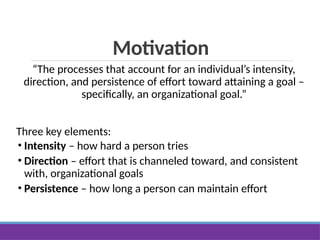
Motivation
“The processes that account for an individual’s intensity,
direction, and persistence of effort toward attaining a goal –
specifically, an organizational goal.”
Three key elements:
• Intensity – how hard a person tries
• Direction – effort that is channeled toward, and consistent
with, organizational goals
• Persistence – how long a person can maintain effort
Early Theories of Motivation
The early theories of motivation may not be valid,
but they do form the basis for contemporary
theories and are still used by practicing managers.
 Maslow’s Hierarchy of Needs Theory
 McGregor’s Theory X and Theory Y
 Herzberg’s Two-Factor Theory
 McClelland’s Theory of Needs
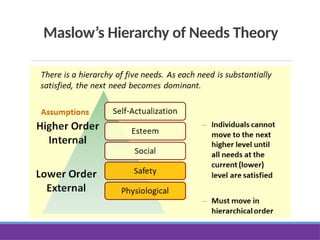
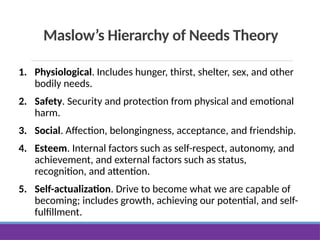
Maslow’s Hierarchy of Needs Theory
1. Physiological. Includes hunger, thirst, shelter, sex, and other
bodily needs.
2. Safety. Security and protection from physical and emotional
harm.
3. Social. Affection, belongingness, acceptance, and friendship.
4. Esteem. Internal factors such as self-respect, autonomy, and
achievement, and external factors such as status,
recognition, and attention.
5. Self-actualization. Drive to become what we are capable of
becoming; includes growth, achieving our potential, and self-
fulfillment.
McGregor’s Theory X and Theory Y
Theory X assumptions are basically negative.
• Employees inherently dislike work and, whenever
possible, will attempt to avoid it.
• They must be coerced, controlled, or threatened
with punishment.
Theory Y assumptions are basically positive.
• Employees can view work as being as natural as rest
or play.
Herzberg’s Two-Factor Theory
• A theory that relates intrinsic factors to job satisfaction
and associates extrinsic factors with dissatisfaction.
• Also called motivation hygiene theory.
1. Hygiene factors = when these are adequate, workers
“feel OK” (i.e. they are NOT dissatisfied). Examples
include quality of supervision, company policies and
administration.
2. Motivators = examines factors contributing to job
satisfaction. Thus, there are factors which lead to job
satisfaction and things that don’t (i.e. notice there is a
difference between “non-satisfying” and “dissatisfying
factors”)
McClelland’s Theory of Needs
“A theory that states achievement, power, and affiliation
are three important needs that help explain motivation:
Need for Achievement (nAch)
• The drive to excel, to achieve in relation to a set of standards, to strive
to succeed.
Need for Power (nPow)
• The need to make others behave in a way that they would not have
behaved otherwise.
Need for Affiliation (nAff)
• The desire for friendly and close interpersonal relationships.
People have varying levels of each of the three needs.
Hard to measure
Cotemporary Theories of Motivation
The name “contemporary” represent the current state of
thinking in explaining employee motivation.
 Cognitive Evaluation Theory
 Goal-Setting Theory
 Self-Efficacy Theory
 Reinforcement Theory
 Equity Theory
 Expectancy Theory
Cotemporary Theories of Motivation
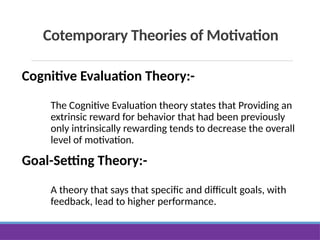
Cognitive Evaluation Theory:-
The Cognitive Evaluation theory states that Providing an
extrinsic reward for behavior that had been previously
only intrinsically rewarding tends to decrease the overall
level of motivation.
Goal-Setting Theory:-
A theory that says that specific and difficult goals, with
feedback, lead to higher performance.
Cotemporary Theories of Motivation
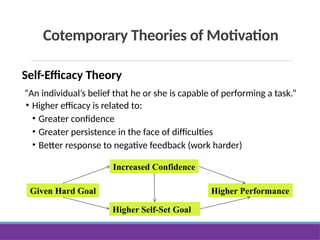
Self-Efficacy Theory
“An individual’s belief that he or she is capable of performing a task.”
• Higher efficacy is related to:
• Greater confidence
• Greater persistence in the face of difficulties
• Better response to negative feedback (work harder)
Given Hard Goal
Higher Self-Set Goal
Increased Confidence
Higher Performance
Cotemporary Theories of Motivation
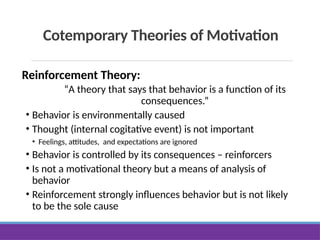
Reinforcement Theory:
“A theory that says that behavior is a function of its
consequences.”
• Behavior is environmentally caused
• Thought (internal cogitative event) is not important
• Feelings, attitudes, and expectations are ignored
• Behavior is controlled by its consequences – reinforcers
• Is not a motivational theory but a means of analysis of
behavior
• Reinforcement strongly influences behavior but is not likely
to be the sole cause
Cotemporary Theories of Motivation
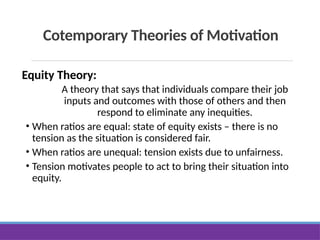
Equity Theory:
A theory that says that individuals compare their job
inputs and outcomes with those of others and then
respond to eliminate any inequities.
• When ratios are equal: state of equity exists – there is no
tension as the situation is considered fair.
• When ratios are unequal: tension exists due to unfairness.
• Tension motivates people to act to bring their situation into
equity.
Cotemporary Theories of Motivation
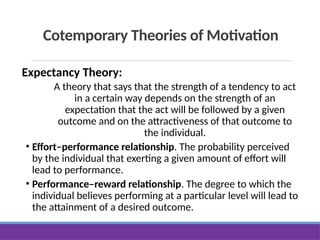
Expectancy Theory:
A theory that says that the strength of a tendency to act
in a certain way depends on the strength of an
expectation that the act will be followed by a given
outcome and on the attractiveness of that outcome to
the individual.
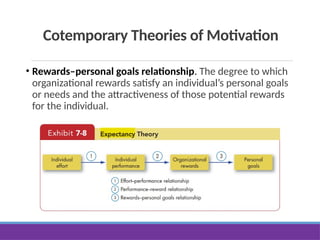
• Effort–performance relationship. The probability perceived
by the individual that exerting a given amount of effort will
lead to performance.
• Performance–reward relationship. The degree to which the
individual believes performing at a particular level will lead to
the attainment of a desired outcome.
Cotemporary Theories of Motivation
• Rewards–personal goals relationship. The degree to which
organizational rewards satisfy an individual’s personal goals
or needs and the attractiveness of those potential rewards
for the individual.

Org B Chap # 7 (Motivation Concepts).pptx

  • 1.
  • 2.
  • 3.
    Motivation “The processes thataccount for an individual’s intensity, direction, and persistence of effort toward attaining a goal – specifically, an organizational goal.” Three key elements: • Intensity – how hard a person tries • Direction – effort that is channeled toward, and consistent with, organizational goals • Persistence – how long a person can maintain effort
  • 4.
    Early Theories ofMotivation The early theories of motivation may not be valid, but they do form the basis for contemporary theories and are still used by practicing managers.  Maslow’s Hierarchy of Needs Theory  McGregor’s Theory X and Theory Y  Herzberg’s Two-Factor Theory  McClelland’s Theory of Needs
  • 5.
  • 6.
    Maslow’s Hierarchy ofNeeds Theory 1. Physiological. Includes hunger, thirst, shelter, sex, and other bodily needs. 2. Safety. Security and protection from physical and emotional harm. 3. Social. Affection, belongingness, acceptance, and friendship. 4. Esteem. Internal factors such as self-respect, autonomy, and achievement, and external factors such as status, recognition, and attention. 5. Self-actualization. Drive to become what we are capable of becoming; includes growth, achieving our potential, and self- fulfillment.
  • 7.
    McGregor’s Theory Xand Theory Y Theory X assumptions are basically negative. • Employees inherently dislike work and, whenever possible, will attempt to avoid it. • They must be coerced, controlled, or threatened with punishment. Theory Y assumptions are basically positive. • Employees can view work as being as natural as rest or play.
  • 8.
    Herzberg’s Two-Factor Theory •A theory that relates intrinsic factors to job satisfaction and associates extrinsic factors with dissatisfaction. • Also called motivation hygiene theory. 1. Hygiene factors = when these are adequate, workers “feel OK” (i.e. they are NOT dissatisfied). Examples include quality of supervision, company policies and administration. 2. Motivators = examines factors contributing to job satisfaction. Thus, there are factors which lead to job satisfaction and things that don’t (i.e. notice there is a difference between “non-satisfying” and “dissatisfying factors”)
  • 9.
    McClelland’s Theory ofNeeds “A theory that states achievement, power, and affiliation are three important needs that help explain motivation: Need for Achievement (nAch) • The drive to excel, to achieve in relation to a set of standards, to strive to succeed. Need for Power (nPow) • The need to make others behave in a way that they would not have behaved otherwise. Need for Affiliation (nAff) • The desire for friendly and close interpersonal relationships. People have varying levels of each of the three needs. Hard to measure
  • 10.
    Cotemporary Theories ofMotivation The name “contemporary” represent the current state of thinking in explaining employee motivation.  Cognitive Evaluation Theory  Goal-Setting Theory  Self-Efficacy Theory  Reinforcement Theory  Equity Theory  Expectancy Theory
  • 11.
    Cotemporary Theories ofMotivation Cognitive Evaluation Theory:- The Cognitive Evaluation theory states that Providing an extrinsic reward for behavior that had been previously only intrinsically rewarding tends to decrease the overall level of motivation. Goal-Setting Theory:- A theory that says that specific and difficult goals, with feedback, lead to higher performance.
  • 12.
    Cotemporary Theories ofMotivation Self-Efficacy Theory “An individual’s belief that he or she is capable of performing a task.” • Higher efficacy is related to: • Greater confidence • Greater persistence in the face of difficulties • Better response to negative feedback (work harder) Given Hard Goal Higher Self-Set Goal Increased Confidence Higher Performance
  • 13.
    Cotemporary Theories ofMotivation Reinforcement Theory: “A theory that says that behavior is a function of its consequences.” • Behavior is environmentally caused • Thought (internal cogitative event) is not important • Feelings, attitudes, and expectations are ignored • Behavior is controlled by its consequences – reinforcers • Is not a motivational theory but a means of analysis of behavior • Reinforcement strongly influences behavior but is not likely to be the sole cause
  • 14.
    Cotemporary Theories ofMotivation Equity Theory: A theory that says that individuals compare their job inputs and outcomes with those of others and then respond to eliminate any inequities. • When ratios are equal: state of equity exists – there is no tension as the situation is considered fair. • When ratios are unequal: tension exists due to unfairness. • Tension motivates people to act to bring their situation into equity.
  • 15.
    Cotemporary Theories ofMotivation Expectancy Theory: A theory that says that the strength of a tendency to act in a certain way depends on the strength of an expectation that the act will be followed by a given outcome and on the attractiveness of that outcome to the individual. • Effort–performance relationship. The probability perceived by the individual that exerting a given amount of effort will lead to performance. • Performance–reward relationship. The degree to which the individual believes performing at a particular level will lead to the attainment of a desired outcome.
  • 16.
    Cotemporary Theories ofMotivation • Rewards–personal goals relationship. The degree to which organizational rewards satisfy an individual’s personal goals or needs and the attractiveness of those potential rewards for the individual.