Psychology 49
 Chapter 1
 Introduction to Industrial/Organizational
 Psychology


                                             1
Objectives
 • Define I/O Psychology
 • Describe the major activities of I/O Psychologists
 • Summarize the history of the I/O field
 • Explain the importance of the research and how it
   relates to practice
Centrality of work to human
       existence
• In today’s society, you are what you do. Your choice of a
  job/occupation determines as much about what you will be,
  the status and prestige you will be afforded, what your children
  will do and who they will do it with, where they go to school,
  as do your choice of a spouse/partner and your own values.
  One of the first questions you ask someone: what’s your major? Or what do you do?
  Or perhaps identify by religion or spouse, not as likely

• Go to a mall, your favorite bar, a construction site, etc., and
  ask anybody who will talk to you, “What are you?” How many
  define themselves in terms of their job or occupation?
 Success = money    Success = happy     Happy = what you want
 What you want requires $$$ or accomplishing goal. Goal usually is professional.

• How does one know when one is a “success?” What is our
  cultural measuring-stick?
                                                                                      3
Work is a source of…
 − Identity - Last name ‘Smith’ ‘Cooper’
 − Relationships outside the family.
 − Obligatory activity
    • Provides structure to our days.
        − deadlines
 − Autonomy--Independence
    • Provides money, products, & associated values. (Women)
 − Opportunity to develop skills.
 − Self-esteem
    • What would you do if you didn’t have college or a job
    • You can afford to be lazy for a break, what about when no
      end in sight.
 − Money

                                                                  4
Implicit Themes of Work
 • Mentioned when work is discussed
   − Good Provider: Heavily influenced by
     social constructions of gender and
     gender identity.
   − Independence: “Stand on one’s own
     two feet.”
      • Being separate from your parents
   − Success: “Hard work pays off.”
   − Self Respect: Hard work of any type
     has dignity; a person’s worth is
     reflected in work.                     5
Unemployment
 • Workplace violence: In 1996, Clifford McCree
   returned to his former place of work 14 months
   after being fired from his maintenance job with
   the City of Fort Lauderdale. He killed five former
   coworkers, wounded one, and killed himself. His
   suicide note said, “The economic lynching without
   regard or recourse was something very evil. Since
   I couldn’t support my family, life became nothing.
   I also want to punish some...that helped bring this
   about.”
 • Cross-culturally: High incidence of suicide among
    “ashamed” Japanese executives
 • Transition to adulthood: work represents a
   “coming of age”
     − Loss of a job marks return to dependency (welfare)   6
What is I/O Psychology?
 • Definition:
      • Application of psychological theory and
        research methods (principles) to issues
        concerned with work


 • Domains:
   − Cognition (worker perception)
   − Affect (worker emotion)
      • Influences worker going beyond call of duty
   − Behavior (worker action)
                                                      7
What is I/O psychology?
 • Textbook definition:
    − “Application of psychological principles
      and theories to the workplace”


 • What I usually tell my student:
    − “It is a study of how people get along at
      work and are able to perform effectively”
I/O vs Management Program
 • Focus:
    − I/O – focus on people . Uses psychological
      theories to better understand groups and
      people in organization with conflict,
      motivation, emotions and other issues.
    − Management – focuses on the running or
      managing as aspect of the organization
      such as marketing, advertising, costing,
      etc.
I/O vs Management Program
 • Approach: Example
   − Management uses unstructured interviews
     for example as their best way to size-up
     and understand applicants or people.
   − I/O uses standardized tests and structured
     interviews are just part and parcel of the
     process of hiring/placement program.
I/O vs Management Program
 • Methodology:
   − Relies extensively in Research,
     Quantitative Methods, and Testing
     techniques.
   − Uses empirical data and statistics to make
     decisions.
   − Scientist-Practitioner Model. Scientist
     when conducting research, practitioner
     when working in actual organization.
What is I/O psychology?
• Subareas within I/O
   − Industrial or Personnel psychology
      • HR stuff: recruitment, job analysis, selection, training,
        performance appraisal, compensation, employment law
        (Title VII of CRA)
      • KSAs job performance
   − Organizational Psychology
      • Micro: motivation, leadership, teams, worker attitudes,
        safety & well-being, work-family
      • Macro: org theory, culture, org development & change
   − Human Factors & Ergonomics
      • Modifying equipment & environment to fit workers
Industrial vs Organizational Psychology
• Industrial Psychology (personnel psychology):
   − Personnel selection--individual differences of employees
   − Prediction of job performance.
   − Covers job analysis
       • distinguish what a successful worker from unsuccessful
   − and selection, training, performance appraisal.
       • Job performance = company “bottom line”
   − Traditionally, correlational approach used for research
     (motivation, interview test)

• Organizational Psychology       (social life aspects applied to work):
   − Leadership
   − Not only job performance, but satisfaction, motivation, etc.
   − Traditionally experimental research method

                                                                           13
The Training of I/O Psychologists (U.S.)
 • * Society for Industrial and
   Organizational Psychologists (SIOP)
   is the professional association with
   which I/O Psychologists affiliate.
    − www.siop.org

 • Training approach uses the
   Scientist-Practitioner Model
    − Stresses both the theoretical study of
      the field, and its application (in
      practice) to the workplace
                                               14
I/O Psychologists Organization
 • PMAP (People Management
   Association of the Philippines)
    − http://www.pmap.org.ph/

 • PAP (Psychological Association of
   the Philippines)
    − http://www.pap.org.ph/


                                       15
Who are I/O psychologists?
• Two general groups
   − Academics
      • Professors in research- and teaching-
        oriented universities and colleges
          − Example departments: psychology, management,
            industrial relations, quantitative sciences, occupational
            health & safety
      • Major activities
          − Teaching courses, conducting research, writing and
            presenting research papers, attending conferences,
            mentoring students, performing university and
            professional service
Who are I/O psychologists?
• Two general groups
   − Practitioners
      • HR and organizational specialists in
        consulting, private, and public organizations
      • Major activities
          − Job analysis, diagnosis, surveying employees,
            designing and administering selection & performance
            appraisal systems, training, developing psychological
            tests, implementing and evaluating OD & change,
            data analysis
   − “Other” category
      • Research institutes, think tanks (e.g., RAND)
Who are I/O psychologists?

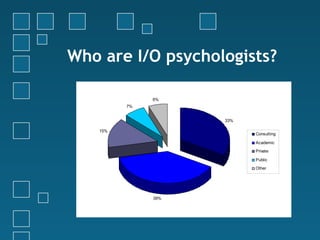
              6%
         7%


                    33%

   15%
                          Consulting

                          Academic
                          Private

                          Public
                          Other


              39%
Activities and Settings of I/O
   Psychologists
• Concerned with practice and research
   − Practice activities involve the use of psychological principles to
     solve real-world problems
   − Research provides principles that can be applied in practice
   − Some practice activities require research to determine the best
     approach to solve the problem at hand
• I/O Psychologists are professors
   − Practice settings include consulting firms, government, the
     military and private corporations (or consulting firms)
   − To create and to disseminate knowledge
   − Enhancing the effectiveness and functioning or organizations
Who are I/O psychologists?
• Scientists AND practitioners
   − Understanding and evaluating research necessary for
     good practice…
   − …and awareness of practical problems necessary for
     good research
• I/Oers are thieves!
   − We “borrow” from social, cognitive, developmental,
     clinical, and other areas of psychology
What do I/O Psychologists DO?
 • Careers emphasize science and
   research or practice.
 • 39% are professors employed by
   universities
 • 15% work in private organizations
   (Human Resources)
 • 15% work in public organizations
 • 33% work in consulting firms
                                       21
The science and practice of I/O Psychology
 • Primary work areas for I/O work:
 • Selection
    − Develop, validate, and administer psychological tests to assess
      (measure) skills, abilities and interests as aids in selection and
      placement and promotion.

 • Training
    − Analyze: First thing I/O dude does, is try to understand nature of
      job--knowledge & task requirements
    − Conduct training programs, and evaluate the effectiveness of
      training.

 • Organizational Development
    − Analyze organizations’ culture/climate, develop interventions -->
      increase in efficiency. E.g. user interface fucking productivity

                                                                           22
More functions of the I/O Psychologist
    • Performance Appraisal
       − Develop rating scales, and other measures of
         individual/organizational performance to improve
         employee performance.


    • Quality of Work-life
       − Previously, human workers were not viewed as human
       − Develop surveys that assess employees’ satisfaction with
         their jobs and commitment to the organization.
         Satisfaction: one of most common surveys.


                                                                    23
Job Titles of I/O Psychologist
  • I/O Psychologist
  • Consultant
  • Psychology Professor
  • HR Recruiter
  • Research psychologist / analyst / scientist
  • Staffing Manager
  • Trainer, Training Coordinator
  • VP – Human Resource
  • VP – Organizational Development
  • HR Director, Generalist, Representative, Specialist,
                                                           24
    Supervisor, Manager
History of I/O Psychology:
(1900-1916)
 • I/O Psych was nameless at first.
    − W. L. Bryan…
       • Stressed importance of studying “concrete
         activities and functions as they appear in
         daily life.”


       • But not really considered father of I/O
         Psych because he was a precursor, before
         the field was established


                                                      25
When was the nameless named?
 • Frank and Lillian Gilbreth
    − Interested in improving productivity and
      efficiency of industrial engineers.
       • Argued for the use of psychology in the
         work lives of industrial engineers.
           − Led to the merger of psychology with
             applied interests.
           − The nameless was crowned industrial
             psychology in 1910.
               • (The “organizational” bit came in the
                 1970s).


                                                         26
The 3 Founding Fathers

 • 1. Walter Dill Scott   (American Psychologist)

 • 2. Hugo Munsterberg      (German)

 • 3. Frederick Taylor    (American Engineer)


                                                    27
Walter Dill Scott
 • Walter Dill Scott   (American Psychologist)
    − First to apply the principles of psychology
      to motivation and productivity in the
      workplace.
    − Would later become instrumental in the
      application of personnel procedures within
      the army during World War I.
       • Boosted Industrial Psychology


                                                    28
Hugo Munsterberg          (German)

 • Father of industrial psychology
   − 1. Applied psychological method to
     practical industrial problems.
   − 2. Psychology and Industrial Efficiency
     (1913)
   − * View of I/O psychology:
      • 1. People need to fit the organization --
        training!
      • 2. Applied behavioral sciences should help
        organizations to shape people to serve as
        replacement parts for organizational
        machines. Mechanistic.                       29
Frederick Taylor              (American Engineer)

• Principles of Scientific Management (1911).
     • Science over intuition
     • The best workers should be selected and trained in
       the established “one best method”
     • Management and workers should cooperatively share
       responsibility for the design and conduct of work.
         − Motivation and monetary gain
     • Motivation results from monetary gain.
  − E.g.: Showed that workers who handle heavy iron ingots
    were more productive when allowed work rests.
     • Training when to work and when to rest raised productivity
       from 12.5 to 47.0 tons moved per day.
     • Company increase efficiency. Costs dropped from 9.2 to 3.9
       cents per ton.
                                                                30
World War I -      I/O field catalyst

 • Robert Yerkes and Walter Dill
   Scott:
    − Screening recruits for mental deficiency—Army
      Alpha and Beta intelligence tests developed.
    − Classification of selected recruits into jobs
    − Performance evaluations of officers
    − Job Analysis
    − soldier motivation and morale
    − Discipline

 • *(1917): Journal of Applied Psychology
   began publication
                                                      31
Between the Wars (1916-1940)
   The Hawthorne Studies
• Collaboration b/w Harvard researchers and
  Western Electric Co.
   − Studied the relation b/w lighting and productivity.
       • Productivity went up when lighting was increased…and when
         light was decreased

• Hawthorne Effect
   − Employees knew they were being watched
       • Following onset of novel treatment (new or increased
          attention usually)
   − If you don’t want more work given to you, purposely perform
     poorly.

• Human Relations Movement – social factors boost
  worker morale.                                                   32
World War II and shortly thereafter
• Selection and classification work continued in the Army:
   − Development of Army General Classification Test (AGCT).
        • Sorted army recruits into categories based on their abilities to learn
          duties of a soldier
   − The Office of Strategic Services came about
        • Assessed candidates’ ability to deal with stressful situations
             − Build a cube with one passive helper and one frustrating ‘helper’
   − Pilots trained to fly warplanes.
        • Good candidates were selected; also equipment’s HF.

• Henceforth, use of employment tests increased in
  industry.
   − Industrial psychologists proved useful for selection, training and machine design.
   − Industrial leaders interested in applying social psychology.
        • Measures of attitudes and morale, now used in industry                    33
History of the Field of I/O Psychology
History of the Field of I/O Psychology (I)
• I/O Psychology is a 20-century invention, with roots
  in the late 1800s and early 1900s
   − First psychologists to do I/O work ere experimental
     psychologists who were applied the new principles of
     psychology to problems in organizations
   − Two main founders of the field were Hugo Munsterberg and
     Walter Dill Scott
      • Munsterberg interested in the selection of employees and the
        use of the new psychological tests, wrote the first I/O
        textbook , Psychology and Industrial Efficiency (1913)
      • Scott interested in advertising, Scott’s The Theory of
        Advertising (1930)
History of the Field of I/O Psychology
  (II)
− The major influence on the I/O field was the work of
  Frederick Winslow Taylor
   • Developed the Scientific Management
      − Each job should be carefully analyzed so that the optimal way of
        doing tasks can be specified
      − Employees should be selected (hired) that related to job
        performance
      − Employees should be carefully trained to do their job tasks
      − Employees should be rewarded for their productivity to encourage
        high levels of performance
− Frank and Lillian Gilberth, who were combined the
  fields of engineering and psychology
   • Their best-known contribution was the time and motion study
      − Measuring and timing people’s motions as they did tasks with the
        goal of developing more efficient ways of working
      − Lillian was the first to receive an I/O Ph.D. in 1915
History of the Field of I/O Psychology (III)
   − Robert Yerkes offered their services to the army
      • Development of the Army Alpha and Army Beta group tests for
        mental ability
      • This is the first large-scale application of psychological testing to
        place individuals in jobs
   − Hawthorne studies (Hawthorne effect)
      • The investigation of lighting-level effects
          − Determine the lighting level that would produce optimal performance
            on a factory task
          − Productivity increased and seemed to have little to do with lighting
            levels
          − Social factors can be more important than physical factors in people’s
            job performance

• APA applied psychology, and Division 14 of Industrial and
  Business Psychology was formed in 1944
History of the Field of I/O Psychology (IV)
 • In 1970, the Division of Industrial and
   Organizational Psychology and today
   called the Society for Industrial and
   Organizational Psychology (SIOP)
 • I/O Psychology was the passage of the
   Civil Rights Act of 1964
    − Help develop procedures that would eliminate
      discrimination in the workplace.
I/O Psychology Around the World
• US has had a long tradition of paying somewhat
  greater attention to the I side than the O side of
  the field
   − Canada and Europe focuses somewhat more on the
     organizational direction
   − Scandinavian countries concerned with employee health
     and stress
   − US , employee selection was the most popular topic

• Began the 21 century, the practice is spreading as
  I/O techniques gain acceptance in more and more
  places
Ethics of The I/O Field
• Ethical code
   − Psychologists should do their best to avoid harming other
     people through their professional work
   − Psychologists have a social responsibility to use their
     talents to help other people
   − Helping to improve organizations so that they function
     better and helping to improve the well-being of
     employees
   − Contains 6 principles
      • Competence, integrity, professional and scientific
        responsibility, respect for people’s rights and dignity,
        concerns for others welfare and social responsibility
      • Honesty, integrity, respect for others, and responsibility
Current Trends Affecting the Field (I)
• Linked to the realities of day-to-day organizational
  life
   − Workplace affect both the practice and the research field
   − Deal with contemporary challenges and problems

• Technology
   − Advances in communication and transportation changed the
     way in which organizations functioned
   − The World Wide Web is responsible for much of this changed
   − Organizations are simply posting their old ads on-line

• Internationalization
   − In the practice side, DDI and PDI changed the meaning of the
     I in their names from “incorporated” to “international”
Current Trends Affecting the Field (II)
   − The research side, collaboration among scholars in
     different countries has grown
   − Providing cross-fertilization of the field through the
     introduction of new ideas
• Skilled Labor Shortages
   − Jobs have become more complex, requiring higher levels of
     skills, the supply of employees has been dwindling
   − How best to attract applications in the first place
   − How to find and train people who have potential
   − How to retain the employees they have

• Occupational Health Psychology
   − Focus on the health, safety and well-being of employees in
     the workplace
A Look Into the Crystal Ball: The Future

• Changing nature of employees:
  −   Fewer young people entering workforce (baby boom)
  −   More women (2/3 of entry-level)
  −   More minorities (1/3 of entry-level)
  −   More temporary workers

• Changing nature of organizations:
  − Mergers and acquisitions; failures and downsizing--layoffs--
    more work, less manpower.
  − Smaller organizations, employing fewer people. Cynical
    workers/job security.
  − Greater focus on work teams (flatter management hierarchy)

                                                              43
A Look Into the Crystal Ball: The Future
• Growing importance of technology:
  − Technology-mediated communication
     • 1. Workers can work anywhere (from home, etc)
     • 2. Loss of direct human contact--impact on social
       relationships, mental health, etc.
  − Human-technology interaction
     • New jobs in maintenance of technology
        − Replace manufacturing operatives as “worker
          elite”
     • Greater focus on decision-making and
       coordination of activities by humans
        − Because jobs are becoming more technologically
          complex
                                                           44
A Look Into the Crystal Ball: The Future
• Redefinition of “job”:
  − less emphasis on job as a fixed bundle of tasks
  − emphasis on constantly changing tasks
      • 1. Requires constant learning
      • 2. More higher-order thinking
      • 3. Less “9 to 5”

• Changing nature of pay:
  − 1. *Tied less to position or tenure in organization
  − 2. Tied more to market value of person’s KSAOs
    (Knowledge, Skills, Abilities and Other characteristics).
                                                            45
Where do you go to become an
 I/O psychologist?
• Grad school!!!
   − Top MA and PhD programs
      • Lots of course work in years 1 and 2
      • MA thesis completed in year 2 or 3
          − Varies in formality by program
      • Internship?
      • Comprehensive exams in year 3
      • Dissertation in years 4 and 5
          − Proposal and defense meetings
When should you begin thinking about
    grad school in I/O psychology?
• The sooner the better!
   − Stuff to think about early on
      • Relevant coursework
          − I/O (duh!), stats, research methods, tests & measures, social,
            personality, motivation, cognitive, OB/HR
      • Research experience
          − Honor’s thesis, RA
          − Experience is more important than topic
      • Interact with faculty, grad students
          − Be active (not passive)
          − Attend brown bags
          − Involvement in professional societies (Psi Chi, SIOP)
Why should you consider getting
 a degree in I/O psychology?
• Applied field
   − There will always be practical problems to solve!
        • Company restructuring & downsizing
        • Workplace diversity

• Variety of job possibilities
   −   Academic positions in multiple departments
   −   Internal and external consulting
   −   Private and public organizations
   −   Any combination of the above
Why should you consider getting a
 degree in I/O psychology?
• Variety of research topics
   −   Attitudes, emotions, behavior (social)
   −   Learning, memory, heuristics (cog)
   −   Employee aging, retirement (develop)
   −   Employee counseling, coaching (clinical)
   −   Data analysis, test development (quant)
• Field is growing
   − More and more I/O and management department’s
   − Out with the old, in with the new…
References:
• Aamodt, Michael G. Industrial and Organizational
  Psychology Philippines (reprint), CENGAGE
  Learning Asia Pte. Ltd., 2012. 
• Muchinsky, Paul M. Psychology Applied to Work
  (An Introduction to Industrial/Organizational
  Psychology). 8th ed. Thomson/Wadsworth.
  University of North Carolina, 2007.

I/O chapter 1

  • 1.
    Psychology 49 Chapter1 Introduction to Industrial/Organizational Psychology 1
  • 2.
    Objectives • DefineI/O Psychology • Describe the major activities of I/O Psychologists • Summarize the history of the I/O field • Explain the importance of the research and how it relates to practice
  • 3.
    Centrality of workto human existence • In today’s society, you are what you do. Your choice of a job/occupation determines as much about what you will be, the status and prestige you will be afforded, what your children will do and who they will do it with, where they go to school, as do your choice of a spouse/partner and your own values. One of the first questions you ask someone: what’s your major? Or what do you do? Or perhaps identify by religion or spouse, not as likely • Go to a mall, your favorite bar, a construction site, etc., and ask anybody who will talk to you, “What are you?” How many define themselves in terms of their job or occupation? Success = money Success = happy Happy = what you want What you want requires $$$ or accomplishing goal. Goal usually is professional. • How does one know when one is a “success?” What is our cultural measuring-stick? 3
  • 4.
    Work is asource of… − Identity - Last name ‘Smith’ ‘Cooper’ − Relationships outside the family. − Obligatory activity • Provides structure to our days. − deadlines − Autonomy--Independence • Provides money, products, & associated values. (Women) − Opportunity to develop skills. − Self-esteem • What would you do if you didn’t have college or a job • You can afford to be lazy for a break, what about when no end in sight. − Money 4
  • 5.
    Implicit Themes ofWork • Mentioned when work is discussed − Good Provider: Heavily influenced by social constructions of gender and gender identity. − Independence: “Stand on one’s own two feet.” • Being separate from your parents − Success: “Hard work pays off.” − Self Respect: Hard work of any type has dignity; a person’s worth is reflected in work. 5
  • 6.
    Unemployment • Workplaceviolence: In 1996, Clifford McCree returned to his former place of work 14 months after being fired from his maintenance job with the City of Fort Lauderdale. He killed five former coworkers, wounded one, and killed himself. His suicide note said, “The economic lynching without regard or recourse was something very evil. Since I couldn’t support my family, life became nothing. I also want to punish some...that helped bring this about.” • Cross-culturally: High incidence of suicide among “ashamed” Japanese executives • Transition to adulthood: work represents a “coming of age” − Loss of a job marks return to dependency (welfare) 6
  • 7.
    What is I/OPsychology? • Definition: • Application of psychological theory and research methods (principles) to issues concerned with work • Domains: − Cognition (worker perception) − Affect (worker emotion) • Influences worker going beyond call of duty − Behavior (worker action) 7
  • 8.
    What is I/Opsychology? • Textbook definition: − “Application of psychological principles and theories to the workplace” • What I usually tell my student: − “It is a study of how people get along at work and are able to perform effectively”
  • 9.
    I/O vs ManagementProgram • Focus: − I/O – focus on people . Uses psychological theories to better understand groups and people in organization with conflict, motivation, emotions and other issues. − Management – focuses on the running or managing as aspect of the organization such as marketing, advertising, costing, etc.
  • 10.
    I/O vs ManagementProgram • Approach: Example − Management uses unstructured interviews for example as their best way to size-up and understand applicants or people. − I/O uses standardized tests and structured interviews are just part and parcel of the process of hiring/placement program.
  • 11.
    I/O vs ManagementProgram • Methodology: − Relies extensively in Research, Quantitative Methods, and Testing techniques. − Uses empirical data and statistics to make decisions. − Scientist-Practitioner Model. Scientist when conducting research, practitioner when working in actual organization.
  • 12.
    What is I/Opsychology? • Subareas within I/O − Industrial or Personnel psychology • HR stuff: recruitment, job analysis, selection, training, performance appraisal, compensation, employment law (Title VII of CRA) • KSAs job performance − Organizational Psychology • Micro: motivation, leadership, teams, worker attitudes, safety & well-being, work-family • Macro: org theory, culture, org development & change − Human Factors & Ergonomics • Modifying equipment & environment to fit workers
  • 13.
    Industrial vs OrganizationalPsychology • Industrial Psychology (personnel psychology): − Personnel selection--individual differences of employees − Prediction of job performance. − Covers job analysis • distinguish what a successful worker from unsuccessful − and selection, training, performance appraisal. • Job performance = company “bottom line” − Traditionally, correlational approach used for research (motivation, interview test) • Organizational Psychology (social life aspects applied to work): − Leadership − Not only job performance, but satisfaction, motivation, etc. − Traditionally experimental research method 13
  • 14.
    The Training ofI/O Psychologists (U.S.) • * Society for Industrial and Organizational Psychologists (SIOP) is the professional association with which I/O Psychologists affiliate. − www.siop.org • Training approach uses the Scientist-Practitioner Model − Stresses both the theoretical study of the field, and its application (in practice) to the workplace 14
  • 15.
    I/O Psychologists Organization • PMAP (People Management Association of the Philippines) − http://www.pmap.org.ph/ • PAP (Psychological Association of the Philippines) − http://www.pap.org.ph/ 15
  • 16.
    Who are I/Opsychologists? • Two general groups − Academics • Professors in research- and teaching- oriented universities and colleges − Example departments: psychology, management, industrial relations, quantitative sciences, occupational health & safety • Major activities − Teaching courses, conducting research, writing and presenting research papers, attending conferences, mentoring students, performing university and professional service
  • 17.
    Who are I/Opsychologists? • Two general groups − Practitioners • HR and organizational specialists in consulting, private, and public organizations • Major activities − Job analysis, diagnosis, surveying employees, designing and administering selection & performance appraisal systems, training, developing psychological tests, implementing and evaluating OD & change, data analysis − “Other” category • Research institutes, think tanks (e.g., RAND)
  • 18.
    Who are I/Opsychologists? 6% 7% 33% 15% Consulting Academic Private Public Other 39%
  • 19.
    Activities and Settingsof I/O Psychologists • Concerned with practice and research − Practice activities involve the use of psychological principles to solve real-world problems − Research provides principles that can be applied in practice − Some practice activities require research to determine the best approach to solve the problem at hand • I/O Psychologists are professors − Practice settings include consulting firms, government, the military and private corporations (or consulting firms) − To create and to disseminate knowledge − Enhancing the effectiveness and functioning or organizations
  • 20.
    Who are I/Opsychologists? • Scientists AND practitioners − Understanding and evaluating research necessary for good practice… − …and awareness of practical problems necessary for good research • I/Oers are thieves! − We “borrow” from social, cognitive, developmental, clinical, and other areas of psychology
  • 21.
    What do I/OPsychologists DO? • Careers emphasize science and research or practice. • 39% are professors employed by universities • 15% work in private organizations (Human Resources) • 15% work in public organizations • 33% work in consulting firms 21
  • 22.
    The science andpractice of I/O Psychology • Primary work areas for I/O work: • Selection − Develop, validate, and administer psychological tests to assess (measure) skills, abilities and interests as aids in selection and placement and promotion. • Training − Analyze: First thing I/O dude does, is try to understand nature of job--knowledge & task requirements − Conduct training programs, and evaluate the effectiveness of training. • Organizational Development − Analyze organizations’ culture/climate, develop interventions --> increase in efficiency. E.g. user interface fucking productivity 22
  • 23.
    More functions ofthe I/O Psychologist • Performance Appraisal − Develop rating scales, and other measures of individual/organizational performance to improve employee performance. • Quality of Work-life − Previously, human workers were not viewed as human − Develop surveys that assess employees’ satisfaction with their jobs and commitment to the organization. Satisfaction: one of most common surveys. 23
  • 24.
    Job Titles ofI/O Psychologist • I/O Psychologist • Consultant • Psychology Professor • HR Recruiter • Research psychologist / analyst / scientist • Staffing Manager • Trainer, Training Coordinator • VP – Human Resource • VP – Organizational Development • HR Director, Generalist, Representative, Specialist, 24 Supervisor, Manager
  • 25.
    History of I/OPsychology: (1900-1916) • I/O Psych was nameless at first. − W. L. Bryan… • Stressed importance of studying “concrete activities and functions as they appear in daily life.” • But not really considered father of I/O Psych because he was a precursor, before the field was established 25
  • 26.
    When was thenameless named? • Frank and Lillian Gilbreth − Interested in improving productivity and efficiency of industrial engineers. • Argued for the use of psychology in the work lives of industrial engineers. − Led to the merger of psychology with applied interests. − The nameless was crowned industrial psychology in 1910. • (The “organizational” bit came in the 1970s). 26
  • 27.
    The 3 FoundingFathers • 1. Walter Dill Scott (American Psychologist) • 2. Hugo Munsterberg (German) • 3. Frederick Taylor (American Engineer) 27
  • 28.
    Walter Dill Scott • Walter Dill Scott (American Psychologist) − First to apply the principles of psychology to motivation and productivity in the workplace. − Would later become instrumental in the application of personnel procedures within the army during World War I. • Boosted Industrial Psychology 28
  • 29.
    Hugo Munsterberg (German) • Father of industrial psychology − 1. Applied psychological method to practical industrial problems. − 2. Psychology and Industrial Efficiency (1913) − * View of I/O psychology: • 1. People need to fit the organization -- training! • 2. Applied behavioral sciences should help organizations to shape people to serve as replacement parts for organizational machines. Mechanistic. 29
  • 30.
    Frederick Taylor (American Engineer) • Principles of Scientific Management (1911). • Science over intuition • The best workers should be selected and trained in the established “one best method” • Management and workers should cooperatively share responsibility for the design and conduct of work. − Motivation and monetary gain • Motivation results from monetary gain. − E.g.: Showed that workers who handle heavy iron ingots were more productive when allowed work rests. • Training when to work and when to rest raised productivity from 12.5 to 47.0 tons moved per day. • Company increase efficiency. Costs dropped from 9.2 to 3.9 cents per ton. 30
  • 31.
    World War I- I/O field catalyst • Robert Yerkes and Walter Dill Scott: − Screening recruits for mental deficiency—Army Alpha and Beta intelligence tests developed. − Classification of selected recruits into jobs − Performance evaluations of officers − Job Analysis − soldier motivation and morale − Discipline • *(1917): Journal of Applied Psychology began publication 31
  • 32.
    Between the Wars(1916-1940) The Hawthorne Studies • Collaboration b/w Harvard researchers and Western Electric Co. − Studied the relation b/w lighting and productivity. • Productivity went up when lighting was increased…and when light was decreased • Hawthorne Effect − Employees knew they were being watched • Following onset of novel treatment (new or increased attention usually) − If you don’t want more work given to you, purposely perform poorly. • Human Relations Movement – social factors boost worker morale. 32
  • 33.
    World War IIand shortly thereafter • Selection and classification work continued in the Army: − Development of Army General Classification Test (AGCT). • Sorted army recruits into categories based on their abilities to learn duties of a soldier − The Office of Strategic Services came about • Assessed candidates’ ability to deal with stressful situations − Build a cube with one passive helper and one frustrating ‘helper’ − Pilots trained to fly warplanes. • Good candidates were selected; also equipment’s HF. • Henceforth, use of employment tests increased in industry. − Industrial psychologists proved useful for selection, training and machine design. − Industrial leaders interested in applying social psychology. • Measures of attitudes and morale, now used in industry 33
  • 34.
    History of theField of I/O Psychology
  • 35.
    History of theField of I/O Psychology (I) • I/O Psychology is a 20-century invention, with roots in the late 1800s and early 1900s − First psychologists to do I/O work ere experimental psychologists who were applied the new principles of psychology to problems in organizations − Two main founders of the field were Hugo Munsterberg and Walter Dill Scott • Munsterberg interested in the selection of employees and the use of the new psychological tests, wrote the first I/O textbook , Psychology and Industrial Efficiency (1913) • Scott interested in advertising, Scott’s The Theory of Advertising (1930)
  • 36.
    History of theField of I/O Psychology (II) − The major influence on the I/O field was the work of Frederick Winslow Taylor • Developed the Scientific Management − Each job should be carefully analyzed so that the optimal way of doing tasks can be specified − Employees should be selected (hired) that related to job performance − Employees should be carefully trained to do their job tasks − Employees should be rewarded for their productivity to encourage high levels of performance − Frank and Lillian Gilberth, who were combined the fields of engineering and psychology • Their best-known contribution was the time and motion study − Measuring and timing people’s motions as they did tasks with the goal of developing more efficient ways of working − Lillian was the first to receive an I/O Ph.D. in 1915
  • 37.
    History of theField of I/O Psychology (III) − Robert Yerkes offered their services to the army • Development of the Army Alpha and Army Beta group tests for mental ability • This is the first large-scale application of psychological testing to place individuals in jobs − Hawthorne studies (Hawthorne effect) • The investigation of lighting-level effects − Determine the lighting level that would produce optimal performance on a factory task − Productivity increased and seemed to have little to do with lighting levels − Social factors can be more important than physical factors in people’s job performance • APA applied psychology, and Division 14 of Industrial and Business Psychology was formed in 1944
  • 38.
    History of theField of I/O Psychology (IV) • In 1970, the Division of Industrial and Organizational Psychology and today called the Society for Industrial and Organizational Psychology (SIOP) • I/O Psychology was the passage of the Civil Rights Act of 1964 − Help develop procedures that would eliminate discrimination in the workplace.
  • 39.
    I/O Psychology Aroundthe World • US has had a long tradition of paying somewhat greater attention to the I side than the O side of the field − Canada and Europe focuses somewhat more on the organizational direction − Scandinavian countries concerned with employee health and stress − US , employee selection was the most popular topic • Began the 21 century, the practice is spreading as I/O techniques gain acceptance in more and more places
  • 40.
    Ethics of TheI/O Field • Ethical code − Psychologists should do their best to avoid harming other people through their professional work − Psychologists have a social responsibility to use their talents to help other people − Helping to improve organizations so that they function better and helping to improve the well-being of employees − Contains 6 principles • Competence, integrity, professional and scientific responsibility, respect for people’s rights and dignity, concerns for others welfare and social responsibility • Honesty, integrity, respect for others, and responsibility
  • 41.
    Current Trends Affectingthe Field (I) • Linked to the realities of day-to-day organizational life − Workplace affect both the practice and the research field − Deal with contemporary challenges and problems • Technology − Advances in communication and transportation changed the way in which organizations functioned − The World Wide Web is responsible for much of this changed − Organizations are simply posting their old ads on-line • Internationalization − In the practice side, DDI and PDI changed the meaning of the I in their names from “incorporated” to “international”
  • 42.
    Current Trends Affectingthe Field (II) − The research side, collaboration among scholars in different countries has grown − Providing cross-fertilization of the field through the introduction of new ideas • Skilled Labor Shortages − Jobs have become more complex, requiring higher levels of skills, the supply of employees has been dwindling − How best to attract applications in the first place − How to find and train people who have potential − How to retain the employees they have • Occupational Health Psychology − Focus on the health, safety and well-being of employees in the workplace
  • 43.
    A Look Intothe Crystal Ball: The Future • Changing nature of employees: − Fewer young people entering workforce (baby boom) − More women (2/3 of entry-level) − More minorities (1/3 of entry-level) − More temporary workers • Changing nature of organizations: − Mergers and acquisitions; failures and downsizing--layoffs-- more work, less manpower. − Smaller organizations, employing fewer people. Cynical workers/job security. − Greater focus on work teams (flatter management hierarchy) 43
  • 44.
    A Look Intothe Crystal Ball: The Future • Growing importance of technology: − Technology-mediated communication • 1. Workers can work anywhere (from home, etc) • 2. Loss of direct human contact--impact on social relationships, mental health, etc. − Human-technology interaction • New jobs in maintenance of technology − Replace manufacturing operatives as “worker elite” • Greater focus on decision-making and coordination of activities by humans − Because jobs are becoming more technologically complex 44
  • 45.
    A Look Intothe Crystal Ball: The Future • Redefinition of “job”: − less emphasis on job as a fixed bundle of tasks − emphasis on constantly changing tasks • 1. Requires constant learning • 2. More higher-order thinking • 3. Less “9 to 5” • Changing nature of pay: − 1. *Tied less to position or tenure in organization − 2. Tied more to market value of person’s KSAOs (Knowledge, Skills, Abilities and Other characteristics). 45
  • 46.
    Where do yougo to become an I/O psychologist? • Grad school!!! − Top MA and PhD programs • Lots of course work in years 1 and 2 • MA thesis completed in year 2 or 3 − Varies in formality by program • Internship? • Comprehensive exams in year 3 • Dissertation in years 4 and 5 − Proposal and defense meetings
  • 47.
    When should youbegin thinking about grad school in I/O psychology? • The sooner the better! − Stuff to think about early on • Relevant coursework − I/O (duh!), stats, research methods, tests & measures, social, personality, motivation, cognitive, OB/HR • Research experience − Honor’s thesis, RA − Experience is more important than topic • Interact with faculty, grad students − Be active (not passive) − Attend brown bags − Involvement in professional societies (Psi Chi, SIOP)
  • 48.
    Why should youconsider getting a degree in I/O psychology? • Applied field − There will always be practical problems to solve! • Company restructuring & downsizing • Workplace diversity • Variety of job possibilities − Academic positions in multiple departments − Internal and external consulting − Private and public organizations − Any combination of the above
  • 49.
    Why should youconsider getting a degree in I/O psychology? • Variety of research topics − Attitudes, emotions, behavior (social) − Learning, memory, heuristics (cog) − Employee aging, retirement (develop) − Employee counseling, coaching (clinical) − Data analysis, test development (quant) • Field is growing − More and more I/O and management department’s − Out with the old, in with the new…
  • 50.
    References: • Aamodt, MichaelG. Industrial and Organizational Psychology Philippines (reprint), CENGAGE Learning Asia Pte. Ltd., 2012.  • Muchinsky, Paul M. Psychology Applied to Work (An Introduction to Industrial/Organizational Psychology). 8th ed. Thomson/Wadsworth. University of North Carolina, 2007.