© 2003 McGraw-Hill Australia Pty Ltd PPTs t/a Organisational Behaviour on the Pacific Rim by McShane and Travaglione
C H A P T E RC H A P T E R 1616
OrganisationalOrganisational
cultureculture
2
Chapter learning objectivesChapter learning objectives
1. Describe the elements of organisational culture.
2. Discuss the importance of organisational subcultures.
3. List four categories of artefacts through which corporate
culture is communicated.
4. Identify three functions of organisational culture.
5. Discuss the conditions under which cultural strength
improves corporate performance.
6. Discuss the effect of organisational culture on business
ethics.
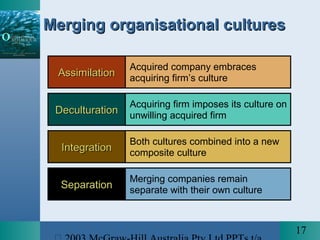
7. Compare and contrast four strategies for merging
organisational cultures.
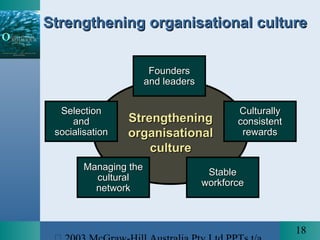
8. Identify five strategies to strengthen an organisation’s
culture.
3
Melso Minerals’ corporate cultureMelso Minerals’ corporate culture
Melso Minerals in
Matamata, New Zealand,
has an egalitarian, team-
oriented corporate culture .
This culture is apparent
through numerous
artefacts, such as the no-
holds barred retreats and
the Melso polo shirts that
everyone wears.
Courtesy of Melso Minerals (Matamata) Ltd
4
Organisational culture definedOrganisational culture defined
The basic pattern of shared
assumptions, values and
beliefs considered to be the
correct way of thinking
about and acting on
problems and opportunities
facing the organisation.
Courtesy of Melso Minerals (Matamata) Ltd
5
Physical structures
Rituals/ceremonies
Stories
Language
Artefacts of
organisational
culture
OrganisationalOrganisational
cultureculture
Elements of organisational cultureElements of organisational culture
6
Meaning of cultural contentMeaning of cultural content
 Cultural content refers to the relative ordering of
beliefs, values and assumptions
 Example: Brown & Brown values aggressiveness;
SAS Institute values work-life balance
 An organisation emphasises only a handful of the
hundreds of cultural values
7
Organisational subculturesOrganisational subcultures
 Located throughout the organisation
 Can support or oppose (countercultures) firm’s
dominant culture
 Two functions of countercultures:
 provide surveillance and evaluation
 source of emerging values
8
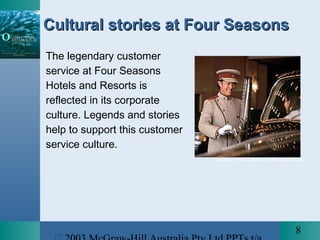
Cultural stories at Four SeasonsCultural stories at Four Seasons
The legendary customer
service at Four Seasons
Hotels and Resorts is
reflected in its corporate
culture. Legends and stories
help to support this customer
service culture.
Courtesy of Four Seasons Hotels and Resorts
9
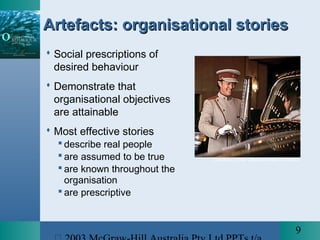
Artefacts: organisational storiesArtefacts: organisational stories
 Social prescriptions of
desired behaviour
 Demonstrate that
organisational objectives
are attainable
 Most effective stories
 describe real people
 are assumed to be true
 are known throughout the
organisation
 are prescriptive
Courtesy of Four Seasons Hotels & Resorts
10
Artefacts: rituals and ceremoniesArtefacts: rituals and ceremonies
 Rituals
 programmed routines
 eg conducting meetings
 Ceremonies
 planned activities for an audience
 eg award ceremonies
11
Artefacts: organisational languageArtefacts: organisational language
 Words used to address people, describe clients, etc
 Leaders use phrases and metaphors as cultural
symbols
 eg General Electric’s ‘grocery store’
 Language also found in subcultures
 eg Whirlpool’s ‘PowerPoint culture’
12
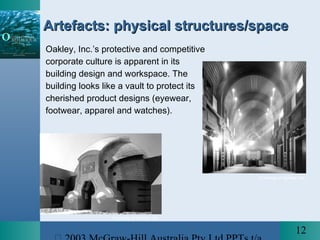
Courtesy of Oakley, Inc.
Artefacts: physical structures/spaceArtefacts: physical structures/space
Oakley, Inc.’s protective and competitive
corporate culture is apparent in its
building design and workspace. The
building looks like a vault to protect its
cherished product designs (eyewear,
footwear, apparel and watches).
Courtesy of Oakley, Inc.
13
Benefits of strong corporate culturesBenefits of strong corporate cultures
Strong
organisational
culture
SocialSocial
controlcontrol
AidsAids
sense-makingsense-making
SocialSocial
glueglue
14
Problems with strong culturesProblems with strong cultures
 Culture content might be incompatible with the
organisation’s environment
 Strong cultures focus attention on one mental
model
 Strong cultures suppress dissenting values from
subcultures
15
Adaptive organisational culturesAdaptive organisational cultures
 External focus − firm’s success depends on
continuous change
 Focus on processes more than goals
 Strong sense of ownership
 Proactive − seek out opportunities
16
Bicultural auditBicultural audit
 Part of ‘due diligence’ in merger
 Minimises risk of cultural collision by diagnosing
companies before merger
 Three steps in bicultural audit
1. collect artefacts
2. analyse data for cultural conflict/compatibility
3. recommend solutions
17
Merging organisational culturesMerging organisational cultures
AssimilationAssimilation
DeculturationDeculturation
Acquired company embraces
acquiring firm’s culture
Acquiring firm imposes its culture on
unwilling acquired firm
IntegrationIntegration
Both cultures combined into a new
composite culture
Separation
Merging companies remain
separate with their own culture
18
StrengtheningStrengthening
organisationalorganisational
cultureculture
FoundersFounders
and leadersand leaders
CulturallyCulturally
consistentconsistent
rewardsrewards
StableStable
workforceworkforce
SelectionSelection
andand
socialisationsocialisation
Managing theManaging the
culturalcultural
networknetwork
Strengthening organisational cultureStrengthening organisational culture
19
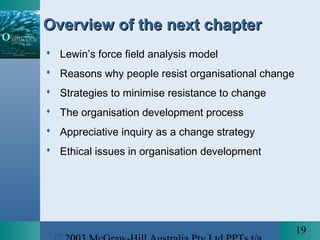
Overview of the next chapterOverview of the next chapter
 Lewin’s force field analysis model
 Reasons why people resist organisational change
 Strategies to minimise resistance to change
 The organisation development process
 Appreciative inquiry as a change strategy
 Ethical issues in organisation development
© 2003 McGraw-Hill Australia Pty Ltd PPTs t/a Organisational Behaviour on the Pacific Rim by McShane and Travaglione
C H A P T E RC H A P T E R 1616
OrganisationalOrganisational
cultureculture

Organizational Behavior CH 16

  • 1.
    © 2003 McGraw-HillAustralia Pty Ltd PPTs t/a Organisational Behaviour on the Pacific Rim by McShane and Travaglione C H A P T E RC H A P T E R 1616 OrganisationalOrganisational cultureculture
  • 2.
    2 Chapter learning objectivesChapterlearning objectives 1. Describe the elements of organisational culture. 2. Discuss the importance of organisational subcultures. 3. List four categories of artefacts through which corporate culture is communicated. 4. Identify three functions of organisational culture. 5. Discuss the conditions under which cultural strength improves corporate performance. 6. Discuss the effect of organisational culture on business ethics. 7. Compare and contrast four strategies for merging organisational cultures. 8. Identify five strategies to strengthen an organisation’s culture.
  • 3.
    3 Melso Minerals’ corporatecultureMelso Minerals’ corporate culture Melso Minerals in Matamata, New Zealand, has an egalitarian, team- oriented corporate culture . This culture is apparent through numerous artefacts, such as the no- holds barred retreats and the Melso polo shirts that everyone wears. Courtesy of Melso Minerals (Matamata) Ltd
  • 4.
    4 Organisational culture definedOrganisationalculture defined The basic pattern of shared assumptions, values and beliefs considered to be the correct way of thinking about and acting on problems and opportunities facing the organisation. Courtesy of Melso Minerals (Matamata) Ltd
  • 5.
  • 6.
    6 Meaning of culturalcontentMeaning of cultural content  Cultural content refers to the relative ordering of beliefs, values and assumptions  Example: Brown & Brown values aggressiveness; SAS Institute values work-life balance  An organisation emphasises only a handful of the hundreds of cultural values
  • 7.
    7 Organisational subculturesOrganisational subcultures Located throughout the organisation  Can support or oppose (countercultures) firm’s dominant culture  Two functions of countercultures:  provide surveillance and evaluation  source of emerging values
  • 8.
    8 Cultural stories atFour SeasonsCultural stories at Four Seasons The legendary customer service at Four Seasons Hotels and Resorts is reflected in its corporate culture. Legends and stories help to support this customer service culture. Courtesy of Four Seasons Hotels and Resorts
  • 9.
    9 Artefacts: organisational storiesArtefacts:organisational stories  Social prescriptions of desired behaviour  Demonstrate that organisational objectives are attainable  Most effective stories  describe real people  are assumed to be true  are known throughout the organisation  are prescriptive Courtesy of Four Seasons Hotels & Resorts
  • 10.
    10 Artefacts: rituals andceremoniesArtefacts: rituals and ceremonies  Rituals  programmed routines  eg conducting meetings  Ceremonies  planned activities for an audience  eg award ceremonies
  • 11.
    11 Artefacts: organisational languageArtefacts:organisational language  Words used to address people, describe clients, etc  Leaders use phrases and metaphors as cultural symbols  eg General Electric’s ‘grocery store’  Language also found in subcultures  eg Whirlpool’s ‘PowerPoint culture’
  • 12.
    12 Courtesy of Oakley,Inc. Artefacts: physical structures/spaceArtefacts: physical structures/space Oakley, Inc.’s protective and competitive corporate culture is apparent in its building design and workspace. The building looks like a vault to protect its cherished product designs (eyewear, footwear, apparel and watches). Courtesy of Oakley, Inc.
  • 13.
    13 Benefits of strongcorporate culturesBenefits of strong corporate cultures Strong organisational culture SocialSocial controlcontrol AidsAids sense-makingsense-making SocialSocial glueglue
  • 14.
    14 Problems with strongculturesProblems with strong cultures  Culture content might be incompatible with the organisation’s environment  Strong cultures focus attention on one mental model  Strong cultures suppress dissenting values from subcultures
  • 15.
    15 Adaptive organisational culturesAdaptiveorganisational cultures  External focus − firm’s success depends on continuous change  Focus on processes more than goals  Strong sense of ownership  Proactive − seek out opportunities
  • 16.
    16 Bicultural auditBicultural audit Part of ‘due diligence’ in merger  Minimises risk of cultural collision by diagnosing companies before merger  Three steps in bicultural audit 1. collect artefacts 2. analyse data for cultural conflict/compatibility 3. recommend solutions
  • 17.
    17 Merging organisational culturesMergingorganisational cultures AssimilationAssimilation DeculturationDeculturation Acquired company embraces acquiring firm’s culture Acquiring firm imposes its culture on unwilling acquired firm IntegrationIntegration Both cultures combined into a new composite culture Separation Merging companies remain separate with their own culture
  • 18.
  • 19.
    19 Overview of thenext chapterOverview of the next chapter  Lewin’s force field analysis model  Reasons why people resist organisational change  Strategies to minimise resistance to change  The organisation development process  Appreciative inquiry as a change strategy  Ethical issues in organisation development
  • 20.
    © 2003 McGraw-HillAustralia Pty Ltd PPTs t/a Organisational Behaviour on the Pacific Rim by McShane and Travaglione C H A P T E RC H A P T E R 1616 OrganisationalOrganisational cultureculture

Editor's Notes

  • #6 <number>
  • #14 <number>
  • #18 <number>