© 2003 McGraw-Hill Australia Pty Ltd PPTs t/a Organisational Behaviour on the Pacific Rim by McShane and Travaglione
C H A P T E RC H A P T E R 1414
LeadershipLeadership
2
Chapter learning objectivesChapter learning objectives
1. List seven competencies of effective leaders.
2. Describe the people-oriented and task-oriented
leadership styles.
3. Outline the path-goal theory of leadership.
4. Discuss the importance of Fiedler’s contingency model
of leadership.
5. Contrast transactional and transformational leadership.
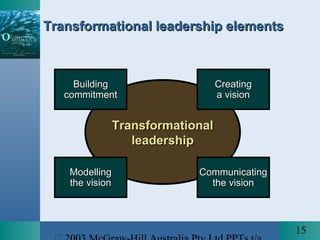
6. Describe the four elements of transformational
leadership.
7. Identify three reasons why people inflate the
importance of leadership.
8. Discuss similarities and differences in the leadership
styles of women and men.
3
The changing concept of leadershipThe changing concept of leadership
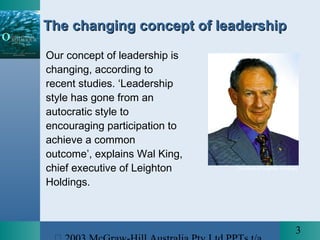
Our concept of leadership is
changing, according to
recent studies. ‘Leadership
style has gone from an
autocratic style to
encouraging participation to
achieve a common
outcome’, explains Wal King,
chief executive of Leighton
Holdings.
Courtesy of Leighton Holdings
4
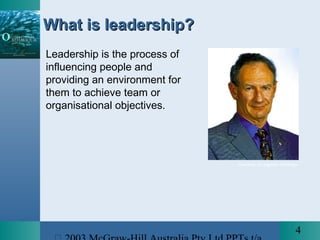
Courtesy of Leighton Holdings
What is leadership?What is leadership?
Leadership is the process of
influencing people and
providing an environment for
them to achieve team or
organisational objectives.
5
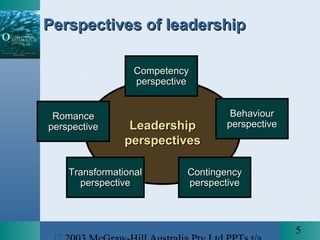
LeadershipLeadership
perspectivesperspectives
CompetencyCompetency
perspectiveperspective
BehaviourBehaviour
perspectiveperspective
ContingencyContingency
perspectiveperspective
RomanceRomance
perspectiveperspective
TransformationalTransformational
perspectiveperspective
Perspectives of leadershipPerspectives of leadership
6
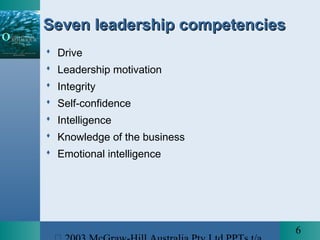
Seven leadership competenciesSeven leadership competencies
 Drive
 Leadership motivation
 Integrity
 Self-confidence
 Intelligence
 Knowledge of the business
 Emotional intelligence
7
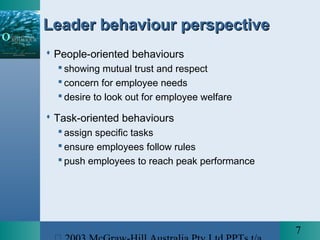
Leader behaviour perspectiveLeader behaviour perspective
 People-oriented behaviours
 showing mutual trust and respect
 concern for employee needs
 desire to look out for employee welfare
 Task-oriented behaviours
 assign specific tasks
 ensure employees follow rules
 push employees to reach peak performance
8
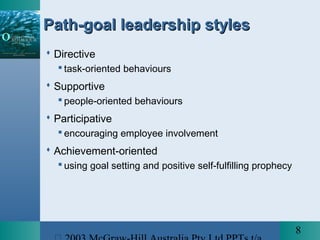
Path-goal leadership stylesPath-goal leadership styles
 Directive
 task-oriented behaviours
 Supportive
 people-oriented behaviours
 Participative
 encouraging employee involvement
 Achievement-oriented
 using goal setting and positive self-fulfilling prophecy
9
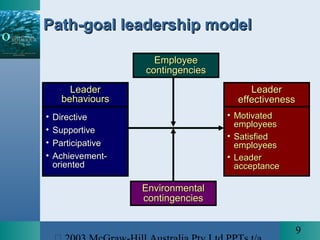
Path-goal leadership modelPath-goal leadership model
EmployeeEmployee
contingenciescontingencies
EnvironmentalEnvironmental
contingenciescontingencies
LeaderLeader
behavioursbehaviours
• DirectiveDirective
• SupportiveSupportive
• ParticipativeParticipative
• Achievement-Achievement-
orientedoriented
LeaderLeader
effectivenesseffectiveness
• MotivatedMotivated
employeesemployees
• SatisfiedSatisfied
employeesemployees
• LeaderLeader
acceptanceacceptance
10
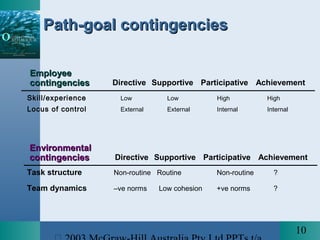
Directive Supportive Participative Achievement
EmployeeEmployee
contingenciescontingencies
Path-goal contingenciesPath-goal contingencies
Skill/experience Low Low High High
Locus of control External External Internal Internal
Task structure Non-routine Routine Non-routine ?
Team dynamics –ve norms Low cohesion +ve norms ?
EnvironmentalEnvironmental
contingenciescontingencies Directive Supportive Participative Achievement
11
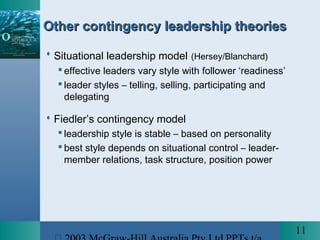
Other contingency leadership theoriesOther contingency leadership theories
 Situational leadership model (Hersey/Blanchard)
 effective leaders vary style with follower ‘readiness’
 leader styles – telling, selling, participating and
delegating
 Fiedler’s contingency model
 leadership style is stable – based on personality
 best style depends on situational control – leader-
member relations, task structure, position power
12
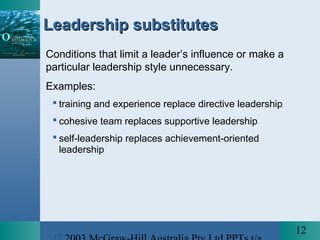
Leadership substitutesLeadership substitutes
Conditions that limit a leader’s influence or make a
particular leadership style unnecessary.
Examples:
 training and experience replace directive leadership
 cohesive team replaces supportive leadership
 self-leadership replaces achievement-oriented
leadership
13
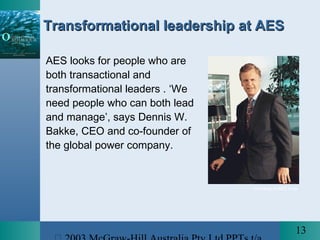
Transformational leadership at AESTransformational leadership at AES
AES looks for people who are
both transactional and
transformational leaders . ‘We
need people who can both lead
and manage’, says Dennis W.
Bakke, CEO and co-founder of
the global power company.
Courtesy of AES Corp
14
Courtesy of AES Corp.
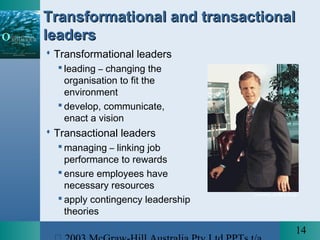
Transformational and transactionalTransformational and transactional
leadersleaders
 Transformational leaders
 leading – changing the
organisation to fit the
environment
 develop, communicate,
enact a vision
 Transactional leaders
 managing – linking job
performance to rewards
 ensure employees have
necessary resources
 apply contingency leadership
theories
15
TransformationalTransformational
leadershipleadership
CreatingCreating
a visiona vision
CommunicatingCommunicating
the visionthe vision
BuildingBuilding
commitmentcommitment
ModellingModelling
the visionthe vision
Transformational leadership elementsTransformational leadership elements
16
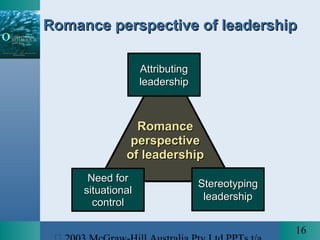
RomanceRomance
perspectiveperspective
of leadershipof leadership
AttributingAttributing
leadershipleadership
StereotypingStereotyping
leadershipleadership
Need forNeed for
situationalsituational
controlcontrol
Romance perspective of leadershipRomance perspective of leadership
17
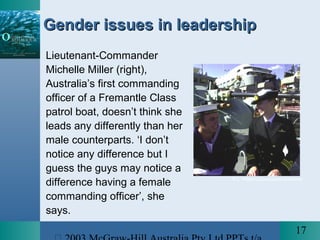
Gender issues in leadershipGender issues in leadership
Lieutenant-Commander
Michelle Miller (right),
Australia’s first commanding
officer of a Fremantle Class
patrol boat, doesn’t think she
leads any differently than her
male counterparts. ‘I don’t
notice any difference but I
guess the guys may notice a
difference having a female
commanding officer’, she
says.
© L. Williams/Launceston Examiner
18
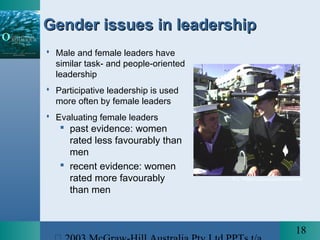
Gender issues in leadershipGender issues in leadership
 Male and female leaders have
similar task- and people-oriented
leadership
 Participative leadership is used
more often by female leaders
 Evaluating female leaders
 past evidence: women
rated less favourably than
men
 recent evidence: women
rated more favourably
than men
© L. Williams/Launceston Examiner
19
Overview of the next chapterOverview of the next chapter
 Two fundamental requirements of organisational
structures
 Four elements of organisational structure
 Types of departmentalisation
 Team-based and network organisational structures
 Contingencies of organisational design
© 2003 McGraw-Hill Australia Pty Ltd PPTs t/a Organisational Behaviour on the Pacific Rim by McShane and Travaglione
C H A P T E RC H A P T E R 1414
LeadershipLeadership

Organizational Behavior CH 14

  • 1.
    © 2003 McGraw-HillAustralia Pty Ltd PPTs t/a Organisational Behaviour on the Pacific Rim by McShane and Travaglione C H A P T E RC H A P T E R 1414 LeadershipLeadership
  • 2.
    2 Chapter learning objectivesChapterlearning objectives 1. List seven competencies of effective leaders. 2. Describe the people-oriented and task-oriented leadership styles. 3. Outline the path-goal theory of leadership. 4. Discuss the importance of Fiedler’s contingency model of leadership. 5. Contrast transactional and transformational leadership. 6. Describe the four elements of transformational leadership. 7. Identify three reasons why people inflate the importance of leadership. 8. Discuss similarities and differences in the leadership styles of women and men.
  • 3.
    3 The changing conceptof leadershipThe changing concept of leadership Our concept of leadership is changing, according to recent studies. ‘Leadership style has gone from an autocratic style to encouraging participation to achieve a common outcome’, explains Wal King, chief executive of Leighton Holdings. Courtesy of Leighton Holdings
  • 4.
    4 Courtesy of LeightonHoldings What is leadership?What is leadership? Leadership is the process of influencing people and providing an environment for them to achieve team or organisational objectives.
  • 5.
  • 6.
    6 Seven leadership competenciesSevenleadership competencies  Drive  Leadership motivation  Integrity  Self-confidence  Intelligence  Knowledge of the business  Emotional intelligence
  • 7.
    7 Leader behaviour perspectiveLeaderbehaviour perspective  People-oriented behaviours  showing mutual trust and respect  concern for employee needs  desire to look out for employee welfare  Task-oriented behaviours  assign specific tasks  ensure employees follow rules  push employees to reach peak performance
  • 8.
    8 Path-goal leadership stylesPath-goalleadership styles  Directive  task-oriented behaviours  Supportive  people-oriented behaviours  Participative  encouraging employee involvement  Achievement-oriented  using goal setting and positive self-fulfilling prophecy
  • 9.
    9 Path-goal leadership modelPath-goalleadership model EmployeeEmployee contingenciescontingencies EnvironmentalEnvironmental contingenciescontingencies LeaderLeader behavioursbehaviours • DirectiveDirective • SupportiveSupportive • ParticipativeParticipative • Achievement-Achievement- orientedoriented LeaderLeader effectivenesseffectiveness • MotivatedMotivated employeesemployees • SatisfiedSatisfied employeesemployees • LeaderLeader acceptanceacceptance
  • 10.
    10 Directive Supportive ParticipativeAchievement EmployeeEmployee contingenciescontingencies Path-goal contingenciesPath-goal contingencies Skill/experience Low Low High High Locus of control External External Internal Internal Task structure Non-routine Routine Non-routine ? Team dynamics –ve norms Low cohesion +ve norms ? EnvironmentalEnvironmental contingenciescontingencies Directive Supportive Participative Achievement
  • 11.
    11 Other contingency leadershiptheoriesOther contingency leadership theories  Situational leadership model (Hersey/Blanchard)  effective leaders vary style with follower ‘readiness’  leader styles – telling, selling, participating and delegating  Fiedler’s contingency model  leadership style is stable – based on personality  best style depends on situational control – leader- member relations, task structure, position power
  • 12.
    12 Leadership substitutesLeadership substitutes Conditionsthat limit a leader’s influence or make a particular leadership style unnecessary. Examples:  training and experience replace directive leadership  cohesive team replaces supportive leadership  self-leadership replaces achievement-oriented leadership
  • 13.
    13 Transformational leadership atAESTransformational leadership at AES AES looks for people who are both transactional and transformational leaders . ‘We need people who can both lead and manage’, says Dennis W. Bakke, CEO and co-founder of the global power company. Courtesy of AES Corp
  • 14.
    14 Courtesy of AESCorp. Transformational and transactionalTransformational and transactional leadersleaders  Transformational leaders  leading – changing the organisation to fit the environment  develop, communicate, enact a vision  Transactional leaders  managing – linking job performance to rewards  ensure employees have necessary resources  apply contingency leadership theories
  • 15.
    15 TransformationalTransformational leadershipleadership CreatingCreating a visiona vision CommunicatingCommunicating thevisionthe vision BuildingBuilding commitmentcommitment ModellingModelling the visionthe vision Transformational leadership elementsTransformational leadership elements
  • 16.
    16 RomanceRomance perspectiveperspective of leadershipof leadership AttributingAttributing leadershipleadership StereotypingStereotyping leadershipleadership NeedforNeed for situationalsituational controlcontrol Romance perspective of leadershipRomance perspective of leadership
  • 17.
    17 Gender issues inleadershipGender issues in leadership Lieutenant-Commander Michelle Miller (right), Australia’s first commanding officer of a Fremantle Class patrol boat, doesn’t think she leads any differently than her male counterparts. ‘I don’t notice any difference but I guess the guys may notice a difference having a female commanding officer’, she says. © L. Williams/Launceston Examiner
  • 18.
    18 Gender issues inleadershipGender issues in leadership  Male and female leaders have similar task- and people-oriented leadership  Participative leadership is used more often by female leaders  Evaluating female leaders  past evidence: women rated less favourably than men  recent evidence: women rated more favourably than men © L. Williams/Launceston Examiner
  • 19.
    19 Overview of thenext chapterOverview of the next chapter  Two fundamental requirements of organisational structures  Four elements of organisational structure  Types of departmentalisation  Team-based and network organisational structures  Contingencies of organisational design
  • 20.
    © 2003 McGraw-HillAustralia Pty Ltd PPTs t/a Organisational Behaviour on the Pacific Rim by McShane and Travaglione C H A P T E RC H A P T E R 1414 LeadershipLeadership

Editor's Notes

  • #3 <number>
  • #8 <number>
  • #10 <number>
  • #11 <number>
  • #17 <number>
  • #19 <number>