© 2003 McGraw-Hill Australia Pty Ltd PPTs t/a Organisational Behaviour on the Pacific Rim by McShane and Travaglione
C H A P T E RC H A P T E R 33
Perception andPerception and
personality inpersonality in
organisationsorganisations
2
Chapter learning objectivesChapter learning objectives
1. Outline the perceptual process.
2. Explain how we perceive ourselves and others through
social identity.
3. Discuss the accuracy of stereotypes.
4. Describe the attribution process and two attribution
errors.
5. Diagram the self-fulfilling prophecy process.
6. Discuss three types of diversity initiatives.
7. Explain how the Johari Window can help improve our
perceptions.
8. Identify the ‘Big Five’ personality dimensions.
9. Discuss the psychological dimensions identified by Jung
and measured in the Myers-Briggs Type Indicator.
3
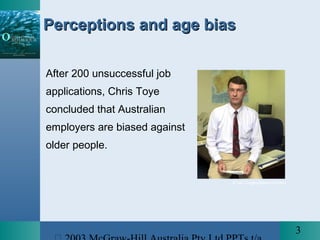
After 200 unsuccessful job
applications, Chris Toye
concluded that Australian
employers are biased against
older people.
Perceptions and age biasPerceptions and age bias
© Ian Cugley/News Limited
4
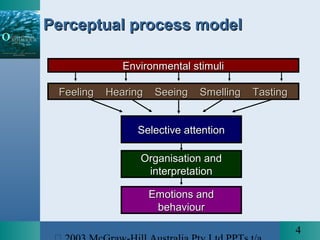
Selective attentionSelective attention
Emotions andEmotions and
behaviourbehaviour
Organisation andOrganisation and
interpretationinterpretation
Perceptual process modelPerceptual process model
Environmental stimuliEnvironmental stimuli
Feeling Hearing Seeing Smelling TastingFeeling Hearing Seeing Smelling Tasting
5
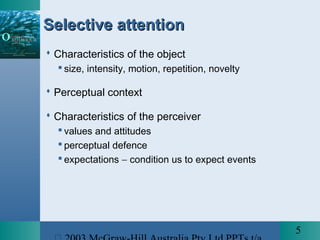
Selective attentionSelective attention
 Characteristics of the object
 size, intensity, motion, repetition, novelty
 Perceptual context
 Characteristics of the perceiver
 values and attitudes
 perceptual defence
 expectations − condition us to expect events
6
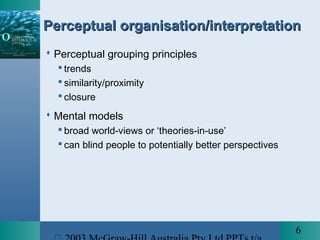
Perceptual organisation/interpretationPerceptual organisation/interpretation
 Perceptual grouping principles
 trends
 similarity/proximity
 closure
 Mental models
 broad world-views or ‘theories-in-use’
 can blind people to potentially better perspectives
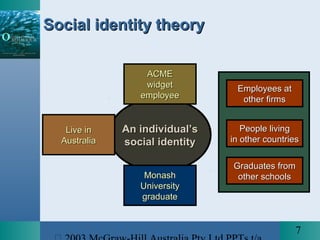
7
An individual’sAn individual’s
social identitysocial identity
ACMEACME
widgetwidget
employeeemployee
Social identity theorySocial identity theory
Live inLive in
AustraliaAustralia
MonashMonash
UniversityUniversity
graduategraduate
Employees atEmployees at
other firmsother firms
People livingPeople living
in other countriesin other countries
Graduates fromGraduates from
other schoolsother schools
8
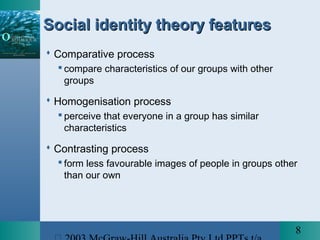
Social identity theory featuresSocial identity theory features
 Comparative process
 compare characteristics of our groups with other
groups
 Homogenisation process
 perceive that everyone in a group has similar
characteristics
 Contrasting process
 form less favourable images of people in groups other
than our own
9
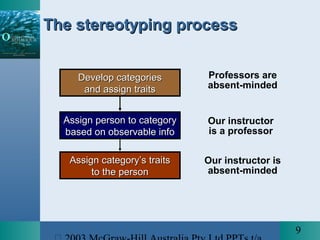
Professors are
absent-minded
Our instructor
is a professor
Our instructor is
absent-minded
The stereotyping processThe stereotyping process
Assign category’s traitsAssign category’s traits
to the personto the person
Assign person to categoryAssign person to category
based on observable infobased on observable info
Develop categoriesDevelop categories
and assign traitsand assign traits
10
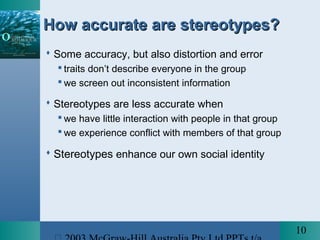
How accurate are stereotypes?How accurate are stereotypes?
 Some accuracy, but also distortion and error
 traits don’t describe everyone in the group
 we screen out inconsistent information
 Stereotypes are less accurate when
 we have little interaction with people in that group
 we experience conflict with members of that group
 Stereotypes enhance our own social identity
11
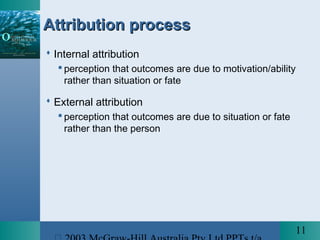
Attribution processAttribution process
 Internal attribution
 perception that outcomes are due to motivation/ability
rather than situation or fate
 External attribution
 perception that outcomes are due to situation or fate
rather than the person
12
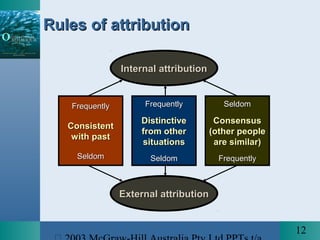
Rules of attributionRules of attribution
External attributionExternal attribution
FrequentlyFrequently
ConsistentConsistent
with pastwith past
SeldomSeldom
Internal attributionInternal attribution
FrequentlyFrequently
DistinctiveDistinctive
from otherfrom other
situationssituations
SeldomSeldom
SeldomSeldom
ConsensusConsensus
(other people(other people
are similar)are similar)
FrequentlyFrequently
13
Attribution errorsAttribution errors
 Fundamental attribution error
 attributing behaviour of other people to internal
factors (their motivation/ability)
 Self-serving bias
 attributing our successes to internal factors and our
failures to external factors
14
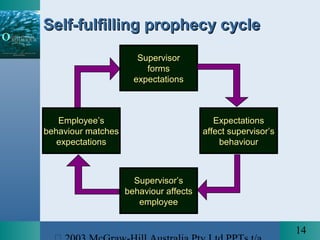
Self-fulfilling prophecy cycleSelf-fulfilling prophecy cycle
SupervisorSupervisor
formsforms
expectationsexpectations
ExpectationsExpectations
affect supervisor’saffect supervisor’s
behaviourbehaviour
Supervisor’sSupervisor’s
behaviour affectsbehaviour affects
employeeemployee
Employee’sEmployee’s
behaviour matchesbehaviour matches
expectationsexpectations
15
Dealing with self-fulfilling prophecyDealing with self-fulfilling prophecy
 Awareness training
 leaders learn effects of negative perceptions
 problem is that awareness doesn’t prevent self-
fulfilling prophecy
 Emerging three-prong strategy
 support a learning orientation
 engage in contingency leadership styles
 increase employee self-efficacy
16
Other perceptual errorsOther perceptual errors
 Primacy
 first impressions
 Recency
 most recent information dominates perceptions
 Halo
 one trait forms a general impression
 Projection
 believing other people are similar to you
17
Types of diversity initiativesTypes of diversity initiatives
 Recruit people with diverse backgrounds
 Provide reasonable accommodation
 Diversity awareness activities
 appreciate differences
 sensitise people to stereotypes/prejudice
 dispel myths
18
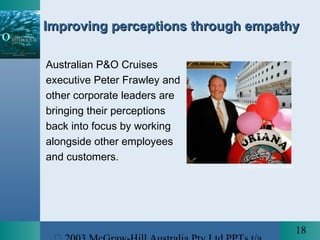
Improving perceptions through empathyImproving perceptions through empathy
Australian P&O Cruises
executive Peter Frawley and
other corporate leaders are
bringing their perceptions
back into focus by working
alongside other employees
and customers.
© Jody D’Arcy/News Limited
19
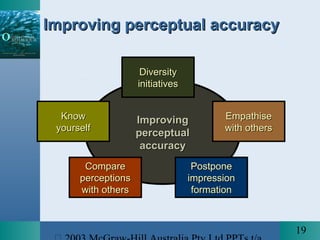
ImprovingImproving
perceptualperceptual
accuracyaccuracy
DiversityDiversity
initiativesinitiatives
EmpathiseEmpathise
with otherswith others
PostponePostpone
impressionimpression
formationformation
KnowKnow
yourselfyourself
CompareCompare
perceptionsperceptions
with otherswith others
Improving perceptual accuracyImproving perceptual accuracy
20
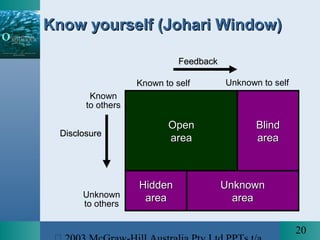
Known to self Unknown to self
Known
to others
Unknown
to others
OpenOpen
AreaArea BlindBlind
AreaArea
UnknownUnknown
AreaArea
HiddenHidden
AreaArea
Know yourself (Johari Window)Know yourself (Johari Window)
OpenOpen
areaarea
BlindBlind
areaarea
HiddenHidden
areaarea
UnknownUnknown
areaarea
DisclosureDisclosure
FeedbackFeedback
21
Personality definedPersonality defined
Relatively stable pattern of behaviours and consistent
internal states that explain a person's behavioural
tendencies.
22
Outgoing, talkative
Courteous, empathic
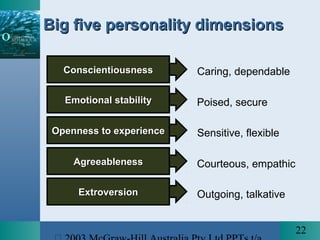
Caring, dependable
Poised, secure
Sensitive, flexible
Big five personality dimensionsBig five personality dimensions
ExtroversionExtroversion
AgreeablenessAgreeableness
ConscientiousnessConscientiousness
Emotional stabilityEmotional stability
Openness to experienceOpenness to experience
23
Courtesy of Thompson Doyle Hennessey & Everest
Myers-Briggs Type IndicatorMyers-Briggs Type Indicator
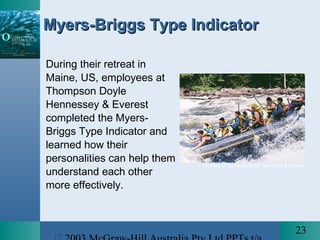
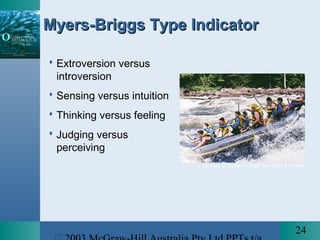
During their retreat in
Maine, US, employees at
Thompson Doyle
Hennessey & Everest
completed the Myers-
Briggs Type Indicator and
learned how their
personalities can help them
understand each other
more effectively.
24
Myers-Briggs Type IndicatorMyers-Briggs Type Indicator
 Extroversion versus
introversion
 Sensing versus intuition
 Thinking versus feeling
 Judging versus
perceiving
Courtesy of Thompson Doyle Hennessey & Everest
25
Locus of control and self-monitoringLocus of control and self-monitoring
 Locus of control
 internals believe in their effort and ability
 externals believe events are mainly due to
external causes
 Self-monitoring personality
 sensitivity to situational cues and ability to adapt
your behaviour to that situation
26
Overview of the next chapterOverview of the next chapter
 Types and levels of values within and across cultures
 Moral intensity, ethical sensitivity and the situation
influence ethical behaviour
 Linkages between emotions and behaviour
 The conditions that require, and the problems associated
with, emotional labour
 Dimensions of emotional intelligence
 Effect of job satisfaction on task performance and
customer service
 Five strategies to increase organisational commitment
© 2003 McGraw-Hill Australia Pty Ltd PPTs t/a Organisational Behaviour on the Pacific Rim by McShane and Travaglione
C H A P T E RC H A P T E R 33
Perception andPerception and
personality inpersonality in
organisationsorganisations

Organizational Behavior CH 03

  • 1.
    © 2003 McGraw-HillAustralia Pty Ltd PPTs t/a Organisational Behaviour on the Pacific Rim by McShane and Travaglione C H A P T E RC H A P T E R 33 Perception andPerception and personality inpersonality in organisationsorganisations
  • 2.
    2 Chapter learning objectivesChapterlearning objectives 1. Outline the perceptual process. 2. Explain how we perceive ourselves and others through social identity. 3. Discuss the accuracy of stereotypes. 4. Describe the attribution process and two attribution errors. 5. Diagram the self-fulfilling prophecy process. 6. Discuss three types of diversity initiatives. 7. Explain how the Johari Window can help improve our perceptions. 8. Identify the ‘Big Five’ personality dimensions. 9. Discuss the psychological dimensions identified by Jung and measured in the Myers-Briggs Type Indicator.
  • 3.
    3 After 200 unsuccessfuljob applications, Chris Toye concluded that Australian employers are biased against older people. Perceptions and age biasPerceptions and age bias © Ian Cugley/News Limited
  • 4.
    4 Selective attentionSelective attention EmotionsandEmotions and behaviourbehaviour Organisation andOrganisation and interpretationinterpretation Perceptual process modelPerceptual process model Environmental stimuliEnvironmental stimuli Feeling Hearing Seeing Smelling TastingFeeling Hearing Seeing Smelling Tasting
  • 5.
    5 Selective attentionSelective attention Characteristics of the object  size, intensity, motion, repetition, novelty  Perceptual context  Characteristics of the perceiver  values and attitudes  perceptual defence  expectations − condition us to expect events
  • 6.
    6 Perceptual organisation/interpretationPerceptual organisation/interpretation Perceptual grouping principles  trends  similarity/proximity  closure  Mental models  broad world-views or ‘theories-in-use’  can blind people to potentially better perspectives
  • 7.
    7 An individual’sAn individual’s socialidentitysocial identity ACMEACME widgetwidget employeeemployee Social identity theorySocial identity theory Live inLive in AustraliaAustralia MonashMonash UniversityUniversity graduategraduate Employees atEmployees at other firmsother firms People livingPeople living in other countriesin other countries Graduates fromGraduates from other schoolsother schools
  • 8.
    8 Social identity theoryfeaturesSocial identity theory features  Comparative process  compare characteristics of our groups with other groups  Homogenisation process  perceive that everyone in a group has similar characteristics  Contrasting process  form less favourable images of people in groups other than our own
  • 9.
    9 Professors are absent-minded Our instructor isa professor Our instructor is absent-minded The stereotyping processThe stereotyping process Assign category’s traitsAssign category’s traits to the personto the person Assign person to categoryAssign person to category based on observable infobased on observable info Develop categoriesDevelop categories and assign traitsand assign traits
  • 10.
    10 How accurate arestereotypes?How accurate are stereotypes?  Some accuracy, but also distortion and error  traits don’t describe everyone in the group  we screen out inconsistent information  Stereotypes are less accurate when  we have little interaction with people in that group  we experience conflict with members of that group  Stereotypes enhance our own social identity
  • 11.
    11 Attribution processAttribution process Internal attribution  perception that outcomes are due to motivation/ability rather than situation or fate  External attribution  perception that outcomes are due to situation or fate rather than the person
  • 12.
    12 Rules of attributionRulesof attribution External attributionExternal attribution FrequentlyFrequently ConsistentConsistent with pastwith past SeldomSeldom Internal attributionInternal attribution FrequentlyFrequently DistinctiveDistinctive from otherfrom other situationssituations SeldomSeldom SeldomSeldom ConsensusConsensus (other people(other people are similar)are similar) FrequentlyFrequently
  • 13.
    13 Attribution errorsAttribution errors Fundamental attribution error  attributing behaviour of other people to internal factors (their motivation/ability)  Self-serving bias  attributing our successes to internal factors and our failures to external factors
  • 14.
    14 Self-fulfilling prophecy cycleSelf-fulfillingprophecy cycle SupervisorSupervisor formsforms expectationsexpectations ExpectationsExpectations affect supervisor’saffect supervisor’s behaviourbehaviour Supervisor’sSupervisor’s behaviour affectsbehaviour affects employeeemployee Employee’sEmployee’s behaviour matchesbehaviour matches expectationsexpectations
  • 15.
    15 Dealing with self-fulfillingprophecyDealing with self-fulfilling prophecy  Awareness training  leaders learn effects of negative perceptions  problem is that awareness doesn’t prevent self- fulfilling prophecy  Emerging three-prong strategy  support a learning orientation  engage in contingency leadership styles  increase employee self-efficacy
  • 16.
    16 Other perceptual errorsOtherperceptual errors  Primacy  first impressions  Recency  most recent information dominates perceptions  Halo  one trait forms a general impression  Projection  believing other people are similar to you
  • 17.
    17 Types of diversityinitiativesTypes of diversity initiatives  Recruit people with diverse backgrounds  Provide reasonable accommodation  Diversity awareness activities  appreciate differences  sensitise people to stereotypes/prejudice  dispel myths
  • 18.
    18 Improving perceptions throughempathyImproving perceptions through empathy Australian P&O Cruises executive Peter Frawley and other corporate leaders are bringing their perceptions back into focus by working alongside other employees and customers. © Jody D’Arcy/News Limited
  • 19.
  • 20.
    20 Known to selfUnknown to self Known to others Unknown to others OpenOpen AreaArea BlindBlind AreaArea UnknownUnknown AreaArea HiddenHidden AreaArea Know yourself (Johari Window)Know yourself (Johari Window) OpenOpen areaarea BlindBlind areaarea HiddenHidden areaarea UnknownUnknown areaarea DisclosureDisclosure FeedbackFeedback
  • 21.
    21 Personality definedPersonality defined Relativelystable pattern of behaviours and consistent internal states that explain a person's behavioural tendencies.
  • 22.
    22 Outgoing, talkative Courteous, empathic Caring,dependable Poised, secure Sensitive, flexible Big five personality dimensionsBig five personality dimensions ExtroversionExtroversion AgreeablenessAgreeableness ConscientiousnessConscientiousness Emotional stabilityEmotional stability Openness to experienceOpenness to experience
  • 23.
    23 Courtesy of ThompsonDoyle Hennessey & Everest Myers-Briggs Type IndicatorMyers-Briggs Type Indicator During their retreat in Maine, US, employees at Thompson Doyle Hennessey & Everest completed the Myers- Briggs Type Indicator and learned how their personalities can help them understand each other more effectively.
  • 24.
    24 Myers-Briggs Type IndicatorMyers-BriggsType Indicator  Extroversion versus introversion  Sensing versus intuition  Thinking versus feeling  Judging versus perceiving Courtesy of Thompson Doyle Hennessey & Everest
  • 25.
    25 Locus of controland self-monitoringLocus of control and self-monitoring  Locus of control  internals believe in their effort and ability  externals believe events are mainly due to external causes  Self-monitoring personality  sensitivity to situational cues and ability to adapt your behaviour to that situation
  • 26.
    26 Overview of thenext chapterOverview of the next chapter  Types and levels of values within and across cultures  Moral intensity, ethical sensitivity and the situation influence ethical behaviour  Linkages between emotions and behaviour  The conditions that require, and the problems associated with, emotional labour  Dimensions of emotional intelligence  Effect of job satisfaction on task performance and customer service  Five strategies to increase organisational commitment
  • 27.
    © 2003 McGraw-HillAustralia Pty Ltd PPTs t/a Organisational Behaviour on the Pacific Rim by McShane and Travaglione C H A P T E RC H A P T E R 33 Perception andPerception and personality inpersonality in organisationsorganisations

Editor's Notes

  • #5 <number>
  • #24 <number>
  • #25 <number>