Organization Culture
Supervised by
Dr. Rana Sobh
Prepared by:
Abeer Ali Mossa Nuha Mohamed Al - Dasouqi
Rehab Mohd. Abu-Jalala Shua’a Masoud Al-Khater
Table of contents
1- The monkey’s story
2- What do we mean by culture?
3- Culture is dynamic
4- What is organization culture?
5- Dr. Schein’s definition about organizational culture
6- How an employee learns culture
7- Three main culture levels
8- The usefulness of understanding organizational culture
9- When strategic & culture change are required ?
10- Culture as a tool of the general manager
11- Sub-Cultures
12- Evaluating culture in Mergers & Acquisitions
13-Conclusion
14 Q- Chem Company (Video)
The Monkey’s Story
What do we mean by "culture"?
Culture refers to the shared beliefs, values and norms of
a group. It includes
• Cognitive schemas (Scripts and frames that mold our
expectations and help us assign meaning and order to
the stream of experience)
• Shared meanings (Perceptions (How the world is, how
things work. Implicit theories of the market, of
management, of politics, of human nature)
• Prescriptions and Preferences (What the best way to
do things is; What they want to happen
• Behavioral codes (How to dress, how to act, what
kinds of things you can joke about, is it cool to be
late?)
• Basic values (What is really important; what is evil)
• Myths and legends (Stories about the past: knowledge
of the stories identifies you as belonging, and often
the stories have hidden points like this is what
happens to people who...)
• Heroes and heroines.
BELIEFS
VALUES
BEHAVIORS
GOALS
Characteristics of Culture
1. Culture is dynamic so that it can evolve with new
experiences by two ways :
a. As a result of a clear present crisis.
b. Through a managed developing under a skilled
manager.
2. Culture is powerful tool for pursuing a particular set of
goals .
3. Culture can constitute a disability at times when change is
critical to addressing new competitive or technological
challenges from unexpected directions .
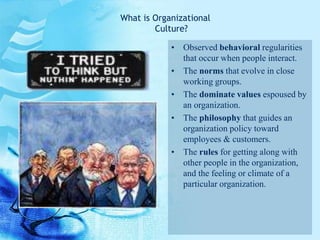
• Observed behavioral regularities
that occur when people interact.
• The norms that evolve in close
working groups.
• The dominate values espoused by
an organization.
• The philosophy that guides an
organization policy toward
employees & customers.
• The rules for getting along with
other people in the organization,
and the feeling or climate of a
particular organization.
What is Organizational
Culture?
A pattern of basic assumptions (Invented, discovered, developed)
by a given group as it learns to cope with its problems of external
adaptation & internal integration. That has worked well enough
to be considered valid and therefore, to be taught to new
members as the correct way to perceive, think and feel in relation
to those problems.
A learned result of a group experience and it is only found where there is a definable group
with a significant history of togetherness.
Who is Edgar Schein ?
Foremost scholars of organization culture.
• Edgar H. Schein was educated at the University of
Chicago , at Stanford University, where he received a
master's degree in psychology; and at Harvard
University, where he received his Ph.D. in social
psychology.
• Dr. Schein has received many honors recently the
Lifetime Achievement Award in Workplace Learning
and Performance
• Schein has been a prolific researcher, writer, teacher,
and consultant.
Schein’s Organizational Culture’s definition
Dr. Edgar H. Schein
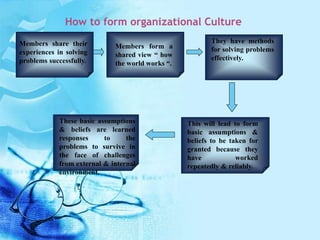
These basic assumptions
& beliefs are learned
responses to the
problems to survive in
the face of challenges
from external & internal
environment.
How to form organizational Culture
Members share their
experiences in solving
problems successfully.
Members form a
shared view “ how
the world works “.
They have methods
for solving problems
effectively.
This will lead to form
basic assumptions &
beliefs to be taken for
granted because they
have worked
repeatedly & reliably.
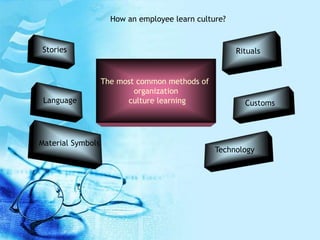
Stories Rituals
Customs
Technology
Language
Material Symbols
The most common methods of
organization
culture learning
How an employee learn culture?
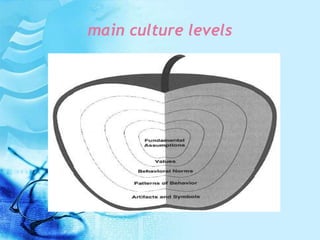
main culture levels
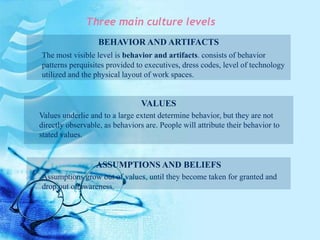
BEHAVIOR AND ARTIFACTS
The most visible level is behavior and artifacts. consists of behavior
patterns perquisites provided to executives, dress codes, level of technology
utilized and the physical layout of work spaces.
Three main culture levels
VALUES
Values underlie and to a large extent determine behavior, but they are not
directly observable, as behaviors are. People will attribute their behavior to
stated values.
ASSUMPTIONS AND BELIEFS
Assumptions grow out of values, until they become taken for granted and
drop out of awareness.
The understanding of organizational culture is
useful in :
• Helping a manager to predict how his organization
is likely to respond to different situations.
• Assessing the difficulties that organization might
experience as it confront a changing future.
• Identify the priority issues for the leadership to
address as they prepare the organization to compete
for future.
• Affects and regulates the way members of the
organization think, feel and act within the
framework of that organization.
When strategic & culture change are required
?
• When the future they foresee finally arrive
in the present.
• This done by creating a separate team of
people & confronting them with a new task,
which represents as closely as possible the
sort of problems the organization will
confront in the future.
• Strong culture is one of the
most powerful tools a skilled
manager can wield.
• It is essential to consistent
decision-making as the
organization’s size & scope
expand.
• It becomes impossible for the
general manager to
participate in or oversee every
process that solve problems.
Culture as a tool of the general manager :
Sub-Cultures :
• Often there are several cultures operating within the larger
organization. There can be managerial culture , nationality
or geography - based culture , occupationally – based
culture, Functional unit culture and business culture. As a
group acquires history, It acquires culture
• Groups often maintain their identity by comparing &
constructing themselves with surrounding groups.
• The most effective group are those that form a culture of
their own with their own language, assumptions for
operations, and sets of attitudes.
• When a sub-group develop their own strong “independent
culture” they experience problems communication with
other groups & become more inflexible in their own
operation.
Evaluating culture in Mergers & Acquisitions
When a company decides to acquire another, It pays over the book value for three classes
of factors :
• Resources :
People, Technology, Products, facilities, equipments, information, relationships with
customers, distributors & suppliers.
• Processes :
Capabilities & disabilities historically has resulted from its processes & decisions
making criteria.
• Business model :
Ways of working together & making decisions (organization culture).
Conclusion
1. The view of culture is most relevant to the analysis
and evaluation of organizational culture and to
culture change strategies that leaders can employ to
improve organizational performance.
2. One of the most important functions of leaders is
the creation and management of it’s culture.
3. One of the important objective of any manager is
“Building maintaining and creating a feeling of
togetherness among group members so that they
become capable of accomplishing things that
individuals can not accomplish a lone”
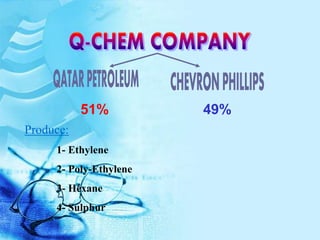
49%51%
Produce:
1- Ethylene
2- Poly-Ethylene
3- Hexane
4- Sulphur
• It established at Qatar in 2003.
• It’s One of the best safety companies in the world.
• Their priorities are :
1- Safety.
2- Environment.
3- Production.
Q-CHEM CULTURE :
1- Training & Learning System :
( Experiences –Methods for solving problems – View of how the world works
- beliefs – Priorities – Procedures ).
2- Observing :
( Check safety during the work , Manufacturing Operations , follow up the
procedures , Quality , Team Work , …)
3- Reward and Punishment system.

organization culture

  • 1.
    Organization Culture Supervised by Dr.Rana Sobh Prepared by: Abeer Ali Mossa Nuha Mohamed Al - Dasouqi Rehab Mohd. Abu-Jalala Shua’a Masoud Al-Khater
  • 2.
    Table of contents 1-The monkey’s story 2- What do we mean by culture? 3- Culture is dynamic 4- What is organization culture? 5- Dr. Schein’s definition about organizational culture 6- How an employee learns culture 7- Three main culture levels 8- The usefulness of understanding organizational culture 9- When strategic & culture change are required ? 10- Culture as a tool of the general manager 11- Sub-Cultures 12- Evaluating culture in Mergers & Acquisitions 13-Conclusion 14 Q- Chem Company (Video)
  • 3.
  • 4.
    What do wemean by "culture"? Culture refers to the shared beliefs, values and norms of a group. It includes • Cognitive schemas (Scripts and frames that mold our expectations and help us assign meaning and order to the stream of experience) • Shared meanings (Perceptions (How the world is, how things work. Implicit theories of the market, of management, of politics, of human nature) • Prescriptions and Preferences (What the best way to do things is; What they want to happen • Behavioral codes (How to dress, how to act, what kinds of things you can joke about, is it cool to be late?) • Basic values (What is really important; what is evil) • Myths and legends (Stories about the past: knowledge of the stories identifies you as belonging, and often the stories have hidden points like this is what happens to people who...) • Heroes and heroines. BELIEFS VALUES BEHAVIORS GOALS
  • 5.
    Characteristics of Culture 1.Culture is dynamic so that it can evolve with new experiences by two ways : a. As a result of a clear present crisis. b. Through a managed developing under a skilled manager. 2. Culture is powerful tool for pursuing a particular set of goals . 3. Culture can constitute a disability at times when change is critical to addressing new competitive or technological challenges from unexpected directions .
  • 6.
    • Observed behavioralregularities that occur when people interact. • The norms that evolve in close working groups. • The dominate values espoused by an organization. • The philosophy that guides an organization policy toward employees & customers. • The rules for getting along with other people in the organization, and the feeling or climate of a particular organization. What is Organizational Culture?
  • 7.
    A pattern ofbasic assumptions (Invented, discovered, developed) by a given group as it learns to cope with its problems of external adaptation & internal integration. That has worked well enough to be considered valid and therefore, to be taught to new members as the correct way to perceive, think and feel in relation to those problems. A learned result of a group experience and it is only found where there is a definable group with a significant history of togetherness. Who is Edgar Schein ? Foremost scholars of organization culture. • Edgar H. Schein was educated at the University of Chicago , at Stanford University, where he received a master's degree in psychology; and at Harvard University, where he received his Ph.D. in social psychology. • Dr. Schein has received many honors recently the Lifetime Achievement Award in Workplace Learning and Performance • Schein has been a prolific researcher, writer, teacher, and consultant. Schein’s Organizational Culture’s definition Dr. Edgar H. Schein
  • 8.
    These basic assumptions &beliefs are learned responses to the problems to survive in the face of challenges from external & internal environment. How to form organizational Culture Members share their experiences in solving problems successfully. Members form a shared view “ how the world works “. They have methods for solving problems effectively. This will lead to form basic assumptions & beliefs to be taken for granted because they have worked repeatedly & reliably.
  • 9.
    Stories Rituals Customs Technology Language Material Symbols Themost common methods of organization culture learning How an employee learn culture?
  • 10.
  • 11.
    BEHAVIOR AND ARTIFACTS Themost visible level is behavior and artifacts. consists of behavior patterns perquisites provided to executives, dress codes, level of technology utilized and the physical layout of work spaces. Three main culture levels VALUES Values underlie and to a large extent determine behavior, but they are not directly observable, as behaviors are. People will attribute their behavior to stated values. ASSUMPTIONS AND BELIEFS Assumptions grow out of values, until they become taken for granted and drop out of awareness.
  • 12.
    The understanding oforganizational culture is useful in : • Helping a manager to predict how his organization is likely to respond to different situations. • Assessing the difficulties that organization might experience as it confront a changing future. • Identify the priority issues for the leadership to address as they prepare the organization to compete for future. • Affects and regulates the way members of the organization think, feel and act within the framework of that organization.
  • 13.
    When strategic &culture change are required ? • When the future they foresee finally arrive in the present. • This done by creating a separate team of people & confronting them with a new task, which represents as closely as possible the sort of problems the organization will confront in the future.
  • 14.
    • Strong cultureis one of the most powerful tools a skilled manager can wield. • It is essential to consistent decision-making as the organization’s size & scope expand. • It becomes impossible for the general manager to participate in or oversee every process that solve problems. Culture as a tool of the general manager :
  • 15.
    Sub-Cultures : • Oftenthere are several cultures operating within the larger organization. There can be managerial culture , nationality or geography - based culture , occupationally – based culture, Functional unit culture and business culture. As a group acquires history, It acquires culture • Groups often maintain their identity by comparing & constructing themselves with surrounding groups. • The most effective group are those that form a culture of their own with their own language, assumptions for operations, and sets of attitudes. • When a sub-group develop their own strong “independent culture” they experience problems communication with other groups & become more inflexible in their own operation.
  • 16.
    Evaluating culture inMergers & Acquisitions When a company decides to acquire another, It pays over the book value for three classes of factors : • Resources : People, Technology, Products, facilities, equipments, information, relationships with customers, distributors & suppliers. • Processes : Capabilities & disabilities historically has resulted from its processes & decisions making criteria. • Business model : Ways of working together & making decisions (organization culture).
  • 17.
    Conclusion 1. The viewof culture is most relevant to the analysis and evaluation of organizational culture and to culture change strategies that leaders can employ to improve organizational performance. 2. One of the most important functions of leaders is the creation and management of it’s culture. 3. One of the important objective of any manager is “Building maintaining and creating a feeling of togetherness among group members so that they become capable of accomplishing things that individuals can not accomplish a lone”
  • 19.
  • 20.
    • It establishedat Qatar in 2003. • It’s One of the best safety companies in the world. • Their priorities are : 1- Safety. 2- Environment. 3- Production.
  • 21.
    Q-CHEM CULTURE : 1-Training & Learning System : ( Experiences –Methods for solving problems – View of how the world works - beliefs – Priorities – Procedures ). 2- Observing : ( Check safety during the work , Manufacturing Operations , follow up the procedures , Quality , Team Work , …) 3- Reward and Punishment system.