© 2003 McGraw-Hill Australia Pty Ltd PPTs t/a Organisational Behaviour on the Pacific Rim by McShane and Travaglione
C H A P T E RC H A P T E R 1212
Power,Power,
politics andpolitics and
persuasionpersuasion
2
Chapter learning objectivesChapter learning objectives
1. Define power and counterpower.
2. Describe the five bases of power in organisations.
3. Explain how information relates to power in organisations.
4. Discuss the four contingencies of power.
5. Discuss the role of power in sexual harassment.
6. Explain how organisational power creates problems in romantic
relationships at work.
7. Summarise the advantages and disadvantages of organisational
politics.
8. Describe six types of political activity found in organisations.
9. Describe the conditions that encourage organisational politics.
10. Identify ways to control dysfunctional organisational politics.
11. Summarise the key features of persuasive communication.
3
© Southland Times/(New Zealand)
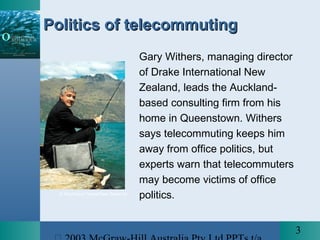
Politics of telecommutingPolitics of telecommuting
Gary Withers, managing director
of Drake International New
Zealand, leads the Auckland-
based consulting firm from his
home in Queenstown. Withers
says telecommuting keeps him
away from office politics, but
experts warn that telecommuters
may become victims of office
politics.
4
The meaning of powerThe meaning of power
Power is the capacity of a
person, team or organisation to
influence others
 the potential to influence
others
 people have power they don’t
use and may not know they
possess
 power requires one person’s
perception of dependence on
another person© Southland Times/(New Zealand)
5
Power and dependencePower and dependence
PersonPerson
AA
Person
B’s goals
PersonPerson
BB
Person B’sPerson B’s
counterpowercounterpower
over Person Aover Person A
Person A’sPerson A’s
power overpower over
Person BPerson B
6
Model of power in organisationsModel of power in organisations
PowerPower
over othersover others
Contingencies
of power
SourcesSources
of powerof power
Legitimate
Reward
Coercive
Expert
Referent
7
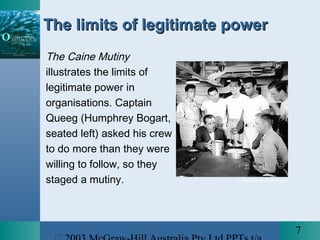
The limits of legitimate powerThe limits of legitimate power
The Caine Mutiny
illustrates the limits of
legitimate power in
organisations. Captain
Queeg (Humphrey Bogart,
seated left) asked his crew
to do more than they were
willing to follow, so they
staged a mutiny. © Reuters Archive Photos
8
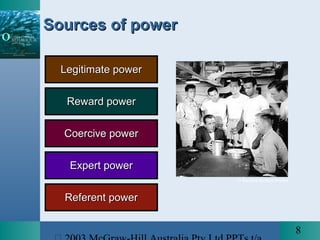
Sources of powerSources of power
Legitimate powerLegitimate power
Reward powerReward power
Coercive powerCoercive power
Expert powerExpert power
Referent powerReferent power
© Reuters Archive Photos
9
Information and powerInformation and power
 Control over information flow
 based on legitimate power
 relates to formal communication network
 common in centralised structures (wheel pattern)
 Coping with uncertainty
 those who know how to cope with organisational
uncertainties gain power
› prevention
› forecasting
› absorption
10
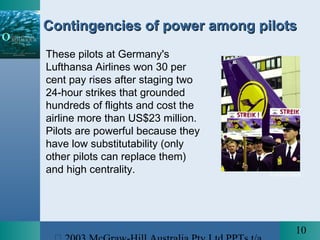
Contingencies of power among pilotsContingencies of power among pilots
These pilots at Germany's
Lufthansa Airlines won 30 per
cent pay rises after staging two
24-hour strikes that grounded
hundreds of flights and cost the
airline more than US$23 million.
Pilots are powerful because they
have low substitutability (only
other pilots can replace them)
and high centrality. © AFP/CORBIS
11
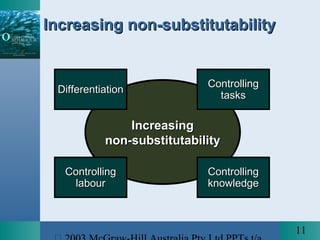
IncreasingIncreasing
non-substitutabilitynon-substitutability
ControllingControlling
taskstasks
ControllingControlling
knowledgeknowledge
DifferentiationDifferentiation
ControllingControlling
labourlabour
Increasing non-substitutabilityIncreasing non-substitutability
12
Contingencies of powerContingencies of power
Contingencies
of power
PowerPower
over othersover others
SourcesSources
of powerof power
Substitutability
Centrality
Discretion
Visibility
13
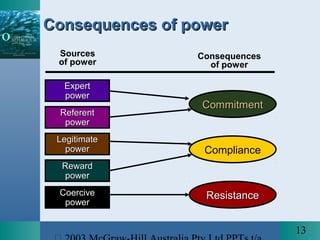
CommitmentCommitment
Consequences of powerConsequences of power
RewardReward
powerpower
LegitimateLegitimate
powerpower
CoerciveCoercive
powerpower
ExpertExpert
powerpower
ReferentReferent
powerpower
ResistanceResistance
Compliance
Sources
of power
Consequences
of power
14
Sexual harassment and powerSexual harassment and power
 Harasser stereotypes the victim as subservient and
powerless
 Harasser threatens job security or safety through
coercive or legitimate power
 Hostile work environment harassment continues
when the victim lacks power to stop the behaviour
15
Office romance and powerOffice romance and power
 Co-workers believe that employees in relationships
abuse their power to favour each other
 Higher risk of sexual harassment claims after
relationship breaks off
16
Organisational politicsOrganisational politics
 Attempts to influence others using discretionary
behaviours to promote personal objectives
 discretionary behaviours − neither explicitly prescribed
nor prohibited
 Politics may be good or bad for the organisation
17
Types ofTypes of
organisationalorganisational
politicspolitics
ManagingManaging
impressionsimpressions
Attacking andAttacking and
blamingblaming
CreatingCreating
obligationsobligations
CultivatingCultivating
networksnetworks
Types of organisational politicsTypes of organisational politics
ControllingControlling
informationinformation
FormingForming
coalitionscoalitions
18
ConditionsConditions
supportingsupporting
organisationalorganisational
politicspolitics
ScarceScarce
resourcesresources
Complex andComplex and
ambiguousambiguous
decisionsdecisions
PersonalPersonal
characteristicscharacteristics
Tolerance ofTolerance of
politicspolitics
Conditions for organisational politicsConditions for organisational politics
19
Controlling political behaviourControlling political behaviour
Peer pressurePeer pressure
against politicsagainst politics
RemoveRemove
political normspolitical norms
Free flowingFree flowing
informationinformation
Manage changeManage change
effectivelyeffectively
ProvideProvide
sufficientsufficient
resourcesresources
IntroduceIntroduce
clear rulesclear rules
HireHire
low-politicslow-politics
employeesemployees
IncreaseIncrease
opportunitiesopportunities
for dialoguefor dialogue
20
AudienceAudience
characteristicscharacteristics
•• Self-esteemSelf-esteem
•• InoculatedInoculated
CommunicatorCommunicator
characteristicscharacteristics
•• ExpertExpert
•• CredibilityCredibility
•• AttractiveAttractive
MessageMessage
contentcontent
•• Present all sidesPresent all sides
•• Few argumentsFew arguments
•• Emotional appealsEmotional appeals
•• Inoculation effectInoculation effect
Communication mediumCommunication medium
Persuasive communicationPersuasive communication
21
Overview of the next chapterOverview of the next chapter
 Distinguishing task-related and socioemotional
conflict
 Advantages and disadvantages of conflict in
organisations
 Six sources of organisational conflict
 Five interpersonal styles of conflict management
 Structural approaches to managing conflict
 Situational influences on negotiations
 Types of third-party dispute resolution
© 2003 McGraw-Hill Australia Pty Ltd PPTs t/a Organisational Behaviour on the Pacific Rim by McShane and Travaglione
C H A P T E RC H A P T E R 1212
Power,Power,
politics andpolitics and
persuasionpersuasion

Organizational Behavior CH 12

  • 1.
    © 2003 McGraw-HillAustralia Pty Ltd PPTs t/a Organisational Behaviour on the Pacific Rim by McShane and Travaglione C H A P T E RC H A P T E R 1212 Power,Power, politics andpolitics and persuasionpersuasion
  • 2.
    2 Chapter learning objectivesChapterlearning objectives 1. Define power and counterpower. 2. Describe the five bases of power in organisations. 3. Explain how information relates to power in organisations. 4. Discuss the four contingencies of power. 5. Discuss the role of power in sexual harassment. 6. Explain how organisational power creates problems in romantic relationships at work. 7. Summarise the advantages and disadvantages of organisational politics. 8. Describe six types of political activity found in organisations. 9. Describe the conditions that encourage organisational politics. 10. Identify ways to control dysfunctional organisational politics. 11. Summarise the key features of persuasive communication.
  • 3.
    3 © Southland Times/(NewZealand) Politics of telecommutingPolitics of telecommuting Gary Withers, managing director of Drake International New Zealand, leads the Auckland- based consulting firm from his home in Queenstown. Withers says telecommuting keeps him away from office politics, but experts warn that telecommuters may become victims of office politics.
  • 4.
    4 The meaning ofpowerThe meaning of power Power is the capacity of a person, team or organisation to influence others  the potential to influence others  people have power they don’t use and may not know they possess  power requires one person’s perception of dependence on another person© Southland Times/(New Zealand)
  • 5.
    5 Power and dependencePowerand dependence PersonPerson AA Person B’s goals PersonPerson BB Person B’sPerson B’s counterpowercounterpower over Person Aover Person A Person A’sPerson A’s power overpower over Person BPerson B
  • 6.
    6 Model of powerin organisationsModel of power in organisations PowerPower over othersover others Contingencies of power SourcesSources of powerof power Legitimate Reward Coercive Expert Referent
  • 7.
    7 The limits oflegitimate powerThe limits of legitimate power The Caine Mutiny illustrates the limits of legitimate power in organisations. Captain Queeg (Humphrey Bogart, seated left) asked his crew to do more than they were willing to follow, so they staged a mutiny. © Reuters Archive Photos
  • 8.
    8 Sources of powerSourcesof power Legitimate powerLegitimate power Reward powerReward power Coercive powerCoercive power Expert powerExpert power Referent powerReferent power © Reuters Archive Photos
  • 9.
    9 Information and powerInformationand power  Control over information flow  based on legitimate power  relates to formal communication network  common in centralised structures (wheel pattern)  Coping with uncertainty  those who know how to cope with organisational uncertainties gain power › prevention › forecasting › absorption
  • 10.
    10 Contingencies of poweramong pilotsContingencies of power among pilots These pilots at Germany's Lufthansa Airlines won 30 per cent pay rises after staging two 24-hour strikes that grounded hundreds of flights and cost the airline more than US$23 million. Pilots are powerful because they have low substitutability (only other pilots can replace them) and high centrality. © AFP/CORBIS
  • 11.
  • 12.
    12 Contingencies of powerContingenciesof power Contingencies of power PowerPower over othersover others SourcesSources of powerof power Substitutability Centrality Discretion Visibility
  • 13.
    13 CommitmentCommitment Consequences of powerConsequencesof power RewardReward powerpower LegitimateLegitimate powerpower CoerciveCoercive powerpower ExpertExpert powerpower ReferentReferent powerpower ResistanceResistance Compliance Sources of power Consequences of power
  • 14.
    14 Sexual harassment andpowerSexual harassment and power  Harasser stereotypes the victim as subservient and powerless  Harasser threatens job security or safety through coercive or legitimate power  Hostile work environment harassment continues when the victim lacks power to stop the behaviour
  • 15.
    15 Office romance andpowerOffice romance and power  Co-workers believe that employees in relationships abuse their power to favour each other  Higher risk of sexual harassment claims after relationship breaks off
  • 16.
    16 Organisational politicsOrganisational politics Attempts to influence others using discretionary behaviours to promote personal objectives  discretionary behaviours − neither explicitly prescribed nor prohibited  Politics may be good or bad for the organisation
  • 17.
    17 Types ofTypes of organisationalorganisational politicspolitics ManagingManaging impressionsimpressions AttackingandAttacking and blamingblaming CreatingCreating obligationsobligations CultivatingCultivating networksnetworks Types of organisational politicsTypes of organisational politics ControllingControlling informationinformation FormingForming coalitionscoalitions
  • 18.
  • 19.
    19 Controlling political behaviourControllingpolitical behaviour Peer pressurePeer pressure against politicsagainst politics RemoveRemove political normspolitical norms Free flowingFree flowing informationinformation Manage changeManage change effectivelyeffectively ProvideProvide sufficientsufficient resourcesresources IntroduceIntroduce clear rulesclear rules HireHire low-politicslow-politics employeesemployees IncreaseIncrease opportunitiesopportunities for dialoguefor dialogue
  • 20.
    20 AudienceAudience characteristicscharacteristics •• Self-esteemSelf-esteem •• InoculatedInoculated CommunicatorCommunicator characteristicscharacteristics ••ExpertExpert •• CredibilityCredibility •• AttractiveAttractive MessageMessage contentcontent •• Present all sidesPresent all sides •• Few argumentsFew arguments •• Emotional appealsEmotional appeals •• Inoculation effectInoculation effect Communication mediumCommunication medium Persuasive communicationPersuasive communication
  • 21.
    21 Overview of thenext chapterOverview of the next chapter  Distinguishing task-related and socioemotional conflict  Advantages and disadvantages of conflict in organisations  Six sources of organisational conflict  Five interpersonal styles of conflict management  Structural approaches to managing conflict  Situational influences on negotiations  Types of third-party dispute resolution
  • 22.
    © 2003 McGraw-HillAustralia Pty Ltd PPTs t/a Organisational Behaviour on the Pacific Rim by McShane and Travaglione C H A P T E RC H A P T E R 1212 Power,Power, politics andpolitics and persuasionpersuasion

Editor's Notes

  • #6 <number>
  • #7 <number>
  • #13 <number>
  • #21 <number>