2-1
Chapter 22Chapter 22
Convertibles,Convertibles,
Exchangeables,Exchangeables,
and Warrantsand Warrants
Instructor: Ajab Khan Burki
2-2
Convertibles, Exchangables,Convertibles, Exchangables,
and Warrantsand Warrants
Convertible Securities
Use of Convertibles
Value of Convertible
Securities
Exchangeable Bonds
Warrants
2-3
Derivative SecurityDerivative Security -- A financial contract
whose value derives in part from the value and
characteristics of one or more underlying
assets (e.g., securities, commodities), interest
rates, exchange rates, or indices.
Derivative SecurityDerivative Security
Straight debt or equity cannot be exchanged for
another asset, but options are exchangeable.
An option is part of the broader category of
derivative securities.
We examine the convertible security, exchangeable
bond, and warrant in this chapter.
2-4
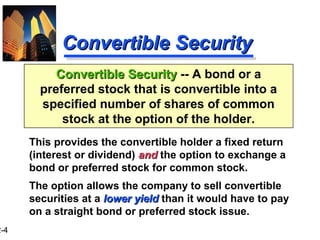
Convertible SecurityConvertible Security -- A bond or a
preferred stock that is convertible into a
specified number of shares of common
stock at the option of the holder.
Convertible SecurityConvertible Security
This provides the convertible holder a fixed return
(interest or dividend) andand the option to exchange a
bond or preferred stock for common stock.
The option allows the company to sell convertible
securities at a lower yieldlower yield than it would have to pay
on a straight bond or preferred stock issue.
2-5
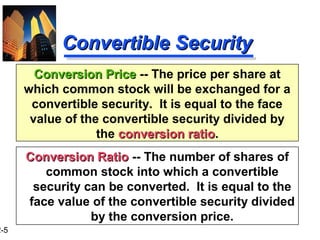
Conversion PriceConversion Price -- The price per share at
which common stock will be exchanged for a
convertible security. It is equal to the face
value of the convertible security divided by
the conversion ratioconversion ratio.
Convertible SecurityConvertible Security
Conversion RatioConversion Ratio -- The number of shares of
common stock into which a convertible
security can be converted. It is equal to the
face value of the convertible security divided
by the conversion price.
2-6
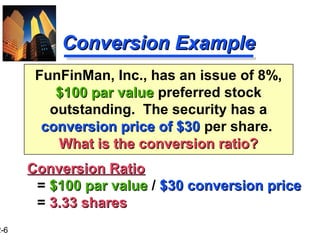
FunFinMan, Inc., has an issue of 8%,
$100 par value$100 par value preferred stock
outstanding. The security has a
conversion price of $30conversion price of $30 per share.
What is the conversion ratio?What is the conversion ratio?
Conversion ExampleConversion Example
Conversion RatioConversion Ratio
= $100 par value$100 par value / $30 conversion price$30 conversion price
= 3.33 shares3.33 shares
2-7
Antidilution and theAntidilution and the
Convertible SecurityConvertible Security
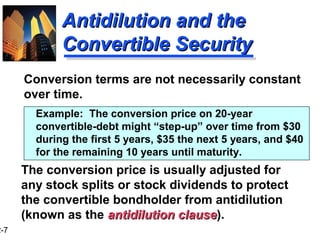
Conversion terms are not necessarily constant
over time.
Example: The conversion price on 20-year
convertible-debt might “step-up” over time from $30
during the first 5 years, $35 the next 5 years, and $40
for the remaining 10 years until maturity.
The conversion price is usually adjusted for
any stock splits or stock dividends to protect
the convertible bondholder from antidilution
(known as the antidilution clauseantidilution clause).
2-8
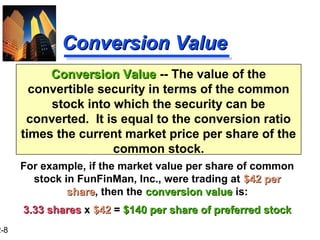
Conversion ValueConversion Value -- The value of the
convertible security in terms of the common
stock into which the security can be
converted. It is equal to the conversion ratio
times the current market price per share of the
common stock.
Conversion ValueConversion Value
For example, if the market value per share of common
stock in FunFinMan, Inc., were trading at $42 per$42 per
shareshare, then the conversion valueconversion value is:
3.33 shares3.33 shares x $42$42 = $140 per share of preferred stock$140 per share of preferred stock
2-9
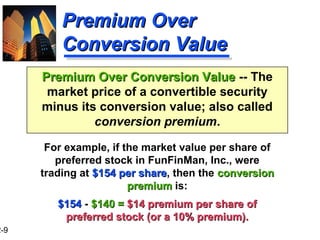
Premium Over Conversion ValuePremium Over Conversion Value -- The
market price of a convertible security
minus its conversion value; also called
conversion premium.
Premium OverPremium Over
Conversion ValueConversion Value
For example, if the market value per share of
preferred stock in FunFinMan, Inc., were
trading at $154 per share$154 per share, then the conversionconversion
premiumpremium is:
$154$154 - $140 =$140 = $14 premium per share of$14 premium per share of
preferred stock (or a 10% premium).preferred stock (or a 10% premium).
2-10
Other Issues withOther Issues with
Convertible SecuritiesConvertible Securities
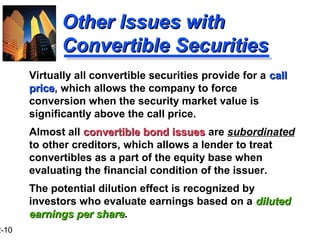
Virtually all convertible securities provide for a callcall
priceprice, which allows the company to force
conversion when the security market value is
significantly above the call price.
Almost all convertible bond issuesconvertible bond issues are subordinated
to other creditors, which allows a lender to treat
convertibles as a part of the equity base when
evaluating the financial condition of the issuer.
The potential dilution effect is recognized by
investors who evaluate earnings based on a diluteddiluted
earnings per shareearnings per share.
2-11
Use ofUse of
Convertible SecuritiesConvertible Securities
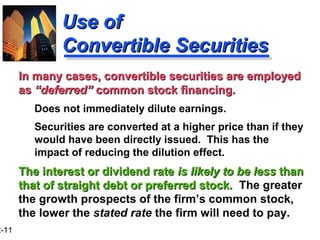
In many cases, convertible securities are employedIn many cases, convertible securities are employed
asas “deferred”“deferred” common stock financing.common stock financing.
Does not immediately dilute earnings.
Securities are converted at a higher price than if they
would have been directly issued. This has the
impact of reducing the dilution effect.
The interest or dividend rateThe interest or dividend rate is likely to be lessis likely to be less thanthan
that of straight debt or preferred stock.that of straight debt or preferred stock. The greater
the growth prospects of the firm’s common stock,
the lower the stated rate the firm will need to pay.
2-12
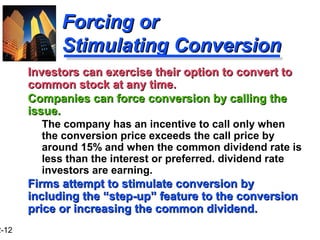
Forcing orForcing or
Stimulating ConversionStimulating Conversion
Investors can exercise their option to convert toInvestors can exercise their option to convert to
common stock at any time.common stock at any time.
Companies can force conversion by calling theCompanies can force conversion by calling the
issue.issue.
The company has an incentive to call only when
the conversion price exceeds the call price by
around 15% and when the common dividend rate is
less than the interest or preferred. dividend rate
investors are earning.
Firms attempt to stimulate conversion byFirms attempt to stimulate conversion by
including the “step-up” feature to the conversionincluding the “step-up” feature to the conversion
price or increasing the common dividend.price or increasing the common dividend.
2-13
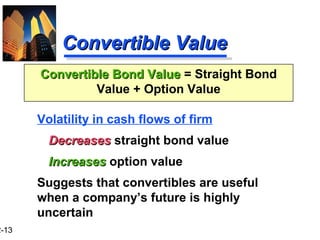
Convertible Bond ValueConvertible Bond Value = Straight Bond
Value + Option Value
Convertible ValueConvertible Value
Volatility in cash flows of firm
DecreasesDecreases straight bond value
IncreasesIncreases option value
Suggests that convertibles are useful
when a company’s future is highly
uncertain
2-14
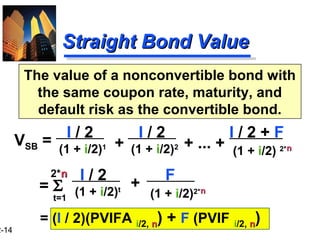
Straight Bond ValueStraight Bond Value
The value of a nonconvertible bond with
the same coupon rate, maturity, and
default risk as the convertible bond.
The value of a nonconvertible bond with
the same coupon rate, maturity, and
default risk as the convertible bond.
(1 + i/2)1
(1 + i/2)2
(1 + i/2) 2*nn
VSB = + + ... +
I / 2 I / 2 + F
= Σ
2*nn
t=1
(1 + i/2)t
= (I / 2)(PVIFA i/2, nn) + F (PVIF i/2, nn)
(1 + i/2)2*nn
+
F
I / 2
I / 2
2-15
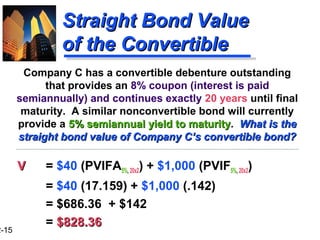
Straight Bond ValueStraight Bond Value
of the Convertibleof the Convertible
Company C has a convertible debenture outstanding
that provides an 8% coupon (interest is paid
semiannually) and continues exactly 20 years until final
maturity. A similar nonconvertible bond will currently
provide a 5% semiannual yield to maturity5% semiannual yield to maturity. What is theWhat is the
straight bond value of Company C’s convertible bond?straight bond value of Company C’s convertible bond?
VV = $40 (PVIFA5%, 20x2) + $1,000 (PVIF5%, 20x2)
= $40 (17.159) + $1,000 (.142)
= $686.36 + $142
= $828.36$828.36
2-16
Why Care AboutWhy Care About
“Straight Bond Value?”“Straight Bond Value?”
The convertible bond valueconvertible bond value equals straightstraight
bond valuebond value plus conversion option valueconversion option value.
The $828.36$828.36 represents a floor (minimum)
below which the convertible value will not
fall. This occurs when the conversion optionconversion option
valuevalue is essentially worthless.
The straight bond value is subject to change
as interest rates, firm risk, and time change.
This, in turn, is likely to impact the
convertible bond value.
2-17
RelationshipsRelationships
Among PremiumsAmong Premiums
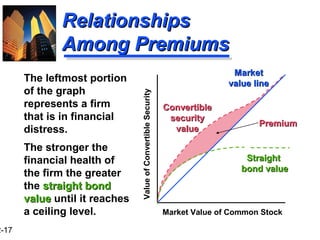
The leftmost portion
of the graph
represents a firm
that is in financial
distress.
The stronger the
financial health of
the firm the greater
the straight bondstraight bond
valuevalue until it reaches
a ceiling level.
ValueofConvertibleSecurity
Market Value of Common Stock
MarketMarket
value linevalue line
PremiumPremium
StraightStraight
bond valuebond value
ConvertibleConvertible
securitysecurity
valuevalue
2-18
Relationships AmongRelationships Among
Premiums -- SummaryPremiums -- Summary
A convertible security offers holders partial
protection on the downside (similar to the
straight bond) based on the going-concern
and liquidation values of the firm.
A convertible security also provides
holders with the ability to participate in the
upward movement in common stock prices.
The greater the volatility of common stock
price, the greater the potential gain and the
more valuable the option.
2-19
Exchangeable BondExchangeable Bond -- A bond that allows the
holder to exchange the security for common
stock of another companyof another company -- generally, one in
which the bond issuer has an ownership
interest.
Exchangeable BondExchangeable Bond
These issues usually occur when the issuer owns
common stock in the company in which the bonds
can be exchanged.
Exchange requests are satisfied either by open
market purchases or directly using the firm’s
investment holdings of the other company’s stock.
2-20
Valuation ofValuation of
an Exchangeablean Exchangeable
Investors may realize diversification benefits since
the bond and the common stock are from different
companies.
Potentially, diversification leads to a higher
valuation for the exchangeable versus the
convertible.
A major disadvantage is that the difference between
the cost of the bond and the market value of the
exchanged common stock, at the time of exchange,
is treated as a capital gain. A convertible gain is
not recognized until the common stock is sold.
2-21
WarrantWarrant -- A relatively long-term option to
purchase common stock at a specified
exercise price over a specified period of time.
WarrantsWarrants
To obtain a lower interest rate.
To raise funds when the firm is
considered a marginal credit risk.
To compensate underwriters and venture
capitalists when founding a company.
Warrants are employed as “sweeteners”:Warrants are employed as “sweeteners”:
2-22
Warrant FeaturesWarrant Features
The warrant contains provisions forThe warrant contains provisions for::
the number of shares that can be purchased per
warrant.
the price at which the warrant can be exercised.
the warrant expiration date.
Warrant holders areWarrant holders are notnot entitled to anyentitled to any
dividends nor do they have any voting power.dividends nor do they have any voting power.
The exercise price is generally adjusted forThe exercise price is generally adjusted for
any common stock dividends and splits.any common stock dividends and splits.
2-23
Example ofExample of
Exercise of WarrantsExercise of Warrants
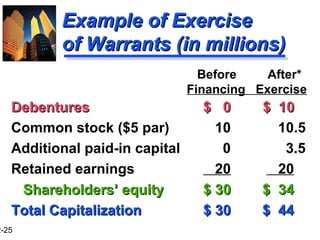
FunFinMan, Inc., is currently financed entirely
with common stock. The firm is composed
of $10 million in common stock ($5 par
value) and $20 million in retained earnings.
The company is considering issuing $20
million of 8%, 20-year debentures including 1
warrant per bond that can be converted into
5 shares of common stock at an exercise
price of $40 per share. How will this impactHow will this impact
the capitalization of the firm?the capitalization of the firm?
2-24
Example of ExerciseExample of Exercise
of Warrants (in millions)of Warrants (in millions)
DebenturesDebentures $ 0$ 0 $ 10$ 10
Common stock ($5 par) 10 10
Additional paid-in capital 0 0
Retained earnings 20 20
Shareholders’ equityShareholders’ equity $ 30 $ 30$ 30 $ 30
Total CapitalizationTotal Capitalization $ 30 $ 40$ 30 $ 40
Before After*
Financing Financing
2-25
Example of ExerciseExample of Exercise
of Warrants (in millions)of Warrants (in millions)
DebenturesDebentures $ 0$ 0 $ 10$ 10
Common stock ($5 par) 10 10.5
Additional paid-in capital 0 3.5
Retained earnings 20 20
Shareholders’ equityShareholders’ equity $ 30 $ 34$ 30 $ 34
Total CapitalizationTotal Capitalization $ 30 $ 44$ 30 $ 44
Before After*
Financing Exercise
2-26
Valuation of a WarrantValuation of a Warrant
Theoretical value of aTheoretical value of a
warrant:warrant:
maxmax [ (NN)(PPss) - EE, 00]
N = number of shares perN = number of shares per
warrantwarrant
PPss = market price of one= market price of one
share of stockshare of stock
E = exercise priceE = exercise price
associated with theassociated with the
purchase of N sharespurchase of N shares
WarrantValue
Associated Common Stock Price
TheoreticalTheoretical
value linevalue line
45o
MarketMarket
value linevalue line
ExerciseExercise
priceprice
2-27
Example of theExample of the
Valuation of a WarrantValuation of a Warrant
Theoretical value of aTheoretical value of a
warrant:warrant:
maxmax [ (NN)(PPss) - EE, 00]
N = 1N = 1, PPss = $10= $10 , E = $5E = $5
maxmax[(11)($10$10)-$5$5, 00] = $5$5
N = 1N = 1, PPss = $15= $15 , E = $5E = $5
maxmax[(11)($15$15)-$5$5, 00] =$10$10
WarrantValue
Associated Common Stock Price
$5$5
$10$10
Stock appreciates 50%Stock appreciates 50%
Theoretical warrantTheoretical warrant
value appreciates 100%value appreciates 100%
MinimumMinimum
value is 0.value is 0.
2-28
Summary of the ExampleSummary of the Example
of Warrant Valuationof Warrant Valuation
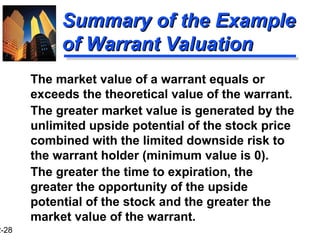
The market value of a warrant equals or
exceeds the theoretical value of the warrant.
The greater market value is generated by the
unlimited upside potential of the stock price
combined with the limited downside risk to
the warrant holder (minimum value is 0).
The greater the time to expiration, the
greater the opportunity of the upside
potential of the stock and the greater the
market value of the warrant.

Financial Management Slides Ch 22

  • 1.
  • 2.
    2-2 Convertibles, Exchangables,Convertibles, Exchangables, andWarrantsand Warrants Convertible Securities Use of Convertibles Value of Convertible Securities Exchangeable Bonds Warrants
  • 3.
    2-3 Derivative SecurityDerivative Security-- A financial contract whose value derives in part from the value and characteristics of one or more underlying assets (e.g., securities, commodities), interest rates, exchange rates, or indices. Derivative SecurityDerivative Security Straight debt or equity cannot be exchanged for another asset, but options are exchangeable. An option is part of the broader category of derivative securities. We examine the convertible security, exchangeable bond, and warrant in this chapter.
  • 4.
    2-4 Convertible SecurityConvertible Security-- A bond or a preferred stock that is convertible into a specified number of shares of common stock at the option of the holder. Convertible SecurityConvertible Security This provides the convertible holder a fixed return (interest or dividend) andand the option to exchange a bond or preferred stock for common stock. The option allows the company to sell convertible securities at a lower yieldlower yield than it would have to pay on a straight bond or preferred stock issue.
  • 5.
    2-5 Conversion PriceConversion Price-- The price per share at which common stock will be exchanged for a convertible security. It is equal to the face value of the convertible security divided by the conversion ratioconversion ratio. Convertible SecurityConvertible Security Conversion RatioConversion Ratio -- The number of shares of common stock into which a convertible security can be converted. It is equal to the face value of the convertible security divided by the conversion price.
  • 6.
    2-6 FunFinMan, Inc., hasan issue of 8%, $100 par value$100 par value preferred stock outstanding. The security has a conversion price of $30conversion price of $30 per share. What is the conversion ratio?What is the conversion ratio? Conversion ExampleConversion Example Conversion RatioConversion Ratio = $100 par value$100 par value / $30 conversion price$30 conversion price = 3.33 shares3.33 shares
  • 7.
    2-7 Antidilution and theAntidilutionand the Convertible SecurityConvertible Security Conversion terms are not necessarily constant over time. Example: The conversion price on 20-year convertible-debt might “step-up” over time from $30 during the first 5 years, $35 the next 5 years, and $40 for the remaining 10 years until maturity. The conversion price is usually adjusted for any stock splits or stock dividends to protect the convertible bondholder from antidilution (known as the antidilution clauseantidilution clause).
  • 8.
    2-8 Conversion ValueConversion Value-- The value of the convertible security in terms of the common stock into which the security can be converted. It is equal to the conversion ratio times the current market price per share of the common stock. Conversion ValueConversion Value For example, if the market value per share of common stock in FunFinMan, Inc., were trading at $42 per$42 per shareshare, then the conversion valueconversion value is: 3.33 shares3.33 shares x $42$42 = $140 per share of preferred stock$140 per share of preferred stock
  • 9.
    2-9 Premium Over ConversionValuePremium Over Conversion Value -- The market price of a convertible security minus its conversion value; also called conversion premium. Premium OverPremium Over Conversion ValueConversion Value For example, if the market value per share of preferred stock in FunFinMan, Inc., were trading at $154 per share$154 per share, then the conversionconversion premiumpremium is: $154$154 - $140 =$140 = $14 premium per share of$14 premium per share of preferred stock (or a 10% premium).preferred stock (or a 10% premium).
  • 10.
    2-10 Other Issues withOtherIssues with Convertible SecuritiesConvertible Securities Virtually all convertible securities provide for a callcall priceprice, which allows the company to force conversion when the security market value is significantly above the call price. Almost all convertible bond issuesconvertible bond issues are subordinated to other creditors, which allows a lender to treat convertibles as a part of the equity base when evaluating the financial condition of the issuer. The potential dilution effect is recognized by investors who evaluate earnings based on a diluteddiluted earnings per shareearnings per share.
  • 11.
    2-11 Use ofUse of ConvertibleSecuritiesConvertible Securities In many cases, convertible securities are employedIn many cases, convertible securities are employed asas “deferred”“deferred” common stock financing.common stock financing. Does not immediately dilute earnings. Securities are converted at a higher price than if they would have been directly issued. This has the impact of reducing the dilution effect. The interest or dividend rateThe interest or dividend rate is likely to be lessis likely to be less thanthan that of straight debt or preferred stock.that of straight debt or preferred stock. The greater the growth prospects of the firm’s common stock, the lower the stated rate the firm will need to pay.
  • 12.
    2-12 Forcing orForcing or StimulatingConversionStimulating Conversion Investors can exercise their option to convert toInvestors can exercise their option to convert to common stock at any time.common stock at any time. Companies can force conversion by calling theCompanies can force conversion by calling the issue.issue. The company has an incentive to call only when the conversion price exceeds the call price by around 15% and when the common dividend rate is less than the interest or preferred. dividend rate investors are earning. Firms attempt to stimulate conversion byFirms attempt to stimulate conversion by including the “step-up” feature to the conversionincluding the “step-up” feature to the conversion price or increasing the common dividend.price or increasing the common dividend.
  • 13.
    2-13 Convertible Bond ValueConvertibleBond Value = Straight Bond Value + Option Value Convertible ValueConvertible Value Volatility in cash flows of firm DecreasesDecreases straight bond value IncreasesIncreases option value Suggests that convertibles are useful when a company’s future is highly uncertain
  • 14.
    2-14 Straight Bond ValueStraightBond Value The value of a nonconvertible bond with the same coupon rate, maturity, and default risk as the convertible bond. The value of a nonconvertible bond with the same coupon rate, maturity, and default risk as the convertible bond. (1 + i/2)1 (1 + i/2)2 (1 + i/2) 2*nn VSB = + + ... + I / 2 I / 2 + F = Σ 2*nn t=1 (1 + i/2)t = (I / 2)(PVIFA i/2, nn) + F (PVIF i/2, nn) (1 + i/2)2*nn + F I / 2 I / 2
  • 15.
    2-15 Straight Bond ValueStraightBond Value of the Convertibleof the Convertible Company C has a convertible debenture outstanding that provides an 8% coupon (interest is paid semiannually) and continues exactly 20 years until final maturity. A similar nonconvertible bond will currently provide a 5% semiannual yield to maturity5% semiannual yield to maturity. What is theWhat is the straight bond value of Company C’s convertible bond?straight bond value of Company C’s convertible bond? VV = $40 (PVIFA5%, 20x2) + $1,000 (PVIF5%, 20x2) = $40 (17.159) + $1,000 (.142) = $686.36 + $142 = $828.36$828.36
  • 16.
    2-16 Why Care AboutWhyCare About “Straight Bond Value?”“Straight Bond Value?” The convertible bond valueconvertible bond value equals straightstraight bond valuebond value plus conversion option valueconversion option value. The $828.36$828.36 represents a floor (minimum) below which the convertible value will not fall. This occurs when the conversion optionconversion option valuevalue is essentially worthless. The straight bond value is subject to change as interest rates, firm risk, and time change. This, in turn, is likely to impact the convertible bond value.
  • 17.
    2-17 RelationshipsRelationships Among PremiumsAmong Premiums Theleftmost portion of the graph represents a firm that is in financial distress. The stronger the financial health of the firm the greater the straight bondstraight bond valuevalue until it reaches a ceiling level. ValueofConvertibleSecurity Market Value of Common Stock MarketMarket value linevalue line PremiumPremium StraightStraight bond valuebond value ConvertibleConvertible securitysecurity valuevalue
  • 18.
    2-18 Relationships AmongRelationships Among Premiums-- SummaryPremiums -- Summary A convertible security offers holders partial protection on the downside (similar to the straight bond) based on the going-concern and liquidation values of the firm. A convertible security also provides holders with the ability to participate in the upward movement in common stock prices. The greater the volatility of common stock price, the greater the potential gain and the more valuable the option.
  • 19.
    2-19 Exchangeable BondExchangeable Bond-- A bond that allows the holder to exchange the security for common stock of another companyof another company -- generally, one in which the bond issuer has an ownership interest. Exchangeable BondExchangeable Bond These issues usually occur when the issuer owns common stock in the company in which the bonds can be exchanged. Exchange requests are satisfied either by open market purchases or directly using the firm’s investment holdings of the other company’s stock.
  • 20.
    2-20 Valuation ofValuation of anExchangeablean Exchangeable Investors may realize diversification benefits since the bond and the common stock are from different companies. Potentially, diversification leads to a higher valuation for the exchangeable versus the convertible. A major disadvantage is that the difference between the cost of the bond and the market value of the exchanged common stock, at the time of exchange, is treated as a capital gain. A convertible gain is not recognized until the common stock is sold.
  • 21.
    2-21 WarrantWarrant -- Arelatively long-term option to purchase common stock at a specified exercise price over a specified period of time. WarrantsWarrants To obtain a lower interest rate. To raise funds when the firm is considered a marginal credit risk. To compensate underwriters and venture capitalists when founding a company. Warrants are employed as “sweeteners”:Warrants are employed as “sweeteners”:
  • 22.
    2-22 Warrant FeaturesWarrant Features Thewarrant contains provisions forThe warrant contains provisions for:: the number of shares that can be purchased per warrant. the price at which the warrant can be exercised. the warrant expiration date. Warrant holders areWarrant holders are notnot entitled to anyentitled to any dividends nor do they have any voting power.dividends nor do they have any voting power. The exercise price is generally adjusted forThe exercise price is generally adjusted for any common stock dividends and splits.any common stock dividends and splits.
  • 23.
    2-23 Example ofExample of Exerciseof WarrantsExercise of Warrants FunFinMan, Inc., is currently financed entirely with common stock. The firm is composed of $10 million in common stock ($5 par value) and $20 million in retained earnings. The company is considering issuing $20 million of 8%, 20-year debentures including 1 warrant per bond that can be converted into 5 shares of common stock at an exercise price of $40 per share. How will this impactHow will this impact the capitalization of the firm?the capitalization of the firm?
  • 24.
    2-24 Example of ExerciseExampleof Exercise of Warrants (in millions)of Warrants (in millions) DebenturesDebentures $ 0$ 0 $ 10$ 10 Common stock ($5 par) 10 10 Additional paid-in capital 0 0 Retained earnings 20 20 Shareholders’ equityShareholders’ equity $ 30 $ 30$ 30 $ 30 Total CapitalizationTotal Capitalization $ 30 $ 40$ 30 $ 40 Before After* Financing Financing
  • 25.
    2-25 Example of ExerciseExampleof Exercise of Warrants (in millions)of Warrants (in millions) DebenturesDebentures $ 0$ 0 $ 10$ 10 Common stock ($5 par) 10 10.5 Additional paid-in capital 0 3.5 Retained earnings 20 20 Shareholders’ equityShareholders’ equity $ 30 $ 34$ 30 $ 34 Total CapitalizationTotal Capitalization $ 30 $ 44$ 30 $ 44 Before After* Financing Exercise
  • 26.
    2-26 Valuation of aWarrantValuation of a Warrant Theoretical value of aTheoretical value of a warrant:warrant: maxmax [ (NN)(PPss) - EE, 00] N = number of shares perN = number of shares per warrantwarrant PPss = market price of one= market price of one share of stockshare of stock E = exercise priceE = exercise price associated with theassociated with the purchase of N sharespurchase of N shares WarrantValue Associated Common Stock Price TheoreticalTheoretical value linevalue line 45o MarketMarket value linevalue line ExerciseExercise priceprice
  • 27.
    2-27 Example of theExampleof the Valuation of a WarrantValuation of a Warrant Theoretical value of aTheoretical value of a warrant:warrant: maxmax [ (NN)(PPss) - EE, 00] N = 1N = 1, PPss = $10= $10 , E = $5E = $5 maxmax[(11)($10$10)-$5$5, 00] = $5$5 N = 1N = 1, PPss = $15= $15 , E = $5E = $5 maxmax[(11)($15$15)-$5$5, 00] =$10$10 WarrantValue Associated Common Stock Price $5$5 $10$10 Stock appreciates 50%Stock appreciates 50% Theoretical warrantTheoretical warrant value appreciates 100%value appreciates 100% MinimumMinimum value is 0.value is 0.
  • 28.
    2-28 Summary of theExampleSummary of the Example of Warrant Valuationof Warrant Valuation The market value of a warrant equals or exceeds the theoretical value of the warrant. The greater market value is generated by the unlimited upside potential of the stock price combined with the limited downside risk to the warrant holder (minimum value is 0). The greater the time to expiration, the greater the opportunity of the upside potential of the stock and the greater the market value of the warrant.