© 2003 McGraw-Hill Australia Pty Ltd PPTs t/a Organisational Behaviour on the Pacific Rim by McShane and Travaglione
C H A P T E RC H A P T E R 44
WorkplaceWorkplace
values, ethicsvalues, ethics
and emotionsand emotions
2
Chapter learning objectivesChapter learning objectives
1. Identify the different types and levels of values.
2. Define the five main values that vary across cultures.
3. Describe three ethical principles and other factors
influencing ethical behaviour.
4. Explain how moral intensity, ethical sensitivity and the
situation influence ethical behaviour.
5. Discuss the linkages between emotions and behaviour.
6. Identify the conditions that require, and the problems with,
emotional labour.
7. Outline the dimensions of emotional intelligence.
8. Discuss the effect of job satisfaction on task performance
and customer service.
9. Describe five strategies to increase organisational
commitment.
3
Courtesy of The Warehouse
Values and ethics at The WarehouseValues and ethics at The Warehouse
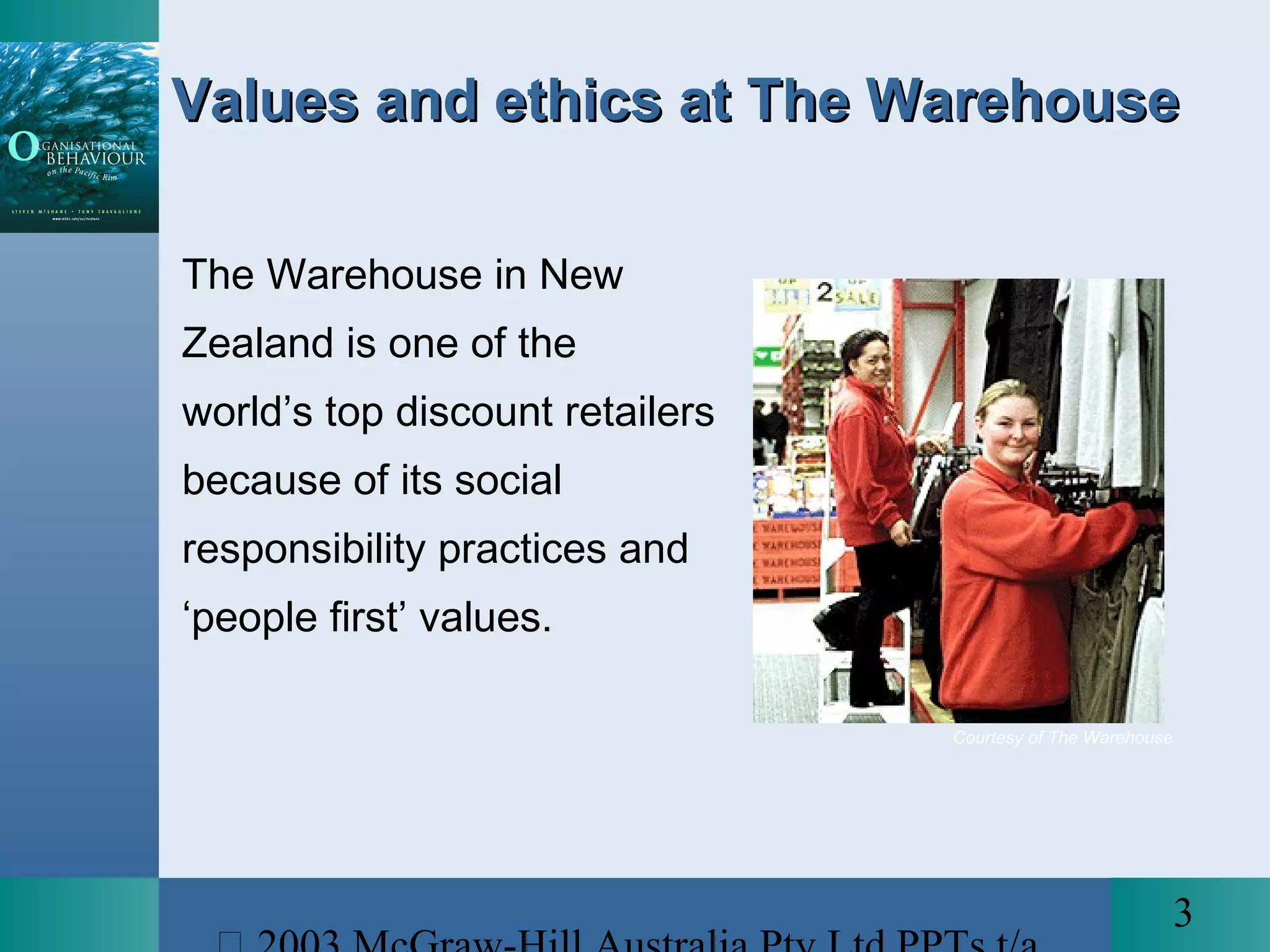
The Warehouse in New
Zealand is one of the
world’s top discount retailers
because of its social
responsibility practices and
‘people first’ values.
4
Courtesy of The Warehouse
Values definedValues defined
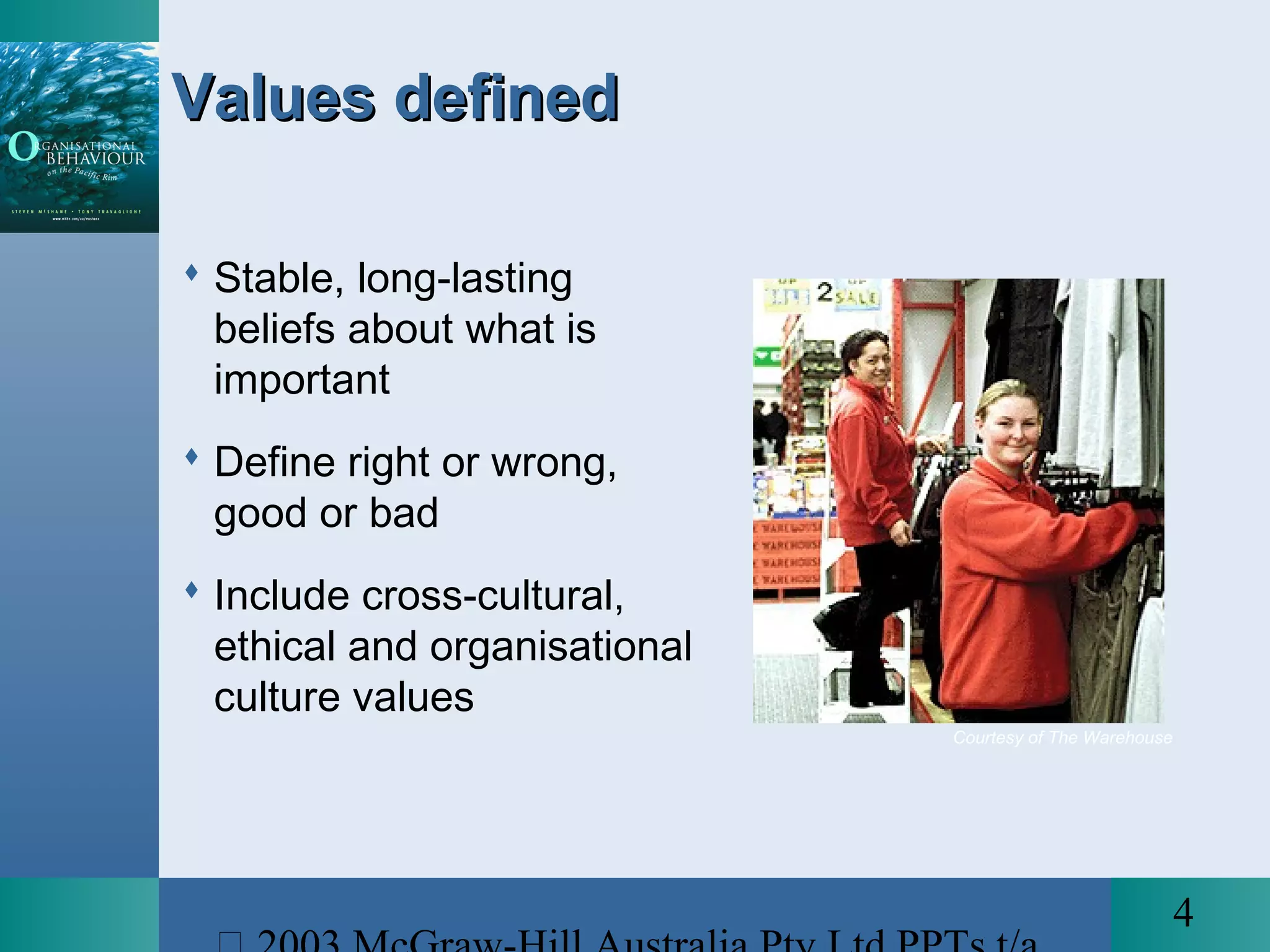
 Stable, long-lasting
beliefs about what is
important
 Define right or wrong,
good or bad
 Include cross-cultural,
ethical and organisational
culture values
5
Forms of workplace valuesForms of workplace values
 Terminal versus instrumental
 terminal are desired states of existence
 instrumental are desirable modes of
behaviour
 Espoused versus enacted
 espoused are values we want others to
believe we hold
 enacted are values-in-use; what we actually
practice
6
Importance of values at workImportance of values at work
 Globalisation
 increasing awareness of, and sensitivity to, different
values across cultures
 Replacing direct supervision
 potentially aligns employees’ decisions and actions
with corporate goals
 Demand for ethical practices
 increasing pressure to engage in ethical practices
7
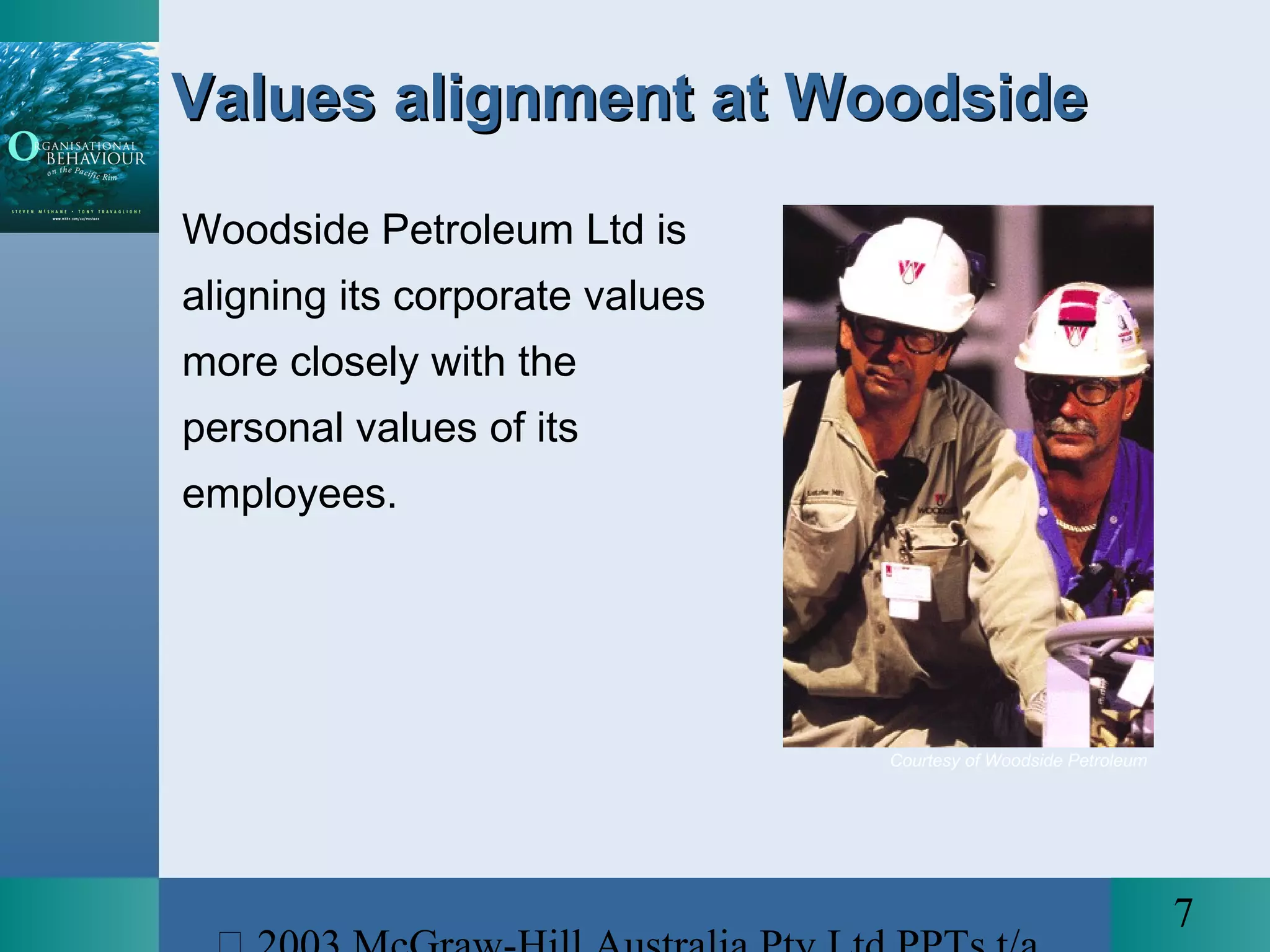
Values alignment at WoodsideValues alignment at Woodside
Woodside Petroleum Ltd is
aligning its corporate values
more closely with the
personal values of its
employees.
Courtesy of Woodside Petroleum
8
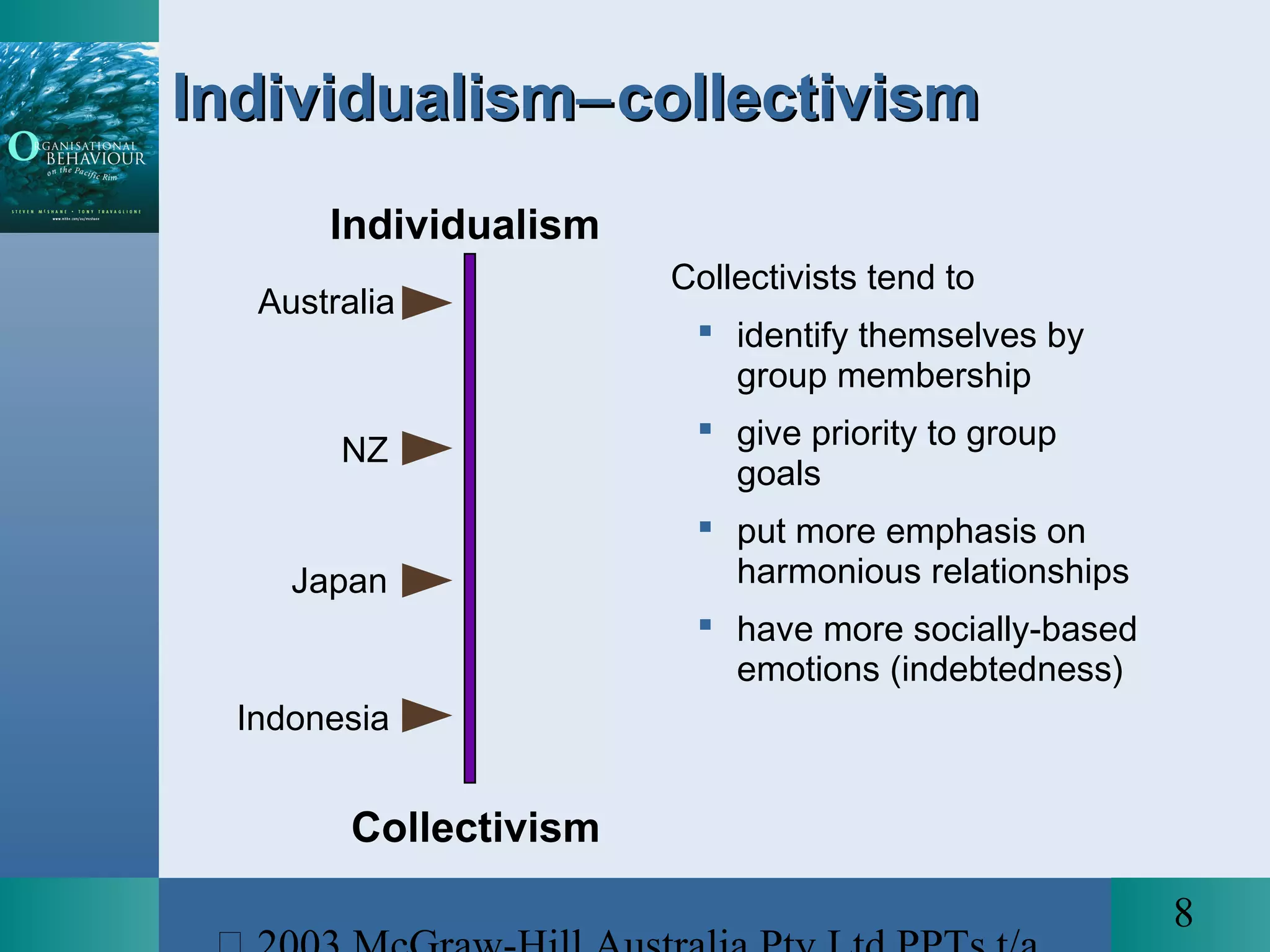
Collectivists tend to
 identify themselves by
group membership
 give priority to group
goals
 put more emphasis on
harmonious relationships
 have more socially-based
emotions (indebtedness)
Japan
NZ
Australia
Collectivism
Individualism
Indonesia
IndividualismIndividualism−−collectivismcollectivism
9
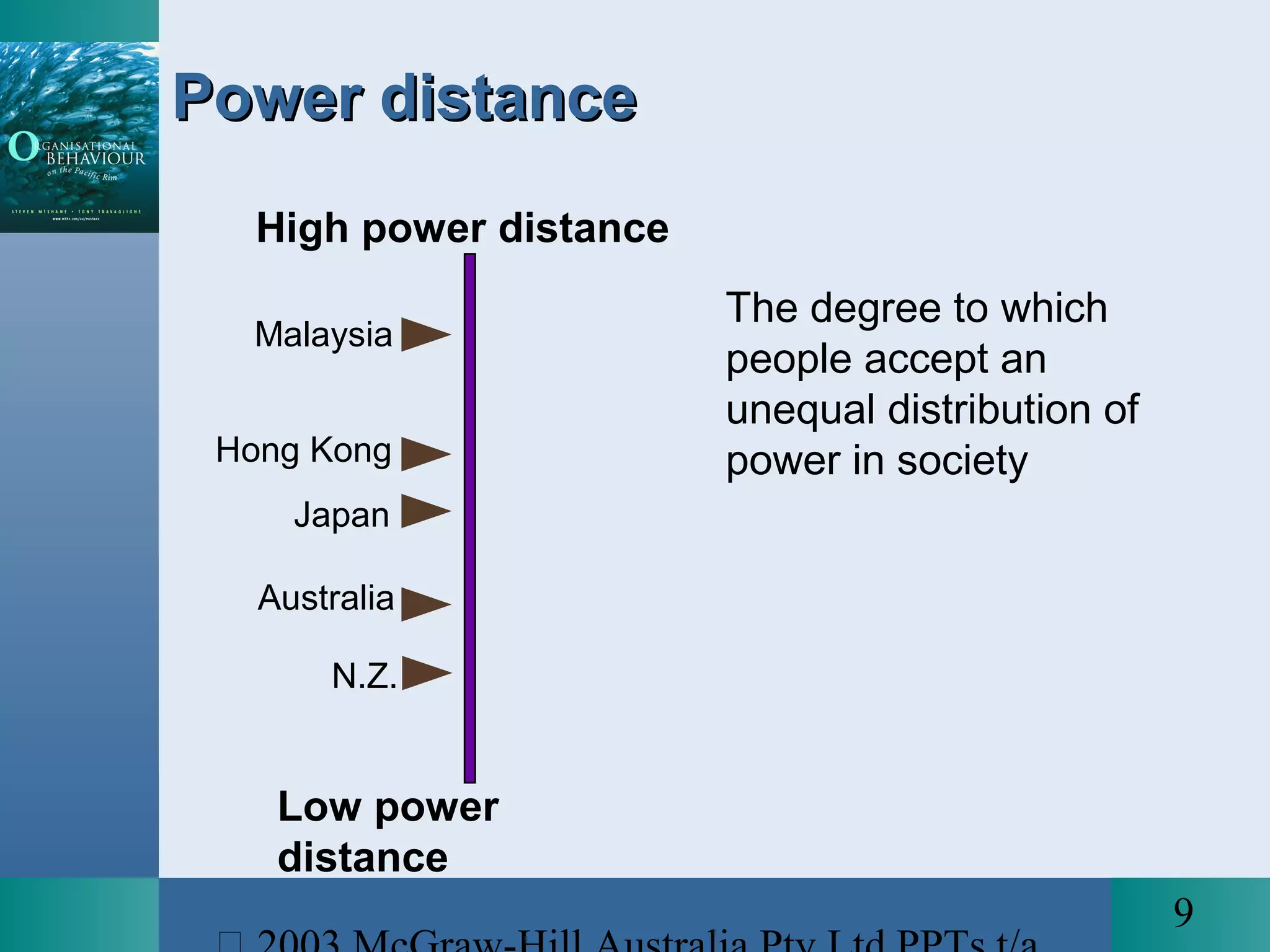
The degree to which
people accept an
unequal distribution of
power in society
Japan
N.Z.
Australia
Hong Kong
High power distance
Malaysia
Low power
distance
Power distancePower distance
10
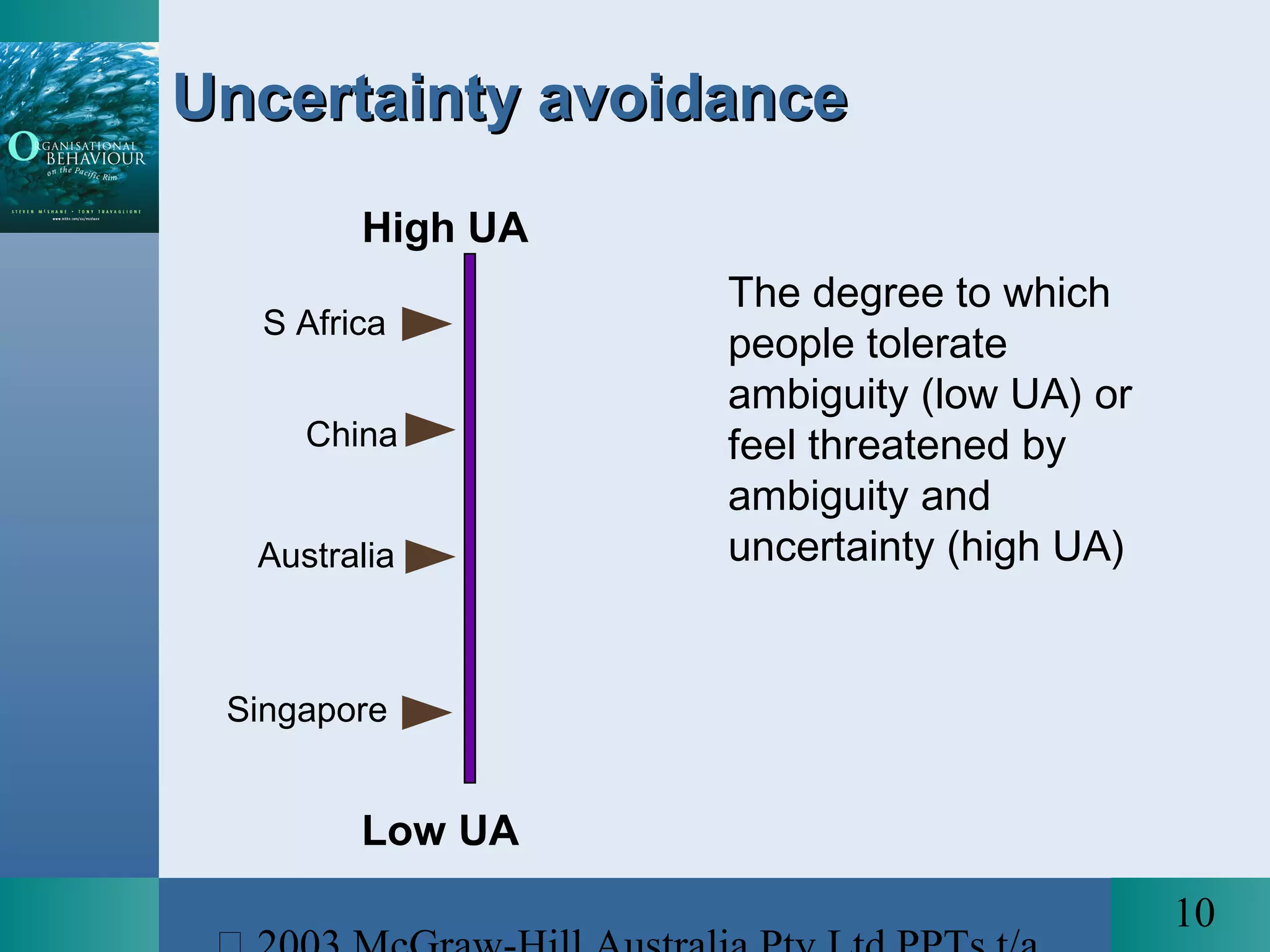
High UA
Low UA
S Africa
China
Singapore
The degree to which
people tolerate
ambiguity (low UA) or
feel threatened by
ambiguity and
uncertainty (high UA)
Uncertainty avoidanceUncertainty avoidance
Australia
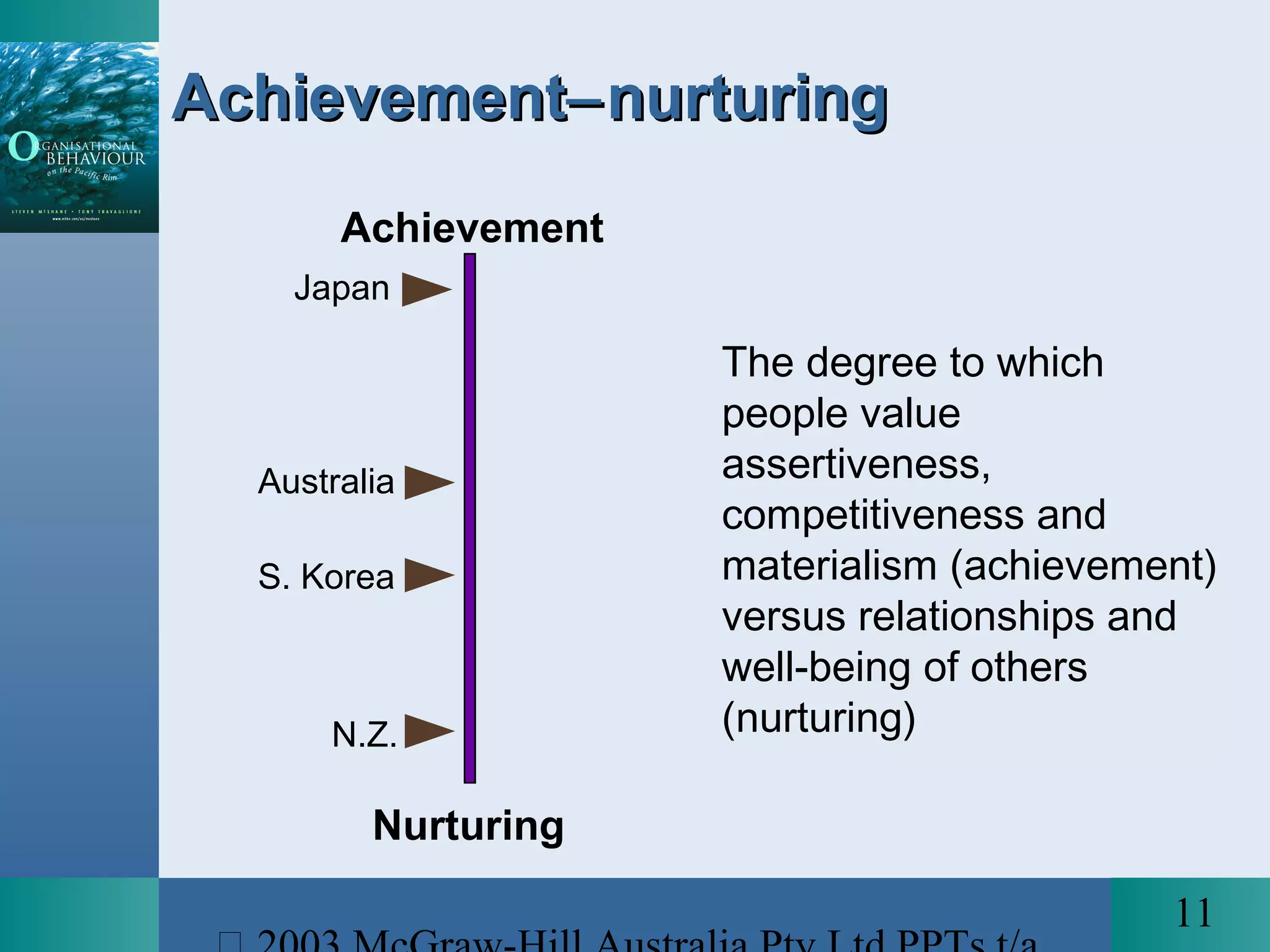
11
Japan
S. Korea
Achievement
Nurturing
N.Z.
The degree to which
people value
assertiveness,
competitiveness and
materialism (achievement)
versus relationships and
well-being of others
(nurturing)
AchievementAchievement−−nurturingnurturing
Australia
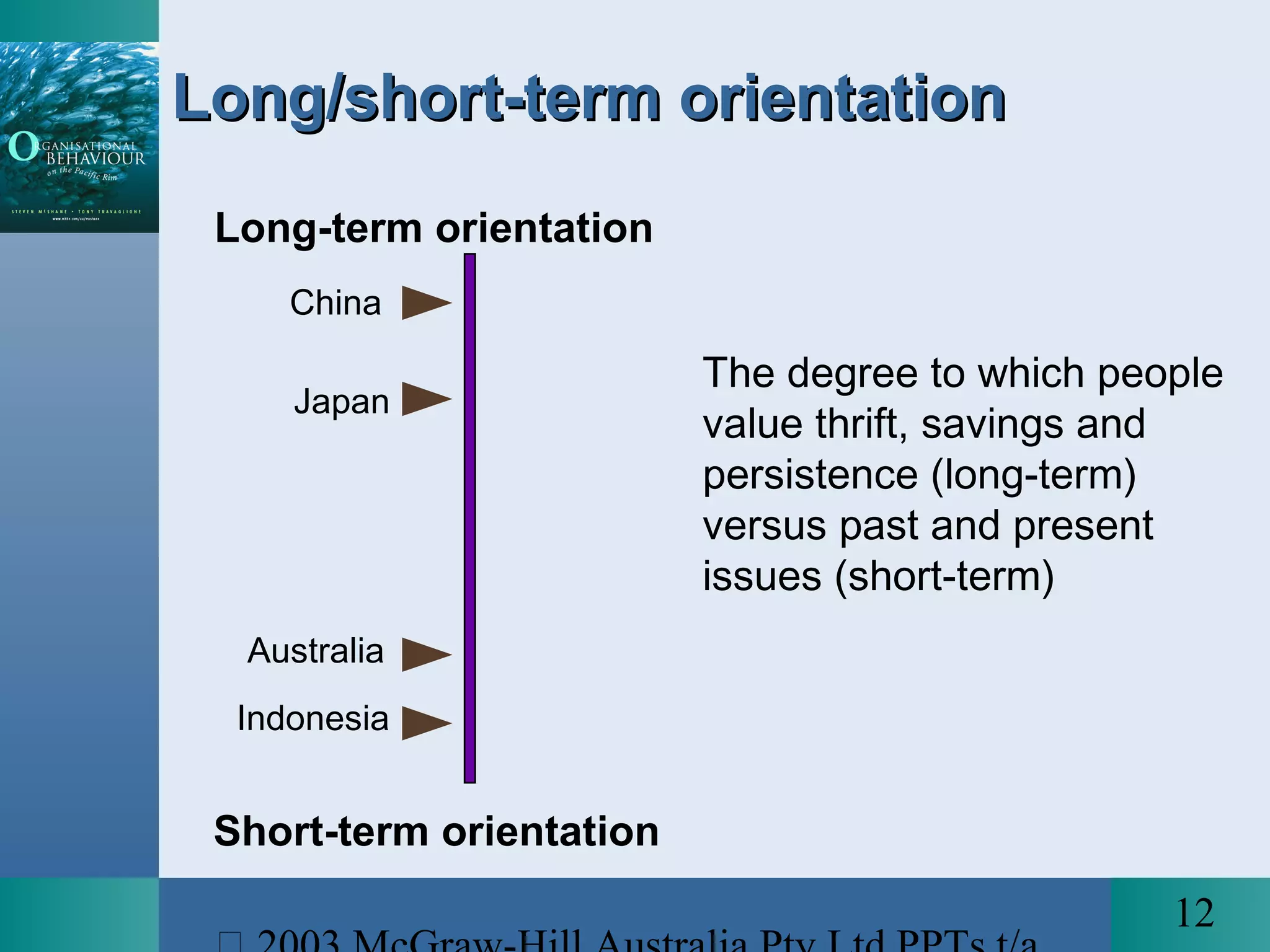
12
Japan
Indonesia
Long-term orientation
Short-term orientation
China
The degree to which people
value thrift, savings and
persistence (long-term)
versus past and present
issues (short-term)
Long/short-term orientationLong/short-term orientation
Australia
13
Ethics at AMP InsuranceEthics at AMP Insurance
AMP Insurance in Wellington, New Zealand is
showing its ethical values and social responsibility by
supporting community events, such as this shave-a-
thon to raise funds for the Leukaemia and Blood
Foundation.
© J. Nicholson, Evening Post (Wellington)
14
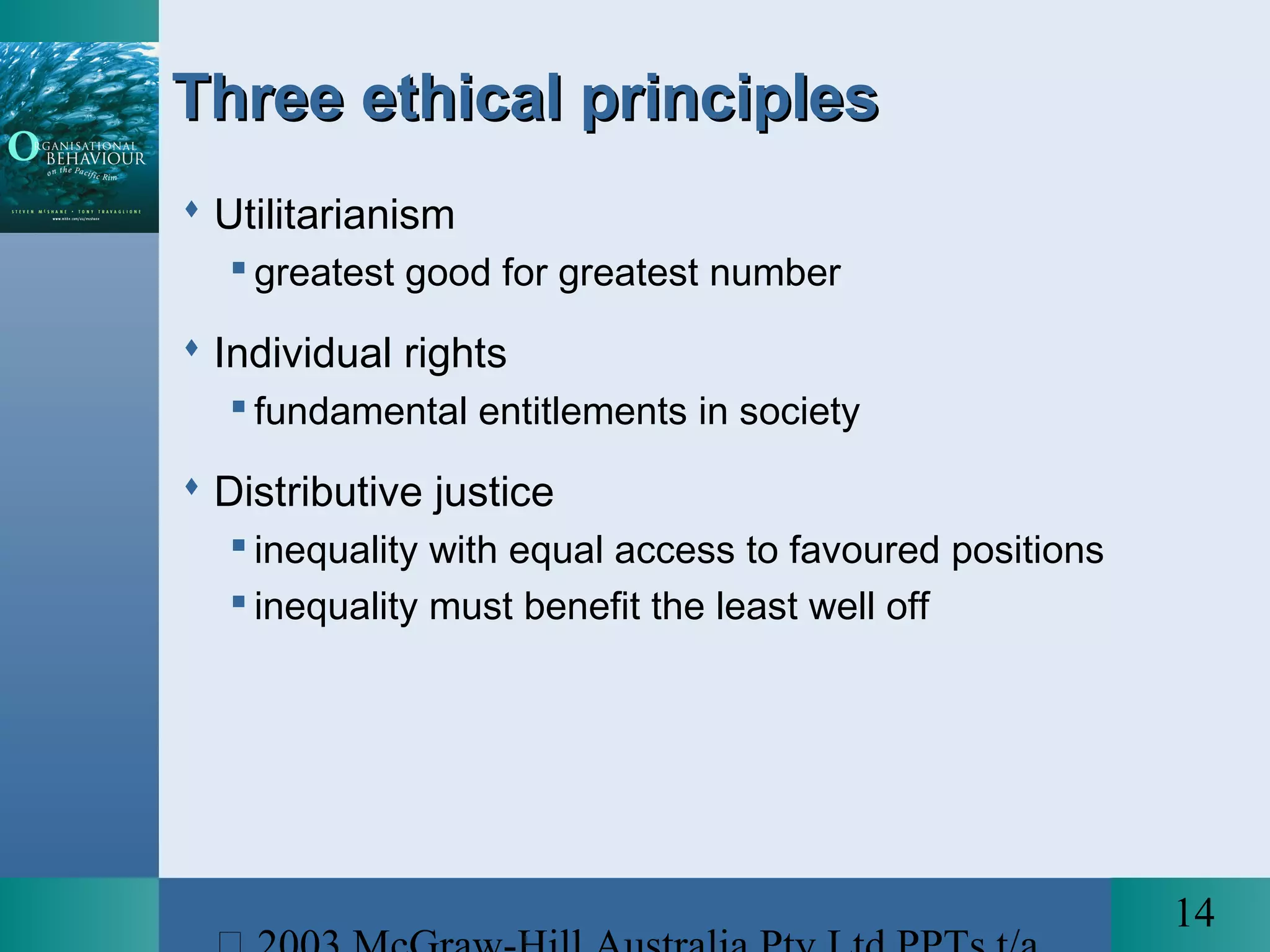
Three ethical principlesThree ethical principles
 Utilitarianism
 greatest good for greatest number
 Individual rights
 fundamental entitlements in society
 Distributive justice
 inequality with equal access to favoured positions
 inequality must benefit the least well off
15
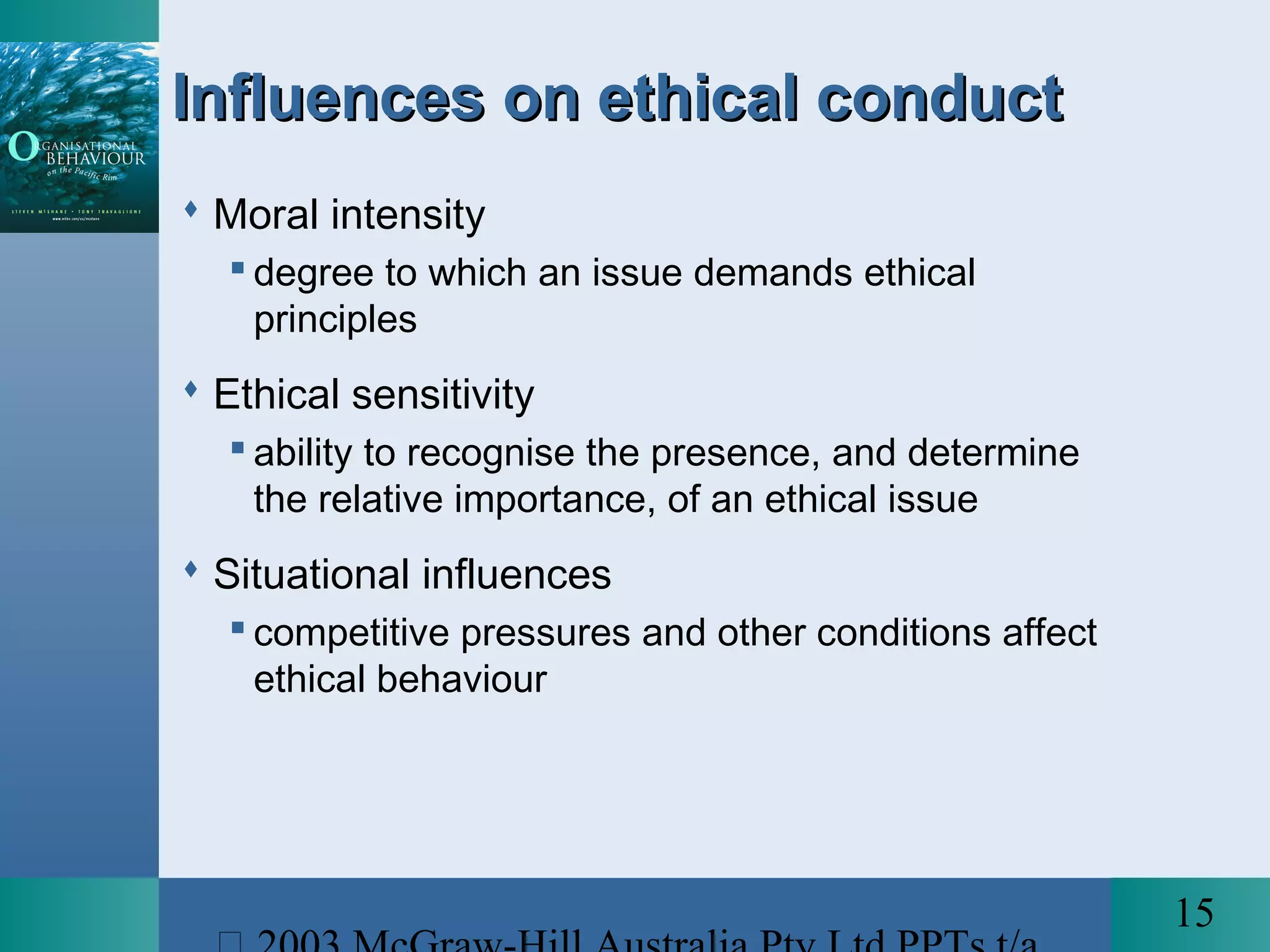
Influences on ethical conductInfluences on ethical conduct
 Moral intensity
 degree to which an issue demands ethical
principles
 Ethical sensitivity
 ability to recognise the presence, and determine
the relative importance, of an ethical issue
 Situational influences
 competitive pressures and other conditions affect
ethical behaviour
16
Emotions definedEmotions defined
Feelings experienced towards an object, person or
event that create a state of readiness
 emotions demand attention and interrupt our train of
thought
 emotions are directed toward something
17
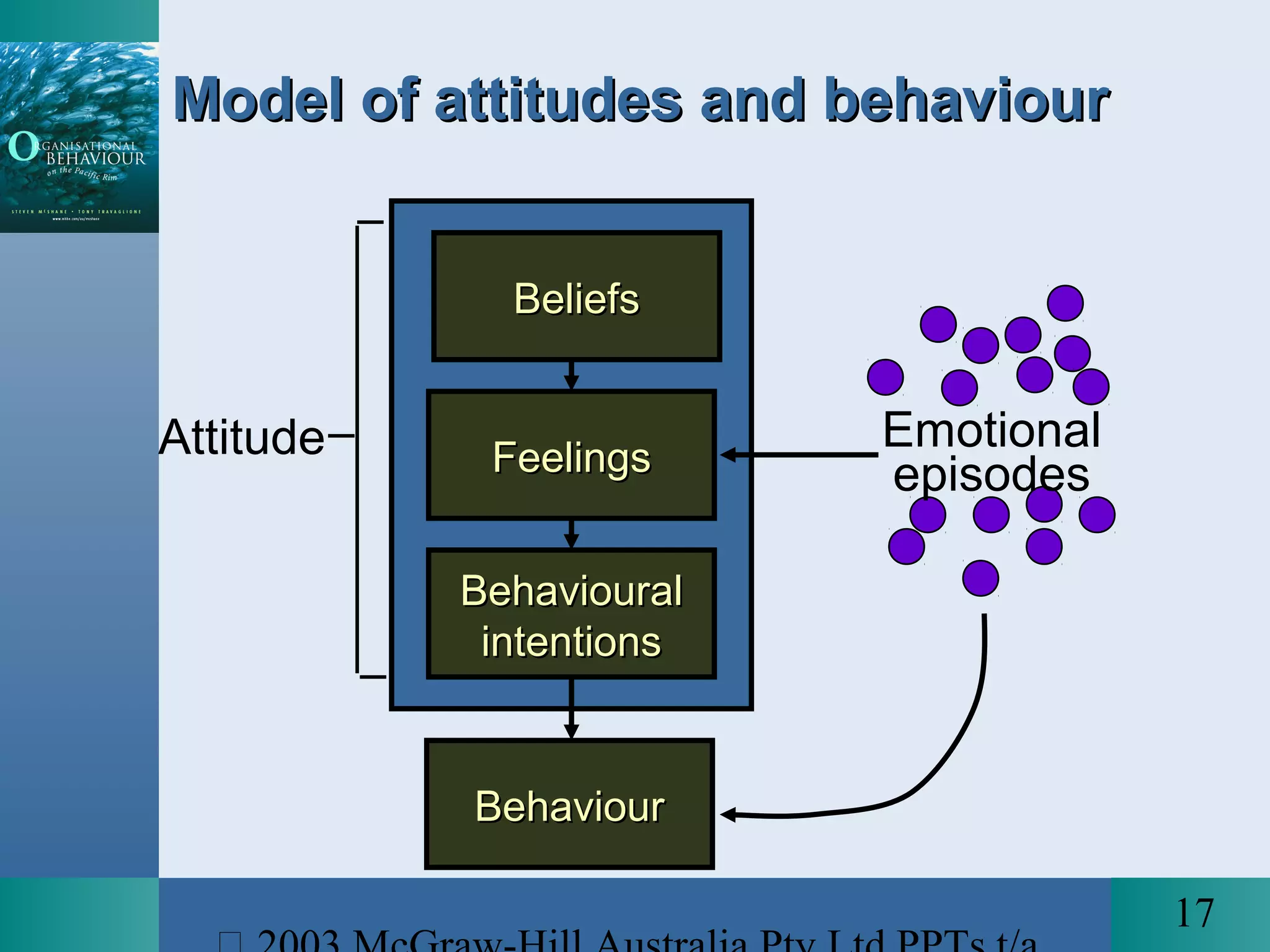
Attitude FeelingsFeelings
BeliefsBeliefs
BehaviouralBehavioural
intentionsintentions
BehaviourBehaviour
Model of attitudes and behaviourModel of attitudes and behaviour
Emotional
episodes
18
Emotional labour definedEmotional labour defined
The effort, planning and control needed to express
organisationally desired emotions during
interpersonal transactions
19
Emotional labour issuesEmotional labour issues
 True emotions leak out − especially with low
emotional adaptability
 Emotional dissonance causes stress
 Display norms vary across cultures
20
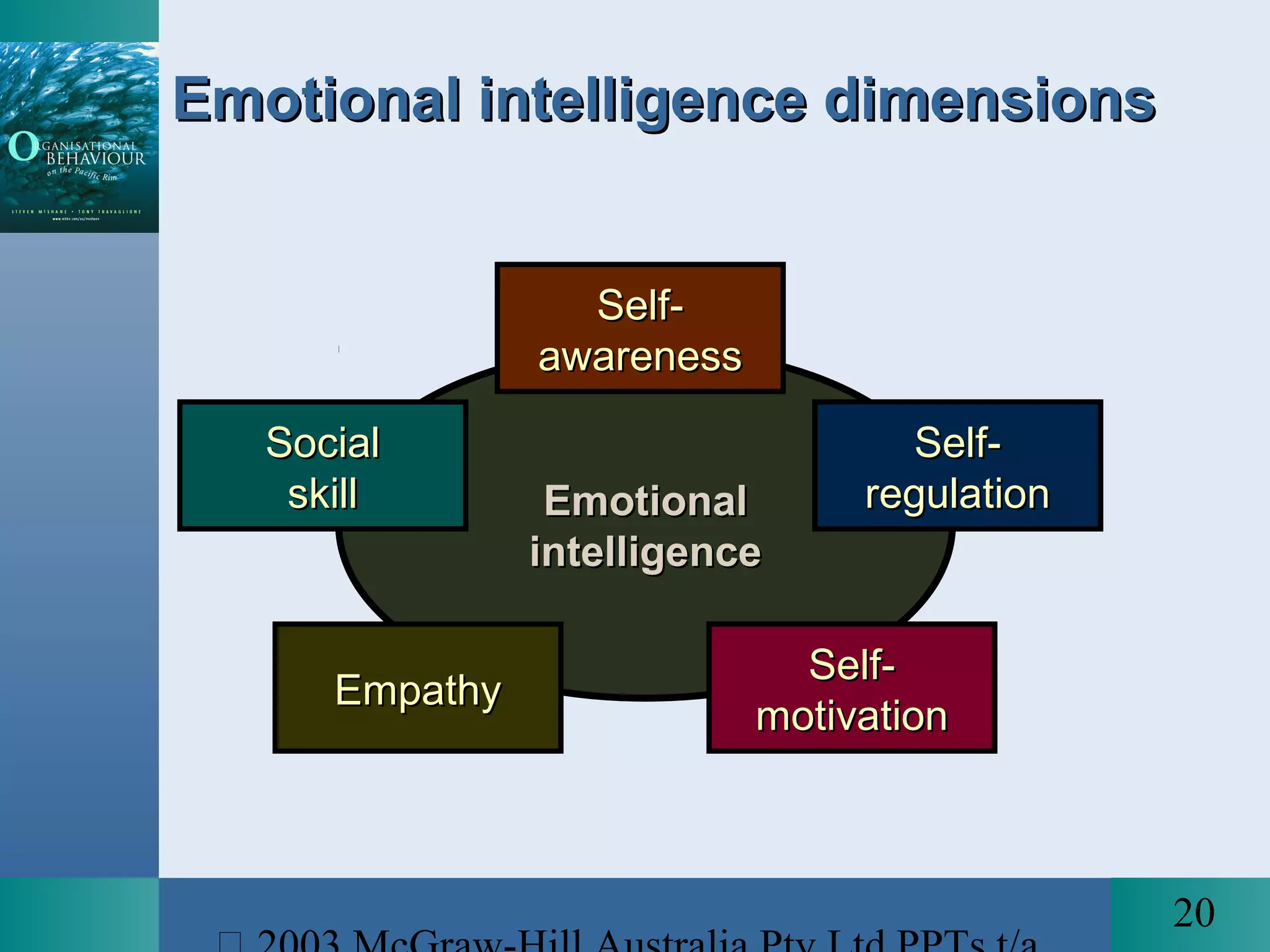
EmotionalEmotional
intelligenceintelligence
Self-Self-
awarenessawareness
Self-Self-
regulationregulation
Self-Self-
motivationmotivation
SocialSocial
skillskill
EmpathyEmpathy
Emotional intelligence dimensionsEmotional intelligence dimensions
21
Job satisfaction and behaviourJob satisfaction and behaviour
 Job satisfaction reduces turnover, absenteeism,
theft
 Weak association with job performance because
 general attitude is a poor predictor of specific
behaviours
 performance affects satisfaction through
rewards
22
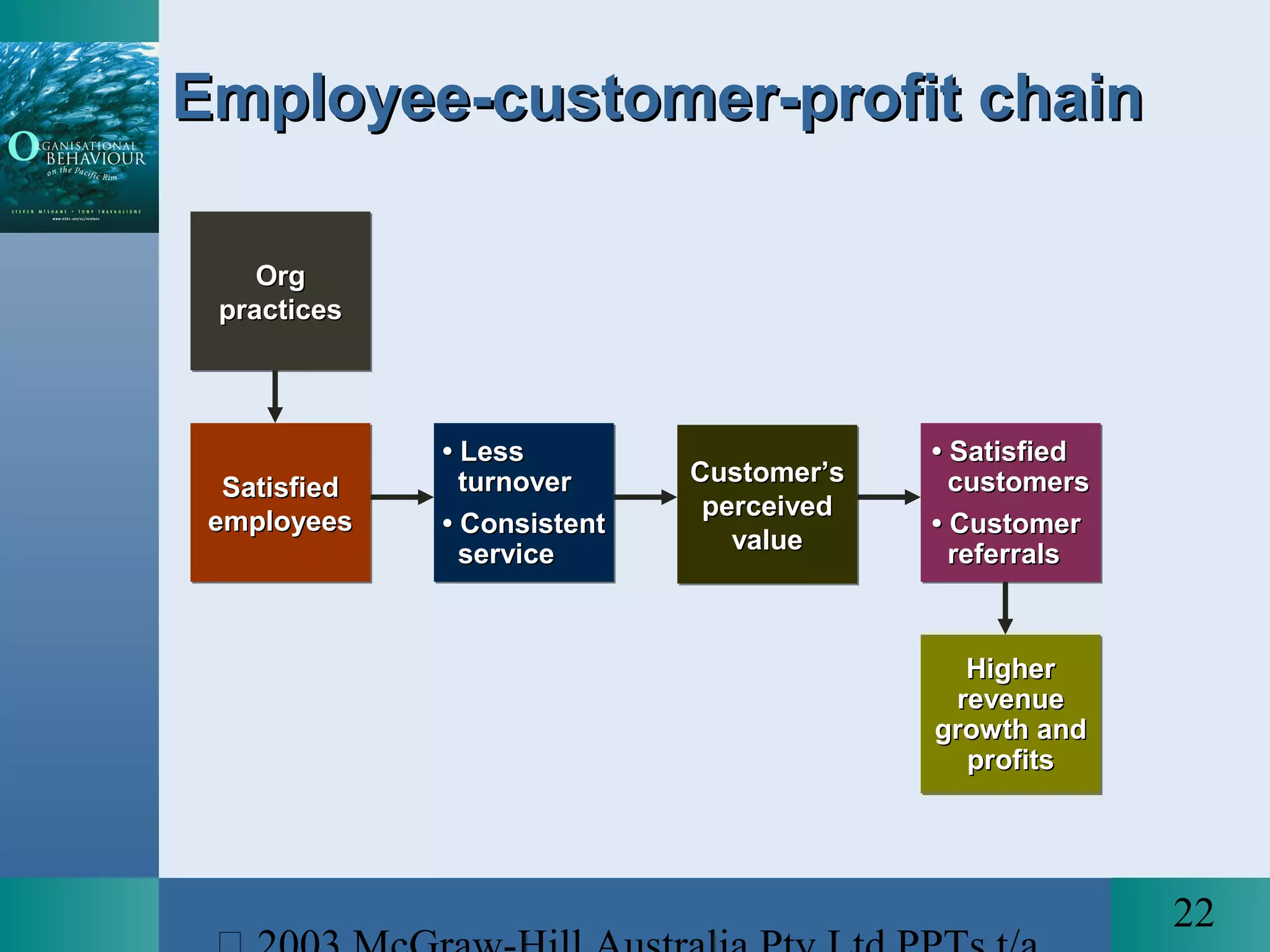
Employee-customer-profit chainEmployee-customer-profit chain
OrgOrg
practicespractices
OrgOrg
practicespractices
SatisfiedSatisfied
employeesemployees
SatisfiedSatisfied
employeesemployees
•• LessLess
turnoverturnover
•• ConsistentConsistent
serviceservice
•• LessLess
turnoverturnover
•• ConsistentConsistent
serviceservice
Customer’sCustomer’s
perceivedperceived
valuevalue
Customer’sCustomer’s
perceivedperceived
valuevalue
•• SatisfiedSatisfied
customerscustomers
•• CustomerCustomer
referralsreferrals
•• SatisfiedSatisfied
customerscustomers
•• CustomerCustomer
referralsreferrals
HigherHigher
revenuerevenue
growth andgrowth and
profitsprofits
HigherHigher
revenuerevenue
growth andgrowth and
profitsprofits
23
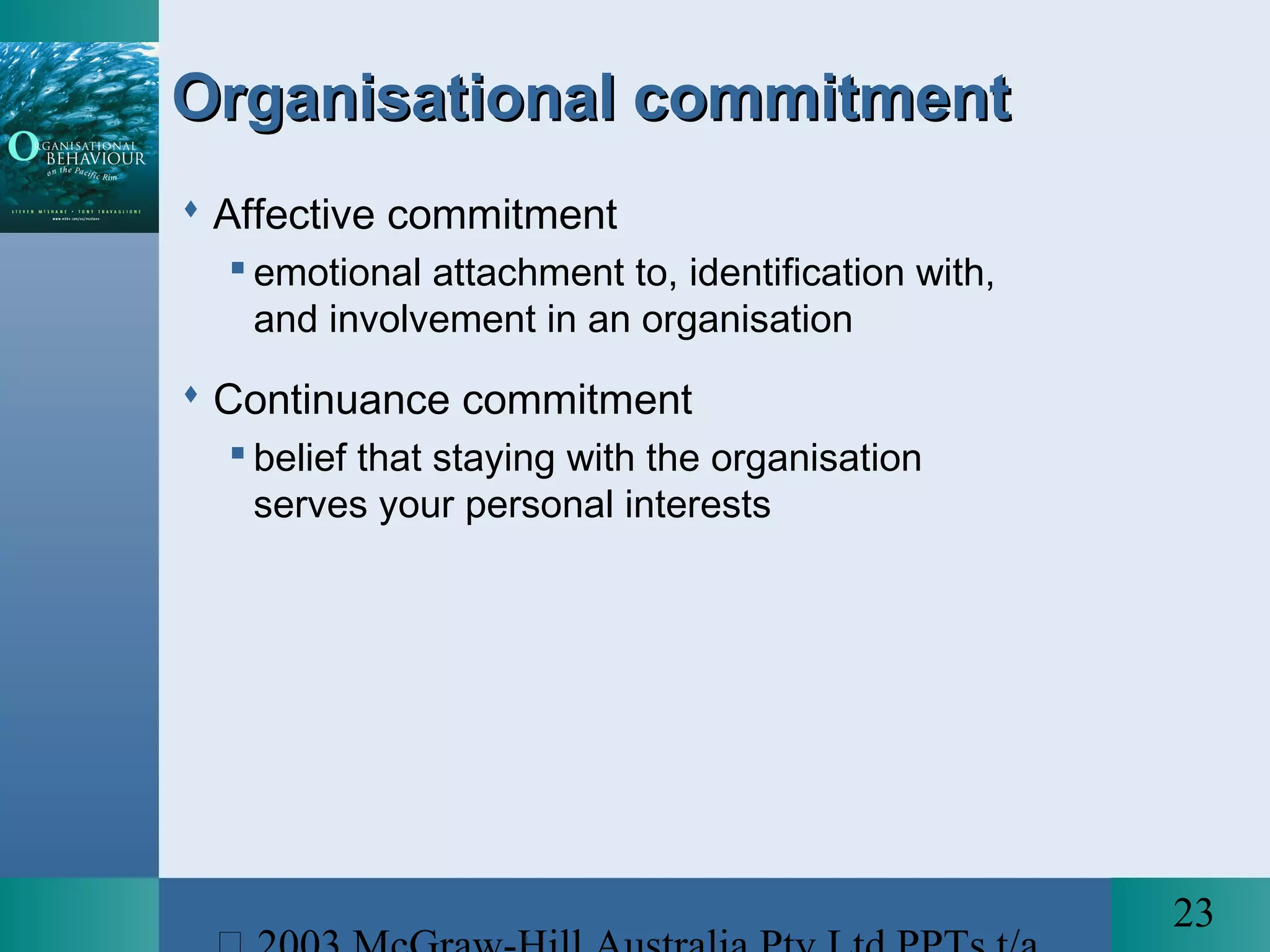
Organisational commitmentOrganisational commitment
 Affective commitment
 emotional attachment to, identification with,
and involvement in an organisation
 Continuance commitment
 belief that staying with the organisation
serves your personal interests
24
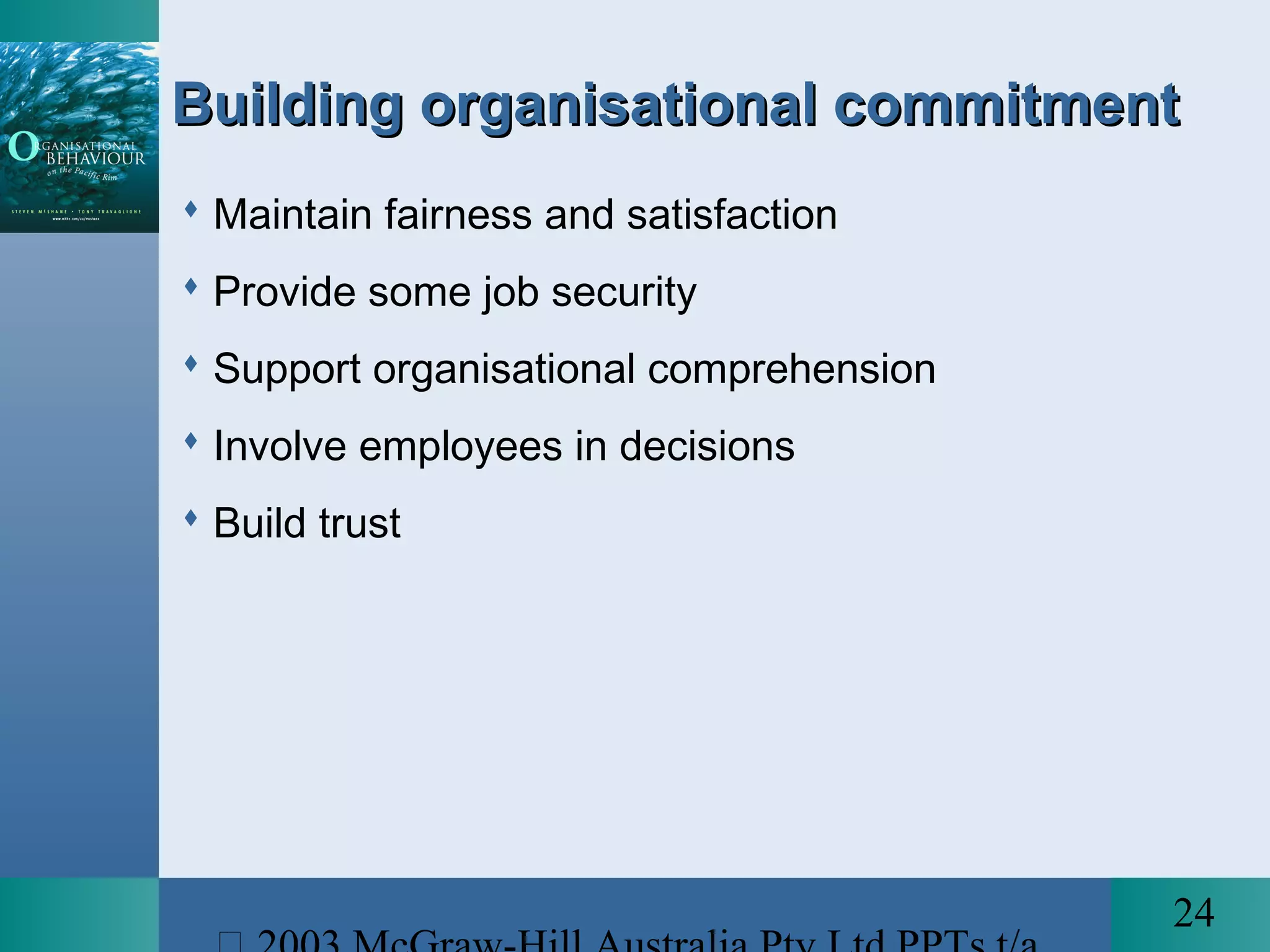
Building organisational commitmentBuilding organisational commitment
 Maintain fairness and satisfaction
 Provide some job security
 Support organisational comprehension
 Involve employees in decisions
 Build trust
25
Overview of the next chapterOverview of the next chapter
 Four content theories of motivation
 Practical implications of content motivation theories
 Expectancy theory and its implications
 Equity theory
 Characteristics of effective goal setting
© 2003 McGraw-Hill Australia Pty Ltd PPTs t/a Organisational Behaviour on the Pacific Rim by McShane and Travaglione
C H A P T E RC H A P T E R 44
WorkplaceWorkplace
values, ethicsvalues, ethics
and emotionsand emotions

Organizational Behavior CH 04

  • 1.
    © 2003 McGraw-HillAustralia Pty Ltd PPTs t/a Organisational Behaviour on the Pacific Rim by McShane and Travaglione C H A P T E RC H A P T E R 44 WorkplaceWorkplace values, ethicsvalues, ethics and emotionsand emotions
  • 2.
    2 Chapter learning objectivesChapterlearning objectives 1. Identify the different types and levels of values. 2. Define the five main values that vary across cultures. 3. Describe three ethical principles and other factors influencing ethical behaviour. 4. Explain how moral intensity, ethical sensitivity and the situation influence ethical behaviour. 5. Discuss the linkages between emotions and behaviour. 6. Identify the conditions that require, and the problems with, emotional labour. 7. Outline the dimensions of emotional intelligence. 8. Discuss the effect of job satisfaction on task performance and customer service. 9. Describe five strategies to increase organisational commitment.
  • 3.
    3 Courtesy of TheWarehouse Values and ethics at The WarehouseValues and ethics at The Warehouse The Warehouse in New Zealand is one of the world’s top discount retailers because of its social responsibility practices and ‘people first’ values.
  • 4.
    4 Courtesy of TheWarehouse Values definedValues defined  Stable, long-lasting beliefs about what is important  Define right or wrong, good or bad  Include cross-cultural, ethical and organisational culture values
  • 5.
    5 Forms of workplacevaluesForms of workplace values  Terminal versus instrumental  terminal are desired states of existence  instrumental are desirable modes of behaviour  Espoused versus enacted  espoused are values we want others to believe we hold  enacted are values-in-use; what we actually practice
  • 6.
    6 Importance of valuesat workImportance of values at work  Globalisation  increasing awareness of, and sensitivity to, different values across cultures  Replacing direct supervision  potentially aligns employees’ decisions and actions with corporate goals  Demand for ethical practices  increasing pressure to engage in ethical practices
  • 7.
    7 Values alignment atWoodsideValues alignment at Woodside Woodside Petroleum Ltd is aligning its corporate values more closely with the personal values of its employees. Courtesy of Woodside Petroleum
  • 8.
    8 Collectivists tend to identify themselves by group membership  give priority to group goals  put more emphasis on harmonious relationships  have more socially-based emotions (indebtedness) Japan NZ Australia Collectivism Individualism Indonesia IndividualismIndividualism−−collectivismcollectivism
  • 9.
    9 The degree towhich people accept an unequal distribution of power in society Japan N.Z. Australia Hong Kong High power distance Malaysia Low power distance Power distancePower distance
  • 10.
    10 High UA Low UA SAfrica China Singapore The degree to which people tolerate ambiguity (low UA) or feel threatened by ambiguity and uncertainty (high UA) Uncertainty avoidanceUncertainty avoidance Australia
  • 11.
    11 Japan S. Korea Achievement Nurturing N.Z. The degreeto which people value assertiveness, competitiveness and materialism (achievement) versus relationships and well-being of others (nurturing) AchievementAchievement−−nurturingnurturing Australia
  • 12.
    12 Japan Indonesia Long-term orientation Short-term orientation China Thedegree to which people value thrift, savings and persistence (long-term) versus past and present issues (short-term) Long/short-term orientationLong/short-term orientation Australia
  • 13.
    13 Ethics at AMPInsuranceEthics at AMP Insurance AMP Insurance in Wellington, New Zealand is showing its ethical values and social responsibility by supporting community events, such as this shave-a- thon to raise funds for the Leukaemia and Blood Foundation. © J. Nicholson, Evening Post (Wellington)
  • 14.
    14 Three ethical principlesThreeethical principles  Utilitarianism  greatest good for greatest number  Individual rights  fundamental entitlements in society  Distributive justice  inequality with equal access to favoured positions  inequality must benefit the least well off
  • 15.
    15 Influences on ethicalconductInfluences on ethical conduct  Moral intensity  degree to which an issue demands ethical principles  Ethical sensitivity  ability to recognise the presence, and determine the relative importance, of an ethical issue  Situational influences  competitive pressures and other conditions affect ethical behaviour
  • 16.
    16 Emotions definedEmotions defined Feelingsexperienced towards an object, person or event that create a state of readiness  emotions demand attention and interrupt our train of thought  emotions are directed toward something
  • 17.
  • 18.
    18 Emotional labour definedEmotionallabour defined The effort, planning and control needed to express organisationally desired emotions during interpersonal transactions
  • 19.
    19 Emotional labour issuesEmotionallabour issues  True emotions leak out − especially with low emotional adaptability  Emotional dissonance causes stress  Display norms vary across cultures
  • 20.
  • 21.
    21 Job satisfaction andbehaviourJob satisfaction and behaviour  Job satisfaction reduces turnover, absenteeism, theft  Weak association with job performance because  general attitude is a poor predictor of specific behaviours  performance affects satisfaction through rewards
  • 22.
    22 Employee-customer-profit chainEmployee-customer-profit chain OrgOrg practicespractices OrgOrg practicespractices SatisfiedSatisfied employeesemployees SatisfiedSatisfied employeesemployees ••LessLess turnoverturnover •• ConsistentConsistent serviceservice •• LessLess turnoverturnover •• ConsistentConsistent serviceservice Customer’sCustomer’s perceivedperceived valuevalue Customer’sCustomer’s perceivedperceived valuevalue •• SatisfiedSatisfied customerscustomers •• CustomerCustomer referralsreferrals •• SatisfiedSatisfied customerscustomers •• CustomerCustomer referralsreferrals HigherHigher revenuerevenue growth andgrowth and profitsprofits HigherHigher revenuerevenue growth andgrowth and profitsprofits
  • 23.
    23 Organisational commitmentOrganisational commitment Affective commitment  emotional attachment to, identification with, and involvement in an organisation  Continuance commitment  belief that staying with the organisation serves your personal interests
  • 24.
    24 Building organisational commitmentBuildingorganisational commitment  Maintain fairness and satisfaction  Provide some job security  Support organisational comprehension  Involve employees in decisions  Build trust
  • 25.
    25 Overview of thenext chapterOverview of the next chapter  Four content theories of motivation  Practical implications of content motivation theories  Expectancy theory and its implications  Equity theory  Characteristics of effective goal setting
  • 26.
    © 2003 McGraw-HillAustralia Pty Ltd PPTs t/a Organisational Behaviour on the Pacific Rim by McShane and Travaglione C H A P T E RC H A P T E R 44 WorkplaceWorkplace values, ethicsvalues, ethics and emotionsand emotions

Editor's Notes

  • #4 <number>
  • #5 <number>
  • #6 <number>
  • #7 <number>
  • #18 <number>