

Individual Behavior,
Personality, and Values
HHUMBEHV
Organizational Behavior Chapter 2 by McShane and Von Glinow
Presented by: Mervyn Maico Aldana, SHTM Faculty
Individual Behavior and Performance
 For years now, experts have investigated the direct predictors of individual
behavior and performance.
 One of the earliest formulas was Performance = Person x Situation
(where person includes individual characteristics and situation represents
external influences on the individual’s behavior)
 Another is Performance = Ability x Motivation, also known as the skill-
and-will model. It elaborates two specific characteristics within the person
that influence individual performance - ability and motivation.
 Ability, motivation, and situation are by far the most commonly mentioned
direct predictors of individual behavior and performance, but in the 1960s
researchers have identified a fourth key factor – role perceptions.
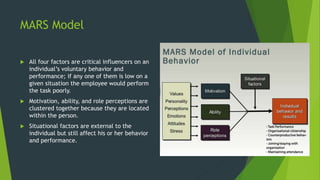
MARS Model
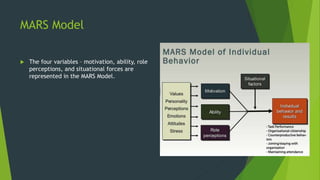
 The four variables – motivation, ability, role
perceptions, and situational forces are
represented in the MARS Model.
MARS Model
 All four factors are critical influencers on an
individual’s voluntary behavior and
performance; if any one of them is low on a
given situation the employee would perform
the task poorly.
 Motivation, ability, and role perceptions are
clustered together because they are located
within the person.
 Situational factors are external to the
individual but still affect his or her behavior
and performance.
Employee Motivation
 Motivation represents forces within a person that affect his or her
direction, intensity, and persistence that affect his or her voluntary
behavior.
 Direction refers to the path along which people steer their effort; they have a
sense of what they are trying to achieve and at what level of quality, quantity,
and so forth. In other words, motivation is goal directed, and not random.
 Intensity is the amount of effort allocated to the goal. Intensity is all about
how much people push themselves to complete a task.
 Persistence is continuing the effort for a certain amount of time, employees
sustain their effort until they reach their goal or give up beforehand.
 Motivation is a force within individuals; it is not their actual behavior.
Abilities
 Ability includes both the natural aptitudes and the learned
capabilities required to successfully complete a task.
 Aptitudes are the natural talents that help employees learn
specific tasks more quickly and perform them better. There are
many physical and mental aptitudes and they affect our ability to
acquire skills.
 Learned capabilities are the skills and knowledge you currently
possess. These capabilities include the physical and mental skills
and knowledge you have acquired. Learned capabilities tend to
wane over time when not in use.
Abilities
 Competencies are closely related to aptitudes and learned
capabilities.
 Competencies are a person’s characteristics that result in superior
performance. These characteristics include knowledge, skills,
aptitudes, and behaviors.
 Some studies have attempted to identify a list of core
competencies for performance in all jobs.
 The challenge is to match a person’s competencies with the job’s
competency requirements. A good person-job match not only
produces higher performance; it also tends to increase the
employee’s well-being.
Role Perceptions
 Motivation and ability are important influences on individual
behavior and performance, but employees also require
accurate role perceptions to perform their jobs well.
 Role perceptions refer to how clearly people understand the
job duties assigned to them or expected of them.
 These perceptions are critical because they guide the
employee’s direction of effort and improve coordination with
coworkers, suppliers, and other stakeholders.
 Employees with clearer role perceptions also tend to have
higher motivation.
Role Perceptions
 Role clarity exist in three forms:
 First, employees have clear role perceptions when they understand the
specific tasks assigned to them, when they know the specific duties and
consequences for which they are accountable.
 Second is how well employees understand the priority of their various tasks
and performance expectations.
 Third is understanding the preferred behaviors or procedures for
accomplishing the assigned tasks.
Situational Factors
 Employees’ behavior and performance also depend on the situation.
 Conditions that are beyond the employee’s immediate control that constrain
or facilitate behavior and performance.
 Example – lack time, budget, physical work facilities, and other situational
conditions.
Types of Individual Behavior
Task Performance
 Task performance refers to goal-directed behaviors
under the individual’s control that support
organizational objectives.
 Task performance behaviors transform raw
materials into goods and services or support and
maintain these technical activities.
 Tasks involve working with data, people, or things,
working alone, or with people; and degrees of
influencing others.
Organizational Citizenship
 Organizational Citizenship Behaviors (OCBs) – various forms
of cooperation and helpfulness to others that support the
organization’s social and psychological context.
 In other words, companies excel when employees go the
“extra mile” beyond the required duties.
 Examples – assisting coworkers with their work problems,
adjusting your work schedule to accommodate coworkers,
showing genuine courtesy towards coworkers, and sharing
your work resources with coworkers, cooperation and
helpfulness toward the organization such as supporting the
company’s public image, taking discretionary action to help
the organization avoid potential problems offering ideas
beyond those required for your own job, attending volunteer
functions, and keeping up with new developments in the
organization.
Counterproductive Work Behaviors
 Counterproductive Work Behaviors (CWBs) are
voluntary behaviors that have the potential to
directly or indirectly harm the organization.
 Examples – harassing coworkers, creating
unnecessary conflict, deviating from preferred
work methods, being untruthful, stealing,
sabotaging work, avoiding work obligation
(tardiness) and wasting resources.
Joining and Staying with the
Organization
 Hiring and retaining talent is a critical requirement in the organization’s
survival and success.
 Even when companies are able to hire qualified staff in the face of shortages,
they need to ensure that these employees stay with the company.
 Companies with high turnover suffer because of the high cost of replacing
people who leave. More important, much of an organization’s intellectual
capital is the knowledge carried around in employee’s heads.
 When people leave, some of this vital knowledge is lost often resulting in
lower productivity, poorer customer service, and so forth.
 Some employers attract job applicants and minimize turnover by nurturing an
enjoyable work environment.
Maintaining Work Attendance
 Along with attracting and retaining employees, organizations need everyone
to show up for work at scheduled times.
 Most employees blame the situation for their absenteeism, such as the bad
weather, transit strike, and family demands. However, some people still show
up for work because they have a strong motivation to be there, whereas
others take sick leave when they are not genuinely unwell.
 Employees who experience job dissatisfaction or work-related stress are more
likely to be absent or late for work because taking time off is a way of
temporarily withdrawing from stressful or dissatisfying conditions.
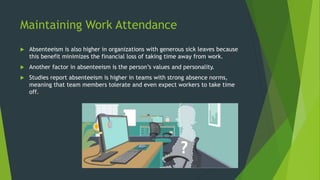
Maintaining Work Attendance
 Absenteeism is also higher in organizations with generous sick leaves because
this benefit minimizes the financial loss of taking time away from work.
 Another factor in absenteeism is the person’s values and personality.
 Studies report absenteeism is higher in teams with strong absence norms,
meaning that team members tolerate and even expect workers to take time
off.
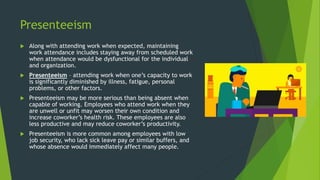
Presenteeism
 Along with attending work when expected, maintaining
work attendance includes staying away from scheduled work
when attendance would be dysfunctional for the individual
and organization.
 Presenteeism – attending work when one’s capacity to work
is significantly diminished by illness, fatigue, personal
problems, or other factors.
 Presenteeism may be more serious than being absent when
capable of working. Employees who attend work when they
are unwell or unfit may worsen their own condition and
increase coworker’s health risk. These employees are also
less productive and may reduce coworker’s productivity.
 Presenteeism is more common among employees with low
job security, who lack sick leave pay or similar buffers, and
whose absence would immediately affect many people.
Personality in Organizations
Personality
 Personality is an important individual characteristic, which explains why
several companies try to estimate the personality traits of job applicants and
employees.
 Personality is the relatively enduring pattern of thoughts, emotions, and
behavior that characterize a person, along with the psychological processes
behind those characteristics.
 It is in essence, the bundle of characteristics that make us similar to or
different from other people.
Personality Determinants: Nature or
Nurture
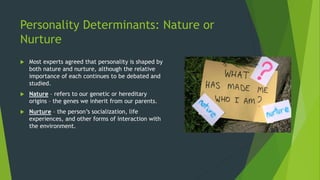
 Most experts agreed that personality is shaped by
both nature and nurture, although the relative
importance of each continues to be debated and
studied.
 Nature – refers to our genetic or hereditary
origins – the genes we inherit from our parents.
 Nurture – the person’s socialization, life
experiences, and other forms of interaction with
the environment.
Five-Factor Model of Personality
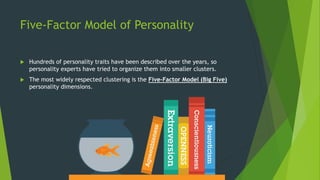
 Hundreds of personality traits have been described over the years, so
personality experts have tried to organize them into smaller clusters.
 The most widely respected clustering is the Five-Factor Model (Big Five)
personality dimensions.
Five-Factor Model of Personality
 Conscientiousness – characterizes people who are organized, dependable,
goal-focused, thorough, disciplined, methodical, and industrious.
 People with low conscientiousness tend to be careless, less thorough, disorganized,
and irresponsible.
 Agreeableness – traits of being trusting, helpful, good-natured, considerate,
tolerant, selfless, generous, and flexible.
 People with low agreeableness tend to be uncooperative, and intolerant of others’
needs as well as more suspicious and self-focused.
 Neuroticism – people who tend to be anxious, insecure, self-conscious,
depressed, and temperamental.
 In contrast, people with low neuroticism are poised, secure and calm.
Five-Factor Model of Personality
 Openness to Experience – refers to the extent in which people are
imaginative, creative, unconventional, curious, nonconforming, autonomous,
and aesthetically perceptive.
 People with low on this dimension tend to be more resistant to change, less open
to new ideas, and more conventional and fixed in their ways.
 Extraversion – people who are outgoing, talkative, energetic, sociable, and
assertive.
 Introversion – people who are quiet, cautious, and less interactive with others.
Jungian Personality Theory and the
Myers-Briggs Type Indicator
 Psychiatrist Carl Jung proposed that personality is primarily
represented by the individual’s preferences regarding perceiving and
judging information.
 Jung explained that perceiving, which involves how people prefer to
gather information or perceive the world around them, occurs through
two competing orientations: Sensing (S) and Intuition (N).
 Sensing (S) involves perceiving information directly through the five
senses; it relies on organized structure to acquire factual and preferably
quantitative details.
 Intuition (N) relies more on insight and subjective experience to see
relationships among variables.
 Sensing type focus on the here and now, whereas intuitive type focus more
on future possibilities.
Jungian Personality Theory and the
Myers-Briggs Type Indicator
 Jung also proposed that judging – how people process information or make
decisions based on what they perceived – consists of two competing
processes: Thinking (T) and Feeling (F).
 People with Thinking (T) orientation rely on rational cause-effect logic and
systematic data collection to make decisions.
 Those with strong Feeling (F) orientation, rely on their emotional responses to the
options presented, as well as how those choices affect others.
Jungian Personality Theory and the
Myers-Briggs Type Indicator (MBTI)
 Along with the four core processes of Sensing, Intuition, Thinking, and
Feeling, people also differ in their degrees of Extraversion (E) and
Introversion (I).
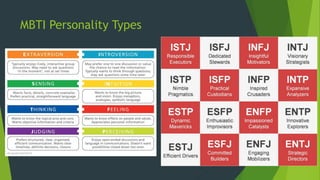
 Along with Jung’s S-N, T-F, E-I, the MBTI also measures Perceiving (P) and
Judging (J), which represents a person’s attitude toward external people.
 People with Perceiving (P) orientation are open, curious, flexible; prefer to adapt
spontaneously to events as they unfold, and they prefer to keep their options
open.
 Judging (J) types prefer order and structure and want to resolve problems quickly.
MBTI Personality Types
Jungian Personality Theory and the
Myers-Briggs Type Indicator (MBTI)
 The MBTI is one of the most widely used personality tests in work settings as
well as in career counseling and executive coaching, however, it poorly
predicts job performance and is generally not recommended for employment
selection or promotion decisions.
Personality Testing in Organizations
 Personality tests are applied for personal
development, such as career development and
team dynamics.
 Personality tests are also being incorporated into
employment selection and promotion decision
process.
Assignment
 Take a Personality Test Online.
 Print and submit next meeting.
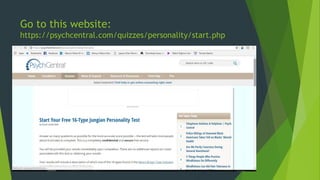
Go to this website:
https://psychcentral.com/quizzes/personality/start.php
Scroll down and answer some questions
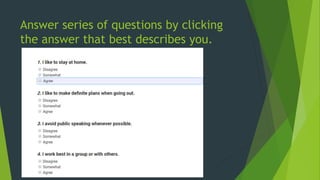
Answer series of questions by clicking
the answer that best describes you.
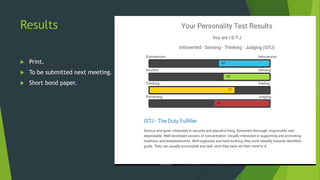
Results
 Print.
 To be submitted next meeting.
 Short bond paper.

Lesson 2 - Individual Behavior, Personality, and Values

  • 1.
    Individual Behavior, Personality, andValues HHUMBEHV Organizational Behavior Chapter 2 by McShane and Von Glinow Presented by: Mervyn Maico Aldana, SHTM Faculty
  • 2.
    Individual Behavior andPerformance  For years now, experts have investigated the direct predictors of individual behavior and performance.  One of the earliest formulas was Performance = Person x Situation (where person includes individual characteristics and situation represents external influences on the individual’s behavior)  Another is Performance = Ability x Motivation, also known as the skill- and-will model. It elaborates two specific characteristics within the person that influence individual performance - ability and motivation.  Ability, motivation, and situation are by far the most commonly mentioned direct predictors of individual behavior and performance, but in the 1960s researchers have identified a fourth key factor – role perceptions.
  • 3.
    MARS Model  Thefour variables – motivation, ability, role perceptions, and situational forces are represented in the MARS Model.
  • 4.
    MARS Model  Allfour factors are critical influencers on an individual’s voluntary behavior and performance; if any one of them is low on a given situation the employee would perform the task poorly.  Motivation, ability, and role perceptions are clustered together because they are located within the person.  Situational factors are external to the individual but still affect his or her behavior and performance.
  • 5.
    Employee Motivation  Motivationrepresents forces within a person that affect his or her direction, intensity, and persistence that affect his or her voluntary behavior.  Direction refers to the path along which people steer their effort; they have a sense of what they are trying to achieve and at what level of quality, quantity, and so forth. In other words, motivation is goal directed, and not random.  Intensity is the amount of effort allocated to the goal. Intensity is all about how much people push themselves to complete a task.  Persistence is continuing the effort for a certain amount of time, employees sustain their effort until they reach their goal or give up beforehand.  Motivation is a force within individuals; it is not their actual behavior.
  • 6.
    Abilities  Ability includesboth the natural aptitudes and the learned capabilities required to successfully complete a task.  Aptitudes are the natural talents that help employees learn specific tasks more quickly and perform them better. There are many physical and mental aptitudes and they affect our ability to acquire skills.  Learned capabilities are the skills and knowledge you currently possess. These capabilities include the physical and mental skills and knowledge you have acquired. Learned capabilities tend to wane over time when not in use.
  • 7.
    Abilities  Competencies areclosely related to aptitudes and learned capabilities.  Competencies are a person’s characteristics that result in superior performance. These characteristics include knowledge, skills, aptitudes, and behaviors.  Some studies have attempted to identify a list of core competencies for performance in all jobs.  The challenge is to match a person’s competencies with the job’s competency requirements. A good person-job match not only produces higher performance; it also tends to increase the employee’s well-being.
  • 8.
    Role Perceptions  Motivationand ability are important influences on individual behavior and performance, but employees also require accurate role perceptions to perform their jobs well.  Role perceptions refer to how clearly people understand the job duties assigned to them or expected of them.  These perceptions are critical because they guide the employee’s direction of effort and improve coordination with coworkers, suppliers, and other stakeholders.  Employees with clearer role perceptions also tend to have higher motivation.
  • 9.
    Role Perceptions  Roleclarity exist in three forms:  First, employees have clear role perceptions when they understand the specific tasks assigned to them, when they know the specific duties and consequences for which they are accountable.  Second is how well employees understand the priority of their various tasks and performance expectations.  Third is understanding the preferred behaviors or procedures for accomplishing the assigned tasks.
  • 10.
    Situational Factors  Employees’behavior and performance also depend on the situation.  Conditions that are beyond the employee’s immediate control that constrain or facilitate behavior and performance.  Example – lack time, budget, physical work facilities, and other situational conditions.
  • 11.
  • 12.
    Task Performance  Taskperformance refers to goal-directed behaviors under the individual’s control that support organizational objectives.  Task performance behaviors transform raw materials into goods and services or support and maintain these technical activities.  Tasks involve working with data, people, or things, working alone, or with people; and degrees of influencing others.
  • 13.
    Organizational Citizenship  OrganizationalCitizenship Behaviors (OCBs) – various forms of cooperation and helpfulness to others that support the organization’s social and psychological context.  In other words, companies excel when employees go the “extra mile” beyond the required duties.  Examples – assisting coworkers with their work problems, adjusting your work schedule to accommodate coworkers, showing genuine courtesy towards coworkers, and sharing your work resources with coworkers, cooperation and helpfulness toward the organization such as supporting the company’s public image, taking discretionary action to help the organization avoid potential problems offering ideas beyond those required for your own job, attending volunteer functions, and keeping up with new developments in the organization.
  • 14.
    Counterproductive Work Behaviors Counterproductive Work Behaviors (CWBs) are voluntary behaviors that have the potential to directly or indirectly harm the organization.  Examples – harassing coworkers, creating unnecessary conflict, deviating from preferred work methods, being untruthful, stealing, sabotaging work, avoiding work obligation (tardiness) and wasting resources.
  • 15.
    Joining and Stayingwith the Organization  Hiring and retaining talent is a critical requirement in the organization’s survival and success.  Even when companies are able to hire qualified staff in the face of shortages, they need to ensure that these employees stay with the company.  Companies with high turnover suffer because of the high cost of replacing people who leave. More important, much of an organization’s intellectual capital is the knowledge carried around in employee’s heads.  When people leave, some of this vital knowledge is lost often resulting in lower productivity, poorer customer service, and so forth.  Some employers attract job applicants and minimize turnover by nurturing an enjoyable work environment.
  • 16.
    Maintaining Work Attendance Along with attracting and retaining employees, organizations need everyone to show up for work at scheduled times.  Most employees blame the situation for their absenteeism, such as the bad weather, transit strike, and family demands. However, some people still show up for work because they have a strong motivation to be there, whereas others take sick leave when they are not genuinely unwell.  Employees who experience job dissatisfaction or work-related stress are more likely to be absent or late for work because taking time off is a way of temporarily withdrawing from stressful or dissatisfying conditions.
  • 17.
    Maintaining Work Attendance Absenteeism is also higher in organizations with generous sick leaves because this benefit minimizes the financial loss of taking time away from work.  Another factor in absenteeism is the person’s values and personality.  Studies report absenteeism is higher in teams with strong absence norms, meaning that team members tolerate and even expect workers to take time off.
  • 18.
    Presenteeism  Along withattending work when expected, maintaining work attendance includes staying away from scheduled work when attendance would be dysfunctional for the individual and organization.  Presenteeism – attending work when one’s capacity to work is significantly diminished by illness, fatigue, personal problems, or other factors.  Presenteeism may be more serious than being absent when capable of working. Employees who attend work when they are unwell or unfit may worsen their own condition and increase coworker’s health risk. These employees are also less productive and may reduce coworker’s productivity.  Presenteeism is more common among employees with low job security, who lack sick leave pay or similar buffers, and whose absence would immediately affect many people.
  • 19.
  • 20.
    Personality  Personality isan important individual characteristic, which explains why several companies try to estimate the personality traits of job applicants and employees.  Personality is the relatively enduring pattern of thoughts, emotions, and behavior that characterize a person, along with the psychological processes behind those characteristics.  It is in essence, the bundle of characteristics that make us similar to or different from other people.
  • 21.
    Personality Determinants: Natureor Nurture  Most experts agreed that personality is shaped by both nature and nurture, although the relative importance of each continues to be debated and studied.  Nature – refers to our genetic or hereditary origins – the genes we inherit from our parents.  Nurture – the person’s socialization, life experiences, and other forms of interaction with the environment.
  • 22.
    Five-Factor Model ofPersonality  Hundreds of personality traits have been described over the years, so personality experts have tried to organize them into smaller clusters.  The most widely respected clustering is the Five-Factor Model (Big Five) personality dimensions.
  • 23.
    Five-Factor Model ofPersonality  Conscientiousness – characterizes people who are organized, dependable, goal-focused, thorough, disciplined, methodical, and industrious.  People with low conscientiousness tend to be careless, less thorough, disorganized, and irresponsible.  Agreeableness – traits of being trusting, helpful, good-natured, considerate, tolerant, selfless, generous, and flexible.  People with low agreeableness tend to be uncooperative, and intolerant of others’ needs as well as more suspicious and self-focused.  Neuroticism – people who tend to be anxious, insecure, self-conscious, depressed, and temperamental.  In contrast, people with low neuroticism are poised, secure and calm.
  • 24.
    Five-Factor Model ofPersonality  Openness to Experience – refers to the extent in which people are imaginative, creative, unconventional, curious, nonconforming, autonomous, and aesthetically perceptive.  People with low on this dimension tend to be more resistant to change, less open to new ideas, and more conventional and fixed in their ways.  Extraversion – people who are outgoing, talkative, energetic, sociable, and assertive.  Introversion – people who are quiet, cautious, and less interactive with others.
  • 25.
    Jungian Personality Theoryand the Myers-Briggs Type Indicator  Psychiatrist Carl Jung proposed that personality is primarily represented by the individual’s preferences regarding perceiving and judging information.  Jung explained that perceiving, which involves how people prefer to gather information or perceive the world around them, occurs through two competing orientations: Sensing (S) and Intuition (N).  Sensing (S) involves perceiving information directly through the five senses; it relies on organized structure to acquire factual and preferably quantitative details.  Intuition (N) relies more on insight and subjective experience to see relationships among variables.  Sensing type focus on the here and now, whereas intuitive type focus more on future possibilities.
  • 26.
    Jungian Personality Theoryand the Myers-Briggs Type Indicator  Jung also proposed that judging – how people process information or make decisions based on what they perceived – consists of two competing processes: Thinking (T) and Feeling (F).  People with Thinking (T) orientation rely on rational cause-effect logic and systematic data collection to make decisions.  Those with strong Feeling (F) orientation, rely on their emotional responses to the options presented, as well as how those choices affect others.
  • 27.
    Jungian Personality Theoryand the Myers-Briggs Type Indicator (MBTI)  Along with the four core processes of Sensing, Intuition, Thinking, and Feeling, people also differ in their degrees of Extraversion (E) and Introversion (I).  Along with Jung’s S-N, T-F, E-I, the MBTI also measures Perceiving (P) and Judging (J), which represents a person’s attitude toward external people.  People with Perceiving (P) orientation are open, curious, flexible; prefer to adapt spontaneously to events as they unfold, and they prefer to keep their options open.  Judging (J) types prefer order and structure and want to resolve problems quickly.
  • 28.
  • 29.
    Jungian Personality Theoryand the Myers-Briggs Type Indicator (MBTI)  The MBTI is one of the most widely used personality tests in work settings as well as in career counseling and executive coaching, however, it poorly predicts job performance and is generally not recommended for employment selection or promotion decisions.
  • 30.
    Personality Testing inOrganizations  Personality tests are applied for personal development, such as career development and team dynamics.  Personality tests are also being incorporated into employment selection and promotion decision process.
  • 31.
    Assignment  Take aPersonality Test Online.  Print and submit next meeting.
  • 32.
    Go to thiswebsite: https://psychcentral.com/quizzes/personality/start.php
  • 33.
    Scroll down andanswer some questions
  • 34.
    Answer series ofquestions by clicking the answer that best describes you.
  • 35.
    Results  Print.  Tobe submitted next meeting.  Short bond paper.