© 2003 McGraw-Hill Australia Pty Ltd PPTs t/a Organisational Behaviour on the Pacific Rim by McShane and Travaglione
C H A P T E RC H A P T E R 66
AppliedApplied
motivationmotivation
practicespractices
2
Chapter learning objectivesChapter learning objectives
1. Explain how money and other financial rewards affect our
needs and emotions.
2. Discuss the advantages and disadvantages of the four types
of rewards.
3. Identify four commonly applied team or organisational-level
performance-based rewards.
4. Describe five ways to improve reward effectiveness.
5. Discuss the advantages and disadvantages of job
specialisation.
6. Diagram the job characteristics model of job design.
7. Identify three strategies to enrich jobs.
8. Describe the five elements of self-leadership.
9. Explain how mental imagery improves employee motivation.
3
Rewarding employees at IKEARewarding employees at IKEA
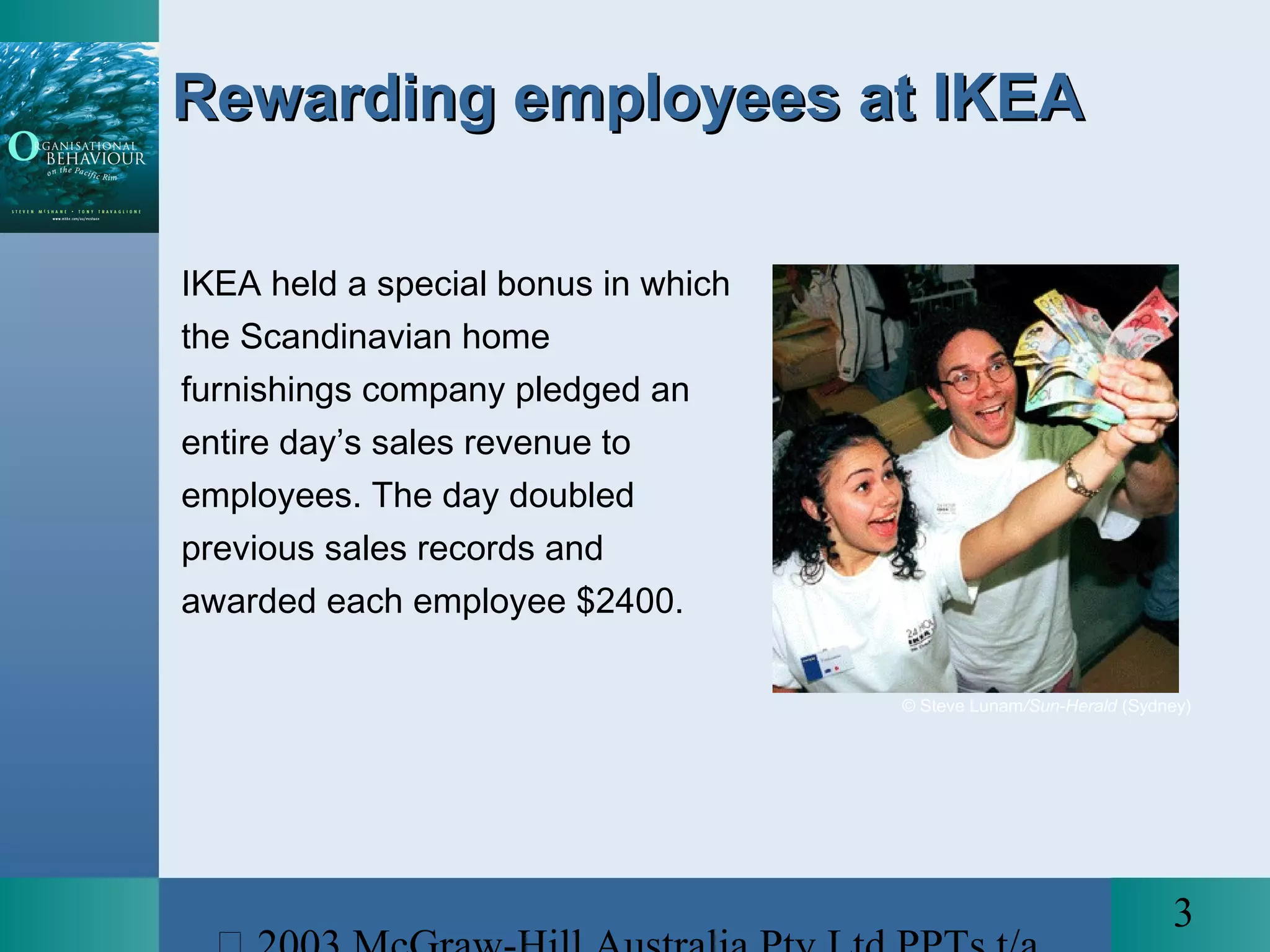
IKEA held a special bonus in which
the Scandinavian home
furnishings company pledged an
entire day’s sales revenue to
employees. The day doubled
previous sales records and
awarded each employee $2400.
© Steve Lunam/Sun-Herald (Sydney)
4
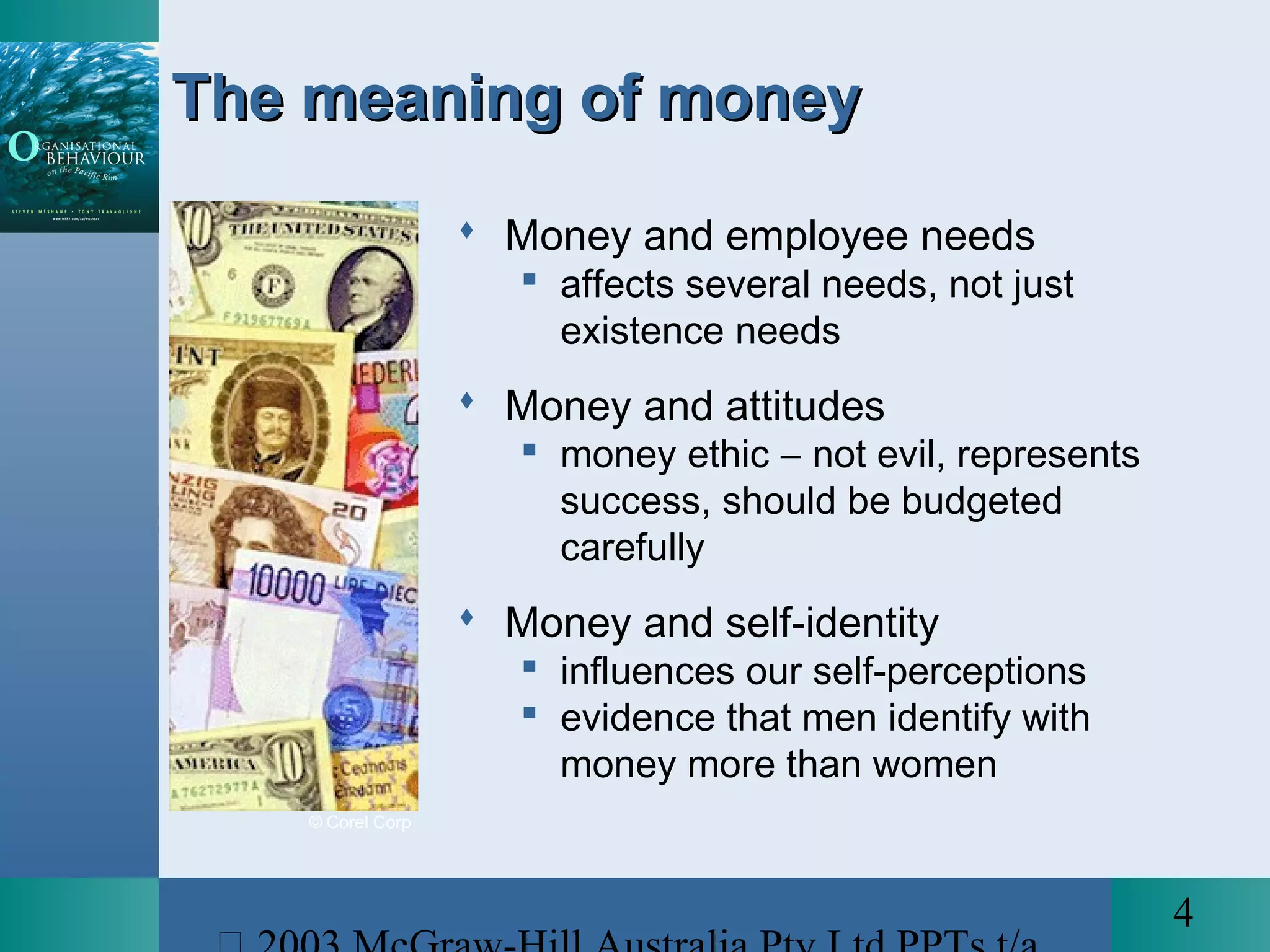
 Money and employee needs
 affects several needs, not just
existence needs
 Money and attitudes
 money ethic − not evil, represents
success, should be budgeted
carefully
 Money and self-identity
 influences our self-perceptions
 evidence that men identify with
money more than women
The meaning of moneyThe meaning of money
© Corel Corp
5
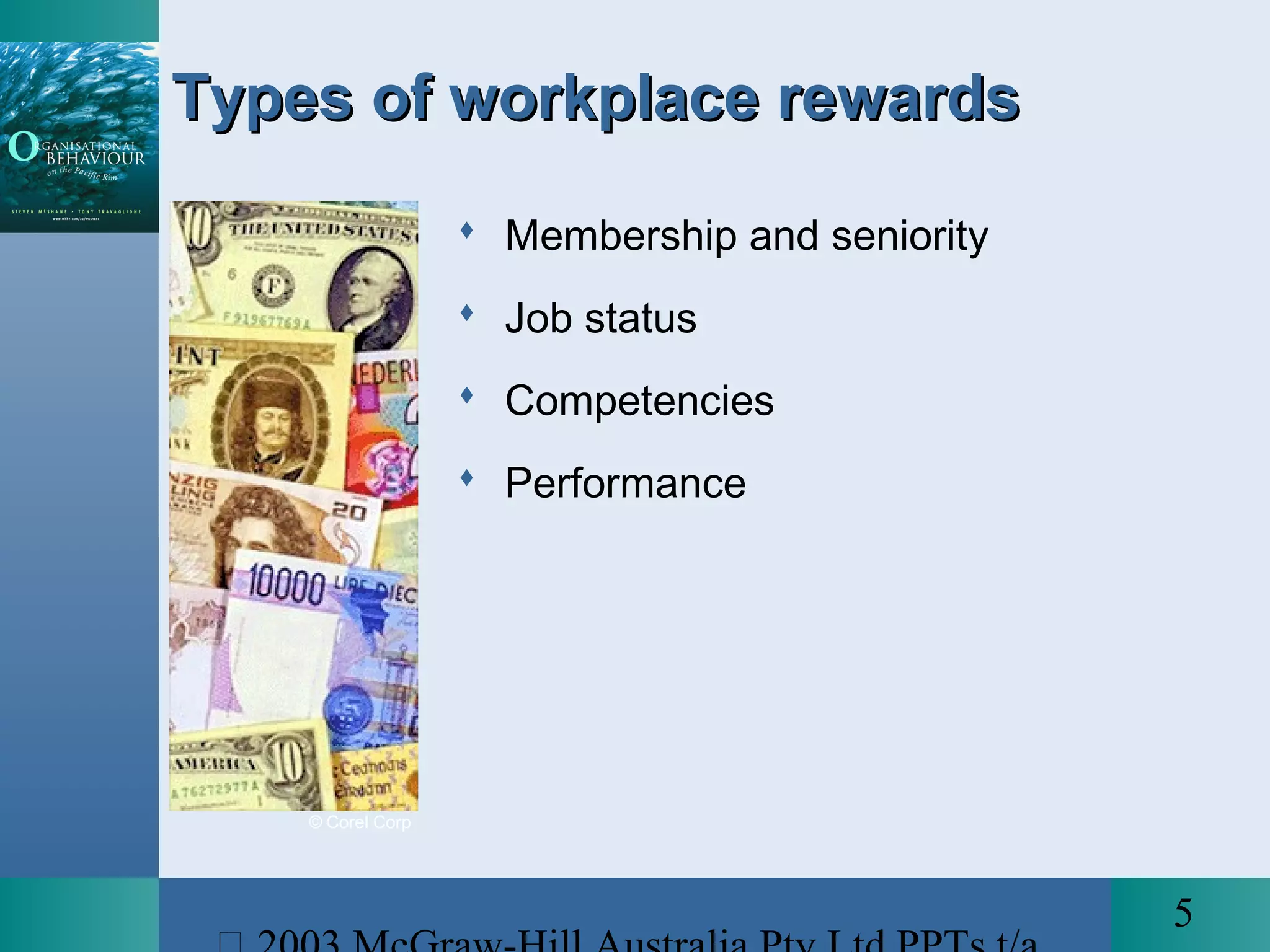
 Membership and seniority
 Job status
 Competencies
 Performance
Types of workplace rewardsTypes of workplace rewards
© Corel Corp
6
Membership/seniority-based rewardsMembership/seniority-based rewards
 Fixed wages, seniority increases
 Advantages
 guaranteed wages may attract job applicants
 seniority-based rewards reduce turnover
 Disadvantages
 don’t motivate job performance
 discourage poor performers from leaving
 may act as golden handcuffs
7
Job status-based rewardsJob status-based rewards
 Include job evaluation and status perks
 Advantages
 job evaluation tries to maintain pay equity
 motivate competition for promotions
 Disadvantages
 employees exaggerate duties, hoard resources
 create psychological distance across hierarchy
 inconsistent with flatter organisations
8
Competency-based rewardsCompetency-based rewards
 Pay increases with competencies acquired or
demonstrated
 Skill-based pay
 pay increases with skill modules learned
 Advantages
 more flexible work force, better quality, consistent with
employability
 Disadvantages
 potentially subjective, higher training costs
9
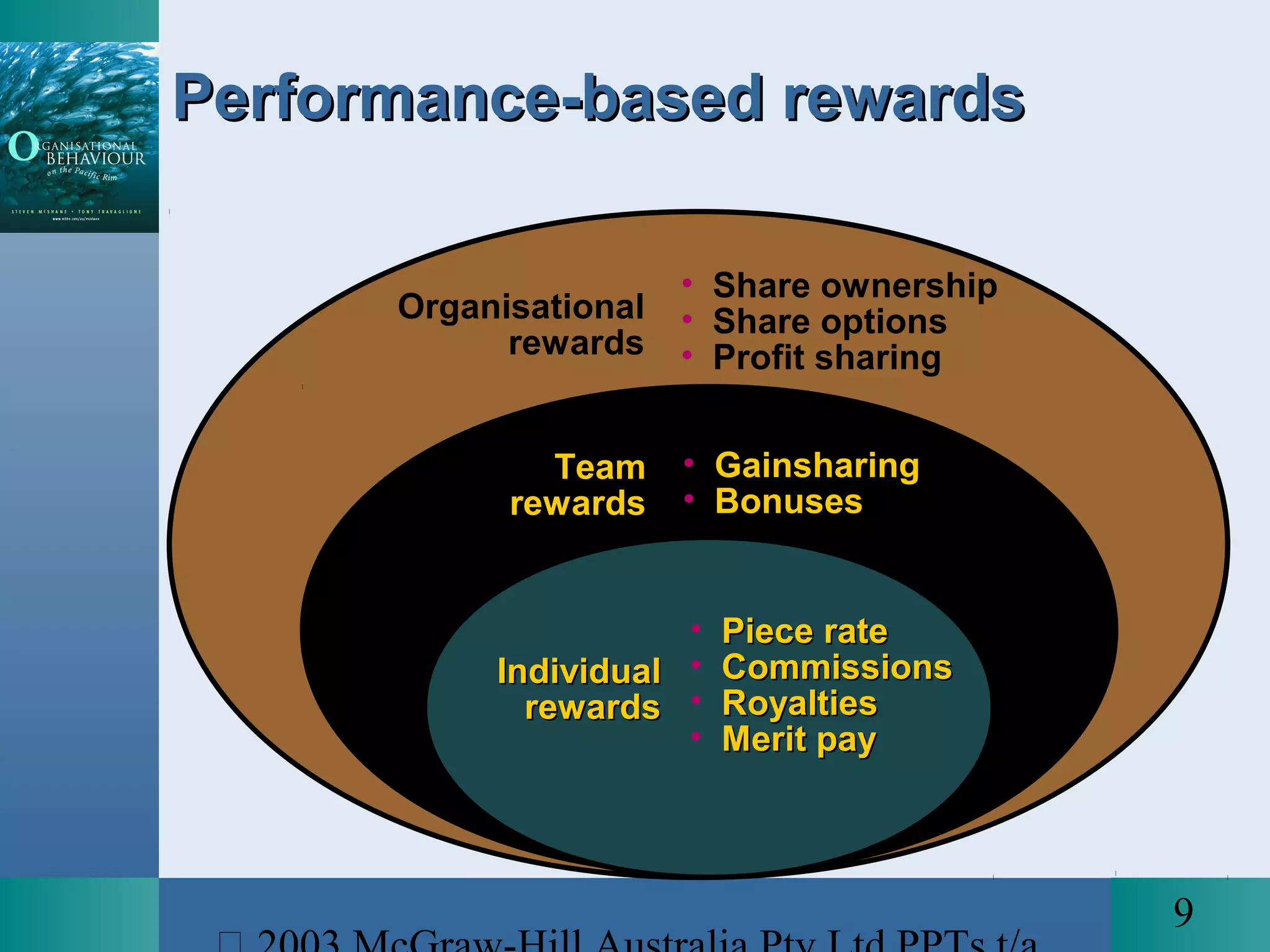
Organisational
rewards
• Share ownership
• Share options
• Profit sharing
Team
rewards
• Gainsharing
• Bonuses
Performance-based rewardsPerformance-based rewards
IndividualIndividual
rewardsrewards
• Piece ratePiece rate
• CommissionsCommissions
• RoyaltiesRoyalties
• Merit payMerit pay
10
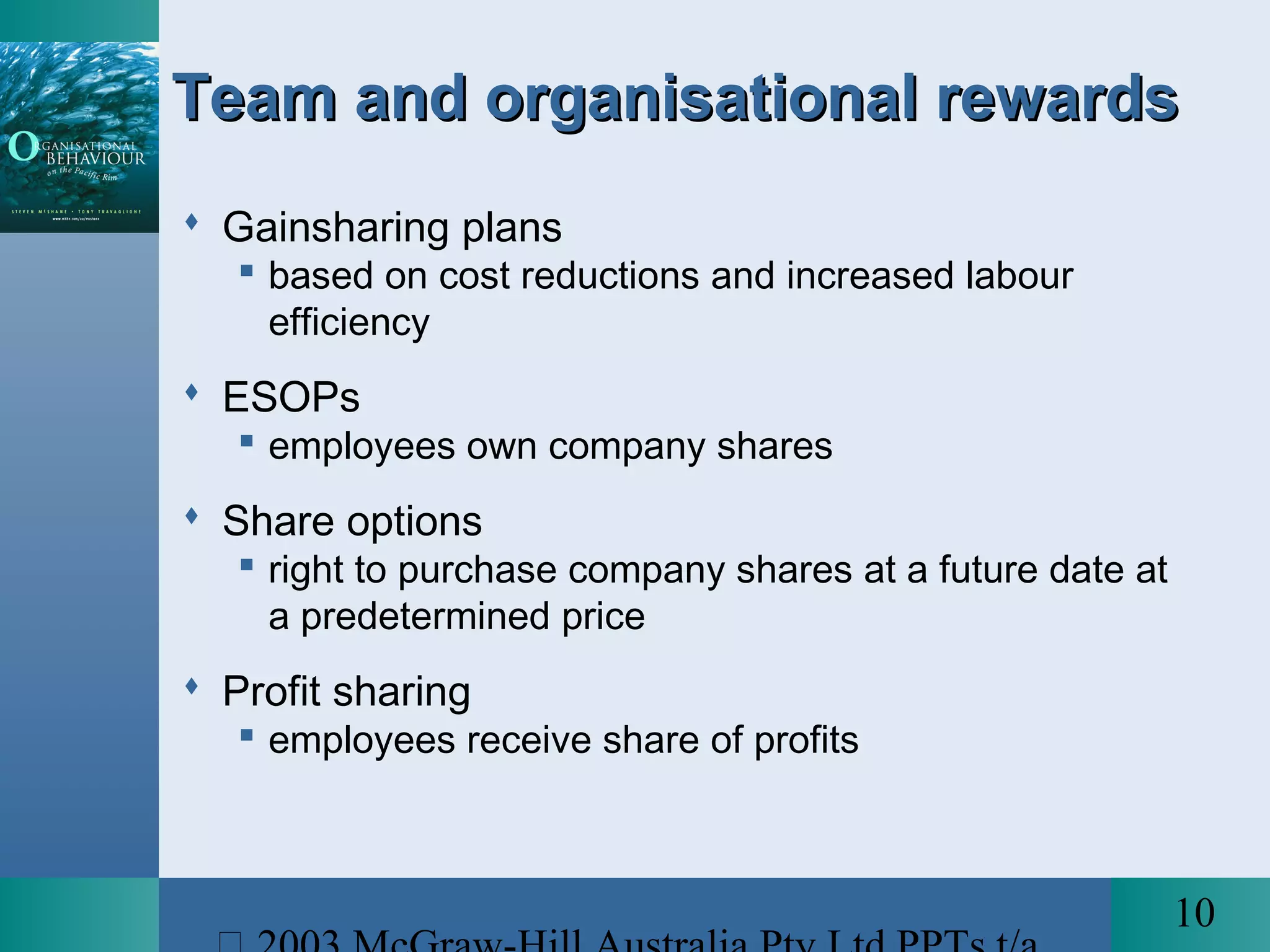
Team and organisational rewardsTeam and organisational rewards
 Gainsharing plans
 based on cost reductions and increased labour
efficiency
 ESOPs
 employees own company shares
 Share options
 right to purchase company shares at a future date at
a predetermined price
 Profit sharing
 employees receive share of profits
11
Performance reward problemsPerformance reward problems
 Shift attention away from motivation of job itself to
extrinsic rewards
 Create a psychological distance with reward giver
 Discourage risk taking
 Used as quick fixes
12
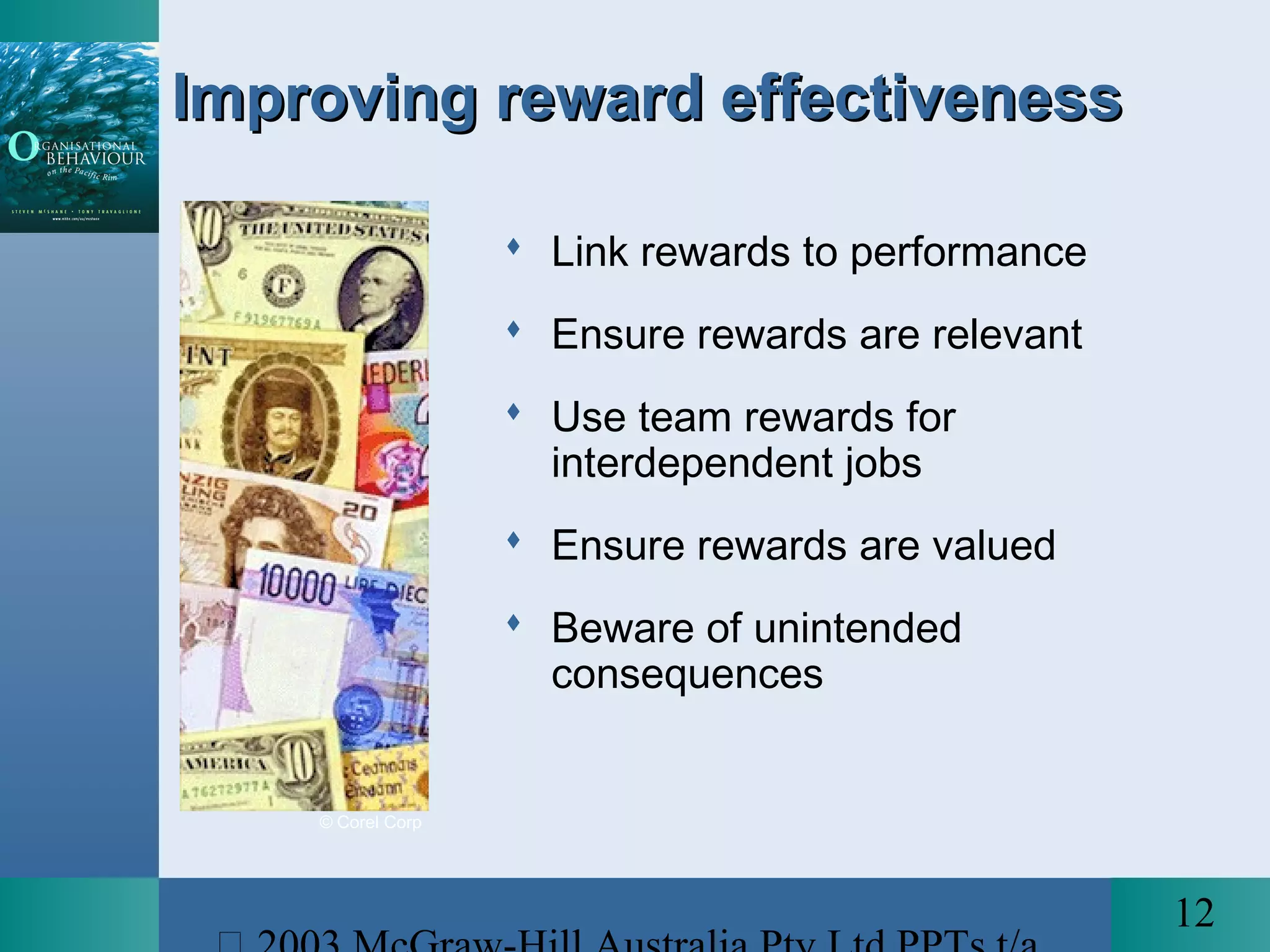
Improving reward effectivenessImproving reward effectiveness
 Link rewards to performance
 Ensure rewards are relevant
 Use team rewards for
interdependent jobs
 Ensure rewards are valued
 Beware of unintended
consequences
© Corel Corp
13
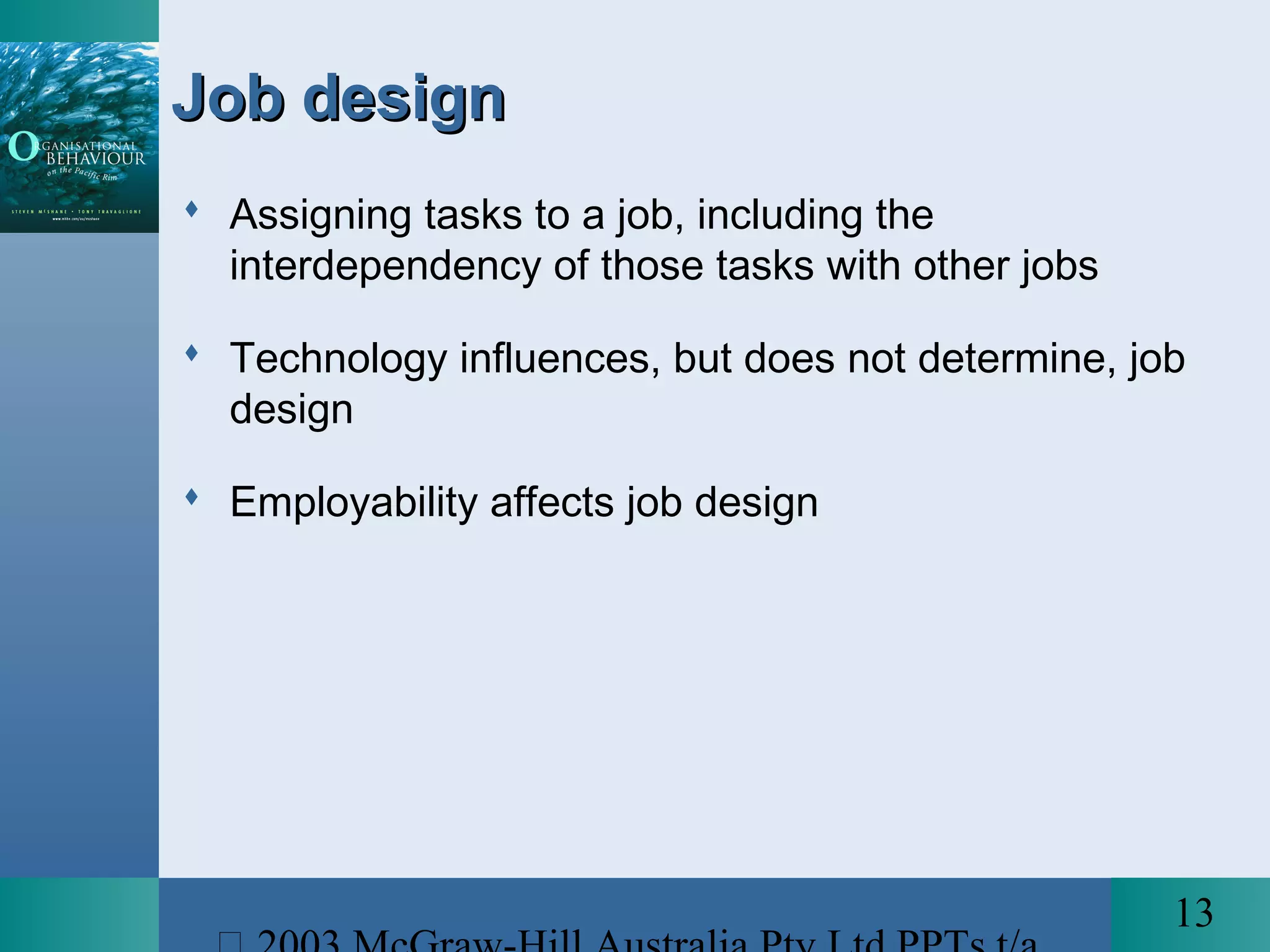
Job designJob design
 Assigning tasks to a job, including the
interdependency of those tasks with other jobs
 Technology influences, but does not determine, job
design
 Employability affects job design
14
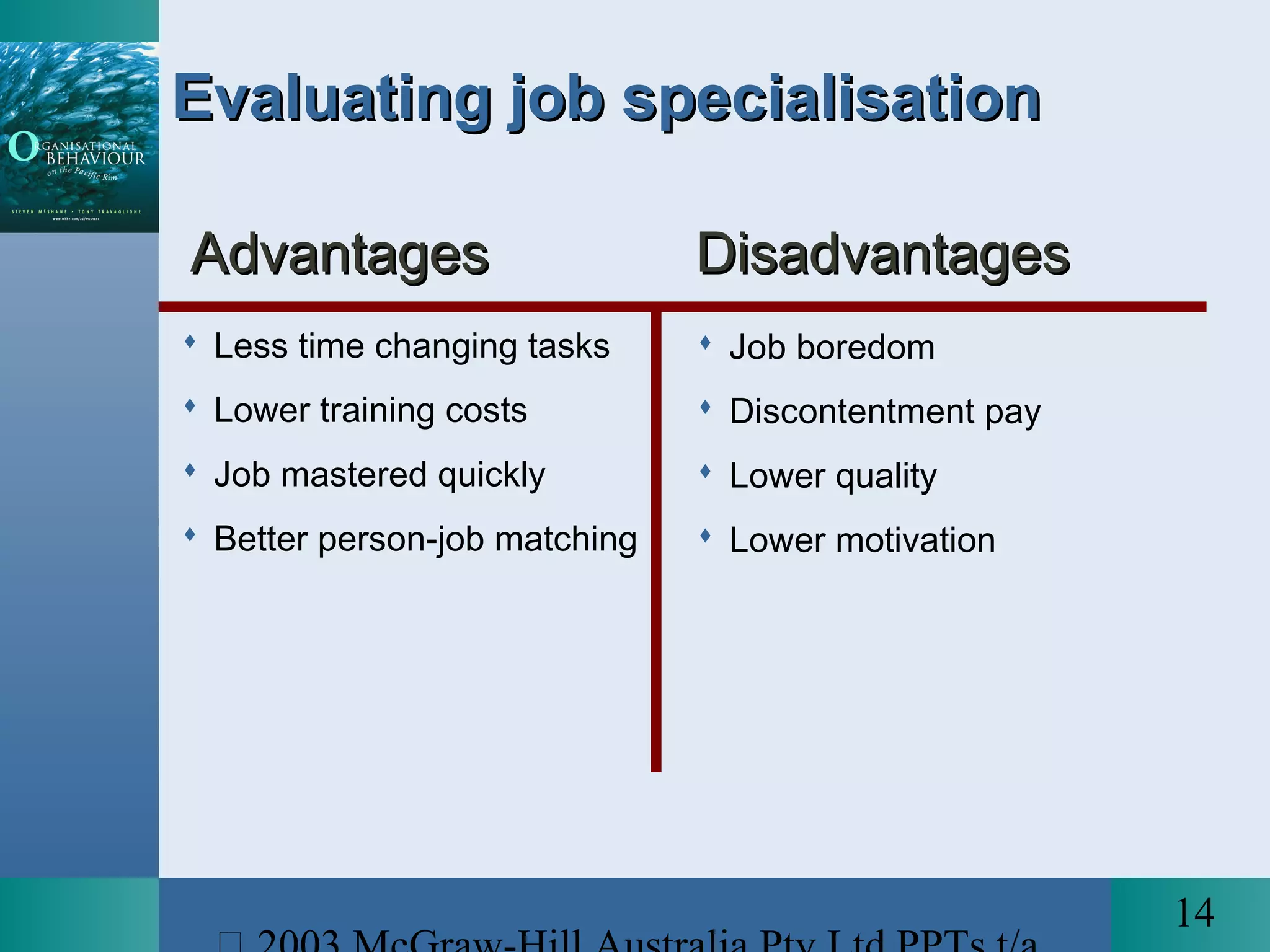
AdvantagesAdvantages DisadvantagesDisadvantages
Evaluating job specialisationEvaluating job specialisation
 Less time changing tasks
 Lower training costs
 Job mastered quickly
 Better person-job matching
 Job boredom
 Discontentment pay
 Lower quality
 Lower motivation
15
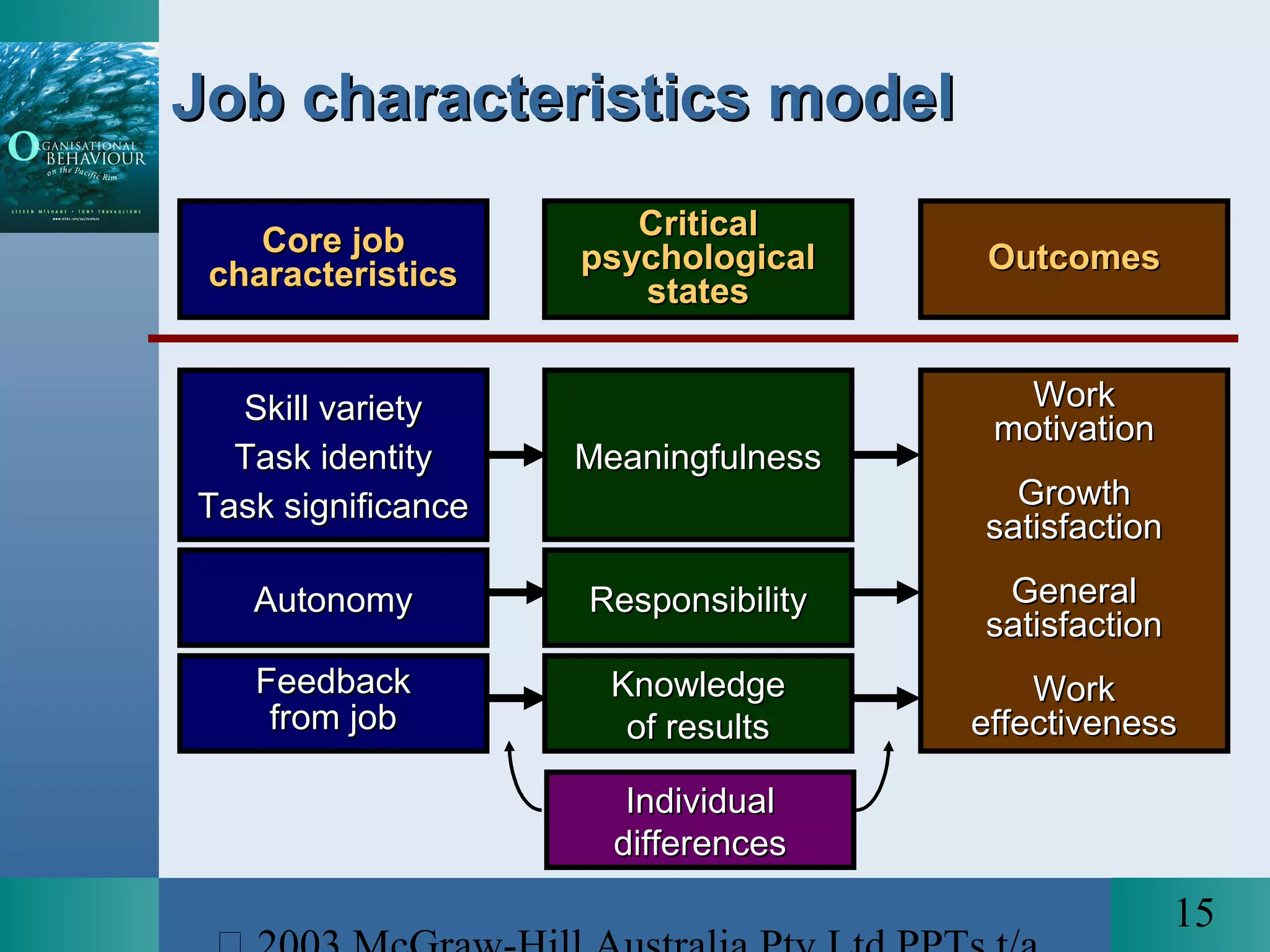
WorkWork
motivationmotivation
GrowthGrowth
satisfactionsatisfaction
GeneralGeneral
satisfactionsatisfaction
WorkWork
effectivenesseffectiveness
Job characteristics modelJob characteristics model
FeedbackFeedback
from jobfrom job
KnowledgeKnowledge
of resultsof results
Skill varietySkill variety
Task identityTask identity
Task significanceTask significance
MeaningfulnessMeaningfulness
AutonomyAutonomy ResponsibilityResponsibility
IndividualIndividual
differencesdifferences
CriticalCritical
psychologicalpsychological
statesstates
Core jobCore job
characteristicscharacteristics OutcomesOutcomes
16
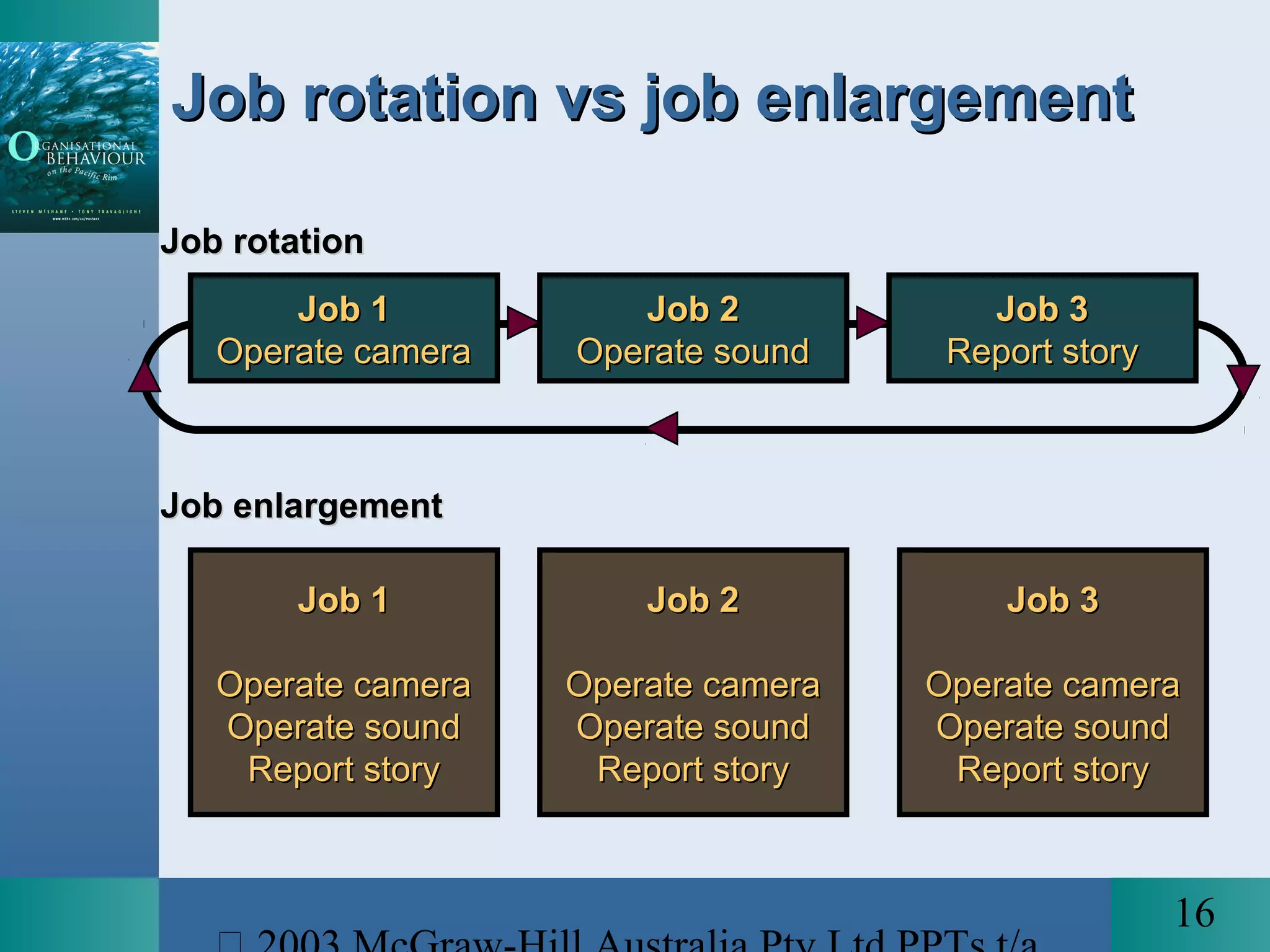
Job enlargementJob enlargement
Job rotationJob rotation
Job 1Job 1
Operate cameraOperate camera
Job 2Job 2
Operate soundOperate sound
Job 3Job 3
Report storyReport story
Job 1Job 1
Operate cameraOperate camera
Operate soundOperate sound
Report storyReport story
Job 2Job 2
Operate cameraOperate camera
Operate soundOperate sound
Report storyReport story
Job 3Job 3
Operate cameraOperate camera
Operate soundOperate sound
Report storyReport story
Job rotation vs job enlargementJob rotation vs job enlargement
17
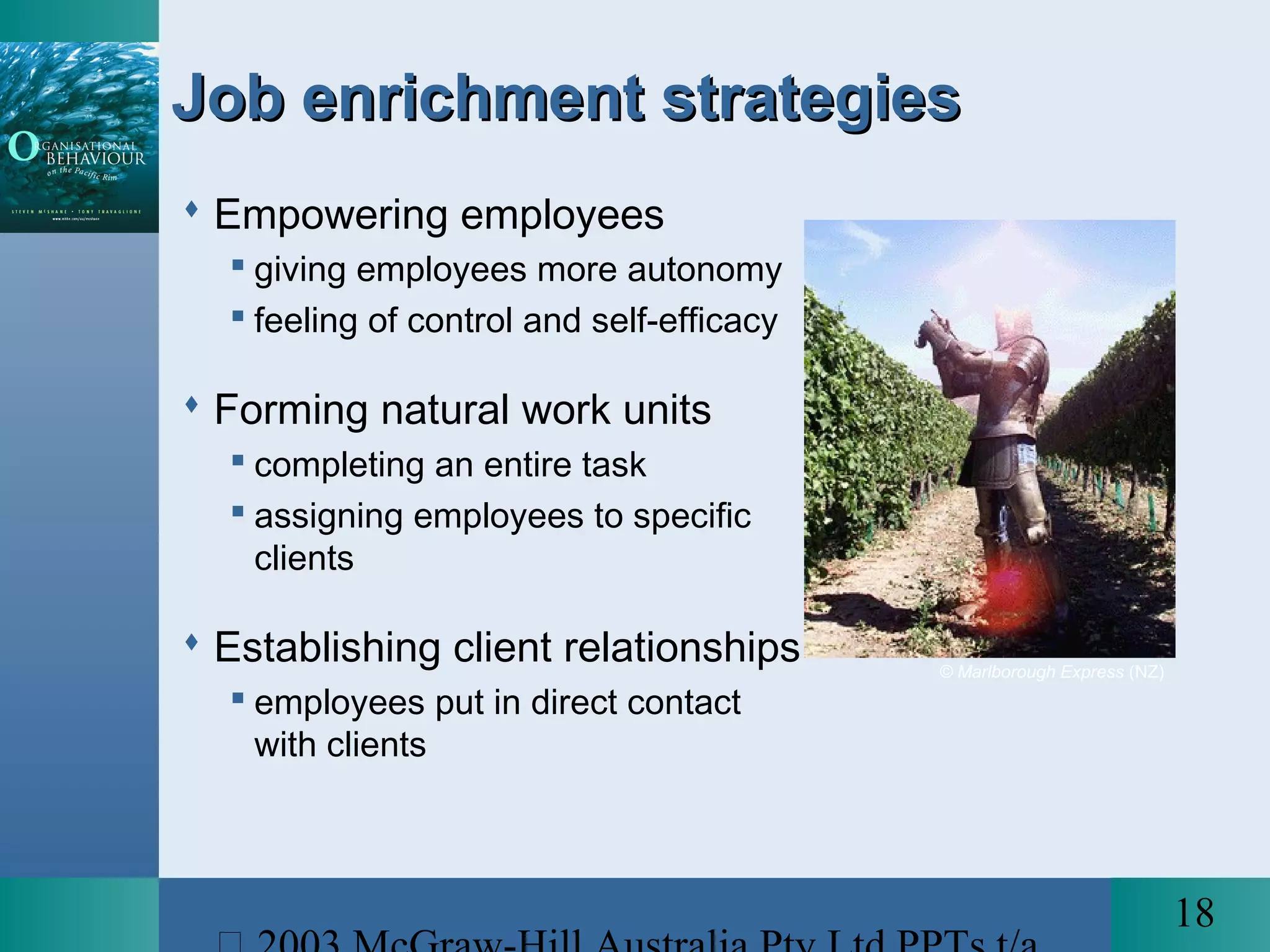
Job enrichment in wine makingJob enrichment in wine making
Mike Just has an enriched job
as wine maker at Lawson’s
Dry Hills Winery near
Blenheim, NZ. ‘[W]e plant
vines here, we pick them, we
make the wine on site and
bottle it, then sell it to
customers who come in’,
explains Just, who also enjoys
jousting.
© Marlborough Express (NZ)
18
Job enrichment strategiesJob enrichment strategies
 Empowering employees
 giving employees more autonomy
 feeling of control and self-efficacy
 Forming natural work units
 completing an entire task
 assigning employees to specific
clients
 Establishing client relationships
 employees put in direct contact
with clients
© Marlborough Express (NZ)
19
Obstacles to job designObstacles to job design
 Difficult to accurately measure job characteristics
 Resistance to change
 skilled workers
 labour union leaders
 supervisors
 Problem finding optimal level of enrichment and
specialisation
20
Self-leadershipSelf-leadership
 The process of influencing oneself to establish the
self-direction and self-motivation needed to perform
a task
 Includes concepts/practices from
 goal setting
 social learning theory
 sports psychology
21
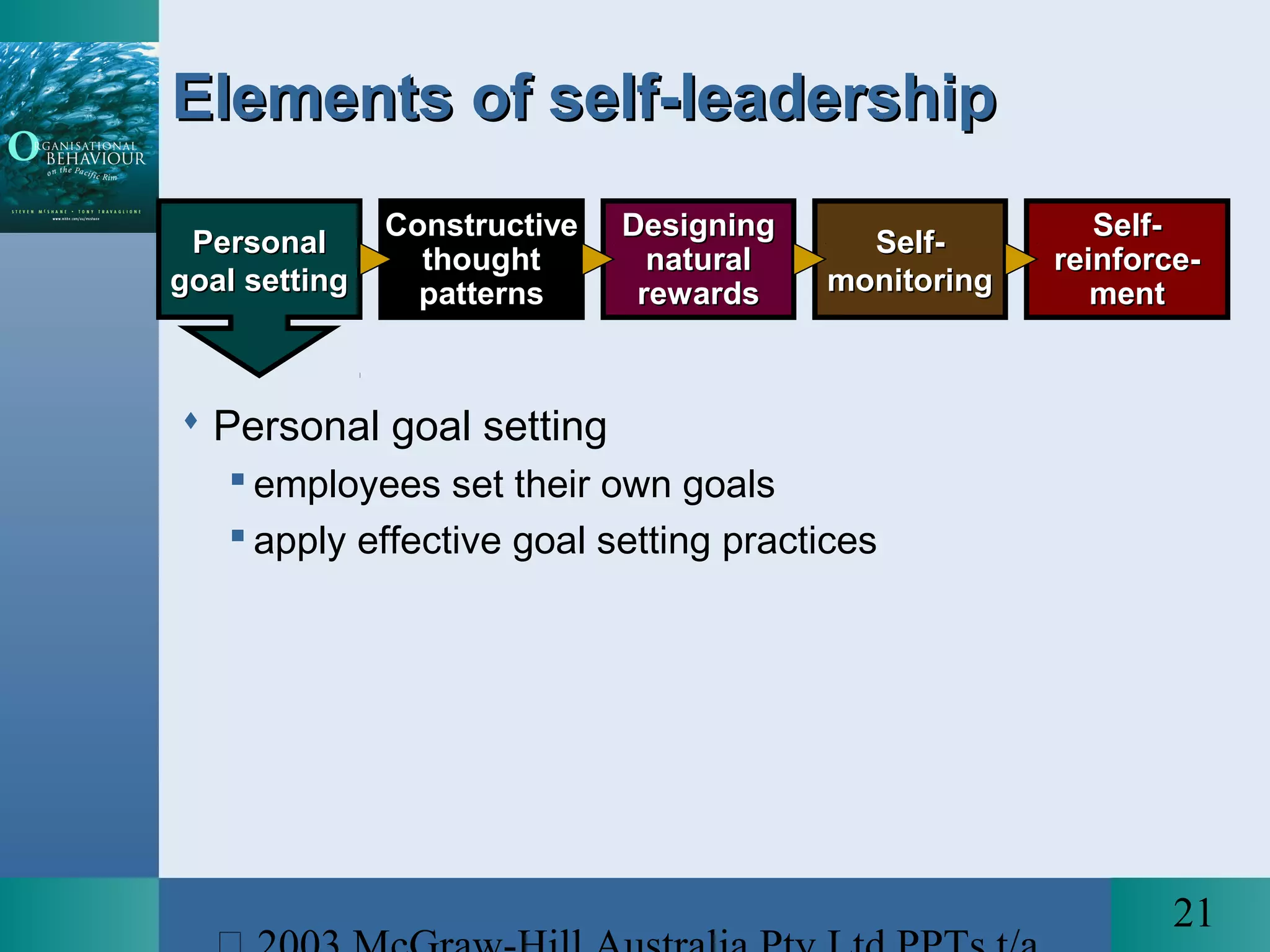
Elements of self-leadershipElements of self-leadership
PersonalPersonal
goal settinggoal setting
ConstructiveConstructive
thoughtthought
patternspatterns
DesigningDesigning
naturalnatural
rewardsrewards
Self-Self-
monitoringmonitoring
Self-Self-
reinforce-reinforce-
mentment
 Personal goal setting
 employees set their own goals
 apply effective goal setting practices
22
PersonalPersonal
goal settinggoal setting
Elements of self-leadershipElements of self-leadership
DesigningDesigning
naturalnatural
rewardsrewards
Self-Self-
monitoringmonitoring
Self-Self-
reinforce-reinforce-
mentment
ConstructiveConstructive
thoughtthought
patternspatterns
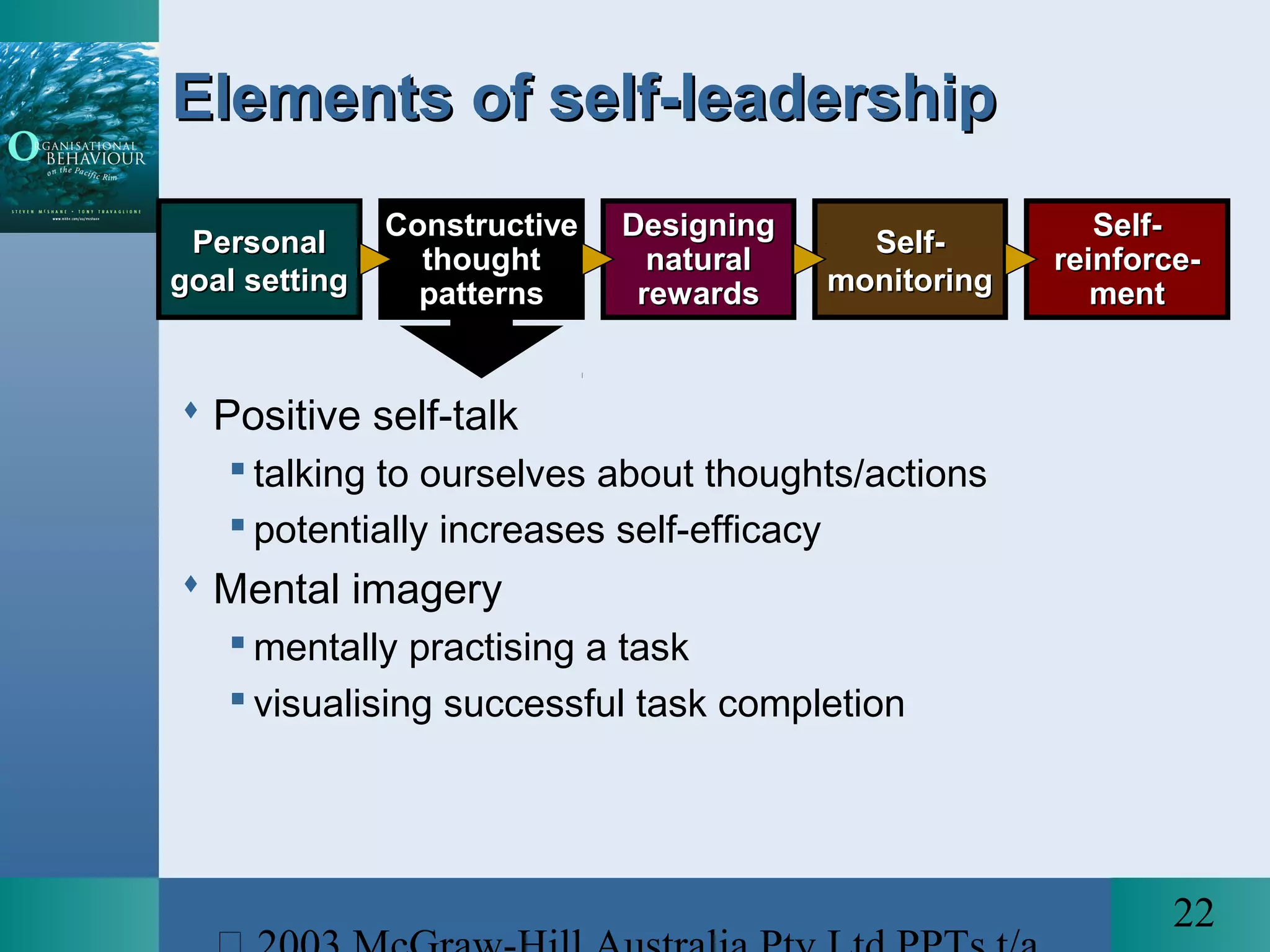
 Positive self-talk
 talking to ourselves about thoughts/actions
 potentially increases self-efficacy
 Mental imagery
 mentally practising a task
 visualising successful task completion
23
DesigningDesigning
naturalnatural
rewardsrewards
Elements of self-leadershipElements of self-leadership
ConstructiveConstructive
thoughtthought
patternspatterns
Self-Self-
monitoringmonitoring
Self-Self-
reinforce-reinforce-
mentment
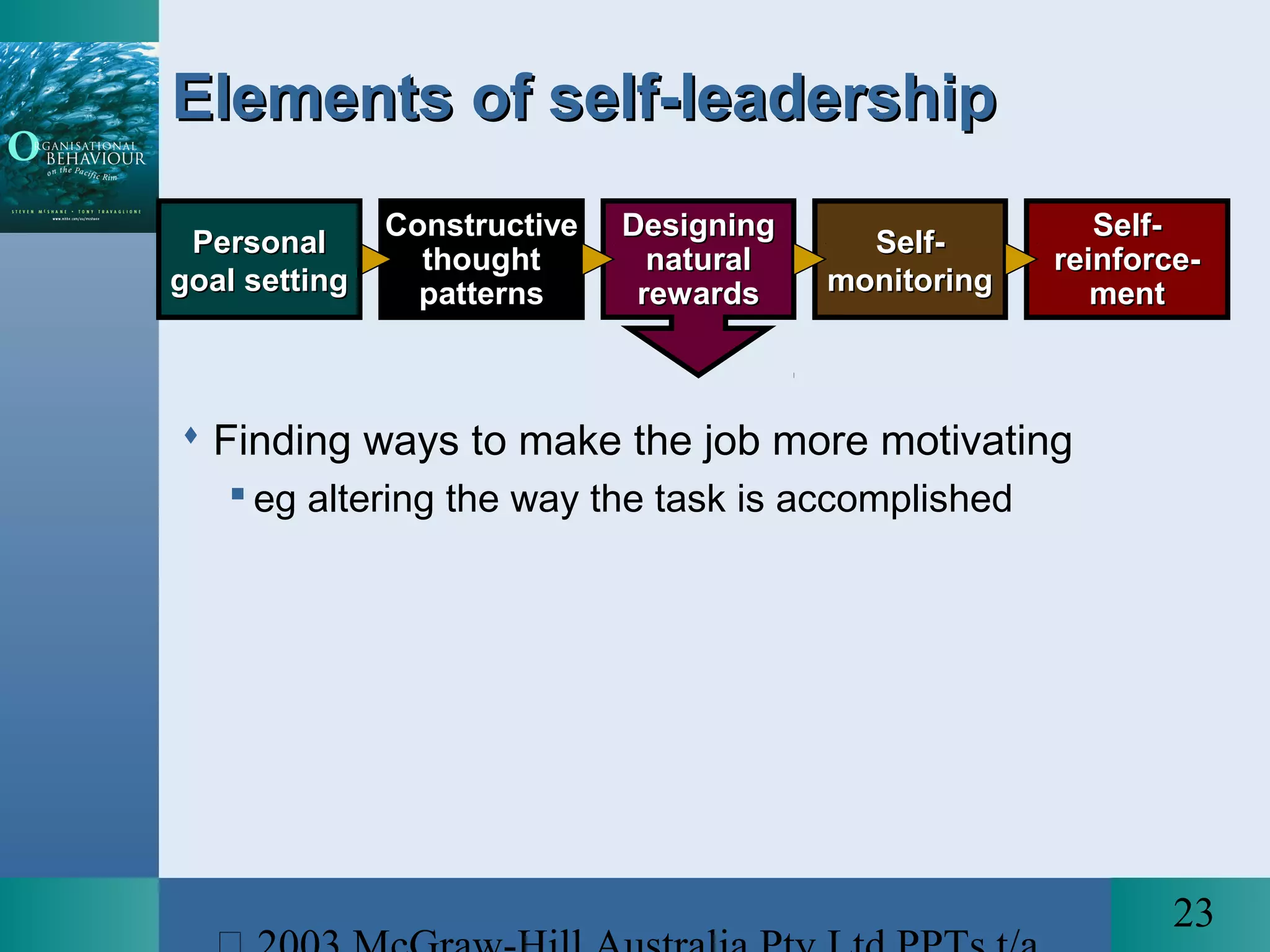
 Finding ways to make the job more motivating
 eg altering the way the task is accomplished
PersonalPersonal
goal settinggoal setting
24
Elements of self-leadershipElements of self-leadership
ConstructiveConstructive
thoughtthought
patternspatterns
DesigningDesigning
naturalnatural
rewardsrewards
Self-Self-
reinforce-reinforce-
mentment
PersonalPersonal
goal settinggoal setting
Self-Self-
monitoringmonitoring
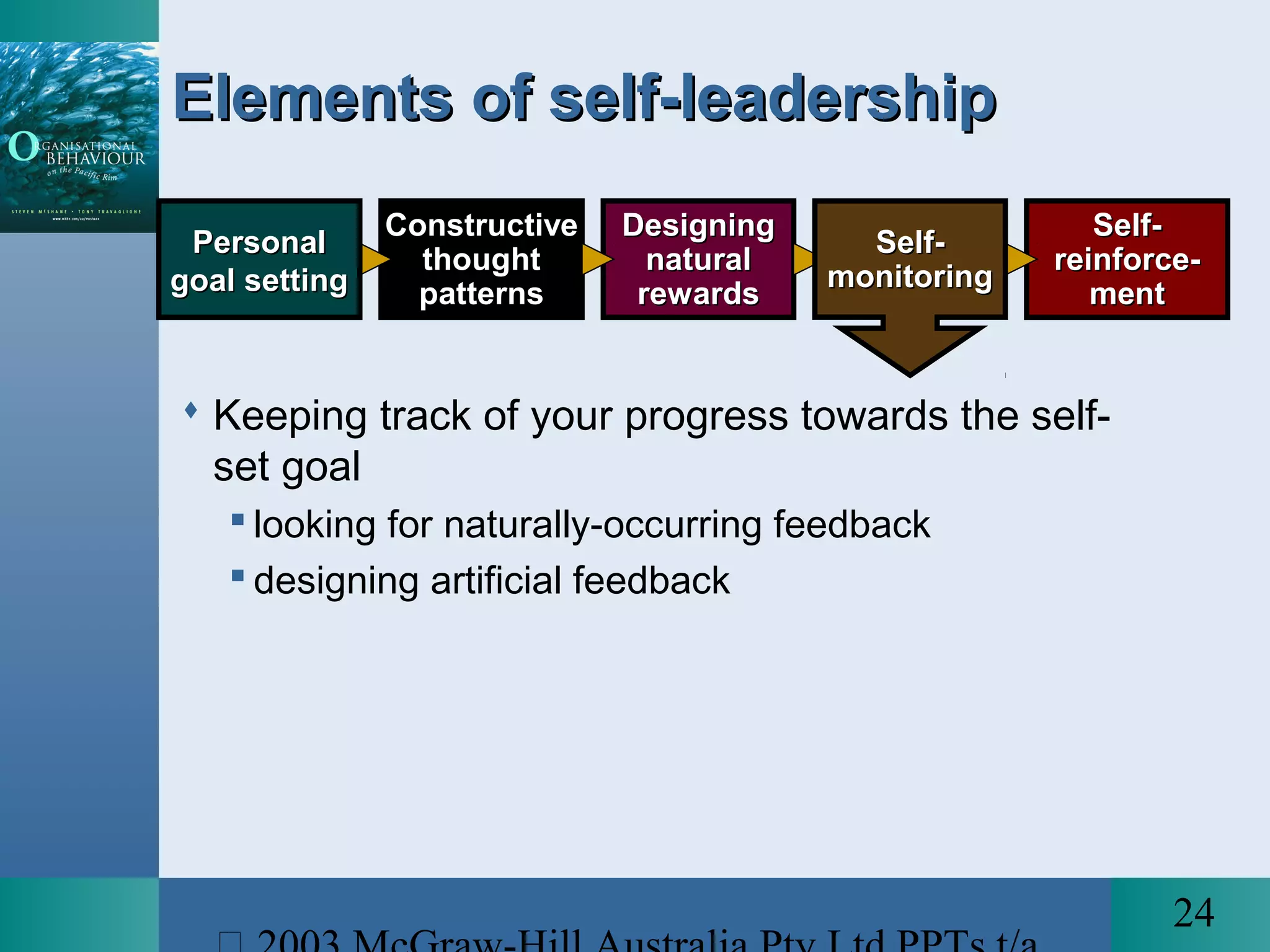
 Keeping track of your progress towards the self-
set goal
 looking for naturally-occurring feedback
 designing artificial feedback
25
Self-Self-
reinforce-reinforce-
mentment
Elements of self-leadershipElements of self-leadership
ConstructiveConstructive
thoughtthought
patternspatterns
DesigningDesigning
naturalnatural
rewardsrewards
Self-Self-
monitoringmonitoring
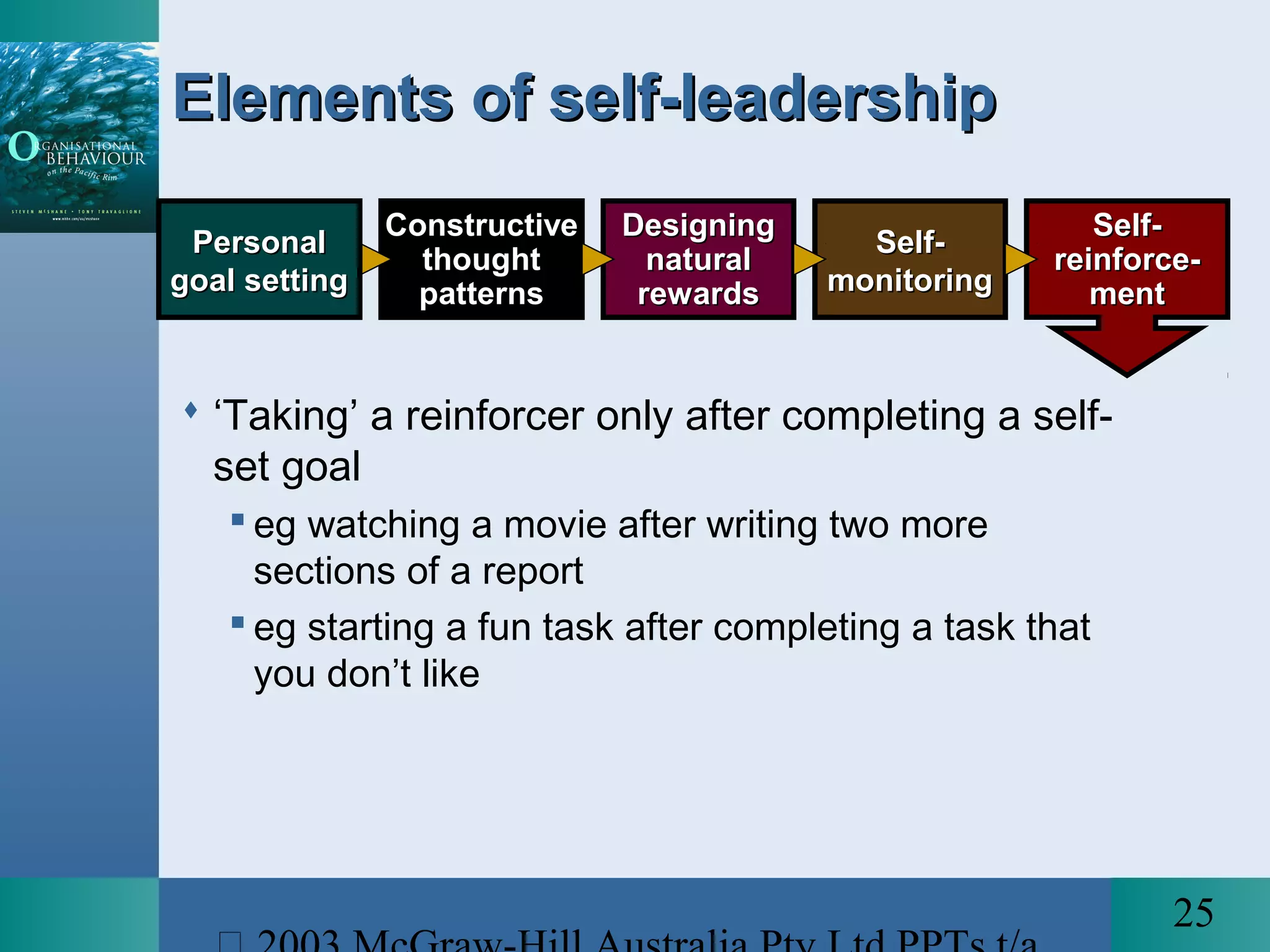
 ‘Taking’ a reinforcer only after completing a self-
set goal
 eg watching a movie after writing two more
sections of a report
 eg starting a fun task after completing a task that
you don’t like
PersonalPersonal
goal settinggoal setting
26
Overview of the next chapterOverview of the next chapter
 Description of the stress experience
 Types of stressors in the workplace
 Individual differences in the stress process
 Physiological, psychological and behavioural
effects of stress
 Five ways to manage workplace stress
© 2003 McGraw-Hill Australia Pty Ltd PPTs t/a Organisational Behaviour on the Pacific Rim by McShane and Travaglione
C H A P T E RC H A P T E R 66
AppliedApplied
motivationmotivation
practicespractices

Organizational Behavior CH 06

  • 1.
    © 2003 McGraw-HillAustralia Pty Ltd PPTs t/a Organisational Behaviour on the Pacific Rim by McShane and Travaglione C H A P T E RC H A P T E R 66 AppliedApplied motivationmotivation practicespractices
  • 2.
    2 Chapter learning objectivesChapterlearning objectives 1. Explain how money and other financial rewards affect our needs and emotions. 2. Discuss the advantages and disadvantages of the four types of rewards. 3. Identify four commonly applied team or organisational-level performance-based rewards. 4. Describe five ways to improve reward effectiveness. 5. Discuss the advantages and disadvantages of job specialisation. 6. Diagram the job characteristics model of job design. 7. Identify three strategies to enrich jobs. 8. Describe the five elements of self-leadership. 9. Explain how mental imagery improves employee motivation.
  • 3.
    3 Rewarding employees atIKEARewarding employees at IKEA IKEA held a special bonus in which the Scandinavian home furnishings company pledged an entire day’s sales revenue to employees. The day doubled previous sales records and awarded each employee $2400. © Steve Lunam/Sun-Herald (Sydney)
  • 4.
    4  Money andemployee needs  affects several needs, not just existence needs  Money and attitudes  money ethic − not evil, represents success, should be budgeted carefully  Money and self-identity  influences our self-perceptions  evidence that men identify with money more than women The meaning of moneyThe meaning of money © Corel Corp
  • 5.
    5  Membership andseniority  Job status  Competencies  Performance Types of workplace rewardsTypes of workplace rewards © Corel Corp
  • 6.
    6 Membership/seniority-based rewardsMembership/seniority-based rewards Fixed wages, seniority increases  Advantages  guaranteed wages may attract job applicants  seniority-based rewards reduce turnover  Disadvantages  don’t motivate job performance  discourage poor performers from leaving  may act as golden handcuffs
  • 7.
    7 Job status-based rewardsJobstatus-based rewards  Include job evaluation and status perks  Advantages  job evaluation tries to maintain pay equity  motivate competition for promotions  Disadvantages  employees exaggerate duties, hoard resources  create psychological distance across hierarchy  inconsistent with flatter organisations
  • 8.
    8 Competency-based rewardsCompetency-based rewards Pay increases with competencies acquired or demonstrated  Skill-based pay  pay increases with skill modules learned  Advantages  more flexible work force, better quality, consistent with employability  Disadvantages  potentially subjective, higher training costs
  • 9.
    9 Organisational rewards • Share ownership •Share options • Profit sharing Team rewards • Gainsharing • Bonuses Performance-based rewardsPerformance-based rewards IndividualIndividual rewardsrewards • Piece ratePiece rate • CommissionsCommissions • RoyaltiesRoyalties • Merit payMerit pay
  • 10.
    10 Team and organisationalrewardsTeam and organisational rewards  Gainsharing plans  based on cost reductions and increased labour efficiency  ESOPs  employees own company shares  Share options  right to purchase company shares at a future date at a predetermined price  Profit sharing  employees receive share of profits
  • 11.
    11 Performance reward problemsPerformancereward problems  Shift attention away from motivation of job itself to extrinsic rewards  Create a psychological distance with reward giver  Discourage risk taking  Used as quick fixes
  • 12.
    12 Improving reward effectivenessImprovingreward effectiveness  Link rewards to performance  Ensure rewards are relevant  Use team rewards for interdependent jobs  Ensure rewards are valued  Beware of unintended consequences © Corel Corp
  • 13.
    13 Job designJob design Assigning tasks to a job, including the interdependency of those tasks with other jobs  Technology influences, but does not determine, job design  Employability affects job design
  • 14.
    14 AdvantagesAdvantages DisadvantagesDisadvantages Evaluating jobspecialisationEvaluating job specialisation  Less time changing tasks  Lower training costs  Job mastered quickly  Better person-job matching  Job boredom  Discontentment pay  Lower quality  Lower motivation
  • 15.
    15 WorkWork motivationmotivation GrowthGrowth satisfactionsatisfaction GeneralGeneral satisfactionsatisfaction WorkWork effectivenesseffectiveness Job characteristics modelJobcharacteristics model FeedbackFeedback from jobfrom job KnowledgeKnowledge of resultsof results Skill varietySkill variety Task identityTask identity Task significanceTask significance MeaningfulnessMeaningfulness AutonomyAutonomy ResponsibilityResponsibility IndividualIndividual differencesdifferences CriticalCritical psychologicalpsychological statesstates Core jobCore job characteristicscharacteristics OutcomesOutcomes
  • 16.
    16 Job enlargementJob enlargement JobrotationJob rotation Job 1Job 1 Operate cameraOperate camera Job 2Job 2 Operate soundOperate sound Job 3Job 3 Report storyReport story Job 1Job 1 Operate cameraOperate camera Operate soundOperate sound Report storyReport story Job 2Job 2 Operate cameraOperate camera Operate soundOperate sound Report storyReport story Job 3Job 3 Operate cameraOperate camera Operate soundOperate sound Report storyReport story Job rotation vs job enlargementJob rotation vs job enlargement
  • 17.
    17 Job enrichment inwine makingJob enrichment in wine making Mike Just has an enriched job as wine maker at Lawson’s Dry Hills Winery near Blenheim, NZ. ‘[W]e plant vines here, we pick them, we make the wine on site and bottle it, then sell it to customers who come in’, explains Just, who also enjoys jousting. © Marlborough Express (NZ)
  • 18.
    18 Job enrichment strategiesJobenrichment strategies  Empowering employees  giving employees more autonomy  feeling of control and self-efficacy  Forming natural work units  completing an entire task  assigning employees to specific clients  Establishing client relationships  employees put in direct contact with clients © Marlborough Express (NZ)
  • 19.
    19 Obstacles to jobdesignObstacles to job design  Difficult to accurately measure job characteristics  Resistance to change  skilled workers  labour union leaders  supervisors  Problem finding optimal level of enrichment and specialisation
  • 20.
    20 Self-leadershipSelf-leadership  The processof influencing oneself to establish the self-direction and self-motivation needed to perform a task  Includes concepts/practices from  goal setting  social learning theory  sports psychology
  • 21.
    21 Elements of self-leadershipElementsof self-leadership PersonalPersonal goal settinggoal setting ConstructiveConstructive thoughtthought patternspatterns DesigningDesigning naturalnatural rewardsrewards Self-Self- monitoringmonitoring Self-Self- reinforce-reinforce- mentment  Personal goal setting  employees set their own goals  apply effective goal setting practices
  • 22.
    22 PersonalPersonal goal settinggoal setting Elementsof self-leadershipElements of self-leadership DesigningDesigning naturalnatural rewardsrewards Self-Self- monitoringmonitoring Self-Self- reinforce-reinforce- mentment ConstructiveConstructive thoughtthought patternspatterns  Positive self-talk  talking to ourselves about thoughts/actions  potentially increases self-efficacy  Mental imagery  mentally practising a task  visualising successful task completion
  • 23.
    23 DesigningDesigning naturalnatural rewardsrewards Elements of self-leadershipElementsof self-leadership ConstructiveConstructive thoughtthought patternspatterns Self-Self- monitoringmonitoring Self-Self- reinforce-reinforce- mentment  Finding ways to make the job more motivating  eg altering the way the task is accomplished PersonalPersonal goal settinggoal setting
  • 24.
    24 Elements of self-leadershipElementsof self-leadership ConstructiveConstructive thoughtthought patternspatterns DesigningDesigning naturalnatural rewardsrewards Self-Self- reinforce-reinforce- mentment PersonalPersonal goal settinggoal setting Self-Self- monitoringmonitoring  Keeping track of your progress towards the self- set goal  looking for naturally-occurring feedback  designing artificial feedback
  • 25.
    25 Self-Self- reinforce-reinforce- mentment Elements of self-leadershipElementsof self-leadership ConstructiveConstructive thoughtthought patternspatterns DesigningDesigning naturalnatural rewardsrewards Self-Self- monitoringmonitoring  ‘Taking’ a reinforcer only after completing a self- set goal  eg watching a movie after writing two more sections of a report  eg starting a fun task after completing a task that you don’t like PersonalPersonal goal settinggoal setting
  • 26.
    26 Overview of thenext chapterOverview of the next chapter  Description of the stress experience  Types of stressors in the workplace  Individual differences in the stress process  Physiological, psychological and behavioural effects of stress  Five ways to manage workplace stress
  • 27.
    © 2003 McGraw-HillAustralia Pty Ltd PPTs t/a Organisational Behaviour on the Pacific Rim by McShane and Travaglione C H A P T E RC H A P T E R 66 AppliedApplied motivationmotivation practicespractices

Editor's Notes

  • #10 <number>
  • #13 <number>
  • #15 <number>
  • #16 <number>
  • #17 <number>