© 2003 McGraw-Hill Australia Pty Ltd PPTs t/a Organisational Behaviour on the Pacific Rim by McShane and Travaglione
C H A P T E RC H A P T E R 22
IndividualIndividual
behaviour andbehaviour and
learning inlearning in
organisationsorganisations
2
Chapter learning objectivesChapter learning objectives
1. Describe the four factors that influence individual
behaviour and performance.
2. Identify five types of work-related behaviour.
3. Define learning.
4. Describe the A-B-C model of behaviour modification.
5. Explain how feedback influences individual behaviour
and performance.
6. Identify five elements of effective feedback.
7. Describe the three features of social learning theory.
8. Outline Kolb’s model of experiential learning.
3
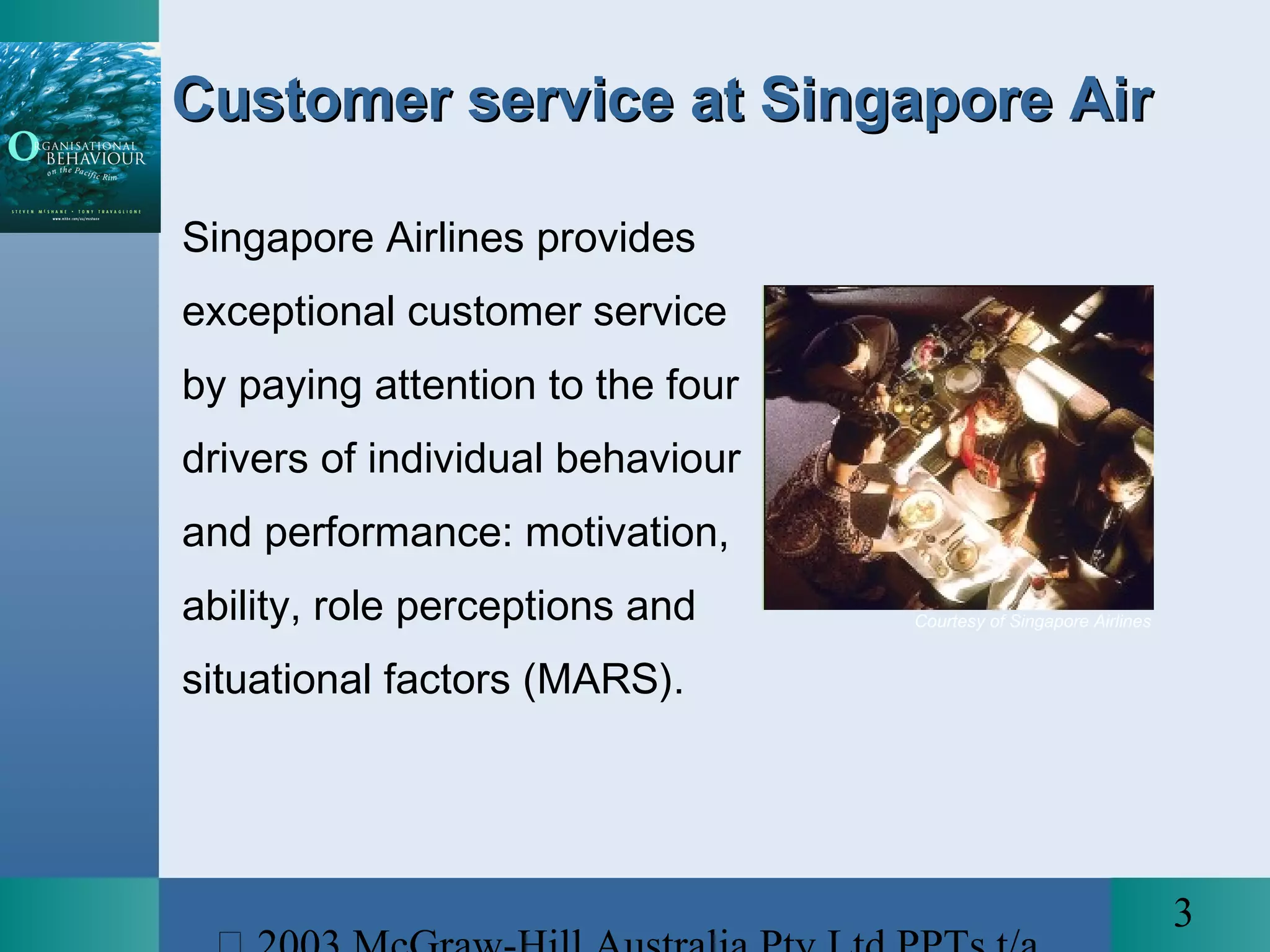
Customer service at Singapore AirCustomer service at Singapore Air
Singapore Airlines provides
exceptional customer service
by paying attention to the four
drivers of individual behaviour
and performance: motivation,
ability, role perceptions and
situational factors (MARS).
Courtesy of Singapore Airlines
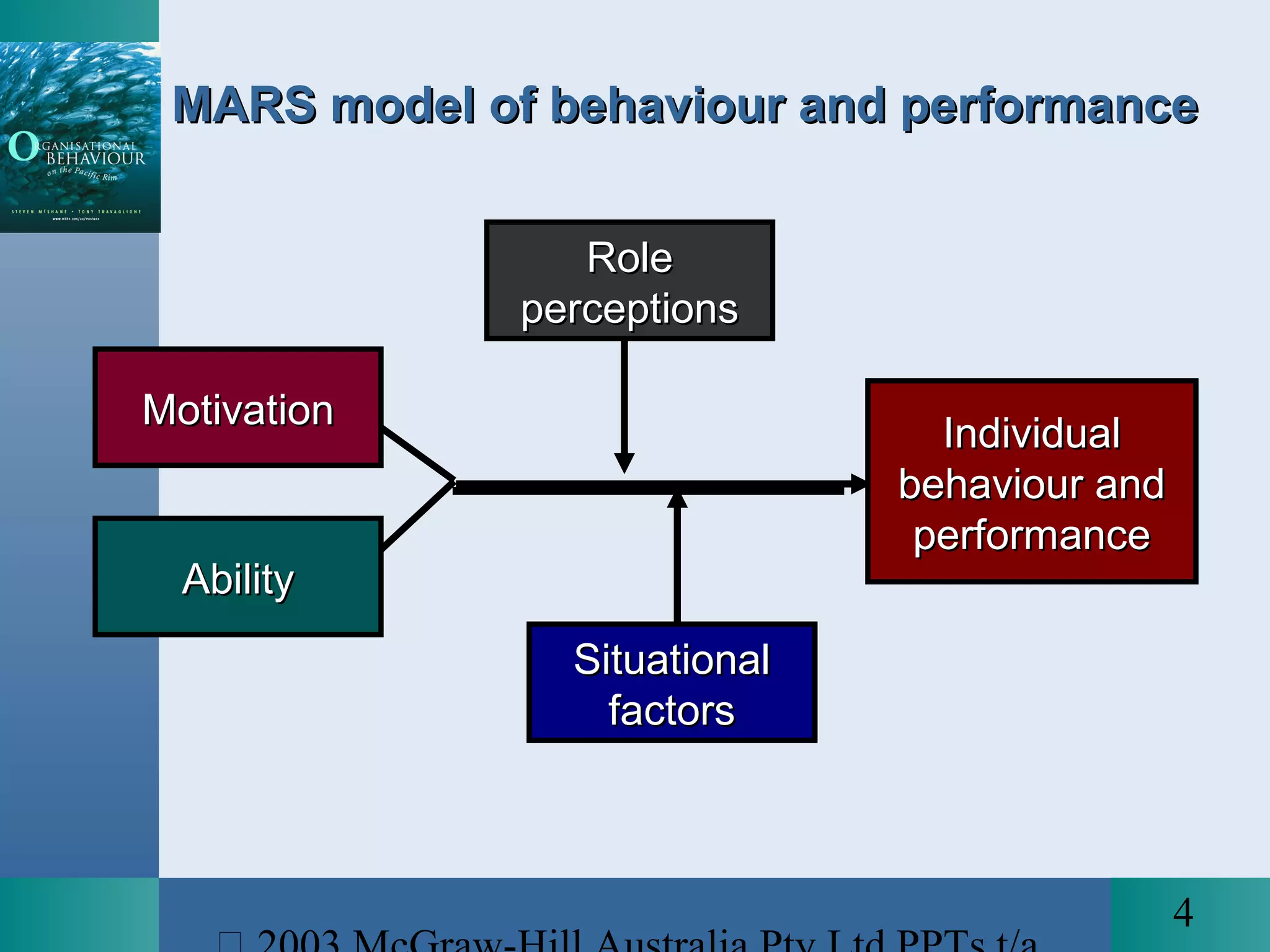
4
MotivationMotivation
IndividualIndividual
behaviour andbehaviour and
performanceperformance
MARS model of behaviour and performanceMARS model of behaviour and performance
RoleRole
perceptionsperceptions
SituationalSituational
factorsfactors
AbilityAbility
5
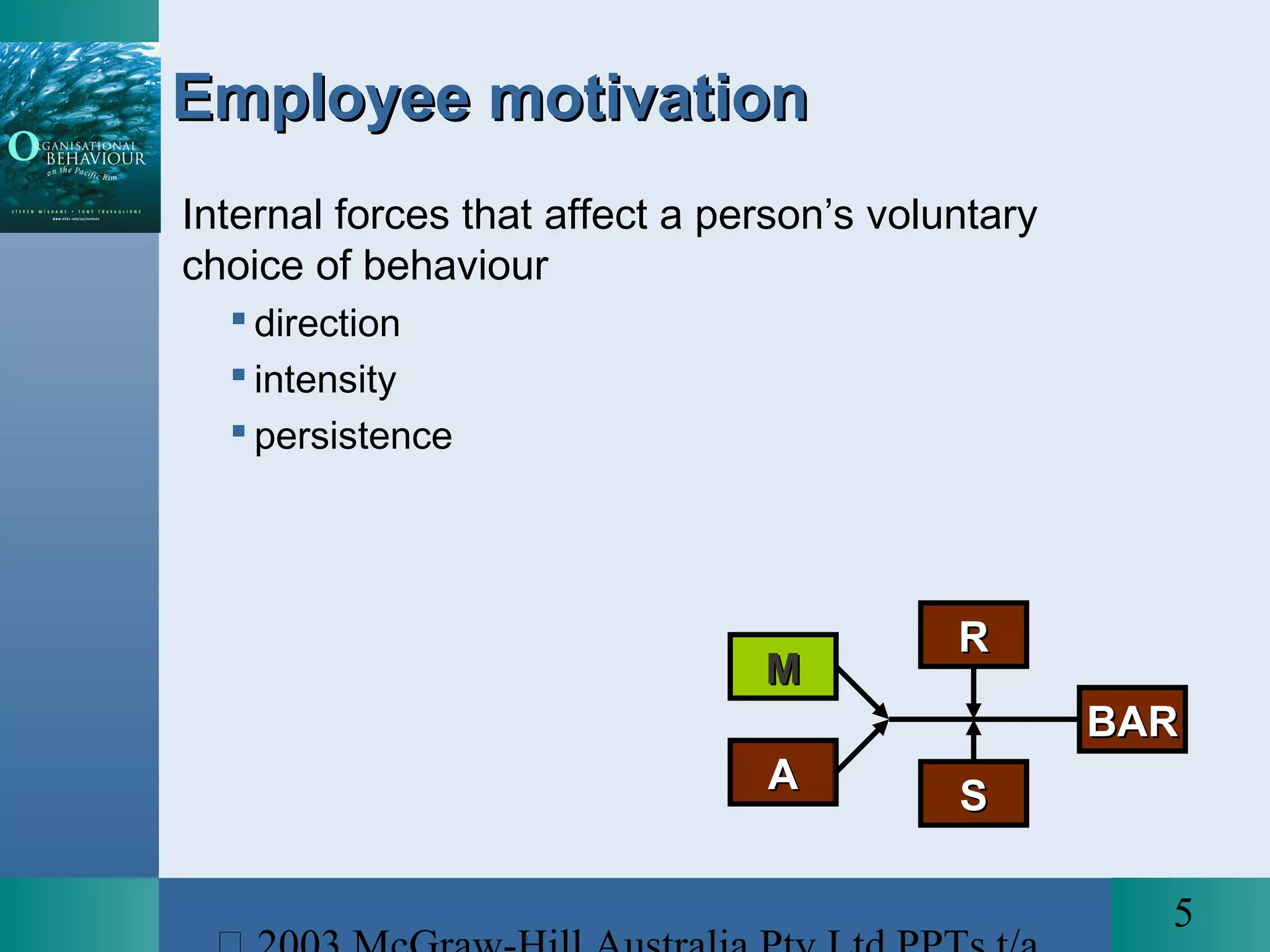
Employee motivationEmployee motivation
Internal forces that affect a person’s voluntary
choice of behaviour
 direction
 intensity
 persistence
MM
AA
RR
SS
BARBAR
6
MM
AA
RR
SS
BARBAR
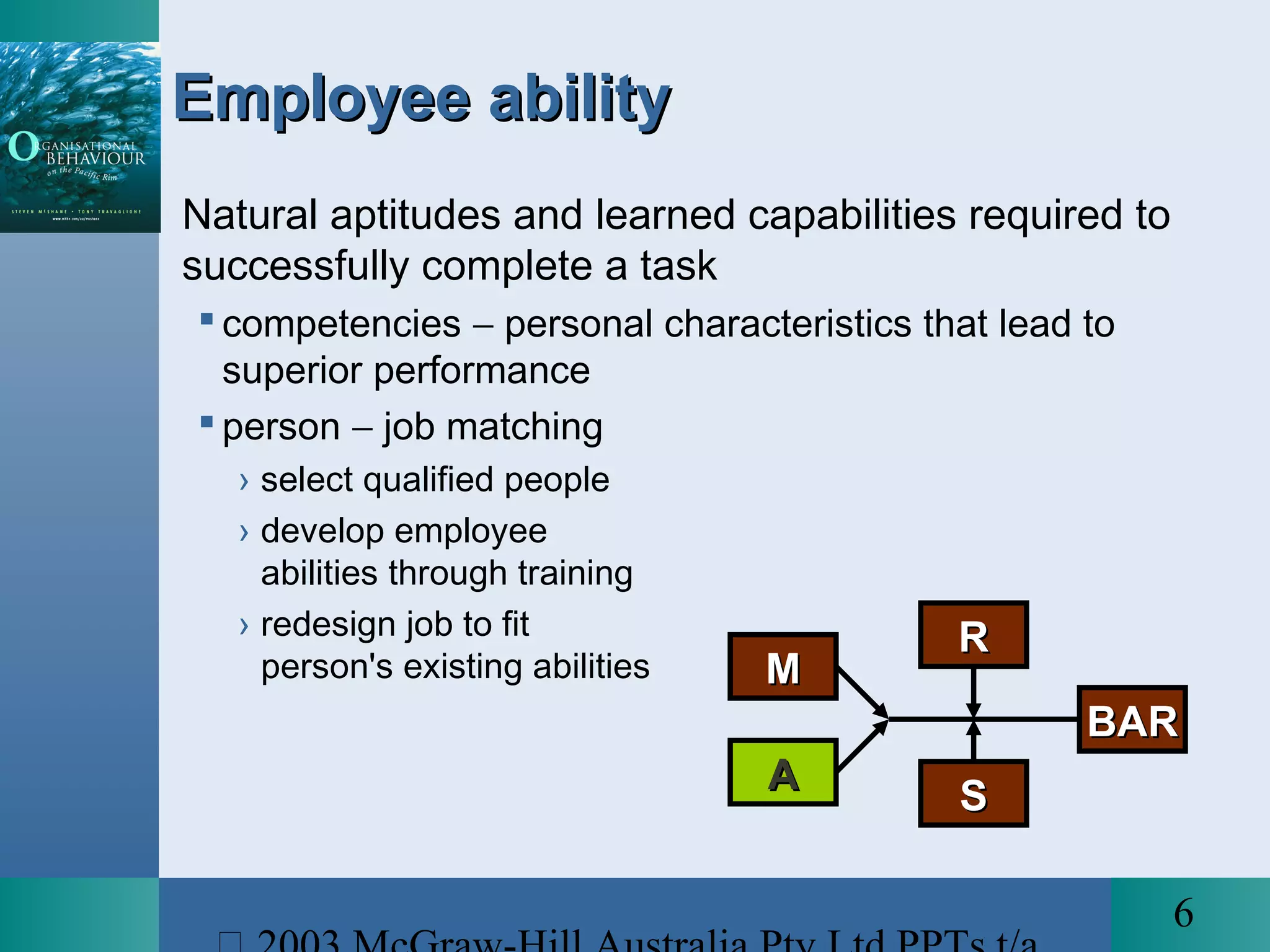
Employee abilityEmployee ability
Natural aptitudes and learned capabilities required to
successfully complete a task
 competencies − personal characteristics that lead to
superior performance
 person − job matching
› select qualified people
› develop employee
abilities through training
› redesign job to fit
person's existing abilities
7
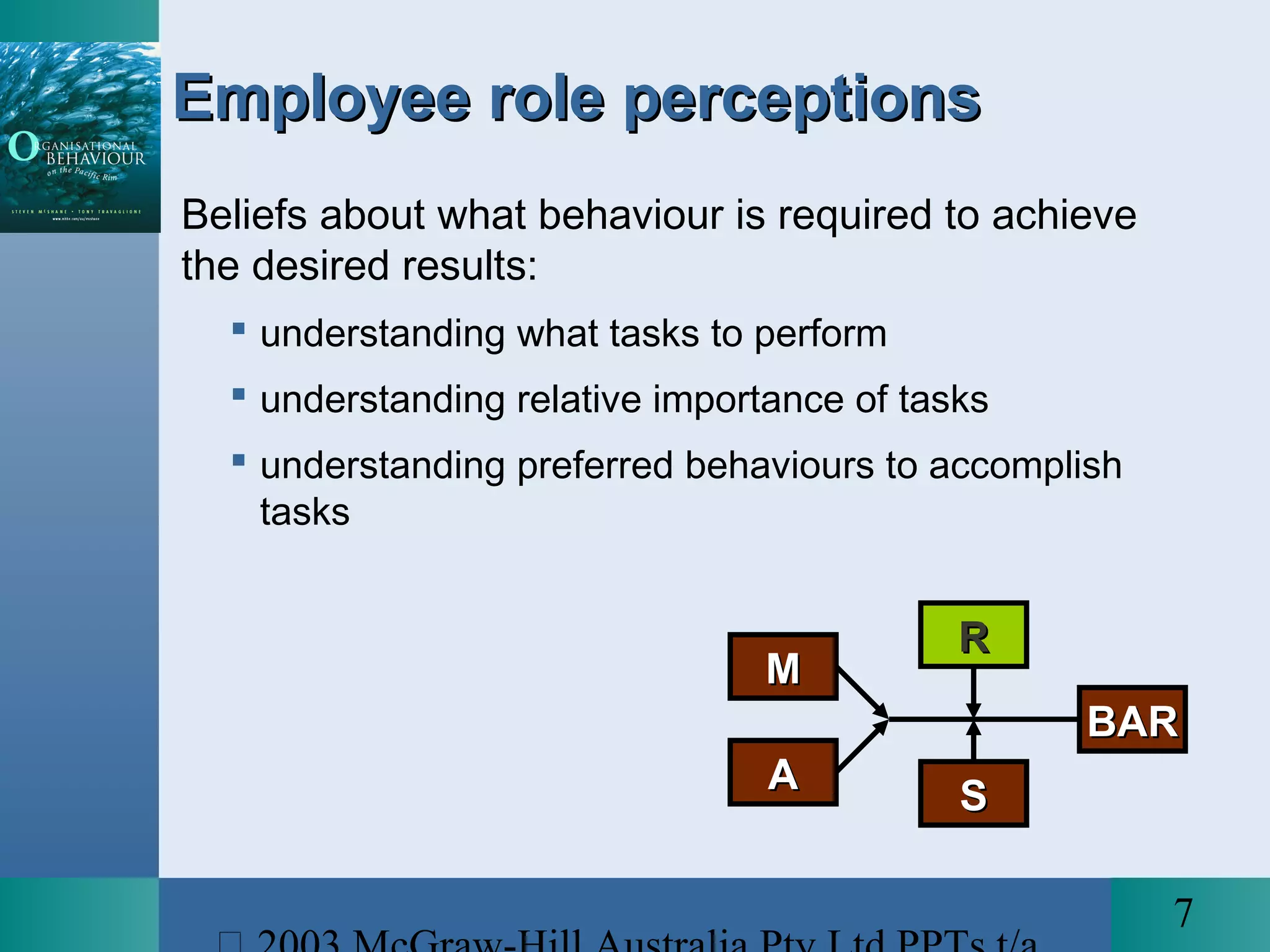
Employee role perceptionsEmployee role perceptions
Beliefs about what behaviour is required to achieve
the desired results:
 understanding what tasks to perform
 understanding relative importance of tasks
 understanding preferred behaviours to accomplish
tasks
MM
AA
RR
SS
BARBAR
8
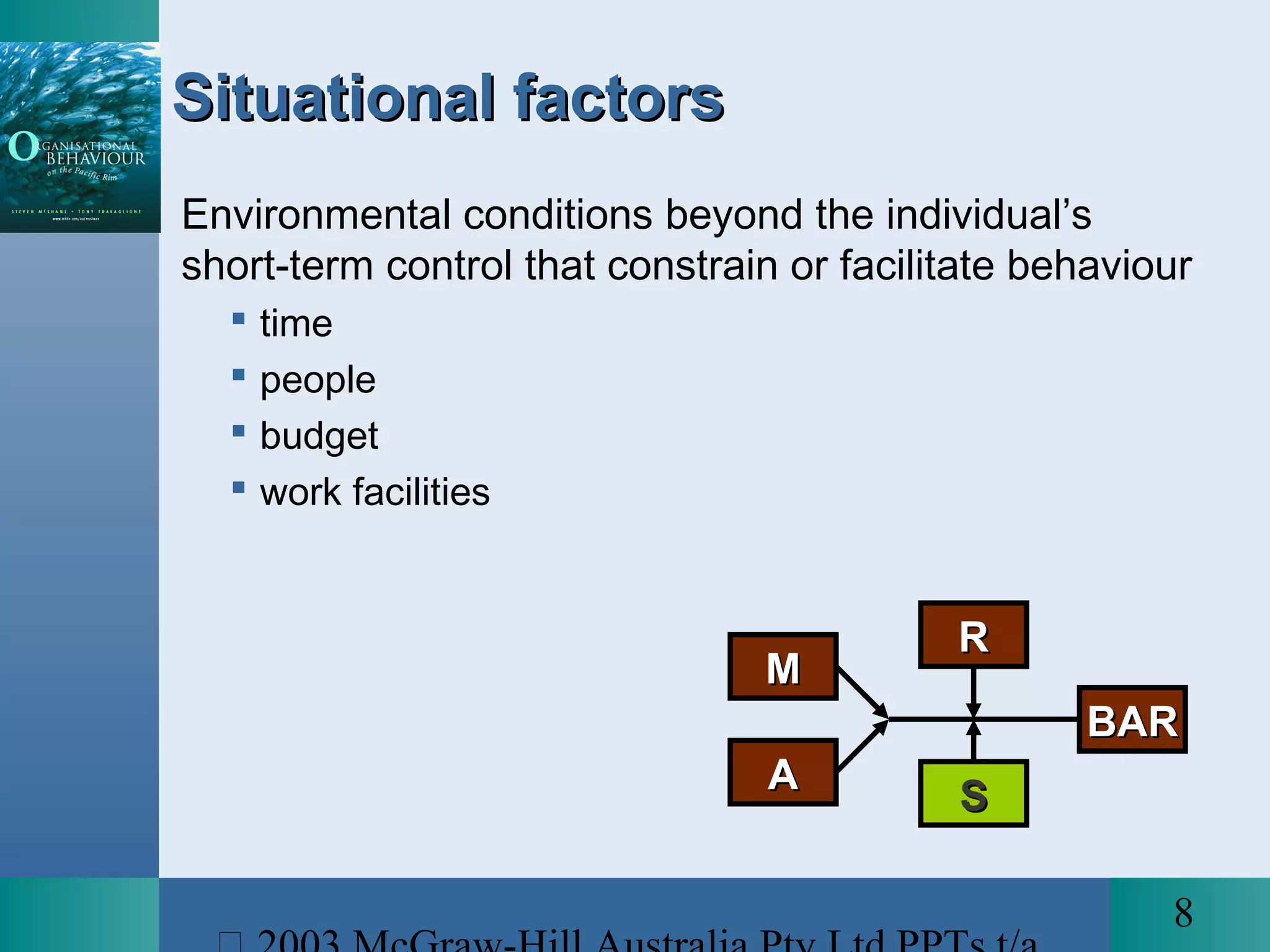
Situational factorsSituational factors
Environmental conditions beyond the individual’s
short-term control that constrain or facilitate behaviour
 time
 people
 budget
 work facilities
MM
AA
RR
SS
BARBAR
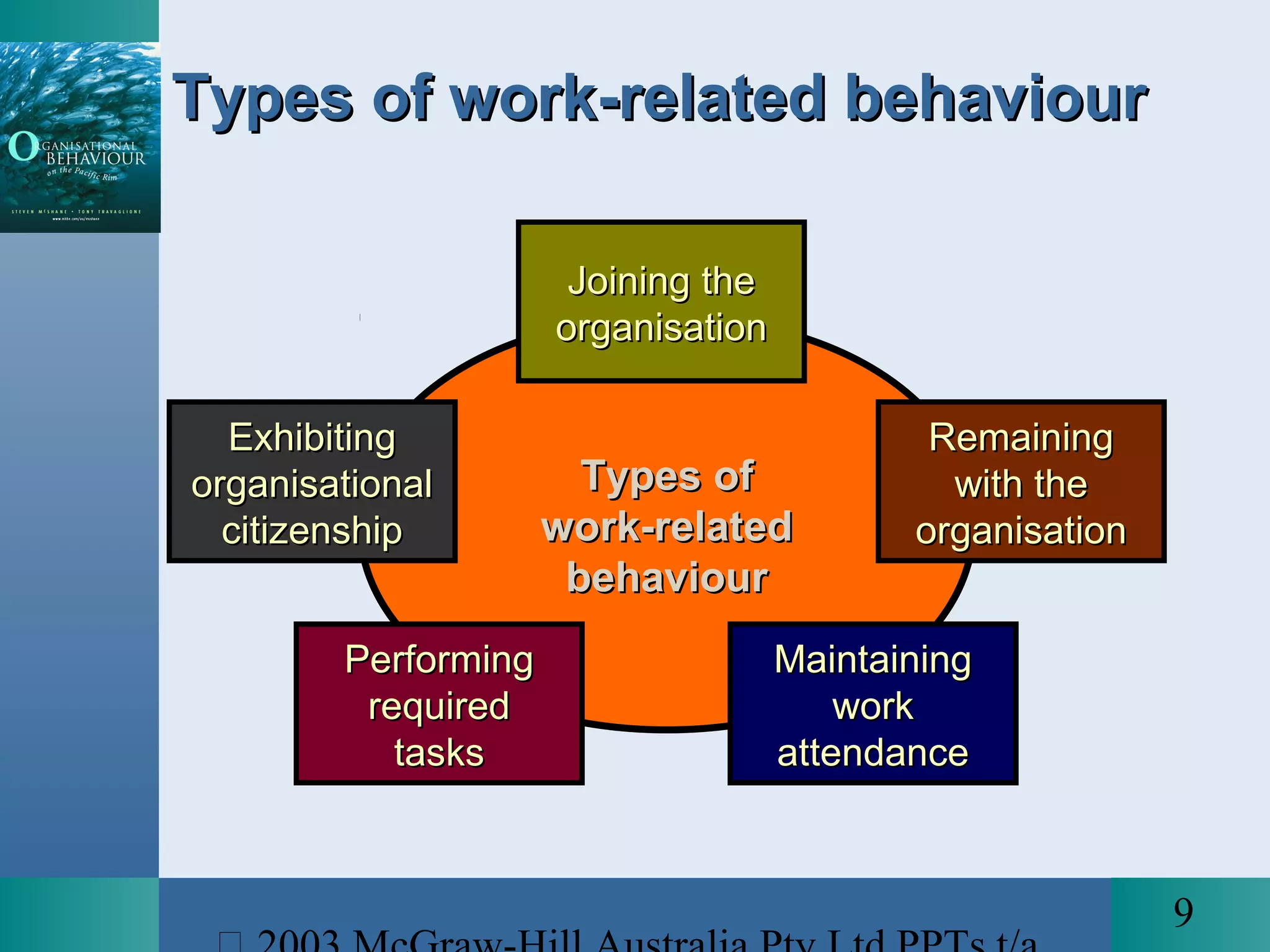
9
Types ofTypes of
work-relatedwork-related
behaviourbehaviour
Joining theJoining the
organisationorganisation
RemainingRemaining
with thewith the
organisationorganisation
MaintainingMaintaining
workwork
attendanceattendance
ExhibitingExhibiting
organisationalorganisational
citizenshipcitizenship
PerformingPerforming
requiredrequired
taskstasks
Types of work-related behaviourTypes of work-related behaviour
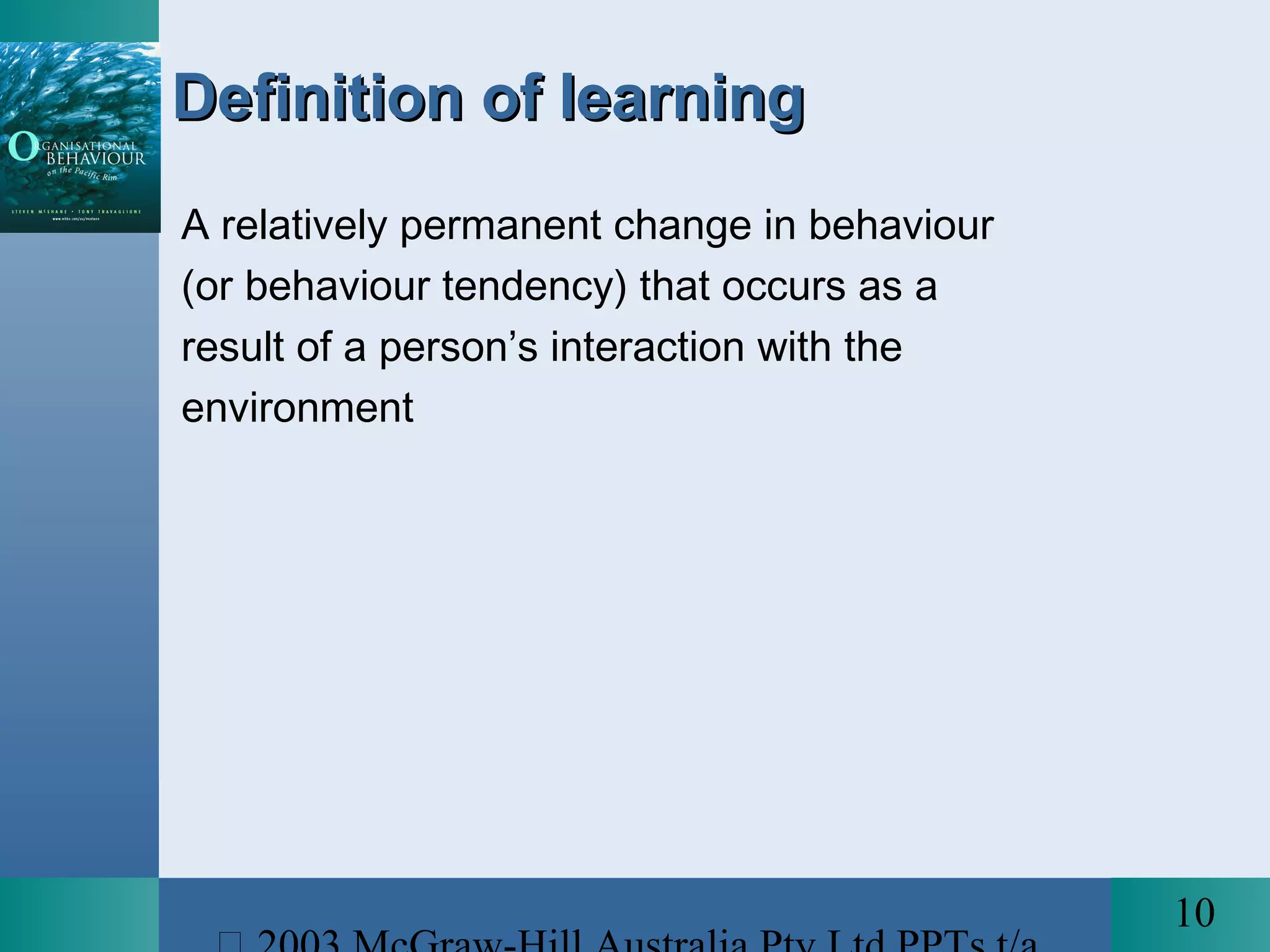
10
Definition of learningDefinition of learning
A relatively permanent change in behaviour
(or behaviour tendency) that occurs as a
result of a person’s interaction with the
environment
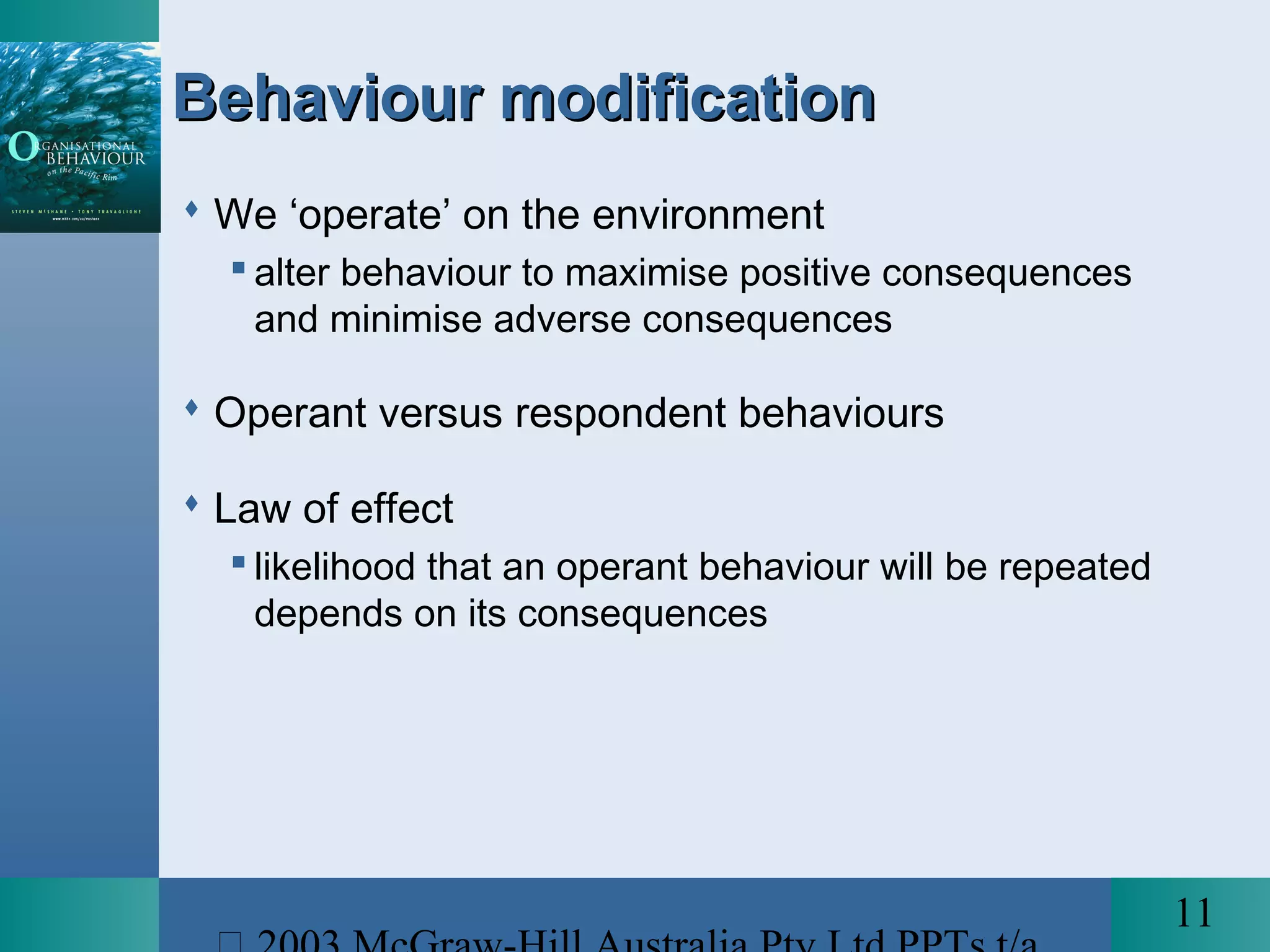
11
Behaviour modificationBehaviour modification
 We ‘operate’ on the environment
 alter behaviour to maximise positive consequences
and minimise adverse consequences
 Operant versus respondent behaviours
 Law of effect
 likelihood that an operant behaviour will be repeated
depends on its consequences
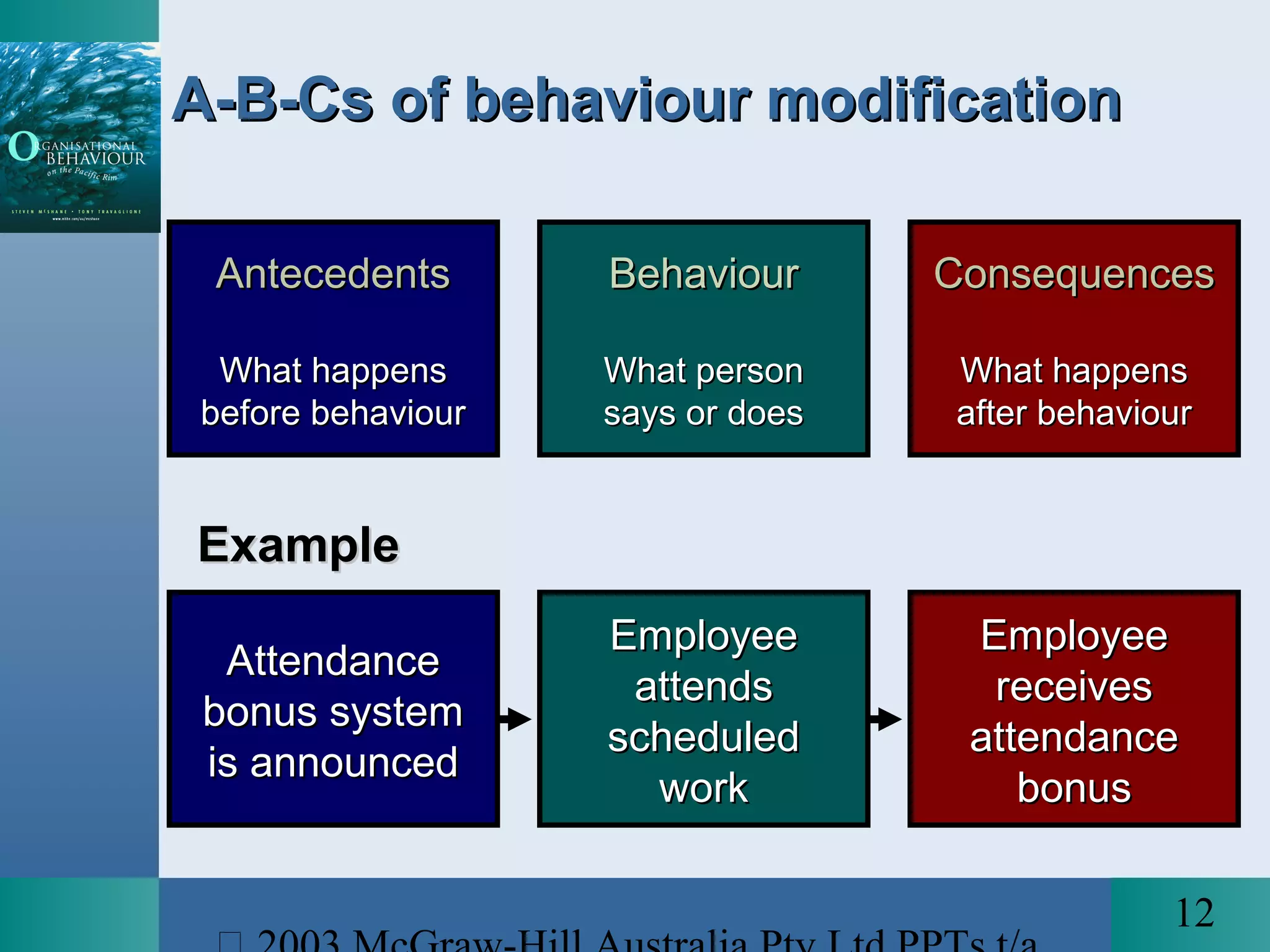
12
ConsequencesConsequences
What happensWhat happens
after behaviourafter behaviour
EmployeeEmployee
receivesreceives
attendanceattendance
bonusbonus
ExampleExample
A-B-Cs of behaviour modificationA-B-Cs of behaviour modification
BehaviourBehaviour
What personWhat person
says or doessays or does
EmployeeEmployee
attendsattends
scheduledscheduled
workwork
AntecedentsAntecedents
What happensWhat happens
before behaviourbefore behaviour
AttendanceAttendance
bonus systembonus system
is announcedis announced
13
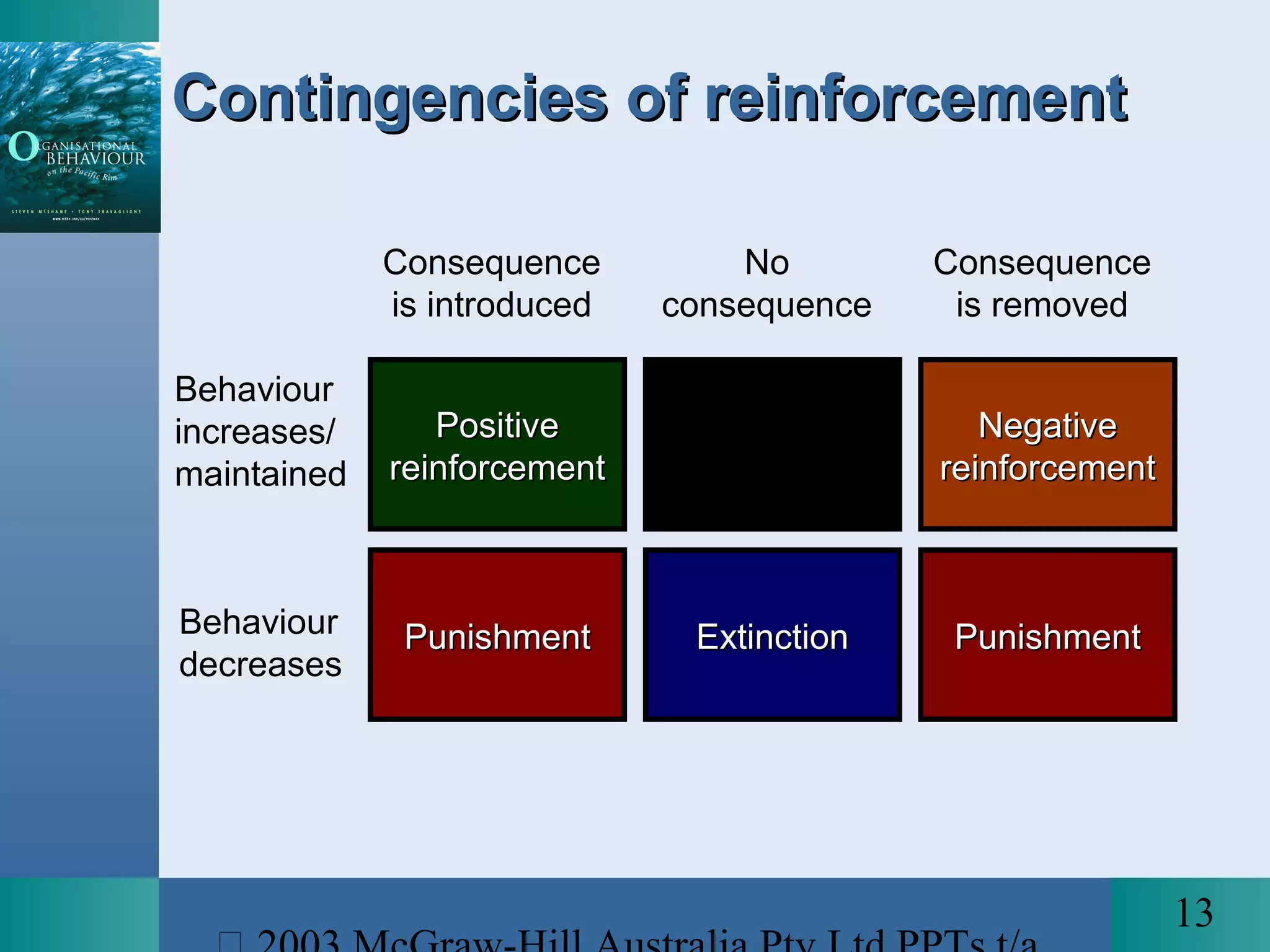
Behaviour
increases/
maintained
Behaviour
decreases
Consequence
is introduced
Consequence
is removed
Contingencies of reinforcementContingencies of reinforcement
PunishmentPunishment
PositivePositive
reinforcementreinforcement
ExtinctionExtinction PunishmentPunishment
NegativeNegative
reinforcementreinforcement
No
consequence
14
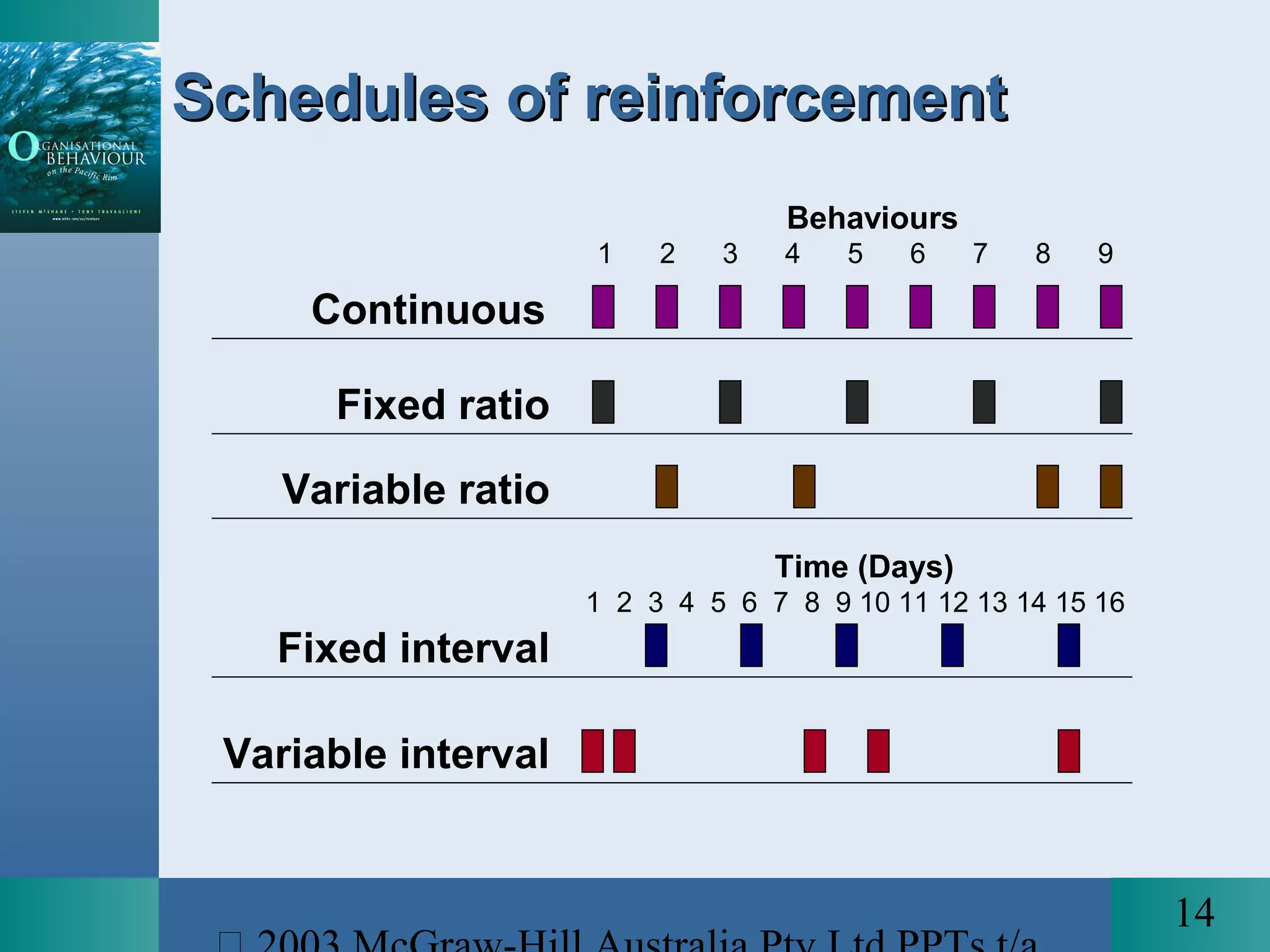
Schedules of reinforcementSchedules of reinforcement
Behaviours
1 2 3 4 5 6 7 8 9
Continuous
Fixed ratio
Variable ratio
Fixed interval
Time (Days)
1 2 3 4 5 6 7 8 9 10 11 12 13 14 15 16
Variable interval
15
Behaviour mod at Nova ChemicalsBehaviour mod at Nova Chemicals
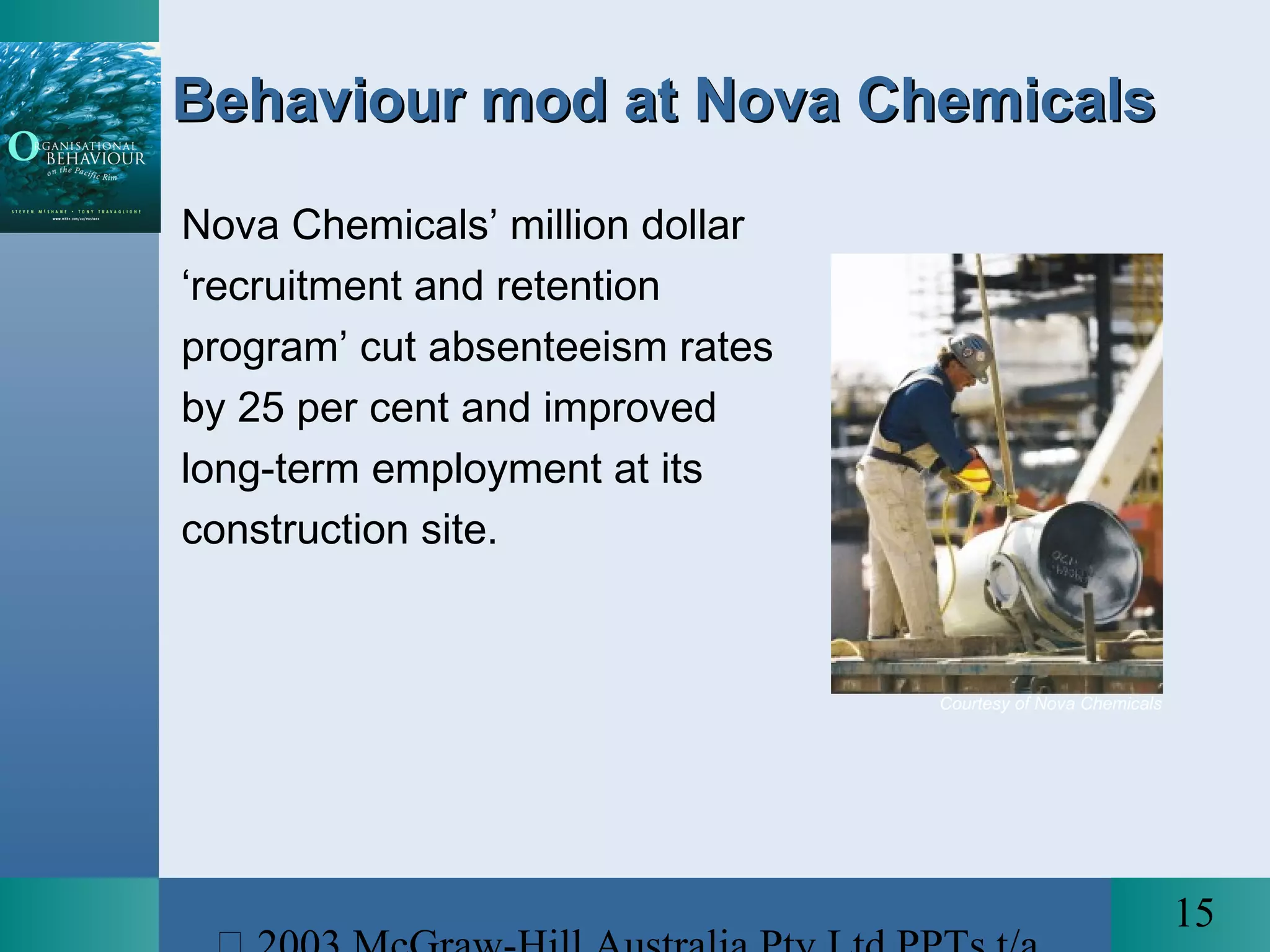
Nova Chemicals’ million dollar
‘recruitment and retention
program’ cut absenteeism rates
by 25 per cent and improved
long-term employment at its
construction site.
Courtesy of Nova Chemicals
16
Behaviour modification limitationsBehaviour modification limitations
 Can’t reinforce non-observable behaviour
 Reinforcer tends to wear off
 Variable ratio schedule is a form of gambling
 Ethical concerns about perceived manipulation
17
Learning through feedbackLearning through feedback
 Any information about consequences of our
behaviour
 Clarifies role perceptions
 Corrective feedback improves ability
 Positive feedback motivates future behaviour
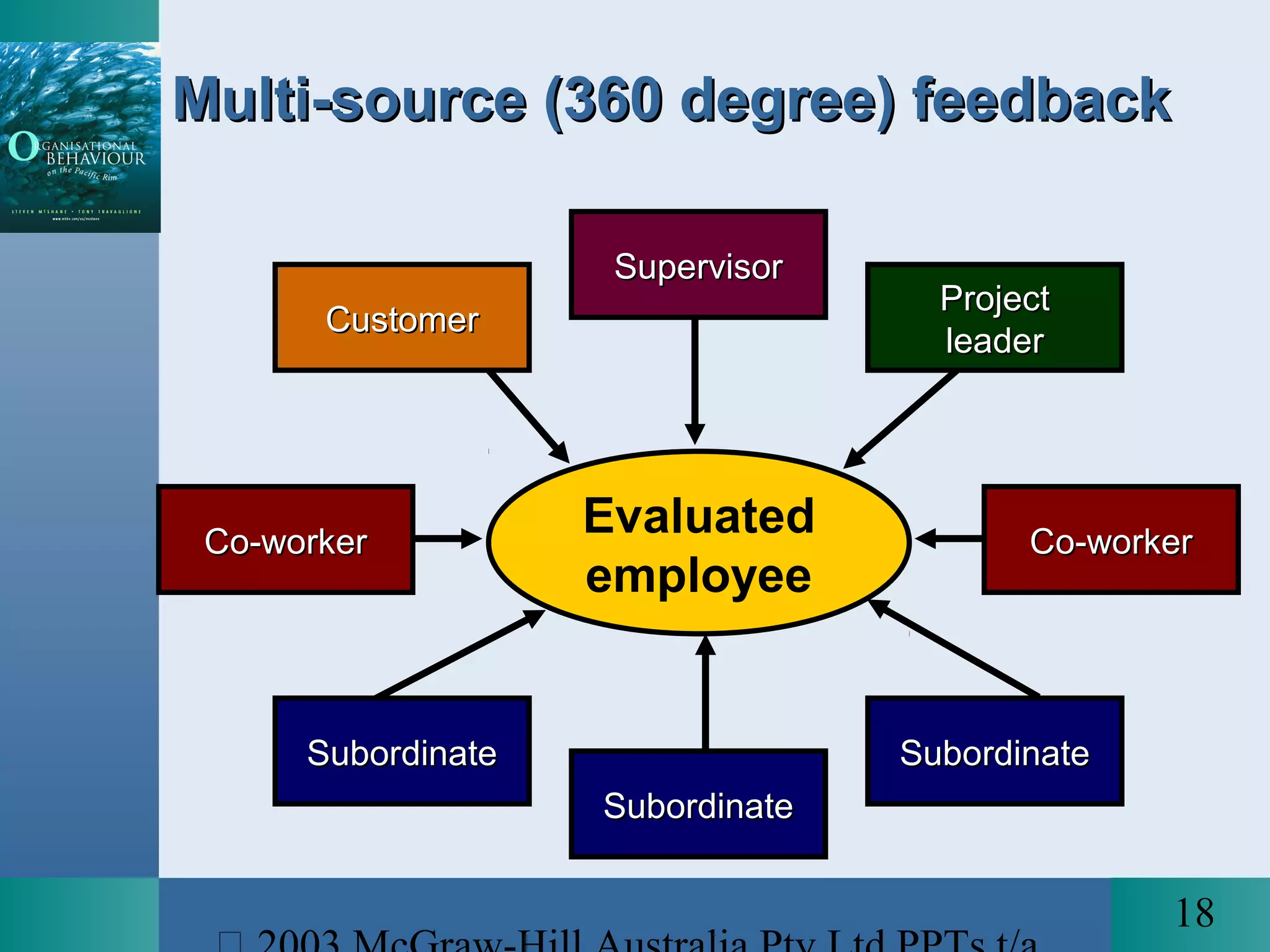
18
Evaluated
employee
Co-workerCo-worker
CustomerCustomer
SubordinateSubordinate
ProjectProject
leaderleader
SupervisorSupervisor
Co-workerCo-worker
SubordinateSubordinate
Multi-source (360 degree) feedbackMulti-source (360 degree) feedback
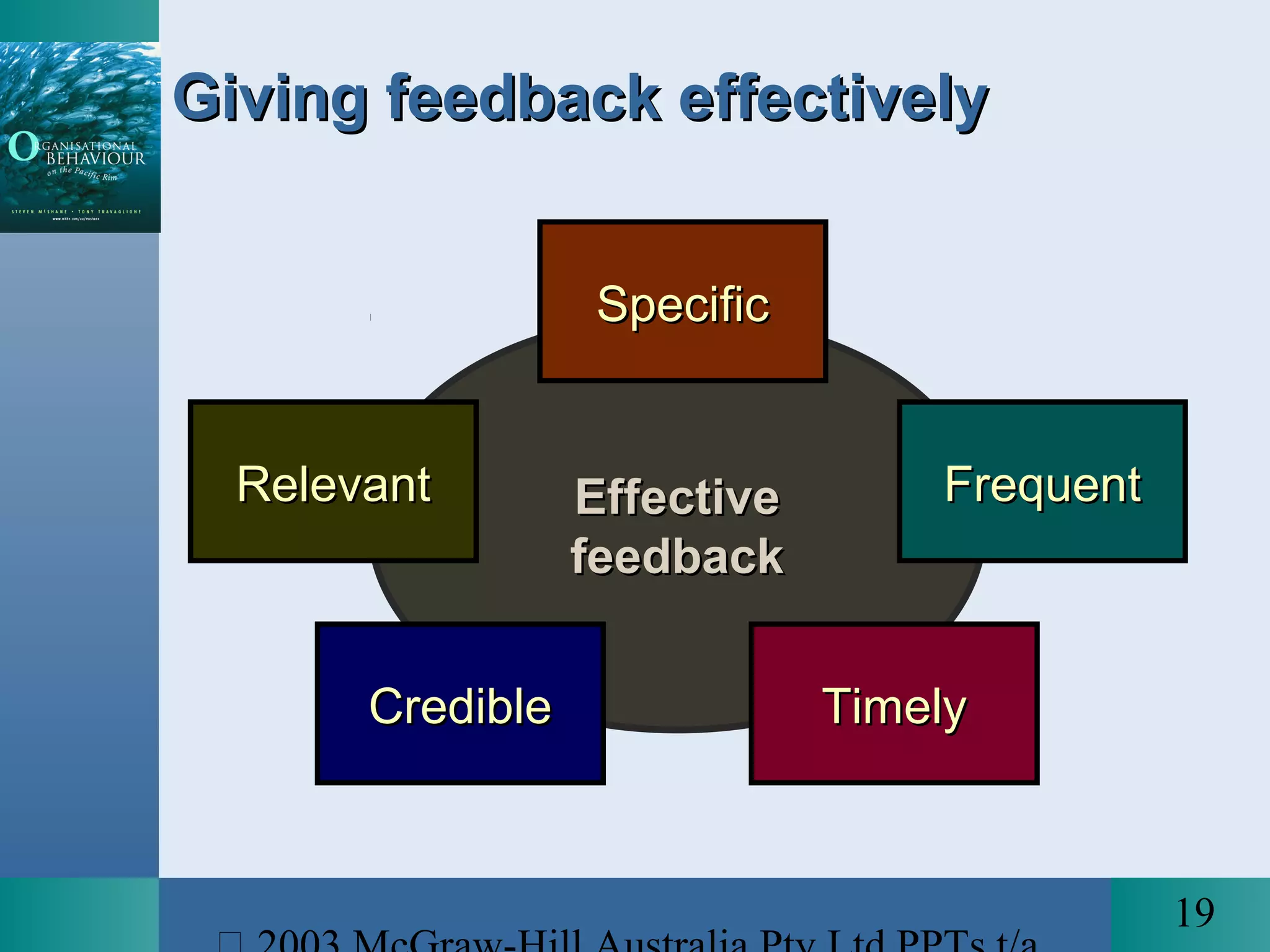
19
EffectiveEffective
feedbackfeedback
SpecificSpecific
FrequentFrequent
TimelyTimely
RelevantRelevant
CredibleCredible
Giving feedback effectivelyGiving feedback effectively
20
Social learning theorySocial learning theory
 Behavioural modelling
 observing and modelling behaviour of others
 Learning behaviour consequences
 observing consequences that others experience
 Self-reinforcement
 reinforcing our own behaviour with consequences
within our control
21
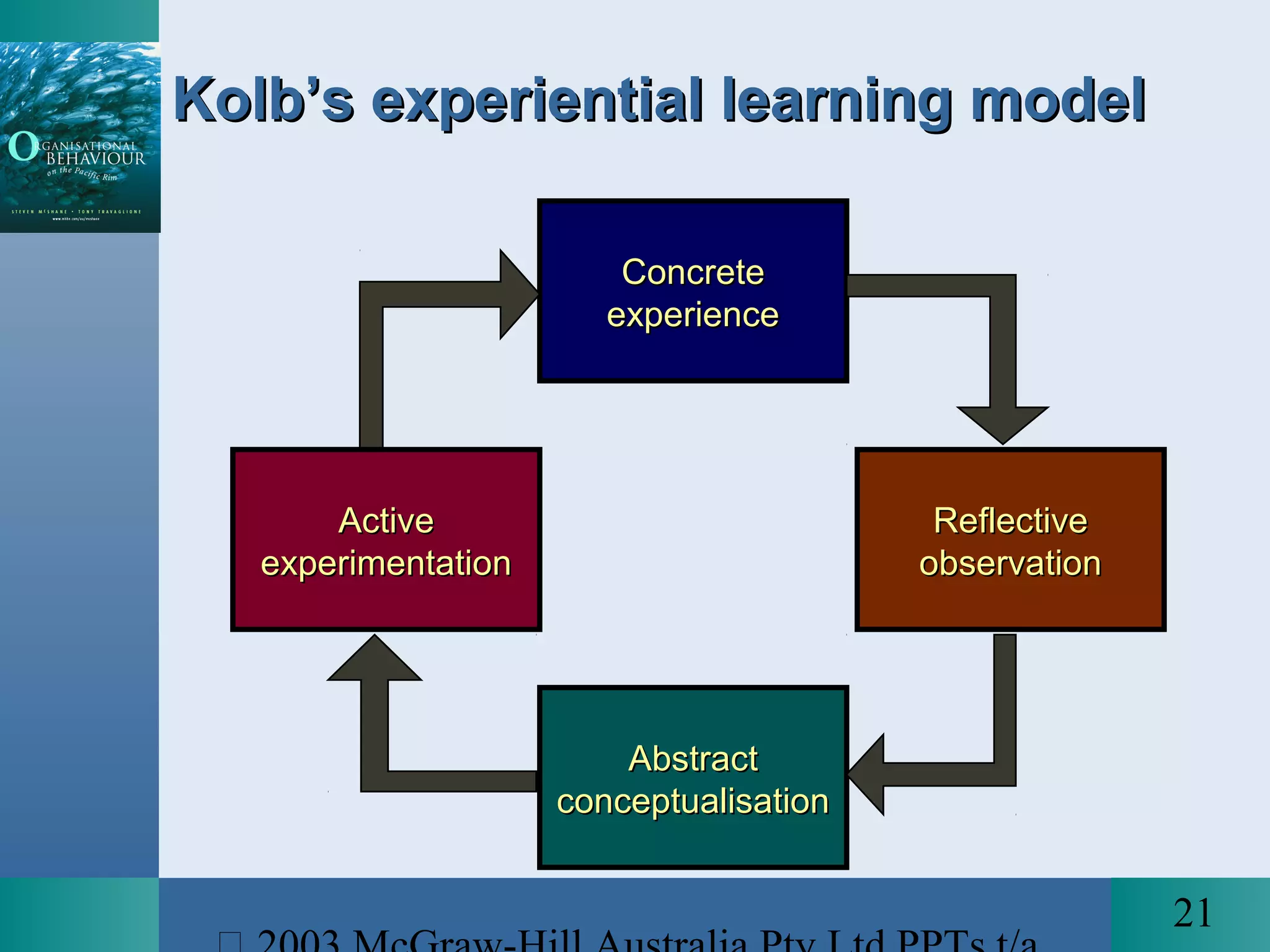
Kolb’s experiential learning modelKolb’s experiential learning model
ConcreteConcrete
experienceexperience
ReflectiveReflective
observationobservation
AbstractAbstract
conceptualisationconceptualisation
ActiveActive
experimentationexperimentation
22
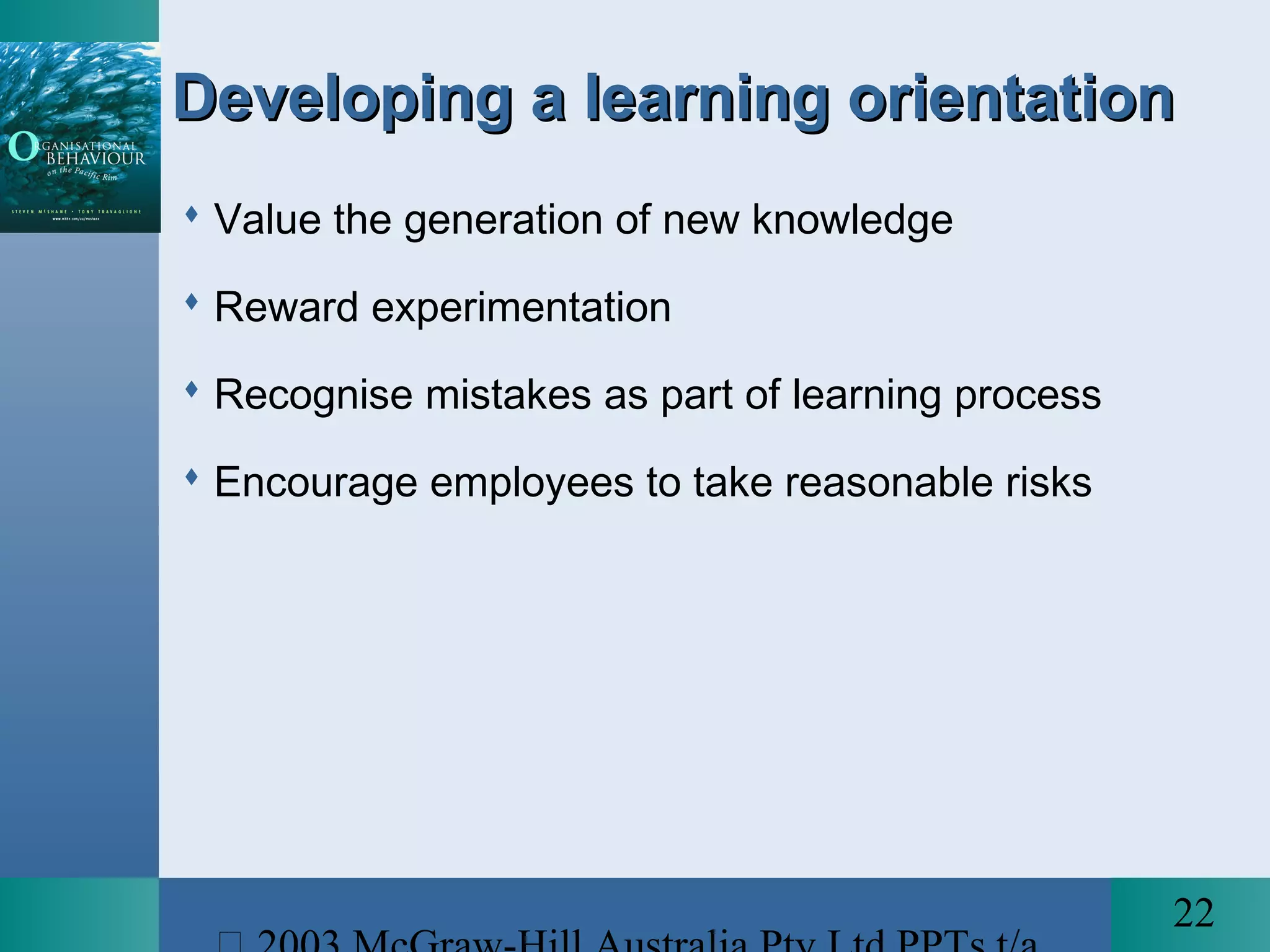
Developing a learning orientationDeveloping a learning orientation
 Value the generation of new knowledge
 Reward experimentation
 Recognise mistakes as part of learning process
 Encourage employees to take reasonable risks
23
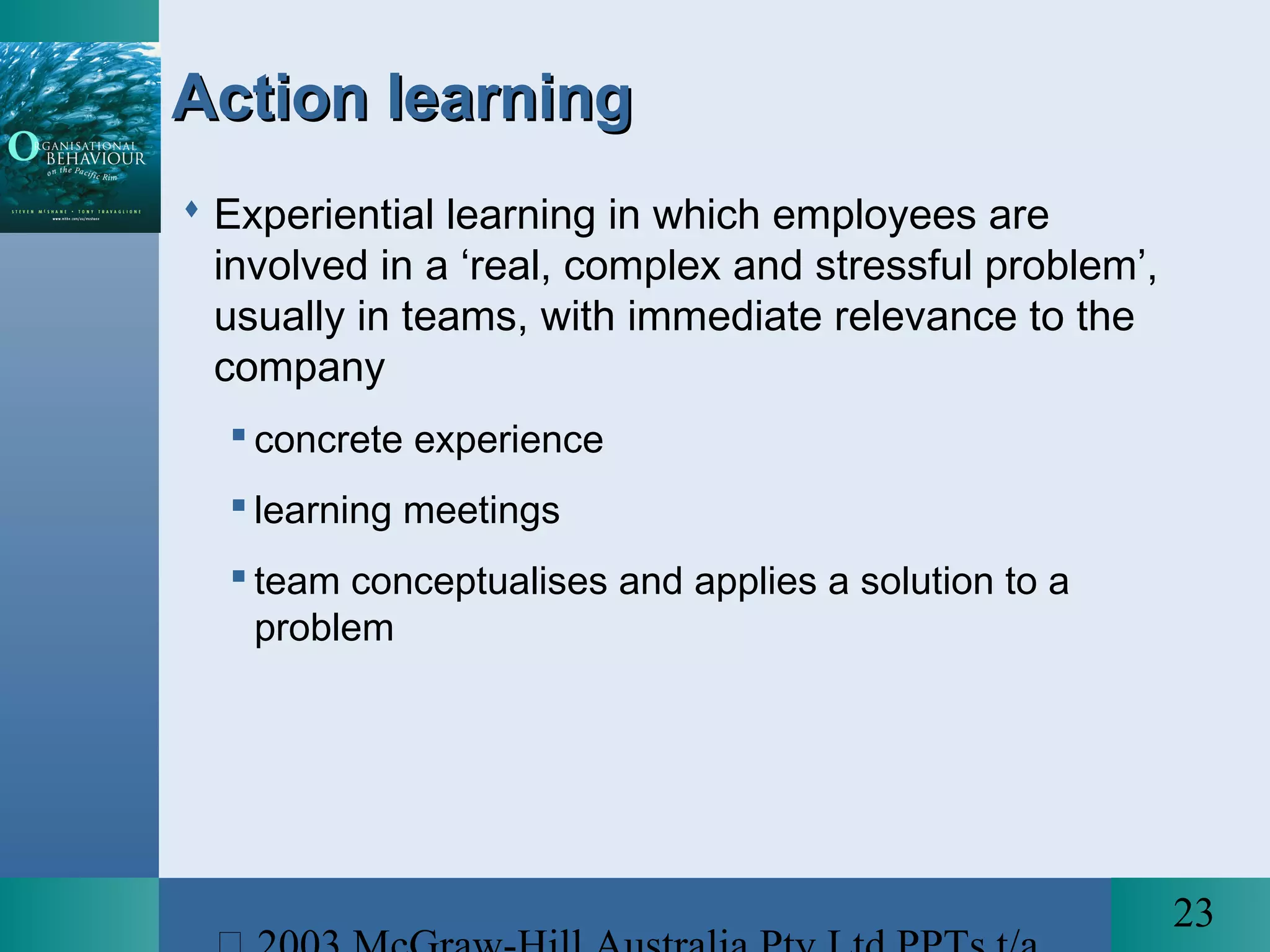
Action learningAction learning
 Experiential learning in which employees are
involved in a ‘real, complex and stressful problem’,
usually in teams, with immediate relevance to the
company
 concrete experience
 learning meetings
 team conceptualises and applies a solution to a
problem
24
Overview of the next chapterOverview of the next chapter
 Perceptual processes of selective attention and
social identity
 Stereotyping and attribution processes
 The self-fulfilling prophecy process
 Types of diversity initiatives
 How the Johari Window can improve our
perceptions
 The ‘Big Five’ personality dimensions
 The Myers-Briggs Type Indicator
© 2003 McGraw-Hill Australia Pty Ltd PPTs t/a Organisational Behaviour on the Pacific Rim by McShane and Travaglione
C H A P T E RC H A P T E R 22
IndividualIndividual
behaviour andbehaviour and
learning inlearning in
organisationsorganisations

Organizational Behavior CH 02

  • 1.
    © 2003 McGraw-HillAustralia Pty Ltd PPTs t/a Organisational Behaviour on the Pacific Rim by McShane and Travaglione C H A P T E RC H A P T E R 22 IndividualIndividual behaviour andbehaviour and learning inlearning in organisationsorganisations
  • 2.
    2 Chapter learning objectivesChapterlearning objectives 1. Describe the four factors that influence individual behaviour and performance. 2. Identify five types of work-related behaviour. 3. Define learning. 4. Describe the A-B-C model of behaviour modification. 5. Explain how feedback influences individual behaviour and performance. 6. Identify five elements of effective feedback. 7. Describe the three features of social learning theory. 8. Outline Kolb’s model of experiential learning.
  • 3.
    3 Customer service atSingapore AirCustomer service at Singapore Air Singapore Airlines provides exceptional customer service by paying attention to the four drivers of individual behaviour and performance: motivation, ability, role perceptions and situational factors (MARS). Courtesy of Singapore Airlines
  • 4.
    4 MotivationMotivation IndividualIndividual behaviour andbehaviour and performanceperformance MARSmodel of behaviour and performanceMARS model of behaviour and performance RoleRole perceptionsperceptions SituationalSituational factorsfactors AbilityAbility
  • 5.
    5 Employee motivationEmployee motivation Internalforces that affect a person’s voluntary choice of behaviour  direction  intensity  persistence MM AA RR SS BARBAR
  • 6.
    6 MM AA RR SS BARBAR Employee abilityEmployee ability Naturalaptitudes and learned capabilities required to successfully complete a task  competencies − personal characteristics that lead to superior performance  person − job matching › select qualified people › develop employee abilities through training › redesign job to fit person's existing abilities
  • 7.
    7 Employee role perceptionsEmployeerole perceptions Beliefs about what behaviour is required to achieve the desired results:  understanding what tasks to perform  understanding relative importance of tasks  understanding preferred behaviours to accomplish tasks MM AA RR SS BARBAR
  • 8.
    8 Situational factorsSituational factors Environmentalconditions beyond the individual’s short-term control that constrain or facilitate behaviour  time  people  budget  work facilities MM AA RR SS BARBAR
  • 9.
    9 Types ofTypes of work-relatedwork-related behaviourbehaviour JoiningtheJoining the organisationorganisation RemainingRemaining with thewith the organisationorganisation MaintainingMaintaining workwork attendanceattendance ExhibitingExhibiting organisationalorganisational citizenshipcitizenship PerformingPerforming requiredrequired taskstasks Types of work-related behaviourTypes of work-related behaviour
  • 10.
    10 Definition of learningDefinitionof learning A relatively permanent change in behaviour (or behaviour tendency) that occurs as a result of a person’s interaction with the environment
  • 11.
    11 Behaviour modificationBehaviour modification We ‘operate’ on the environment  alter behaviour to maximise positive consequences and minimise adverse consequences  Operant versus respondent behaviours  Law of effect  likelihood that an operant behaviour will be repeated depends on its consequences
  • 12.
    12 ConsequencesConsequences What happensWhat happens afterbehaviourafter behaviour EmployeeEmployee receivesreceives attendanceattendance bonusbonus ExampleExample A-B-Cs of behaviour modificationA-B-Cs of behaviour modification BehaviourBehaviour What personWhat person says or doessays or does EmployeeEmployee attendsattends scheduledscheduled workwork AntecedentsAntecedents What happensWhat happens before behaviourbefore behaviour AttendanceAttendance bonus systembonus system is announcedis announced
  • 13.
    13 Behaviour increases/ maintained Behaviour decreases Consequence is introduced Consequence is removed Contingenciesof reinforcementContingencies of reinforcement PunishmentPunishment PositivePositive reinforcementreinforcement ExtinctionExtinction PunishmentPunishment NegativeNegative reinforcementreinforcement No consequence
  • 14.
    14 Schedules of reinforcementSchedulesof reinforcement Behaviours 1 2 3 4 5 6 7 8 9 Continuous Fixed ratio Variable ratio Fixed interval Time (Days) 1 2 3 4 5 6 7 8 9 10 11 12 13 14 15 16 Variable interval
  • 15.
    15 Behaviour mod atNova ChemicalsBehaviour mod at Nova Chemicals Nova Chemicals’ million dollar ‘recruitment and retention program’ cut absenteeism rates by 25 per cent and improved long-term employment at its construction site. Courtesy of Nova Chemicals
  • 16.
    16 Behaviour modification limitationsBehaviourmodification limitations  Can’t reinforce non-observable behaviour  Reinforcer tends to wear off  Variable ratio schedule is a form of gambling  Ethical concerns about perceived manipulation
  • 17.
    17 Learning through feedbackLearningthrough feedback  Any information about consequences of our behaviour  Clarifies role perceptions  Corrective feedback improves ability  Positive feedback motivates future behaviour
  • 18.
  • 19.
  • 20.
    20 Social learning theorySociallearning theory  Behavioural modelling  observing and modelling behaviour of others  Learning behaviour consequences  observing consequences that others experience  Self-reinforcement  reinforcing our own behaviour with consequences within our control
  • 21.
    21 Kolb’s experiential learningmodelKolb’s experiential learning model ConcreteConcrete experienceexperience ReflectiveReflective observationobservation AbstractAbstract conceptualisationconceptualisation ActiveActive experimentationexperimentation
  • 22.
    22 Developing a learningorientationDeveloping a learning orientation  Value the generation of new knowledge  Reward experimentation  Recognise mistakes as part of learning process  Encourage employees to take reasonable risks
  • 23.
    23 Action learningAction learning Experiential learning in which employees are involved in a ‘real, complex and stressful problem’, usually in teams, with immediate relevance to the company  concrete experience  learning meetings  team conceptualises and applies a solution to a problem
  • 24.
    24 Overview of thenext chapterOverview of the next chapter  Perceptual processes of selective attention and social identity  Stereotyping and attribution processes  The self-fulfilling prophecy process  Types of diversity initiatives  How the Johari Window can improve our perceptions  The ‘Big Five’ personality dimensions  The Myers-Briggs Type Indicator
  • 25.
    © 2003 McGraw-HillAustralia Pty Ltd PPTs t/a Organisational Behaviour on the Pacific Rim by McShane and Travaglione C H A P T E RC H A P T E R 22 IndividualIndividual behaviour andbehaviour and learning inlearning in organisationsorganisations