Clay Chemistry
Unit -3
2
Content
• Clay chemistry and its application to drilling fluids
• Types of Clay
• Hydration
• Flocculation
• Aggregation
• Dispersion
3
Importance of studying clay mineralogy
• Clay provides the colloidal base for all aqueous muds and oil-base mud
• Drilling cuttings from argillaceous formation changes properties of drilling fluid
• Stability of borehole depends on interaction between drilling fluids and exposed shale
• Clay content on drilling fluid may contaminate the formation and affects productivity
• Commercial clay used for drilling fluid is Wyoming bentonite (yield 100 bbl/ton when
used with pure water)
4
Characteristics of Colloidal System
• What do you mean by Colloids?
• Particle whose size fall roughly between smallest particle seen through
microscope and molecules
• Colloidal system: consist of solids dispersed in liquids (Clay suspensions), liquid
droplets dispersed in liquids (e.g. emulsion), or solids dispersed in gases (e.g.,
smoke).
• Aqueous colloidal systems is that particle, so small that they kept in suspension
indefinitely by bombardment of water molecules, a phenomena known as the
Brownian movement.
• The movement of the particle can be seen by light reflected from them and
observed against dark background in the ultramicroscope.
5
Brownian motion
6
Characteristics of Colloidal System
• The particles are so small that properties like
viscosity and sedimentation velocity are controlled
by surface phenomena.
• Surface phenomena occur because molecules in the
surface layer are not in electrostatic balance
• The surface carries an electrostatic charge, the size
and sign of which depends on the coordination of
the atoms on both sides of the interface.
• Some substances, notably clay minerals, carry an
unusually high surface potential because of certain
deficiencies in their atomic structure
7
Characteristics of Colloidal System
• The greater the degree of subdivision of a solid, the greater will be its surface area
per unit weight, and therefore the greater will be the influence of the
surface phenomena.
• For example, a cube with sides one mm long would have a total surface area of 6mm2
. If
it were subdivided into cubes with one micron sides (1 micron = 1 x 10⁻³
mm) there
would be 109
cubes, each with a surface area of 6 x 10⁻⁶
mm2
, and the total surface area
would be 6 x 10³
mm2
.
• Subdivided again into milli-micron cubes, the total surface area would be 6 x 10⁶
mm2,
or 6 square meters.
• The ratio of surface area per unit weight of particles is called the specific surface. Thus if
a 1 cm3
cube were divided into micron sized cubes, the specific surface would be 6 x 10⁶
/72.7 = 2.2 x 10⁶
mm2
/g = 2.2 m2
/g, assuming the specific gravity of the cube to be 2.7.
8
Characteristics of Colloidal System
• Specific surface versus cube size
• To put the values in perspective, the size of various
particles, expressed in equivalent spherical radii
(esr), are shown at the top.
• The esr of a particle is the radius of a sphere that
would have the same sedimentation rate as the
particle.
• The esr may be determined by applying Stokes'
Law to the measured sedimentation rate.
Figure: Specific surface of cubes. Assuming specific gravity of 2.7
9
10
Clay Minerals
• General Characteristics
• Small particle size
• Plastic across range of water contents
• High dry strength
• Potential for shrink/swell
• High resistance to weathering
• Particle have net negative charge
11
Clay Mineralogy
• A science dealing with structure of clay minerals on microscopic,
molecular and atomic scale is called Clay Mineralogy.
• It includes study of the mineralogical composition and electrical
properties of the particles.
• The most significant properties of clay depend upon the type of
mineral.
• There are three types of clay minerals:
• Kaolinite clay
• Montomorillonite Clay
• Illite clay
12
Clay Mineralogy
• Kaolinite clay
• Montomorillonite Clay
• Illite clay
Kaolinite clay Montomorillonite Clay Illite clay
There are three types of clay minerals:
13
Basic structures of clay minerals
1. Silica tetrahedral sheet
2. Aluminium octahedron sheet or also called as gibbsite
Silica tetrahedral aluminium octahedron
14
Basic structures of clay minerals
1. Silica tetrahedral sheet
Silica tetrahedral
15
Basic structures of clay minerals
1. Silica tetrahedral sheet
2. Aluminium octahedron sheet
or also called as gibbsite
aluminium octahedron
16
Structural arrangement
• The unit layers are stacked together face-
to-face to form what is known as
the crystal lattice.
• The distance between a plane in one layer
and the corresponding plane in the next
layer is called either the c spacing, or the
basal spacing.
• This spacing is 9.2 Angstoms* for the
standard three-layer mineral, and 7.2 A for
a two-layer mineral.
17
Example of structural arrangement
18
Classification of clays
1. Kaolinite Clay
• The basic unit of this type of clay is formed by
atomic bond of the unsatisfied face of silica sheet
and face of aluminum sheet (Gibbsite)
• The bond between two sheets is strong and is
primary bond (H+
Bond).
Kaolinite clay
Ratio- Si: Gi (1:1)
19
Classification of clays
1. Kaolinite Clay
• Atomic structure of Kaolinite
20
1. Kaolinite Clay
• The hydrogen bond is very strong bond
because of that, it shows less/no swelling
and shrinkage Behavior
• It is least active clay minerals. Example:
China soil, application paper, rubber,
paint.
• The thickness of one unit is about 7.2
angstrom.
• SEM (Scanning Electron Microscope)
image of kaolinite clay is illustrated in
Figure.
SEM image of Kaolinite clay
21
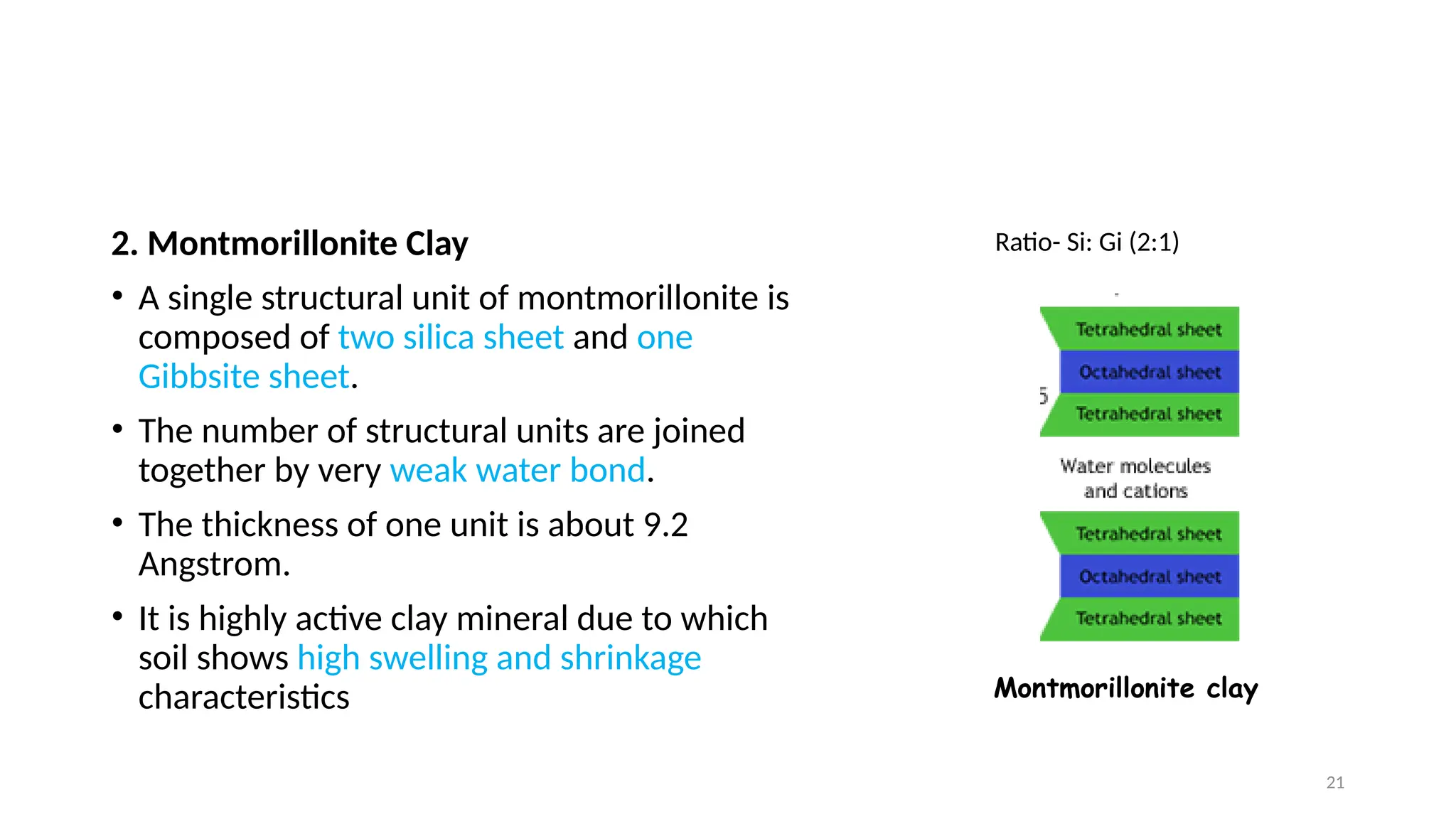
2. Montmorillonite Clay
• A single structural unit of montmorillonite is
composed of two silica sheet and one
Gibbsite sheet.
• The number of structural units are joined
together by very weak water bond.
• The thickness of one unit is about 9.2
Angstrom.
• It is highly active clay mineral due to which
soil shows high swelling and shrinkage
characteristics Montmorillonite clay
Ratio- Si: Gi (2:1)
22
Montmorillonite Clay
Atomic structure of Montmorillionite Clay
23
Montmorillonite Clay
• The link is due to natural attraction for the
cations in the intervening space and due to
Vander Waal forces.
• The negatively charged surfaces of the silica
sheet attract water in the space between
two structural units. This results in an
expansion of the mineral.
• The soil containing a large amount of the
mineral montmorillonite exhibits high
shrinkage and swelling characteristics.
SEM image of Montmorillonite clay
24
Illite Clay
• Basic structure of this clay is the same as the one of
montmorillonite.
• A single structure unit of illite is composed of two silica
sheet and one alumina sheet.
• The alumina sheet is sandwiched between two silica
sheet.
• The number of structural units are joined together by
Ionic bond (K+ potassium Ion bond)
• The potassium ion bond is weaker then hydrogen bond
• It shows medium swelling and shrinkage characteristics
• Medium active
Illite clay
Ratio- Si: Gi (2:1)
25
Illite Clay
• Atomic structure
26
Illite Clay
• The thickness of 1 unit is 10 Angstrom
• The characteristics of this clay are classified as in
between those of kaolinite and montmorillonite.
• SEM image is shown in Figure
SEM image of Illite clay
27
Brucite is the mineral form of magnesium hydroxide,
with the chemical formula Mg(OH)2.
28
Characteristics comparison
Let, A be Kaolinite
B be illite
C be montmoriollonite
1. Swelling and shrinkage characteristics: A<B<C
2. Strength of bond between structural units: C<B<A
3. Plasticity/plasticity index : A<B<C
4. Grain size: C<b<A
29
Clay shapes and surface areas
• Clays are formed in stack of several layers of basic sheet units.
• Clays are generally flat and smaller in size, so, their surface areas per
weight are very large.
30
Origin and occurrence of clay minerals
• Clay minerals originate from the degradation of igneous rocks in situ.
• The parent minerals are the micas, the feldspars, [(CaO) (K20)Al2036Si02]; and
ferromagnesium minerals, such as horneblende [(Ca, Na2
)2 (Mg, Fe, Al)s (Al, Si)8022
(OH,F)2]
• Bentonite is formed by the weathering of volcanic ash.
• Bentonite was originally defined as a clay produced by in situ alteration of volcanic ash
to montmorillonite
• The main factors are climate, topography, vegetation, and time of exposure.
31
32
Ion Exchange
• Cations are adsorbed on the basal surfaces of clay crystals.
• In aqueous suspension, ions on clay may exchange with ions in
the bulk solution.
• The exchange reaction is governed primarily by the relative
concentration of the different species of ions in each phase, as
expressed by the law of mass action.
• For example, for two species of monovalent ions, the equation
maybe written:
33
Ion Exchange
• Where [A]s and [B]s are the molecular concentration of the two species of ions in
the solution, and [A]c and [B]c are those on the clay.
• K is the ion exchange equilibrium constant
• Example: when K is greater than unity, A is preferentially adsorbed.
34
Ion Exchange
• When two ions of different valencies are present, the one with the higher valence is
generally adsorbed preferentially.
• The order of preference usually is:
• Note: Hydrogen is strongly adsorbed, and therefore pH has strong influence on the base
exchange reaction.
35
Illustration of the cation exchange between
vine roots and surrounding soil particles
(Source: bio1903.nicerweb.com)
36
Ion Exchange
• The total amount of cations adsorbed, expressed in milliequivalents per hundred
grams of dry clay, is called the base exchange capacity (BEC), or the cation
exchange capacity (CEC).
• The value of the BEC varies considerably, even within each clay mineral group.
• Within montmorillonite and illite, the basal surfaces account for some 80% of the
BEC.
• With kaolinite, the broken bonds at the crystal edges account for most of the BEC.
37
38
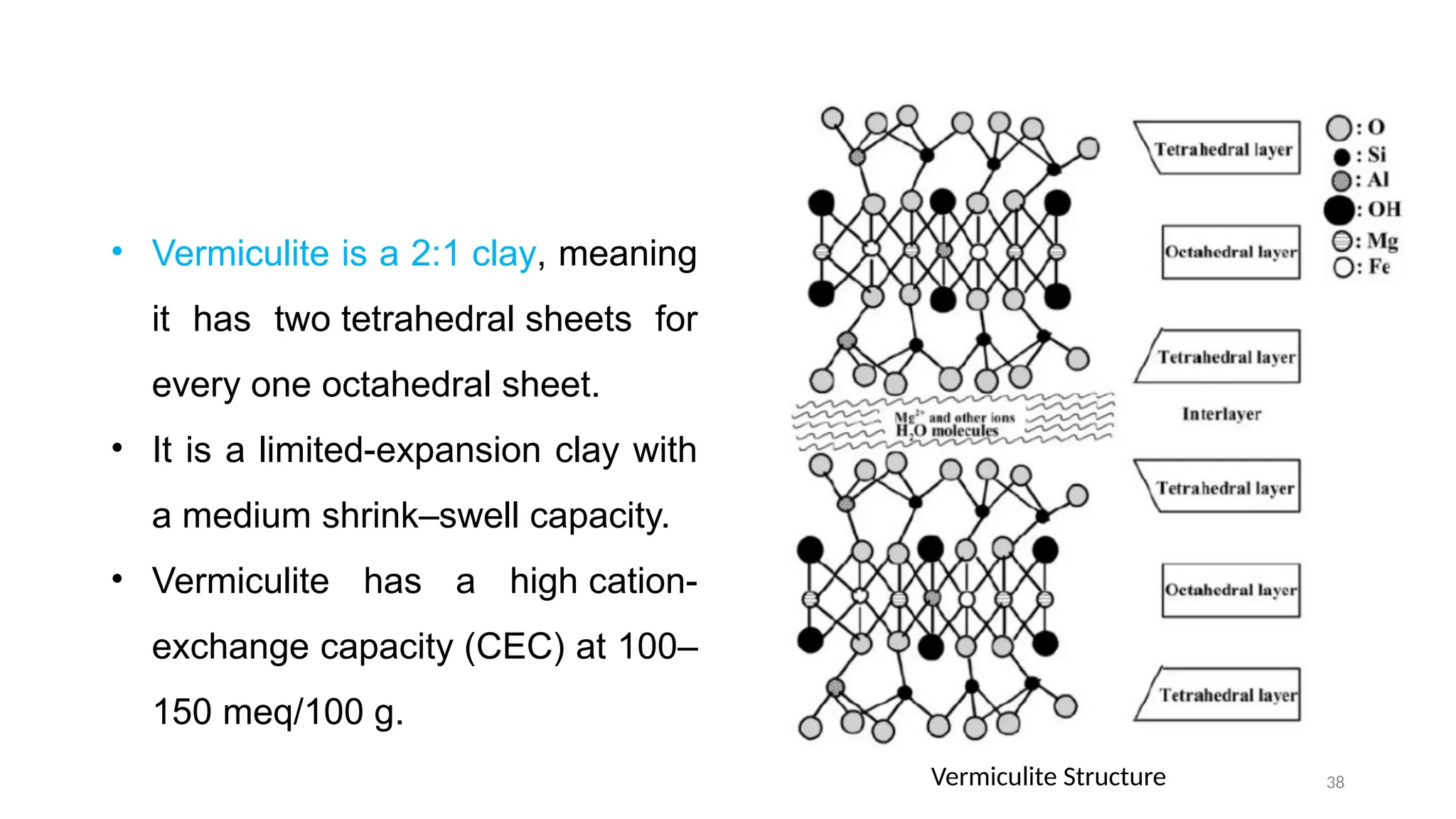
Vermiculite Structure
• Vermiculite is a 2:1 clay, meaning
it has two tetrahedral sheets for
every one octahedral sheet.
• It is a limited-expansion clay with
a medium shrink–swell capacity.
• Vermiculite has a high cation-
exchange capacity (CEC) at 100–
150 meq/100 g.
39
Ion Exchange
• The BEC of a clay and the species of cations in the exchange positions are
a good indication of the colloidal activity of the clay.
• A clay such as montmorillonite that has a high base exchange capacity, swells
greatly and forms viscous suspensions at low concentrations of clay, particularly
when sodium is in the exchange positions.
• In contrast, kaolinite is relatively inert, regardless of the species of exchange
cations.
40
Cation Exchange Capacity Significance
• Cation exchange capacity expressed as methylene blue capacity and Bentonite
content in ppb of mud.
• It give the ability of the clay particles to hydrate depends greatly on the
loosely held captions present.
• In formation evaluation, it is the contribution of cation-exchange sites to
the formation electrical properties.
41
Clay swelling mechanism
• All classes of clay minerals adsorb water, but montmorillonite take up
much larger volumes than do other classes, because of their expanding
lattice.
• Mechanisms for Clay swellings
• Crystalline
• Osmotic
42
Clay swelling mechanism
• Crystalline swelling: (Sometime
called surface hydration)
• Results from the adsorption of non-
molecular layers of water on the
basal crystal surfaces on both the
external, and, in the case of
expanding lattice clays, the inter-
layer surfaces
43
Clay swelling mechanism
• The first layer of water is held on the
surface by hydrogen bonding to the
hexagonal network of oxygen atoms.
• Consequently, the water molecules are
also in hexagonal coordination
• The strength of the bonds decreases
with distance from the surface
Combined water layers between layers of partially dehydrated vermiculite
44
Clay swelling mechanism
• Osmotic swelling occurs because the concentration of cations between the layers is greater than that in
the bulk solution (CL>CS).
• Consequently, water is drawn between the layers, thereby increasing the c-spacing and permitting the
development of the diffuse double layers
• Osmotic swelling causes much larger increases in bulk volume than does crystalline swelling.
• For example, sodium montmorillonite adsorbs about 0.5g water per g of dry clay, doubling the volume, in the crystalline
swelling region, but about 10 g water per g dry clay, increasing the volume twenty fold, in the osmotic region.
• On the other hand, the repulsive forces between the layers are much less in the osmotic region than in
the crystalline region
45
46
Electrostatic Double Layer
• Particles in colloidal suspension carried a surface
charge. This charge attracts ions of the opposite
sign, which are called counter ions, and the
combination is called the electrostatic double
layer.
• Some counter ions are not tightly held to the
surface and tend to drift away, forming a diffuse
ionic atmosphere around the particle.
• In addition to attracting ions of the opposite sign,
the surface charge repels those of the same sign.
• The net result is a distribution of positive and
negative ions, as shown schematically in Figure
47
Electrostatic Double Layer
• The distribution of ions in the double layer
results in a potential grading from a maximum
at the clay surface to zero in the bulk solution,
as shown in Figure
• The layer of cations next to the surface of the
particle, known as the Stern layer, is bound to
and moves with the particle whereas the
diffuse ions are independently mobile.
• The potential difference from the plane of
shear to the bulk of the solution is known as
the zeta potential
• Water flowing through the pores of a shale,
removes the mobile ions, thereby generating
a potential, which is known as the streaming
potential zeta potential
48
Electrostatic Double Layer
• The zeta potential is maximum, and the mobile
layer is most diffuse when the bulk solution is
pure water.
• Addition of electrolytes to the suspension
compresses the diffuse layer, and reduces the
zeta potential.
• The zeta potential decreases greatly with increase
in valence of the added cations, especially if low
valence ions are replaced by higher valence ones
through base exchange, the ratio being
approximately 1 to 10 to 500 for monovalent,
divalent, and trivalent cations, respectively.
• The zeta potential is also reduced by the
adsorption of certain long-chain organic cations.
• In some cases, it is possible to neutralize and
reverse the zeta potential.
49
Electrostatic Double Layer
• The edge charge is less than the basal surface charge, and may be positive or
negative, largely depending on pH
• For example, if kaolinite is treated with HCI, it has a positive charge, and if treated
with NaOH, it has a negative charge.
• The reason for this behavior is that aluminum atoms at the edge react with HCI to
form A1CI3, strong electrolyte which dissociates to Al+3 +Cl- , whereas with NaOH,
aluminum forms aluminum hydroxide, which is insoluble.
• (Remember that ion adsorption in kaolinite takes place almost entirely at the edge,
so that the charge on the particle is determined by the charge on the edge)
50
Electrostatic Double Layer
• The existence of positive sites on
the edges of kaolinite has also
been demonstrated by an
experiment in which a negative
gold sol was added to a kaolinite
suspension.
• An electron micrograph showed
the gold particles adsorbed only at
the crystal edges
Electron micrograph of a mixture of kaolinite and a gold sol
51
Particle association
https://www.youtube.com/watch?v=kFS1GwaqR4g
52
Flocculation and Deflocculation
• When an electrolyte is added, the double
layers are compressed, and if enough
electrolyte is added, the particles can
approach each other so closely that the
attractive forces predominate, and the
particles agglomerate. This phenomenon is
known as flocculation,
• The critical concentration of electrolyte at
which it occurs is known as the flocculation
value.
• The flocculation value of clays may be readily
determined by adding increasing amounts of
electrolyte to a series of dilute suspensions.
Schematic representation of
flocculated clay platelets (assuming
negative edge potential)
53
Flocculation and Deflocculation
• The flocculation value depends on
• The species of clay mineral,
• The exchange cations
• kind of salt added
• The higher the valence of the cations (either on the clay or in the salt) the lower
the flocculation value
• Sodium montmorillonite is flocculated by about 15 meq/l of sodium chloride, and
• Calcium montmorillonite by about 0.2 meq/l of calcium chloride.
54
Flocculation and Deflocculation
• When the cation of the salt is different from the cation on the clay, then base
exchange occurs, but the flocculation value is always much lower whenever
polyvalent cations are involved.
• For instance, the flocculation value of sodium montmorillonite by calcium chloride
is about 5 meq/l, and of calcium montmorillonite by sodium chloride about 1.5
meq/l.
• There is a slight difference in the flocculating power of monovalent salts, as
follows:
Cs>Rb>NH4>K>Na>Li.
This series is known as the Hoffmeister series, or as the lyotropic series.
55
Flocculation and Deflocculation
• If the concentration of clay in a suspension is high enough, flocculation will cause
the formation of a continuous gel structure instead of individual flocs.
• The gels commonly observed in aqueous drilling fluids are the result of
flocculation by soluble salts, which are always present in sufficient concentrations
to cause at least a mild degree of flocculation.
• Gel structures build up slowly with time, as the particles orient themselves into
positions of minimum free energy under the influence of Brownian motion of the
water molecules
• Flocculation may be prevented, or reversed, by the addition of the sodium salts of
certain complex anions, notably polyphosphates, tannates, and lignosulfonates
• Example: if about 0.5% of sodium hexameta-phosphate is added to a dilute
suspension of sodium montmorillonite, the flocculation value is raised from 15
meq/l to about 400 meq/l of sodium chloride
56
Aggregation and Dispersion
• The term flocculation is limited to the loose association of clay platelets which
forms flocs or gel structures
• The term aggregation, referes to the collapse of the diffuse double layers and the
formation of aggregates of parallel platelets spaced 20 A or less, apart.
• Flocculation causes an increase in gel strength, whereas aggregation causes a
decrease because it reduces
(1) the number of units available to build gel structures and
(2) the surface area available for particle interaction
57
Aggregation and Dispersion
• The term dispersion is commonly used to
describe the subdivision of particle aggregates
in a suspension, usually by mechanical means
• The subdivision of clay platelet stacks, which
is usually the result of electro-chemical
effects, and thus to distinguish between the
dispersion-aggregation process and the
deflocculation flocculation process.
Schematic representation of the flocculation-deflocculation
mechanism and the aggregation-dispersion mechanism.
58
Aggregation and Dispersion
• The onset of flocculation is shown in
Figure by the rise in gel strengths from 10
meq/l or greater.
• The gel strength continues to rise
with concentration of sodium chloride up to
400 meq/l, but the particles reach equilibrium
positions slowly, as indicated by the difference
between the initial and ten-minute gel
strengths.
Flocculation and aggregation of sodium bentonite
by sodium chloride
59
Aggregation and Dispersion
• The addition of polyvalent salts to
sodium bentonite suspensions show
flocculation at first, and then aggregation
as the concentration increases
• Many clays encountered in drilling are
predominately calcium and magnesium
clays, and hence are aggregated
Flocculation and aggregation of sodium bentonite by calcium
chloride
60
Aggregation and Dispersion
Floccuiation and aggregation of sodium bentonite by
aluminium chloride.
61
Aggregation and Dispersion
• When treated with thinner, both deflocculation and dispersion occur
simultaneously—deflocculation because of the action of the anion, and
dispersion because of the conversion of the clay to the sodium form
• Dispersion is undesirable because it increases the plastic viscosity
• Dispersion may be avoided by the simultaneous addition of a
polyvalent salt or hydroxide with the thinner
62
Mechanism of Gelation
Various linkages and plate orientations proposed to account for gel structure
may be summarized as follows:
1. Cross-linking between parallel plates, through positive edge to negative
surface linkages, to form a house of cards structure.
2. Edge-to-edge association, to form intersecting ribbons.
 The basis for this theory is, briefly, that because of the relatively high repulsive
potential between the basal surfaces, the preferred platelet orientation will be
parallel with edge-to-edge association.
3. Parallel association of plates, held together by the quasi-crystalline water
between them
63
Mechanism of Gelation
• When the edges are positive, the platelets will flex
toward a negative basal surface, as shown in
Figure
• When the edges are negative, the stronger basal
repulsive potential will cause the platelets to align
parallel, when not prevented from doing so by
mechanical interference.
• Addition of a thinner reverses positive
edge potentials, and increases the repulsive forces
between the edges Schematic representation of edge-to-face bonds.
64
Polymers
• Organic colloids composed of unit cells
(monomers) such as the cellulose cell
shown in Figure
• Linked together either in straight or
branched chains to form macromolecules
• Polymer configuration when it mixed with
water depends on its degree of
polymerization (D.P) and its degree of
substitution (D.S)
• D.P refers to number of times the ring
structure is repeated,
• D.S refers to number of substitutions
occurring on a single repeating ring
structure
65
Polymers Use
• To give desired properties which cannot be obtained with
colloidal clays.
• Example: Starch (filtration control in salt water mud)
• Starch is stable in salt water, whereas clays are not
• Synthetic polymers are often made by modifying natural
polymers.
• Example: Carboxymethylcellulose (CMC) is made by
reacting cellulose with chloracetic acid and NaOH,
substituting CH3COO~ Na+ for H, as shown in Figure
66
• Polymer applications and functions in drilling fluids depend on its molecular
weight distribution and ionicity
• Polymer stability in solution depends on salt concentrating, pH, calcium presence,
and degradation.
• Drilling fluids viscosity and filtration are controlled by polymer molecular weight;
• The negative charged anionic polymer functions as deflocculant, fluid loss
controller and shale stabilizers.
• Polymer ability to hydrate in water nor to perform its functions can be hampered
if the salinity of water.
67
Polymers Use
Important function of carboxyl group
1. It imparts water solubility (strictly speaking, water dispersibility) to the
otherwise insoluble cellulose polymer
2. Dissociation of Na creates negative sites along the chain, Mutual repulsion
between the charges causes the randomly coiled chains to stretch linearly,
thereby increasing the viscosity
 Soluble salts, especially polyvalent salts, repress dissociation, allowing the
chains to coil.
 Polymers that carry electrostatic charges are termed polyelectrolytes. Because
its charges are negative, CMC is an anionic polyelectrolyte.
68
Polymers Use
• Degree of polymerization (DP): The number of monomers in a macromolecule
• Polymers are synthesized by varying By varying the DP and the DS.
• A high DP results in a high viscosity.
• A high DS also gives a high viscosity (a phenomenon known as the
electroviscous effect) and increases the resistance to soluble salts.
69
Polymers Examples
• CMC is used as a viscosifier and as a filtration control agent.
• Three grades covering a range of viscosity are available, and there is a
proprietary product called polyanionic cellulose for use in salt-water muds.
• It is made by converting some of the amides on a polyacrylamlde chain to
carboxylates, a process called hydrolysis.
• 70% hydrolyzed copolymer is used for filtration control;
• 30% one for preserving hole stability
70
Polymers Use
• The most likely explanation of the shale stabilizing action of the 30% hydrolyzed
copolymer is that it coats the shale surfaces exposed on the sides of the hole, thereby
inhibiting disintegration. Similarly, it coats and protects shale drill cuttings—a process
known as encapsulation.
• The coating is believed to result from the attraction between the negative sites on the
polymer chain and the posilive sites on the edges of the clay platelets. The reason the
30% hydrolyzed copolymer is the most effective for shale preservation is probably that
the charged sites on the chain match the spacing of the clay platelets.
71
Mechanism of water clarification
• The copolymer does not by itself cause flocculation; at least enough salt must be present to
initiate flocculation, and then the polymer chains will bind the flocculated particles together.
• This point may be demonstrated by changing the order in which salt and
the copolymer are added to a suspension of clay in fresh water (see Figure
4-30A).
• If the copolymer is added first, the chains are adsorbed around the edges
of individual platelets, and are therefore not available for linking between platelets when
the salt is subsequently added.
• Consequently, the platelets separate if the salt concentration is diluted below the
flocculation value.
• On the other hand, if the salt is added first, then the chains can link between adjacent
platelets and hold the floes together when the suspension is diluted.
72
Effect of order of addition of salt and polymer
73
Platelets repel each other when the edges are
saturated with polyelectrolyte
74
• Another acrylic copolymer, vinyl acetate-maleic acid, is used as a
bentonite extender to increase the yield of commercial bentonite
• Between 0.1% and 2 % of the copolymer is added to the bentonite
• When the bentonite is dispersed in fresh water, the copolymer chains
form links between the dispersed platelets, increasing the viscosity
and yield point.
75
• Nonionic polymers have no dissociable inorganic radical, and
therefore carry no electrostatic charge
• Greater stability in high salinity fluids
• Example: Starch is nonionic, and is used for filtration control in salt
water muds.
• It has the advantage of being inexpensive,
• Disadvantage of being biodegradable, and a biocide must be used
with it.
76
• Other nonionic polymers include hydroxyethylcellulose (HEC) and guargum
• Like CMC, HEC is made from cellulose, but its functional group is an ethylene
oxide chain, (CH2-O-CH2)n- HEC
• Advantages: it is stable in polyvalent brines, and it is almost completely soluble in acid.
• It is used as completion and workover fluids.
• Guar gum is also used in workover fluids, but is degraded by enzymes instead of acid.
• The colloidal activity of natural gums is reduced by high concentrations of monovalent
salts, and eliminated in polyvalent brines. However, gums that have been reacted with
ethylene oxide or propylene oxide (see Figure 4-31) are stable even in saturated
polyvalent brines.
77
Disadvantage of organics polymer
• Thermal decomposition
• Bacterial degradation
78
Problem 1
79
80
Solution

Unit 3 Clay Chemistry for drilling fluids.pptx

  • 1.
  • 2.
    2 Content • Clay chemistryand its application to drilling fluids • Types of Clay • Hydration • Flocculation • Aggregation • Dispersion
  • 3.
    3 Importance of studyingclay mineralogy • Clay provides the colloidal base for all aqueous muds and oil-base mud • Drilling cuttings from argillaceous formation changes properties of drilling fluid • Stability of borehole depends on interaction between drilling fluids and exposed shale • Clay content on drilling fluid may contaminate the formation and affects productivity • Commercial clay used for drilling fluid is Wyoming bentonite (yield 100 bbl/ton when used with pure water)
  • 4.
    4 Characteristics of ColloidalSystem • What do you mean by Colloids? • Particle whose size fall roughly between smallest particle seen through microscope and molecules • Colloidal system: consist of solids dispersed in liquids (Clay suspensions), liquid droplets dispersed in liquids (e.g. emulsion), or solids dispersed in gases (e.g., smoke). • Aqueous colloidal systems is that particle, so small that they kept in suspension indefinitely by bombardment of water molecules, a phenomena known as the Brownian movement. • The movement of the particle can be seen by light reflected from them and observed against dark background in the ultramicroscope.
  • 5.
  • 6.
    6 Characteristics of ColloidalSystem • The particles are so small that properties like viscosity and sedimentation velocity are controlled by surface phenomena. • Surface phenomena occur because molecules in the surface layer are not in electrostatic balance • The surface carries an electrostatic charge, the size and sign of which depends on the coordination of the atoms on both sides of the interface. • Some substances, notably clay minerals, carry an unusually high surface potential because of certain deficiencies in their atomic structure
  • 7.
    7 Characteristics of ColloidalSystem • The greater the degree of subdivision of a solid, the greater will be its surface area per unit weight, and therefore the greater will be the influence of the surface phenomena. • For example, a cube with sides one mm long would have a total surface area of 6mm2 . If it were subdivided into cubes with one micron sides (1 micron = 1 x 10⁻³ mm) there would be 109 cubes, each with a surface area of 6 x 10⁻⁶ mm2 , and the total surface area would be 6 x 103 mm2 . • Subdivided again into milli-micron cubes, the total surface area would be 6 x 106 mm2, or 6 square meters. • The ratio of surface area per unit weight of particles is called the specific surface. Thus if a 1 cm3 cube were divided into micron sized cubes, the specific surface would be 6 x 10⁶ /72.7 = 2.2 x 106 mm2 /g = 2.2 m2 /g, assuming the specific gravity of the cube to be 2.7.
  • 8.
    8 Characteristics of ColloidalSystem • Specific surface versus cube size • To put the values in perspective, the size of various particles, expressed in equivalent spherical radii (esr), are shown at the top. • The esr of a particle is the radius of a sphere that would have the same sedimentation rate as the particle. • The esr may be determined by applying Stokes' Law to the measured sedimentation rate. Figure: Specific surface of cubes. Assuming specific gravity of 2.7
  • 9.
  • 10.
    10 Clay Minerals • GeneralCharacteristics • Small particle size • Plastic across range of water contents • High dry strength • Potential for shrink/swell • High resistance to weathering • Particle have net negative charge
  • 11.
    11 Clay Mineralogy • Ascience dealing with structure of clay minerals on microscopic, molecular and atomic scale is called Clay Mineralogy. • It includes study of the mineralogical composition and electrical properties of the particles. • The most significant properties of clay depend upon the type of mineral. • There are three types of clay minerals: • Kaolinite clay • Montomorillonite Clay • Illite clay
  • 12.
    12 Clay Mineralogy • Kaoliniteclay • Montomorillonite Clay • Illite clay Kaolinite clay Montomorillonite Clay Illite clay There are three types of clay minerals:
  • 13.
    13 Basic structures ofclay minerals 1. Silica tetrahedral sheet 2. Aluminium octahedron sheet or also called as gibbsite Silica tetrahedral aluminium octahedron
  • 14.
    14 Basic structures ofclay minerals 1. Silica tetrahedral sheet Silica tetrahedral
  • 15.
    15 Basic structures ofclay minerals 1. Silica tetrahedral sheet 2. Aluminium octahedron sheet or also called as gibbsite aluminium octahedron
  • 16.
    16 Structural arrangement • Theunit layers are stacked together face- to-face to form what is known as the crystal lattice. • The distance between a plane in one layer and the corresponding plane in the next layer is called either the c spacing, or the basal spacing. • This spacing is 9.2 Angstoms* for the standard three-layer mineral, and 7.2 A for a two-layer mineral.
  • 17.
  • 18.
    18 Classification of clays 1.Kaolinite Clay • The basic unit of this type of clay is formed by atomic bond of the unsatisfied face of silica sheet and face of aluminum sheet (Gibbsite) • The bond between two sheets is strong and is primary bond (H+ Bond). Kaolinite clay Ratio- Si: Gi (1:1)
  • 19.
    19 Classification of clays 1.Kaolinite Clay • Atomic structure of Kaolinite
  • 20.
    20 1. Kaolinite Clay •The hydrogen bond is very strong bond because of that, it shows less/no swelling and shrinkage Behavior • It is least active clay minerals. Example: China soil, application paper, rubber, paint. • The thickness of one unit is about 7.2 angstrom. • SEM (Scanning Electron Microscope) image of kaolinite clay is illustrated in Figure. SEM image of Kaolinite clay
  • 21.
    21 2. Montmorillonite Clay •A single structural unit of montmorillonite is composed of two silica sheet and one Gibbsite sheet. • The number of structural units are joined together by very weak water bond. • The thickness of one unit is about 9.2 Angstrom. • It is highly active clay mineral due to which soil shows high swelling and shrinkage characteristics Montmorillonite clay Ratio- Si: Gi (2:1)
  • 22.
  • 23.
    23 Montmorillonite Clay • Thelink is due to natural attraction for the cations in the intervening space and due to Vander Waal forces. • The negatively charged surfaces of the silica sheet attract water in the space between two structural units. This results in an expansion of the mineral. • The soil containing a large amount of the mineral montmorillonite exhibits high shrinkage and swelling characteristics. SEM image of Montmorillonite clay
  • 24.
    24 Illite Clay • Basicstructure of this clay is the same as the one of montmorillonite. • A single structure unit of illite is composed of two silica sheet and one alumina sheet. • The alumina sheet is sandwiched between two silica sheet. • The number of structural units are joined together by Ionic bond (K+ potassium Ion bond) • The potassium ion bond is weaker then hydrogen bond • It shows medium swelling and shrinkage characteristics • Medium active Illite clay Ratio- Si: Gi (2:1)
  • 25.
  • 26.
    26 Illite Clay • Thethickness of 1 unit is 10 Angstrom • The characteristics of this clay are classified as in between those of kaolinite and montmorillonite. • SEM image is shown in Figure SEM image of Illite clay
  • 27.
    27 Brucite is themineral form of magnesium hydroxide, with the chemical formula Mg(OH)2.
  • 28.
    28 Characteristics comparison Let, Abe Kaolinite B be illite C be montmoriollonite 1. Swelling and shrinkage characteristics: A<B<C 2. Strength of bond between structural units: C<B<A 3. Plasticity/plasticity index : A<B<C 4. Grain size: C<b<A
  • 29.
    29 Clay shapes andsurface areas • Clays are formed in stack of several layers of basic sheet units. • Clays are generally flat and smaller in size, so, their surface areas per weight are very large.
  • 30.
    30 Origin and occurrenceof clay minerals • Clay minerals originate from the degradation of igneous rocks in situ. • The parent minerals are the micas, the feldspars, [(CaO) (K20)Al2036Si02]; and ferromagnesium minerals, such as horneblende [(Ca, Na2 )2 (Mg, Fe, Al)s (Al, Si)8022 (OH,F)2] • Bentonite is formed by the weathering of volcanic ash. • Bentonite was originally defined as a clay produced by in situ alteration of volcanic ash to montmorillonite • The main factors are climate, topography, vegetation, and time of exposure.
  • 31.
  • 32.
    32 Ion Exchange • Cationsare adsorbed on the basal surfaces of clay crystals. • In aqueous suspension, ions on clay may exchange with ions in the bulk solution. • The exchange reaction is governed primarily by the relative concentration of the different species of ions in each phase, as expressed by the law of mass action. • For example, for two species of monovalent ions, the equation maybe written:
  • 33.
    33 Ion Exchange • Where[A]s and [B]s are the molecular concentration of the two species of ions in the solution, and [A]c and [B]c are those on the clay. • K is the ion exchange equilibrium constant • Example: when K is greater than unity, A is preferentially adsorbed.
  • 34.
    34 Ion Exchange • Whentwo ions of different valencies are present, the one with the higher valence is generally adsorbed preferentially. • The order of preference usually is: • Note: Hydrogen is strongly adsorbed, and therefore pH has strong influence on the base exchange reaction.
  • 35.
    35 Illustration of thecation exchange between vine roots and surrounding soil particles (Source: bio1903.nicerweb.com)
  • 36.
    36 Ion Exchange • Thetotal amount of cations adsorbed, expressed in milliequivalents per hundred grams of dry clay, is called the base exchange capacity (BEC), or the cation exchange capacity (CEC). • The value of the BEC varies considerably, even within each clay mineral group. • Within montmorillonite and illite, the basal surfaces account for some 80% of the BEC. • With kaolinite, the broken bonds at the crystal edges account for most of the BEC.
  • 37.
  • 38.
    38 Vermiculite Structure • Vermiculiteis a 2:1 clay, meaning it has two tetrahedral sheets for every one octahedral sheet. • It is a limited-expansion clay with a medium shrink–swell capacity. • Vermiculite has a high cation- exchange capacity (CEC) at 100– 150 meq/100 g.
  • 39.
    39 Ion Exchange • TheBEC of a clay and the species of cations in the exchange positions are a good indication of the colloidal activity of the clay. • A clay such as montmorillonite that has a high base exchange capacity, swells greatly and forms viscous suspensions at low concentrations of clay, particularly when sodium is in the exchange positions. • In contrast, kaolinite is relatively inert, regardless of the species of exchange cations.
  • 40.
    40 Cation Exchange CapacitySignificance • Cation exchange capacity expressed as methylene blue capacity and Bentonite content in ppb of mud. • It give the ability of the clay particles to hydrate depends greatly on the loosely held captions present. • In formation evaluation, it is the contribution of cation-exchange sites to the formation electrical properties.
  • 41.
    41 Clay swelling mechanism •All classes of clay minerals adsorb water, but montmorillonite take up much larger volumes than do other classes, because of their expanding lattice. • Mechanisms for Clay swellings • Crystalline • Osmotic
  • 42.
    42 Clay swelling mechanism •Crystalline swelling: (Sometime called surface hydration) • Results from the adsorption of non- molecular layers of water on the basal crystal surfaces on both the external, and, in the case of expanding lattice clays, the inter- layer surfaces
  • 43.
    43 Clay swelling mechanism •The first layer of water is held on the surface by hydrogen bonding to the hexagonal network of oxygen atoms. • Consequently, the water molecules are also in hexagonal coordination • The strength of the bonds decreases with distance from the surface Combined water layers between layers of partially dehydrated vermiculite
  • 44.
    44 Clay swelling mechanism •Osmotic swelling occurs because the concentration of cations between the layers is greater than that in the bulk solution (CL>CS). • Consequently, water is drawn between the layers, thereby increasing the c-spacing and permitting the development of the diffuse double layers • Osmotic swelling causes much larger increases in bulk volume than does crystalline swelling. • For example, sodium montmorillonite adsorbs about 0.5g water per g of dry clay, doubling the volume, in the crystalline swelling region, but about 10 g water per g dry clay, increasing the volume twenty fold, in the osmotic region. • On the other hand, the repulsive forces between the layers are much less in the osmotic region than in the crystalline region
  • 45.
  • 46.
    46 Electrostatic Double Layer •Particles in colloidal suspension carried a surface charge. This charge attracts ions of the opposite sign, which are called counter ions, and the combination is called the electrostatic double layer. • Some counter ions are not tightly held to the surface and tend to drift away, forming a diffuse ionic atmosphere around the particle. • In addition to attracting ions of the opposite sign, the surface charge repels those of the same sign. • The net result is a distribution of positive and negative ions, as shown schematically in Figure
  • 47.
    47 Electrostatic Double Layer •The distribution of ions in the double layer results in a potential grading from a maximum at the clay surface to zero in the bulk solution, as shown in Figure • The layer of cations next to the surface of the particle, known as the Stern layer, is bound to and moves with the particle whereas the diffuse ions are independently mobile. • The potential difference from the plane of shear to the bulk of the solution is known as the zeta potential • Water flowing through the pores of a shale, removes the mobile ions, thereby generating a potential, which is known as the streaming potential zeta potential
  • 48.
    48 Electrostatic Double Layer •The zeta potential is maximum, and the mobile layer is most diffuse when the bulk solution is pure water. • Addition of electrolytes to the suspension compresses the diffuse layer, and reduces the zeta potential. • The zeta potential decreases greatly with increase in valence of the added cations, especially if low valence ions are replaced by higher valence ones through base exchange, the ratio being approximately 1 to 10 to 500 for monovalent, divalent, and trivalent cations, respectively. • The zeta potential is also reduced by the adsorption of certain long-chain organic cations. • In some cases, it is possible to neutralize and reverse the zeta potential.
  • 49.
    49 Electrostatic Double Layer •The edge charge is less than the basal surface charge, and may be positive or negative, largely depending on pH • For example, if kaolinite is treated with HCI, it has a positive charge, and if treated with NaOH, it has a negative charge. • The reason for this behavior is that aluminum atoms at the edge react with HCI to form A1CI3, strong electrolyte which dissociates to Al+3 +Cl- , whereas with NaOH, aluminum forms aluminum hydroxide, which is insoluble. • (Remember that ion adsorption in kaolinite takes place almost entirely at the edge, so that the charge on the particle is determined by the charge on the edge)
  • 50.
    50 Electrostatic Double Layer •The existence of positive sites on the edges of kaolinite has also been demonstrated by an experiment in which a negative gold sol was added to a kaolinite suspension. • An electron micrograph showed the gold particles adsorbed only at the crystal edges Electron micrograph of a mixture of kaolinite and a gold sol
  • 51.
  • 52.
    52 Flocculation and Deflocculation •When an electrolyte is added, the double layers are compressed, and if enough electrolyte is added, the particles can approach each other so closely that the attractive forces predominate, and the particles agglomerate. This phenomenon is known as flocculation, • The critical concentration of electrolyte at which it occurs is known as the flocculation value. • The flocculation value of clays may be readily determined by adding increasing amounts of electrolyte to a series of dilute suspensions. Schematic representation of flocculated clay platelets (assuming negative edge potential)
  • 53.
    53 Flocculation and Deflocculation •The flocculation value depends on • The species of clay mineral, • The exchange cations • kind of salt added • The higher the valence of the cations (either on the clay or in the salt) the lower the flocculation value • Sodium montmorillonite is flocculated by about 15 meq/l of sodium chloride, and • Calcium montmorillonite by about 0.2 meq/l of calcium chloride.
  • 54.
    54 Flocculation and Deflocculation •When the cation of the salt is different from the cation on the clay, then base exchange occurs, but the flocculation value is always much lower whenever polyvalent cations are involved. • For instance, the flocculation value of sodium montmorillonite by calcium chloride is about 5 meq/l, and of calcium montmorillonite by sodium chloride about 1.5 meq/l. • There is a slight difference in the flocculating power of monovalent salts, as follows: Cs>Rb>NH4>K>Na>Li. This series is known as the Hoffmeister series, or as the lyotropic series.
  • 55.
    55 Flocculation and Deflocculation •If the concentration of clay in a suspension is high enough, flocculation will cause the formation of a continuous gel structure instead of individual flocs. • The gels commonly observed in aqueous drilling fluids are the result of flocculation by soluble salts, which are always present in sufficient concentrations to cause at least a mild degree of flocculation. • Gel structures build up slowly with time, as the particles orient themselves into positions of minimum free energy under the influence of Brownian motion of the water molecules • Flocculation may be prevented, or reversed, by the addition of the sodium salts of certain complex anions, notably polyphosphates, tannates, and lignosulfonates • Example: if about 0.5% of sodium hexameta-phosphate is added to a dilute suspension of sodium montmorillonite, the flocculation value is raised from 15 meq/l to about 400 meq/l of sodium chloride
  • 56.
    56 Aggregation and Dispersion •The term flocculation is limited to the loose association of clay platelets which forms flocs or gel structures • The term aggregation, referes to the collapse of the diffuse double layers and the formation of aggregates of parallel platelets spaced 20 A or less, apart. • Flocculation causes an increase in gel strength, whereas aggregation causes a decrease because it reduces (1) the number of units available to build gel structures and (2) the surface area available for particle interaction
  • 57.
    57 Aggregation and Dispersion •The term dispersion is commonly used to describe the subdivision of particle aggregates in a suspension, usually by mechanical means • The subdivision of clay platelet stacks, which is usually the result of electro-chemical effects, and thus to distinguish between the dispersion-aggregation process and the deflocculation flocculation process. Schematic representation of the flocculation-deflocculation mechanism and the aggregation-dispersion mechanism.
  • 58.
    58 Aggregation and Dispersion •The onset of flocculation is shown in Figure by the rise in gel strengths from 10 meq/l or greater. • The gel strength continues to rise with concentration of sodium chloride up to 400 meq/l, but the particles reach equilibrium positions slowly, as indicated by the difference between the initial and ten-minute gel strengths. Flocculation and aggregation of sodium bentonite by sodium chloride
  • 59.
    59 Aggregation and Dispersion •The addition of polyvalent salts to sodium bentonite suspensions show flocculation at first, and then aggregation as the concentration increases • Many clays encountered in drilling are predominately calcium and magnesium clays, and hence are aggregated Flocculation and aggregation of sodium bentonite by calcium chloride
  • 60.
    60 Aggregation and Dispersion Floccuiationand aggregation of sodium bentonite by aluminium chloride.
  • 61.
    61 Aggregation and Dispersion •When treated with thinner, both deflocculation and dispersion occur simultaneously—deflocculation because of the action of the anion, and dispersion because of the conversion of the clay to the sodium form • Dispersion is undesirable because it increases the plastic viscosity • Dispersion may be avoided by the simultaneous addition of a polyvalent salt or hydroxide with the thinner
  • 62.
    62 Mechanism of Gelation Variouslinkages and plate orientations proposed to account for gel structure may be summarized as follows: 1. Cross-linking between parallel plates, through positive edge to negative surface linkages, to form a house of cards structure. 2. Edge-to-edge association, to form intersecting ribbons.  The basis for this theory is, briefly, that because of the relatively high repulsive potential between the basal surfaces, the preferred platelet orientation will be parallel with edge-to-edge association. 3. Parallel association of plates, held together by the quasi-crystalline water between them
  • 63.
    63 Mechanism of Gelation •When the edges are positive, the platelets will flex toward a negative basal surface, as shown in Figure • When the edges are negative, the stronger basal repulsive potential will cause the platelets to align parallel, when not prevented from doing so by mechanical interference. • Addition of a thinner reverses positive edge potentials, and increases the repulsive forces between the edges Schematic representation of edge-to-face bonds.
  • 64.
    64 Polymers • Organic colloidscomposed of unit cells (monomers) such as the cellulose cell shown in Figure • Linked together either in straight or branched chains to form macromolecules • Polymer configuration when it mixed with water depends on its degree of polymerization (D.P) and its degree of substitution (D.S) • D.P refers to number of times the ring structure is repeated, • D.S refers to number of substitutions occurring on a single repeating ring structure
  • 65.
    65 Polymers Use • Togive desired properties which cannot be obtained with colloidal clays. • Example: Starch (filtration control in salt water mud) • Starch is stable in salt water, whereas clays are not • Synthetic polymers are often made by modifying natural polymers. • Example: Carboxymethylcellulose (CMC) is made by reacting cellulose with chloracetic acid and NaOH, substituting CH3COO~ Na+ for H, as shown in Figure
  • 66.
    66 • Polymer applicationsand functions in drilling fluids depend on its molecular weight distribution and ionicity • Polymer stability in solution depends on salt concentrating, pH, calcium presence, and degradation. • Drilling fluids viscosity and filtration are controlled by polymer molecular weight; • The negative charged anionic polymer functions as deflocculant, fluid loss controller and shale stabilizers. • Polymer ability to hydrate in water nor to perform its functions can be hampered if the salinity of water.
  • 67.
    67 Polymers Use Important functionof carboxyl group 1. It imparts water solubility (strictly speaking, water dispersibility) to the otherwise insoluble cellulose polymer 2. Dissociation of Na creates negative sites along the chain, Mutual repulsion between the charges causes the randomly coiled chains to stretch linearly, thereby increasing the viscosity  Soluble salts, especially polyvalent salts, repress dissociation, allowing the chains to coil.  Polymers that carry electrostatic charges are termed polyelectrolytes. Because its charges are negative, CMC is an anionic polyelectrolyte.
  • 68.
    68 Polymers Use • Degreeof polymerization (DP): The number of monomers in a macromolecule • Polymers are synthesized by varying By varying the DP and the DS. • A high DP results in a high viscosity. • A high DS also gives a high viscosity (a phenomenon known as the electroviscous effect) and increases the resistance to soluble salts.
  • 69.
    69 Polymers Examples • CMCis used as a viscosifier and as a filtration control agent. • Three grades covering a range of viscosity are available, and there is a proprietary product called polyanionic cellulose for use in salt-water muds. • It is made by converting some of the amides on a polyacrylamlde chain to carboxylates, a process called hydrolysis. • 70% hydrolyzed copolymer is used for filtration control; • 30% one for preserving hole stability
  • 70.
    70 Polymers Use • Themost likely explanation of the shale stabilizing action of the 30% hydrolyzed copolymer is that it coats the shale surfaces exposed on the sides of the hole, thereby inhibiting disintegration. Similarly, it coats and protects shale drill cuttings—a process known as encapsulation. • The coating is believed to result from the attraction between the negative sites on the polymer chain and the posilive sites on the edges of the clay platelets. The reason the 30% hydrolyzed copolymer is the most effective for shale preservation is probably that the charged sites on the chain match the spacing of the clay platelets.
  • 71.
    71 Mechanism of waterclarification • The copolymer does not by itself cause flocculation; at least enough salt must be present to initiate flocculation, and then the polymer chains will bind the flocculated particles together. • This point may be demonstrated by changing the order in which salt and the copolymer are added to a suspension of clay in fresh water (see Figure 4-30A). • If the copolymer is added first, the chains are adsorbed around the edges of individual platelets, and are therefore not available for linking between platelets when the salt is subsequently added. • Consequently, the platelets separate if the salt concentration is diluted below the flocculation value. • On the other hand, if the salt is added first, then the chains can link between adjacent platelets and hold the floes together when the suspension is diluted.
  • 72.
    72 Effect of orderof addition of salt and polymer
  • 73.
    73 Platelets repel eachother when the edges are saturated with polyelectrolyte
  • 74.
    74 • Another acryliccopolymer, vinyl acetate-maleic acid, is used as a bentonite extender to increase the yield of commercial bentonite • Between 0.1% and 2 % of the copolymer is added to the bentonite • When the bentonite is dispersed in fresh water, the copolymer chains form links between the dispersed platelets, increasing the viscosity and yield point.
  • 75.
    75 • Nonionic polymershave no dissociable inorganic radical, and therefore carry no electrostatic charge • Greater stability in high salinity fluids • Example: Starch is nonionic, and is used for filtration control in salt water muds. • It has the advantage of being inexpensive, • Disadvantage of being biodegradable, and a biocide must be used with it.
  • 76.
    76 • Other nonionicpolymers include hydroxyethylcellulose (HEC) and guargum • Like CMC, HEC is made from cellulose, but its functional group is an ethylene oxide chain, (CH2-O-CH2)n- HEC • Advantages: it is stable in polyvalent brines, and it is almost completely soluble in acid. • It is used as completion and workover fluids. • Guar gum is also used in workover fluids, but is degraded by enzymes instead of acid. • The colloidal activity of natural gums is reduced by high concentrations of monovalent salts, and eliminated in polyvalent brines. However, gums that have been reacted with ethylene oxide or propylene oxide (see Figure 4-31) are stable even in saturated polyvalent brines.
  • 77.
    77 Disadvantage of organicspolymer • Thermal decomposition • Bacterial degradation
  • 78.
  • 79.
  • 80.

Editor's Notes

  • #5 Clay minerals are composed essentially of silica, alumina or magnesia or both, and water, but iron substitutes for aluminum and magnesium in varying degrees, and appreciable quantities of potassium, sodium, and calcium are frequently present as well