BY,
SHIVANI PANDYA
CENTRE FOR NANOSCIENCE
   What are composites??
    word “composite” means “made of two or
    more different parts.”
                        or
    “A composite is a combination of two or more
    different materials that are mixed in an effort
    to blend the best properties of both.”
“ A Nanocomposite is a composite material, in
  which one of the components has at least one
  dimension that is around 10-9 m.
                       or
“ A Nanocomposite is a multiphase solid
  material where one of the phases has one,
  two or three dimensions of less than 100 nm,
  or structure having nano-scale repeat
  distance between the different phases that
  make up the material.
   Mechanically the term nanocomposites are
    differ from conventional composites due to
    the exceptionally high surface to volume ratio
    of the reinforcing and/or its exceptionally
    high aspect ratio.
 consist of one or more discontinuous phases of
 distributed in one continuous phase.

 continuous phase is called “matrix”, whereas
 discontinuous phase is called “reinforcement" or
 “reinforcing material”
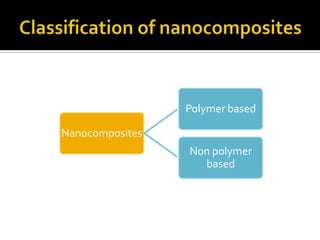
Polymer based

Nanocomposites
                 Non polymer
                   based
 Metal/Metal nanocomposites
  (either in the form of alloy or core-shell structure)
   Eg. Pt-Ru
 Metal/Ceramic nanocomposites
  (either in the form of nanotube or complicated
  nanostructure)
   Eg. Polysilazane/polysiloxane
 Ceramic/Ceramic nanocomposites
  (alloy or ceramic)
   Eg. Zirconia-toughened alumina
 Polymer/Ceramic Nanocomposites
  (Layer structure) Eg. Barium-titanate with polymers

 Inorganic/Organic Polymer nanocomposites
  (clusters) Eg. Polymer nanofiber with zero valent
 nanoparticles.

 Inorganic/Organic Hybrid Nanocomposites

  (Nanocrystal) Eg. CdS nanocrystals, Poly N- vinyl
  carbozole- photorefractivity.
 Polymer/ layered silicate nanocomposites
  Eg. Nylon-6 (N6)/ montmorillonite(MMT) with
  silicate
 Polymer/Polymer nanocomposites
  (fillers) Eg. Poly(p- phinylene oxide )- plastic scrap
 recycling
 Biocomposites
  Eg. Elastin- collagen
   Increase in electrical break down strength of
    polymers.
   Melting temperature, color ,magnetization
    and charge capacity is more.
   interacting Zone is increasing such that we
    can get our expected property.
   electro catalyst in batteries for energy saving
   light weight materials for less fuel
    consumption.
   in artificial joints, economically beneficial
   carbon nanotubes most widely speaking
    nanomaterial which can be made as
    nanocomposite fibers.
   Abrasion and wear Applications
   Marine Application
   Food packaging
   Fuel tanks
   Films
   Environmental protection
   Flame ability reaction
   Erosion and corrosion Applications
    Nanocomposites are upcoming materials
    which shows the great changes in all the
    industrial fields and it is also going to be a
    economical barrier for developing countries
    as a tool of Nanotechnology.
Nanocomposite

Nanocomposite

  • 1.
  • 2.
    What are composites?? word “composite” means “made of two or more different parts.” or “A composite is a combination of two or more different materials that are mixed in an effort to blend the best properties of both.”
  • 3.
    “ A Nanocompositeis a composite material, in which one of the components has at least one dimension that is around 10-9 m. or “ A Nanocomposite is a multiphase solid material where one of the phases has one, two or three dimensions of less than 100 nm, or structure having nano-scale repeat distance between the different phases that make up the material.
  • 4.
    Mechanically the term nanocomposites are differ from conventional composites due to the exceptionally high surface to volume ratio of the reinforcing and/or its exceptionally high aspect ratio.
  • 5.
     consist ofone or more discontinuous phases of distributed in one continuous phase.  continuous phase is called “matrix”, whereas discontinuous phase is called “reinforcement" or “reinforcing material”
  • 6.
  • 7.
     Metal/Metal nanocomposites (either in the form of alloy or core-shell structure) Eg. Pt-Ru  Metal/Ceramic nanocomposites (either in the form of nanotube or complicated nanostructure) Eg. Polysilazane/polysiloxane  Ceramic/Ceramic nanocomposites (alloy or ceramic) Eg. Zirconia-toughened alumina
  • 8.
     Polymer/Ceramic Nanocomposites (Layer structure) Eg. Barium-titanate with polymers  Inorganic/Organic Polymer nanocomposites (clusters) Eg. Polymer nanofiber with zero valent nanoparticles.  Inorganic/Organic Hybrid Nanocomposites (Nanocrystal) Eg. CdS nanocrystals, Poly N- vinyl carbozole- photorefractivity.
  • 9.
     Polymer/ layeredsilicate nanocomposites Eg. Nylon-6 (N6)/ montmorillonite(MMT) with silicate  Polymer/Polymer nanocomposites (fillers) Eg. Poly(p- phinylene oxide )- plastic scrap recycling  Biocomposites Eg. Elastin- collagen
  • 10.
    Increase in electrical break down strength of polymers.  Melting temperature, color ,magnetization and charge capacity is more.  interacting Zone is increasing such that we can get our expected property.
  • 11.
    electro catalyst in batteries for energy saving  light weight materials for less fuel consumption.  in artificial joints, economically beneficial  carbon nanotubes most widely speaking nanomaterial which can be made as nanocomposite fibers.  Abrasion and wear Applications  Marine Application
  • 12.
    Food packaging  Fuel tanks  Films  Environmental protection  Flame ability reaction  Erosion and corrosion Applications
  • 13.
    Nanocomposites are upcoming materials which shows the great changes in all the industrial fields and it is also going to be a economical barrier for developing countries as a tool of Nanotechnology.