PRESENTED BY:
VIMLESH VERMA
2017GE10
CONTENTS
• INTRODUCTION
• BASIC STRUCTURAL UNITS OF CLAY MINERAL
• TYPES OF PREVALENT BONDING
• CLAY MINERAL CLASSIFICATION
• CONCLUSION
• REFERENCES
INTRODUCTION
 Clay minerals are layer silicates that are formed usually as
products of chemical weathering of other silicate minerals at
the earth's surface. They are found most often in shales, the
most common type of sedimentary rock.
 Chemical weathering results in the formation of groups of
crystalline particles of colloidal size(<.002mm) is known as
clay mineral.
 Soil structure means the geometrical arrangement of particle
in a soil mass, relative to each other and the forces acting
between them to hold them together in their positions.
BASIC STRUCTURAL UNITS OF
CLAY MINERAL
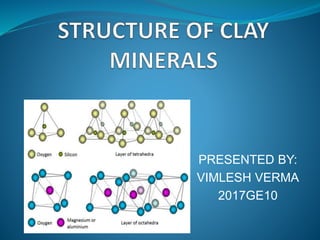
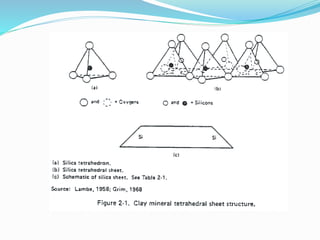
Tetrahedron or Silica unit:
 It is formed by connecting the centers of the four
oxygen anions surrounding a central cation.
 In the clay minerals the predominant central cation of
the tetrahedron is silicon.
 The isolated tetrahedron has a net negative charge of -4
(Si with 4+ charges and four O with 2- charges).
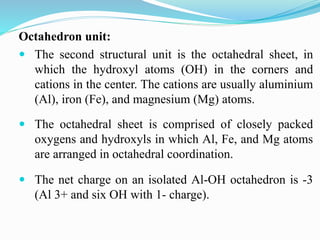
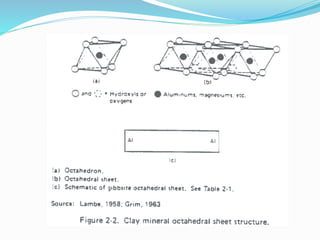
Octahedron unit:
 The second structural unit is the octahedral sheet, in
which the hydroxyl atoms (OH) in the corners and
cations in the center. The cations are usually aluminium
(Al), iron (Fe), and magnesium (Mg) atoms.
 The octahedral sheet is comprised of closely packed
oxygens and hydroxyls in which Al, Fe, and Mg atoms
are arranged in octahedral coordination.
 The net charge on an isolated Al-OH octahedron is -3
(Al 3+ and six OH with 1- charge).
TYPES OF PREVALENT BOND
Primary balance bond:
• Ionic bonding: Ionic bonding is the complete transfer of
valence electron(s) between atoms. It is a type of
chemical bond that generates two oppositely charged
ions.
• Covalent bonding: Covalent bonding is the sharing of
electrons between atoms. This bonding occurs primarily
between nonmetals; however, it can also be observed
between nonmetals and metals. Ex. O2.
Hydrogen bonding:
Interaction involving a hydrogen atom located between
a pair of other atoms having a high affinity for electrons;
such a bond is weaker than an ionic bond or covalent
bond but stronger than van der Waals forces.
Secondary valence bond:
Van der waals forces are distance dependent interactions
between atoms or molecules. Unlike ionic or covalent
bonds, these attractions are not a result of any chemical
electronic bond, and they are comparatively weak.
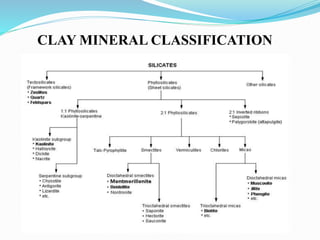
CLAY MINERAL CLASSIFICATION
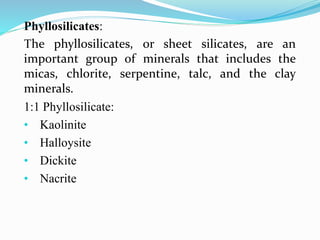
Phyllosilicates:
The phyllosilicates, or sheet silicates, are an
important group of minerals that includes the
micas, chlorite, serpentine, talc, and the clay
minerals.
1:1 Phyllosilicate:
• Kaolinite
• Halloysite
• Dickite
• Nacrite
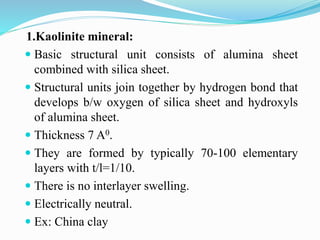
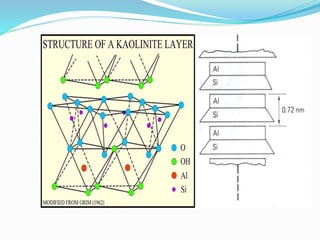
1.Kaolinite mineral:
 Basic structural unit consists of alumina sheet
combined with silica sheet.
 Structural units join together by hydrogen bond that
develops b/w oxygen of silica sheet and hydroxyls
of alumina sheet.
 Thickness 7 A0.
 They are formed by typically 70-100 elementary
layers with t/l=1/10.
 There is no interlayer swelling.
 Electrically neutral.
 Ex: China clay
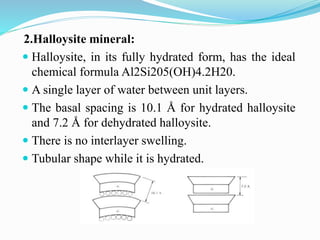
2.Halloysite mineral:
 Halloysite, in its fully hydrated form, has the ideal
chemical formula Al2Si205(OH)4.2H20.
 A single layer of water between unit layers.
 The basal spacing is 10.1 Å for hydrated halloysite
and 7.2 Å for dehydrated halloysite.
 There is no interlayer swelling.
 Tubular shape while it is hydrated.
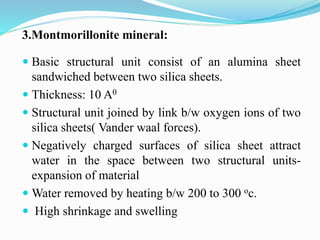
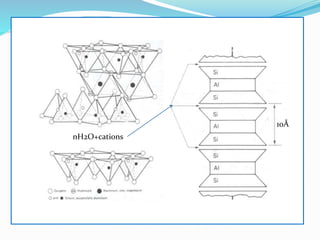
3.Montmorillonite mineral:
 Basic structural unit consist of an alumina sheet
sandwiched between two silica sheets.
 Thickness: 10 A0
 Structural unit joined by link b/w oxygen ions of two
silica sheets( Vander waal forces).
 Negatively charged surfaces of silica sheet attract
water in the space between two structural units-
expansion of material
 Water removed by heating b/w 200 to 300 oc.
 High shrinkage and swelling
nH2O+cations
10Å
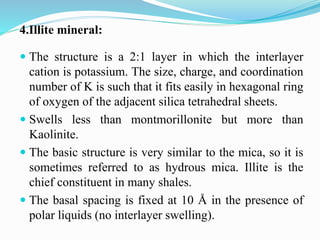
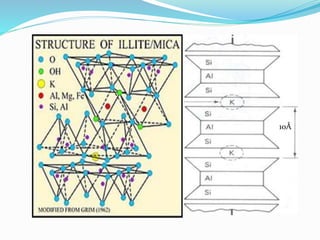
4.Illite mineral:
 The structure is a 2:1 layer in which the interlayer
cation is potassium. The size, charge, and coordination
number of K is such that it fits easily in hexagonal ring
of oxygen of the adjacent silica tetrahedral sheets.
 Swells less than montmorillonite but more than
Kaolinite.
 The basic structure is very similar to the mica, so it is
sometimes referred to as hydrous mica. Illite is the
chief constituent in many shales.
 The basal spacing is fixed at 10 Å in the presence of
polar liquids (no interlayer swelling).
10Å
CONCLUSION
The term “clay mineral” refers to phyllosilicate minerals
and to minerals which impart plasticity to clay and which
harden upon drying or firing. Clay minerals are layer
silicates that are formed usually as products of chemical
weathering of other silicate minerals at the earth's surface.
Atomic structure of clay mineral is built of fundamental
sheets Tetrahedron or silica sheet and Octahedron or
alumina sheet. These sheets are attached with different
type of bonding such as ionic bonding, covalent bonding,
metallic bonding, hydrogen bonding and van der Waals
bonding. There are different types of clay minerals such
as Kaolin group, Smectite mineral, Illite, Chlorite,
Vermiculite, etc
REFERENCES
 Ralph E.Grim, Clay Mineralogy, 1st Ed. McGraw-Hill Book Co.: New York,
1953.
 CLAY AND CLAY MINERALOGY by Dr. Thair Al-Ani and Dr. Olli
Sarapää
 CLAY MINERALS by CD. Barton United States Department of Agriculture
Forest Service, Aiken, South Carolina, U.S.A. A.D. Karathanasis University
of Kentucky, Lexington, Kentucky, U.S.A.
 SYNTHESIS OF ANIONIC CLAY MINERALS (MIXED METAL
HYDROXIDES, HYDROTALCITE) Walter T. REICHLE Specialty
Chemicals Division, Union Carbide Corporation, USA
 Structure and mineralogy of clay minerals by M.F.Brigatti, E.Galan and
B.K.G. Theng.
 Crystal structure of clay mineral and their x-ray identification by
G.W.Brindlay and G.Brown
 NPTEL- Advanced Geotechnical Engineering
 Basic and applied soil mechanics by Gopal Ranjan, ASR RAO
Thank you

Clay mineralogy

  • 1.
  • 2.
    CONTENTS • INTRODUCTION • BASICSTRUCTURAL UNITS OF CLAY MINERAL • TYPES OF PREVALENT BONDING • CLAY MINERAL CLASSIFICATION • CONCLUSION • REFERENCES
  • 3.
    INTRODUCTION  Clay mineralsare layer silicates that are formed usually as products of chemical weathering of other silicate minerals at the earth's surface. They are found most often in shales, the most common type of sedimentary rock.  Chemical weathering results in the formation of groups of crystalline particles of colloidal size(<.002mm) is known as clay mineral.  Soil structure means the geometrical arrangement of particle in a soil mass, relative to each other and the forces acting between them to hold them together in their positions.
  • 4.
    BASIC STRUCTURAL UNITSOF CLAY MINERAL Tetrahedron or Silica unit:  It is formed by connecting the centers of the four oxygen anions surrounding a central cation.  In the clay minerals the predominant central cation of the tetrahedron is silicon.  The isolated tetrahedron has a net negative charge of -4 (Si with 4+ charges and four O with 2- charges).
  • 6.
    Octahedron unit:  Thesecond structural unit is the octahedral sheet, in which the hydroxyl atoms (OH) in the corners and cations in the center. The cations are usually aluminium (Al), iron (Fe), and magnesium (Mg) atoms.  The octahedral sheet is comprised of closely packed oxygens and hydroxyls in which Al, Fe, and Mg atoms are arranged in octahedral coordination.  The net charge on an isolated Al-OH octahedron is -3 (Al 3+ and six OH with 1- charge).
  • 8.
    TYPES OF PREVALENTBOND Primary balance bond: • Ionic bonding: Ionic bonding is the complete transfer of valence electron(s) between atoms. It is a type of chemical bond that generates two oppositely charged ions. • Covalent bonding: Covalent bonding is the sharing of electrons between atoms. This bonding occurs primarily between nonmetals; however, it can also be observed between nonmetals and metals. Ex. O2.
  • 9.
    Hydrogen bonding: Interaction involvinga hydrogen atom located between a pair of other atoms having a high affinity for electrons; such a bond is weaker than an ionic bond or covalent bond but stronger than van der Waals forces. Secondary valence bond: Van der waals forces are distance dependent interactions between atoms or molecules. Unlike ionic or covalent bonds, these attractions are not a result of any chemical electronic bond, and they are comparatively weak.
  • 10.
  • 11.
    Phyllosilicates: The phyllosilicates, orsheet silicates, are an important group of minerals that includes the micas, chlorite, serpentine, talc, and the clay minerals. 1:1 Phyllosilicate: • Kaolinite • Halloysite • Dickite • Nacrite
  • 12.
    1.Kaolinite mineral:  Basicstructural unit consists of alumina sheet combined with silica sheet.  Structural units join together by hydrogen bond that develops b/w oxygen of silica sheet and hydroxyls of alumina sheet.  Thickness 7 A0.  They are formed by typically 70-100 elementary layers with t/l=1/10.  There is no interlayer swelling.  Electrically neutral.  Ex: China clay
  • 14.
    2.Halloysite mineral:  Halloysite,in its fully hydrated form, has the ideal chemical formula Al2Si205(OH)4.2H20.  A single layer of water between unit layers.  The basal spacing is 10.1 Å for hydrated halloysite and 7.2 Å for dehydrated halloysite.  There is no interlayer swelling.  Tubular shape while it is hydrated.
  • 15.
    3.Montmorillonite mineral:  Basicstructural unit consist of an alumina sheet sandwiched between two silica sheets.  Thickness: 10 A0  Structural unit joined by link b/w oxygen ions of two silica sheets( Vander waal forces).  Negatively charged surfaces of silica sheet attract water in the space between two structural units- expansion of material  Water removed by heating b/w 200 to 300 oc.  High shrinkage and swelling
  • 16.
  • 17.
    4.Illite mineral:  Thestructure is a 2:1 layer in which the interlayer cation is potassium. The size, charge, and coordination number of K is such that it fits easily in hexagonal ring of oxygen of the adjacent silica tetrahedral sheets.  Swells less than montmorillonite but more than Kaolinite.  The basic structure is very similar to the mica, so it is sometimes referred to as hydrous mica. Illite is the chief constituent in many shales.  The basal spacing is fixed at 10 Å in the presence of polar liquids (no interlayer swelling).
  • 18.
  • 19.
    CONCLUSION The term “claymineral” refers to phyllosilicate minerals and to minerals which impart plasticity to clay and which harden upon drying or firing. Clay minerals are layer silicates that are formed usually as products of chemical weathering of other silicate minerals at the earth's surface. Atomic structure of clay mineral is built of fundamental sheets Tetrahedron or silica sheet and Octahedron or alumina sheet. These sheets are attached with different type of bonding such as ionic bonding, covalent bonding, metallic bonding, hydrogen bonding and van der Waals bonding. There are different types of clay minerals such as Kaolin group, Smectite mineral, Illite, Chlorite, Vermiculite, etc
  • 20.
    REFERENCES  Ralph E.Grim,Clay Mineralogy, 1st Ed. McGraw-Hill Book Co.: New York, 1953.  CLAY AND CLAY MINERALOGY by Dr. Thair Al-Ani and Dr. Olli Sarapää  CLAY MINERALS by CD. Barton United States Department of Agriculture Forest Service, Aiken, South Carolina, U.S.A. A.D. Karathanasis University of Kentucky, Lexington, Kentucky, U.S.A.  SYNTHESIS OF ANIONIC CLAY MINERALS (MIXED METAL HYDROXIDES, HYDROTALCITE) Walter T. REICHLE Specialty Chemicals Division, Union Carbide Corporation, USA  Structure and mineralogy of clay minerals by M.F.Brigatti, E.Galan and B.K.G. Theng.  Crystal structure of clay mineral and their x-ray identification by G.W.Brindlay and G.Brown  NPTEL- Advanced Geotechnical Engineering  Basic and applied soil mechanics by Gopal Ranjan, ASR RAO
  • 21.