Ionic Liquid Pretreatment 

EERE Webinar 

June 24, 2013 

Blake Simmons, Ph.D.

Vice-President, Deconstruction Division, Joint BioEnergy Institute

Senior Manager, Biomass Program Lead, Sandia National 

Laboratories


INTRODUCTION - IONIC LIQUIDS

• Salts that are liquid at ambient temperatures.
• Have stable liquid range of over 300 K.
• Very low vapour pressure at room temperature.
• Selective solubility of water and organics.
• Potential to replace volatile organic solvents used in
processes
• Often associated with Green Chemistry. Has been a
major driving force behind the intense interest in ionic
liquids


INDUSTRY DRIVERS: ALTERNATIVE SOLVENTS

FOR PROCESS INTENSIFICATION

• There is a need to develop more environmentally benign
solvents or use solventless systems
• Such solvents should replace toxic and environmentally
hazardous and/or volatile solvents
• Necessary to develop and optimize reactions conditions to
use these new solvents and at the same time maximize yield
and minimize energy usage.
• Examples include use of solids or involatile liquids rather than
volatile, flammable and environmentally hazardous organic
compounds (VOC).


WHY CONSIDER IONIC LIQUIDS
AS GREEN SOLVENTS
• Low melting organic salts (-60 °C)
• Very low vapor pressure (good)
• Non-flammable (good)
• Wide liquid range (300 °C) (good)
• Moderate to high viscosity (bad)
• Solvent properties different from molecular solvents (good
and bad)
• Solvent properties can be controlled by selection of anion
and cation – hence often termed designer solvents (good)
• BUT – some ionic liquids are toxic to the environment and
humans
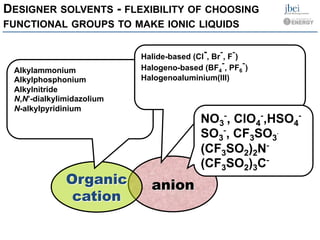
anionOrganic
cation
DESIGNER SOLVENTS - FLEXIBILITY OF CHOOSING
FUNCTIONAL GROUPS TO MAKE IONIC LIQUIDS
Alkylammonium
Alkylphosphonium
Alkylnitride
N,N’-dialkylimidazolium
N-alkylpyridinium

Halide-based (Cl
-, Br
-­‐, F
-­‐)
Halogeno-based (BF4
-­‐, PF6
-­‐)
Halogenoaluminium(III)

NO3
-­‐, ClO4
-­‐,HSO4
-­‐
SO3
-­‐, CF3SO3
-­‐
(CF3SO2)2N-­‐
(CF3SO2)3C-­‐
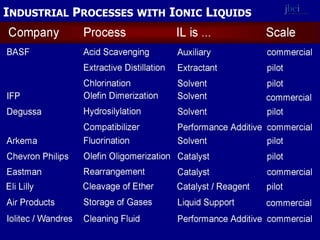
INDUSTRIAL PROCESSES WITH IONIC LIQUIDS
1-ethyl-3-methylimidazolium acetate, abbreviated
as [C2mim][OAc], dissolves > 20 wt% cellulose
CERTAIN IONIC LIQUIDS (ILS) ARE
EFFECTIVE BIOMASS SOLVENTS
Cation determines:
-  stability
-  properties
Anion determines:
- chemistry
- functionality
Room	
  Temperature,	
  Molten	
  Salts	
  
Simmons,	
  B.	
  et	
  al.,	
  Ionic	
  Liquid	
  Pretreatment,	
  Chem	
  Eng	
  Prog,	
  2010,	
  3,	
  50-­‐55	
  
7	
  
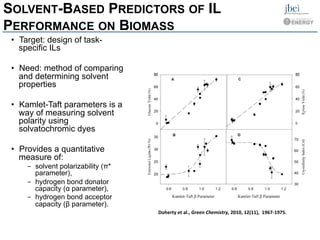
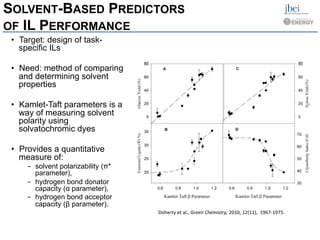
SOLVENT-BASED PREDICTORS OF IL
PERFORMANCE ON BIOMASS
•  Target: design of task-
specific ILs
•  Need: method of comparing
and determining solvent
properties
•  Kamlet-Taft parameters is a
way of measuring solvent
polarity using
solvatochromic dyes
•  Provides a quantitative
measure of:
-  solvent polarizability (π*
parameter),
-  hydrogen bond donator
capacity (α parameter),
-  hydrogen bond acceptor
capacity (β parameter).
Doherty	
  et	
  al.,	
  Green	
  Chemistry,	
  2010,	
  12(11),	
  	
  1967-­‐1975.	
  	
  
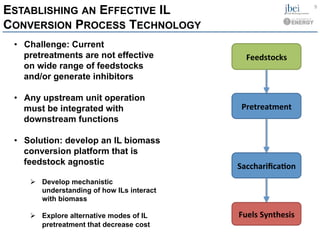
ESTABLISHING AN EFFECTIVE IL
CONVERSION PROCESS TECHNOLOGY
Feedstocks	
  
Pretreatment	
  
SaccharificaHon	
  
Fuels	
  Synthesis	
  
•  Challenge: Current
pretreatments are not effective
on wide range of feedstocks
and/or generate inhibitors
•  Any upstream unit operation
must be integrated with
downstream functions
•  Solution: develop an IL biomass
conversion platform that is
feedstock agnostic
Ø  Develop mechanistic
understanding of how ILs interact
with biomass
Ø  Explore alternative modes of IL
pretreatment that decrease cost
9	
  
[C2mim][OAc] Switchgrass
Heat
Stir
Anti-
solvent
Advantages:
•  Increased enzyme accessibility
•  Decreased lignin
•  Significantly impacted cellulose crystallinity
Challenges:
•  IL recovery and recycle
•  Process integration
•  IL cost
WE HAVE ESTABLISHED AN EFFECTIVE IONIC
LIQUID PRETREATMENT PROCESS BASELINE
10	
  
UNDERSTANDING IL PRETREATMENT
Molecular	
  scale:	
  20-­‐mer	
  of	
  cellulose;	
  [C2mim][OAc]/H2O	
  (w/w)	
  =	
  50/50	
  
Ø  MD	
  simulaHons	
  conducted	
  using	
  
NERSC	
  resources	
  
Ø  Provides	
  new	
  insight	
  into	
  the	
  
mechanism	
  of	
  cellulose	
  solvaHon	
  in	
  
ionic	
  liquids	
  
Ø  Produced	
  new	
  hypothesis	
  on	
  the	
  
mechanism	
  of	
  cellulose	
  precipitaHon	
  
Liu	
  et	
  al.,	
  Journal	
  of	
  Physical	
  Chemistry	
  (2011),	
  115(34),	
  10251-­‐10258.	
  
11	
  
Macroscale:	
  plant	
  cell	
  walls	
  of	
  pine,	
  [C2mim][OAc],	
  120	
  oC	
  
Ø  In	
  situ	
  studies	
  using	
  bright	
  field	
  
microscopy	
  
Ø  Rapid	
  swelling	
  of	
  the	
  plant	
  cell	
  walls,	
  
followed	
  by	
  dissoluHon	
  
Ø  Complementary	
  Raman	
  studies	
  
indicate	
  that	
  lignin	
  is	
  solvated	
  first,	
  
then	
  cellulose	
  
SWITCHGRASS UNDERGOING IL PRETREATMENT
•  [C2mim][OAc],	
  120oC,	
  t	
  =	
  10	
  minutes	
  
•  In	
  situ	
  studies	
  using	
  bright	
  field	
  microscopy	
  
•  Complementary	
  Raman	
  and	
  fluorescence	
  studies	
  indicate	
  that	
  
lignin	
  is	
  solvated	
  first,	
  then	
  cellulose	
  
12	
  
SOLVENT-BASED PREDICTORS
OF IL PERFORMANCE
•  Target: design of task-
specific ILs
•  Need: method of comparing
and determining solvent
properties
•  Kamlet-Taft parameters is a
way of measuring solvent
polarity using
solvatochromic dyes
•  Provides a quantitative
measure of:
-  solvent polarizability (π*
parameter),
-  hydrogen bond donator
capacity (α parameter),
-  hydrogen bond acceptor
capacity (β parameter).
Doherty	
  et	
  al.,	
  Green	
  Chemistry,	
  2010,	
  12(11),	
  	
  1967-­‐1975.	
  	
  
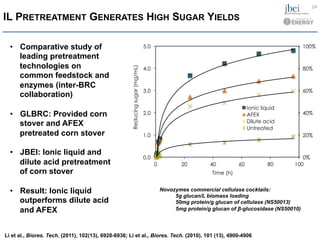
•  Comparative study of
leading pretreatment
technologies on
common feedstock and
enzymes (inter-BRC
collaboration)
•  GLBRC: Provided corn
stover and AFEX
pretreated corn stover
•  JBEI: Ionic liquid and
dilute acid pretreatment
of corn stover
•  Result: Ionic liquid
outperforms dilute acid
and AFEX
0%
20%
40%
60%
80%
100%
0.0
1.0
2.0
3.0
4.0
5.0
0 20 40 60 80 100
Reducingsugar(mg/mL)
Time (h)
Ionic liquid
AFEX
Dilute acid
Untreated
IL PRETREATMENT GENERATES HIGH SUGAR YIELDS
Novozymes commercial cellulase cocktails:
5g glucan/L biomass loading
50mg protein/g glucan of cellulase (NS50013)
5mg protein/g glucan of β-glucosidase (NS50010)
Li et al., Biores. Tech. (2011), 102(13), 6928-6936; Li et al., Biores. Tech. (2010), 101 (13), 4900-4906
14	
  
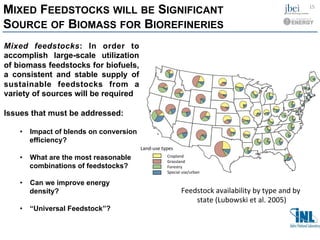
Feedstock	
  availability	
  by	
  type	
  and	
  by	
  
state	
  (Lubowski	
  et	
  al.	
  2005)	
  
Mixed feedstocks: In order to
accomplish large-scale utilization
of biomass feedstocks for biofuels,
a consistent and stable supply of
sustainable feedstocks from a
variety of sources will be required
Issues that must be addressed:
•  Impact of blends on conversion
efficiency?
•  What are the most reasonable
combinations of feedstocks?
•  Can we improve energy
density?
•  “Universal Feedstock”?
MIXED FEEDSTOCKS WILL BE SIGNIFICANT
SOURCE OF BIOMASS FOR BIOREFINERIES
15	
  
Cropland	
  
Grassland	
  
Forestry	
  
Special	
  use/urban	
  
Land-­‐use	
  types	
  
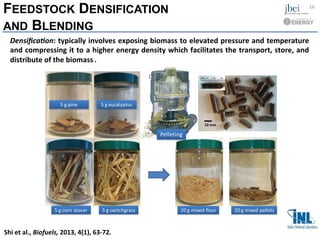
Densifica:on:	
  typically	
  involves	
  exposing	
  biomass	
  to	
  elevated	
  pressure	
  and	
  temperature	
  
and	
  compressing	
  it	
  to	
  a	
  higher	
  energy	
  density	
  which	
  facilitates	
  the	
  transport,	
  store,	
  and	
  
distribute	
  of	
  the	
  biomass	
  .	
  	
  
20	
  g	
  mixed	
  flour 20	
  g	
  mixed	
  pellets
5	
  g	
  pine 5	
  g	
  eucalyptus
5	
  g	
  corn	
  stover 5	
  g	
  switchgrass
10	
  mm
Pelleting
FEEDSTOCK DENSIFICATION
AND BLENDING
16	
  
Shi	
  et	
  al.,	
  Biofuels,	
  2013,	
  4(1),	
  63-­‐72.	
  	
  
IL PROCESS GENERATES HIGH SUGAR
YIELDS FOR SINGLE AND MIXED FEEDSTOCKS
• Pretreatment: [C2mim][OAc], 15% solids loading, 160 oC, 3 hours
• Saccharification: 15% solids loading, CTec2 @ 40 mg/g glucan loading, HTec2 4 mg/g xylan
• Mixed feedstocks appear to perform better than average of single feedstock yields – why?
17	
  
0
10
20
30
40
50
60
70
Mixed Eucalyptus Pine Switchgrass Corn	
  stover
Sugar	
  released	
  (g/L)
Biomass	
  types
Arabinose
Galactose
Glucose
Xylose
Shi	
  et	
  al.,	
  Biofuels,	
  2013,	
  4(1),	
  63-­‐72.	
  	
  
DENSIFIED FEEDSTOCKS ARE
EFFECTIVELY PRETREATED USING ILS
20#g#mixed#flour# 20#g#mixed#pellets#
A" B"
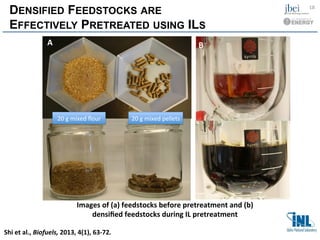
Images	
  of	
  (a)	
  feedstocks	
  before	
  pretreatment	
  and	
  (b)	
  
densified	
  feedstocks	
  during	
  IL	
  pretreatment	
  
18	
  
Shi	
  et	
  al.,	
  Biofuels,	
  2013,	
  4(1),	
  63-­‐72.	
  	
  
0 24 48 72
0
20
40
60
80
100
EnzymaticDigestibility,%
Time, h
mixed flour-IL pretreated
mixed pellets-IL pretreated
mixed flour-untreated
mixed pellets-untreated
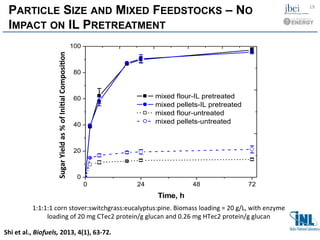
PARTICLE SIZE AND MIXED FEEDSTOCKS – NO
IMPACT ON IL PRETREATMENT
1:1:1:1	
  corn	
  stover:switchgrass:eucalyptus:pine.	
  Biomass	
  loading	
  =	
  20	
  g/L,	
  with	
  enzyme	
  
loading	
  of	
  20	
  mg	
  CTec2	
  protein/g	
  glucan	
  and	
  0.26	
  mg	
  HTec2	
  protein/g	
  glucan	
  	
  
19	
  
Sugar	
  Yield	
  as	
  %	
  of	
  IniHal	
  ComposiHon	
  
Shi	
  et	
  al.,	
  Biofuels,	
  2013,	
  4(1),	
  63-­‐72.	
  	
  
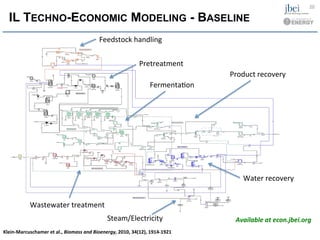
IL TECHNO-ECONOMIC MODELING - BASELINE
Feedstock	
  handling	
  
Pretreatment	
  
FermentaVon	
  
Product	
  recovery	
  
Water	
  recovery	
  
Wastewater	
  treatment	
  
Steam/Electricity	
  
Klein-­‐Marcuschamer	
  et	
  al.,	
  Biomass	
  and	
  Bioenergy,	
  2010,	
  34(12),	
  1914-­‐1921	
  
Available	
  at	
  econ.jbei.org	
  
20	
  
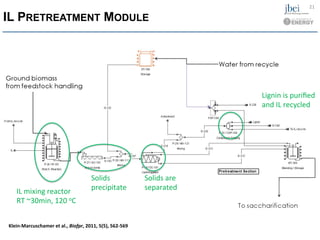
IL PRETREATMENT MODULE
IL	
  mixing	
  reactor	
  
RT	
  ~30min,	
  120	
  oC	
  
Solids	
  
precipitate	
  
Solids	
  are	
  
separated	
  
Lignin	
  is	
  purified	
  
and	
  IL	
  recycled	
  
	
  Klein-­‐Marcuschamer	
  et	
  al.,	
  Biofpr,	
  2011,	
  5(5),	
  562-­‐569	


21	
  
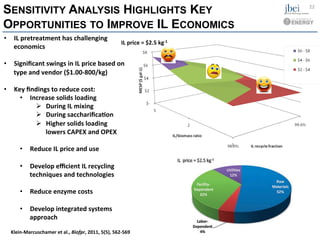
SENSITIVITY ANALYSIS HIGHLIGHTS KEY
OPPORTUNITIES TO IMPROVE IL ECONOMICS
	
  Klein-­‐Marcuschamer	
  et	
  al.,	
  Biofpr,	
  2011,	
  5(5),	
  562-­‐569	
  
•  IL	
  pretreatment	
  has	
  challenging	
  
economics	
  
•  Significant	
  swings	
  in	
  IL	
  price	
  based	
  on	
  
type	
  and	
  vendor	
  ($1.00-­‐800/kg)	
  
•  Key	
  findings	
  to	
  reduce	
  cost:	
  
•  Increase	
  solids	
  loading	
  	
  
Ø  During	
  IL	
  mixing	
  	
  
Ø  During	
  saccharificaHon	
  
Ø  Higher	
  solids	
  loading	
  
lowers	
  CAPEX	
  and	
  OPEX	
  
•  Reduce	
  IL	
  price	
  and	
  use	


•  Develop	
  efficient	
  IL	
  recycling	
  
techniques	
  and	
  technologies	
  	
  
•  Reduce	
  enzyme	
  costs	
  
•  Develop	
  integrated	
  systems	
  
approach	
  
22	
  
IL	
  price	
  =	
  $2.5	
  kg-­‐1	
  
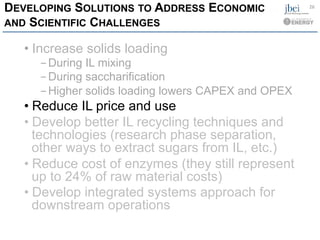
DEVELOPING SOLUTIONS TO ADDRESS ECONOMIC
AND SCIENTIFIC CHALLENGES
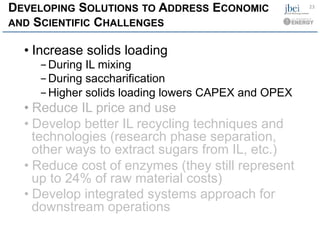
• Increase solids loading
- During IL mixing
- During saccharification
- Higher solids loading lowers CAPEX and OPEX
• Reduce IL price and use
• Develop better IL recycling techniques and
technologies (research phase separation,
other ways to extract sugars from IL, etc.)
• Reduce cost of enzymes (they still represent
up to 24% of raw material costs)
• Develop integrated systems approach for
downstream operations
23	
  
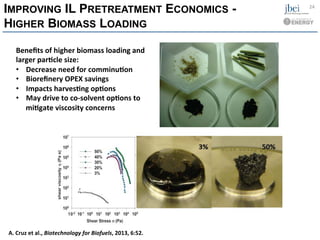
IMPROVING IL PRETREATMENT ECONOMICS -
HIGHER BIOMASS LOADING
Benefits	
  of	
  higher	
  biomass	
  loading	
  and	
  
larger	
  parHcle	
  size:	
  
•  Decrease	
  need	
  for	
  comminuHon	
  
•  Biorefinery	
  OPEX	
  savings	
  
•  Impacts	
  harvesHng	
  opHons	
  
•  May	
  drive	
  to	
  co-­‐solvent	
  opHons	
  to	
  
miHgate	
  viscosity	
  concerns	
  
24	
  
A.	
  Cruz	
  et	
  al.,	
  Biotechnology	
  for	
  Biofuels,	
  2013,	
  6:52.	
  
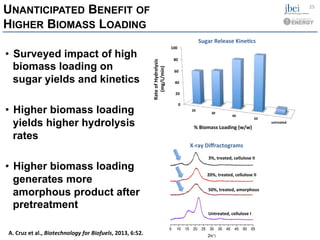
3%,$$CrI$=$0.35$(Cellulose$II)$
20%,$CrI$=$0.26$(Cellulose$II)$
50%,$CrI$=$0.03$(Mostly$Amorphous)$
Untreated,$CrI$=$0.36$(Cellulose$I)$
Untreated,)cellulose)I)
3%,)treated,)cellulose)II)
20%,)treated,)cellulose)II)
50%,)treated,)amorphous)
0"
20"
40"
60"
80"
100"
20"
30"
40"
50"
untreated"
Rate"of"Hydrolysis"
"(mg/L/min)"""
%"Biomass"Loading"(w/w)"
UNANTICIPATED BENEFIT OF
HIGHER BIOMASS LOADING
•  Surveyed impact of high
biomass loading on
sugar yields and kinetics
•  Higher biomass loading
yields higher hydrolysis
rates
•  Higher biomass loading
generates more
amorphous product after
pretreatment
25	
  
X-­‐ray	
  Diffractograms	
  
Sugar	
  Release	
  KineHcs	
  
A.	
  Cruz	
  et	
  al.,	
  Biotechnology	
  for	
  Biofuels,	
  2013,	
  6:52.	
  
DEVELOPING SOLUTIONS TO ADDRESS ECONOMIC
AND SCIENTIFIC CHALLENGES
• Increase solids loading
- During IL mixing
- During saccharification
- Higher solids loading lowers CAPEX and OPEX
• Reduce IL price and use
• Develop better IL recycling techniques and
technologies (research phase separation,
other ways to extract sugars from IL, etc.)
• Reduce cost of enzymes (they still represent
up to 24% of raw material costs)
• Develop integrated systems approach for
downstream operations
26	
  
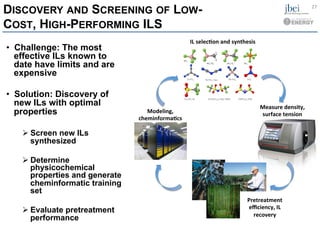
DISCOVERY AND SCREENING OF LOW-
COST, HIGH-PERFORMING ILS
•  Challenge: The most
effective ILs known to
date have limits and are
expensive
•  Solution: Discovery of
new ILs with optimal
properties
Ø Screen new ILs
synthesized
Ø Determine
physicochemical
properties and generate
cheminformatic training
set
Ø Evaluate pretreatment
performance
27	
  
IL	
  selecHon	
  and	
  synthesis	
  
Measure	
  density,	
  
surface	
  tension	
  
Pretreatment	
  
efficiency,	
  IL	
  
recovery	
  
Modeling,	
  
cheminformaHcs	
  
Goal:	
  Design,	
  synthesize	
  and	
  screen	
  new	
  ionic	
  liquids	
  that:	


1.  Compare	
  favorably	
  in	
  performance	
  to	
  our	
  current	
  gold	
  standard	
  [C2mim][OAc]	
  
2.  Do	
  not	
  require	
  anhydrous	
  condiVons	
  (operate	
  effecVvely	
  at	
  20%	
  H2O)	
  
3.  Compete	
  in	
  cost	
  with	
  commonly	
  used	
  industrial	
  reagents	


HSO4-­‐	
  anions	
  (good	
  delignifiers)	
  systemaVcally	
  varied	
  caVon,	
  to	
  understand	
  mechanisms.	


IDENTIFYING AND DEVELOPING
COST-EFFECTIVE ILS
ethylammonium	
  
diethylammonium	
  
triethylammonium	
  
diisopropylammonium	
  
NH3
+
N
H2
+
N
H2
+
NH+
monoethanolammonium	
  
diethanolammonium	
  
triethanolammonium	
  
NH3
+
HO
NH+
HO OH
OH
H2
+
N
HO OH
28	
  
80:20 TRIETHYLAMMONIUM:H2O MIXTURE IS ~80% AS
EFFECTIVE AS 80:20 [C2MIM][OAC]:H2O……
0	
  
10	
  
20	
  
30	
  
40	
  
50	
  
60	
  
70	
  
80	
  
90	
  
48	
  hr	
  hydrolysis	
  yield	
  /[%]	
  
Pretreatment	
  condiHons:	
  120	
  oC,	
  2	
  hours,	
  10%	
  loading	
  
SaccharificaHon	
  condiHons:	
  50	
  oC,	
  1%	
  glucan	
  loading,	
  72	
  hours,	
  CTec2	
  20	
  mg/g	
  
glucan,	
  HTec2	
  1:10	
  
29	
  
....AND COSTS $0.75 PER KG VERSUS $20
Ionic	
  liquid	
   Cost	
  /kg	
  
[C4C1im][PF6]	
  (Sigma-­‐Aldrich)	
   (250g)	
   $2000	
  
[C2mim][OAc]	
  (Sigma-­‐Aldrich)	
   (1kg)	
   $850	
  
[(C8)3C1N][Br]	
  (Solvent	
  InnovaVons)	
   (100T)	
   $30	
  
[C2mim][OAc]	
  (BASF)	
   (best	
  case	
  bulk	
  esVmate)	
   $20	
  
[C4mim][HSO4]	
  (BASF)	
   (best	
  case	
  bulk	
  esVmate)	
   $2.5	
  
TRIETHYLAMMONIUM	
  HYDROGEN	
  
SULPHATE	
  
Cost/kg	
  
Raw	
  materials:	


  H2SO4	


  Triethylamine	
  
$0.04	


$1.45	
  
Process	
  costs	
   $0.01	
  
TOTAL	
  COST	
   $0.75	
  
30	
  
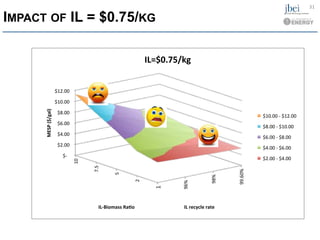
IMPACT OF IL = $0.75/KG
31	
  
_"
96%"
98%"
99.60%"
"$*""""
"$2.00""
"$4.00""
"$6.00""
"$8.00""
"$10.00""
"$12.00""
10"
7.5"
5"
2"
1"
IL#recycle#rate#
MESP#($/gal)#
IL4Biomass#Ra;o#
IL=$0.75/kg#
"$10.00"*"$12.00""
"$8.00"*"$10.00""
"$6.00"*"$8.00""
"$4.00"*"$6.00""
"$2.00"*"$4.00""
"$*"""*"$2.00""
DEVELOPING SOLUTIONS TO ADDRESS
ECONOMIC AND SCIENTIFIC CHALLENGES
• Reduce IL price and use
• Increase the solids loading
- During IL mixing (as shown in this presentation)
- During saccharification
- Higher solids loading mean lower CAPEX and
OPEX
• Develop better IL recycling techniques and
technologies (research phase separation,
other ways to extract sugars from IL, etc.)
• Reduce the contribution of enzymes (they still
represent up to 24% of raw material costs)
• Develop integrated systems approach for
downstream operations
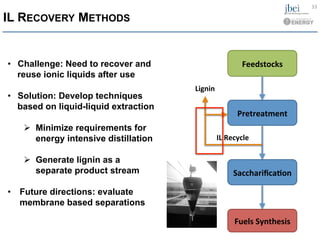
IL RECOVERY METHODS
Feedstocks	
  
Pretreatment	
  
SaccharificaHon	
  
Fuels	
  Synthesis	
  
•  Challenge: Need to recover and
reuse ionic liquids after use
•  Solution: Develop techniques
based on liquid-liquid extraction
Ø  Minimize requirements for
energy intensive distillation
Ø  Generate lignin as a
separate product stream
•  Future directions: evaluate
membrane based separations
33	
  
IL	
  Recycle	
  
Lignin	
  
ESTABLISHING ROUTES TO EFFICIENT IL
RECOVERY AND RECYCLE
•  Challenge: IL must be
recovered and recycled
•  Solution: Demonstrated
~90% IL recovery and IL
maintains pretreatment
efficacy.
Ø  Biomass fractionation
can be tailored to
desired output streams.
Ø  <1% IL degraded during
pretreatment at these
conditions
Estimated mass balances!
!"
Starting Biomass
(Corn Stover)
100%
3%
2%
18%
77%
64%
13%
Xylan-rich product
6.5% of C6 Carb.
15.3% of C5 Carb.
14.3% of Lignin
19.2% of Other
Aliphatic-rich product
8.4% of Other
Lig.-rich product
1.2% of C6 Carb.
3.7% of C5 Carb.
5.9% of Lig
1.2% of Other
Lost
7.6% of C6 Carb.
16.6% of C5 Carb.
44.6% of Lignin
21.3% of Other
Glucan-rich product
84.7% of C6 Carb.
64.3% of C5 Carb.
35.2% of Lignin
49.9% of Other
IL recovery ! 89%
ComposiHon	
  and	
  disposiHon	
  of	
  corn	
  stover	
  aler	
  IL	
  pretreatment	
  
uHlizing	
  new	
  [C2mim][OAc]	
  IL	
  for	
  3	
  hours	
  at	
  140	
  °C.	
  A	
  Xylan-­‐rich	
  
product	
  is	
  obtained	
  from	
  a	
  water	
  wash	
  of	
  pretreated	
  solids.	
  
Dibble	
  et	
  al.,	
  A	
  facile	
  method	
  for	
  the	
  recovery	
  of	
  ionic	
  liquid	
  and	
  lignin	
  from	
  
biomass	
  pretreatment,	
  Green	
  Chemistry,	
  2011,13,	
  3255-­‐3264.	


34	
  
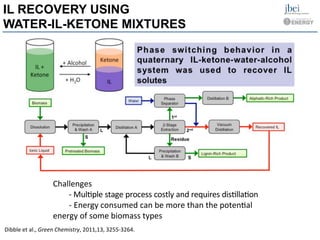
IL RECOVERY USING
WATER-IL-KETONE MIXTURES
	
  Dibble	
  et	
  al.,	
  Green	
  Chemistry,	
  2011,13,	
  3255-­‐3264.	


Challenges	
  
	
  -­‐	
  MulVple	
  stage	
  process	
  costly	
  and	
  requires	
  disVllaVon	
  
	
  -­‐	
  Energy	
  consumed	
  can	
  be	
  more	
  than	
  the	
  potenVal	
  
energy	
  of	
  some	
  biomass	
  types	
  
DEVELOPING SOLUTIONS TO ADDRESS
ECONOMIC AND SCIENTIFIC CHALLENGES
• Reduce IL price and use
• Increase the solids loading
- During IL mixing (as shown in this presentation)
- During saccharification
- Higher solids loading mean lower CAPEX and
OPEX
• Develop better IL recycling techniques and
technologies (research phase separation,
other ways to extract sugars from IL, etc.)
• Reduce the contribution of enzymes (they still
represent up to 24% of raw material costs)
• Develop integrated systems approach for
downstream operations
[C2mim]Cl	
  
[C2mim]Cl	
  
HCl	
  
FERMENTABLE SUGARS BY ACID HYDROLYSIS
Binder	
  and	
  Raines.	
  PNAS	
  (2010)	
  
v  Directly hydrolyze biomass dissolved in IL with the aid of acid	

v  HMF/furfural reduction by titration of water	

v  Cost effective separation of sugars/products from ILs and IL
recycling is a challenge	

105	
  oC/6h	
  
IL RECOVERY USING AQUEOUS
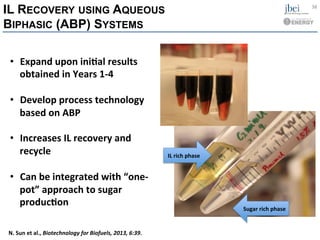
BIPHASIC (ABP) SYSTEMS
38	
  
IL	
  rich	
  phase	
  
Sugar	
  rich	
  phase	
  
•  Expand	
  upon	
  iniHal	
  results	
  
obtained	
  in	
  Years	
  1-­‐4	
  
•  Develop	
  process	
  technology	
  
based	
  on	
  ABP	
  
•  Increases	
  IL	
  recovery	
  and	
  
recycle	
  
•  Can	
  be	
  integrated	
  with	
  “one-­‐
pot”	
  approach	
  to	
  sugar	
  
producHon	
  
N.	
  Sun	
  et	
  al.,	
  Biotechnology	
  for	
  Biofuels,	
  2013,	
  6:39.	
  
39	
  
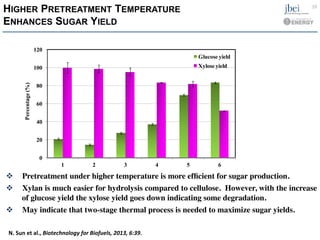
HIGHER PRETREATMENT TEMPERATURE
ENHANCES SUGAR YIELD
v  Pretreatment under higher temperature is more efficient for sugar production. 	

v  Xylan is much easier for hydrolysis compared to cellulose. However, with the increase
of glucose yield the xylose yield goes down indicating some degradation. 	

v  May indicate that two-stage thermal process is needed to maximize sugar yields.	

0
20
40
60
80
100
120
1 2 3 4 5 6
Glucose yield
Xylose yield
Percentage(%)
N.	
  Sun	
  et	
  al.,	
  Biotechnology	
  for	
  Biofuels,	
  2013,	
  6:39.	
  
DEVELOPING SOLUTIONS TO ADDRESS
ECONOMIC AND SCIENTIFIC CHALLENGES
• Reduce IL price and use
• Increase the solids loading
- During IL mixing (as shown in this presentation)
- During saccharification
- Higher solids loading mean lower CAPEX and
OPEX
• Develop better IL recycling techniques and
technologies (research phase separation,
other ways to extract sugars from IL, etc.)
• Reduce the contribution of enzymes (they still
represent up to 24% of raw material costs)
• Develop integrated systems approach for
downstream operations
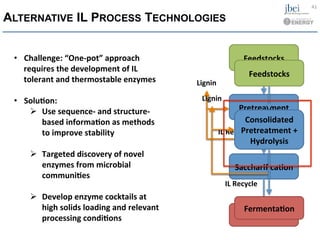
ALTERNATIVE IL PROCESS TECHNOLOGIES
Feedstocks	
  
Pretreatment	
  
SaccharificaHon	
  
FermentaHon	
  
IL	
  Recycle	
  
Lignin	
  
•  Challenge:	
  “One-­‐pot”	
  approach	
  
requires	
  the	
  development	
  of	
  IL	
  
tolerant	
  and	
  thermostable	
  enzymes	
  
•  SoluHon:	
  
Ø  Use	
  sequence-­‐	
  and	
  structure-­‐
based	
  informaHon	
  as	
  methods	
  
to	
  improve	
  stability	
  
Ø  Targeted	
  discovery	
  of	
  novel	
  
enzymes	
  from	
  microbial	
  
communiHes	


Ø  Develop	
  enzyme	
  cocktails	
  at	
  
high	
  solids	
  loading	
  and	
  relevant	
  
processing	
  condiHons	
  
41	
  
Feedstocks	
  
Consolidated	
  
Pretreatment	
  +	
  
Hydrolysis	
  
FermentaHon	
  
IL	
  Recycle	
  
Lignin	
  
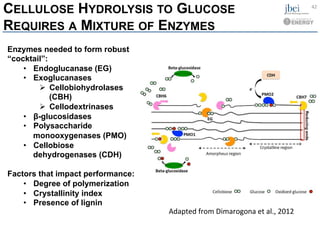
CELLULOSE HYDROLYSIS TO GLUCOSE
REQUIRES A MIXTURE OF ENZYMES
42	
  
Adapted	
  from	
  Dimarogona	
  et	
  al.,	
  2012	
  	
  
Enzymes needed to form robust
“cocktail”:
•  Endoglucanase (EG)
•  Exoglucanases
Ø  Cellobiohydrolases
(CBH)
Ø  Cellodextrinases
•  β-glucosidases
•  Polysaccharide
monooxygenases (PMO)
•  Cellobiose
dehydrogenases (CDH)
Factors that impact performance:
•  Degree of polymerization
•  Crystallinity index
•  Presence of lignin
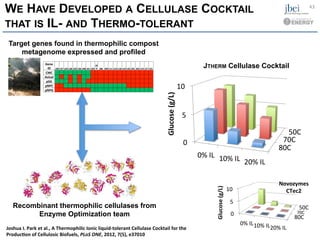
WE HAVE DEVELOPED A CELLULASE COCKTAIL
THAT IS IL- AND THERMO-TOLERANT
Recombinant thermophilic cellulases from
Enzyme Optimization team
JTHERM Cellulase Cocktail
Target genes found in thermophilic compost
metagenome expressed and profiled
Gene$
ID$ J30$J37$J24$J28$J29$J36$J40$J41$J03$
J0
6$ J08$ J09$J11$J14$J18$J19$J35$J01$J02$J15$J17$J31$
CMC$ $$ $$ $$ $$ $$ $$ $$ $$ $$ $$ $$ $$ $$ $$ $$ $$ $$ $$ $$ $$ $$ $$
Avicel$ $$ $$ $$ $$ $$ $$ $$ $$ $$ $$ $$ $$ $$ $$ $$ $$ $$ $$ $$ $$ $$ $$
pSG$ $$ $$ $$ $$ $$ $$ $$ $$ $$ $$ $$ $$ $$ $$ $$ $$ $$ $$ $$ $$ $$ $$
pNPC$ $$ $$ $$ $$ $$ $$ $$ $$ $$ $$ $$ $$ $$ $$ $$ $$ $$ $$ $$ $$ $$ $$
pNPG$ $$ $$ $$ $$ $$ $$ $$ $$ $$ $$ $$ $$ $$ $$ $$ $$ $$ $$ $$ $$ $$ $$
Joshua	
  I.	
  Park	
  et	
  al.,	
  A	
  Thermophilic	
  Ionic	
  liquid-­‐tolerant	
  Cellulase	
  Cocktail	
  for	
  the	
  
ProducHon	
  of	
  Cellulosic	
  Biofuels,	
  PLoS	
  ONE,	
  2012,	
  7(5),	
  e37010	
  
80C	
  
50C	
  
0	
  
5	
  
10	
  
0%	
  IL	
   10%	
  IL	
   20%	
  IL	
  
Glucose	
  (g/L)	
  
80C$
50C$
0$
5$
10$
0%$IL$10%$IL$20%$IL$
Novozymes)
CTec2)
Glucose)(g/L))
43	
  
70C	
  
70C	
  
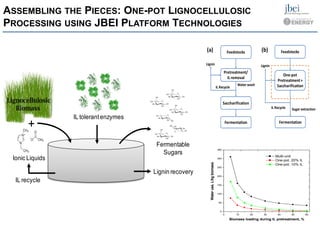
ASSEMBLING THE PIECES: ONE-POT LIGNOCELLULOSIC
PROCESSING USING JBEI PLATFORM TECHNOLOGIES
IL tolerantenzymes
Ionic Liquids
Fermentable
Sugars
+
Lignin recovery
IL recycle
0 10 20 30 40 50 60
0
50
100
150
200
250
300
350
Wateruse,L/kgbiomass
Biomass loading during IL pretreatment, %
Multi-unit
One-pot, 20% IL
One-pot, 10% IL
Feedstocks
Pretreatment/
IL	
  removal
Saccharification
Fermentation
IL	
  Recycle
Lignin
Feedstocks
One-­‐pot	
  
Pretreatment	
  +	
  
Saccharification
Fermentation
IL	
  Recycle
Lignin
Sugar	
  extraction
(a) (b)
Water	
  wash
0
20
40
60
80
100
Untreated --
CTec + washed
CTec + IL --
JTherm
+ IL
0
10
20
30
Glucoseyield,%ofmaximumpotential
Glucosemassyield,g/100grawSG
Glucose
Xylose
Ø  Wash-­‐free	
  
Ø  No	
  pH	
  adjustment	
  needed	
  
Ø  Glucose	
  and	
  xylose	
  yields	
  comparable	
  to	
  
tradiHonal	
  IL	
  pretreatment	
  and	
  
saccharificaHon	
  using	
  commercial	
  enzymes	
  
Ø  SelecHve	
  sugar	
  extracHon	
  
Ø  Lignin	
  streams	
  open	
  to	
  recycle	
  and	
  
valorizaHon	
  
Ø  Batch	
  mode	
  à	
  conHnuous	
  mode	
  	
  
Switchgrass
Ionic Liquid
Pretreatment
Enzymatic
Hydrolysis
1
2
3
Liquid
Solids
16.8 g dry
residual solids
100 g dry weight
31.5 g glucose
13.6 g xylose
1.0 g glucose oligomers
6.0 g xylose oligomers
7.7 g lignin
Overall yield of glucose from liquid streams = 81.9%
Overall yield of xylose plus xylooligomers from liquid streams = 85.4%
JTherm Protein ~ 2.3 g
(23 mg enzyme/g )
2.1 g glucan
2.2 g xylan
11.3 g lignin
1.6 g others
160 o
C, 3h
Atmospheric pressure
10% solid loading
34.6 g glucan (G)
20.2 g xylan
19.0 g lignin
26.2 g others Water
9000 g
[C2mim][OAc]
900 g
(a)
ONE-POT LIGNOCELLULOSIC PROCESSING
USING JBEI PLATFORM TECHNOLOGIES
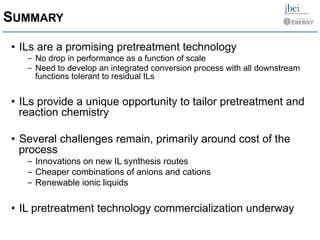
SUMMARY
•  ILs are a promising pretreatment technology
-  No drop in performance as a function of scale
-  Need to develop an integrated conversion process with all downstream
functions tolerant to residual ILs
•  ILs provide a unique opportunity to tailor pretreatment and
reaction chemistry
•  Several challenges remain, primarily around cost of the
process
-  Innovations on new IL synthesis routes
-  Cheaper combinations of anions and cations
-  Renewable ionic liquids
•  IL pretreatment technology commercialization underway
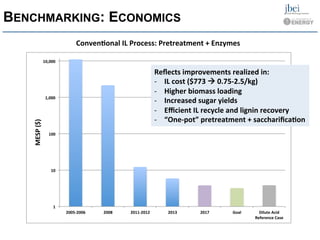
BENCHMARKING: ECONOMICS
ConvenHonal	
  IL	
  Process:	
  Pretreatment	
  +	
  Enzymes	
  
1"
10"
100"
1,000"
10,000"
2005'2006" 2008" 2011'2012" 2013" 2017" Goal" Dilute"Acid"
Reference"Case"
MESP"($)"
Reflects	
  improvements	
  realized	
  in:	
  
-­‐  IL	
  cost	
  ($773	
  à	
  0.75-­‐2.5/kg)	
  
-­‐  Higher	
  biomass	
  loading	
  
-­‐  Increased	
  sugar	
  yields	
  
-­‐  Efficient	
  IL	
  recycle	
  and	
  lignin	
  recovery	
  
-­‐  “One-­‐pot”	
  pretreatment	
  +	
  saccharificaHon	
  
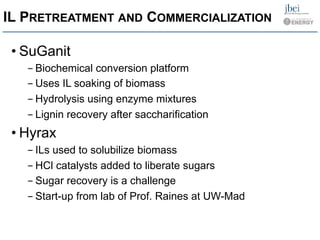
IL PRETREATMENT AND COMMERCIALIZATION
• SuGanit
- Biochemical conversion platform
- Uses IL soaking of biomass
- Hydrolysis using enzyme mixtures
- Lignin recovery after saccharification
• Hyrax
- ILs used to solubilize biomass
- HCl catalysts added to liberate sugars
- Sugar recovery is a challenge
- Start-up from lab of Prof. Raines at UW-Mad
ACKNOWLEDGMENTS
•  JBEI: Seema Singh, Ning Sun, Jian Shi, Kim Tran, Mike
Kent, Rich Heins, John Gladden, Ken Sale, Steve Singer
•  Imperial College: Tom Welton, Jason Hallett
•  VTT: Alistair King
•  ABPDU: James Gardner, Chenlin Li, Deepti Tanjore, Wei He
•  INL: Richard Hess, Vicki Thompson
49	
  

Ionic Liquid Pretreatment

  • 1.
    Ionic Liquid Pretreatment EERE Webinar June 24, 2013 Blake Simmons, Ph.D. Vice-President, Deconstruction Division, Joint BioEnergy Institute Senior Manager, Biomass Program Lead, Sandia National Laboratories
  • 2.
                INTRODUCTION - IONICLIQUIDS • Salts that are liquid at ambient temperatures. • Have stable liquid range of over 300 K. • Very low vapour pressure at room temperature. • Selective solubility of water and organics. • Potential to replace volatile organic solvents used in processes • Often associated with Green Chemistry. Has been a major driving force behind the intense interest in ionic liquids
  • 3.
            INDUSTRY DRIVERS: ALTERNATIVESOLVENTS FOR PROCESS INTENSIFICATION • There is a need to develop more environmentally benign solvents or use solventless systems • Such solvents should replace toxic and environmentally hazardous and/or volatile solvents • Necessary to develop and optimize reactions conditions to use these new solvents and at the same time maximize yield and minimize energy usage. • Examples include use of solids or involatile liquids rather than volatile, flammable and environmentally hazardous organic compounds (VOC).
  • 4.
                    WHY CONSIDER IONICLIQUIDS AS GREEN SOLVENTS • Low melting organic salts (-60 °C) • Very low vapor pressure (good) • Non-flammable (good) • Wide liquid range (300 °C) (good) • Moderate to high viscosity (bad) • Solvent properties different from molecular solvents (good and bad) • Solvent properties can be controlled by selection of anion and cation – hence often termed designer solvents (good) • BUT – some ionic liquids are toxic to the environment and humans
  • 5.
    anionOrganic cation DESIGNER SOLVENTS -FLEXIBILITY OF CHOOSING FUNCTIONAL GROUPS TO MAKE IONIC LIQUIDS Alkylammonium Alkylphosphonium Alkylnitride N,N’-dialkylimidazolium N-alkylpyridinium Halide-based (Cl -, Br -­‐, F -­‐) Halogeno-based (BF4 -­‐, PF6 -­‐) Halogenoaluminium(III) NO3 -­‐, ClO4 -­‐,HSO4 -­‐ SO3 -­‐, CF3SO3 -­‐ (CF3SO2)2N-­‐ (CF3SO2)3C-­‐
  • 6.
  • 7.
    1-ethyl-3-methylimidazolium acetate, abbreviated as[C2mim][OAc], dissolves > 20 wt% cellulose CERTAIN IONIC LIQUIDS (ILS) ARE EFFECTIVE BIOMASS SOLVENTS Cation determines: -  stability -  properties Anion determines: - chemistry - functionality Room  Temperature,  Molten  Salts   Simmons,  B.  et  al.,  Ionic  Liquid  Pretreatment,  Chem  Eng  Prog,  2010,  3,  50-­‐55   7  
  • 8.
    SOLVENT-BASED PREDICTORS OFIL PERFORMANCE ON BIOMASS •  Target: design of task- specific ILs •  Need: method of comparing and determining solvent properties •  Kamlet-Taft parameters is a way of measuring solvent polarity using solvatochromic dyes •  Provides a quantitative measure of: -  solvent polarizability (π* parameter), -  hydrogen bond donator capacity (α parameter), -  hydrogen bond acceptor capacity (β parameter). Doherty  et  al.,  Green  Chemistry,  2010,  12(11),    1967-­‐1975.    
  • 9.
    ESTABLISHING AN EFFECTIVEIL CONVERSION PROCESS TECHNOLOGY Feedstocks   Pretreatment   SaccharificaHon   Fuels  Synthesis   •  Challenge: Current pretreatments are not effective on wide range of feedstocks and/or generate inhibitors •  Any upstream unit operation must be integrated with downstream functions •  Solution: develop an IL biomass conversion platform that is feedstock agnostic Ø  Develop mechanistic understanding of how ILs interact with biomass Ø  Explore alternative modes of IL pretreatment that decrease cost 9  
  • 10.
    [C2mim][OAc] Switchgrass Heat Stir Anti- solvent Advantages: •  Increasedenzyme accessibility •  Decreased lignin •  Significantly impacted cellulose crystallinity Challenges: •  IL recovery and recycle •  Process integration •  IL cost WE HAVE ESTABLISHED AN EFFECTIVE IONIC LIQUID PRETREATMENT PROCESS BASELINE 10  
  • 11.
    UNDERSTANDING IL PRETREATMENT Molecular  scale:  20-­‐mer  of  cellulose;  [C2mim][OAc]/H2O  (w/w)  =  50/50   Ø  MD  simulaHons  conducted  using   NERSC  resources   Ø  Provides  new  insight  into  the   mechanism  of  cellulose  solvaHon  in   ionic  liquids   Ø  Produced  new  hypothesis  on  the   mechanism  of  cellulose  precipitaHon   Liu  et  al.,  Journal  of  Physical  Chemistry  (2011),  115(34),  10251-­‐10258.   11   Macroscale:  plant  cell  walls  of  pine,  [C2mim][OAc],  120  oC   Ø  In  situ  studies  using  bright  field   microscopy   Ø  Rapid  swelling  of  the  plant  cell  walls,   followed  by  dissoluHon   Ø  Complementary  Raman  studies   indicate  that  lignin  is  solvated  first,   then  cellulose  
  • 12.
    SWITCHGRASS UNDERGOING ILPRETREATMENT •  [C2mim][OAc],  120oC,  t  =  10  minutes   •  In  situ  studies  using  bright  field  microscopy   •  Complementary  Raman  and  fluorescence  studies  indicate  that   lignin  is  solvated  first,  then  cellulose   12  
  • 13.
    SOLVENT-BASED PREDICTORS OF ILPERFORMANCE •  Target: design of task- specific ILs •  Need: method of comparing and determining solvent properties •  Kamlet-Taft parameters is a way of measuring solvent polarity using solvatochromic dyes •  Provides a quantitative measure of: -  solvent polarizability (π* parameter), -  hydrogen bond donator capacity (α parameter), -  hydrogen bond acceptor capacity (β parameter). Doherty  et  al.,  Green  Chemistry,  2010,  12(11),    1967-­‐1975.    
  • 14.
    •  Comparative studyof leading pretreatment technologies on common feedstock and enzymes (inter-BRC collaboration) •  GLBRC: Provided corn stover and AFEX pretreated corn stover •  JBEI: Ionic liquid and dilute acid pretreatment of corn stover •  Result: Ionic liquid outperforms dilute acid and AFEX 0% 20% 40% 60% 80% 100% 0.0 1.0 2.0 3.0 4.0 5.0 0 20 40 60 80 100 Reducingsugar(mg/mL) Time (h) Ionic liquid AFEX Dilute acid Untreated IL PRETREATMENT GENERATES HIGH SUGAR YIELDS Novozymes commercial cellulase cocktails: 5g glucan/L biomass loading 50mg protein/g glucan of cellulase (NS50013) 5mg protein/g glucan of β-glucosidase (NS50010) Li et al., Biores. Tech. (2011), 102(13), 6928-6936; Li et al., Biores. Tech. (2010), 101 (13), 4900-4906 14  
  • 15.
    Feedstock  availability  by  type  and  by   state  (Lubowski  et  al.  2005)   Mixed feedstocks: In order to accomplish large-scale utilization of biomass feedstocks for biofuels, a consistent and stable supply of sustainable feedstocks from a variety of sources will be required Issues that must be addressed: •  Impact of blends on conversion efficiency? •  What are the most reasonable combinations of feedstocks? •  Can we improve energy density? •  “Universal Feedstock”? MIXED FEEDSTOCKS WILL BE SIGNIFICANT SOURCE OF BIOMASS FOR BIOREFINERIES 15   Cropland   Grassland   Forestry   Special  use/urban   Land-­‐use  types  
  • 16.
    Densifica:on:  typically  involves  exposing  biomass  to  elevated  pressure  and  temperature   and  compressing  it  to  a  higher  energy  density  which  facilitates  the  transport,  store,  and   distribute  of  the  biomass  .     20  g  mixed  flour 20  g  mixed  pellets 5  g  pine 5  g  eucalyptus 5  g  corn  stover 5  g  switchgrass 10  mm Pelleting FEEDSTOCK DENSIFICATION AND BLENDING 16   Shi  et  al.,  Biofuels,  2013,  4(1),  63-­‐72.    
  • 17.
    IL PROCESS GENERATESHIGH SUGAR YIELDS FOR SINGLE AND MIXED FEEDSTOCKS • Pretreatment: [C2mim][OAc], 15% solids loading, 160 oC, 3 hours • Saccharification: 15% solids loading, CTec2 @ 40 mg/g glucan loading, HTec2 4 mg/g xylan • Mixed feedstocks appear to perform better than average of single feedstock yields – why? 17   0 10 20 30 40 50 60 70 Mixed Eucalyptus Pine Switchgrass Corn  stover Sugar  released  (g/L) Biomass  types Arabinose Galactose Glucose Xylose Shi  et  al.,  Biofuels,  2013,  4(1),  63-­‐72.    
  • 18.
    DENSIFIED FEEDSTOCKS ARE EFFECTIVELYPRETREATED USING ILS 20#g#mixed#flour# 20#g#mixed#pellets# A" B" Images  of  (a)  feedstocks  before  pretreatment  and  (b)   densified  feedstocks  during  IL  pretreatment   18   Shi  et  al.,  Biofuels,  2013,  4(1),  63-­‐72.    
  • 19.
    0 24 4872 0 20 40 60 80 100 EnzymaticDigestibility,% Time, h mixed flour-IL pretreated mixed pellets-IL pretreated mixed flour-untreated mixed pellets-untreated PARTICLE SIZE AND MIXED FEEDSTOCKS – NO IMPACT ON IL PRETREATMENT 1:1:1:1  corn  stover:switchgrass:eucalyptus:pine.  Biomass  loading  =  20  g/L,  with  enzyme   loading  of  20  mg  CTec2  protein/g  glucan  and  0.26  mg  HTec2  protein/g  glucan     19   Sugar  Yield  as  %  of  IniHal  ComposiHon   Shi  et  al.,  Biofuels,  2013,  4(1),  63-­‐72.    
  • 20.
    IL TECHNO-ECONOMIC MODELING- BASELINE Feedstock  handling   Pretreatment   FermentaVon   Product  recovery   Water  recovery   Wastewater  treatment   Steam/Electricity   Klein-­‐Marcuschamer  et  al.,  Biomass  and  Bioenergy,  2010,  34(12),  1914-­‐1921   Available  at  econ.jbei.org   20  
  • 21.
    IL PRETREATMENT MODULE IL  mixing  reactor   RT  ~30min,  120  oC   Solids   precipitate   Solids  are   separated   Lignin  is  purified   and  IL  recycled    Klein-­‐Marcuschamer  et  al.,  Biofpr,  2011,  5(5),  562-­‐569     21  
  • 22.
    SENSITIVITY ANALYSIS HIGHLIGHTSKEY OPPORTUNITIES TO IMPROVE IL ECONOMICS  Klein-­‐Marcuschamer  et  al.,  Biofpr,  2011,  5(5),  562-­‐569   •  IL  pretreatment  has  challenging   economics   •  Significant  swings  in  IL  price  based  on   type  and  vendor  ($1.00-­‐800/kg)   •  Key  findings  to  reduce  cost:   •  Increase  solids  loading     Ø  During  IL  mixing     Ø  During  saccharificaHon   Ø  Higher  solids  loading   lowers  CAPEX  and  OPEX   •  Reduce  IL  price  and  use     •  Develop  efficient  IL  recycling   techniques  and  technologies     •  Reduce  enzyme  costs   •  Develop  integrated  systems   approach   22   IL  price  =  $2.5  kg-­‐1  
  • 23.
    DEVELOPING SOLUTIONS TOADDRESS ECONOMIC AND SCIENTIFIC CHALLENGES • Increase solids loading - During IL mixing - During saccharification - Higher solids loading lowers CAPEX and OPEX • Reduce IL price and use • Develop better IL recycling techniques and technologies (research phase separation, other ways to extract sugars from IL, etc.) • Reduce cost of enzymes (they still represent up to 24% of raw material costs) • Develop integrated systems approach for downstream operations 23  
  • 24.
    IMPROVING IL PRETREATMENTECONOMICS - HIGHER BIOMASS LOADING Benefits  of  higher  biomass  loading  and   larger  parHcle  size:   •  Decrease  need  for  comminuHon   •  Biorefinery  OPEX  savings   •  Impacts  harvesHng  opHons   •  May  drive  to  co-­‐solvent  opHons  to   miHgate  viscosity  concerns   24   A.  Cruz  et  al.,  Biotechnology  for  Biofuels,  2013,  6:52.  
  • 25.
    3%,$$CrI$=$0.35$(Cellulose$II)$ 20%,$CrI$=$0.26$(Cellulose$II)$ 50%,$CrI$=$0.03$(Mostly$Amorphous)$ Untreated,$CrI$=$0.36$(Cellulose$I)$ Untreated,)cellulose)I) 3%,)treated,)cellulose)II) 20%,)treated,)cellulose)II) 50%,)treated,)amorphous) 0" 20" 40" 60" 80" 100" 20" 30" 40" 50" untreated" Rate"of"Hydrolysis" "(mg/L/min)""" %"Biomass"Loading"(w/w)" UNANTICIPATED BENEFIT OF HIGHERBIOMASS LOADING •  Surveyed impact of high biomass loading on sugar yields and kinetics •  Higher biomass loading yields higher hydrolysis rates •  Higher biomass loading generates more amorphous product after pretreatment 25   X-­‐ray  Diffractograms   Sugar  Release  KineHcs   A.  Cruz  et  al.,  Biotechnology  for  Biofuels,  2013,  6:52.  
  • 26.
    DEVELOPING SOLUTIONS TOADDRESS ECONOMIC AND SCIENTIFIC CHALLENGES • Increase solids loading - During IL mixing - During saccharification - Higher solids loading lowers CAPEX and OPEX • Reduce IL price and use • Develop better IL recycling techniques and technologies (research phase separation, other ways to extract sugars from IL, etc.) • Reduce cost of enzymes (they still represent up to 24% of raw material costs) • Develop integrated systems approach for downstream operations 26  
  • 27.
    DISCOVERY AND SCREENINGOF LOW- COST, HIGH-PERFORMING ILS •  Challenge: The most effective ILs known to date have limits and are expensive •  Solution: Discovery of new ILs with optimal properties Ø Screen new ILs synthesized Ø Determine physicochemical properties and generate cheminformatic training set Ø Evaluate pretreatment performance 27   IL  selecHon  and  synthesis   Measure  density,   surface  tension   Pretreatment   efficiency,  IL   recovery   Modeling,   cheminformaHcs  
  • 28.
    Goal:  Design,  synthesize  and  screen  new  ionic  liquids  that:     1.  Compare  favorably  in  performance  to  our  current  gold  standard  [C2mim][OAc]   2.  Do  not  require  anhydrous  condiVons  (operate  effecVvely  at  20%  H2O)   3.  Compete  in  cost  with  commonly  used  industrial  reagents     HSO4-­‐  anions  (good  delignifiers)  systemaVcally  varied  caVon,  to  understand  mechanisms.         IDENTIFYING AND DEVELOPING COST-EFFECTIVE ILS ethylammonium   diethylammonium   triethylammonium   diisopropylammonium   NH3 + N H2 + N H2 + NH+ monoethanolammonium   diethanolammonium   triethanolammonium   NH3 + HO NH+ HO OH OH H2 + N HO OH 28  
  • 29.
    80:20 TRIETHYLAMMONIUM:H2O MIXTUREIS ~80% AS EFFECTIVE AS 80:20 [C2MIM][OAC]:H2O…… 0   10   20   30   40   50   60   70   80   90   48  hr  hydrolysis  yield  /[%]   Pretreatment  condiHons:  120  oC,  2  hours,  10%  loading   SaccharificaHon  condiHons:  50  oC,  1%  glucan  loading,  72  hours,  CTec2  20  mg/g   glucan,  HTec2  1:10   29  
  • 30.
    ....AND COSTS $0.75PER KG VERSUS $20 Ionic  liquid   Cost  /kg   [C4C1im][PF6]  (Sigma-­‐Aldrich)   (250g)   $2000   [C2mim][OAc]  (Sigma-­‐Aldrich)   (1kg)   $850   [(C8)3C1N][Br]  (Solvent  InnovaVons)   (100T)   $30   [C2mim][OAc]  (BASF)   (best  case  bulk  esVmate)   $20   [C4mim][HSO4]  (BASF)   (best  case  bulk  esVmate)   $2.5   TRIETHYLAMMONIUM  HYDROGEN   SULPHATE   Cost/kg   Raw  materials:        H2SO4                                                              Triethylamine   $0.04                 $1.45   Process  costs   $0.01   TOTAL  COST   $0.75   30  
  • 31.
    IMPACT OF IL= $0.75/KG 31   _" 96%" 98%" 99.60%" "$*"""" "$2.00"" "$4.00"" "$6.00"" "$8.00"" "$10.00"" "$12.00"" 10" 7.5" 5" 2" 1" IL#recycle#rate# MESP#($/gal)# IL4Biomass#Ra;o# IL=$0.75/kg# "$10.00"*"$12.00"" "$8.00"*"$10.00"" "$6.00"*"$8.00"" "$4.00"*"$6.00"" "$2.00"*"$4.00"" "$*"""*"$2.00""
  • 32.
    DEVELOPING SOLUTIONS TOADDRESS ECONOMIC AND SCIENTIFIC CHALLENGES • Reduce IL price and use • Increase the solids loading - During IL mixing (as shown in this presentation) - During saccharification - Higher solids loading mean lower CAPEX and OPEX • Develop better IL recycling techniques and technologies (research phase separation, other ways to extract sugars from IL, etc.) • Reduce the contribution of enzymes (they still represent up to 24% of raw material costs) • Develop integrated systems approach for downstream operations
  • 33.
    IL RECOVERY METHODS Feedstocks   Pretreatment   SaccharificaHon   Fuels  Synthesis   •  Challenge: Need to recover and reuse ionic liquids after use •  Solution: Develop techniques based on liquid-liquid extraction Ø  Minimize requirements for energy intensive distillation Ø  Generate lignin as a separate product stream •  Future directions: evaluate membrane based separations 33   IL  Recycle   Lignin  
  • 34.
    ESTABLISHING ROUTES TOEFFICIENT IL RECOVERY AND RECYCLE •  Challenge: IL must be recovered and recycled •  Solution: Demonstrated ~90% IL recovery and IL maintains pretreatment efficacy. Ø  Biomass fractionation can be tailored to desired output streams. Ø  <1% IL degraded during pretreatment at these conditions Estimated mass balances! !" Starting Biomass (Corn Stover) 100% 3% 2% 18% 77% 64% 13% Xylan-rich product 6.5% of C6 Carb. 15.3% of C5 Carb. 14.3% of Lignin 19.2% of Other Aliphatic-rich product 8.4% of Other Lig.-rich product 1.2% of C6 Carb. 3.7% of C5 Carb. 5.9% of Lig 1.2% of Other Lost 7.6% of C6 Carb. 16.6% of C5 Carb. 44.6% of Lignin 21.3% of Other Glucan-rich product 84.7% of C6 Carb. 64.3% of C5 Carb. 35.2% of Lignin 49.9% of Other IL recovery ! 89% ComposiHon  and  disposiHon  of  corn  stover  aler  IL  pretreatment   uHlizing  new  [C2mim][OAc]  IL  for  3  hours  at  140  °C.  A  Xylan-­‐rich   product  is  obtained  from  a  water  wash  of  pretreated  solids.   Dibble  et  al.,  A  facile  method  for  the  recovery  of  ionic  liquid  and  lignin  from   biomass  pretreatment,  Green  Chemistry,  2011,13,  3255-­‐3264.     34  
  • 35.
    IL RECOVERY USING WATER-IL-KETONEMIXTURES  Dibble  et  al.,  Green  Chemistry,  2011,13,  3255-­‐3264.     Challenges    -­‐  MulVple  stage  process  costly  and  requires  disVllaVon    -­‐  Energy  consumed  can  be  more  than  the  potenVal   energy  of  some  biomass  types  
  • 36.
    DEVELOPING SOLUTIONS TOADDRESS ECONOMIC AND SCIENTIFIC CHALLENGES • Reduce IL price and use • Increase the solids loading - During IL mixing (as shown in this presentation) - During saccharification - Higher solids loading mean lower CAPEX and OPEX • Develop better IL recycling techniques and technologies (research phase separation, other ways to extract sugars from IL, etc.) • Reduce the contribution of enzymes (they still represent up to 24% of raw material costs) • Develop integrated systems approach for downstream operations
  • 37.
    [C2mim]Cl   [C2mim]Cl   HCl   FERMENTABLE SUGARS BY ACID HYDROLYSIS Binder  and  Raines.  PNAS  (2010)   v  Directly hydrolyze biomass dissolved in IL with the aid of acid v  HMF/furfural reduction by titration of water v  Cost effective separation of sugars/products from ILs and IL recycling is a challenge 105  oC/6h  
  • 38.
    IL RECOVERY USINGAQUEOUS BIPHASIC (ABP) SYSTEMS 38   IL  rich  phase   Sugar  rich  phase   •  Expand  upon  iniHal  results   obtained  in  Years  1-­‐4   •  Develop  process  technology   based  on  ABP   •  Increases  IL  recovery  and   recycle   •  Can  be  integrated  with  “one-­‐ pot”  approach  to  sugar   producHon   N.  Sun  et  al.,  Biotechnology  for  Biofuels,  2013,  6:39.  
  • 39.
    39   HIGHER PRETREATMENTTEMPERATURE ENHANCES SUGAR YIELD v  Pretreatment under higher temperature is more efficient for sugar production. v  Xylan is much easier for hydrolysis compared to cellulose. However, with the increase of glucose yield the xylose yield goes down indicating some degradation. v  May indicate that two-stage thermal process is needed to maximize sugar yields. 0 20 40 60 80 100 120 1 2 3 4 5 6 Glucose yield Xylose yield Percentage(%) N.  Sun  et  al.,  Biotechnology  for  Biofuels,  2013,  6:39.  
  • 40.
    DEVELOPING SOLUTIONS TOADDRESS ECONOMIC AND SCIENTIFIC CHALLENGES • Reduce IL price and use • Increase the solids loading - During IL mixing (as shown in this presentation) - During saccharification - Higher solids loading mean lower CAPEX and OPEX • Develop better IL recycling techniques and technologies (research phase separation, other ways to extract sugars from IL, etc.) • Reduce the contribution of enzymes (they still represent up to 24% of raw material costs) • Develop integrated systems approach for downstream operations
  • 41.
    ALTERNATIVE IL PROCESSTECHNOLOGIES Feedstocks   Pretreatment   SaccharificaHon   FermentaHon   IL  Recycle   Lignin   •  Challenge:  “One-­‐pot”  approach   requires  the  development  of  IL   tolerant  and  thermostable  enzymes   •  SoluHon:   Ø  Use  sequence-­‐  and  structure-­‐ based  informaHon  as  methods   to  improve  stability   Ø  Targeted  discovery  of  novel   enzymes  from  microbial   communiHes     Ø  Develop  enzyme  cocktails  at   high  solids  loading  and  relevant   processing  condiHons   41   Feedstocks   Consolidated   Pretreatment  +   Hydrolysis   FermentaHon   IL  Recycle   Lignin  
  • 42.
    CELLULOSE HYDROLYSIS TOGLUCOSE REQUIRES A MIXTURE OF ENZYMES 42   Adapted  from  Dimarogona  et  al.,  2012     Enzymes needed to form robust “cocktail”: •  Endoglucanase (EG) •  Exoglucanases Ø  Cellobiohydrolases (CBH) Ø  Cellodextrinases •  β-glucosidases •  Polysaccharide monooxygenases (PMO) •  Cellobiose dehydrogenases (CDH) Factors that impact performance: •  Degree of polymerization •  Crystallinity index •  Presence of lignin
  • 43.
    WE HAVE DEVELOPEDA CELLULASE COCKTAIL THAT IS IL- AND THERMO-TOLERANT Recombinant thermophilic cellulases from Enzyme Optimization team JTHERM Cellulase Cocktail Target genes found in thermophilic compost metagenome expressed and profiled Gene$ ID$ J30$J37$J24$J28$J29$J36$J40$J41$J03$ J0 6$ J08$ J09$J11$J14$J18$J19$J35$J01$J02$J15$J17$J31$ CMC$ $$ $$ $$ $$ $$ $$ $$ $$ $$ $$ $$ $$ $$ $$ $$ $$ $$ $$ $$ $$ $$ $$ Avicel$ $$ $$ $$ $$ $$ $$ $$ $$ $$ $$ $$ $$ $$ $$ $$ $$ $$ $$ $$ $$ $$ $$ pSG$ $$ $$ $$ $$ $$ $$ $$ $$ $$ $$ $$ $$ $$ $$ $$ $$ $$ $$ $$ $$ $$ $$ pNPC$ $$ $$ $$ $$ $$ $$ $$ $$ $$ $$ $$ $$ $$ $$ $$ $$ $$ $$ $$ $$ $$ $$ pNPG$ $$ $$ $$ $$ $$ $$ $$ $$ $$ $$ $$ $$ $$ $$ $$ $$ $$ $$ $$ $$ $$ $$ Joshua  I.  Park  et  al.,  A  Thermophilic  Ionic  liquid-­‐tolerant  Cellulase  Cocktail  for  the   ProducHon  of  Cellulosic  Biofuels,  PLoS  ONE,  2012,  7(5),  e37010   80C   50C   0   5   10   0%  IL   10%  IL   20%  IL   Glucose  (g/L)   80C$ 50C$ 0$ 5$ 10$ 0%$IL$10%$IL$20%$IL$ Novozymes) CTec2) Glucose)(g/L)) 43   70C   70C  
  • 44.
    ASSEMBLING THE PIECES:ONE-POT LIGNOCELLULOSIC PROCESSING USING JBEI PLATFORM TECHNOLOGIES IL tolerantenzymes Ionic Liquids Fermentable Sugars + Lignin recovery IL recycle 0 10 20 30 40 50 60 0 50 100 150 200 250 300 350 Wateruse,L/kgbiomass Biomass loading during IL pretreatment, % Multi-unit One-pot, 20% IL One-pot, 10% IL Feedstocks Pretreatment/ IL  removal Saccharification Fermentation IL  Recycle Lignin Feedstocks One-­‐pot   Pretreatment  +   Saccharification Fermentation IL  Recycle Lignin Sugar  extraction (a) (b) Water  wash
  • 45.
    0 20 40 60 80 100 Untreated -- CTec +washed CTec + IL -- JTherm + IL 0 10 20 30 Glucoseyield,%ofmaximumpotential Glucosemassyield,g/100grawSG Glucose Xylose Ø  Wash-­‐free   Ø  No  pH  adjustment  needed   Ø  Glucose  and  xylose  yields  comparable  to   tradiHonal  IL  pretreatment  and   saccharificaHon  using  commercial  enzymes   Ø  SelecHve  sugar  extracHon   Ø  Lignin  streams  open  to  recycle  and   valorizaHon   Ø  Batch  mode  à  conHnuous  mode     Switchgrass Ionic Liquid Pretreatment Enzymatic Hydrolysis 1 2 3 Liquid Solids 16.8 g dry residual solids 100 g dry weight 31.5 g glucose 13.6 g xylose 1.0 g glucose oligomers 6.0 g xylose oligomers 7.7 g lignin Overall yield of glucose from liquid streams = 81.9% Overall yield of xylose plus xylooligomers from liquid streams = 85.4% JTherm Protein ~ 2.3 g (23 mg enzyme/g ) 2.1 g glucan 2.2 g xylan 11.3 g lignin 1.6 g others 160 o C, 3h Atmospheric pressure 10% solid loading 34.6 g glucan (G) 20.2 g xylan 19.0 g lignin 26.2 g others Water 9000 g [C2mim][OAc] 900 g (a) ONE-POT LIGNOCELLULOSIC PROCESSING USING JBEI PLATFORM TECHNOLOGIES
  • 46.
    SUMMARY •  ILs area promising pretreatment technology -  No drop in performance as a function of scale -  Need to develop an integrated conversion process with all downstream functions tolerant to residual ILs •  ILs provide a unique opportunity to tailor pretreatment and reaction chemistry •  Several challenges remain, primarily around cost of the process -  Innovations on new IL synthesis routes -  Cheaper combinations of anions and cations -  Renewable ionic liquids •  IL pretreatment technology commercialization underway
  • 47.
    BENCHMARKING: ECONOMICS ConvenHonal  IL  Process:  Pretreatment  +  Enzymes   1" 10" 100" 1,000" 10,000" 2005'2006" 2008" 2011'2012" 2013" 2017" Goal" Dilute"Acid" Reference"Case" MESP"($)" Reflects  improvements  realized  in:   -­‐  IL  cost  ($773  à  0.75-­‐2.5/kg)   -­‐  Higher  biomass  loading   -­‐  Increased  sugar  yields   -­‐  Efficient  IL  recycle  and  lignin  recovery   -­‐  “One-­‐pot”  pretreatment  +  saccharificaHon  
  • 48.
    IL PRETREATMENT ANDCOMMERCIALIZATION • SuGanit - Biochemical conversion platform - Uses IL soaking of biomass - Hydrolysis using enzyme mixtures - Lignin recovery after saccharification • Hyrax - ILs used to solubilize biomass - HCl catalysts added to liberate sugars - Sugar recovery is a challenge - Start-up from lab of Prof. Raines at UW-Mad
  • 49.
    ACKNOWLEDGMENTS •  JBEI: SeemaSingh, Ning Sun, Jian Shi, Kim Tran, Mike Kent, Rich Heins, John Gladden, Ken Sale, Steve Singer •  Imperial College: Tom Welton, Jason Hallett •  VTT: Alistair King •  ABPDU: James Gardner, Chenlin Li, Deepti Tanjore, Wei He •  INL: Richard Hess, Vicki Thompson 49