Water filtration
through Zeolite
Sagar Kumar Nayak
PhD Scholar , LARPM,
CIPET, Bhubaneswar
Presented by :
What is Zeolite?
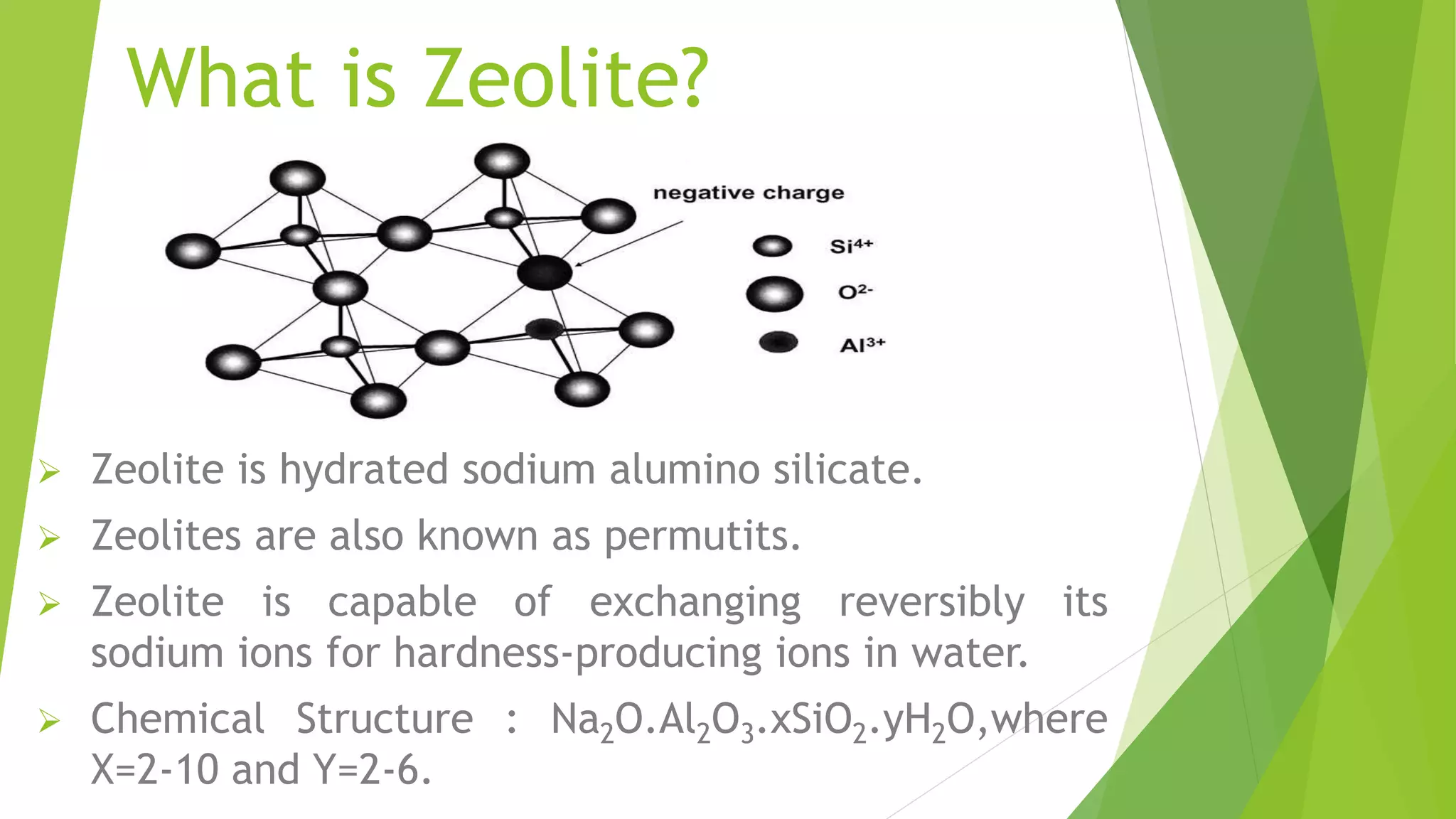
 Zeolite is hydrated sodium alumino silicate.
 Zeolites are also known as permutits.
 Zeolite is capable of exchanging reversibly its
sodium ions for hardness-producing ions in water.
 Chemical Structure : Na2O.Al2O3.xSiO2.yH2O,where
X=2-10 and Y=2-6.
Types of Zeolite
Zeolites are of two types:
1. Natural zeolite :
 Natural zeolite are non-porous.
 for example, natrolite ,Na2O.Al2O3.xSiO2.yH2O.
2. Synthetic zeolite :
 Synthetic zeolite are porous and posses get structure.
 They are prepared by heating together china clay, feldspar
and soda ash.
 such zeolites possess higher exchange capacity per unit
weight than natural zeolites.
Process
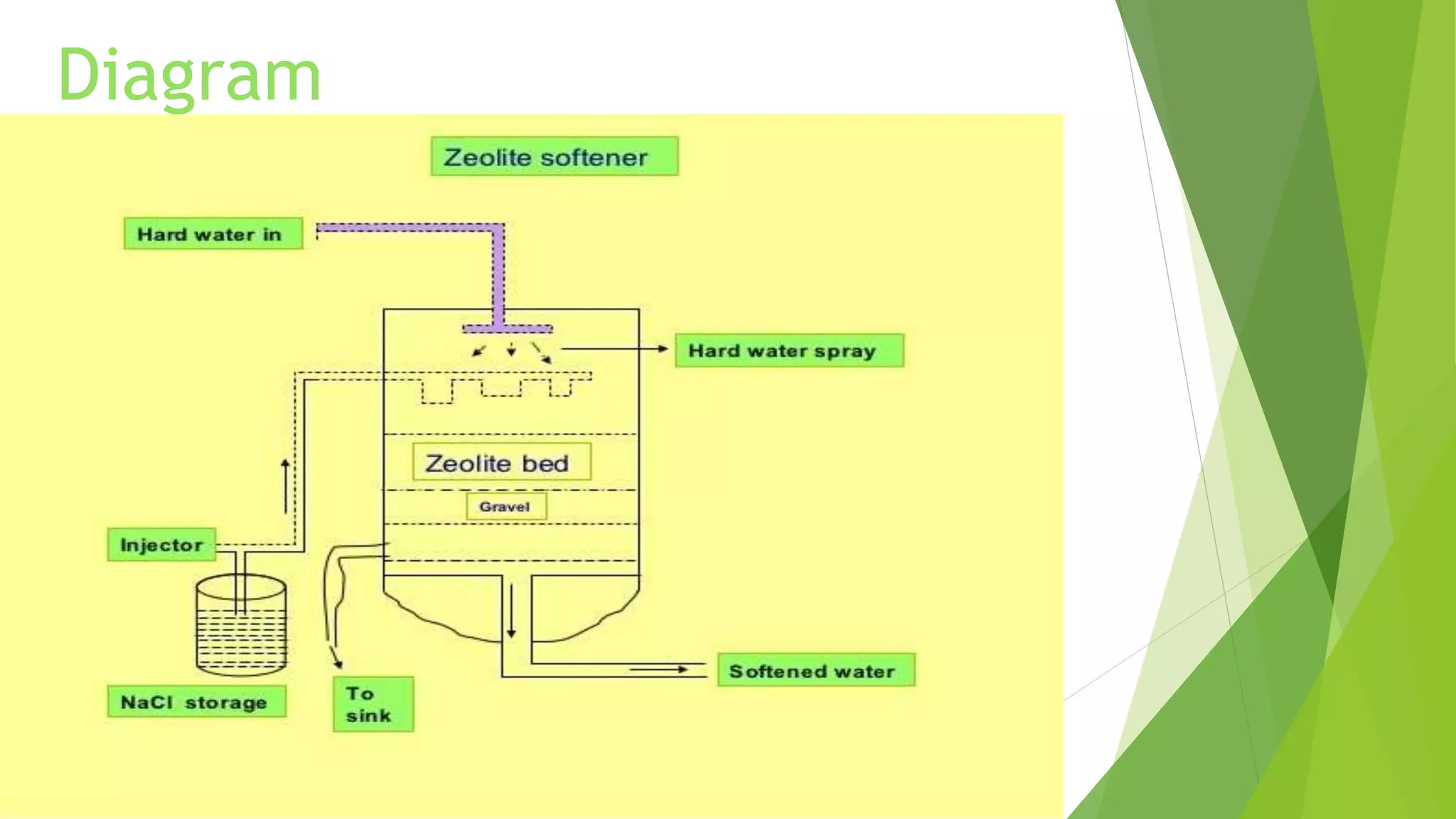
 For softening of water by zeolite process, hard water
is percolated at a specified rate through a bed of
zeolite, kept in a cylinder.
 The hardness causing ions(Ca2+ ,Mg2+ ,etc.) are
retained by the zeolite as CaZ and MgZ ; while the
outgoing water contains sodium salts.
Diagram
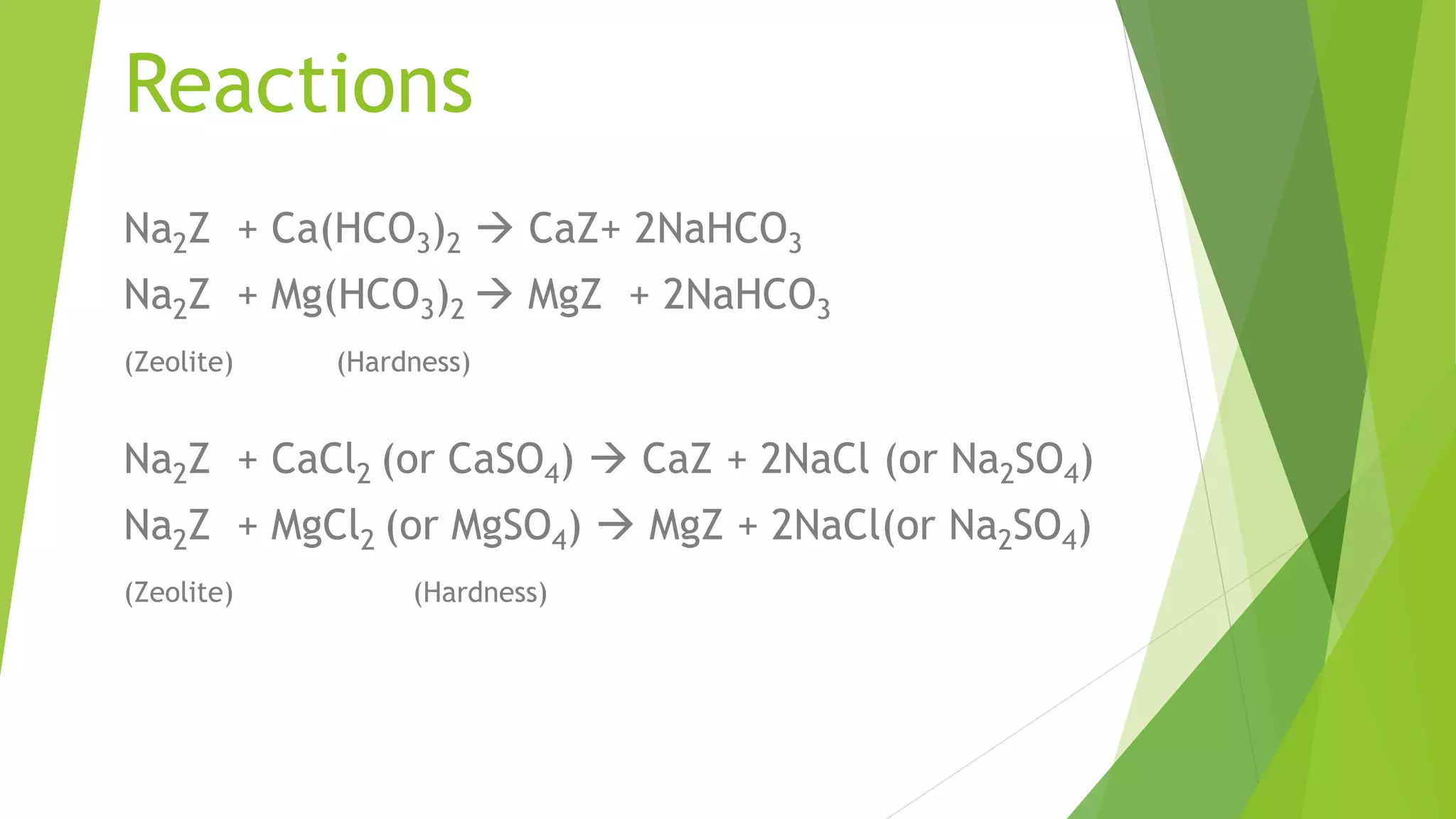
Reactions
Na2Z + Ca(HCO3)2  CaZ+ 2NaHCO3
Na2Z + Mg(HCO3)2  MgZ + 2NaHCO3
(Zeolite) (Hardness)
Na2Z + CaCl2 (or CaSO4)  CaZ + 2NaCl (or Na2SO4)
Na2Z + MgCl2 (or MgSO4)  MgZ + 2NaCl(or Na2SO4)
(Zeolite) (Hardness)
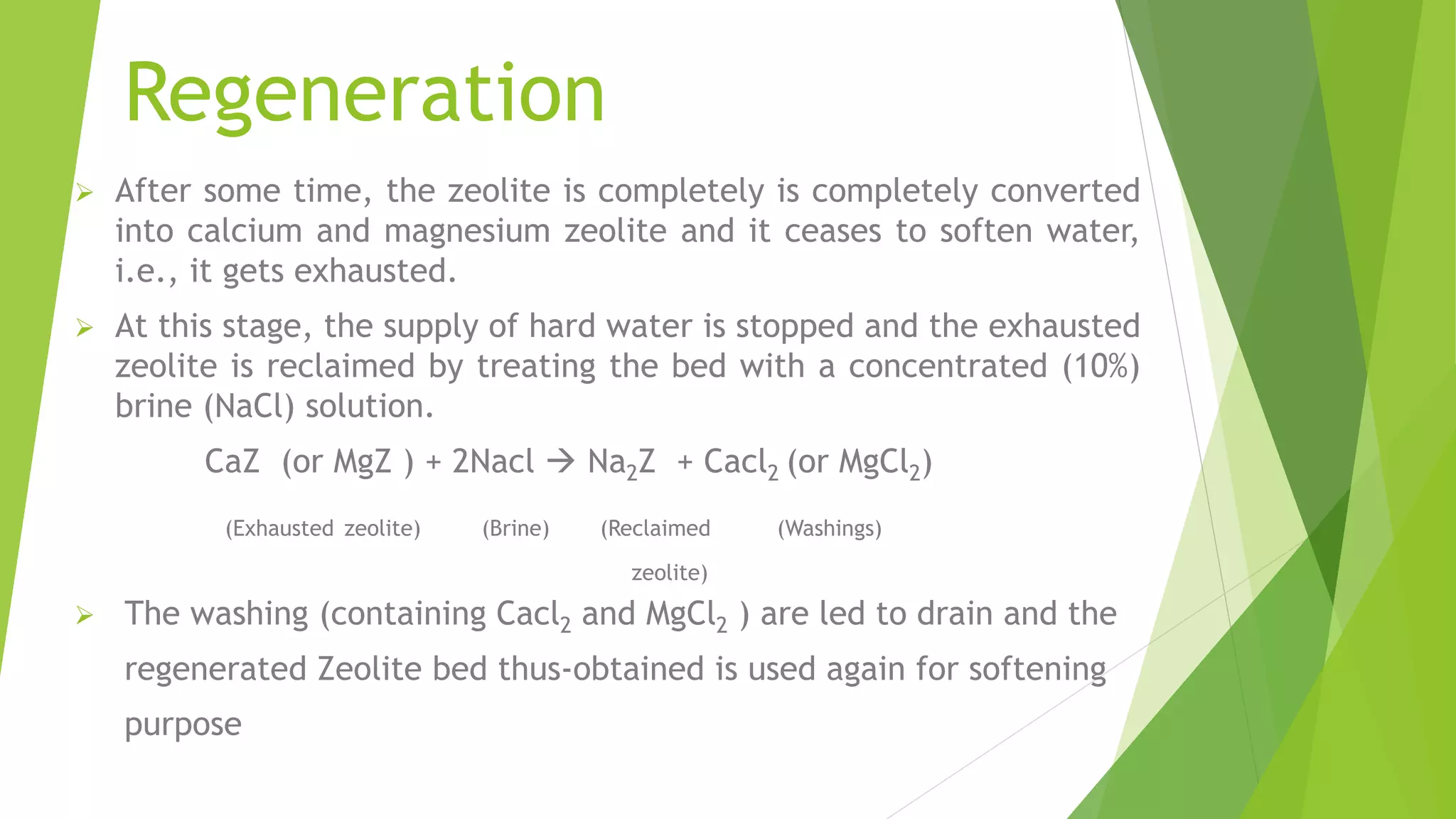
Regeneration
 After some time, the zeolite is completely is completely converted
into calcium and magnesium zeolite and it ceases to soften water,
i.e., it gets exhausted.
 At this stage, the supply of hard water is stopped and the exhausted
zeolite is reclaimed by treating the bed with a concentrated (10%)
brine (NaCl) solution.
CaZ (or MgZ ) + 2Nacl  Na2Z + Cacl2 (or MgCl2)
(Exhausted zeolite) (Brine) (Reclaimed (Washings)
zeolite)
 The washing (containing Cacl2 and MgCl2 ) are led to drain and the
regenerated Zeolite bed thus-obtained is used again for softening
purpose
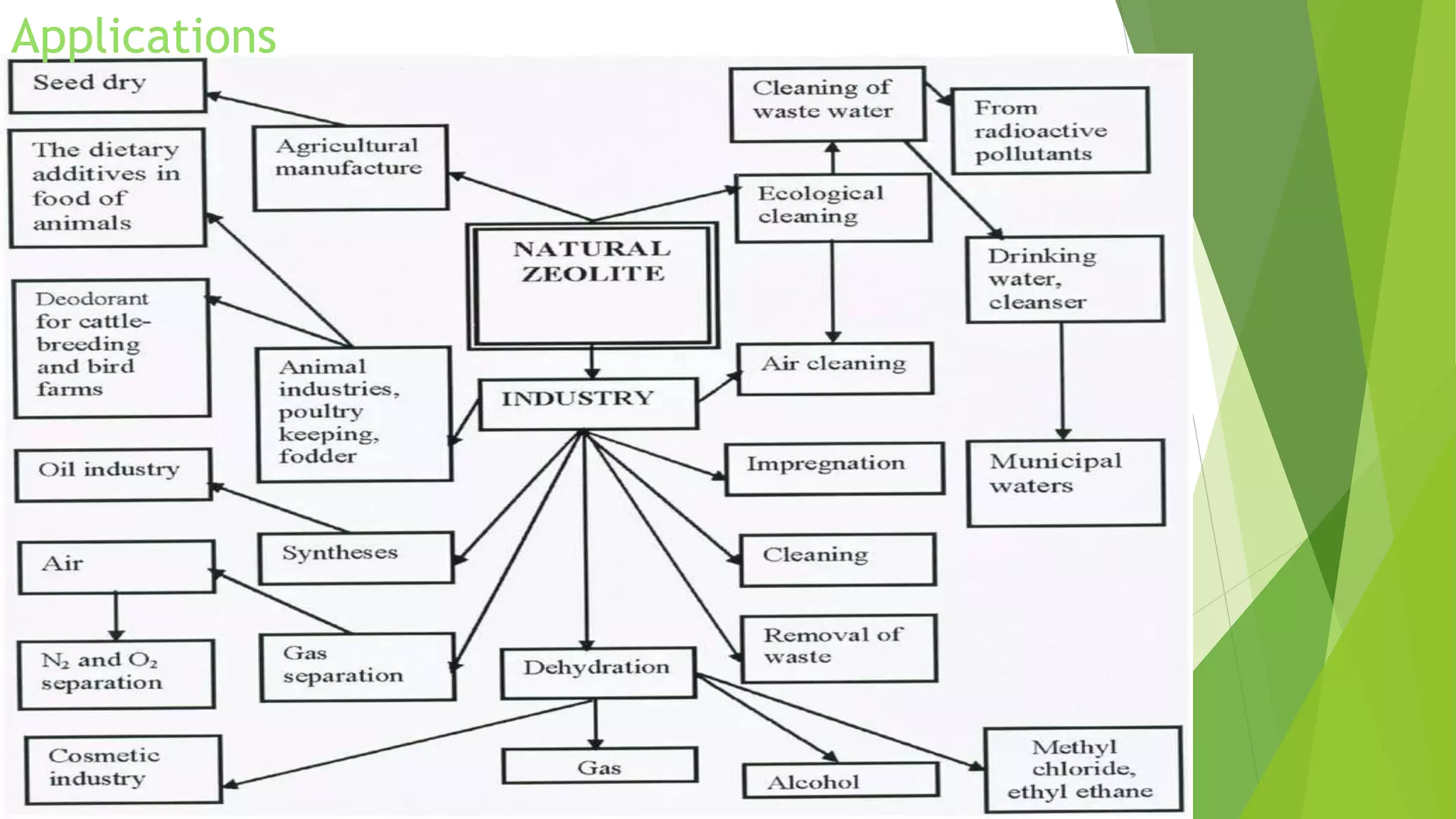
Applications
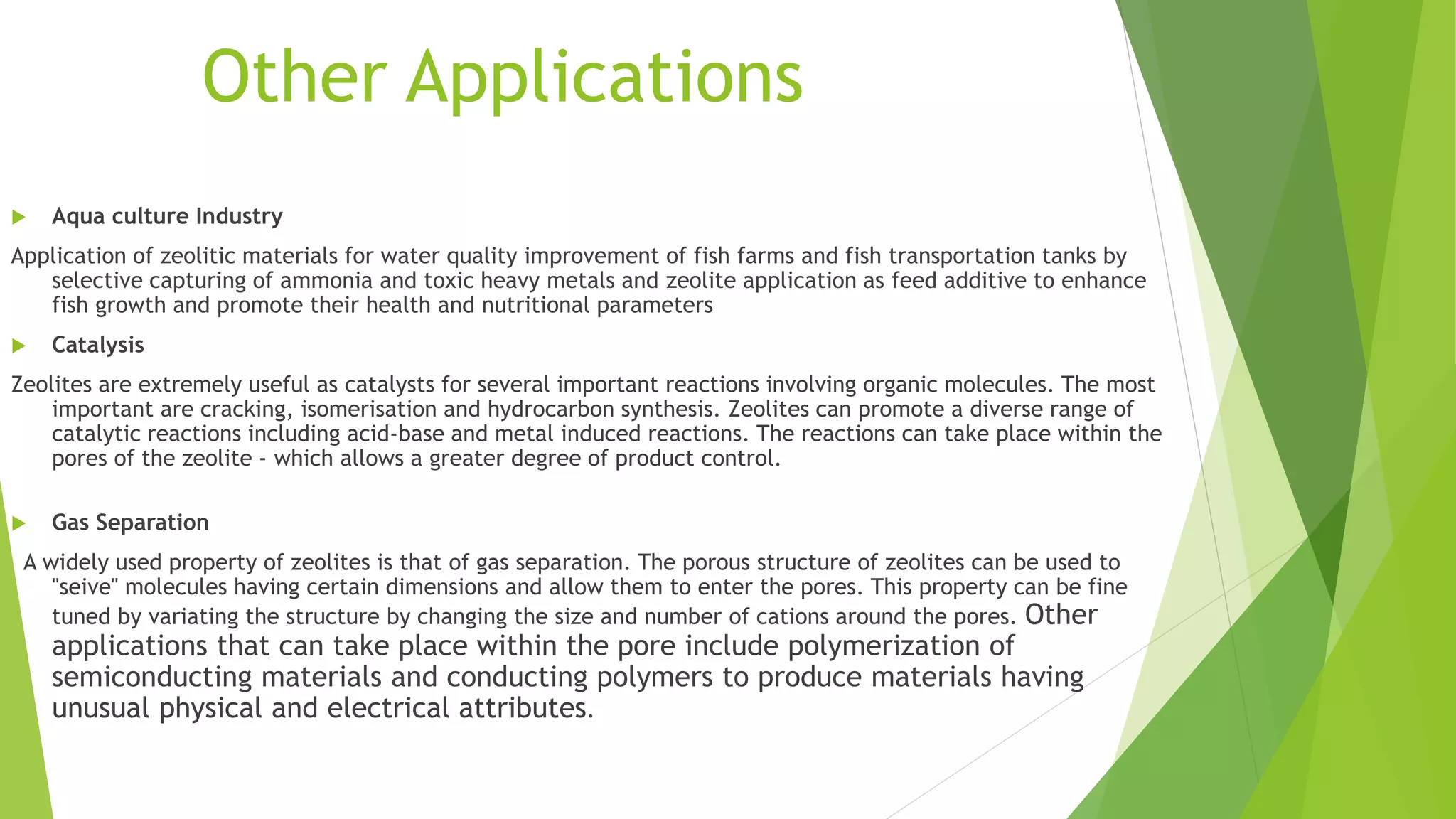
Other Applications
 Aqua culture Industry
Application of zeolitic materials for water quality improvement of fish farms and fish transportation tanks by
selective capturing of ammonia and toxic heavy metals and zeolite application as feed additive to enhance
fish growth and promote their health and nutritional parameters
 Catalysis
Zeolites are extremely useful as catalysts for several important reactions involving organic molecules. The most
important are cracking, isomerisation and hydrocarbon synthesis. Zeolites can promote a diverse range of
catalytic reactions including acid-base and metal induced reactions. The reactions can take place within the
pores of the zeolite - which allows a greater degree of product control.
 Gas Separation
A widely used property of zeolites is that of gas separation. The porous structure of zeolites can be used to
"seive" molecules having certain dimensions and allow them to enter the pores. This property can be fine
tuned by variating the structure by changing the size and number of cations around the pores. Other
applications that can take place within the pore include polymerization of
semiconducting materials and conducting polymers to produce materials having
unusual physical and electrical attributes.
Limitations of process:
1. If the supply of water is turbid, the suspended matter must
be removed (by coagulation, filtration, etc.), before the
water is admitted to the zeolite bed ; otherwise the
turbidity will clog the pores of zeolite bed, thereby making
it inactive.
2. If water contains large quantities of coloured ions such as
Mn2+ and Fe2+,they must be removed first, because these
ions produce manganese and iron zeolite, which cannot be
easily regenerated.
3. Mineral acids, if present in water, destroy the zeolite bed
and, therefore, they must be neutralized with soda, before
admitting the water to the zeolite softening plant.
Advantages of process:
1. It removes the hardness almost completely and water of
about 10 ppm hardness is predicted.
2. The equipment used is compact, occupying a small space.
3. No impurities are precipitated, so there is no danger of
sludge formation in the treatedwater at a later stage.
4. The process automatically adjust itself for variation in
hardness of incoming water.
5. It is quite clean.
6. It requires less time for softening.
7. It requires less skill for maintenance as well as operation.
Disadvantages of process :
1. The treated-water contains more sodium more sodium
salts than in lime-soda process.
2. The method only replaces ca2+ and Mg2+ ions, but leaves
all the acidic ions ( like HCO3
- and CO3
2-) as such in the
softened water. When such softened water (containing
NaHCO3 , Na2CO3 ,etc.) is used in boilers for steam
generation, sodium bicarbonate decomposes producing
CO2 , which causes corrosion ;and sodium carbonate
hydrolysis to sodium hydroxide, which causes caustic
embrittlement.
3. High turbidity water cannot be treated efficiently by
this method, because fine impurities get deposited on
the zeolite bed, thereby reating problem for its
working.
Synthesis of Zeolite From waste
 Zeolite is preparing through hydrothermal crystallization
of alumino silicate material.
WASTE MATERIAL
Pulverized fuel ash.
Blast furnace slag
Municipal solid waste
References
 [1] Caputo D, Pepe F (2007) Experiments and data processing of ion exchange equilibria involving
Italian natural zeolites: a review. Micropor.Mesopor.Mater. 105:222-231. Natural Zeolites in Water
Treatment – How Effective is Their Use 107
 [2] Misaelides P (2011) Application of natural zeolites in environmental remediation: A short
review. Micropor.Mesopor.Mater. 144:15-18.
 [3] Fu F, Wang Q (2011) Removal of heavy metal ions from wastewaters: A review.
J.Environ.Manage.92:407-418.
 [4] Wang S, Peng Y (2010) Natural zeolites as effective adsorbents in water and wastewater
treatment. Chem. Engin.J. 156:11-24.
 [5] Moussavia G, Talebi S, Farrokhi M, Sabouti RM (2011) The investigation of mechanism, kinetic
and isotherm of ammonia and humic acid co-adsorption onto natural zeolite. Chem. Engin.J.
171:1159-1169.
 [6] Inglezakis VJ, Doula MK, Aggelatou V, Zorpas AA (2010) Removal of iron and manganese from
underground water by use of natural minerals in batch mode treatment. Desalin. Water Treat.
18:341-346.
 [7] Doula MK (2009) Simultaneous removal of Cu, Mn and Zn from drinking water with the use of
clinoptilolite and its Fe-modified form. Water Res. 43:15:3659-3672
Basic of zeolite & its applications

Basic of zeolite & its applications

  • 1.
    Water filtration through Zeolite SagarKumar Nayak PhD Scholar , LARPM, CIPET, Bhubaneswar Presented by :
  • 2.
    What is Zeolite? Zeolite is hydrated sodium alumino silicate.  Zeolites are also known as permutits.  Zeolite is capable of exchanging reversibly its sodium ions for hardness-producing ions in water.  Chemical Structure : Na2O.Al2O3.xSiO2.yH2O,where X=2-10 and Y=2-6.
  • 3.
    Types of Zeolite Zeolitesare of two types: 1. Natural zeolite :  Natural zeolite are non-porous.  for example, natrolite ,Na2O.Al2O3.xSiO2.yH2O. 2. Synthetic zeolite :  Synthetic zeolite are porous and posses get structure.  They are prepared by heating together china clay, feldspar and soda ash.  such zeolites possess higher exchange capacity per unit weight than natural zeolites.
  • 4.
    Process  For softeningof water by zeolite process, hard water is percolated at a specified rate through a bed of zeolite, kept in a cylinder.  The hardness causing ions(Ca2+ ,Mg2+ ,etc.) are retained by the zeolite as CaZ and MgZ ; while the outgoing water contains sodium salts.
  • 5.
  • 6.
    Reactions Na2Z + Ca(HCO3)2 CaZ+ 2NaHCO3 Na2Z + Mg(HCO3)2  MgZ + 2NaHCO3 (Zeolite) (Hardness) Na2Z + CaCl2 (or CaSO4)  CaZ + 2NaCl (or Na2SO4) Na2Z + MgCl2 (or MgSO4)  MgZ + 2NaCl(or Na2SO4) (Zeolite) (Hardness)
  • 7.
    Regeneration  After sometime, the zeolite is completely is completely converted into calcium and magnesium zeolite and it ceases to soften water, i.e., it gets exhausted.  At this stage, the supply of hard water is stopped and the exhausted zeolite is reclaimed by treating the bed with a concentrated (10%) brine (NaCl) solution. CaZ (or MgZ ) + 2Nacl  Na2Z + Cacl2 (or MgCl2) (Exhausted zeolite) (Brine) (Reclaimed (Washings) zeolite)  The washing (containing Cacl2 and MgCl2 ) are led to drain and the regenerated Zeolite bed thus-obtained is used again for softening purpose
  • 8.
  • 9.
    Other Applications  Aquaculture Industry Application of zeolitic materials for water quality improvement of fish farms and fish transportation tanks by selective capturing of ammonia and toxic heavy metals and zeolite application as feed additive to enhance fish growth and promote their health and nutritional parameters  Catalysis Zeolites are extremely useful as catalysts for several important reactions involving organic molecules. The most important are cracking, isomerisation and hydrocarbon synthesis. Zeolites can promote a diverse range of catalytic reactions including acid-base and metal induced reactions. The reactions can take place within the pores of the zeolite - which allows a greater degree of product control.  Gas Separation A widely used property of zeolites is that of gas separation. The porous structure of zeolites can be used to "seive" molecules having certain dimensions and allow them to enter the pores. This property can be fine tuned by variating the structure by changing the size and number of cations around the pores. Other applications that can take place within the pore include polymerization of semiconducting materials and conducting polymers to produce materials having unusual physical and electrical attributes.
  • 10.
    Limitations of process: 1.If the supply of water is turbid, the suspended matter must be removed (by coagulation, filtration, etc.), before the water is admitted to the zeolite bed ; otherwise the turbidity will clog the pores of zeolite bed, thereby making it inactive. 2. If water contains large quantities of coloured ions such as Mn2+ and Fe2+,they must be removed first, because these ions produce manganese and iron zeolite, which cannot be easily regenerated. 3. Mineral acids, if present in water, destroy the zeolite bed and, therefore, they must be neutralized with soda, before admitting the water to the zeolite softening plant.
  • 11.
    Advantages of process: 1.It removes the hardness almost completely and water of about 10 ppm hardness is predicted. 2. The equipment used is compact, occupying a small space. 3. No impurities are precipitated, so there is no danger of sludge formation in the treatedwater at a later stage. 4. The process automatically adjust itself for variation in hardness of incoming water. 5. It is quite clean. 6. It requires less time for softening. 7. It requires less skill for maintenance as well as operation.
  • 12.
    Disadvantages of process: 1. The treated-water contains more sodium more sodium salts than in lime-soda process. 2. The method only replaces ca2+ and Mg2+ ions, but leaves all the acidic ions ( like HCO3 - and CO3 2-) as such in the softened water. When such softened water (containing NaHCO3 , Na2CO3 ,etc.) is used in boilers for steam generation, sodium bicarbonate decomposes producing CO2 , which causes corrosion ;and sodium carbonate hydrolysis to sodium hydroxide, which causes caustic embrittlement. 3. High turbidity water cannot be treated efficiently by this method, because fine impurities get deposited on the zeolite bed, thereby reating problem for its working.
  • 13.
    Synthesis of ZeoliteFrom waste  Zeolite is preparing through hydrothermal crystallization of alumino silicate material. WASTE MATERIAL Pulverized fuel ash. Blast furnace slag Municipal solid waste
  • 14.
    References  [1] CaputoD, Pepe F (2007) Experiments and data processing of ion exchange equilibria involving Italian natural zeolites: a review. Micropor.Mesopor.Mater. 105:222-231. Natural Zeolites in Water Treatment – How Effective is Their Use 107  [2] Misaelides P (2011) Application of natural zeolites in environmental remediation: A short review. Micropor.Mesopor.Mater. 144:15-18.  [3] Fu F, Wang Q (2011) Removal of heavy metal ions from wastewaters: A review. J.Environ.Manage.92:407-418.  [4] Wang S, Peng Y (2010) Natural zeolites as effective adsorbents in water and wastewater treatment. Chem. Engin.J. 156:11-24.  [5] Moussavia G, Talebi S, Farrokhi M, Sabouti RM (2011) The investigation of mechanism, kinetic and isotherm of ammonia and humic acid co-adsorption onto natural zeolite. Chem. Engin.J. 171:1159-1169.  [6] Inglezakis VJ, Doula MK, Aggelatou V, Zorpas AA (2010) Removal of iron and manganese from underground water by use of natural minerals in batch mode treatment. Desalin. Water Treat. 18:341-346.  [7] Doula MK (2009) Simultaneous removal of Cu, Mn and Zn from drinking water with the use of clinoptilolite and its Fe-modified form. Water Res. 43:15:3659-3672