Preventing Clay Swelling
A challenge in oil and gas exploration industry
Omar Atef Radwan
201306050
1
Term Paper- (GEOL 599)
OUTLINE
• Introduction
• Clay swelling mechanisms
• Clay swelling characterization
• Clay swelling inhibitors
• Conclusion
2
INTRODUCTION
Problem statement
The tendency of sodium saturated smectites to swell
macroscopically is the principal cause of shale instability in oil
well drilling operations and can potentially lead to collapse of
the wellbore
Objectives
To provide a comprehensive understanding of
o the mechanism by which clay minerals swell
o development of effective and environmentally friendly clay
swelling inhibitors
3
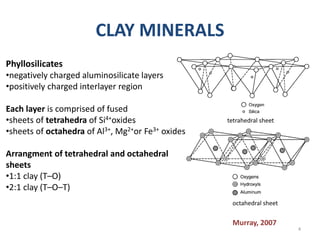
CLAY MINERALS
octahedral sheet
tetrahedral sheet
Murray, 2007
Phyllosilicates
•negatively charged aluminosilicate layers
•positively charged interlayer region
Each layer is comprised of fused
•sheets of tetrahedra of Si4+oxides
•sheets of octahedra of Al3+, Mg2+or Fe3+ oxides
Arrangment of tetrahedral and octahedral
sheets
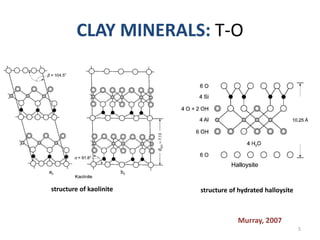
•1:1 clay (T–O)
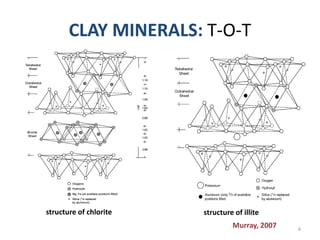
•2:1 clay (T–O–T)
4
CLAY MINERALS: T-O
structure of kaolinite structure of hydrated halloysite
Murray, 2007
5
CLAY MINERALS: T-O-T
6
structure of chlorite
Murray, 2007
structure of illite
CLAY MINERALS: T-O-T
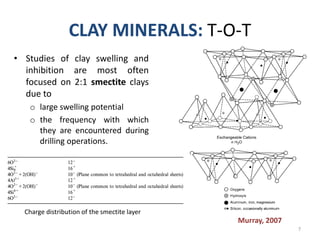
• Studies of clay swelling and
inhibition are most often
focused on 2:1 smectite clays
due to
o large swelling potential
o the frequency with which
they are encountered during
drilling operations.
7
Murray, 2007
Charge distribution of the smectite layer
CLAY SWELLING
• Drilling fluids:
o lubricate the drill bit
o maintain hydrostatic pressure
o transmit sensor readings
o remove rock cuttings
• Water-based drilling fluids:
o more environmentally acceptable than oil-based or synthetic-
based fluids
o their use facilitates clay hydration and swelling
8
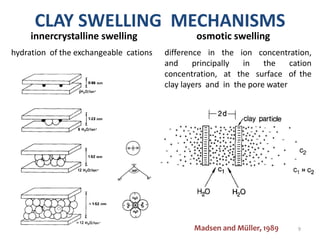
CLAY SWELLING MECHANISMS
innercrystalline swelling
hydration of the exchangeable cations
osmotic swelling
difference in the ion concentration,
and principally in the cation
concentration, at the surface of the
clay layers and in the pore water
9Madsen and Müller, 1989
CLAY SWELLING CHARACTERIZATION
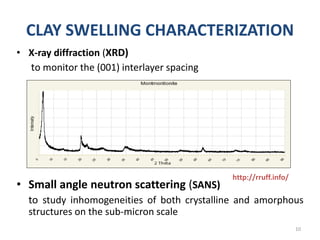
• X-ray diffraction (XRD)
to monitor the (001) interlayer spacing
• Small angle neutron scattering (SANS)
to study inhomogeneities of both crystalline and amorphous
structures on the sub-micron scale
10
http://rruff.info/
CLAY SWELLING CHARACTERIZATION
• Inductively coupled plasma mass spectrometry (ICP-MS)
to study the influence of the saturating cation
(Mg2+,Ca2+,Li+,Na+,K+)of upon swelling-shrinkage behavior
• Fourier transform infrared spectroscopy (FTIR)
to study hydration behaviour of clay minerals, and
intercalation of these minerals with organic molecules
• Thermo-gravimetric analysis (TGA)
to study the distribution of water in a clay across various
specific locations within the mineral structure and can be
used to understand the swelling process upon hydration of
clay minerals
11
CLAY SWELLING INHIBITORS
• When water-based drilling fluids (WBDFs) are employed, clay
swelling can have a tremendously adverse impact on the drilling
operation
o Problems when running casing
o agglomeration of drilled cuttings leading to reduced hole cleaning
efficiency
o build up of thick cuttings beds
o reduced rates of penetration arising from balling of the drill bit with sticky
clay
o In the worst case, wellbore instability can result in the loss of the drilling
assembly, well side-tracks or total abandonment of the well
12
CLAY SWELLING INHIBITORS
• 1960’s: WBDFs + high concentrations of electrolytes such as KCl
• 1970’s: oil based drilling fluids (OBDFs)
• The development of swelling inhibitors represents a challenge to
organic oilfield chemistry due to
o the complex and heterogeneous nature of clay minerals
o the careful balance of properties that must be maintained for a
drilling fluid to be effective
13
CLAY SWELLING INHIBITORS
• Effective and more environmentally acceptable: organic
polymers and surfactants
• Inhibiting Mechanism:
incorporate appropriate functional groups that interact favorably
with clays to reduce swelling
o the hydrophobic regions hinder further ingress of water
o the hydrophilic regions enhance the binding of highly hydratable
sodium cations to the clay, preventing their hydration.
14
CLAY SWELLING INHIBITORS
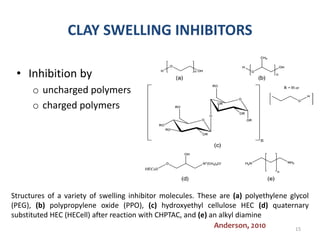
• Inhibition by
o uncharged polymers
o charged polymers
15
Structures of a variety of swelling inhibitor molecules. These are (a) polyethylene glycol
(PEG), (b) polypropylene oxide (PPO), (c) hydroxyethyl cellulose HEC (d) quaternary
substituted HEC (HECell) after reaction with CHPTAC, and (e) an alkyl diamine
Anderson, 2010
CONCLUSIONS
• In swelling clays two categories of swelling are observed; the
innercrystalline swelling and the osmotic swelling.
• The chemical and physical characteristics of swelling clay
minerals can be investigated by a large variety of techniques:
XRD, ICP-MS, SANS, GTA and FTIR.
• Criteria for effective clay swelling inhibitor
o stable when exposed to typical wellbore temperatures and
pressures
o must not adversely affect the properties of the overall drilling
fluid formulations
o must be cost effective
o must be of low environmental impact
16
REFERENCES
• Anderson, R.L., Ratcliffe, I., Greenwell, H.C., Williams, P.A.,
Cliffe, S., Coveney, P.V., 2010. Clay swelling — A challenge in
the oilfield. Earth-Science Reviews 98, 201–216.
• Madsen, F.T., Müller-Vonmoos, M., 1989. The swelling
behaviour of clays. Applied Clay Science 4, 143–156.
• Murray, H.H., 2007. Applied Clay Mineralogy, Volume 2:
Occurrences, Processing and Applications of Kaolins, Bentonites,
Palygorskitesepiolite, and Common Clays, 1 edition. ed. Elsevier
Science, Boston.
• http://rruff.info/
17
18

Preventing Clay Swelling

  • 1.
    Preventing Clay Swelling Achallenge in oil and gas exploration industry Omar Atef Radwan 201306050 1 Term Paper- (GEOL 599)
  • 2.
    OUTLINE • Introduction • Clayswelling mechanisms • Clay swelling characterization • Clay swelling inhibitors • Conclusion 2
  • 3.
    INTRODUCTION Problem statement The tendencyof sodium saturated smectites to swell macroscopically is the principal cause of shale instability in oil well drilling operations and can potentially lead to collapse of the wellbore Objectives To provide a comprehensive understanding of o the mechanism by which clay minerals swell o development of effective and environmentally friendly clay swelling inhibitors 3
  • 4.
    CLAY MINERALS octahedral sheet tetrahedralsheet Murray, 2007 Phyllosilicates •negatively charged aluminosilicate layers •positively charged interlayer region Each layer is comprised of fused •sheets of tetrahedra of Si4+oxides •sheets of octahedra of Al3+, Mg2+or Fe3+ oxides Arrangment of tetrahedral and octahedral sheets •1:1 clay (T–O) •2:1 clay (T–O–T) 4
  • 5.
    CLAY MINERALS: T-O structureof kaolinite structure of hydrated halloysite Murray, 2007 5
  • 6.
    CLAY MINERALS: T-O-T 6 structureof chlorite Murray, 2007 structure of illite
  • 7.
    CLAY MINERALS: T-O-T •Studies of clay swelling and inhibition are most often focused on 2:1 smectite clays due to o large swelling potential o the frequency with which they are encountered during drilling operations. 7 Murray, 2007 Charge distribution of the smectite layer
  • 8.
    CLAY SWELLING • Drillingfluids: o lubricate the drill bit o maintain hydrostatic pressure o transmit sensor readings o remove rock cuttings • Water-based drilling fluids: o more environmentally acceptable than oil-based or synthetic- based fluids o their use facilitates clay hydration and swelling 8
  • 9.
    CLAY SWELLING MECHANISMS innercrystallineswelling hydration of the exchangeable cations osmotic swelling difference in the ion concentration, and principally in the cation concentration, at the surface of the clay layers and in the pore water 9Madsen and Müller, 1989
  • 10.
    CLAY SWELLING CHARACTERIZATION •X-ray diffraction (XRD) to monitor the (001) interlayer spacing • Small angle neutron scattering (SANS) to study inhomogeneities of both crystalline and amorphous structures on the sub-micron scale 10 http://rruff.info/
  • 11.
    CLAY SWELLING CHARACTERIZATION •Inductively coupled plasma mass spectrometry (ICP-MS) to study the influence of the saturating cation (Mg2+,Ca2+,Li+,Na+,K+)of upon swelling-shrinkage behavior • Fourier transform infrared spectroscopy (FTIR) to study hydration behaviour of clay minerals, and intercalation of these minerals with organic molecules • Thermo-gravimetric analysis (TGA) to study the distribution of water in a clay across various specific locations within the mineral structure and can be used to understand the swelling process upon hydration of clay minerals 11
  • 12.
    CLAY SWELLING INHIBITORS •When water-based drilling fluids (WBDFs) are employed, clay swelling can have a tremendously adverse impact on the drilling operation o Problems when running casing o agglomeration of drilled cuttings leading to reduced hole cleaning efficiency o build up of thick cuttings beds o reduced rates of penetration arising from balling of the drill bit with sticky clay o In the worst case, wellbore instability can result in the loss of the drilling assembly, well side-tracks or total abandonment of the well 12
  • 13.
    CLAY SWELLING INHIBITORS •1960’s: WBDFs + high concentrations of electrolytes such as KCl • 1970’s: oil based drilling fluids (OBDFs) • The development of swelling inhibitors represents a challenge to organic oilfield chemistry due to o the complex and heterogeneous nature of clay minerals o the careful balance of properties that must be maintained for a drilling fluid to be effective 13
  • 14.
    CLAY SWELLING INHIBITORS •Effective and more environmentally acceptable: organic polymers and surfactants • Inhibiting Mechanism: incorporate appropriate functional groups that interact favorably with clays to reduce swelling o the hydrophobic regions hinder further ingress of water o the hydrophilic regions enhance the binding of highly hydratable sodium cations to the clay, preventing their hydration. 14
  • 15.
    CLAY SWELLING INHIBITORS •Inhibition by o uncharged polymers o charged polymers 15 Structures of a variety of swelling inhibitor molecules. These are (a) polyethylene glycol (PEG), (b) polypropylene oxide (PPO), (c) hydroxyethyl cellulose HEC (d) quaternary substituted HEC (HECell) after reaction with CHPTAC, and (e) an alkyl diamine Anderson, 2010
  • 16.
    CONCLUSIONS • In swellingclays two categories of swelling are observed; the innercrystalline swelling and the osmotic swelling. • The chemical and physical characteristics of swelling clay minerals can be investigated by a large variety of techniques: XRD, ICP-MS, SANS, GTA and FTIR. • Criteria for effective clay swelling inhibitor o stable when exposed to typical wellbore temperatures and pressures o must not adversely affect the properties of the overall drilling fluid formulations o must be cost effective o must be of low environmental impact 16
  • 17.
    REFERENCES • Anderson, R.L.,Ratcliffe, I., Greenwell, H.C., Williams, P.A., Cliffe, S., Coveney, P.V., 2010. Clay swelling — A challenge in the oilfield. Earth-Science Reviews 98, 201–216. • Madsen, F.T., Müller-Vonmoos, M., 1989. The swelling behaviour of clays. Applied Clay Science 4, 143–156. • Murray, H.H., 2007. Applied Clay Mineralogy, Volume 2: Occurrences, Processing and Applications of Kaolins, Bentonites, Palygorskitesepiolite, and Common Clays, 1 edition. ed. Elsevier Science, Boston. • http://rruff.info/ 17
  • 18.