Clay
• Determining thetype of clay and its reaction will help
us to understand the way of inhibition for it.
• Clay minerals are classified as layered silicates because
the dominant structure consists of layers formed by
sheets of silica and alumina.
6.
Clay nature
• Claysare usually either of the two-layer type like kaolin or
three-layer type such as montmorillonite, chlorite or illite.
• Each plate-like clay particle consists of a stack of parallel unit
layers.
• Each unit layer is a combination of tetrahedral (pyramid)
arranged silica sheets and octahedral (eight-faced) arranged
alumina sheets.
Clay Platelets reactions
•Charge on the edge will vary with pH
• At low pH the edges are more positive ( Active)
• At high pH the edges are more negative (Non-active)
• 1- Illite
•plate-like, non-swelling (or slightly swelling).
• found in formation shales
Properties
Illite has a substitution of Al+3
for Si+4
still giving a negative
charge.
The compensating cations are primarily the potassium ion
(K+)
The spacing between unit layers is 2.8 Å.
The ionic diameter of the K+ Is 2.66 Å.
This allows the K+ to fit snugly between unit layers forming
a bond that prevents swelling in the presence of water
• 2- CHLORITES(THREE-LAYER CLAYS)
• In these clays, the charge-compensating cations between
unit layers are replaced by a layer of octahedral magnesium
hydroxide (Brucite).
• This layer has a net positive charge because of some
replacement of Mg +2
by Al+3
in the brucite layer .
• It does not cause significant problems unless present in
large quantities.
• Low cation exchange capacity 10-40
14.
• 3- KAOLINITES(TWO-LAYER CLAYS)
• It is a non-swelling clay that has its unit layers bound
tightly together by hydrogen bonding.
• This prevents expansion of the particle because water is
unable to penetrate the layers.
• 4- Attapulgite(Salt Gel)
Properties
Not found in formation shale
it is non-swelling in Fresh water.
Exhibit very poor filtration properties.
Used as viscosifier in salt water mud
17.
5- Mixed Layer
•More than one clay mineral
•Examples
• montmorillonite/illite
• illite/kaolinite
• chlolrite/kaolinite
18.
• 6- Montmorillonites(semectite)
• Calcium type
• plate-like (slightly swelling).
• found in formation shales ( Calcium montmorillonite
type)
• montmorillonite sodium type
Sodium montmorillonite is added to a mud to increase
viscosity and reduce fluid loss.
19.
Composition
• If justone atom of Magnesium (Mg ++ ) is substituted for
one atom of Aluminum(AL+++) in the lattice structure
(arrangement of atoms), it will then possess a surplus
electron or negative charge.
• The net negative charge is compensated by the adsorption of
cations (positive ions) on the unit layer surfaces.
• This can occur by Na+ , Ca++ ,Mg++
22.
Swelling mechanism
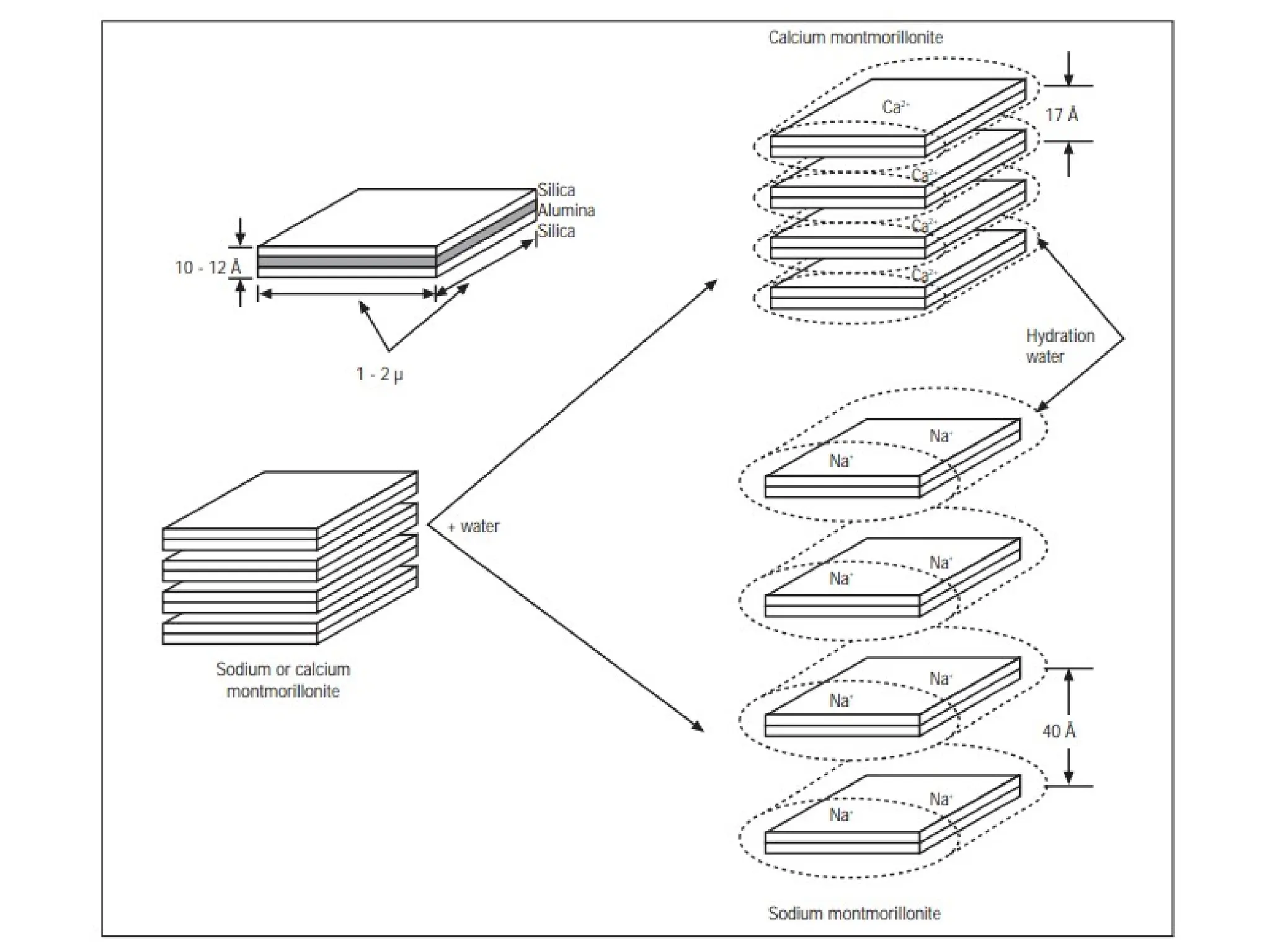
• Claysexist in nature with a stacked or layered structure, with
each unit layer roughly 10 angstroms (Å) thick.
• Each clay layer is very thin and has a huge surface area.
• In freshwater , the layers adsorb water and swell .
• This increase in number of particles with the resulting increase
in surface area, causes the suspension to thicken.
23.
Relationship - Size& Surface Area
The same solid cut
in half on each face
Cut in half again
on each face
20 micron solid surface
area 2400 microns
24.
Cation Effects
• Ca2+
associateswith two layers
• Limited swelling and dispersion
• less surface area and associated water
Ca+2
Ca+2
Ca+2
Ca+2
12.1 A
17 A
Hydrated
25.
Cation effects
• Na+
associateswith one layer
• High hydration potential
• Encourages hydration and layer separation
Na+
Na+
Na
+
Na+
Na+
Na
+
Na+
9.8 A
Na+
Na+
Na+
40 A to infinite
Hydrated
27.
Cation Exchange Capacity(CEC)
• The compensating cations that are adsorbed on the
unit-layer surface may be exchanged for other
cations and are called the exchangeable cations of
the clay .
28.
Clay Interactions
• Aggregation:The clay in its dry state has platelets stacked in face-
to-face association, like a deck of cards.
• Dispersion: When the dry clay is placed into fresh water with no
agitation, the packets adsorb water, hydrate, and swell. Upon
agitation, the swollen packets disintegrate into individual plates or
smaller packets of plates.
• Flocculation : When agitation is stopped, clay platelets will be
mutually attracted in edge-to-edge or edge-to-face association. This
forces a structure similar to a house of cards
• Deflocculated: If an anionic chemical thinner (deflocculant) is
added, such as lignosulfonate or lignite, etc., it neutralizes the
positive edge charges on clay platelets, so they are deflocculated.
Clay Dispersion
• Smectite
–Swelling clay, fresh water sensitive, takes on water and
expands
• Mixed layer
– Smectite/illite layering, swells, but not same degree as
smectite, will disperse in fresh water
• Illite
– Disperses in fresh water
Kaolinite
– Subject to dispersion, not same degree as illite
• Chlorite
– Not fresh water sensitive, doesn’t swell, high iron content,
some times acid sensitive
#8 The combinations of sheets and modifications to their basic structure give rise to the range of clay minerals with different properties.
The two basic structural units are the alumina octahedral and the silica tetrahedral sheet.
The tetrahedral and octahedral sheets are tied together into a platelet by shared oxygens.
The tetrahedron faces inwards an shares the apex oxygens with the octahedral sheet which displaces two of the three hydroxyls originally present.
Over 26 different clay minerals
if only two out of three octahedral center sites are occupied by a metal atom it is called a dioctahedral.
If all three sites are occupied it is called a trioctahedral.
Clay minerals are built up by different ratios of silica sheet to octahedral sheet. Largest group is 2:1 others are 2:1:1 and 1:1 minerals.
The unit layers are stacked together face-to-face to form a crystal lattice.
#9 Both cations and anions are adsorbed at the platelet edges.
In aqueous solutions both sets of ions, surface and edge, exchange in bulk solution.
Some of the newly exposed groups have the structure of silica, a weak acid, and some have the structure of aluminum or magnesium, a weak base.
Low pH is maintained to insure that the clay particles are negatively charged so that the electrostatic interactions are kept to a minimum.
#10 KAOLINITE; Composed by a single tetrahedral sheet and a single dioctahedral sheet. Low CEC
ILLITE; Called micas,2:1 lattice, Two silica sheets sandwich an octahedral sheet. The isomorphous substitution is mainly in the tetrahedral sheet where silicon is replaced by aluminum and the dificiency charge is balanced by potassium
CHLORITE: Structurally related to the three sheet type clays. 2:1:1
MIXED LAYERS; Composed of more than one clay mineral mixed in several ways.
MONTMORILLONITE; Called smectitas - bentonite - predominant isomorphous subtitution are Mg and Fe by AL in Octahedral, thus the charge in central of the layer.
SEPIOLITE; Double silica chains parallel to the long axis.
ATTAPULGITE: Structured consists of three-dimensional chains.
#12 The hydrated potassium ion will enter between the sheets easily because of its small size.
Because the water envelope about the ion is easily deformible, the sheets would be drawn together with comparatyively low concentrations of cations.
Hydrated potassium ions that enter holes in the clay sheet will be held tightly because of the snug fit.
Potassium ions tend to collapse swelled clay platelets and inhibit clays from swelling.
#17 The composition of the sheets of different layer clay minerals are very similar, all being composed of silica tetrahedral sheets and closely packed octahedral sheets of oxygen and hydroxyl groups. Two different types:
Interstratification - the unit cell is equivalent to the sum of the individual layers. Regular and uniform.
Chlorite is composed of regular alternations of mica ( three layer clay) and brucite (magnesium octahedral sheet) layers
irregular interstratification - no uniformn repitition of layers.
Disperse in water to small units more easily than do single mineral latices.
#23 The greater the subdivision the greater the surface area per unit weight and the greater the surface phenomena
#24 Swelling behavior is most dependent on the type of cation in the exchangeable sites. Na and Ca are the most common in drilling fluids.
Ca2+ cannot effectively associate with two negative charge centers on one sheet, and thus must bind two sheets togeether.
Contact with water can cause swelling, and mechanical dispersion may separate a layer, but the ultimate surface area available, and the volume of closely associated water will be considerably lower than with the sodium system.
#25 Na+ can only associate with one charge deficient area on one layer and has little influence on preventing dispersion in water.
Because of its high hydration potential it encourages hydration and separation of the layers.
The unique properties of montmorillonite are due to the very large surface area available when the clay expands and and hydrates fully to only single sheets.
This creates a colloidal dispersion whose viscosity is controlled by surface phenomena including surface potential.
#30 An assemblage of sheets that may be disaggregated by hydration and or mechanical shear.
#31 The surfaces of clays contain hydroxyl and oxygen groups which form hydrogen bonds to water molecules.
The exchangeable cations adsorbed on the clay surface will also have an envelope of closely associated water molecules.
Water also forms a bond with negative sites on the edges.
These interactions combine to create a zone of 10-15 layers of water closely associated with the clay, creating a hydration envelope.
In the case of sodium montmorillonite, this envelope may extend 60A or about 20 layers of water.
This reduction of free water builds structure and resistance to shear.
#32 The subdivision of particles in a fluid from the aggregated state, by mechanical force to a hydrated colloid particle is the dispersing of that particle.
In fresh water dispersions the clay platelets drift about in an independent manner, or in very small clusters.
Dispersed with Na+ shield
#33 A system is described as flocculated when there are net attractive forces for the particles and they can associate with each other, to form a loose structure.
Dispersed clays and the aggregates themselves may be flocculated.
The edge may carry charges arising from broken bonds, which may be positive or negative and dependent on pH.
The face may also carry pH independent negative charges.
The forces acting on the clay particles can be described as either repulsive or attractive.
The particles approach each other due to Brownian motion.
Whether or not they will agglomerate depends on the summation of the two forces.
Edge to face with clorine capturing H2O
#34 Calcium is the most common ion, although aluminum, magnesium, and zirconium are other polyvalent examples.
Calcium is often encountered in the form of gypsum (calcium sulfate) and cement.
Some muds overcome this problem by ensuring the clays are already in the calcium form.
Lime or Gypsum may be added to ensure that a source of calcium is available
#36 High molecular weight polymers form a polymer bridge connecting the clay platelets together.
The molecules must adsorb onto the clay platelets, so the presence of anionic or cationic groups often make the molecules more effective.
The reaction between clays and polymers depends on a number of factors such as the molecular weight of the polymer and the adsorption of the polymer on the clay particle.
There is a definite relationship between the weight of a polymer and its length.
A high molecular weight weight material, such as a synthetic polyacrylate with a molecular weight of 107, will have a chain length of approximately 20 microns, which may be much larger than the clay particles.
The strength of the adsorption and the site of the adsorbtion will depend on the chemical character of the polymer.
Generally, negatively charged polymers can adsorb on cationic sites generated at the edges. Most polymers in drilling fluids tend to be of this type.
Adsorbtion tends to be stronger for higher molecular weight materials. other factors, such as charge density, salinity, pH, etc make the situation to complex to generalize.
#37 Minimize the electrolyte concentration.
Repulsive forces dominate at low salinities.
Clays are maximally dispersed in fresh water systems.
A pH above 8.0 will increase the number of negative silicate groups on the clay edges.
Increase pH with caustic soda or soda ash.
#38 Short chain, negatively charged polymer can neutralize a positive charge by becoming adsorbed on the platelet edge. This has a net effect of increasing the over-all negative charge density.
Since the polymers are reacting on the platelet edge sites and the edge surface area is a relatively small portion of the total, polymers can be effective at very low concentrations.
Low weight polymers alter the charge on individual clay particles so that they may be equally charged and deflocculated.
#39 Lignosulfonates wrap around th edge of the platelets to neutralize the positive sites.