POLYMER
NANOCOMPOSITES
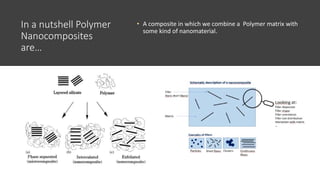
In a nutshell Polymer
Nanocomposites
are…
• A composite in which we combine a Polymer matrix with
some kind of nanomaterial.
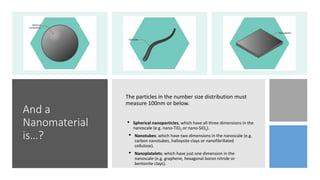
And a
Nanomaterial
is…?
• Spherical nanoparticles; which have all three dimensions in the
nanoscale (e.g. nano-TiO2 or nano-SiO2).
• Nanotubes; which have two dimensions in the nanoscale (e.g.
carbon nanotubes, halloysite clays or nanofibrillated
cellulose).
• Nanoplatelets; which have just one dimension in the
nanoscale (e.g. graphene, hexagonal boron nitride or
bentonite clays).
The particles in the number size distribution must
measure 100nm or below.
Why are people
interested in polymer
nanocomposites?
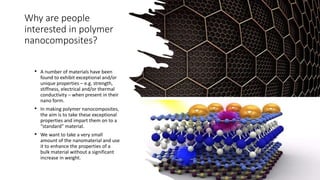
• A number of materials have been
found to exhibit exceptional and/or
unique properties – e.g. strength,
stiffness, electrical and/or thermal
conductivity – when present in their
nano form.
• In making polymer nanocomposites,
the aim is to take these exceptional
properties and impart them on to a
“standard” material.
• We want to take a very small
amount of the nanomaterial and use
it to enhance the properties of a
bulk material without a significant
increase in weight.
How do nanocomposites
work..?
Properties enhanced...
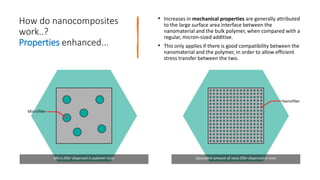
• Increases in mechanical properties are generally attributed
to the large surface area interface between the
nanomaterial and the bulk polymer, when compared with a
regular, micron-sized additive.
• This only applies if there is good compatibility between the
nanomaterial and the polymer, in order to allow efficient
stress transfer between the two.
Micro filler dispersed in polymer resin Equivalent amount of nano filler dispersed in resin
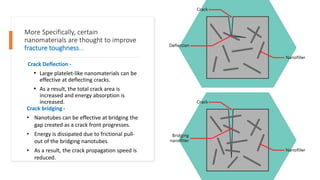
More Specifically, certain
nanomaterials are thought to improve
fracture toughness...
Crack Deflection -
• Large platelet-like nanomaterials can be
effective at deflecting cracks.
• As a result, the total crack area is
increased and energy absorption is
increased.
Crack bridging -
• Nanotubes can be effective at bridging the
gap created as a crack front progresses.
• Energy is dissipated due to frictional pull-
out of the bridging nanotubes.
• As a result, the crack propagation speed is
reduced.
When it comes
to electrical and thermal
properties...
For electrical conductivity, it may not be necessary to aim for perfect, uniform distribution. At low
nanoparticle loadings, the presence of some agglomerates can actually be favourable.
Improvements in gas barrier properties...
• Due to the nanomaterials forming a
“tortuous path”, which any small
molecule must traverse in order the
permeate the bulk material.
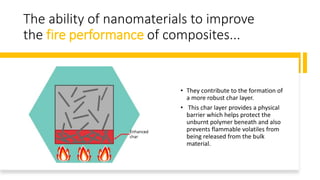
The ability of nanomaterials to improve
the fire performance of composites...
• They contribute to the formation of
a more robust char layer.
• This char layer provides a physical
barrier which helps protect the
unburnt polymer beneath and also
prevents flammable volatiles from
being released from the bulk
material.
That’s the theory, however…
Making a polymer nanocomposite remains far from
straightforward, with a number of factors potentially
influencing the final properties, such as...
• The specific grade of nanomaterial being used (for example, if it
is graphene; how many layers does it have? what are the lateral
dimensions? has it been functionalised in any way? etc).
• The amount of nanomaterial being used.
• The way in which the nanomaterial is incorporated into the bulk
polymer.
• The way in which components are manufactured.
Processing of polymer
nanocomposites -
•In-situ Polymerization
•Blending
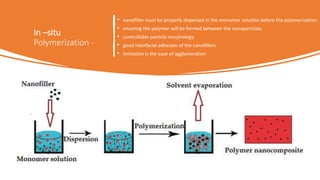
In –situ
Polymerization -
• nanofiller must be properly dispersed in the monomer solution before the polymerization.
• ensuring the polymer will be formed between the nanoparticles.
• controllable particle morphology
• good interfacial adhesion of the nanofillers
• limitation is the ease of agglomeration
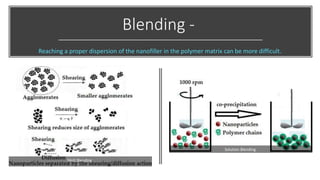
Blending -
Reaching a proper dispersion of the nanofiller in the polymer matrix can be more difficult.
Solution Blending
Melt Blending
Applications
-
• Automotive and Aerospace
• Electrical and Electronics
• Packaging
• Biomedical
• Paints and Coatings​
Polymer Nanocomposites Market
THANK YOU

Polymer Nano-Composites Presentation.

  • 1.
  • 2.
    In a nutshellPolymer Nanocomposites are… • A composite in which we combine a Polymer matrix with some kind of nanomaterial.
  • 3.
    And a Nanomaterial is…? • Sphericalnanoparticles; which have all three dimensions in the nanoscale (e.g. nano-TiO2 or nano-SiO2). • Nanotubes; which have two dimensions in the nanoscale (e.g. carbon nanotubes, halloysite clays or nanofibrillated cellulose). • Nanoplatelets; which have just one dimension in the nanoscale (e.g. graphene, hexagonal boron nitride or bentonite clays). The particles in the number size distribution must measure 100nm or below.
  • 4.
    Why are people interestedin polymer nanocomposites? • A number of materials have been found to exhibit exceptional and/or unique properties – e.g. strength, stiffness, electrical and/or thermal conductivity – when present in their nano form. • In making polymer nanocomposites, the aim is to take these exceptional properties and impart them on to a “standard” material. • We want to take a very small amount of the nanomaterial and use it to enhance the properties of a bulk material without a significant increase in weight.
  • 5.
    How do nanocomposites work..? Propertiesenhanced... • Increases in mechanical properties are generally attributed to the large surface area interface between the nanomaterial and the bulk polymer, when compared with a regular, micron-sized additive. • This only applies if there is good compatibility between the nanomaterial and the polymer, in order to allow efficient stress transfer between the two. Micro filler dispersed in polymer resin Equivalent amount of nano filler dispersed in resin
  • 6.
    More Specifically, certain nanomaterialsare thought to improve fracture toughness... Crack Deflection - • Large platelet-like nanomaterials can be effective at deflecting cracks. • As a result, the total crack area is increased and energy absorption is increased. Crack bridging - • Nanotubes can be effective at bridging the gap created as a crack front progresses. • Energy is dissipated due to frictional pull- out of the bridging nanotubes. • As a result, the crack propagation speed is reduced.
  • 7.
    When it comes toelectrical and thermal properties... For electrical conductivity, it may not be necessary to aim for perfect, uniform distribution. At low nanoparticle loadings, the presence of some agglomerates can actually be favourable.
  • 8.
    Improvements in gasbarrier properties... • Due to the nanomaterials forming a “tortuous path”, which any small molecule must traverse in order the permeate the bulk material.
  • 9.
    The ability ofnanomaterials to improve the fire performance of composites... • They contribute to the formation of a more robust char layer. • This char layer provides a physical barrier which helps protect the unburnt polymer beneath and also prevents flammable volatiles from being released from the bulk material.
  • 10.
    That’s the theory,however… Making a polymer nanocomposite remains far from straightforward, with a number of factors potentially influencing the final properties, such as... • The specific grade of nanomaterial being used (for example, if it is graphene; how many layers does it have? what are the lateral dimensions? has it been functionalised in any way? etc). • The amount of nanomaterial being used. • The way in which the nanomaterial is incorporated into the bulk polymer. • The way in which components are manufactured.
  • 11.
    Processing of polymer nanocomposites- •In-situ Polymerization •Blending
  • 12.
    In –situ Polymerization - •nanofiller must be properly dispersed in the monomer solution before the polymerization. • ensuring the polymer will be formed between the nanoparticles. • controllable particle morphology • good interfacial adhesion of the nanofillers • limitation is the ease of agglomeration
  • 13.
    Blending - Reaching aproper dispersion of the nanofiller in the polymer matrix can be more difficult. Solution Blending Melt Blending
  • 14.
    Applications - • Automotive andAerospace • Electrical and Electronics • Packaging • Biomedical • Paints and Coatings​
  • 15.
  • 16.