0LA E0
E
TYPES OF FORDLAS
1. N ke* (
v CHg , CH Bv Hls ave col) geses
Lempeva ve and pve
AeCutar Eo ta Cy H10
v otnev ve dlkanes ave 1ią ds
e all mpisei le wit wałev (ins
CH CH CH (H
cOndlevsed Shuch a Eov ula
o Vea h Fon a cov Is esuosht hon veochon)
(
with H rai ) thvovgnemination veathion
ło fo y) a| v1
a suksHtUłjow veachov
( 0 Log)
In feyY1 e tol
Stvuc al.Eøm a o Alkanes: n+2
Mawing comp eX Bvanchaed CiaieAlkanes Esammpie
t |
Espaiiating te metting and Boiing Paint r CVFTC
In kydvca aans WeaEikatemeitaulaxr foKces Df athathons exist piten tetove wove
ce neigkak2ou ing DI ukes co as berweev na
V ve nvio| CU
tachve fovce l etueen
neqnbou i g mo
AIkanes la e Law Se
a 2 ng
baling inIS EHwane n lec e
a Y ovg nl mal1es
delting andkooiting poinrsInc easeina equ rway-as thcIengtLof W ca ø n cuaiviac cas
lavkons 5t ave ii uids lavg alk nesave sovidls
Atvoum tep a u e, Lavlbons 1- duegaseS
Alkanes ave Non-polav DmoIcules tlc avc insoL øle v wate
*Melting andioiting p inss wcvcase as the to CES of athcactions bełsecn 9lecutesLa acts
ca aonchai Length inecase5 Waicn means tnanAOve Cn o isneeded o.auevcomethese
OF CY2Cn
1C Su
Alkones veused extensiv eryas. tues; Plentif 0—2on coaushe p o wałoouet
ange
(uy C e
l Cv vy
Limited 0inco ekecor ushon t vaduee ADand 0. nd
h o nge Br _watexinp esehce Of U tight and)o eatO slaauy
React sIo nd
t c0l uY as thisSukashtütov Yeachon cukS Br
geS
y .Br
t Brg
nalaa ane (sl0w eathonsonteds V as a całalyst)
dikane ł naoge 2=
MlacIesWeHakøm r atomsin analkane_a ByX W aereXisa , e,l)
Euoco catáva, bzonD,1aca Liistaphabericalzuke2v i lescontainn0 eban 1hat gen)
Pnina y
Suondvy
() n0 |Chl0V 0V1an(
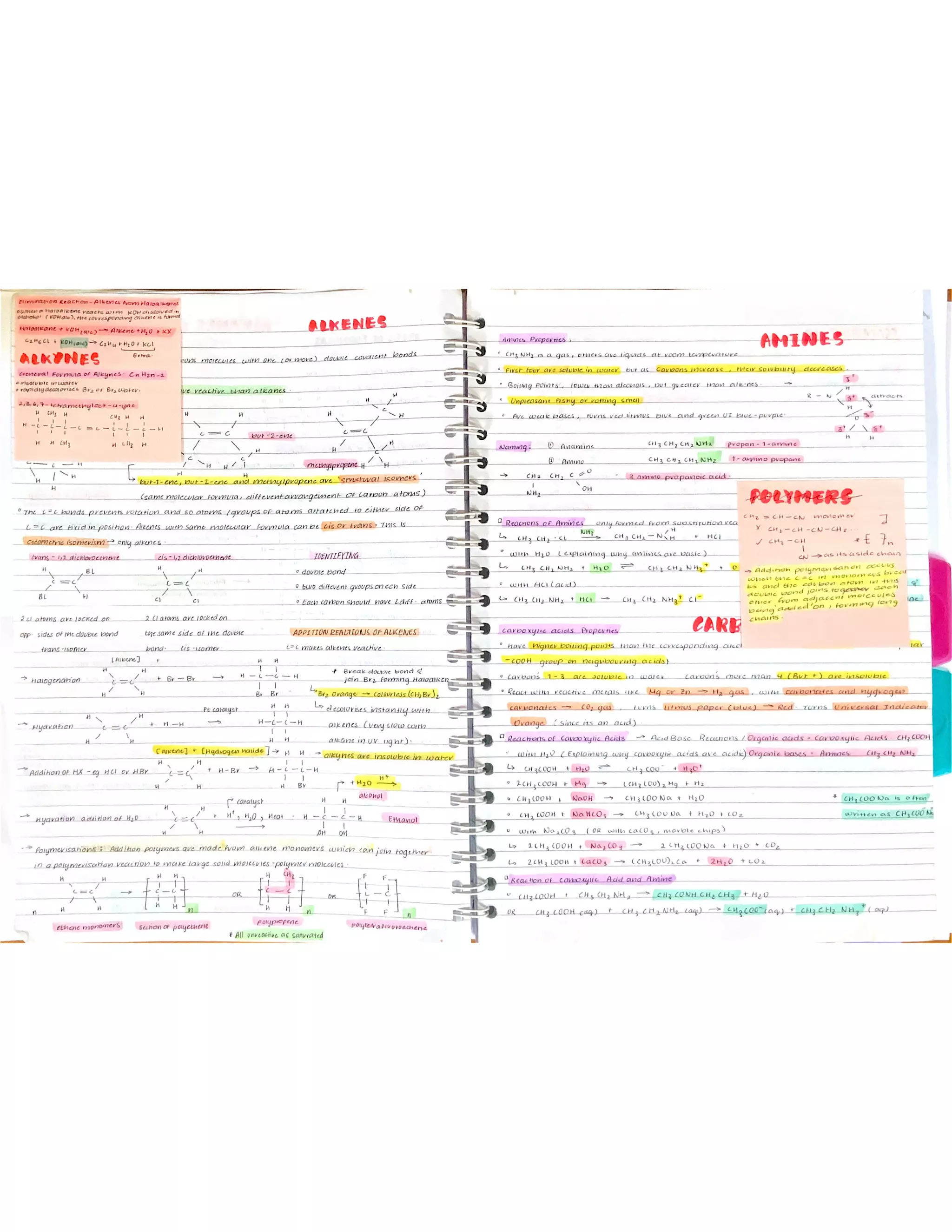
Amines Properties AMINES
attracts
Ave weak bases, tuvns ved litmus bive and grien ul bue-purpie
are hixidin position Avenes with same moleular formula can be cis or tvans) This is
and the
same side al the doybic
chais
since is an acid)
1- Allines ham Haloalbores
Exha
douore coudient. lands M3 NH2 is a gas atners ave liquids at voom tempevature
teneral Formula Alkynes On Hzn-2
Fist four ave scluble in warey butas Cavinansmmcass their sowbuty decreases
rapidigdeworises Bvz or Br, wak ve reactive than alkanes
Baiting Points_ lowa tan alcohals , D01 greatcy
Unpicasant fishy smel
4,3,b,?- tctvamnetnylcct-u-yne
H
Naming;
(H 3 CH2 CH2 OH Pvopan - 1-amine
D Amina CH3 CH2 CH1 NH2 1- amino propane
(same mulcular formula, cittevent awangernent lamon atomas, POLYMERS
lounds prevents s /groups of arum attatched to cittev side. of
Reactions of Amines only f
CHI-CH -CU-CHE.
CH1 TCH
tvans - 12 dichlovoetnent cis- 1,2 dichiovoerone N >as its aside
double bond CH3 CH NH2 CH3 CH2 N
bivo liftevent groups on ect side
when
L (H3 (H2 NH2 t HOL
Each carbon Shovld have Ldiff atoms
deled'on , tovming
beng
2 cL atoms ave locked on Catons ave locked on
OPp: sides of the double loond APPITIUN REALTIDN'S OF ALKENES carbaxglie acids Propernes
CARE
bond: Us -isomer. maxes alkenes veathve have higher bing points than the tamesponding cucel
H
halogenation By- Br
H
join Bry forming Hawaikn:
• lalkons 1-3 ata voluble in tuatcl laroons more man 4 (But ty ave insawbic
Br. Beact tim reactive metals uke
elecotovises instanny with. utmus paper Chlus) Red. Turns Universal Iaduieata
'Reactions of canaxylic Ad
alkynts ave insowbie in warcv wit 1;0 ( Explaining wng carboxye acids ave acide) Oiganie bases Amines
H-BY A-
H20 ( CH3 (00) 2 Mg + r
CH3000 Na H20 LH; 000 Na is often
nyavation_ acuition of Hi0 Ethanol
CH2 COOM CH3 COU Da 1 H20 1 (02
With Na03 OR with tat0s, mavble chips
Polymerisations: Addition polymens ave made from alcene monomers wnich can join together
L. 2 CH3 (OOH Na) C0 g
in a polynexisatian veainon h mare layge sold pieevies "polyily molceves
• Reaction af carasylic Acd and Amine
CHa CONH CHa CH& 1 HgQ
H
OR
ethane monomers schon of polyethone
All vnvcochve as saturated
i
3 3 la 2dhl butLnis catLs RALalettpeta
o
inaL L L aU
0 f
LLLIs MioiD pLLkALEA icmenation ceachon loesausc thcseagant keH taic)lininatck Nha taivgen
educesa dcubi bend ( tkCne)The l p adtcl uaL awe tewmed ave
lCAhen0 u
tu0ch iC (V H Ht )and c lz Her le Mecvevnikovs celt
SLh L TLSPIEy0
12 the caytben anattched to w9e hc genh )
ICA fC fVC
Alkene.
5 4
2 = CH2|+H 0
Sogjar iann el oC1clleilaas a He (
ova fneCio iePOmer S B noec . 2 Cra c-3CFl3Cv- rFreF1a C T' En
wo a e
HC1 inov odluCt 15 fov edle tev Fieot ovleoeesel ce aEdl
V k.1
fevming_(eH eria H3)
(cnuey j (avo yue cund
W YvOenv rC gCVL C prCF12 I3 vv 5 Fvv CEV e9 CTyivev
=CHc 3
w/ p"
(ooeadi * * L1 1 e d
1.5 lu1n
hyVCtu altD m lcutor CnD'L K
/ y Y
E ykatLt1oLhkLp)AekM. 11M1 1.RI)CLy CSAE1O CV0 l /S
EI LAOn
pv cluCŁSaUvC_taVmcdL
esavne4 Hcy civelbonded39ougr
plain nA p rAMDpaIDE
Saturated and unsaturated hydrocarbons and how to test for
Saturated hydrocarbons have C-C bonds; each C atom is bonded to 4 other atoms.
Orange (red-brown) bromine water Br2is slowly decolourised; needs UV light and/or heat
SUBSTITUTION
Unsaturated hydrocarbons have C=C or C=C bonds; not every C atomis bondedto 4 other atoms
° Orange bromine wateris rapidly decolourised(no need for UV and/or heat)- ADDITION
° Alkene purple H'/MnO4 solution reacts to form diol and the solution becomes colourless.
OXIDATION
Bum win o cican almost colouviess A structural (constitutional)isomer has the same molecular formula (same number of each type of atoms),
but a different arrangement of atoms (Could be any of straight chain / branched chain or position of
Oxidation%
functional group or type of functional group).
Geometricalisomers (cis and trans) have
C=C double bond (which cannot rotate)
atoms / groups on each of the carbons of the double bond that are different.
If one C of the C=C has 2 atoms/ groupsthe same e.g. 2 H's or 2 CH3 S then if these were swappedi
would still be the same molecule so that molecule can't have cis or transisomers
The KEY is to draw themin shape. C shape = cis.
group
TRANS
Substitution
An atom or group of atoms is replaced with another atom or group of atoms. There are 2 products.
Alkane > haloalkane: Br2 water and UV light and/or heat snow deiouvisition of ovange
Alcohol > chloroalkane: SOCI2 or PCIs or PCl3 or HCI (bromoalkane write Br instead of CI)
Haloalkane amine: concNHs(alc), heat
Addition
The double bondis broken and two atoms/groups are a cq:Motamey Ethane / Posynev: porychliene
one saturated product.
Addition reactions making 2 products
There are two products if an asymmetric reagent & monomey; unsatuata
asymmetric alkene (CH;CH=CH.). There are two ca
with sothere are two possible combinations.
Predict the major product by using Markovnikov's
most hydrogens gains more hydrogens (rich getricher). The other product will be theminor
product.
me anconois ave
H
SUBSIT TUTLON BEAL
Lav alanoss citia marc tuah 6 c atons
fame
C2Hs D) + 30z > 2002 311,0 Paideci cho
dut/una ) purpic
Idennty the avkan aton
atoms ductly bonded ft
and noting point of deonds macases. A the
U attrorions locilveen ive molevies ger swanger
C1-3 ave sallak in
water. ch onwards av nat becaust the
longer non polar hydrocavion regions
By wate
Haloalkane > alcohol: KOH(aq), heat /du7
sicps thie Oh
addition potyurensahon ocuvs we the
Monomers tears and tire cavton atornsin timsdoviale
ponds romn to coch foom adjacent motacutes
fovm tangchains
Alkene- > alkane: H2(g), Pt (or Ni) catalyst
Alkene alcohol: H'/H20, heat/dit $z H2504
Alkene- > haloalkane: Add HX(g) or X2(g)(would r beabie todvaw hom arnene men you can draw
any MOVONCv: L ] shows one repearig int
10 do for onny mononncs slmpig dvewo therm
porymey sanated biss viachve
ty Ivsriryg annyits adddson C first semence have)
Elimination
Two atoms/ groups are removed from adjacent carbon atoms and a double bondis created to form an
Alcohol alkene: conc.H25O4 , sulfuric acid(H and OH removed, C=C made) 2-0H -alleenet H.0
Haloalkane -> alkene: KOH(alc), heat (H and X removed, C=Cmade) d-x - alkene PHX
Eliminationreactions making 2 products
There are two productsifthe alcohol can losean OH and a H fromthe C on either side.
Thereare two productsif the haloalkane can lose an X and a Hfrom the C on either side.
Predict the majorproduct the carbon with the least hydrogensloses the hydrogen (poor get
poorer). The other product will bethe minor product. (Saytzeff's rule).
Oxidation
1° alcohol carboxylic acid: MnO4 /H heat OR Cr2O72-/H* heat. (2° and 3° NOT converted to
carboxylic acid)
Acid-base
Reaction of carboxylic acid with base NaOH(no visible reaction) or carbonate NaHCOg or Na2CO3 (both
release CO2gas). The acid donates a proton. Will make ionic salts, e.g. CH3COO Na*. CHCOO® is the
Reaction of amine with HCI or H25O (no visiblereaction). The base acceptsa protonfrom the acid. Will
make(ionic)salts e.g. CH3NH2 + HCI -> CH3NH3* Cli
Wateris a polarmolecule. Any (aq)solutionalsocontains mostly water! Remember this!!
If theorganic molecule is non-polar(alkane,alkene, alkyne)itwill not dissolvein water, is insoluble.
Twolayers willform.
For soluble organic moleculesas #CT solubility (as non-polar hydrocarbon bit gets bigger).
Small alcohols(C1-3), small carboxylic acids (C1-4) and small amines (C1-5) are soluble as the -OH and
-COOH and -NH2 groups are polar and are attracted to polar water molecules. Onelayer only.
Litmus and Ul paper - must be MOIST/DAMP
The only organic acids at L2 are carboxylic acids.
Bluelitmus turns red, redlitmus stays red
Green UIturns orange(weak acid)
The only organic bases are L2 are amines.
Red litmus turns blue, bluelitmus stays blue
Green UI turnsblue (weak base)
All other organic chemicals + LITMUS or IU at L2- say"no change"
Classificationof alcoholsand haloalkanes (X where X is CI, Br etc)
Primary: the-OH (or -CI) is attachedto a C atom that has ONE other C atom attached to it.
Secondary: the -OH (or-CI) is attached to a C atom that hasTWO other C atoms attached to it.
Tertiary: the -OH(or-CI)is attached to a C atom that has THREE other C atoms attached to it.
con
Reaction with either MnO4 OR Cr2O72 both "oxidising agents" - usually used "acidified", i.e. with H*
Alkene- > diol: Mn04/H* (purple to colourless) oi MnO4 (purple to brown)
U> avoidit possible
ethanoate ion. y bubbies b
know how to dvow
know to dyaw.
> vemernbev turse ave coluble
In n acid base
Alcohols-neutral(no changeto litmus or UI).

Organic Chemistry

  • 1.
    0LA E0 E TYPES OFFORDLAS 1. N ke* ( v CHg , CH Bv Hls ave col) geses Lempeva ve and pve AeCutar Eo ta Cy H10 v otnev ve dlkanes ave 1ią ds e all mpisei le wit wałev (ins CH CH CH (H cOndlevsed Shuch a Eov ula o Vea h Fon a cov Is esuosht hon veochon) ( with H rai ) thvovgnemination veathion ło fo y) a| v1 a suksHtUłjow veachov ( 0 Log) In feyY1 e tol Stvuc al.Eøm a o Alkanes: n+2 Mawing comp eX Bvanchaed CiaieAlkanes Esammpie t | Espaiiating te metting and Boiing Paint r CVFTC In kydvca aans WeaEikatemeitaulaxr foKces Df athathons exist piten tetove wove ce neigkak2ou ing DI ukes co as berweev na V ve nvio| CU tachve fovce l etueen neqnbou i g mo AIkanes la e Law Se a 2 ng baling inIS EHwane n lec e a Y ovg nl mal1es delting andkooiting poinrsInc easeina equ rway-as thcIengtLof W ca ø n cuaiviac cas lavkons 5t ave ii uids lavg alk nesave sovidls Atvoum tep a u e, Lavlbons 1- duegaseS Alkanes ave Non-polav DmoIcules tlc avc insoL øle v wate *Melting andioiting p inss wcvcase as the to CES of athcactions bełsecn 9lecutesLa acts ca aonchai Length inecase5 Waicn means tnanAOve Cn o isneeded o.auevcomethese OF CY2Cn 1C Su Alkones veused extensiv eryas. tues; Plentif 0—2on coaushe p o wałoouet ange (uy C e l Cv vy Limited 0inco ekecor ushon t vaduee ADand 0. nd h o nge Br _watexinp esehce Of U tight and)o eatO slaauy React sIo nd t c0l uY as thisSukashtütov Yeachon cukS Br geS y .Br t Brg nalaa ane (sl0w eathonsonteds V as a całalyst) dikane ł naoge 2= MlacIesWeHakøm r atomsin analkane_a ByX W aereXisa , e,l) Euoco catáva, bzonD,1aca Liistaphabericalzuke2v i lescontainn0 eban 1hat gen) Pnina y Suondvy () n0 |Chl0V 0V1an(
  • 2.
    Amines Properties AMINES attracts Aveweak bases, tuvns ved litmus bive and grien ul bue-purpie are hixidin position Avenes with same moleular formula can be cis or tvans) This is and the same side al the doybic chais since is an acid) 1- Allines ham Haloalbores Exha douore coudient. lands M3 NH2 is a gas atners ave liquids at voom tempevature teneral Formula Alkynes On Hzn-2 Fist four ave scluble in warey butas Cavinansmmcass their sowbuty decreases rapidigdeworises Bvz or Br, wak ve reactive than alkanes Baiting Points_ lowa tan alcohals , D01 greatcy Unpicasant fishy smel 4,3,b,?- tctvamnetnylcct-u-yne H Naming; (H 3 CH2 CH2 OH Pvopan - 1-amine D Amina CH3 CH2 CH1 NH2 1- amino propane (same mulcular formula, cittevent awangernent lamon atomas, POLYMERS lounds prevents s /groups of arum attatched to cittev side. of Reactions of Amines only f CHI-CH -CU-CHE. CH1 TCH tvans - 12 dichlovoetnent cis- 1,2 dichiovoerone N >as its aside double bond CH3 CH NH2 CH3 CH2 N bivo liftevent groups on ect side when L (H3 (H2 NH2 t HOL Each carbon Shovld have Ldiff atoms deled'on , tovming beng 2 cL atoms ave locked on Catons ave locked on OPp: sides of the double loond APPITIUN REALTIDN'S OF ALKENES carbaxglie acids Propernes CARE bond: Us -isomer. maxes alkenes veathve have higher bing points than the tamesponding cucel H halogenation By- Br H join Bry forming Hawaikn: • lalkons 1-3 ata voluble in tuatcl laroons more man 4 (But ty ave insawbic Br. Beact tim reactive metals uke elecotovises instanny with. utmus paper Chlus) Red. Turns Universal Iaduieata 'Reactions of canaxylic Ad alkynts ave insowbie in warcv wit 1;0 ( Explaining wng carboxye acids ave acide) Oiganie bases Amines H-BY A- H20 ( CH3 (00) 2 Mg + r CH3000 Na H20 LH; 000 Na is often nyavation_ acuition of Hi0 Ethanol CH2 COOM CH3 COU Da 1 H20 1 (02 With Na03 OR with tat0s, mavble chips Polymerisations: Addition polymens ave made from alcene monomers wnich can join together L. 2 CH3 (OOH Na) C0 g in a polynexisatian veainon h mare layge sold pieevies "polyily molceves • Reaction af carasylic Acd and Amine CHa CONH CHa CH& 1 HgQ H OR ethane monomers schon of polyethone All vnvcochve as saturated
  • 3.
    i 3 3 la2dhl butLnis catLs RALalettpeta o inaL L L aU 0 f LLLIs MioiD pLLkALEA icmenation ceachon loesausc thcseagant keH taic)lininatck Nha taivgen educesa dcubi bend ( tkCne)The l p adtcl uaL awe tewmed ave lCAhen0 u tu0ch iC (V H Ht )and c lz Her le Mecvevnikovs celt SLh L TLSPIEy0 12 the caytben anattched to w9e hc genh ) ICA fC fVC Alkene. 5 4 2 = CH2|+H 0 Sogjar iann el oC1clleilaas a He ( ova fneCio iePOmer S B noec . 2 Cra c-3CFl3Cv- rFreF1a C T' En wo a e HC1 inov odluCt 15 fov edle tev Fieot ovleoeesel ce aEdl V k.1 fevming_(eH eria H3) (cnuey j (avo yue cund W YvOenv rC gCVL C prCF12 I3 vv 5 Fvv CEV e9 CTyivev =CHc 3 w/ p" (ooeadi * * L1 1 e d 1.5 lu1n hyVCtu altD m lcutor CnD'L K / y Y E ykatLt1oLhkLp)AekM. 11M1 1.RI)CLy CSAE1O CV0 l /S EI LAOn pv cluCŁSaUvC_taVmcdL esavne4 Hcy civelbonded39ougr plain nA p rAMDpaIDE
  • 4.
    Saturated and unsaturatedhydrocarbons and how to test for Saturated hydrocarbons have C-C bonds; each C atom is bonded to 4 other atoms. Orange (red-brown) bromine water Br2is slowly decolourised; needs UV light and/or heat SUBSTITUTION Unsaturated hydrocarbons have C=C or C=C bonds; not every C atomis bondedto 4 other atoms ° Orange bromine wateris rapidly decolourised(no need for UV and/or heat)- ADDITION ° Alkene purple H'/MnO4 solution reacts to form diol and the solution becomes colourless. OXIDATION Bum win o cican almost colouviess A structural (constitutional)isomer has the same molecular formula (same number of each type of atoms), but a different arrangement of atoms (Could be any of straight chain / branched chain or position of Oxidation% functional group or type of functional group). Geometricalisomers (cis and trans) have C=C double bond (which cannot rotate) atoms / groups on each of the carbons of the double bond that are different. If one C of the C=C has 2 atoms/ groupsthe same e.g. 2 H's or 2 CH3 S then if these were swappedi would still be the same molecule so that molecule can't have cis or transisomers The KEY is to draw themin shape. C shape = cis. group TRANS Substitution An atom or group of atoms is replaced with another atom or group of atoms. There are 2 products. Alkane > haloalkane: Br2 water and UV light and/or heat snow deiouvisition of ovange Alcohol > chloroalkane: SOCI2 or PCIs or PCl3 or HCI (bromoalkane write Br instead of CI) Haloalkane amine: concNHs(alc), heat Addition The double bondis broken and two atoms/groups are a cq:Motamey Ethane / Posynev: porychliene one saturated product. Addition reactions making 2 products There are two products if an asymmetric reagent & monomey; unsatuata asymmetric alkene (CH;CH=CH.). There are two ca with sothere are two possible combinations. Predict the major product by using Markovnikov's most hydrogens gains more hydrogens (rich getricher). The other product will be theminor product. me anconois ave H SUBSIT TUTLON BEAL Lav alanoss citia marc tuah 6 c atons fame C2Hs D) + 30z > 2002 311,0 Paideci cho dut/una ) purpic Idennty the avkan aton atoms ductly bonded ft and noting point of deonds macases. A the U attrorions locilveen ive molevies ger swanger C1-3 ave sallak in water. ch onwards av nat becaust the longer non polar hydrocavion regions By wate Haloalkane > alcohol: KOH(aq), heat /du7 sicps thie Oh addition potyurensahon ocuvs we the Monomers tears and tire cavton atornsin timsdoviale ponds romn to coch foom adjacent motacutes fovm tangchains Alkene- > alkane: H2(g), Pt (or Ni) catalyst Alkene alcohol: H'/H20, heat/dit $z H2504 Alkene- > haloalkane: Add HX(g) or X2(g)(would r beabie todvaw hom arnene men you can draw any MOVONCv: L ] shows one repearig int 10 do for onny mononncs slmpig dvewo therm porymey sanated biss viachve ty Ivsriryg annyits adddson C first semence have)
  • 5.
    Elimination Two atoms/ groupsare removed from adjacent carbon atoms and a double bondis created to form an Alcohol alkene: conc.H25O4 , sulfuric acid(H and OH removed, C=C made) 2-0H -alleenet H.0 Haloalkane -> alkene: KOH(alc), heat (H and X removed, C=Cmade) d-x - alkene PHX Eliminationreactions making 2 products There are two productsifthe alcohol can losean OH and a H fromthe C on either side. Thereare two productsif the haloalkane can lose an X and a Hfrom the C on either side. Predict the majorproduct the carbon with the least hydrogensloses the hydrogen (poor get poorer). The other product will bethe minor product. (Saytzeff's rule). Oxidation 1° alcohol carboxylic acid: MnO4 /H heat OR Cr2O72-/H* heat. (2° and 3° NOT converted to carboxylic acid) Acid-base Reaction of carboxylic acid with base NaOH(no visible reaction) or carbonate NaHCOg or Na2CO3 (both release CO2gas). The acid donates a proton. Will make ionic salts, e.g. CH3COO Na*. CHCOO® is the Reaction of amine with HCI or H25O (no visiblereaction). The base acceptsa protonfrom the acid. Will make(ionic)salts e.g. CH3NH2 + HCI -> CH3NH3* Cli Wateris a polarmolecule. Any (aq)solutionalsocontains mostly water! Remember this!! If theorganic molecule is non-polar(alkane,alkene, alkyne)itwill not dissolvein water, is insoluble. Twolayers willform. For soluble organic moleculesas #CT solubility (as non-polar hydrocarbon bit gets bigger). Small alcohols(C1-3), small carboxylic acids (C1-4) and small amines (C1-5) are soluble as the -OH and -COOH and -NH2 groups are polar and are attracted to polar water molecules. Onelayer only. Litmus and Ul paper - must be MOIST/DAMP The only organic acids at L2 are carboxylic acids. Bluelitmus turns red, redlitmus stays red Green UIturns orange(weak acid) The only organic bases are L2 are amines. Red litmus turns blue, bluelitmus stays blue Green UI turnsblue (weak base) All other organic chemicals + LITMUS or IU at L2- say"no change" Classificationof alcoholsand haloalkanes (X where X is CI, Br etc) Primary: the-OH (or -CI) is attachedto a C atom that has ONE other C atom attached to it. Secondary: the -OH (or-CI) is attached to a C atom that hasTWO other C atoms attached to it. Tertiary: the -OH(or-CI)is attached to a C atom that has THREE other C atoms attached to it. con Reaction with either MnO4 OR Cr2O72 both "oxidising agents" - usually used "acidified", i.e. with H* Alkene- > diol: Mn04/H* (purple to colourless) oi MnO4 (purple to brown) U> avoidit possible ethanoate ion. y bubbies b know how to dvow know to dyaw. > vemernbev turse ave coluble In n acid base Alcohols-neutral(no changeto litmus or UI).