Elements, compounds and
Experimental techniques
Learning objectives:
 Apparatus used in taking measurements
 Hazards labels and Laboratory rules for working in a laboratory
 What are elements, mixtures and compounds and mixtures
 Check purity
 Separation of mixtures
Measurements
1.Volume
2.Time
3.Mass
4.Temp
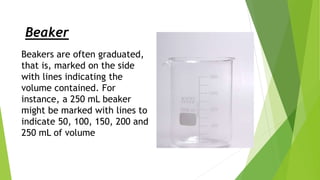
Beaker
Beakers are often graduated,
that is, marked on the side
with lines indicating the
volume contained. For
instance, a 250 mL beaker
might be marked with lines to
indicate 50, 100, 150, 200 and
250 mL of volume
Measuring cylinder
A graduated cylinder is
meant to be read with the
surface of the liquid at
eye level, where the
bottom of the meniscus
shows the measurement
line. A measuring cylinder
is accurate to nearest
cm3.
Burette
A burette is a volumetric measuring
glassware which is used in analytical
chemistry for the accurate dispensing of a
liquid, especially of one of the reagents in
a titration. The burette tube carries
graduated marks from which the
dispensed volume of the liquid can be
determined. Burettes are available in a
limited range of sizes; the most common
size is 50-mL. The scale of a 50-mL
burette is divided into 0.1mL increments.
Therefore, when the liquid level in a
burette is read, it is read and recorded to
the nearest 0.1 mL .
Pipette
Graduated pipettes made of
glass or plastic and are used
to accurately measure the
liquid volumes. Use them for
measuring volumes between 1
ml and 10 ml: For larger
volumes, you would use a
graduated cylinder, and for
smaller volumes.
Gas syringe
To measure the volume of a
gas, we use a gas syringe.
The plunger is pressed fully
into the barrel to expel any gas
present in the syringe. As gas
is produced during a reaction
and enters the syringe, the
plunger is pushed outwards
and the volume of the gas
produced can be measured.
Mass
 The units for measuring mass are grams and kilograms.
1kg= 1000 g
• Electronic balance can be
used to measure the mass.
• They measure mass to an
accuracy of one hundredth of
grams.
• When taking measurements
using electronic balance, you
should wait until the reading is
steady before taking it in order
to reduce the errors.
Temperature
 A laboratory thermometer, is used for measuring temperatures other than the
human body temperature. It ranges from -10˚C to 110˚C. Laboratory
thermometers are designed for lab purposes such as checking boiling point,
freezing point, or temperature of other substances.
Time
Experiments involving rates of
reaction will require the use of an
accurate stop watch – one that
measures time to a hundredth of a
second.
The units of measuring time are
hours, minutes and seconds.
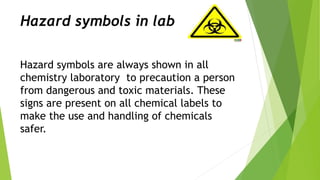
Hazard symbols in lab
Hazard symbols are always shown in all
chemistry laboratory to precaution a person
from dangerous and toxic materials. These
signs are present on all chemical labels to
make the use and handling of chemicals
safer.
Hazard symbols and label guide in lab
Rules for working in a lab
Avoid doing in lab
What is an Element?
 Substances that cannot be chemically broken down into simpler substances.
 They are primary constituents of matter.
 Each element is distinguished by its atomic number, i.e. the number of protons in the nuclei of its
atoms.
What is a Compound?
 A compound is a material formed by chemically bonding two or more chemical
elements.
 The type of bond keeping elements in a compound together may vary. Covalent
bonds and ionic bonds are two common types.
 The elements are always present in fixed ratios in any compound.
What is a Mixture?
 A mixture is a material made up of two or more different substances which are
physically combined.
 A mixture is the physical combination of two or more substances in which the
identities are retained and are mixed in the form of solutions
 Mixtures are not chemically united and the substances in it exist in no fixed
proportion to each other.
Difference between Elements,
Compound and Mixtures
Elements Compounds Mixtures
Made up of only one
kind of atom
Made up of more than
one atom
Made up of more than
one kind of molecule
Cannot be broken down
by chemical means
Can be broken down by
chemical means
Can be separated by
physical means
Has the same properties
as the atoms making it
up
Has different properties
from the elements
making it up
Has same properties as
the substances making it
up
Has the same properties
throughout
Has the same properties
throughout
Has different properties
throughout
Examples of Elements, Compounds
and Mixture
Elements
 Sodium(Na)
 Calcium(Ca)
 Magnesium(Mg)
 Hydrogen(H)
Compounds
 Water(H22O)
 Magnesium Oxide(MgO)
 Hydrogen Chloride(HCl)
Mixture
 Sugar Solution
 Milk and Water
 Salt Solution
 Coffee and Milk
Checking Purity
Why do we check purity of a substance?
-Because pure substances form predictable products whereas impure substances
might give unexpected results
There are three ways you can check if the substance is pure or not:
-Measuring it’s melting point
-Measuring it’s boiling point
-Chromatography
Measuring its melting point
In this process the substance’s melting point will be checked multiple times and
if it has a sharp melting point it is considered to be a pure substance whereas if
the substance melts over a range of temperatures it is considered to be non-pure
substance. Pure substances will have lower melting point then the impure
substance.
For example, pure ice melts completely at zero degree Celsius but the impure
ice will start to melt before zero degree Celsius. The more impurities a substance
contains, the lower its melting point will be.
Measuring its boiling point
In this process the substance’s boiling point will be checked multiple times and if
it has a sharp boiling point it is considered to be a pure substance whereas if the
substance boils over a range of temperatures it is considered to be non-pure
substance. Impure substances will have higher boiling point then the pure
substance.
For example, pure water boils completely at 100 degree Celsius but the impure
water will start to boil after 100 degree Celsius. The more impurities a substance
contains, the higher its boiling point will be.
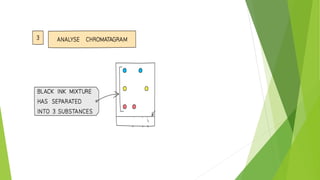
Chromatography
A chromatogram produced by paper chromatography can be used to distinguish
between pure and impure substances. A pure substance would produce one
spot on the chromatogram whereas an impure substance would produce
multiple spots on the chromatogram.
For example water from lakes and rivers will produce 2 marks and water from
drinking water will produce 1 mark
Miscible and immiscible liquids
Miscible liquids
Miscibility is the property of two
substances to mix in all proportions.
The term is most often applied to
liquids but also applies to solids and
gases. For example, water and ethanol
are miscible because they mix in all
proportions.
Immiscible liquids
Immiscible liquids are those which
won't mix to give a single phase. Oil
and water are examples of immiscible
liquids
Miscible liquids Immiscible liquids
Water and ethanol Water and oil
Milk and water Water and cyclohexane
Rubbing alcohol and water Gasoline and water
Petrol and kerosene Pentane and acetic acid
Water and vinegar Molten silver and lead
Liquid/Liquid mixtures
Immiscible liquids Miscible liquids
Immiscible liquids
This is used to separate immiscible liquids.
Example: water and oil.
Fractional Distillation
To separate two or more liquids that are miscible with one another and have
different boiling point.(e.g. ethanol and water from a mixture of the two).
Important applications of fractional distillation
 Separation of ethanol and water
 Separate of liquid air into oxygen and nitrogen.
 Separation of crude oil into useful fractions
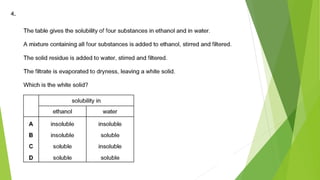
Solid/liquid mixtures
Soluble Insoluble
Evaporation
Crystallization
Simple
distillation
Filtration
Decantation
Centrifugation
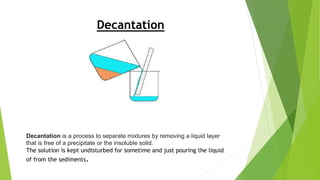
Decantation
Decantation is a process to separate mixtures by removing a liquid layer
that is free of a precipitate or the insoluble solid.
The solution is kept undisturbed for sometime and just pouring the liquid
of from the sediments.
Filtration
• To separate an insoluble solid from a mixture.
• E.g. sand from seawater.
• Upon filtration the mixture is separated into residue and filtrate.
• Residue – the insoluble solid that remains on the filter paper.
• Filtrate – the liquid that passes through the filter paper.
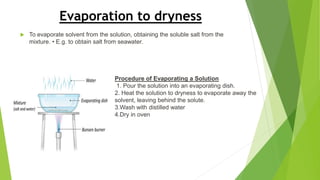
Evaporation to dryness
 To evaporate solvent from the solution, obtaining the soluble salt from the
mixture. • E.g. to obtain salt from seawater.
Procedure of Evaporating a Solution
1. Pour the solution into an evaporating dish.
2. Heat the solution to dryness to evaporate away the
solvent, leaving behind the solute.
3.Wash with distilled water
4.Dry in oven
Crystallization
 When a solid dissolves in a liquid solvent, a solution is produced. If this
solution is heated, some of the solvent evaporates. When the hot solution is
allowed to cool, some of the dissolved solid reappear as pure crystals. This
process is called crystallisation.
 Example: Sugar crystals can be obtained from sugar solution
Procedure of Crystallisation
1. Pour the solution, into an evaporating dish.
2. Heat the solution till the crystallization point.
3. Leave the solution to cool for the crystals to form.
4 Filter the mixture to collect the crystals which will be the
residue.
5. Dry between filter paper.
Simple distillation
 To separate a liquid and soluble solid from a solution
 When a solution is boiled , the solvent changes to vapour, the vapour passes
down a condenser where it is converted back to liquid and collected as
distillate.
 Example: water can be separated from salt solution by simple distillation.
Paper Chromatography
Things to remember
 The number of spots indicates the number of substances present in the
mixture.
 A pure substance gives only one spot.
 If a spot remains on the starting line then it means that the substance is
insoluble in the solvent used.
Using Rf values to identify
components of a mixture
Rf value = distance moved by compound ÷ distance moved by
solvent
The Rf value of a particular substance is always the same.
Rf value is always less than 1.
Applications of chromatography
1. Separate dyes in ink
2. Pigments in plants
3. Amino acids obtained from proteins
4. To identify poisons (e.g. pesticides)
5. To detect traces of banned substances in food
1.
2.
3.
4.
5.
Thank you for your
attention

Elements, compounds and experimental techniques ppt

  • 1.
  • 2.
    Learning objectives:  Apparatusused in taking measurements  Hazards labels and Laboratory rules for working in a laboratory  What are elements, mixtures and compounds and mixtures  Check purity  Separation of mixtures
  • 3.
  • 4.
    Beaker Beakers are oftengraduated, that is, marked on the side with lines indicating the volume contained. For instance, a 250 mL beaker might be marked with lines to indicate 50, 100, 150, 200 and 250 mL of volume
  • 5.
    Measuring cylinder A graduatedcylinder is meant to be read with the surface of the liquid at eye level, where the bottom of the meniscus shows the measurement line. A measuring cylinder is accurate to nearest cm3.
  • 6.
    Burette A burette isa volumetric measuring glassware which is used in analytical chemistry for the accurate dispensing of a liquid, especially of one of the reagents in a titration. The burette tube carries graduated marks from which the dispensed volume of the liquid can be determined. Burettes are available in a limited range of sizes; the most common size is 50-mL. The scale of a 50-mL burette is divided into 0.1mL increments. Therefore, when the liquid level in a burette is read, it is read and recorded to the nearest 0.1 mL .
  • 7.
    Pipette Graduated pipettes madeof glass or plastic and are used to accurately measure the liquid volumes. Use them for measuring volumes between 1 ml and 10 ml: For larger volumes, you would use a graduated cylinder, and for smaller volumes.
  • 8.
    Gas syringe To measurethe volume of a gas, we use a gas syringe. The plunger is pressed fully into the barrel to expel any gas present in the syringe. As gas is produced during a reaction and enters the syringe, the plunger is pushed outwards and the volume of the gas produced can be measured.
  • 9.
    Mass  The unitsfor measuring mass are grams and kilograms. 1kg= 1000 g • Electronic balance can be used to measure the mass. • They measure mass to an accuracy of one hundredth of grams. • When taking measurements using electronic balance, you should wait until the reading is steady before taking it in order to reduce the errors.
  • 10.
    Temperature  A laboratorythermometer, is used for measuring temperatures other than the human body temperature. It ranges from -10˚C to 110˚C. Laboratory thermometers are designed for lab purposes such as checking boiling point, freezing point, or temperature of other substances.
  • 11.
    Time Experiments involving ratesof reaction will require the use of an accurate stop watch – one that measures time to a hundredth of a second. The units of measuring time are hours, minutes and seconds.
  • 12.
    Hazard symbols inlab Hazard symbols are always shown in all chemistry laboratory to precaution a person from dangerous and toxic materials. These signs are present on all chemical labels to make the use and handling of chemicals safer.
  • 13.
    Hazard symbols andlabel guide in lab
  • 14.
  • 15.
  • 16.
    What is anElement?  Substances that cannot be chemically broken down into simpler substances.  They are primary constituents of matter.  Each element is distinguished by its atomic number, i.e. the number of protons in the nuclei of its atoms.
  • 17.
    What is aCompound?  A compound is a material formed by chemically bonding two or more chemical elements.  The type of bond keeping elements in a compound together may vary. Covalent bonds and ionic bonds are two common types.  The elements are always present in fixed ratios in any compound.
  • 18.
    What is aMixture?  A mixture is a material made up of two or more different substances which are physically combined.  A mixture is the physical combination of two or more substances in which the identities are retained and are mixed in the form of solutions  Mixtures are not chemically united and the substances in it exist in no fixed proportion to each other.
  • 19.
    Difference between Elements, Compoundand Mixtures Elements Compounds Mixtures Made up of only one kind of atom Made up of more than one atom Made up of more than one kind of molecule Cannot be broken down by chemical means Can be broken down by chemical means Can be separated by physical means Has the same properties as the atoms making it up Has different properties from the elements making it up Has same properties as the substances making it up Has the same properties throughout Has the same properties throughout Has different properties throughout
  • 20.
    Examples of Elements,Compounds and Mixture Elements  Sodium(Na)  Calcium(Ca)  Magnesium(Mg)  Hydrogen(H) Compounds  Water(H22O)  Magnesium Oxide(MgO)  Hydrogen Chloride(HCl) Mixture  Sugar Solution  Milk and Water  Salt Solution  Coffee and Milk
  • 21.
    Checking Purity Why dowe check purity of a substance? -Because pure substances form predictable products whereas impure substances might give unexpected results There are three ways you can check if the substance is pure or not: -Measuring it’s melting point -Measuring it’s boiling point -Chromatography
  • 22.
    Measuring its meltingpoint In this process the substance’s melting point will be checked multiple times and if it has a sharp melting point it is considered to be a pure substance whereas if the substance melts over a range of temperatures it is considered to be non-pure substance. Pure substances will have lower melting point then the impure substance. For example, pure ice melts completely at zero degree Celsius but the impure ice will start to melt before zero degree Celsius. The more impurities a substance contains, the lower its melting point will be.
  • 23.
    Measuring its boilingpoint In this process the substance’s boiling point will be checked multiple times and if it has a sharp boiling point it is considered to be a pure substance whereas if the substance boils over a range of temperatures it is considered to be non-pure substance. Impure substances will have higher boiling point then the pure substance. For example, pure water boils completely at 100 degree Celsius but the impure water will start to boil after 100 degree Celsius. The more impurities a substance contains, the higher its boiling point will be.
  • 24.
    Chromatography A chromatogram producedby paper chromatography can be used to distinguish between pure and impure substances. A pure substance would produce one spot on the chromatogram whereas an impure substance would produce multiple spots on the chromatogram. For example water from lakes and rivers will produce 2 marks and water from drinking water will produce 1 mark
  • 25.
    Miscible and immiscibleliquids Miscible liquids Miscibility is the property of two substances to mix in all proportions. The term is most often applied to liquids but also applies to solids and gases. For example, water and ethanol are miscible because they mix in all proportions. Immiscible liquids Immiscible liquids are those which won't mix to give a single phase. Oil and water are examples of immiscible liquids
  • 26.
    Miscible liquids Immiscibleliquids Water and ethanol Water and oil Milk and water Water and cyclohexane Rubbing alcohol and water Gasoline and water Petrol and kerosene Pentane and acetic acid Water and vinegar Molten silver and lead
  • 27.
  • 28.
    Immiscible liquids This isused to separate immiscible liquids. Example: water and oil.
  • 29.
    Fractional Distillation To separatetwo or more liquids that are miscible with one another and have different boiling point.(e.g. ethanol and water from a mixture of the two).
  • 30.
    Important applications offractional distillation  Separation of ethanol and water  Separate of liquid air into oxygen and nitrogen.  Separation of crude oil into useful fractions
  • 31.
  • 32.
    Decantation Decantation is aprocess to separate mixtures by removing a liquid layer that is free of a precipitate or the insoluble solid. The solution is kept undisturbed for sometime and just pouring the liquid of from the sediments.
  • 33.
    Filtration • To separatean insoluble solid from a mixture. • E.g. sand from seawater. • Upon filtration the mixture is separated into residue and filtrate. • Residue – the insoluble solid that remains on the filter paper. • Filtrate – the liquid that passes through the filter paper.
  • 34.
    Evaporation to dryness To evaporate solvent from the solution, obtaining the soluble salt from the mixture. • E.g. to obtain salt from seawater. Procedure of Evaporating a Solution 1. Pour the solution into an evaporating dish. 2. Heat the solution to dryness to evaporate away the solvent, leaving behind the solute. 3.Wash with distilled water 4.Dry in oven
  • 35.
    Crystallization  When asolid dissolves in a liquid solvent, a solution is produced. If this solution is heated, some of the solvent evaporates. When the hot solution is allowed to cool, some of the dissolved solid reappear as pure crystals. This process is called crystallisation.  Example: Sugar crystals can be obtained from sugar solution
  • 36.
    Procedure of Crystallisation 1.Pour the solution, into an evaporating dish. 2. Heat the solution till the crystallization point. 3. Leave the solution to cool for the crystals to form. 4 Filter the mixture to collect the crystals which will be the residue. 5. Dry between filter paper.
  • 37.
    Simple distillation  Toseparate a liquid and soluble solid from a solution  When a solution is boiled , the solvent changes to vapour, the vapour passes down a condenser where it is converted back to liquid and collected as distillate.  Example: water can be separated from salt solution by simple distillation.
  • 38.
  • 41.
    Things to remember The number of spots indicates the number of substances present in the mixture.  A pure substance gives only one spot.  If a spot remains on the starting line then it means that the substance is insoluble in the solvent used.
  • 42.
    Using Rf valuesto identify components of a mixture Rf value = distance moved by compound ÷ distance moved by solvent The Rf value of a particular substance is always the same. Rf value is always less than 1.
  • 43.
    Applications of chromatography 1.Separate dyes in ink 2. Pigments in plants 3. Amino acids obtained from proteins 4. To identify poisons (e.g. pesticides) 5. To detect traces of banned substances in food
  • 44.
  • 45.
  • 46.
  • 47.
  • 48.
  • 49.
    Thank you foryour attention