

1.Some considerations 
regarding oral exams 
2.Why must we give an oral 
exam? 
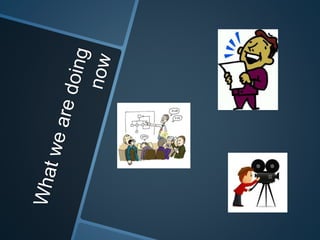
3.What we are doing now 
4.What we should be doing 
5.Rubrics are a must
 
I evaluate my students’ 
speaking skills by _____. 
 
The criteria I use to grade 
my students’ oral 
communication skills are 
_____. 
 
The problems and 
challenges I have with 
evaluating my students’ 
oral skills are _____.
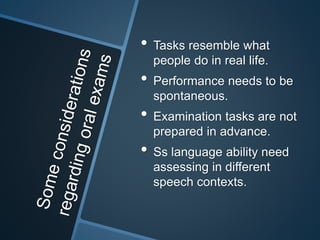
• Tasks resemble what 
people do in real life. 
• Performance needs to be 
spontaneous. 
• Examination tasks are not 
prepared in advance. 
• Ss language ability need 
assessing in different 
speech contexts.
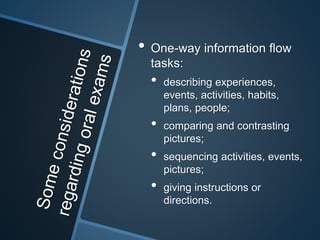
• One-way information flow 
tasks: 
• describing experiences, 
events, activities, habits, 
plans, people; 
• comparing and contrasting 
pictures; 
• sequencing activities, events, 
pictures; 
• giving instructions or 
directions.
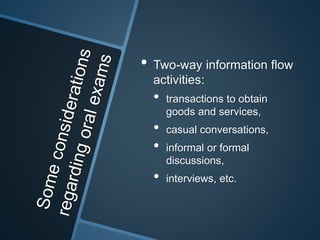
• Two-way information flow 
activities: 
• transactions to obtain 
goods and services, 
• casual conversations, 
• informal or formal 
discussions, 
• interviews, etc.
The third wheel 
Take a picture card and find 
the other two people who 
match your group. 
Ex.: Batman, Robin & 
Catwoman
Discuss in your groups: 
Why should we do oral 
exams? 
(come up with at least 
three answers)
For Ss to demonstrate: 
1.Knowledge 
2.Ability to communicate 
3.They can interact 
4.They can manage language 
5.Balance accuracy and 
fluency
Work in pairs. Look at the 
following statements. 
Discuss with your partner. 
Are the statements true or 
false? Explain your 
decision.
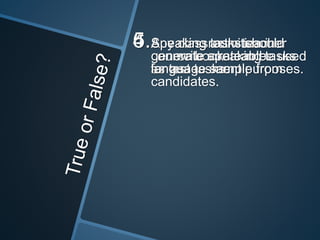
2.Good speaking tasks try to 
1.Speaking tasks can be 
3.In role play tasks both 
replicate real life language 
use. 
used with any student 
irrespective of their level of 
proficiency. 
students should have an 
opportunity to contribute 
equally to the exchange.
5.Speaking tasks should 
6.Any classroom teacher 
4.activities in 
generate a rateable 
language sample from 
candidates. 
can write speaking tasks 
for assessment purposes. 
course books can be used 
as test tasks.
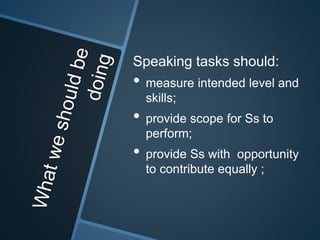
Speaking tasks should: 
• measure intended level and 
skills; 
• provide scope for Ss to 
perform; 
• provide Ss with opportunity 
to contribute equally ;
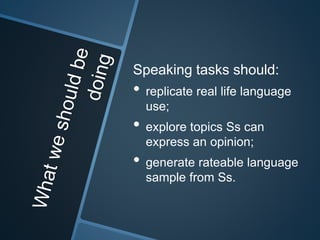
Speaking tasks should: 
• replicate real life language 
use; 
• explore topics Ss can 
express an opinion; 
• generate rateable language 
sample from Ss.
Tell a story or personal 
anecdote 
Ss tell a story they make up 
or a true story about 
something that has 
happened to them.
Tell a story or 
personal anecdote 
Tell me about a holiday you had. 
Tell me about a difficult journey you 
had. 
Tell me about a perfect day you’ve 
had. 
Tell me about a special event in 
your life.
Information gap 
activities 
A student looks at some 
information and another looks 
at different information and 
then they talk and exchange 
the information.
Information gap 
activities 
Student A: Look at the information 
about films at the local cinema. 
Listen to your partner’s questions 
and use the information to answer 
them. 
Student B: Look at the information 
about films at the local cinema and 
ask your partner questions to find 
out more about the films.
Discussions 
Present Ss with a topic that 
has pros and cons, or 
advantages and 
disadvantages.
Discussions 
• Young people under 15 
shouldn’t use mobile phones. 
• There shouldn’t be any 
advertising on TV during 
children’s programs. 
• Famous celebrities shouldn’t 
complain if the paparazzi take 
photos of them every day. 
• It is the children’s responsibility 
to look after their parents when 
they get
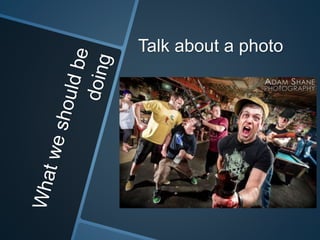
Talk about a photo 
Present Ss with a picture of any 
sort. 
Ss can describe the picture. 
Invent a story based on it.
Talk about a photo
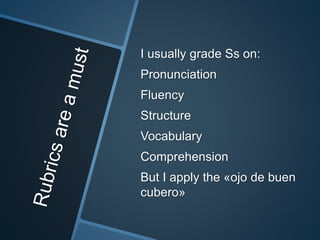
I usually grade Ss on: 
Pronunciation 
Fluency 
Structure 
Vocabulary 
Comprehension 
But I apply the «ojo de buen 
cubero»
Let’s group up:
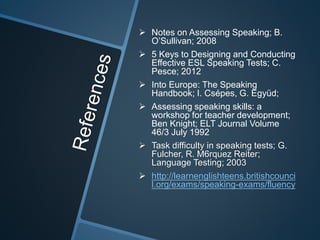
 Notes on Assessing Speaking; B. 
O’Sullivan; 2008 
 5 Keys to Designing and Conducting 
Effective ESL Speaking Tests; C. 
Pesce; 2012 
 Into Europe: The Speaking 
Handbook; I. Csépes, G. Együd; 
 Assessing speaking skills: a 
workshop for teacher development; 
Ben Knight; ELT Journal Volume 
46/3 July 1992 
 Task difficulty in speaking tests; G. 
Fulcher, R. M6rquez Reiter; 
Language Testing; 2003 
 http://learnenglishteens.britishcounci 
l.org/exams/speaking-exams/fluency
destrell@espol.edu.ec

Oral exams: How to go about them

  • 2.
    1.Some considerations regardingoral exams 2.Why must we give an oral exam? 3.What we are doing now 4.What we should be doing 5.Rubrics are a must
  • 3.
     I evaluatemy students’ speaking skills by _____.  The criteria I use to grade my students’ oral communication skills are _____.  The problems and challenges I have with evaluating my students’ oral skills are _____.
  • 5.
    • Tasks resemblewhat people do in real life. • Performance needs to be spontaneous. • Examination tasks are not prepared in advance. • Ss language ability need assessing in different speech contexts.
  • 6.
    • One-way informationflow tasks: • describing experiences, events, activities, habits, plans, people; • comparing and contrasting pictures; • sequencing activities, events, pictures; • giving instructions or directions.
  • 7.
    • Two-way informationflow activities: • transactions to obtain goods and services, • casual conversations, • informal or formal discussions, • interviews, etc.
  • 9.
    The third wheel Take a picture card and find the other two people who match your group. Ex.: Batman, Robin & Catwoman
  • 10.
    Discuss in yourgroups: Why should we do oral exams? (come up with at least three answers)
  • 11.
    For Ss todemonstrate: 1.Knowledge 2.Ability to communicate 3.They can interact 4.They can manage language 5.Balance accuracy and fluency
  • 13.
    Work in pairs.Look at the following statements. Discuss with your partner. Are the statements true or false? Explain your decision.
  • 14.
    2.Good speaking taskstry to 1.Speaking tasks can be 3.In role play tasks both replicate real life language use. used with any student irrespective of their level of proficiency. students should have an opportunity to contribute equally to the exchange.
  • 15.
    5.Speaking tasks should 6.Any classroom teacher 4.activities in generate a rateable language sample from candidates. can write speaking tasks for assessment purposes. course books can be used as test tasks.
  • 16.
    Speaking tasks should: • measure intended level and skills; • provide scope for Ss to perform; • provide Ss with opportunity to contribute equally ;
  • 17.
    Speaking tasks should: • replicate real life language use; • explore topics Ss can express an opinion; • generate rateable language sample from Ss.
  • 18.
    Tell a storyor personal anecdote Ss tell a story they make up or a true story about something that has happened to them.
  • 19.
    Tell a storyor personal anecdote Tell me about a holiday you had. Tell me about a difficult journey you had. Tell me about a perfect day you’ve had. Tell me about a special event in your life.
  • 20.
    Information gap activities A student looks at some information and another looks at different information and then they talk and exchange the information.
  • 21.
    Information gap activities Student A: Look at the information about films at the local cinema. Listen to your partner’s questions and use the information to answer them. Student B: Look at the information about films at the local cinema and ask your partner questions to find out more about the films.
  • 22.
    Discussions Present Sswith a topic that has pros and cons, or advantages and disadvantages.
  • 23.
    Discussions • Youngpeople under 15 shouldn’t use mobile phones. • There shouldn’t be any advertising on TV during children’s programs. • Famous celebrities shouldn’t complain if the paparazzi take photos of them every day. • It is the children’s responsibility to look after their parents when they get
  • 24.
    Talk about aphoto Present Ss with a picture of any sort. Ss can describe the picture. Invent a story based on it.
  • 25.
  • 26.
    I usually gradeSs on: Pronunciation Fluency Structure Vocabulary Comprehension But I apply the «ojo de buen cubero»
  • 27.
  • 28.
     Notes onAssessing Speaking; B. O’Sullivan; 2008  5 Keys to Designing and Conducting Effective ESL Speaking Tests; C. Pesce; 2012  Into Europe: The Speaking Handbook; I. Csépes, G. Együd;  Assessing speaking skills: a workshop for teacher development; Ben Knight; ELT Journal Volume 46/3 July 1992  Task difficulty in speaking tests; G. Fulcher, R. M6rquez Reiter; Language Testing; 2003  http://learnenglishteens.britishcounci l.org/exams/speaking-exams/fluency
  • 29.