TESTING LITERATURE
By Mr. Kurt S. Candilas
MAE-ENG
Why should we test literature?
• to elicit a specific response
• to develop literary competence
• to bring a literary piece of art to students
intellectual and emotional baggage
• to develop decision-making and meaningmaking
Tips on Literature Testing
1. Aim for balanced test. The test can include
knowledge and skills items; guided,
controlled and free response items; and
productive and receptive response type
items.
2. Use actual, authentic texts. The items require
contact with actual texts. This will eliminate
dependence on prepared or memorized
notes.
3. Provide linguistic support when necessary.
Vocabulary and/or structure (grammar) helps
eliminate can help eliminate linguistics
difficulties that hinder the application of
literary skills.
4. Test items should require the application of
skills and principles.
5. Test items should encourage the transfer of
skills from familiar texts to unfamiliar ones.
6. Write the test items to meet student level,
not tutor expectations.
7. The test items should give abstract concepts a
practical and concrete focus.
8. Devise questions that would encourage the
test-takers to identify with and personalize the
texts they meet.
9. Translate into test situations those activities
found to be motivating in the classroom.
What are the common forms in
testing literature?
1.
2.
3.
4.
5.
6.

Multiple choice
True or False
Gap-Filling
Essay test
Knowledge Question
Oral test
Multiple Choice
Example:
Dappled things in line 1 refer to all things that God
a. ignored
b. created
c. forgot
 Difficult to design but easy to mark
 Exclusively examines knowledge
 Knowledge is limited to options provided
 Encourages guessing (25% chance)
 More than one option may be possible
True or False
Example
Noam Chomsky is known as the father of
generative grammar.

Does not demonstrate broader knowledge
Difficult to construct in higher levels
Encourages guessing due to 50/50 chance
Difficult to test attitudes toward learning
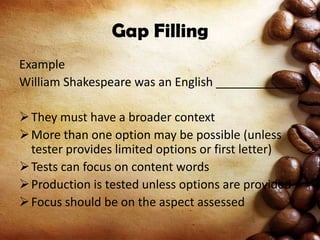
Gap Filling
Example
William Shakespeare was an English ____________.
 They must have a broader context
 More than one option may be possible (unless
tester provides limited options or first letter)
 Tests can focus on content words
 Production is tested unless options are provided
 Focus should be on the aspect assessed
Essay Test
Example
Check out the language meaning of the song and
explain its denotation and connotation in
semantics.

 frequently essay questions in literature course are
based on subject matter discussed in class.
 requires the students to organize their thoughts
and substantiate their interpretations.
 a highly valid test form
Knowledge Question: Reading
Example
Identify the following characters and briefly
describe their roles.

 encourages reading of the texts
 they are authentic and communicative
 a highly valid test form
Oral Test
Positive Points
 favor the students who express themselves
fluently in the target language
 permit a broader sampling of the subject matter
 confront with more direct questions
Negative Points
 difficult too score with complete reliability
 Teacher and student rapport may tend to
influence the best grade
THE END
#teachingandtestinglanguageliteratureandreading
@callmekurtz

Testing literature

  • 1.
    TESTING LITERATURE By Mr.Kurt S. Candilas MAE-ENG
  • 2.
    Why should wetest literature? • to elicit a specific response • to develop literary competence • to bring a literary piece of art to students intellectual and emotional baggage • to develop decision-making and meaningmaking
  • 3.
    Tips on LiteratureTesting 1. Aim for balanced test. The test can include knowledge and skills items; guided, controlled and free response items; and productive and receptive response type items. 2. Use actual, authentic texts. The items require contact with actual texts. This will eliminate dependence on prepared or memorized notes.
  • 4.
    3. Provide linguisticsupport when necessary. Vocabulary and/or structure (grammar) helps eliminate can help eliminate linguistics difficulties that hinder the application of literary skills. 4. Test items should require the application of skills and principles. 5. Test items should encourage the transfer of skills from familiar texts to unfamiliar ones. 6. Write the test items to meet student level, not tutor expectations.
  • 5.
    7. The testitems should give abstract concepts a practical and concrete focus. 8. Devise questions that would encourage the test-takers to identify with and personalize the texts they meet. 9. Translate into test situations those activities found to be motivating in the classroom.
  • 6.
    What are thecommon forms in testing literature? 1. 2. 3. 4. 5. 6. Multiple choice True or False Gap-Filling Essay test Knowledge Question Oral test
  • 7.
    Multiple Choice Example: Dappled thingsin line 1 refer to all things that God a. ignored b. created c. forgot  Difficult to design but easy to mark  Exclusively examines knowledge  Knowledge is limited to options provided  Encourages guessing (25% chance)  More than one option may be possible
  • 8.
    True or False Example NoamChomsky is known as the father of generative grammar. Does not demonstrate broader knowledge Difficult to construct in higher levels Encourages guessing due to 50/50 chance Difficult to test attitudes toward learning
  • 9.
    Gap Filling Example William Shakespearewas an English ____________.  They must have a broader context  More than one option may be possible (unless tester provides limited options or first letter)  Tests can focus on content words  Production is tested unless options are provided  Focus should be on the aspect assessed
  • 10.
    Essay Test Example Check outthe language meaning of the song and explain its denotation and connotation in semantics.  frequently essay questions in literature course are based on subject matter discussed in class.  requires the students to organize their thoughts and substantiate their interpretations.  a highly valid test form
  • 11.
    Knowledge Question: Reading Example Identifythe following characters and briefly describe their roles.  encourages reading of the texts  they are authentic and communicative  a highly valid test form
  • 12.
    Oral Test Positive Points favor the students who express themselves fluently in the target language  permit a broader sampling of the subject matter  confront with more direct questions Negative Points  difficult too score with complete reliability  Teacher and student rapport may tend to influence the best grade
  • 13.