


Guidelines and
Practical Approaches for
Test Construction
Cindy Cruz-Cabrera
Professor | Consultant | Gender Specialist
about.me/cindycruzcabrera
Why do we give tests?
Tests have many purposes in our schools.
• To assess a student’s understanding of a given
topic within a subject and identify what they
have learned
• To evaluate a student’s progress in a subject
within a given period of time
• To assess a student’s strengths and
weaknesses for focus, assistance or
individualized instruction
• To determine who will receive
awards, recognition, and scholarships
• To provide a basis of qualification for entry
into a school, program, internship, higher
education, scholarship
• To gain college credit – advanced placement
exams
• To measure a teacher or school’s effectiveness
– Part of teacher evaluation
– High-stakes testing
Kinds of Tests
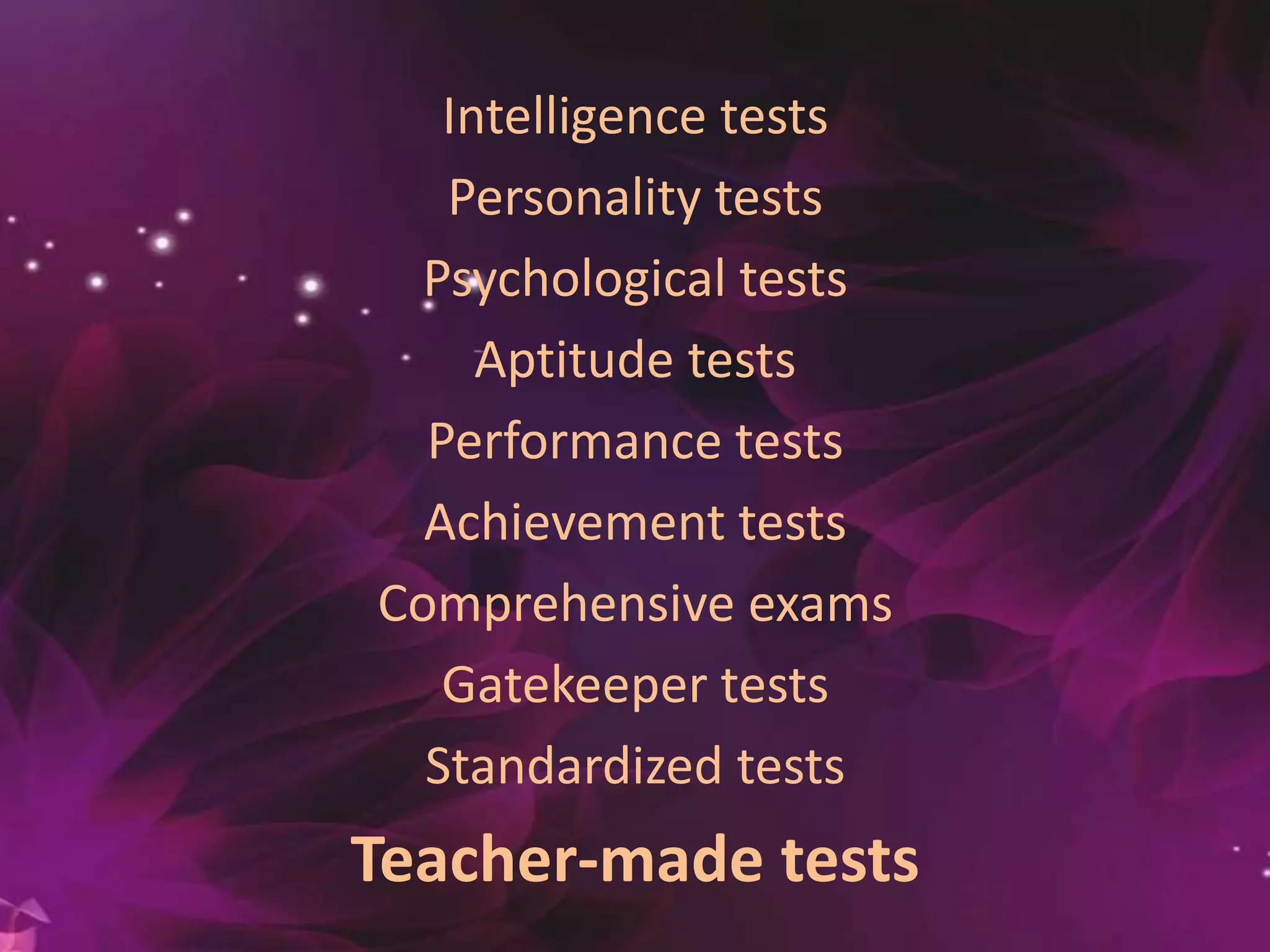
Intelligence tests
Personality tests
Psychological tests
Aptitude tests
Performance tests
Achievement tests
Comprehensive exams
Gatekeeper tests
Standardized tests
Teacher-made tests
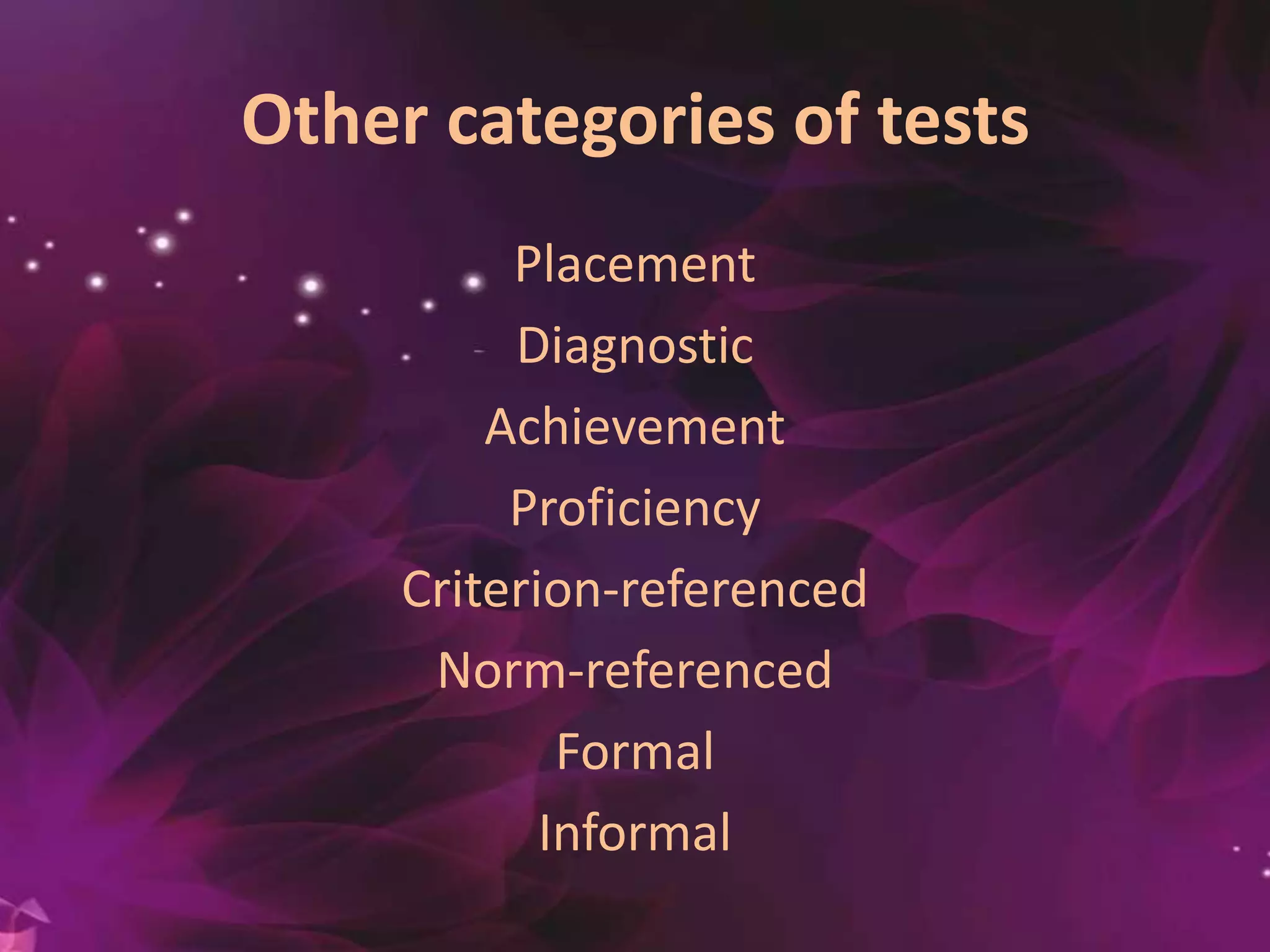
Other categories of tests
Placement
Diagnostic
Achievement
Proficiency
Criterion-referenced
Norm-referenced
Formal
Informal
Key Concepts
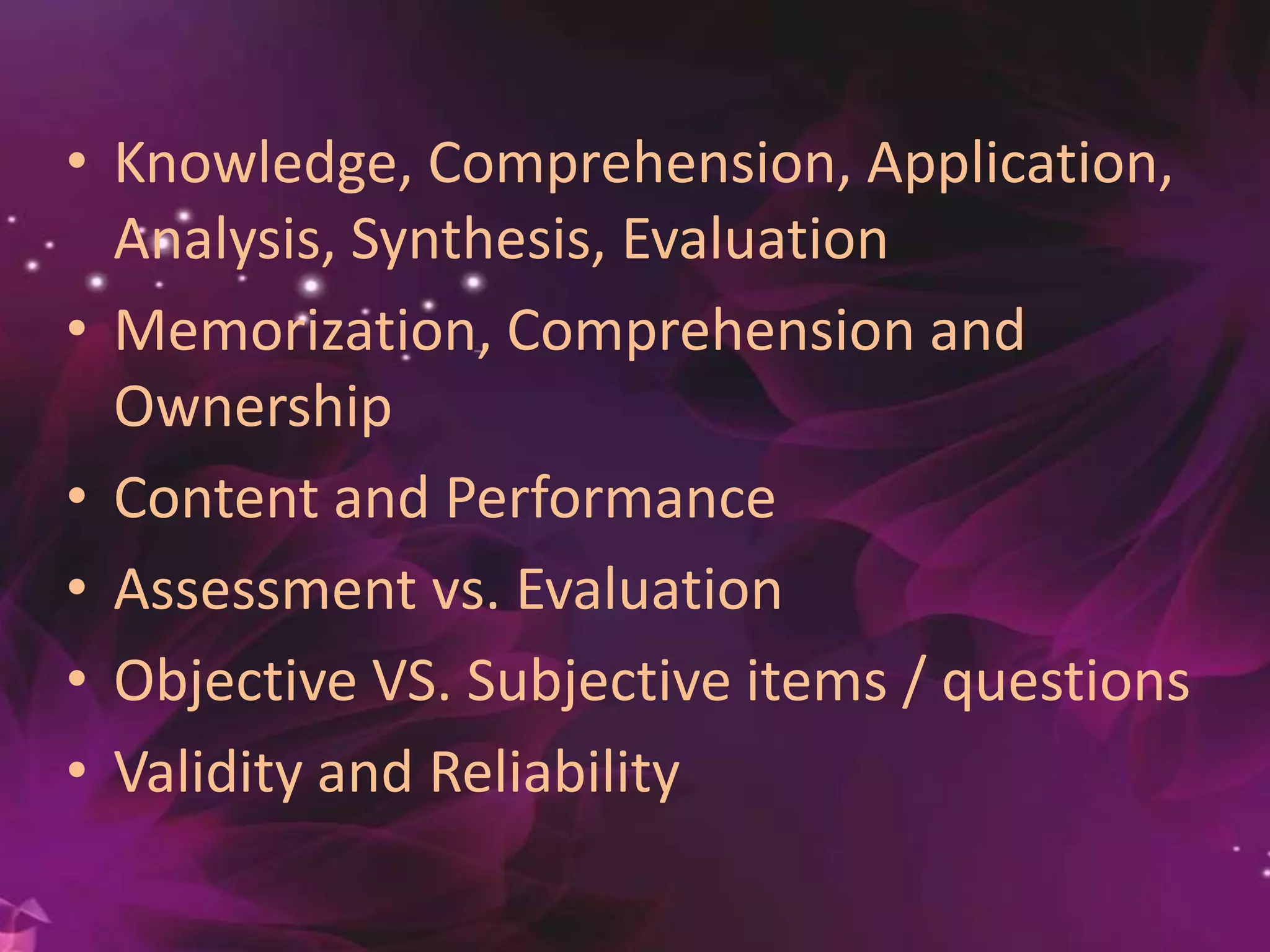
• Knowledge, Comprehension, Application,
Analysis, Synthesis, Evaluation
• Memorization, Comprehension and
Ownership
• Content and Performance
• Assessment vs. Evaluation
• Objective VS. Subjective items / questions
• Validity and Reliability
Issues
• Do tests accurately reflect and measure what
students should be learning OR are learning at
school?
• Teaching the curriculum VS. “Teaching to the
test”
• On the measurement of a teacher or school’s
effectiveness: “Many factors influence a
student’s grade on an exam.”
What are your thoughts
and insights?
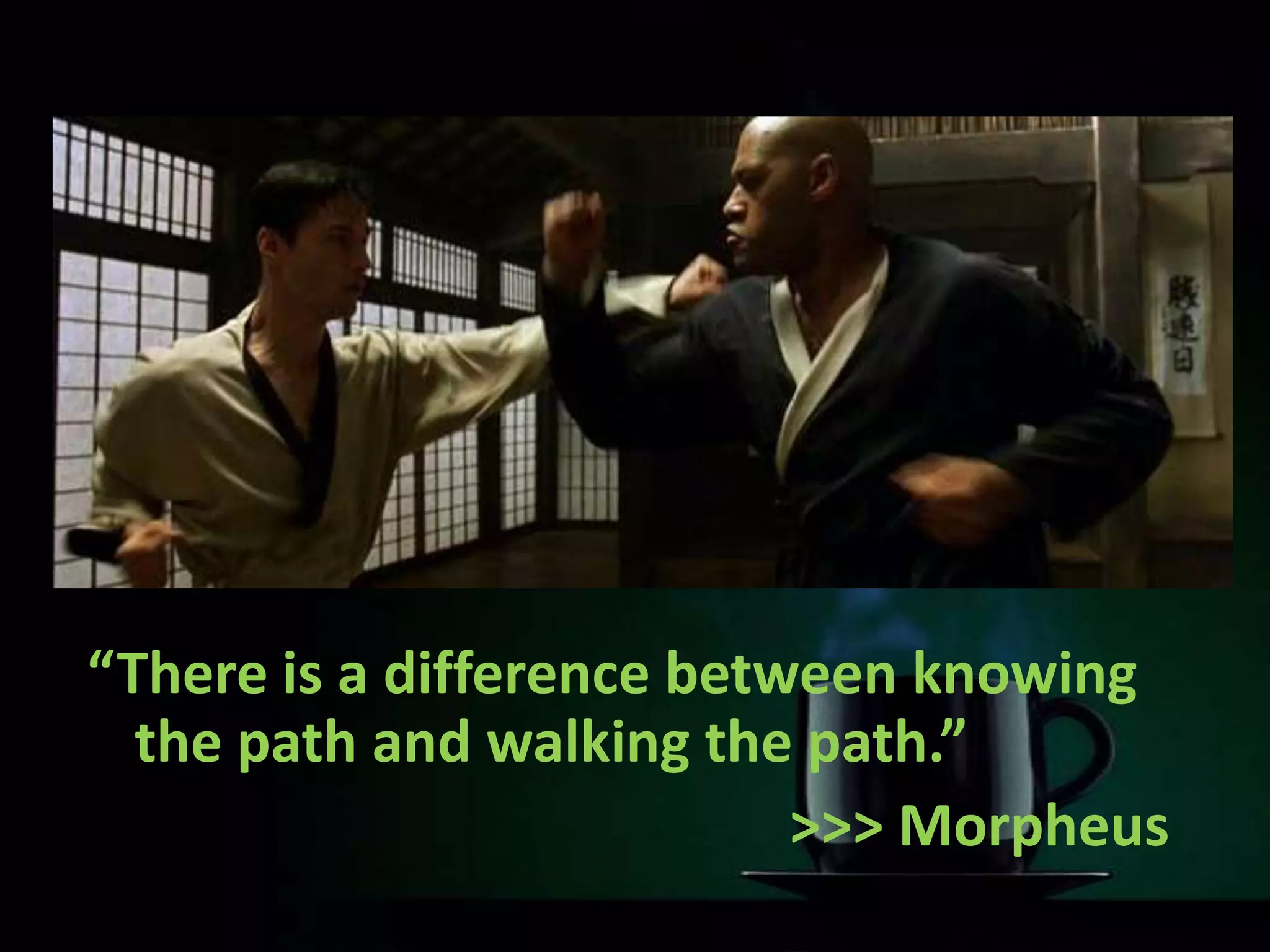
“There is a difference between knowing
the path and walking the path.”
>>> Morpheus
• What is more important to measure:
memorization or comprehension / ownership?
Or both/all? Explain your answer.
• Should we “teach to the test”? Or should we
just stick to teaching the curriculum? Or
should we do both? Why or why not?
• Should students’ tests results and grades be
made part of a teacher’s evaluation? Why or
why not?
Types of Tests
Multiple Choice
A number of set answers for each
question or item is provided
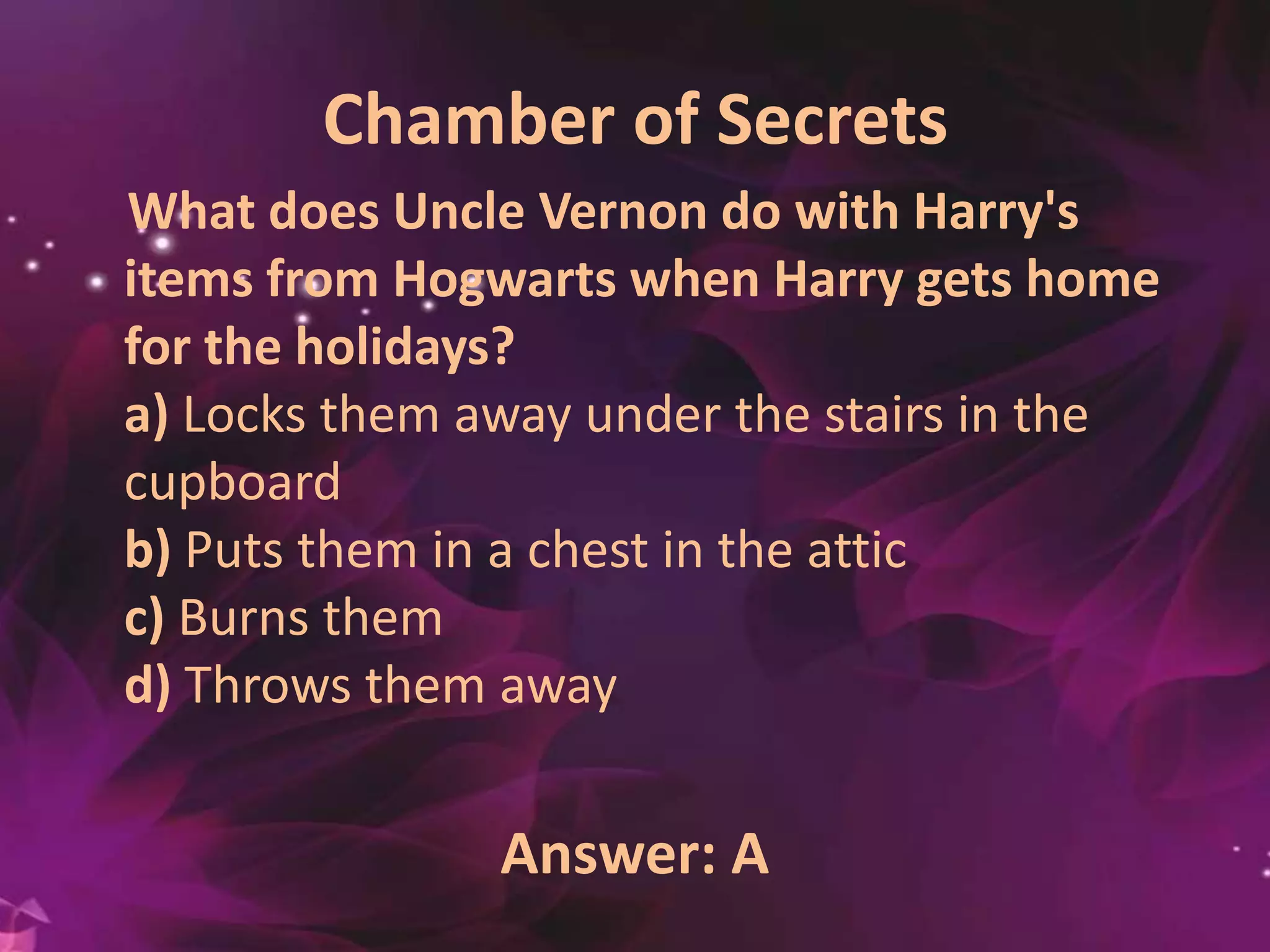
Chamber of Secrets
What does Uncle Vernon do with Harry's
items from Hogwarts when Harry gets home
for the holidays?
a) Locks them away under the stairs in the
cupboard
b) Puts them in a chest in the attic
c) Burns them
d) Throws them away
Answer: A
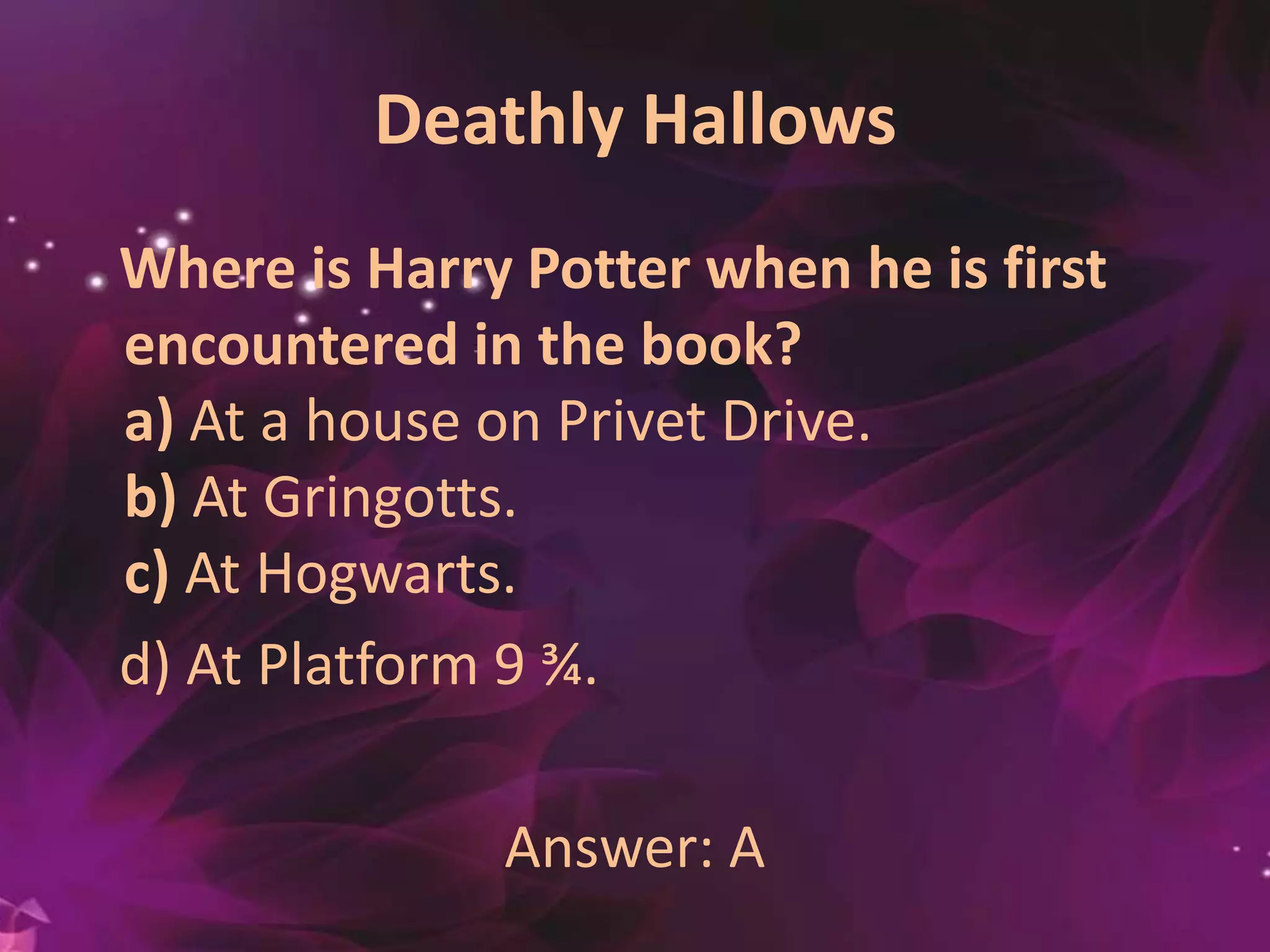
Deathly Hallows
Where is Harry Potter when he is first
encountered in the book?
a) At a house on Privet Drive.
b) At Gringotts.
c) At Hogwarts.
d) At Platform 9 ¾.
Answer: A
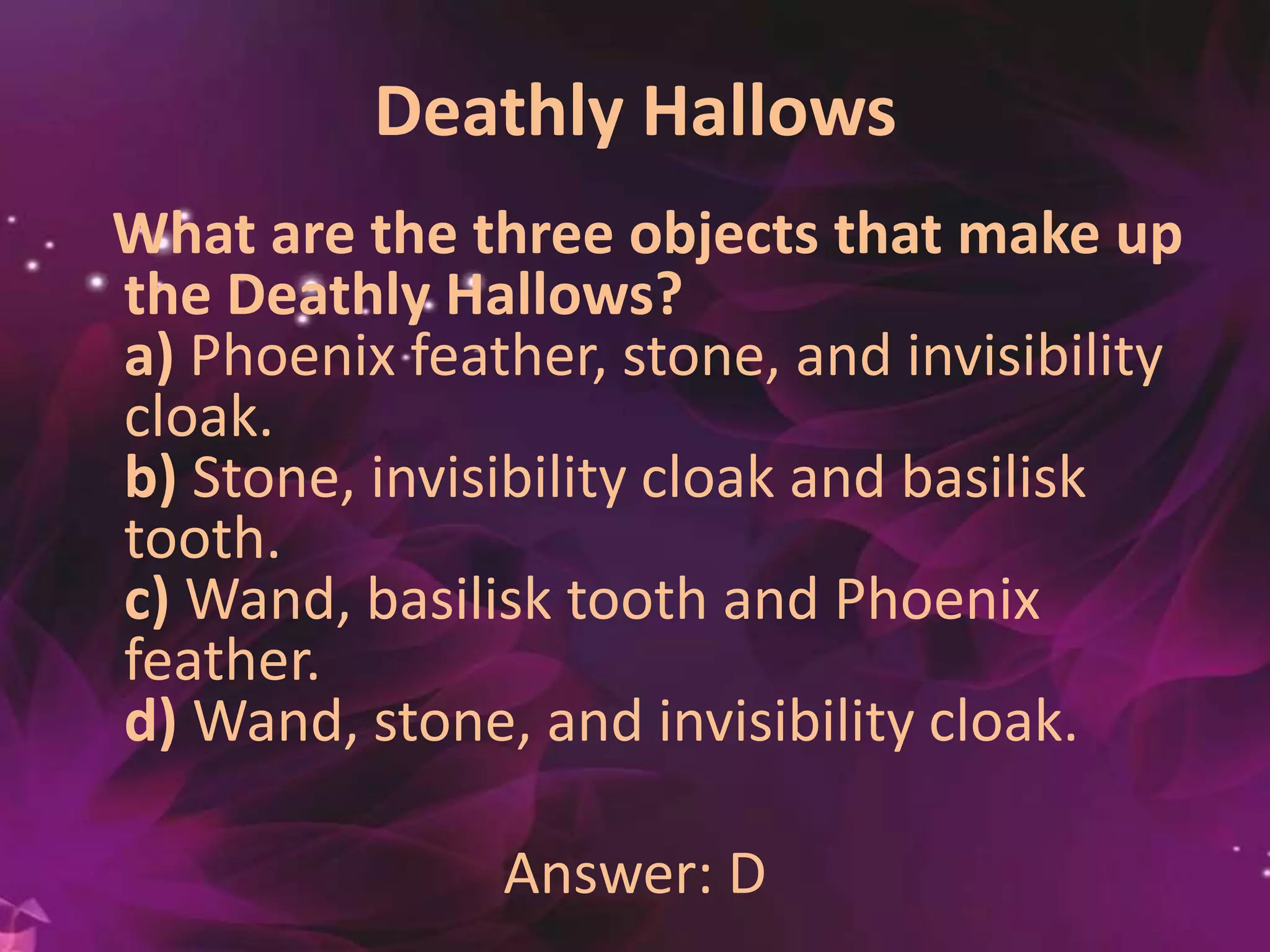
Deathly Hallows
What are the three objects that make up
the Deathly Hallows?
a) Phoenix feather, stone, and invisibility
cloak.
b) Stone, invisibility cloak and basilisk
tooth.
c) Wand, basilisk tooth and Phoenix
feather.
d) Wand, stone, and invisibility cloak.
Answer: D
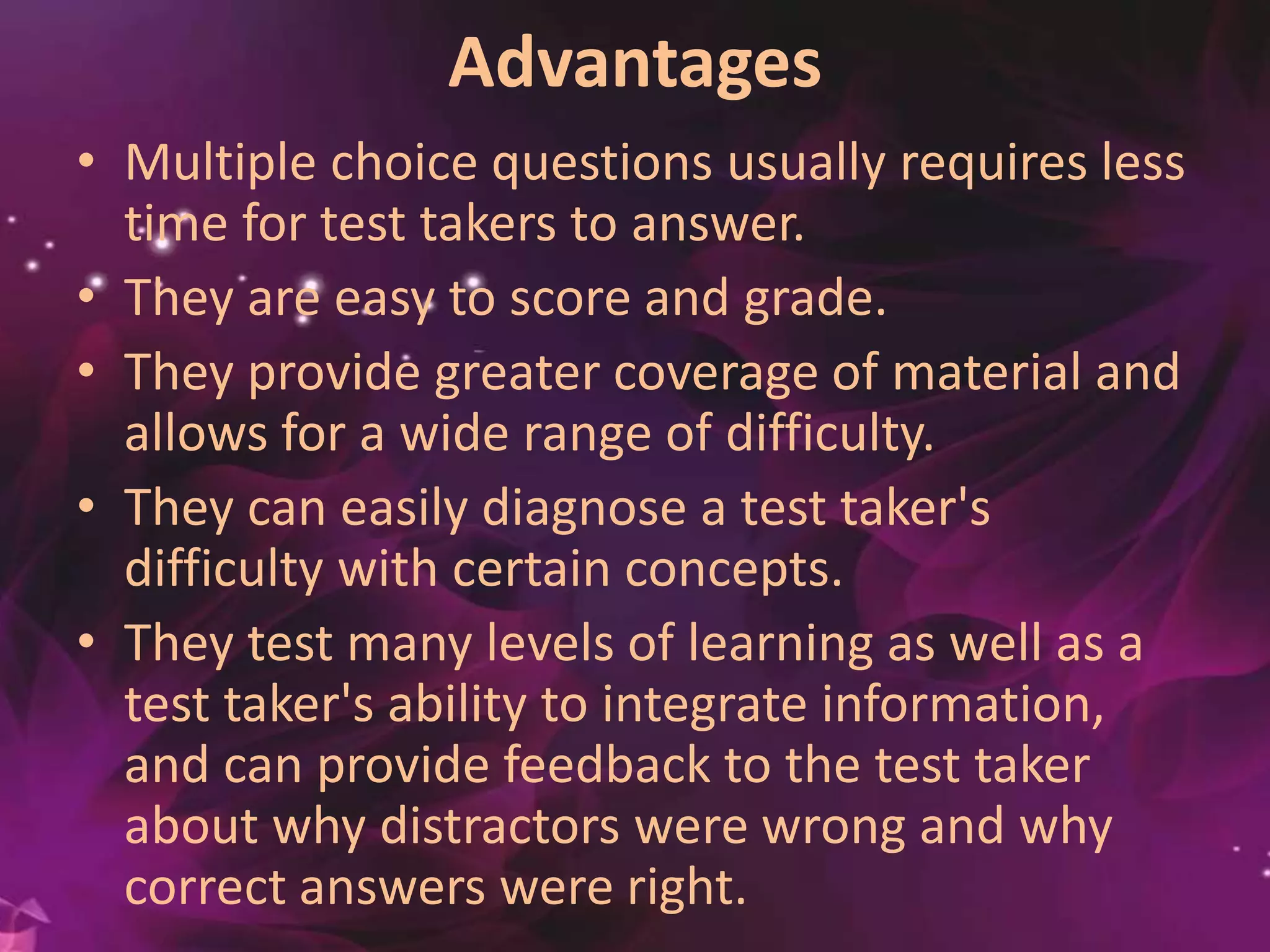
Advantages
• Multiple choice questions usually requires less
time for test takers to answer.
• They are easy to score and grade.
• They provide greater coverage of material and
allows for a wide range of difficulty.
• They can easily diagnose a test taker's
difficulty with certain concepts.
• They test many levels of learning as well as a
test taker's ability to integrate
information, and can provide feedback to the
test taker about why distractors were wrong
and why correct answers were right.
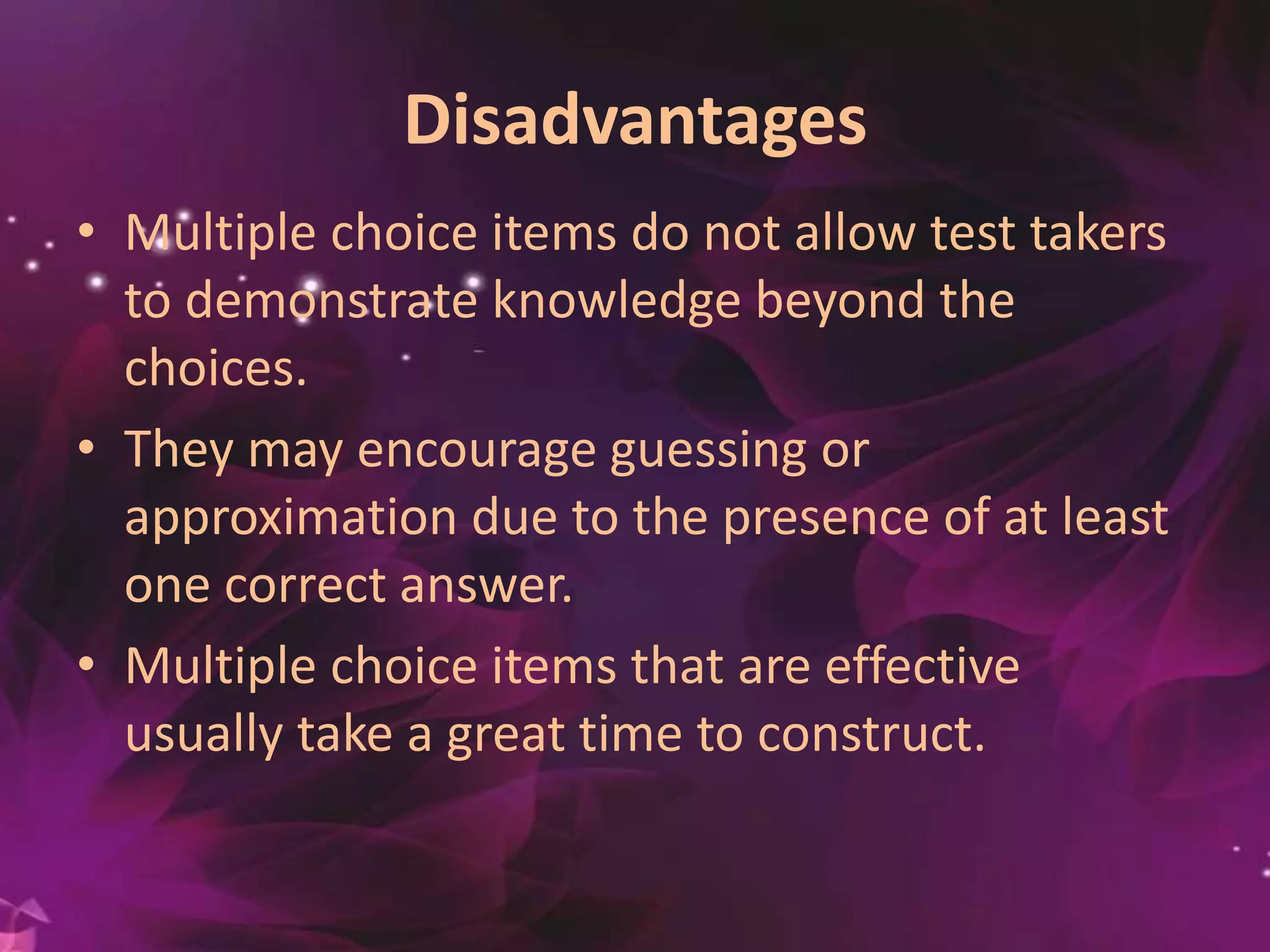
Disadvantages
• Multiple choice items do not allow test takers
to demonstrate knowledge beyond the
choices.
• They may encourage guessing or
approximation due to the presence of at least
one correct answer.
• Multiple choice items that are effective
usually take a great time to construct.
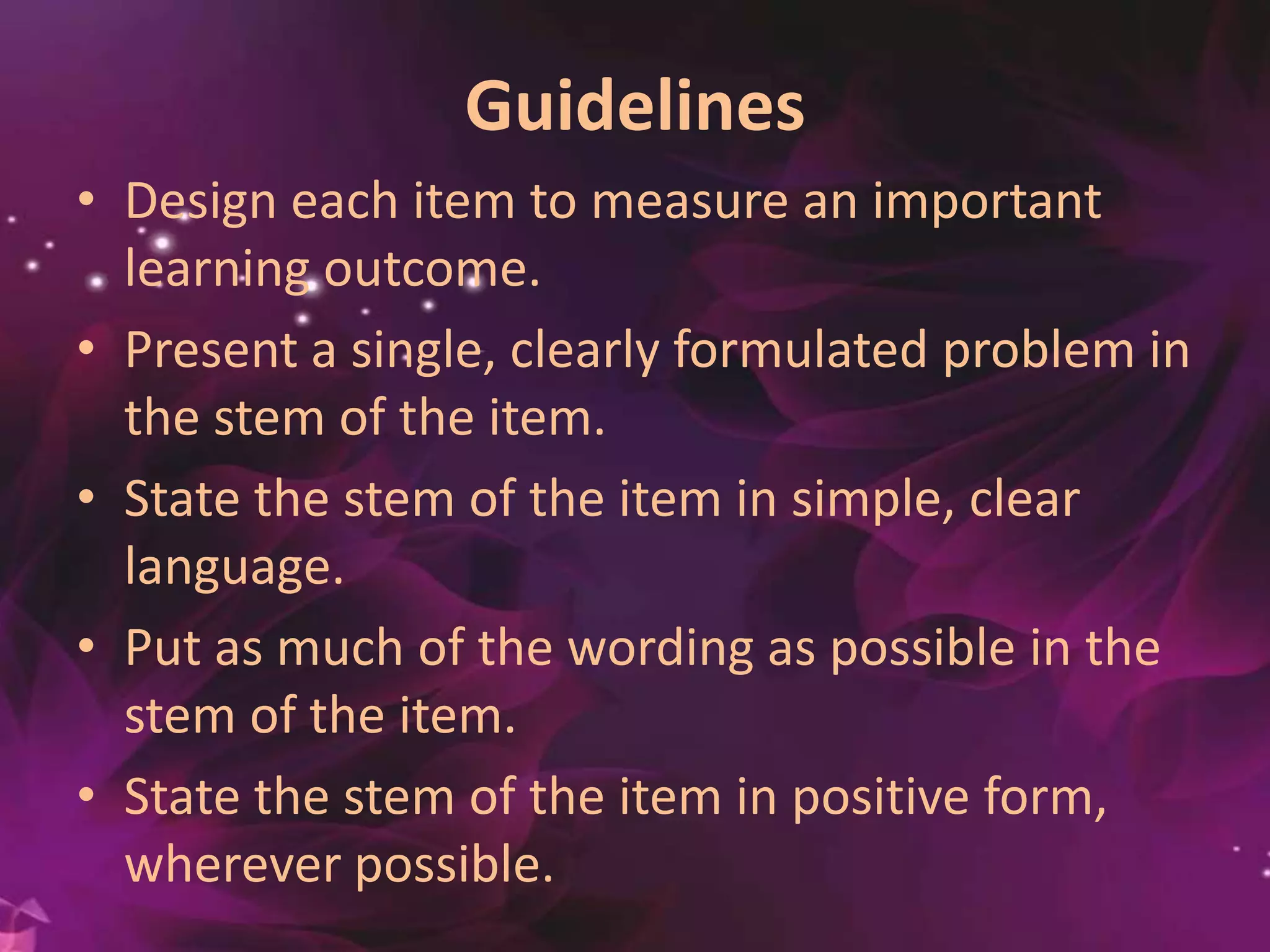
Guidelines
• Design each item to measure an important
learning outcome.
• Present a single, clearly formulated problem in
the stem of the item.
• State the stem of the item in simple, clear
language.
• Put as much of the wording as possible in the
stem of the item.
• State the stem of the item in positive
form, wherever possible.
• Emphasize negative wording whenever it is
used in the stem of an item.
• Make certain that the intended answer is
correct or clearly best among choices.
• Make all alternatives grammatically consistent
with the stem of the item and parallel in form.
• Avoid verbal clues which might enable
students to select the correct answer or to
eliminate an incorrect alternative.
• Make the distracters plausible and attractive
to the uninformed.
Alternate Response
(TRUE or FALSE)
Binary choice – a statement is either
TRUE or FALSE
Modified TRUE or FALSE
• Harry Potter is a muggle.
• A Squib is someone born to non-magical
parents who can do magic.
• There are four houses at Hogwarts school.
• Gryffindor won the Quidditch Cup in Harry
Potter's second year at Hogwarts.
• Rita Skeeter's Animagus is a ladybug.
• The student Harry Potter was supposed to
save in the Triwizard Tournament was
Hermione Granger.
• Neville Longbottom's parents were killed by
Bellatrix Lestrange.
Advantages
• True-False items can cover a wide range of
difficulty levels.
• These require less time to answer, and are
easily graded and scored.
Disadvantages
• These do not allow for test takers to
demonstrate broad range of knowledge.
• Guesswork may work.
Guidelines
• Include only one central significant idea in
each statement.
• Word the statement so precisely that it can be
judged unequivocally true or false.
• Use negative statements sparingly and avoid
double negatives.
• Statements of opinion should be attributed to
some source.
• Keep statements short and use simple
language structure.
Matching Type
Provides a defined term and requires a
test taker to match identifying
characteristics with the correct term.
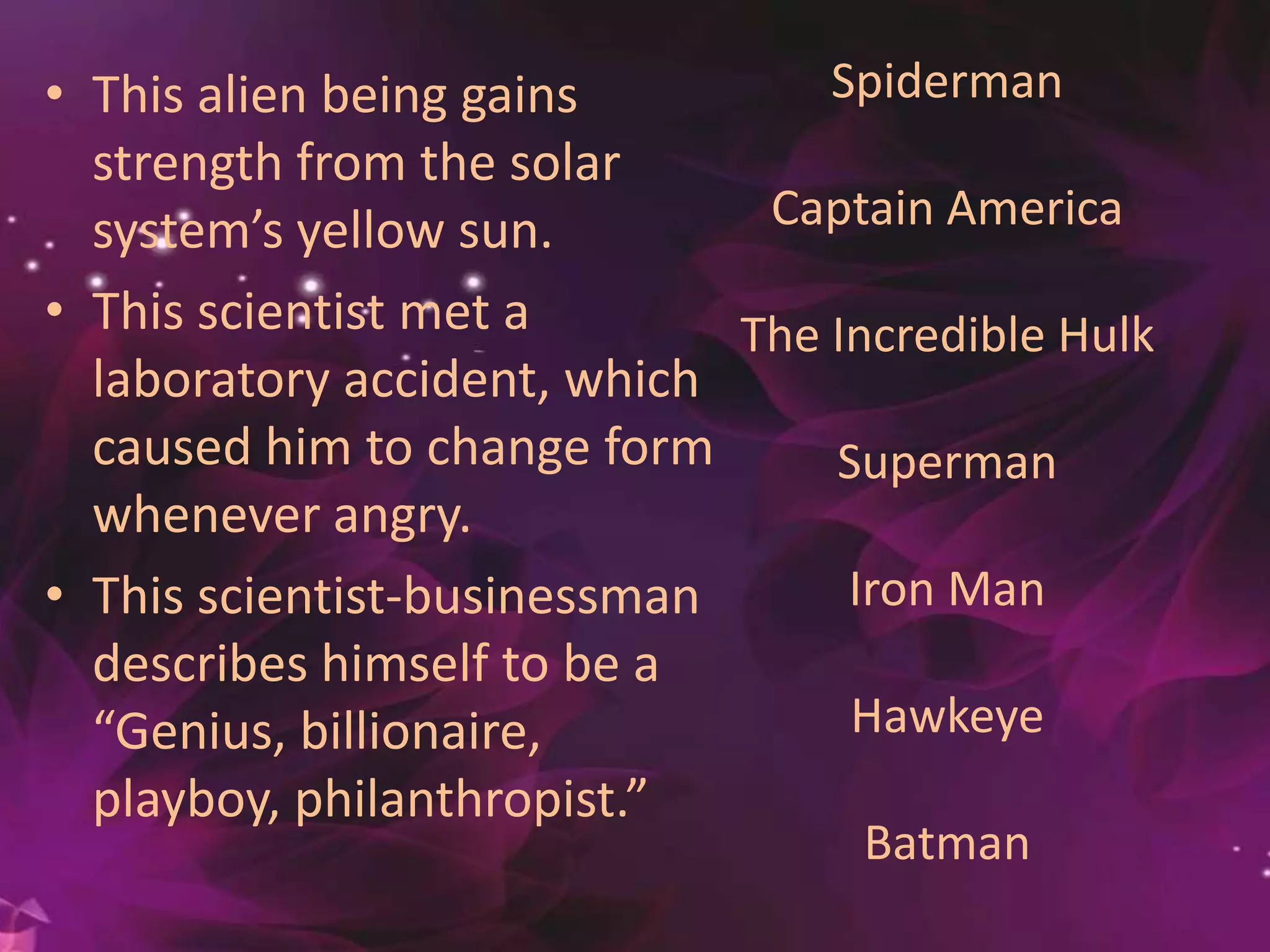
• This alien being gains
strength from the solar
system’s yellow sun.
• This scientist met a
laboratory accident, which
caused him to change form
whenever angry.
• This scientist-businessman
describes himself to be a
“Genius, billionaire, playbo
y, philanthropist.”
Spiderman
Captain America
The Incredible Hulk
Superman
Iron Man
Hawkeye
Batman
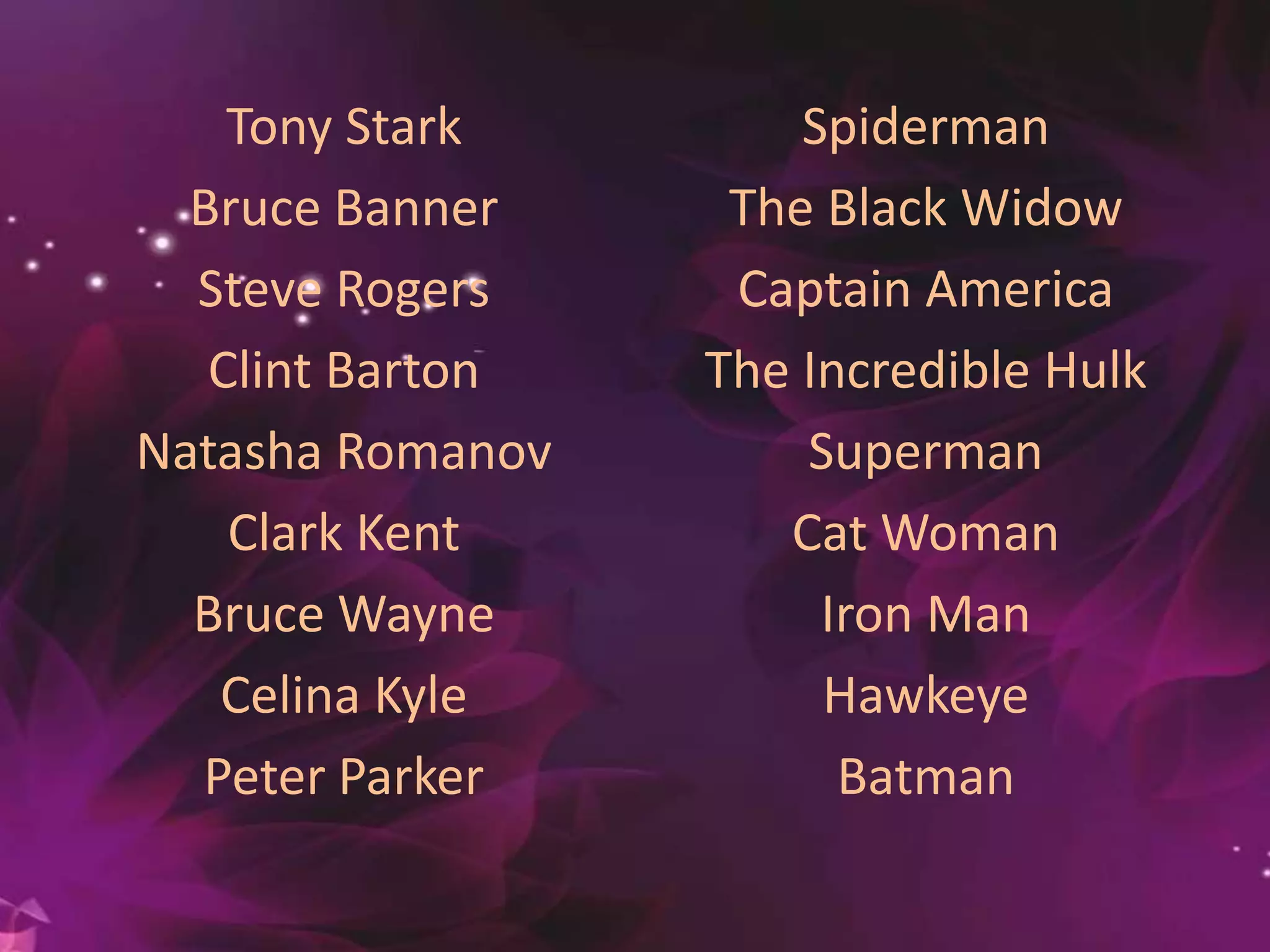
Tony Stark
Bruce Banner
Steve Rogers
Clint Barton
Natasha Romanov
Clark Kent
Bruce Wayne
Celina Kyle
Peter Parker
Spiderman
The Black Widow
Captain America
The Incredible Hulk
Superman
Cat Woman
Iron Man
Hawkeye
Batman
Advantages
• Matching type items usually requires less time
for test takers to answer.
• They are easy to score and grade.
• Distractors may be provided.
Disadvantages
• Answers are already provided, which makes it
prone to guesswork.
• These items do not allow test takers to
demonstrate knowledge beyond the choices.
Guidelines
• Keep the lists of items short and put the
brief responses on the right.
• Use a larger, or smaller, number of
responses than premises, and permit the
responses to be used more than once.
• Specify in the directions the basis for
matching and indicate that each
response may be used once, more than
once, or not at all.
Completion Type
(Fill-in-the-blanks)
Provides a test taker with identifying
characteristics and requires the test
taker to recall the correct term.
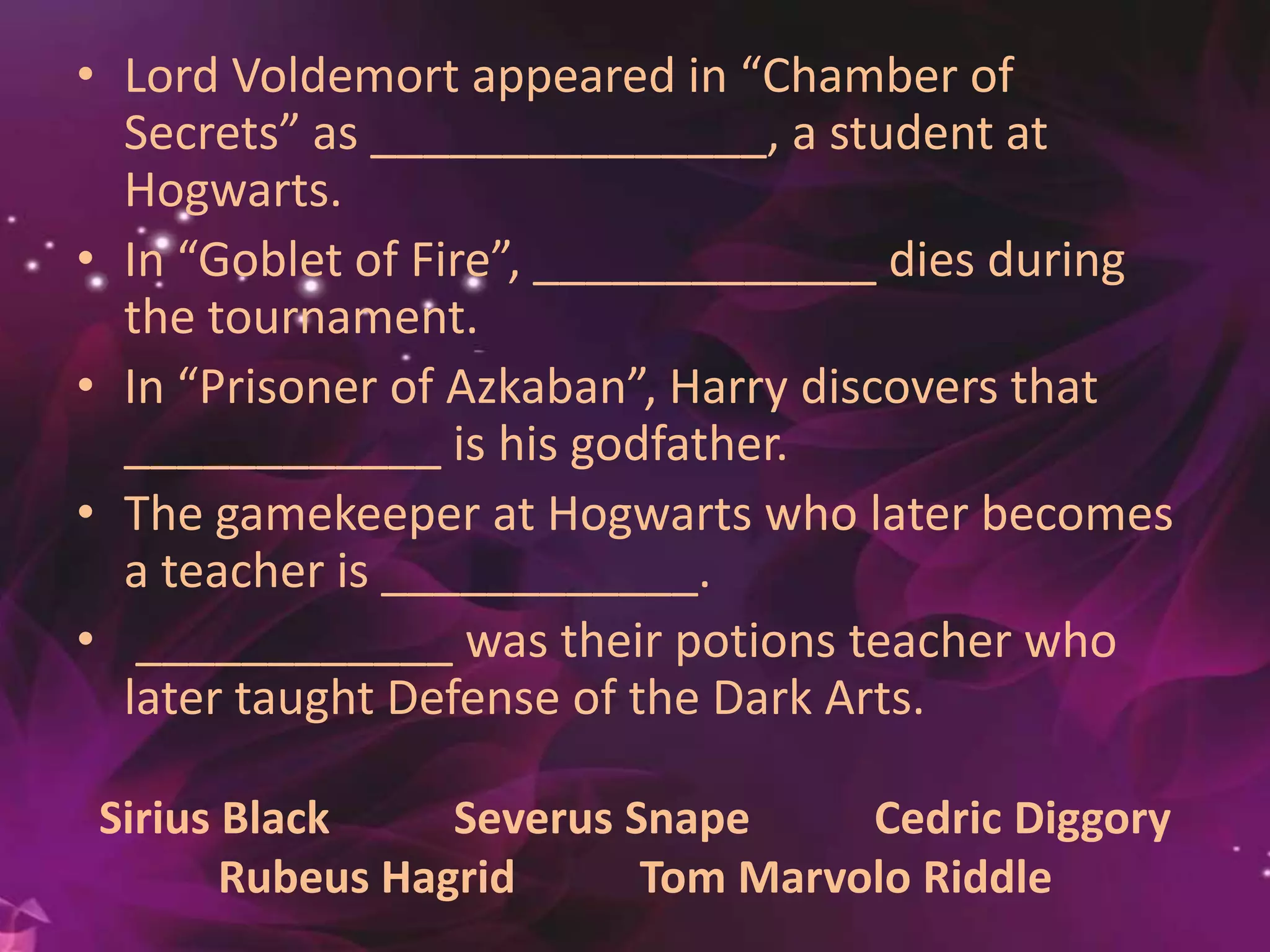
• Lord Voldemort appeared in “Chamber of
Secrets” as _______________, a student at
Hogwarts.
• In “Goblet of Fire”, _____________ dies
during the tournament.
• In “Prisoner of Azkaban”, Harry discovers that
____________ is his godfather.
• The gamekeeper at Hogwarts who later
becomes a teacher is ____________.
• ____________ was their potions teacher who
later taught Defense of the Dark Arts.
Sirius Black Severus Snape Cedric Diggory
Rubeus Hagrid Tom Marvolo Riddle
• Lord Voldemort appeared in “Chamber of
Secrets” as _______________, a student at
Hogwarts.
• In “Goblet of Fire”, _____________ dies during
the tournament.
• In “Prisoner of Azkaban”, Harry discovers that
____________ is his godfather.
• The gamekeeper at Hogwarts who later becomes
a teacher is ____________.
• ____________ was their potions teacher who
later taught Defense of the Dark Arts.
Types
• Word bank provided – each word to be used
once
• Word bank provided – some words to be used
more than once, others not at all
• No word bank provided
• Students may guess but with more difficulty.
• This type of item is generally feared by
students when no word bank is provided.
Essay
A response is written in paragraph
form to in answer to a question or to
fulfill requirements of an item.
Short
• Describe Harry's feelings for Hogwarts, his
school, as compared to the Dursley house
where he lives with his aunt and uncle from
what is detailed in Chapter One.
• Give one word that explains Vernon Dursley's
reaction when Harry says "magic" in Chapter
One. Explain why you have given this word.
Comprehensive
The Chamber of Secrets had been opened
only fifty years ago. Many of the people at
Hogwarts, such as the ghosts and
teachers, were around at that time.
Part 1-Describe why they were so quick to
dismiss the fact that the chamber was a myth
and didn't exist.
Part 2-How would things have been different if
the Chamber of Secrets had been taken as a
more serious threat in the beginning?
Comprehensive
Oftentimes, a book is more of a character-driven
plot rather than action driven, and oftentimes
the other way. Some books seem to balance the
two. Discuss the following:
1. What do you think it means to say that a plot
is character-driven or action-driven?
2. How do you think a plot differs if it is
character-driven versus action-driven?
3. Which type of plot do you find more
interesting? Why?
4. Do you think it is possible to have a plot where
action and character development share equal
time?
Advantages
• Essay items can test complex learning
objectives and processes used to answer the
question.
• Summary, critique, analysis, defense, stand, et
c.
• These items require test takers to
demonstrate their writing skills as well as
correct spelling and grammar.
• Essay items are not given to guesswork.
Disadvantages
• Test items can be made quickly but take quite
some time to answer and check.
• The grading process may be subjective –
different score results for different teachers.
• Essay questions may potentially be unreliable
in assessing the entire content of a subject
matter.
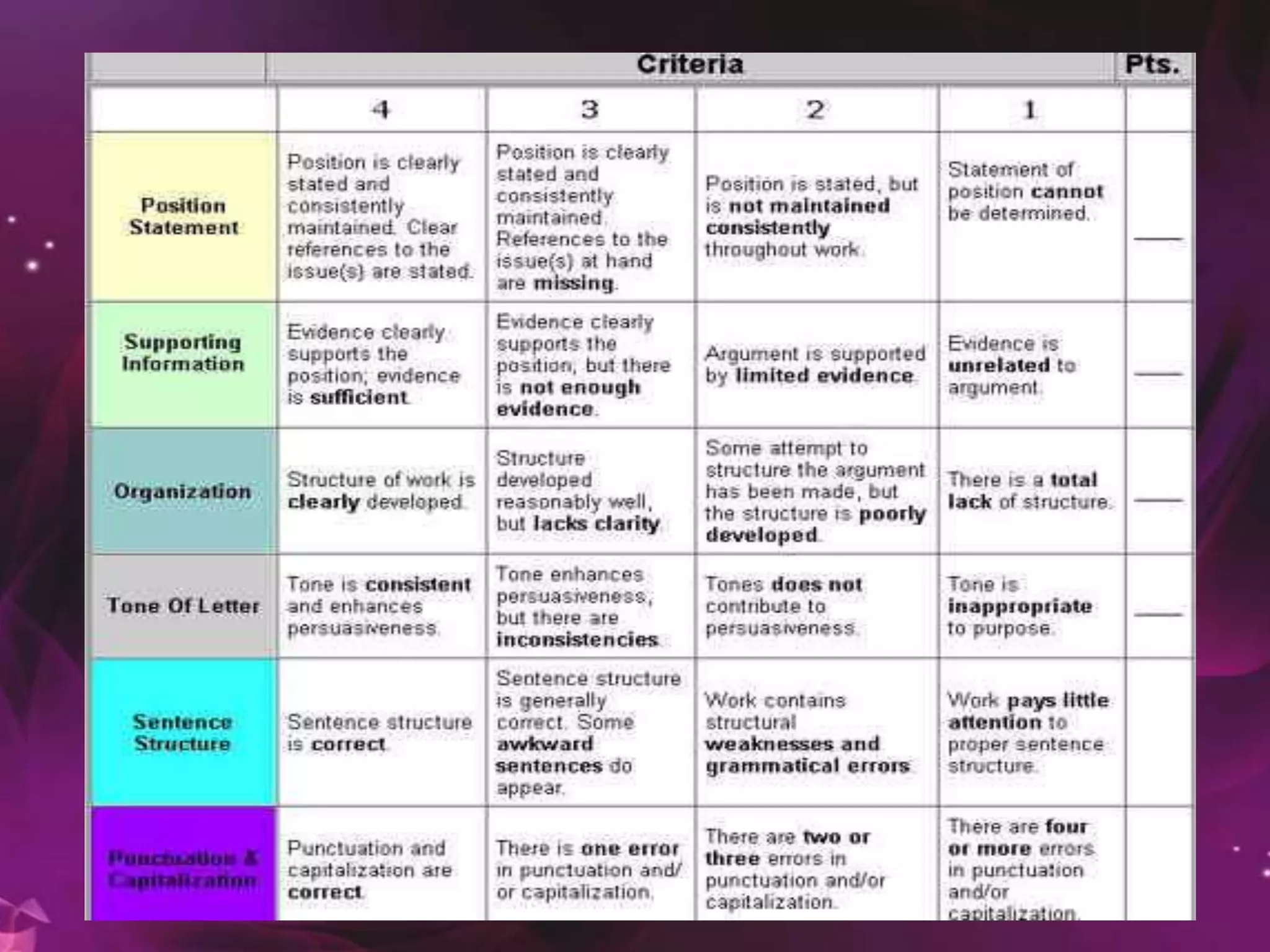
Rubric
A chart that communicates and outlines the
following:
• Expectations for the project / activity / exercise
• Criteria
• Scoring guide and corresponding performance
indicators / levels of quality
Rubrics are used to TEACH as well as EVALUATE.
• These focus on the process as well as the
product.
• These guide students to make dependable
judgments about their work and give feedback.
• Clarify standards for quality performance and
progress towards those standards
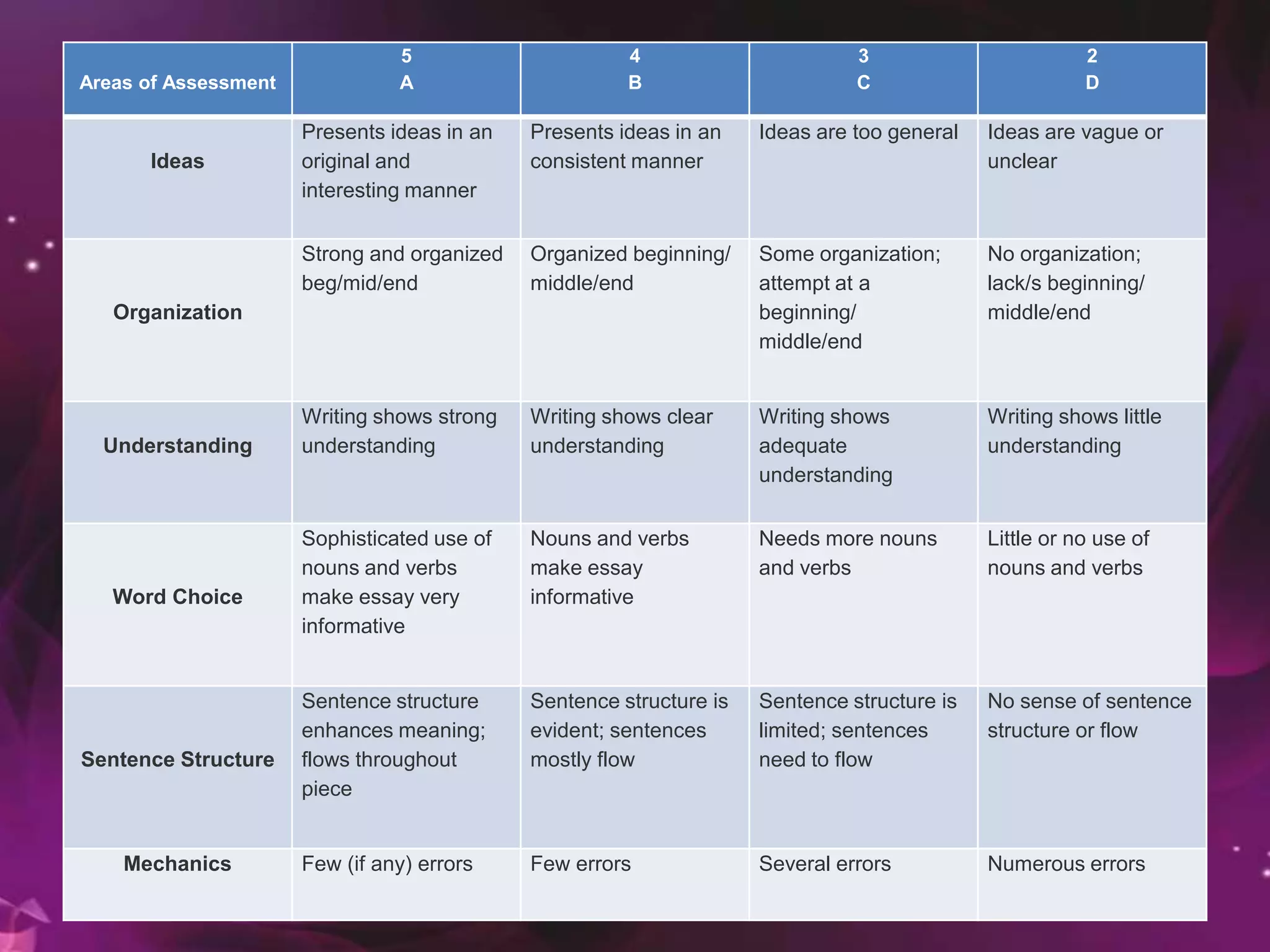
Areas of Assessment
5
A
4
B
3
C
2
D
Ideas
Presents ideas in an
original and
interesting manner
Presents ideas in an
consistent manner
Ideas are too general Ideas are vague or
unclear
Organization
Strong and organized
beg/mid/end
Organized beginning/
middle/end
Some organization;
attempt at a
beginning/
middle/end
No organization;
lack/s beginning/
middle/end
Understanding
Writing shows strong
understanding
Writing shows clear
understanding
Writing shows
adequate
understanding
Writing shows little
understanding
Word Choice
Sophisticated use of
nouns and verbs
make essay very
informative
Nouns and verbs
make essay
informative
Needs more nouns
and verbs
Little or no use of
nouns and verbs
Sentence Structure
Sentence structure
enhances meaning;
flows throughout
piece
Sentence structure is
evident; sentences
mostly flow
Sentence structure is
limited; sentences
need to flow
No sense of sentence
structure or flow
Mechanics Few (if any) errors Few errors Several errors Numerous errors
Mathematics Questions
State a mathematical problem or
exercise that requires a student to
write a freehand response.
• Identify the laws of physics present in the
game ANGRY BIRDS. Explain the occurrence of
these laws in the game and how these are
illustrated.
• Explain the physics concepts and their
corresponding equations as illustrated in the
catapult activity in ANGRY BIRDS.
• Maths, Chemistry, Physics, Economics
• Steps (process)
• Multiple parts (series)
• Variations on true or false, which involves
verifying validity by direct proof or
counterexample.
Physical Fitness Test
Designed to measure physical
strength, agility and endurance
• Usually part of the physical education
curriculum
• Fulfills eligibility requirements in fields
that focus on physical ability (more
rigorous)
• Standard requirement for school
admissions and monitoring of students
(less stringent)
Performance Test /
Practical Exam
Requires an examinee to actually
perform a task or activity,
rather than simply answering
questions referring to specific parts
• Actual or simulation – demonstration of
ability or judgment
• Reason: greater fidelity to what is being
tested
• Driving, dancing, doing sports
• Laboratory exam – specimens on display
• Scientific method – laboratory sheet
Types of Tests:
What are your thoughts
and insights?
• What type of tests are best suited for
evaluating your subject area? Explain
your answer.
• Create an essay test rubric for your
subject area / department. What criteria
would you employ? What weights would
you assign each criterion and why?
Explain your answer.
• Create and share two items per type of
test.
Guidelines
for Test Construction
Preparing the Test
• Write test items according to rules of
construction for the type(s) chosen.
• Select the items to be included in the test
according to table of specifications.
• Review and edit items according to guidelines.
• Arrange items and decide on
– Grouping of items,
– Sequence of items within groups,
– Sequence of groupings.
Planning for the Test
• Outline subject matter content to be
considered as the basis for the test.
• Identify learning outcomes to be measured by
the test.
• Prepare the table of specifications.
• Choose appropriate type(s) of test items for
evaluation of learning outcomes as
summarized in the table of specifications.
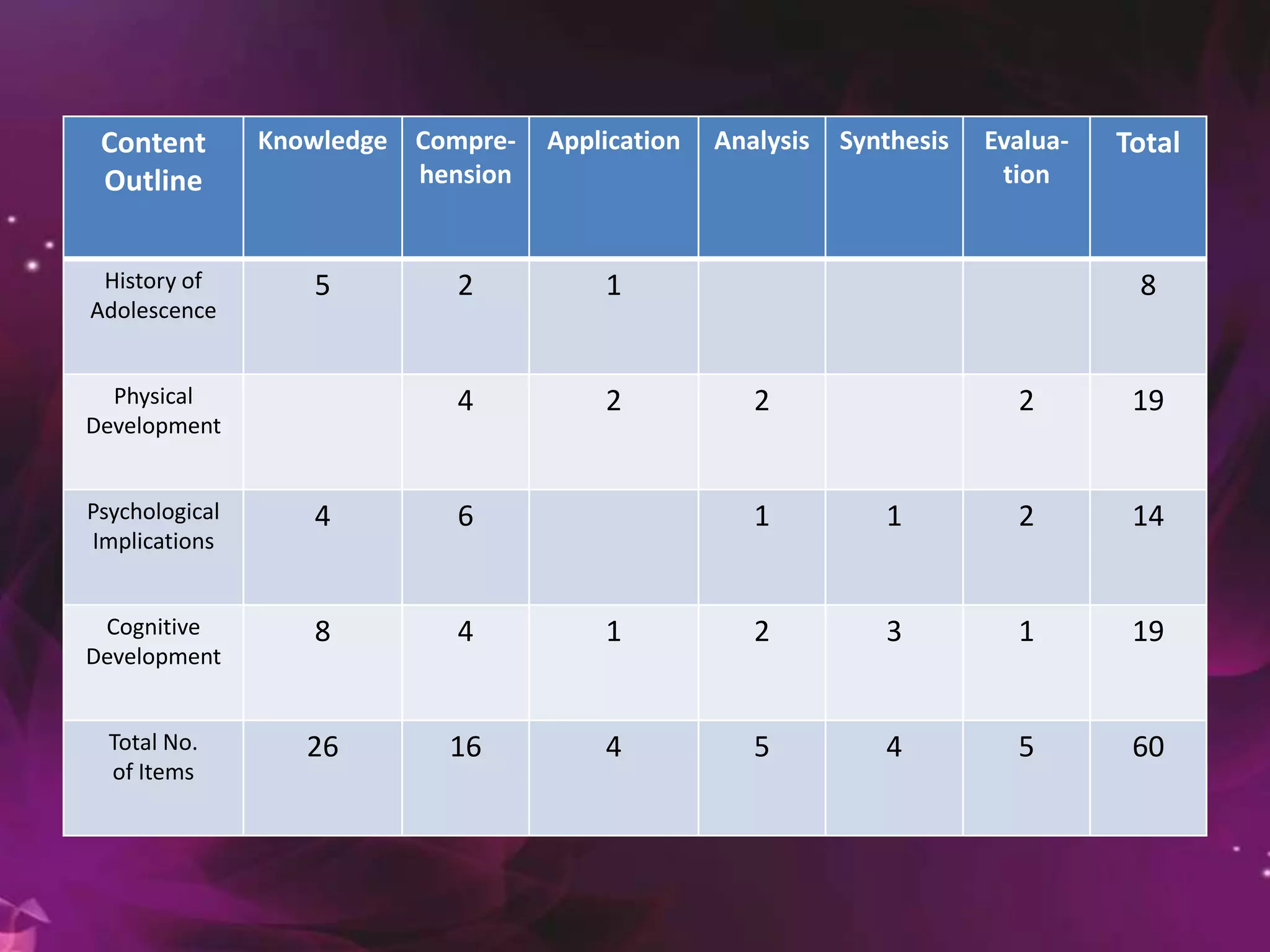
Content
Outline
Knowledge Compre-
hension
Application Analysis Synthesis Evalua-
tion
Total
History of
Adolescence
5 2 1 8
Physical
Development
4 2 2 2 19
Psychological
Implications
4 6 1 1 2 14
Cognitive
Development
8 4 1 2 3 1 19
Total No.
of Items
26 16 4 5 4 5 60
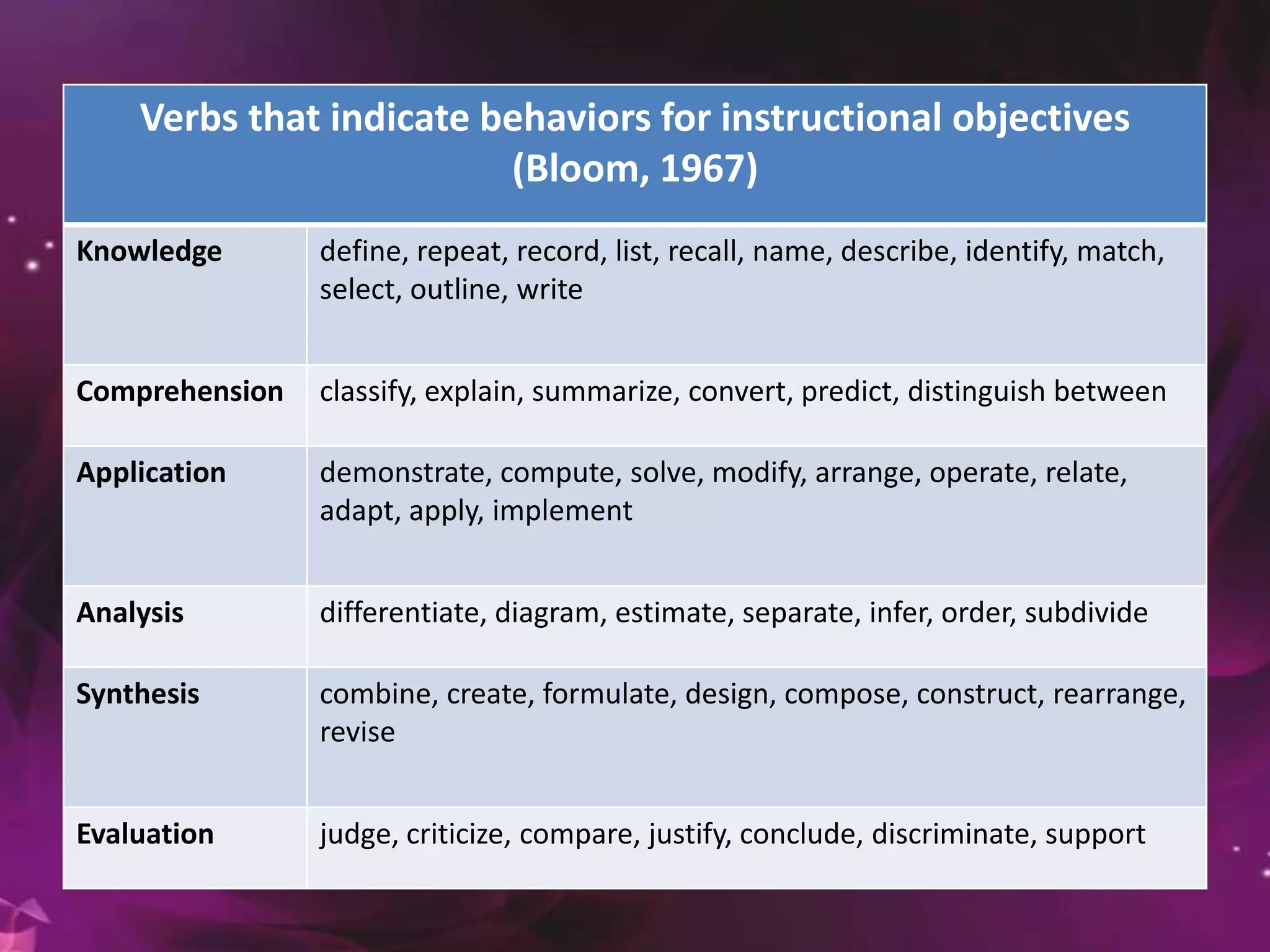
Verbs that indicate behaviors for instructional objectives
(Bloom, 1967)
Knowledge define, repeat, record, list, recall, name, describe, identify, match,
select, outline, write
Comprehension classify, explain, summarize, convert, predict, distinguish between
Application demonstrate, compute, solve, modify, arrange, operate, relate,
adapt, apply, implement
Analysis differentiate, diagram, estimate, separate, infer, order, subdivide
Synthesis combine, create, formulate, design, compose, construct, rearrange,
revise
Evaluation judge, criticize, compare, justify, conclude, discriminate, support
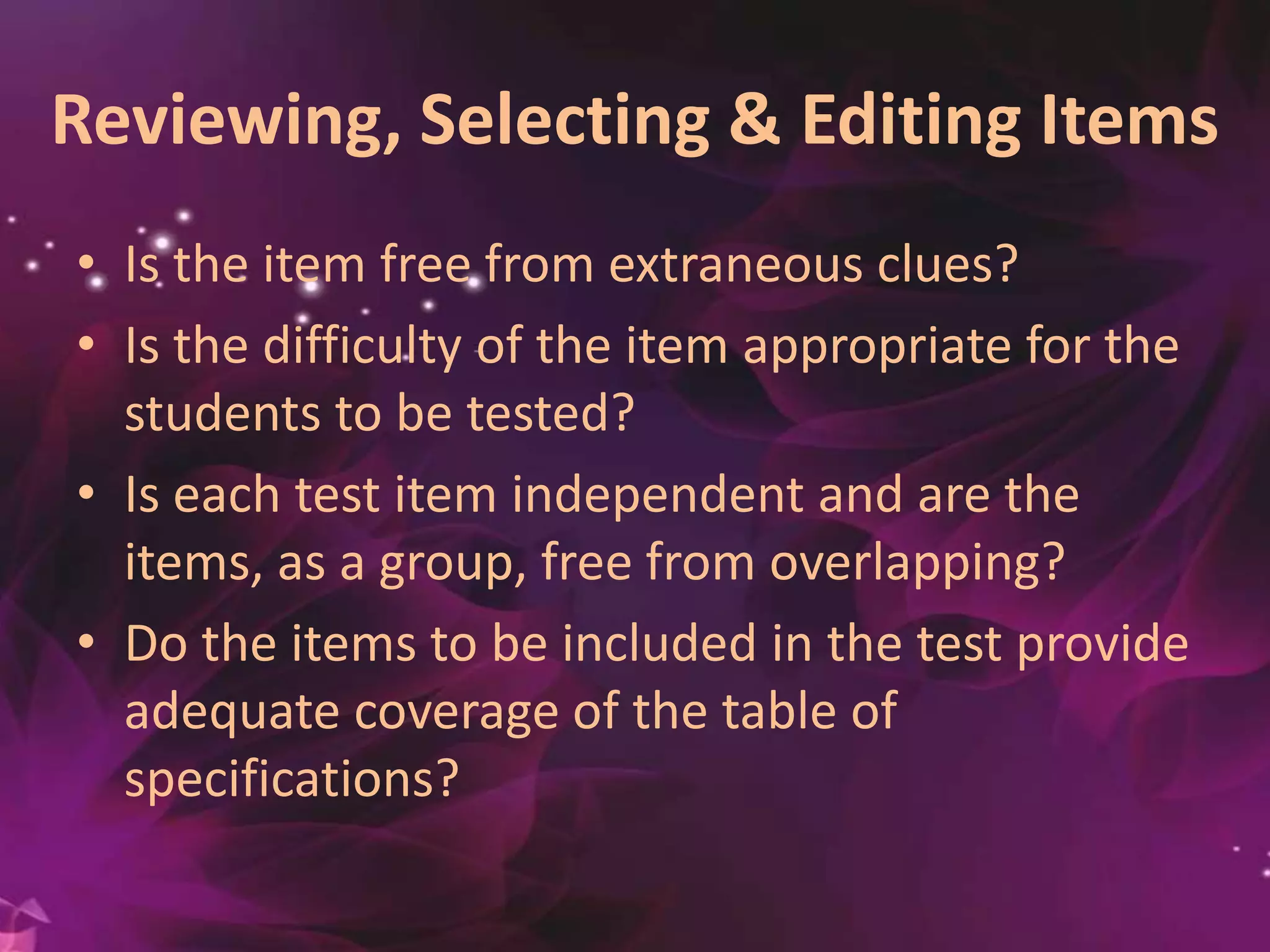
Reviewing, Selecting & Editing Items
• Is the item free from extraneous clues?
• Is the difficulty of the item appropriate for the
students to be tested?
• Is each test item independent and are the
items, as a group, free from overlapping?
• Do the items to be included in the test provide
adequate coverage of the table of
specifications?
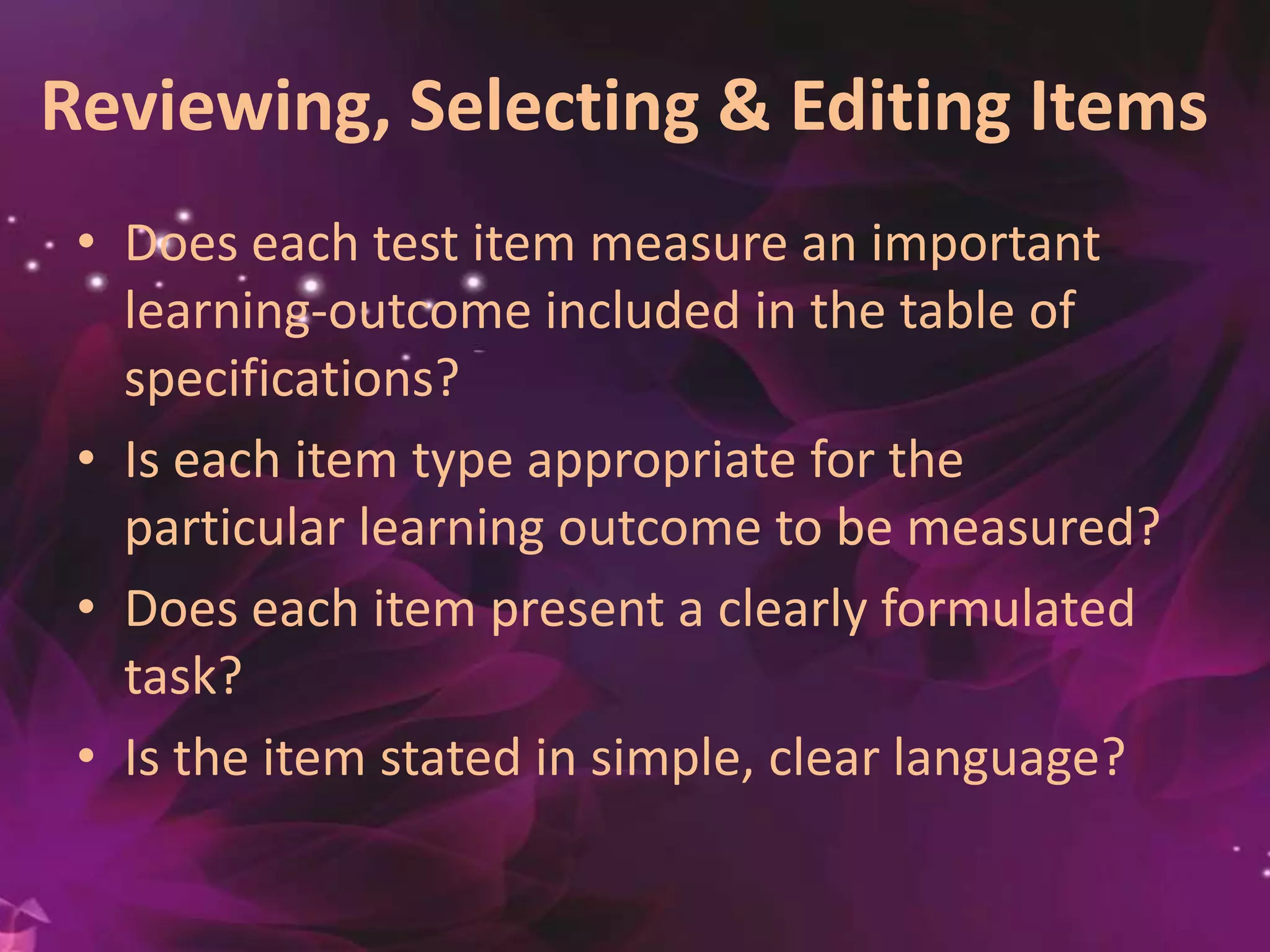
Reviewing, Selecting & Editing Items
• Does each test item measure an important
learning-outcome included in the table of
specifications?
• Is each item type appropriate for the
particular learning outcome to be measured?
• Does each item present a clearly formulated
task?
• Is the item stated in simple, clear language?
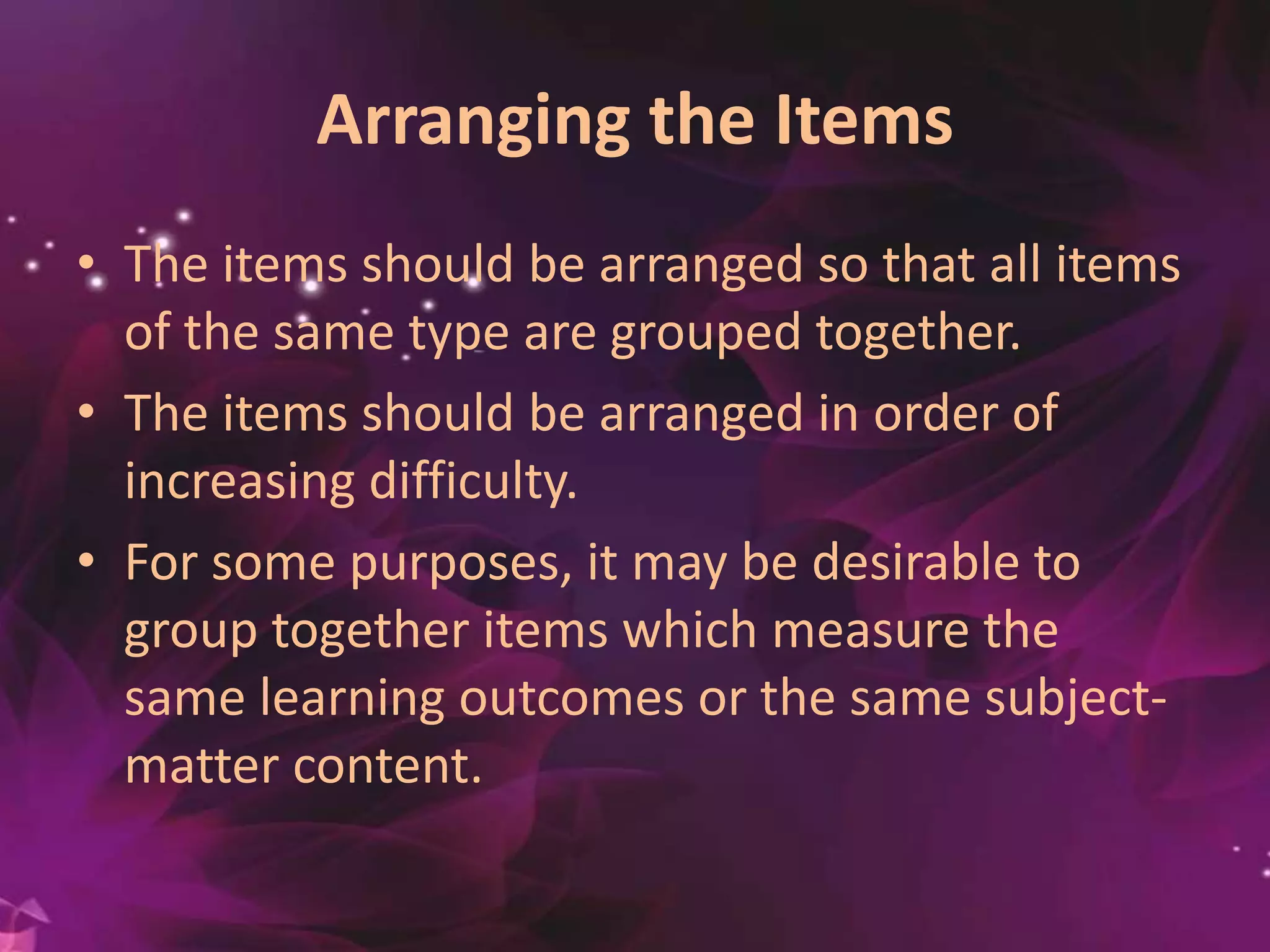
Arranging the Items
• The items should be arranged so that all items
of the same type are grouped together.
• The items should be arranged in order of
increasing difficulty.
• For some purposes, it may be desirable to
group together items which measure the
same learning outcomes or the same subject-
matter content.
Writing Directions
The directions for an achievement test should
be simple and concise and yet contain
information concerning each of the following:
• Purpose of the test.
• Time allowed to complete the test.
• How to record the answers.
• Whether to guess when in doubt about the
answer.
TIPS
• Construct test items bearing in mind that
they must be answerable by most students.
• Each item must be evaluated with respect to
sensitivity to the needs of students from
diverse backgrounds.
• Promote a “daily review” “lesson recap” or
“beginning/end-of-lesson test” (or other
method best suited to you and your class).
• Create an item bank.
Use feedback to aid in both teaching and
test construction.
• On Results: Tests are not just important
for grading, but also for teaching and
helping our students.
• Check tests right away and get them back
to students within a matter of days (next
day / class meeting, if possible).
• Allow for consultation, whenever
possible.
Guidelines and Tips:
What are your thoughts
and insights?
• Do you agree that test items should be
arranged from the easiest to the most
difficult? Why or why not?
• “Each item must be evaluated with respect to
sensitivity to the needs of students from
diverse backgrounds.” What are the ways that
we can do this for our students when
constructing tests? Give examples and explain.
• What are your tips, best practices and success
stories for test construction?
Open Forum
Connect with me!
cindycatz javadiggincat oldgirlinpeyups cindy cruz-cabrera
09166843723
cindycruzcabrera@gmail.com
References
• “Educational Measurement, Assessment and Evaluation” by Boyet B.
Aluan http://www.slideshare.net/BoyetAluan/educational-measurement-
assessment-and-evaluation
• “The Purpose of Tests” by Melissa Kelly
http://712educators.about.com/od/assessments/tp/The-Purpose-Of-
Tests.htm
• Wikipedia
– http://en.wikipedia.org/wiki/Test_(student_assessment)
• “What is an essay rubric?” by Janelle Cox (sample rubric)
http://k6educators.about.com/od/GradingStudents/a/Essay-Rubrics.htm
• “Four types of tests” http://www.teachers-corner.co.uk/four-types-of-
tests/
• “Types of Tests”
http://www.educationoasis.com/curriculum/assessment/typestests.htm
• “Types of Test Item Formats”
http://www.siop.org/workplace/employment%20testing/testformats.aspx
• “Test Construction Manual” by Professors Marjorie Devine & Nevart
Yaghlian of the Center for Teaching Excellence www.cte.cornell.edu
• “The Physics of Angry Birds” http://ct-
stem.northwestern.edu/assets/AngryBirds.pdf
References
• “The Physics of Angry Birds”
https://www.google.com.ph/url?sa=t&rct=j&q=&esrc=s&source=web&cd
=4&cad=rja&ved=0CEsQFjAD&url=http%3A%2F%2Fopen.umich.edu%2Fsit
es%2Fdefault%2Ffiles%2F2013-the-physics-of-angry-birds-jbon-jmoline-
lab.docx&ei=SEmrUbHeL-
GPiAeG2YD4DA&usg=AFQjCNER2X6qEHFUEEMcU7mW6Iu2B1ivXQ&sig2=
8ce-40WuCEXf5SU2eUishw&bvm=bv.47244034,d.aGc
• Harry Potter and the Deathly Hallows at www.bookrags.com
http://www.bookrags.com/lessonplan/harry-potter-and-the-deathly-
hallows
• Harry Potter and the Chamber of Secrets at www.bookrags.com
http://www.bookrags.com/lessonplan/chamber-of-secrets
• Harry Potter Quiz http://quizlet.com/1515137/harry-potter-quiz-flash-
cards/
• Harry Potter True or False http://www.braingle.com/trivia/1507/harry-
potter-true-or-false.html
• Harry Potter True or False
• http://www.goodreads.com/quizzes/21583-harry-potter-true-or-false

Guidelines and Practical Approaches for Test Construction Cindy Cruz-Cabrera June 3 seminar-workshop

  • 1.
    Guidelines and Practical Approachesfor Test Construction Cindy Cruz-Cabrera Professor | Consultant | Gender Specialist about.me/cindycruzcabrera
  • 2.
    Why do wegive tests?
  • 3.
    Tests have manypurposes in our schools. • To assess a student’s understanding of a given topic within a subject and identify what they have learned • To evaluate a student’s progress in a subject within a given period of time • To assess a student’s strengths and weaknesses for focus, assistance or individualized instruction
  • 4.
    • To determinewho will receive awards, recognition, and scholarships • To provide a basis of qualification for entry into a school, program, internship, higher education, scholarship • To gain college credit – advanced placement exams • To measure a teacher or school’s effectiveness – Part of teacher evaluation – High-stakes testing
  • 5.
  • 6.
    Intelligence tests Personality tests Psychologicaltests Aptitude tests Performance tests Achievement tests Comprehensive exams Gatekeeper tests Standardized tests Teacher-made tests
  • 7.
    Other categories oftests Placement Diagnostic Achievement Proficiency Criterion-referenced Norm-referenced Formal Informal
  • 8.
  • 9.
    • Knowledge, Comprehension,Application, Analysis, Synthesis, Evaluation • Memorization, Comprehension and Ownership • Content and Performance • Assessment vs. Evaluation • Objective VS. Subjective items / questions • Validity and Reliability
  • 10.
    Issues • Do testsaccurately reflect and measure what students should be learning OR are learning at school? • Teaching the curriculum VS. “Teaching to the test” • On the measurement of a teacher or school’s effectiveness: “Many factors influence a student’s grade on an exam.”
  • 11.
    What are yourthoughts and insights?
  • 12.
    “There is adifference between knowing the path and walking the path.” >>> Morpheus
  • 13.
    • What ismore important to measure: memorization or comprehension / ownership? Or both/all? Explain your answer. • Should we “teach to the test”? Or should we just stick to teaching the curriculum? Or should we do both? Why or why not? • Should students’ tests results and grades be made part of a teacher’s evaluation? Why or why not?
  • 14.
  • 15.
    Multiple Choice A numberof set answers for each question or item is provided
  • 16.
    Chamber of Secrets Whatdoes Uncle Vernon do with Harry's items from Hogwarts when Harry gets home for the holidays? a) Locks them away under the stairs in the cupboard b) Puts them in a chest in the attic c) Burns them d) Throws them away Answer: A
  • 17.
    Deathly Hallows Where isHarry Potter when he is first encountered in the book? a) At a house on Privet Drive. b) At Gringotts. c) At Hogwarts. d) At Platform 9 ¾. Answer: A
  • 18.
    Deathly Hallows What arethe three objects that make up the Deathly Hallows? a) Phoenix feather, stone, and invisibility cloak. b) Stone, invisibility cloak and basilisk tooth. c) Wand, basilisk tooth and Phoenix feather. d) Wand, stone, and invisibility cloak. Answer: D
  • 19.
    Advantages • Multiple choicequestions usually requires less time for test takers to answer. • They are easy to score and grade. • They provide greater coverage of material and allows for a wide range of difficulty. • They can easily diagnose a test taker's difficulty with certain concepts. • They test many levels of learning as well as a test taker's ability to integrate information, and can provide feedback to the test taker about why distractors were wrong and why correct answers were right.
  • 20.
    Disadvantages • Multiple choiceitems do not allow test takers to demonstrate knowledge beyond the choices. • They may encourage guessing or approximation due to the presence of at least one correct answer. • Multiple choice items that are effective usually take a great time to construct.
  • 21.
    Guidelines • Design eachitem to measure an important learning outcome. • Present a single, clearly formulated problem in the stem of the item. • State the stem of the item in simple, clear language. • Put as much of the wording as possible in the stem of the item. • State the stem of the item in positive form, wherever possible.
  • 22.
    • Emphasize negativewording whenever it is used in the stem of an item. • Make certain that the intended answer is correct or clearly best among choices. • Make all alternatives grammatically consistent with the stem of the item and parallel in form. • Avoid verbal clues which might enable students to select the correct answer or to eliminate an incorrect alternative. • Make the distracters plausible and attractive to the uninformed.
  • 23.
    Alternate Response (TRUE orFALSE) Binary choice – a statement is either TRUE or FALSE Modified TRUE or FALSE
  • 24.
    • Harry Potteris a muggle. • A Squib is someone born to non-magical parents who can do magic. • There are four houses at Hogwarts school. • Gryffindor won the Quidditch Cup in Harry Potter's second year at Hogwarts. • Rita Skeeter's Animagus is a ladybug. • The student Harry Potter was supposed to save in the Triwizard Tournament was Hermione Granger. • Neville Longbottom's parents were killed by Bellatrix Lestrange.
  • 25.
    Advantages • True-False itemscan cover a wide range of difficulty levels. • These require less time to answer, and are easily graded and scored. Disadvantages • These do not allow for test takers to demonstrate broad range of knowledge. • Guesswork may work.
  • 26.
    Guidelines • Include onlyone central significant idea in each statement. • Word the statement so precisely that it can be judged unequivocally true or false. • Use negative statements sparingly and avoid double negatives. • Statements of opinion should be attributed to some source. • Keep statements short and use simple language structure.
  • 27.
    Matching Type Provides adefined term and requires a test taker to match identifying characteristics with the correct term.
  • 28.
    • This alienbeing gains strength from the solar system’s yellow sun. • This scientist met a laboratory accident, which caused him to change form whenever angry. • This scientist-businessman describes himself to be a “Genius, billionaire, playbo y, philanthropist.” Spiderman Captain America The Incredible Hulk Superman Iron Man Hawkeye Batman
  • 29.
    Tony Stark Bruce Banner SteveRogers Clint Barton Natasha Romanov Clark Kent Bruce Wayne Celina Kyle Peter Parker Spiderman The Black Widow Captain America The Incredible Hulk Superman Cat Woman Iron Man Hawkeye Batman
  • 30.
    Advantages • Matching typeitems usually requires less time for test takers to answer. • They are easy to score and grade. • Distractors may be provided. Disadvantages • Answers are already provided, which makes it prone to guesswork. • These items do not allow test takers to demonstrate knowledge beyond the choices.
  • 31.
    Guidelines • Keep thelists of items short and put the brief responses on the right. • Use a larger, or smaller, number of responses than premises, and permit the responses to be used more than once. • Specify in the directions the basis for matching and indicate that each response may be used once, more than once, or not at all.
  • 32.
    Completion Type (Fill-in-the-blanks) Provides atest taker with identifying characteristics and requires the test taker to recall the correct term.
  • 33.
    • Lord Voldemortappeared in “Chamber of Secrets” as _______________, a student at Hogwarts. • In “Goblet of Fire”, _____________ dies during the tournament. • In “Prisoner of Azkaban”, Harry discovers that ____________ is his godfather. • The gamekeeper at Hogwarts who later becomes a teacher is ____________. • ____________ was their potions teacher who later taught Defense of the Dark Arts.
  • 34.
    Sirius Black SeverusSnape Cedric Diggory Rubeus Hagrid Tom Marvolo Riddle • Lord Voldemort appeared in “Chamber of Secrets” as _______________, a student at Hogwarts. • In “Goblet of Fire”, _____________ dies during the tournament. • In “Prisoner of Azkaban”, Harry discovers that ____________ is his godfather. • The gamekeeper at Hogwarts who later becomes a teacher is ____________. • ____________ was their potions teacher who later taught Defense of the Dark Arts.
  • 35.
    Types • Word bankprovided – each word to be used once • Word bank provided – some words to be used more than once, others not at all • No word bank provided • Students may guess but with more difficulty. • This type of item is generally feared by students when no word bank is provided.
  • 36.
    Essay A response iswritten in paragraph form to in answer to a question or to fulfill requirements of an item.
  • 37.
    Short • Describe Harry'sfeelings for Hogwarts, his school, as compared to the Dursley house where he lives with his aunt and uncle from what is detailed in Chapter One. • Give one word that explains Vernon Dursley's reaction when Harry says "magic" in Chapter One. Explain why you have given this word.
  • 38.
    Comprehensive The Chamber ofSecrets had been opened only fifty years ago. Many of the people at Hogwarts, such as the ghosts and teachers, were around at that time. Part 1-Describe why they were so quick to dismiss the fact that the chamber was a myth and didn't exist. Part 2-How would things have been different if the Chamber of Secrets had been taken as a more serious threat in the beginning?
  • 39.
    Comprehensive Oftentimes, a bookis more of a character-driven plot rather than action driven, and oftentimes the other way. Some books seem to balance the two. Discuss the following: 1. What do you think it means to say that a plot is character-driven or action-driven? 2. How do you think a plot differs if it is character-driven versus action-driven? 3. Which type of plot do you find more interesting? Why? 4. Do you think it is possible to have a plot where action and character development share equal time?
  • 40.
    Advantages • Essay itemscan test complex learning objectives and processes used to answer the question. • Summary, critique, analysis, defense, stand, et c. • These items require test takers to demonstrate their writing skills as well as correct spelling and grammar. • Essay items are not given to guesswork.
  • 41.
    Disadvantages • Test itemscan be made quickly but take quite some time to answer and check. • The grading process may be subjective – different score results for different teachers. • Essay questions may potentially be unreliable in assessing the entire content of a subject matter.
  • 42.
    Rubric A chart thatcommunicates and outlines the following: • Expectations for the project / activity / exercise • Criteria • Scoring guide and corresponding performance indicators / levels of quality Rubrics are used to TEACH as well as EVALUATE. • These focus on the process as well as the product. • These guide students to make dependable judgments about their work and give feedback. • Clarify standards for quality performance and progress towards those standards
  • 44.
    Areas of Assessment 5 A 4 B 3 C 2 D Ideas Presentsideas in an original and interesting manner Presents ideas in an consistent manner Ideas are too general Ideas are vague or unclear Organization Strong and organized beg/mid/end Organized beginning/ middle/end Some organization; attempt at a beginning/ middle/end No organization; lack/s beginning/ middle/end Understanding Writing shows strong understanding Writing shows clear understanding Writing shows adequate understanding Writing shows little understanding Word Choice Sophisticated use of nouns and verbs make essay very informative Nouns and verbs make essay informative Needs more nouns and verbs Little or no use of nouns and verbs Sentence Structure Sentence structure enhances meaning; flows throughout piece Sentence structure is evident; sentences mostly flow Sentence structure is limited; sentences need to flow No sense of sentence structure or flow Mechanics Few (if any) errors Few errors Several errors Numerous errors
  • 45.
    Mathematics Questions State amathematical problem or exercise that requires a student to write a freehand response.
  • 46.
    • Identify thelaws of physics present in the game ANGRY BIRDS. Explain the occurrence of these laws in the game and how these are illustrated. • Explain the physics concepts and their corresponding equations as illustrated in the catapult activity in ANGRY BIRDS.
  • 47.
    • Maths, Chemistry,Physics, Economics • Steps (process) • Multiple parts (series) • Variations on true or false, which involves verifying validity by direct proof or counterexample.
  • 48.
    Physical Fitness Test Designedto measure physical strength, agility and endurance
  • 49.
    • Usually partof the physical education curriculum • Fulfills eligibility requirements in fields that focus on physical ability (more rigorous) • Standard requirement for school admissions and monitoring of students (less stringent)
  • 50.
    Performance Test / PracticalExam Requires an examinee to actually perform a task or activity, rather than simply answering questions referring to specific parts
  • 51.
    • Actual orsimulation – demonstration of ability or judgment • Reason: greater fidelity to what is being tested • Driving, dancing, doing sports • Laboratory exam – specimens on display • Scientific method – laboratory sheet
  • 52.
    Types of Tests: Whatare your thoughts and insights?
  • 53.
    • What typeof tests are best suited for evaluating your subject area? Explain your answer. • Create an essay test rubric for your subject area / department. What criteria would you employ? What weights would you assign each criterion and why? Explain your answer. • Create and share two items per type of test.
  • 54.
  • 55.
    Preparing the Test •Write test items according to rules of construction for the type(s) chosen. • Select the items to be included in the test according to table of specifications. • Review and edit items according to guidelines. • Arrange items and decide on – Grouping of items, – Sequence of items within groups, – Sequence of groupings.
  • 56.
    Planning for theTest • Outline subject matter content to be considered as the basis for the test. • Identify learning outcomes to be measured by the test. • Prepare the table of specifications. • Choose appropriate type(s) of test items for evaluation of learning outcomes as summarized in the table of specifications.
  • 57.
    Content Outline Knowledge Compre- hension Application AnalysisSynthesis Evalua- tion Total History of Adolescence 5 2 1 8 Physical Development 4 2 2 2 19 Psychological Implications 4 6 1 1 2 14 Cognitive Development 8 4 1 2 3 1 19 Total No. of Items 26 16 4 5 4 5 60
  • 58.
    Verbs that indicatebehaviors for instructional objectives (Bloom, 1967) Knowledge define, repeat, record, list, recall, name, describe, identify, match, select, outline, write Comprehension classify, explain, summarize, convert, predict, distinguish between Application demonstrate, compute, solve, modify, arrange, operate, relate, adapt, apply, implement Analysis differentiate, diagram, estimate, separate, infer, order, subdivide Synthesis combine, create, formulate, design, compose, construct, rearrange, revise Evaluation judge, criticize, compare, justify, conclude, discriminate, support
  • 59.
    Reviewing, Selecting &Editing Items • Is the item free from extraneous clues? • Is the difficulty of the item appropriate for the students to be tested? • Is each test item independent and are the items, as a group, free from overlapping? • Do the items to be included in the test provide adequate coverage of the table of specifications?
  • 60.
    Reviewing, Selecting &Editing Items • Does each test item measure an important learning-outcome included in the table of specifications? • Is each item type appropriate for the particular learning outcome to be measured? • Does each item present a clearly formulated task? • Is the item stated in simple, clear language?
  • 61.
    Arranging the Items •The items should be arranged so that all items of the same type are grouped together. • The items should be arranged in order of increasing difficulty. • For some purposes, it may be desirable to group together items which measure the same learning outcomes or the same subject- matter content.
  • 62.
    Writing Directions The directionsfor an achievement test should be simple and concise and yet contain information concerning each of the following: • Purpose of the test. • Time allowed to complete the test. • How to record the answers. • Whether to guess when in doubt about the answer.
  • 63.
  • 64.
    • Construct testitems bearing in mind that they must be answerable by most students. • Each item must be evaluated with respect to sensitivity to the needs of students from diverse backgrounds. • Promote a “daily review” “lesson recap” or “beginning/end-of-lesson test” (or other method best suited to you and your class). • Create an item bank.
  • 65.
    Use feedback toaid in both teaching and test construction. • On Results: Tests are not just important for grading, but also for teaching and helping our students. • Check tests right away and get them back to students within a matter of days (next day / class meeting, if possible). • Allow for consultation, whenever possible.
  • 66.
    Guidelines and Tips: Whatare your thoughts and insights?
  • 67.
    • Do youagree that test items should be arranged from the easiest to the most difficult? Why or why not? • “Each item must be evaluated with respect to sensitivity to the needs of students from diverse backgrounds.” What are the ways that we can do this for our students when constructing tests? Give examples and explain. • What are your tips, best practices and success stories for test construction?
  • 68.
    Open Forum Connect withme! cindycatz javadiggincat oldgirlinpeyups cindy cruz-cabrera 09166843723 cindycruzcabrera@gmail.com
  • 69.
    References • “Educational Measurement,Assessment and Evaluation” by Boyet B. Aluan http://www.slideshare.net/BoyetAluan/educational-measurement- assessment-and-evaluation • “The Purpose of Tests” by Melissa Kelly http://712educators.about.com/od/assessments/tp/The-Purpose-Of- Tests.htm • Wikipedia – http://en.wikipedia.org/wiki/Test_(student_assessment) • “What is an essay rubric?” by Janelle Cox (sample rubric) http://k6educators.about.com/od/GradingStudents/a/Essay-Rubrics.htm • “Four types of tests” http://www.teachers-corner.co.uk/four-types-of- tests/ • “Types of Tests” http://www.educationoasis.com/curriculum/assessment/typestests.htm • “Types of Test Item Formats” http://www.siop.org/workplace/employment%20testing/testformats.aspx • “Test Construction Manual” by Professors Marjorie Devine & Nevart Yaghlian of the Center for Teaching Excellence www.cte.cornell.edu • “The Physics of Angry Birds” http://ct- stem.northwestern.edu/assets/AngryBirds.pdf
  • 70.
    References • “The Physicsof Angry Birds” https://www.google.com.ph/url?sa=t&rct=j&q=&esrc=s&source=web&cd =4&cad=rja&ved=0CEsQFjAD&url=http%3A%2F%2Fopen.umich.edu%2Fsit es%2Fdefault%2Ffiles%2F2013-the-physics-of-angry-birds-jbon-jmoline- lab.docx&ei=SEmrUbHeL- GPiAeG2YD4DA&usg=AFQjCNER2X6qEHFUEEMcU7mW6Iu2B1ivXQ&sig2= 8ce-40WuCEXf5SU2eUishw&bvm=bv.47244034,d.aGc • Harry Potter and the Deathly Hallows at www.bookrags.com http://www.bookrags.com/lessonplan/harry-potter-and-the-deathly- hallows • Harry Potter and the Chamber of Secrets at www.bookrags.com http://www.bookrags.com/lessonplan/chamber-of-secrets • Harry Potter Quiz http://quizlet.com/1515137/harry-potter-quiz-flash- cards/ • Harry Potter True or False http://www.braingle.com/trivia/1507/harry- potter-true-or-false.html • Harry Potter True or False • http://www.goodreads.com/quizzes/21583-harry-potter-true-or-false