Challenges in the teaching and 
testing of speaking 
John Campbell-Larsen 
Cameron Romney
This Presentation 
• Part one: What is speaking? 
• Part two: How do you teach conversation? 
• Part three: How is speaking (often) evaluated? 
• Part four: Ideas to take away.
Part one 
What is speaking?
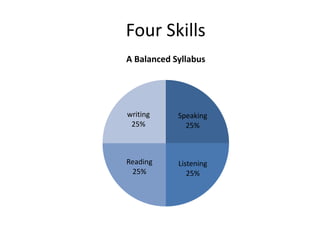
Four Skills 
A Balanced Syllabus 
Speaking 
25% 
Listening 
25% 
writing 
25% 
Reading 
25%
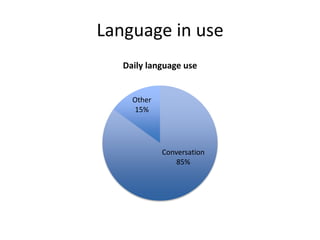
Language in use 
Daily language use 
Conversation 
85% 
Other 
15%
“It [speaking] is the skill by which 
they [learners] are most frequently 
judged … It is the vehicle par 
excellence of social solidarity, of 
social ranking, of professional 
advancement and of business.” 
Martin Bygate (1987), p. vii
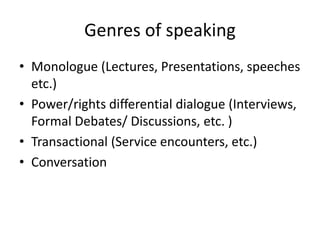
Genres of speaking 
• Monologue (Lectures, Presentations, speeches 
etc.) 
• Power/rights differential dialogue (Interviews, 
Formal Debates/ Discussions, etc. ) 
• Transactional (Service encounters, etc.) 
• Conversation
Participant Question 
How much time do you spend in 
each of these genres?
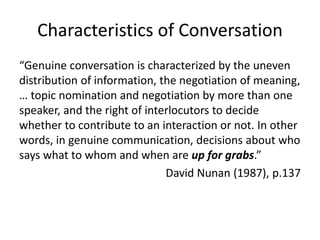
Characteristics of Conversation 
“Genuine conversation is characterized by the uneven 
distribution of information, the negotiation of meaning, 
… topic nomination and negotiation by more than one 
speaker, and the right of interlocutors to decide 
whether to contribute to an interaction or not. In other 
words, in genuine communication, decisions about who 
says what to whom and when are up for grabs.” 
David Nunan (1987), p.137
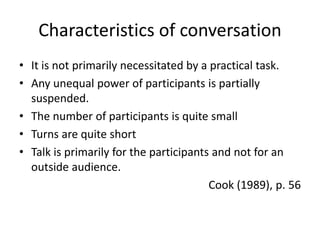
Characteristics of conversation 
• It is not primarily necessitated by a practical task. 
• Any unequal power of participants is partially 
suspended. 
• The number of participants is quite small 
• Turns are quite short 
• Talk is primarily for the participants and not for an 
outside audience. 
Cook (1989), p. 56
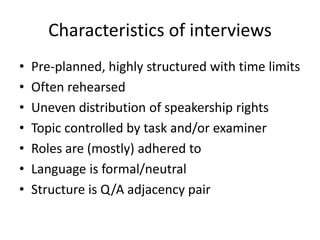
Characteristics of interviews 
• Pre-planned, highly structured with time limits 
• Often rehearsed 
• Uneven distribution of speakership rights 
• Topic controlled by task and/or examiner 
• Roles are (mostly) adhered to 
• Language is formal/neutral 
• Structure is Q/A adjacency pair
Example Video
Part two 
How do you teach conversation?
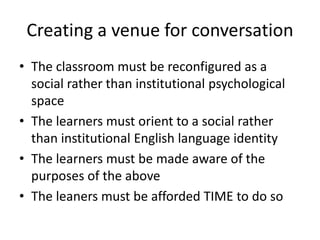
Creating a venue for conversation 
• The classroom must be reconfigured as a 
social rather than institutional psychological 
space 
• The learners must orient to a social rather 
than institutional English language identity 
• The learners must be made aware of the 
purposes of the above 
• The leaners must be afforded TIME to do so
Example Video
Part three 
How is speaking (often) evaluated?
Common forms of Evaluation 
• Written tests 
• Presentations 
• Task observations, e.g. role plays 
• Interviews tests
Written Tests 
Positives 
• Easy to evaluate large groups of students 
• Student know what to do 
Negatives 
• Not speaking 
• Often receptive skills not productive and/or 
linguistic knowledge
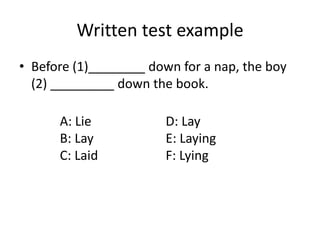
Written test example 
• Before (1)________ down for a nap, the boy 
(2) _________ down the book. 
A: Lie 
B: Lay 
C: Laid 
D: Lay 
E: Laying 
F: Lying
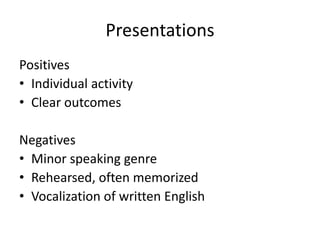
Presentations 
Positives 
• Individual activity 
• Clear outcomes 
Negatives 
• Minor speaking genre 
• Rehearsed, often memorized 
• Vocalization of written English
Example Video
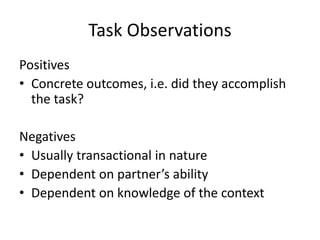
Task Observations 
Positives 
• Concrete outcomes, i.e. did they accomplish 
the task? 
Negatives 
• Usually transactional in nature 
• Dependent on partner’s ability 
• Dependent on knowledge of the context
Issue with role-plays 
“Role-playing ability can be compared with 
acting ability, and of course not everyone is a 
good actor. Nor is being a good actor equivalent 
to being a good communicator. Furthermore, 
role playing is a specialized kind of acting, 
requiring ad-libbing ability. Not every good actor 
is a good ad-libber.” 
van Lier (1989), p. 502
Interviews tests 
Positives: 
• Students produce lots of language (ideally) 
Negatives: 
• Minor speaking genre 
• Highly structured with time limits 
• Controlled by interviewer 
• One-sided interaction
How do you evaluate speaking?
Example Video
Example Video
Example Video
Part Four 
Ideas to take away
#1: 
Speaking has 
DIFFERENT 
genres
Speaking Genres 
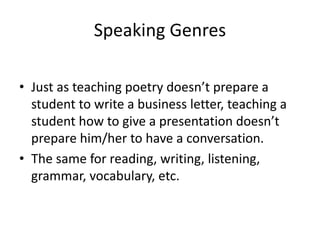
• Just as teaching poetry doesn’t prepare a 
student to write a business letter, teaching a 
student how to give a presentation doesn’t 
prepare him/her to have a conversation. 
• The same for reading, writing, listening, 
grammar, vocabulary, etc.
#2: 
Conversation is 
THE 
skill
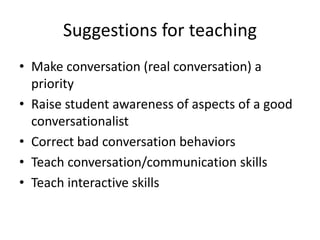
Suggestions for teaching 
• Make conversation (real conversation) a 
priority 
• Raise student awareness of aspects of a good 
conversationalist 
• Correct bad conversation behaviors 
• Teach conversation/communication skills 
• Teach interactive skills
#3: 
Test what you teach 
and 
teach what you test
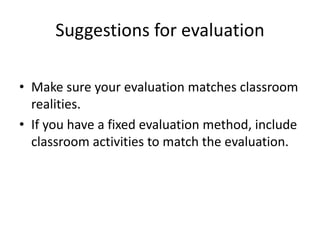
Suggestions for evaluation 
• Make sure your evaluation matches classroom 
realities. 
• If you have a fixed evaluation method, include 
classroom activities to match the evaluation.
Challenges in the teaching and 
testing of speaking 
John Campbell-Larsen 
Cameron Romney
Example Video

Challenges in the teaching and testing of speaking

  • 1.
    Challenges in theteaching and testing of speaking John Campbell-Larsen Cameron Romney
  • 2.
    This Presentation •Part one: What is speaking? • Part two: How do you teach conversation? • Part three: How is speaking (often) evaluated? • Part four: Ideas to take away.
  • 3.
    Part one Whatis speaking?
  • 4.
    Four Skills ABalanced Syllabus Speaking 25% Listening 25% writing 25% Reading 25%
  • 5.
    Language in use Daily language use Conversation 85% Other 15%
  • 6.
    “It [speaking] isthe skill by which they [learners] are most frequently judged … It is the vehicle par excellence of social solidarity, of social ranking, of professional advancement and of business.” Martin Bygate (1987), p. vii
  • 7.
    Genres of speaking • Monologue (Lectures, Presentations, speeches etc.) • Power/rights differential dialogue (Interviews, Formal Debates/ Discussions, etc. ) • Transactional (Service encounters, etc.) • Conversation
  • 8.
    Participant Question Howmuch time do you spend in each of these genres?
  • 9.
    Characteristics of Conversation “Genuine conversation is characterized by the uneven distribution of information, the negotiation of meaning, … topic nomination and negotiation by more than one speaker, and the right of interlocutors to decide whether to contribute to an interaction or not. In other words, in genuine communication, decisions about who says what to whom and when are up for grabs.” David Nunan (1987), p.137
  • 10.
    Characteristics of conversation • It is not primarily necessitated by a practical task. • Any unequal power of participants is partially suspended. • The number of participants is quite small • Turns are quite short • Talk is primarily for the participants and not for an outside audience. Cook (1989), p. 56
  • 11.
    Characteristics of interviews • Pre-planned, highly structured with time limits • Often rehearsed • Uneven distribution of speakership rights • Topic controlled by task and/or examiner • Roles are (mostly) adhered to • Language is formal/neutral • Structure is Q/A adjacency pair
  • 12.
  • 13.
    Part two Howdo you teach conversation?
  • 14.
    Creating a venuefor conversation • The classroom must be reconfigured as a social rather than institutional psychological space • The learners must orient to a social rather than institutional English language identity • The learners must be made aware of the purposes of the above • The leaners must be afforded TIME to do so
  • 15.
  • 16.
    Part three Howis speaking (often) evaluated?
  • 17.
    Common forms ofEvaluation • Written tests • Presentations • Task observations, e.g. role plays • Interviews tests
  • 18.
    Written Tests Positives • Easy to evaluate large groups of students • Student know what to do Negatives • Not speaking • Often receptive skills not productive and/or linguistic knowledge
  • 19.
    Written test example • Before (1)________ down for a nap, the boy (2) _________ down the book. A: Lie B: Lay C: Laid D: Lay E: Laying F: Lying
  • 20.
    Presentations Positives •Individual activity • Clear outcomes Negatives • Minor speaking genre • Rehearsed, often memorized • Vocalization of written English
  • 21.
  • 22.
    Task Observations Positives • Concrete outcomes, i.e. did they accomplish the task? Negatives • Usually transactional in nature • Dependent on partner’s ability • Dependent on knowledge of the context
  • 23.
    Issue with role-plays “Role-playing ability can be compared with acting ability, and of course not everyone is a good actor. Nor is being a good actor equivalent to being a good communicator. Furthermore, role playing is a specialized kind of acting, requiring ad-libbing ability. Not every good actor is a good ad-libber.” van Lier (1989), p. 502
  • 24.
    Interviews tests Positives: • Students produce lots of language (ideally) Negatives: • Minor speaking genre • Highly structured with time limits • Controlled by interviewer • One-sided interaction
  • 25.
    How do youevaluate speaking?
  • 26.
  • 27.
  • 28.
  • 29.
    Part Four Ideasto take away
  • 30.
    #1: Speaking has DIFFERENT genres
  • 31.
    Speaking Genres •Just as teaching poetry doesn’t prepare a student to write a business letter, teaching a student how to give a presentation doesn’t prepare him/her to have a conversation. • The same for reading, writing, listening, grammar, vocabulary, etc.
  • 32.
  • 33.
    Suggestions for teaching • Make conversation (real conversation) a priority • Raise student awareness of aspects of a good conversationalist • Correct bad conversation behaviors • Teach conversation/communication skills • Teach interactive skills
  • 34.
    #3: Test whatyou teach and teach what you test
  • 35.
    Suggestions for evaluation • Make sure your evaluation matches classroom realities. • If you have a fixed evaluation method, include classroom activities to match the evaluation.
  • 36.
    Challenges in theteaching and testing of speaking John Campbell-Larsen Cameron Romney
  • 37.