UNIVERSIDAD CATOLICA DE LA SSMA. CONCEPCION
ASSESSING SPEAKING
ASSESSMENT
EDUCATION FACULTY
ENGLISH LANGUAGE DEPARTMENT
KARLA ESSMANN TORRES
ANALIA NOVA GONZALEZ
PROFESSOR
ROXANNA CORREA PEREZ
DATE
CONCEPCION, 2013
Assessing Speaking
Página 2
Speaking task 1
Please look at the six pictures below. Tell the story that the pictures show,
starting with picture number 1 and going through picture number 6. Please take one
minute to look at the pictures and think about the story. Do not begin the story until you
are told to do so.
Tell me the story that the pictures show. (3 minutes)
(ETS, 2002)
2 31
54 6
Assessing Speaking
Página 3
Speaking task 2
Please look at the pictures below. When you need to buy some provisions, do
you prefer a shop or a supermarket? Why? (2 minutes)
Imagine that we are standing in front of your house. Tell me how to get to the
shop or supermarket from there. Please take one minute to think about the answer. Do
not answer until you are told to do so.
Answer the question. (3 minutes)
Shop
Supermarket
(© Nasjonalt læremiddelsenter, Norway, 1996)
SEE ATTACHED HARD COPY
Assessing Speaking
Página 4
Specifications from Luoma (2004)
1. Test purpose: The purpose of the test is to evaluate the student’s capacity of telling a
story, expressing preferences and giving directions.
2. Description of the examinees:
Age: 18 years old
Grade: First year at the University
Level of English: Intermediate
Hour of English: 2 modules per week (45 minutes each)
Other English courses: English summer camps 2013
3. Test Level: For University students. Intermediate
4. Definition of construct:
Luoma, S. (2004). Assessing speaking. Cambridge, UK: Cambridge University Press.
5. Number of sections/ papers: 2 sections.
6. Time for each section paper:
- First section: 4 minutes.
- Second section: 6 minutes.
Assessing Speaking
Página 5
7. Weighting for each section: Each section contains 16 points.
8. Target language situation:
“Sequencing events to tell a story”: First, second, then, next, finally, simple past tense.
“Expressing preferences”: I prefer this...because...
“Giving directions”: Go straight on, turn back./go back, turn left/right (into …-street),
go along, cross, take the first/second road on the left/right, straight on, opposite, near,
next to, between, at the end (of), on/at the corner, behind, in front of, around the corner.
9. Text types: Three pictures and written questions.
10. Text Length: Two pages long which take as a whole 10 minutes.
11. Language skill to be tested: Speaking (oral performance).
12. Language elements to be tested: Fluency, pronunciation, vocabulary,
articulateness.
13. Test tasks:
-Speaking task 1
Please look at the six pictures below. Tell me the story that the pictures show, starting
with picture number 1 and going through picture number 6. Please take one minute to
look at the pictures and think about the story. Do not begin the story until you are told to
do so.
Tell me the story that the pictures show. (3 minutes)
Assessing Speaking
Página 6
-Speaking task 2
Please look at the pictures below. When you need to buy some groceries, do you prefer
a grocery shop or a supermarket? Why? (2 minutes)
Imagine that we are standing in front of your house. Tell me how to get to the shop or
supermarket from there. Please take one minute to think about the answer. Do not
answer until you are told to do so.
Answer the question. (3 minutes)
14. Test Methods: The test will be individual, in the first section the test taker will have
4 minutes to answer and in the second section the test taker will have 6 minutes to
answer.
Assessing Speaking
Página 7
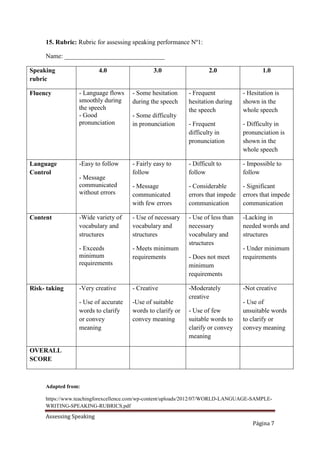
15. Rubric: Rubric for assessing speaking performance Nº1:
Name: _______________________________
Speaking
rubric
4.0 3.0 2.0 1.0
Fluency - Language flows
smoothly during
the speech
- Good
pronunciation
- Some hesitation
during the speech
- Some difficulty
in pronunciation
- Frequent
hesitation during
the speech
- Frequent
difficulty in
pronunciation
- Hesitation is
shown in the
whole speech
- Difficulty in
pronunciation is
shown in the
whole speech
Language
Control
-Easy to follow
- Message
communicated
without errors
- Fairly easy to
follow
- Message
communicated
with few errors
- Difficult to
follow
- Considerable
errors that impede
communication
- Impossible to
follow
- Significant
errors that impede
communication
Content -Wide variety of
vocabulary and
structures
- Exceeds
minimum
requirements
- Use of necessary
vocabulary and
structures
- Meets minimum
requirements
- Use of less than
necessary
vocabulary and
structures
- Does not meet
minimum
requirements
-Lacking in
needed words and
structures
- Under minimum
requirements
Risk- taking -Very creative
- Use of accurate
words to clarify
or convey
meaning
- Creative
-Use of suitable
words to clarify or
convey meaning
-Moderately
creative
- Use of few
suitable words to
clarify or convey
meaning
-Not creative
- Use of
unsuitable words
to clarify or
convey meaning
OVERALL
SCORE
Adapted from:
https://www.teachingforexcellence.com/wp-content/uploads/2012/07/WORLD-LANGUAGE-SAMPLE-
WRITING-SPEAKING-RUBRICS.pdf
Assessing Speaking
Página 8
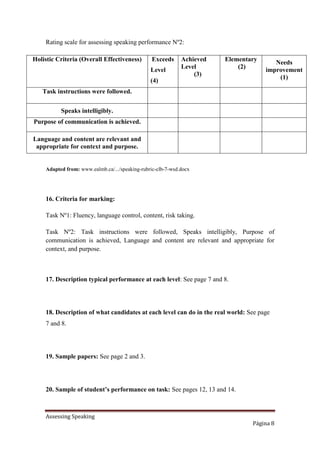
Rating scale for assessing speaking performance Nº2:
Adapted from: www.ealmb.ca/.../speaking-rubric- - -
16. Criteria for marking:
Task Nº1: Fluency, language control, content, risk taking.
Task Nº2: Task instructions were followed, Speaks intelligibly, Purpose of
communication is achieved, Language and content are relevant and appropriate for
context, and purpose.
17. Description typical performance at each level: See page 7 and 8.
18. Description of what candidates at each level can do in the real world: See page
7 and 8.
19. Sample papers: See page 2 and 3.
20. Sample of student’s performance on task: See pages 12, 13 and 14.
Holistic Criteria (Overall Effectiveness) Exceeds
Level
(4)
Achieved
Level
(3)
Elementary
(2)
Needs
improvement
(1)
Task instructions were followed.
Speaks intelligibly.
Purpose of communication is achieved.
Language and content are relevant and
appropriate for context and purpose.
Assessing Speaking
Página 9
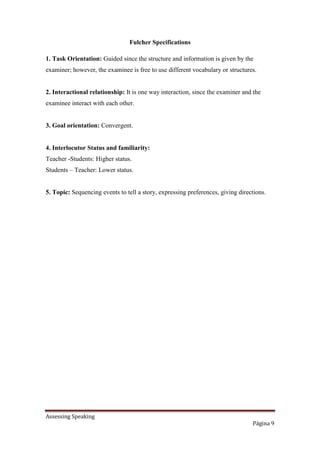
Fulcher Specifications
1. Task Orientation: Guided since the structure and information is given by the
examiner; however, the examinee is free to use different vocabulary or structures.
2. Interactional relationship: It is one way interaction, since the examiner and the
examinee interact with each other.
3. Goal orientation: Convergent.
4. Interlocutor Status and familiarity:
Teacher -Students: Higher status.
Students – Teacher: Lower status.
5. Topic: Sequencing events to tell a story, expressing preferences, giving directions.
Assessing Speaking
Página 10
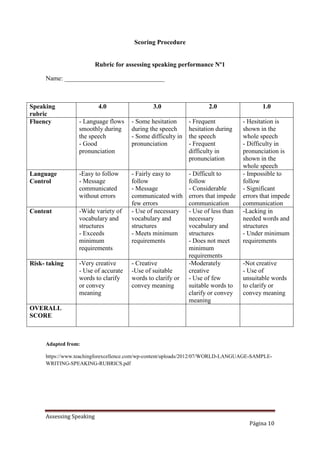
Scoring Procedure
Rubric for assessing speaking performance Nº1
Name: _______________________________
Speaking
rubric
4.0 3.0 2.0 1.0
Fluency - Language flows
smoothly during
the speech
- Good
pronunciation
- Some hesitation
during the speech
- Some difficulty in
pronunciation
- Frequent
hesitation during
the speech
- Frequent
difficulty in
pronunciation
- Hesitation is
shown in the
whole speech
- Difficulty in
pronunciation is
shown in the
whole speech
Language
Control
-Easy to follow
- Message
communicated
without errors
- Fairly easy to
follow
- Message
communicated with
few errors
- Difficult to
follow
- Considerable
errors that impede
communication
- Impossible to
follow
- Significant
errors that impede
communication
Content -Wide variety of
vocabulary and
structures
- Exceeds
minimum
requirements
- Use of necessary
vocabulary and
structures
- Meets minimum
requirements
- Use of less than
necessary
vocabulary and
structures
- Does not meet
minimum
requirements
-Lacking in
needed words and
structures
- Under minimum
requirements
Risk- taking -Very creative
- Use of accurate
words to clarify
or convey
meaning
- Creative
-Use of suitable
words to clarify or
convey meaning
-Moderately
creative
- Use of few
suitable words to
clarify or convey
meaning
-Not creative
- Use of
unsuitable words
to clarify or
convey meaning
OVERALL
SCORE
Adapted from:
https://www.teachingforexcellence.com/wp-content/uploads/2012/07/WORLD-LANGUAGE-SAMPLE-
WRITING-SPEAKING-RUBRICS.pdf
Assessing Speaking
Página 11
Rating scale for assessing speaking performance Nº2
Name: _______________________________
Adapted from: www.ealmb.ca/.../speaking-rubric- - -
Holistic Criteria (Overall Effectiveness) Exceeds
Level
(4)
Achieved
Level
(3)
Elementary
(2)
Needs
improvement
(1)
Task instructions were followed.
Speaks intelligibly.
Purpose of communication is achieved.
Language and content are relevant and
appropriate for context and purpose.
Assessing Speaking
Página 12
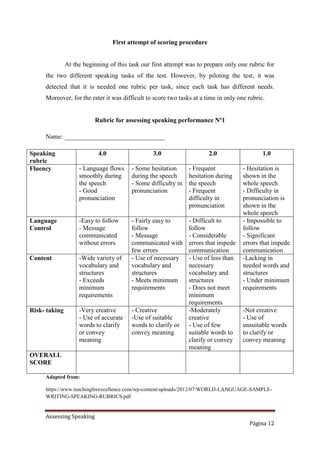
First attempt of scoring procedure
At the beginning of this task our first attempt was to prepare only one rubric for
the two different speaking tasks of the test. However, by piloting the test, it was
detected that it is needed one rubric per task, since each task has different needs.
Moreover, for the rater it was difficult to score two tasks at a time in only one rubric.
Rubric for assessing speaking performance Nº1
Name: _______________________________
Speaking
rubric
4.0 3.0 2.0 1.0
Fluency - Language flows
smoothly during
the speech
- Good
pronunciation
- Some hesitation
during the speech
- Some difficulty in
pronunciation
- Frequent
hesitation during
the speech
- Frequent
difficulty in
pronunciation
- Hesitation is
shown in the
whole speech
- Difficulty in
pronunciation is
shown in the
whole speech
Language
Control
-Easy to follow
- Message
communicated
without errors
- Fairly easy to
follow
- Message
communicated with
few errors
- Difficult to
follow
- Considerable
errors that impede
communication
- Impossible to
follow
- Significant
errors that impede
communication
Content -Wide variety of
vocabulary and
structures
- Exceeds
minimum
requirements
- Use of necessary
vocabulary and
structures
- Meets minimum
requirements
- Use of less than
necessary
vocabulary and
structures
- Does not meet
minimum
requirements
-Lacking in
needed words and
structures
- Under minimum
requirements
Risk- taking -Very creative
- Use of accurate
words to clarify
or convey
meaning
- Creative
-Use of suitable
words to clarify or
convey meaning
-Moderately
creative
- Use of few
suitable words to
clarify or convey
meaning
-Not creative
- Use of
unsuitable words
to clarify or
convey meaning
OVERALL
SCORE
Adapted from:
https://www.teachingforexcellence.com/wp-content/uploads/2012/07/WORLD-LANGUAGE-SAMPLE-
WRITING-SPEAKING-RUBRICS.pdf
Assessing Speaking
Página 13
Second attempt of scoring procedure
In the second attempt of the piloting it was used the same first rubric but, in this
case only for task Nº1. Besides, a rating scale was added for the second task in order to
make the test organized and clear.
Rubric for assessing speaking performance task Nº1
Name: _______________________________
Speaking
rubric
4.0 3.0 2.0 1.0
Fluency - Language flows
smoothly during
the speech
- Good
pronunciation
- Some hesitation
during the speech
- Some difficulty in
pronunciation
- Frequent
hesitation during
the speech
- Frequent
difficulty in
pronunciation
- Hesitation is
shown in the
whole speech
- Difficulty in
pronunciation is
shown in the
whole speech
Language
Control
-Easy to follow
- Message
communicated
without errors
- Fairly easy to
follow
- Message
communicated with
few errors
- Difficult to
follow
- Considerable
errors that impede
communication
- Impossible to
follow
- Significant
errors that impede
communication
Content -Wide variety of
vocabulary and
structures
- Exceeds
minimum
requirements
- Use of necessary
vocabulary and
structures
- Meets minimum
requirements
- Use of less than
necessary
vocabulary and
structures
- Does not meet
minimum
requirements
-Lacking in
needed words and
structures
- Under minimum
requirements
Risk- taking -Very creative
- Use of accurate
words to clarify
or convey
meaning
- Creative
-Use of suitable
words to clarify or
convey meaning
-Moderately
creative
- Use of few
suitable words to
clarify or convey
meaning
-Not creative
- Use of
unsuitable words
to clarify or
convey meaning
OVERALL
SCORE
Adapted from:
https://www.teachingforexcellence.com/wp-content/uploads/2012/07/WORLD-LANGUAGE-SAMPLE-
WRITING-SPEAKING-RUBRICS.pdf
Assessing Speaking
Página 14
Rating scale for assessing speaking performance task Nº2
The following rubric is the instrument we used to asses task number 2 from the
speaking test.
Name: _______________________________
Adapted from: www.ealmb.ca/.../speaking-rubric- - -
Holistic Criteria (Overall Effectiveness) Exceeds
Level (4)
Achieved
Level
(3)
Elementary
(2)
Needs
improvement
(1)
Task instructions were followed.
Speaks intelligibly.
Purpose of communication is achieved.
Language and content are relevant and
appropriate for context and purpose.
Assessing Speaking
Página 15
References
ETS (2002). TSE Practice Questions. Downloaded from http://www.toefl.org/tse/
tseindx.html under the Practice questions link, 15 May 2002.
INSERT SIX PICTURE
Fulcher, G. (n.d.). In Assessing Speaking: Putting the Pieces Together. Retrieved June
3, 2013, from http://uvirtual.ucsc.cl/file.php/9281/AssessingSpeaking4-12.pdf
Luoma, S. (2004). Assessing speaking. Cambridge, UK: Cambridge University Press.
Nasjonalt læremiddelsenter (Norway) (1996). Kartleggning av kommunikativ
kompetanse i engelsk. Speaking test. 8th class. Oslo: Nasjonalt læremiddelsenter.

Speaking tasks

  • 1.
    UNIVERSIDAD CATOLICA DELA SSMA. CONCEPCION ASSESSING SPEAKING ASSESSMENT EDUCATION FACULTY ENGLISH LANGUAGE DEPARTMENT KARLA ESSMANN TORRES ANALIA NOVA GONZALEZ PROFESSOR ROXANNA CORREA PEREZ DATE CONCEPCION, 2013
  • 2.
    Assessing Speaking Página 2 Speakingtask 1 Please look at the six pictures below. Tell the story that the pictures show, starting with picture number 1 and going through picture number 6. Please take one minute to look at the pictures and think about the story. Do not begin the story until you are told to do so. Tell me the story that the pictures show. (3 minutes) (ETS, 2002) 2 31 54 6
  • 3.
    Assessing Speaking Página 3 Speakingtask 2 Please look at the pictures below. When you need to buy some provisions, do you prefer a shop or a supermarket? Why? (2 minutes) Imagine that we are standing in front of your house. Tell me how to get to the shop or supermarket from there. Please take one minute to think about the answer. Do not answer until you are told to do so. Answer the question. (3 minutes) Shop Supermarket (© Nasjonalt læremiddelsenter, Norway, 1996) SEE ATTACHED HARD COPY
  • 4.
    Assessing Speaking Página 4 Specificationsfrom Luoma (2004) 1. Test purpose: The purpose of the test is to evaluate the student’s capacity of telling a story, expressing preferences and giving directions. 2. Description of the examinees: Age: 18 years old Grade: First year at the University Level of English: Intermediate Hour of English: 2 modules per week (45 minutes each) Other English courses: English summer camps 2013 3. Test Level: For University students. Intermediate 4. Definition of construct: Luoma, S. (2004). Assessing speaking. Cambridge, UK: Cambridge University Press. 5. Number of sections/ papers: 2 sections. 6. Time for each section paper: - First section: 4 minutes. - Second section: 6 minutes.
  • 5.
    Assessing Speaking Página 5 7.Weighting for each section: Each section contains 16 points. 8. Target language situation: “Sequencing events to tell a story”: First, second, then, next, finally, simple past tense. “Expressing preferences”: I prefer this...because... “Giving directions”: Go straight on, turn back./go back, turn left/right (into …-street), go along, cross, take the first/second road on the left/right, straight on, opposite, near, next to, between, at the end (of), on/at the corner, behind, in front of, around the corner. 9. Text types: Three pictures and written questions. 10. Text Length: Two pages long which take as a whole 10 minutes. 11. Language skill to be tested: Speaking (oral performance). 12. Language elements to be tested: Fluency, pronunciation, vocabulary, articulateness. 13. Test tasks: -Speaking task 1 Please look at the six pictures below. Tell me the story that the pictures show, starting with picture number 1 and going through picture number 6. Please take one minute to look at the pictures and think about the story. Do not begin the story until you are told to do so. Tell me the story that the pictures show. (3 minutes)
  • 6.
    Assessing Speaking Página 6 -Speakingtask 2 Please look at the pictures below. When you need to buy some groceries, do you prefer a grocery shop or a supermarket? Why? (2 minutes) Imagine that we are standing in front of your house. Tell me how to get to the shop or supermarket from there. Please take one minute to think about the answer. Do not answer until you are told to do so. Answer the question. (3 minutes) 14. Test Methods: The test will be individual, in the first section the test taker will have 4 minutes to answer and in the second section the test taker will have 6 minutes to answer.
  • 7.
    Assessing Speaking Página 7 15.Rubric: Rubric for assessing speaking performance Nº1: Name: _______________________________ Speaking rubric 4.0 3.0 2.0 1.0 Fluency - Language flows smoothly during the speech - Good pronunciation - Some hesitation during the speech - Some difficulty in pronunciation - Frequent hesitation during the speech - Frequent difficulty in pronunciation - Hesitation is shown in the whole speech - Difficulty in pronunciation is shown in the whole speech Language Control -Easy to follow - Message communicated without errors - Fairly easy to follow - Message communicated with few errors - Difficult to follow - Considerable errors that impede communication - Impossible to follow - Significant errors that impede communication Content -Wide variety of vocabulary and structures - Exceeds minimum requirements - Use of necessary vocabulary and structures - Meets minimum requirements - Use of less than necessary vocabulary and structures - Does not meet minimum requirements -Lacking in needed words and structures - Under minimum requirements Risk- taking -Very creative - Use of accurate words to clarify or convey meaning - Creative -Use of suitable words to clarify or convey meaning -Moderately creative - Use of few suitable words to clarify or convey meaning -Not creative - Use of unsuitable words to clarify or convey meaning OVERALL SCORE Adapted from: https://www.teachingforexcellence.com/wp-content/uploads/2012/07/WORLD-LANGUAGE-SAMPLE- WRITING-SPEAKING-RUBRICS.pdf
  • 8.
    Assessing Speaking Página 8 Ratingscale for assessing speaking performance Nº2: Adapted from: www.ealmb.ca/.../speaking-rubric- - - 16. Criteria for marking: Task Nº1: Fluency, language control, content, risk taking. Task Nº2: Task instructions were followed, Speaks intelligibly, Purpose of communication is achieved, Language and content are relevant and appropriate for context, and purpose. 17. Description typical performance at each level: See page 7 and 8. 18. Description of what candidates at each level can do in the real world: See page 7 and 8. 19. Sample papers: See page 2 and 3. 20. Sample of student’s performance on task: See pages 12, 13 and 14. Holistic Criteria (Overall Effectiveness) Exceeds Level (4) Achieved Level (3) Elementary (2) Needs improvement (1) Task instructions were followed. Speaks intelligibly. Purpose of communication is achieved. Language and content are relevant and appropriate for context and purpose.
  • 9.
    Assessing Speaking Página 9 FulcherSpecifications 1. Task Orientation: Guided since the structure and information is given by the examiner; however, the examinee is free to use different vocabulary or structures. 2. Interactional relationship: It is one way interaction, since the examiner and the examinee interact with each other. 3. Goal orientation: Convergent. 4. Interlocutor Status and familiarity: Teacher -Students: Higher status. Students – Teacher: Lower status. 5. Topic: Sequencing events to tell a story, expressing preferences, giving directions.
  • 10.
    Assessing Speaking Página 10 ScoringProcedure Rubric for assessing speaking performance Nº1 Name: _______________________________ Speaking rubric 4.0 3.0 2.0 1.0 Fluency - Language flows smoothly during the speech - Good pronunciation - Some hesitation during the speech - Some difficulty in pronunciation - Frequent hesitation during the speech - Frequent difficulty in pronunciation - Hesitation is shown in the whole speech - Difficulty in pronunciation is shown in the whole speech Language Control -Easy to follow - Message communicated without errors - Fairly easy to follow - Message communicated with few errors - Difficult to follow - Considerable errors that impede communication - Impossible to follow - Significant errors that impede communication Content -Wide variety of vocabulary and structures - Exceeds minimum requirements - Use of necessary vocabulary and structures - Meets minimum requirements - Use of less than necessary vocabulary and structures - Does not meet minimum requirements -Lacking in needed words and structures - Under minimum requirements Risk- taking -Very creative - Use of accurate words to clarify or convey meaning - Creative -Use of suitable words to clarify or convey meaning -Moderately creative - Use of few suitable words to clarify or convey meaning -Not creative - Use of unsuitable words to clarify or convey meaning OVERALL SCORE Adapted from: https://www.teachingforexcellence.com/wp-content/uploads/2012/07/WORLD-LANGUAGE-SAMPLE- WRITING-SPEAKING-RUBRICS.pdf
  • 11.
    Assessing Speaking Página 11 Ratingscale for assessing speaking performance Nº2 Name: _______________________________ Adapted from: www.ealmb.ca/.../speaking-rubric- - - Holistic Criteria (Overall Effectiveness) Exceeds Level (4) Achieved Level (3) Elementary (2) Needs improvement (1) Task instructions were followed. Speaks intelligibly. Purpose of communication is achieved. Language and content are relevant and appropriate for context and purpose.
  • 12.
    Assessing Speaking Página 12 Firstattempt of scoring procedure At the beginning of this task our first attempt was to prepare only one rubric for the two different speaking tasks of the test. However, by piloting the test, it was detected that it is needed one rubric per task, since each task has different needs. Moreover, for the rater it was difficult to score two tasks at a time in only one rubric. Rubric for assessing speaking performance Nº1 Name: _______________________________ Speaking rubric 4.0 3.0 2.0 1.0 Fluency - Language flows smoothly during the speech - Good pronunciation - Some hesitation during the speech - Some difficulty in pronunciation - Frequent hesitation during the speech - Frequent difficulty in pronunciation - Hesitation is shown in the whole speech - Difficulty in pronunciation is shown in the whole speech Language Control -Easy to follow - Message communicated without errors - Fairly easy to follow - Message communicated with few errors - Difficult to follow - Considerable errors that impede communication - Impossible to follow - Significant errors that impede communication Content -Wide variety of vocabulary and structures - Exceeds minimum requirements - Use of necessary vocabulary and structures - Meets minimum requirements - Use of less than necessary vocabulary and structures - Does not meet minimum requirements -Lacking in needed words and structures - Under minimum requirements Risk- taking -Very creative - Use of accurate words to clarify or convey meaning - Creative -Use of suitable words to clarify or convey meaning -Moderately creative - Use of few suitable words to clarify or convey meaning -Not creative - Use of unsuitable words to clarify or convey meaning OVERALL SCORE Adapted from: https://www.teachingforexcellence.com/wp-content/uploads/2012/07/WORLD-LANGUAGE-SAMPLE- WRITING-SPEAKING-RUBRICS.pdf
  • 13.
    Assessing Speaking Página 13 Secondattempt of scoring procedure In the second attempt of the piloting it was used the same first rubric but, in this case only for task Nº1. Besides, a rating scale was added for the second task in order to make the test organized and clear. Rubric for assessing speaking performance task Nº1 Name: _______________________________ Speaking rubric 4.0 3.0 2.0 1.0 Fluency - Language flows smoothly during the speech - Good pronunciation - Some hesitation during the speech - Some difficulty in pronunciation - Frequent hesitation during the speech - Frequent difficulty in pronunciation - Hesitation is shown in the whole speech - Difficulty in pronunciation is shown in the whole speech Language Control -Easy to follow - Message communicated without errors - Fairly easy to follow - Message communicated with few errors - Difficult to follow - Considerable errors that impede communication - Impossible to follow - Significant errors that impede communication Content -Wide variety of vocabulary and structures - Exceeds minimum requirements - Use of necessary vocabulary and structures - Meets minimum requirements - Use of less than necessary vocabulary and structures - Does not meet minimum requirements -Lacking in needed words and structures - Under minimum requirements Risk- taking -Very creative - Use of accurate words to clarify or convey meaning - Creative -Use of suitable words to clarify or convey meaning -Moderately creative - Use of few suitable words to clarify or convey meaning -Not creative - Use of unsuitable words to clarify or convey meaning OVERALL SCORE Adapted from: https://www.teachingforexcellence.com/wp-content/uploads/2012/07/WORLD-LANGUAGE-SAMPLE- WRITING-SPEAKING-RUBRICS.pdf
  • 14.
    Assessing Speaking Página 14 Ratingscale for assessing speaking performance task Nº2 The following rubric is the instrument we used to asses task number 2 from the speaking test. Name: _______________________________ Adapted from: www.ealmb.ca/.../speaking-rubric- - - Holistic Criteria (Overall Effectiveness) Exceeds Level (4) Achieved Level (3) Elementary (2) Needs improvement (1) Task instructions were followed. Speaks intelligibly. Purpose of communication is achieved. Language and content are relevant and appropriate for context and purpose.
  • 15.
    Assessing Speaking Página 15 References ETS(2002). TSE Practice Questions. Downloaded from http://www.toefl.org/tse/ tseindx.html under the Practice questions link, 15 May 2002. INSERT SIX PICTURE Fulcher, G. (n.d.). In Assessing Speaking: Putting the Pieces Together. Retrieved June 3, 2013, from http://uvirtual.ucsc.cl/file.php/9281/AssessingSpeaking4-12.pdf Luoma, S. (2004). Assessing speaking. Cambridge, UK: Cambridge University Press. Nasjonalt læremiddelsenter (Norway) (1996). Kartleggning av kommunikativ kompetanse i engelsk. Speaking test. 8th class. Oslo: Nasjonalt læremiddelsenter.