EII604
Chapter 4 - Introduction
Assessing the Four Language Skills
ABOUT SKILLS ASSESSMENT
The four language skills that we assess on a day to
day basis are reading, writing, listening and
speaking.
These skills should be integrated during
assessment and not tested individually. This
allows for language ability to be assessed
authentically and provides more washback.
Grammar, vocabulary and phonology are not valid
assessments as isolated items. A grammar or vocabulary test
must be assessed within the realm of skills assessment.
Otherwise, the “test” would be a practice activity.
These aspects of language are part of integrated skills
assessment and should not be treated separately.
ABOUT SKILLS ASSESSMENT
There are two interacting responses that we must consider
when assessing integrated skills:
• performance
• competence
Performance is how a student carries out a certain act or
task.
Competency is his/her ability to accomplish the objective or
goal of the task using the integrated skills.
ABOUT SKILLS ASSESSMENT
Sometimes a performance does not demonstrate true
competence:
A student may possess the competency to achieve the task
or goal at hand, but his/her performance may not result in
the achievement of a given task due to a reliability factor
such as illness, emotional distraction, validity of exam site,
etc.
Multiple measures will always give you a more reliable and
valid assessment than a single measure.
ABOUT SKILLS ASSESSMENT
Therefore, it is important to offer two or more performances
and/or contexts in order to draw a conclusion. Some
examples are:
• several tests that are combined to form an
assessment;
• a single test with multiple test tasks to account for
learning styles and performance variables;
• in-class and extra-class graded work;
• alternative forms of assessment (e.g. journal, portfolio,
conference, observation, self assessment, peer-
assessment)
ABOUT SKILLS ASSESSMENT
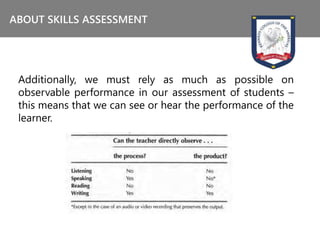
Additionally, we must rely as much as possible on
observable performance in our assessment of students –
this means that we can see or hear the performance of the
learner.
ABOUT SKILLS ASSESSMENT
Brown, H. Douglas, 2004. Language Assessment: Principles and classroom
practices. Pearson Education, Inc.
REFERENCES

Chapter 4 introduction to assessing language skills

  • 1.
    EII604 Chapter 4 -Introduction Assessing the Four Language Skills
  • 2.
    ABOUT SKILLS ASSESSMENT Thefour language skills that we assess on a day to day basis are reading, writing, listening and speaking. These skills should be integrated during assessment and not tested individually. This allows for language ability to be assessed authentically and provides more washback.
  • 3.
    Grammar, vocabulary andphonology are not valid assessments as isolated items. A grammar or vocabulary test must be assessed within the realm of skills assessment. Otherwise, the “test” would be a practice activity. These aspects of language are part of integrated skills assessment and should not be treated separately. ABOUT SKILLS ASSESSMENT
  • 4.
    There are twointeracting responses that we must consider when assessing integrated skills: • performance • competence Performance is how a student carries out a certain act or task. Competency is his/her ability to accomplish the objective or goal of the task using the integrated skills. ABOUT SKILLS ASSESSMENT
  • 5.
    Sometimes a performancedoes not demonstrate true competence: A student may possess the competency to achieve the task or goal at hand, but his/her performance may not result in the achievement of a given task due to a reliability factor such as illness, emotional distraction, validity of exam site, etc. Multiple measures will always give you a more reliable and valid assessment than a single measure. ABOUT SKILLS ASSESSMENT
  • 6.
    Therefore, it isimportant to offer two or more performances and/or contexts in order to draw a conclusion. Some examples are: • several tests that are combined to form an assessment; • a single test with multiple test tasks to account for learning styles and performance variables; • in-class and extra-class graded work; • alternative forms of assessment (e.g. journal, portfolio, conference, observation, self assessment, peer- assessment) ABOUT SKILLS ASSESSMENT
  • 7.
    Additionally, we mustrely as much as possible on observable performance in our assessment of students – this means that we can see or hear the performance of the learner. ABOUT SKILLS ASSESSMENT
  • 8.
    Brown, H. Douglas,2004. Language Assessment: Principles and classroom practices. Pearson Education, Inc. REFERENCES