Assessing Oral Language
Proficiency in our students
Learning about
speaking tests
More resources
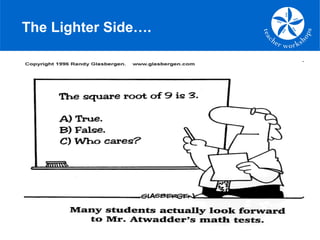
The Lighter Side….
What’s on tap?
 What are the principles of good test
design?
 Practice making test rubrics and
assessing.
 Learn how to deliver and design a
“retelling” speaking test AND a level
placement test.
What do you believe….?
We give tests so that ……………………..
Tests provide teachers with ……………………..
When testing in my class, I usually ……………………..
Tests help students ……………………..
A good speaking test should ……………………..
All tests must ……………………..
My opinion on tests is ……………………..
An example of one kind of test is ……………………..
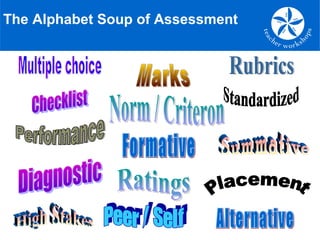
The Alphabet Soup of Assessment
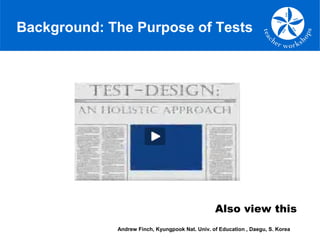
Background: The Purpose of Tests
Andrew Finch, Kyungpook Nat. Univ. of Education , Daegu, S. Korea
Also view this
Basics 1 – Making a rubric
What is a rubric?
"a scoring tool that lists the criteria for a
piece of work or 'what counts.' "
-- Heidi Goodrich
Complete the Following…..
The purpose of testing is….
Tests can easily become ….
Classroom based tests
should ………
Also, they should ……….
Complete the Following…..
The purpose of testing is….
To give information to the
students and teachers (also
parents!)
Complete the Following…..
Tests can easily become ….
Normative and Comparative.
(but should be Criterion based
and about what the student
CAN do)
Complete the following
Classroom based tests should
………
- Non – threatening
environment
- Focus on “real situations”
and the process of learning.
Complete the Following…..
Also, they should ……….
Provide big picture.
Emphasize thinking skills and
collaboration.
provide information and be
about the learning.
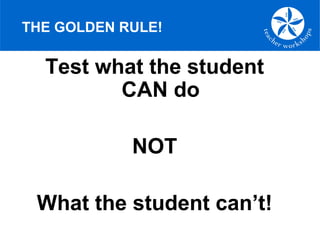
THE GOLDEN RULE!
Test what the student
CAN do
NOT
What the student can’t!
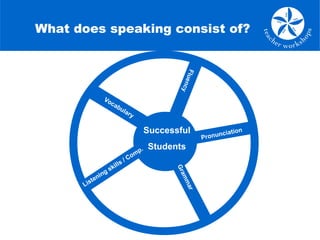
Listening skills / Comp.
Vocabulary
Fluency
Grammar
Successful
Students
Pronunciation
What does speaking consist of?
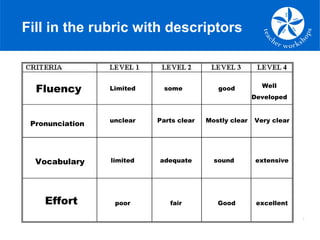
Fill in the rubric with descriptors
Fluency
Pronunciation
Effort
Vocabulary
Limited
Parts clear Mostly clear Very clearunclear
some good Well
Developed
limited adequate sound extensive
poor fair Good excellent
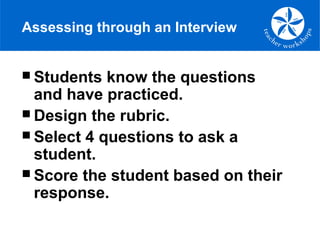
Assessing through an Interview
 Students know the questions
and have practiced.
 Design the rubric.
 Select 4 questions to ask a
student.
 Score the student based on their
response.
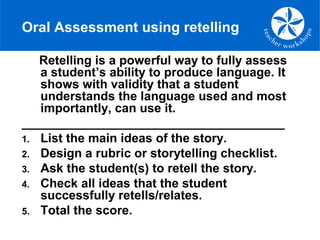
Oral Assessment using retelling
Retelling is a powerful way to fully assess
a student’s ability to produce language. It
shows with validity that a student
understands the language used and most
importantly, can use it.
______________________________________
1. List the main ideas of the story.
2. Design a rubric or storytelling checklist.
3. Ask the student(s) to retell the story.
4. Check all ideas that the student
successfully retells/relates.
5. Total the score.
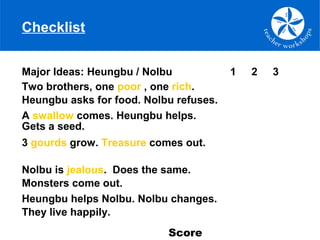
Checklist
Major Ideas: Heungbu / Nolbu 1 2 3
Two brothers, one poor , one rich.
Heungbu asks for food. Nolbu refuses.
A swallow comes. Heungbu helps.
Gets a seed.
3 gourds grow. Treasure comes out.
Nolbu is jealous. Does the same.
Monsters come out.
Heungbu helps Nolbu. Nolbu changes.
They live happily.
Score
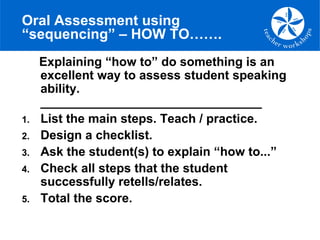
Oral Assessment using
“sequencing” – HOW TO…….
Explaining “how to” do something is an
excellent way to assess student speaking
ability.
________________________________
1. List the main steps. Teach / practice.
2. Design a checklist.
3. Ask the student(s) to explain “how to...”
4. Check all steps that the student
successfully retells/relates.
5. Total the score.
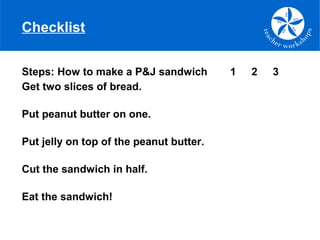
Checklist
Steps: How to make a P&J sandwich 1 2 3
Get two slices of bread.
Put peanut butter on one.
Put jelly on top of the peanut butter.
Cut the sandwich in half.
Eat the sandwich!
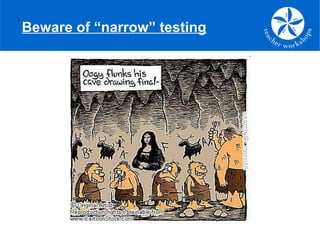
Beware of “narrow” testing
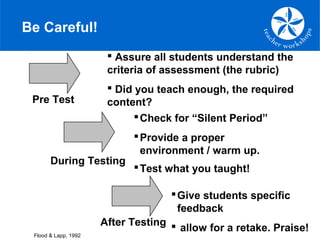
Be Careful!
 Assure all students understand the
criteria of assessment (the rubric)
 Did you teach enough, the required
content?
Check for “Silent Period”
Provide a proper
environment / warm up.
Test what you taught!
Give students specific
feedback
 allow for a retake. Praise!
Flood & Lapp, 1992
Pre Test
During Testing
After Testing
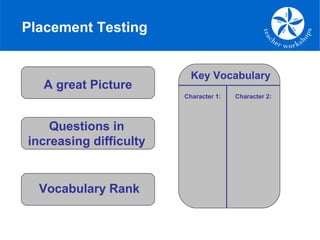
Placement Testing
A great Picture
Questions in
increasing difficulty
Vocabulary Rank
Key Vocabulary
Character 1: Character 2:
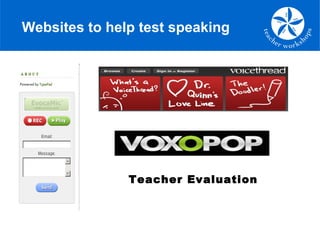
Websites to help test speaking
Teacher Evaluation
ddeubel@gmail.com
http://eflclassroom.ning.com
“one teaches, two learn.”

Assessment of Oral language proficiency

  • 1.
    Assessing Oral Language Proficiencyin our students Learning about speaking tests More resources
  • 2.
  • 3.
    What’s on tap? What are the principles of good test design?  Practice making test rubrics and assessing.  Learn how to deliver and design a “retelling” speaking test AND a level placement test.
  • 4.
    What do youbelieve….? We give tests so that …………………….. Tests provide teachers with …………………….. When testing in my class, I usually …………………….. Tests help students …………………….. A good speaking test should …………………….. All tests must …………………….. My opinion on tests is …………………….. An example of one kind of test is ……………………..
  • 5.
    The Alphabet Soupof Assessment
  • 6.
    Background: The Purposeof Tests Andrew Finch, Kyungpook Nat. Univ. of Education , Daegu, S. Korea Also view this
  • 7.
    Basics 1 –Making a rubric What is a rubric? "a scoring tool that lists the criteria for a piece of work or 'what counts.' " -- Heidi Goodrich
  • 8.
    Complete the Following….. Thepurpose of testing is…. Tests can easily become …. Classroom based tests should ……… Also, they should ……….
  • 9.
    Complete the Following….. Thepurpose of testing is…. To give information to the students and teachers (also parents!)
  • 10.
    Complete the Following….. Testscan easily become …. Normative and Comparative. (but should be Criterion based and about what the student CAN do)
  • 11.
    Complete the following Classroombased tests should ……… - Non – threatening environment - Focus on “real situations” and the process of learning.
  • 12.
    Complete the Following….. Also,they should ………. Provide big picture. Emphasize thinking skills and collaboration. provide information and be about the learning.
  • 13.
    THE GOLDEN RULE! Testwhat the student CAN do NOT What the student can’t!
  • 14.
    Listening skills /Comp. Vocabulary Fluency Grammar Successful Students Pronunciation What does speaking consist of?
  • 15.
    Fill in therubric with descriptors Fluency Pronunciation Effort Vocabulary Limited Parts clear Mostly clear Very clearunclear some good Well Developed limited adequate sound extensive poor fair Good excellent
  • 16.
    Assessing through anInterview  Students know the questions and have practiced.  Design the rubric.  Select 4 questions to ask a student.  Score the student based on their response.
  • 17.
    Oral Assessment usingretelling Retelling is a powerful way to fully assess a student’s ability to produce language. It shows with validity that a student understands the language used and most importantly, can use it. ______________________________________ 1. List the main ideas of the story. 2. Design a rubric or storytelling checklist. 3. Ask the student(s) to retell the story. 4. Check all ideas that the student successfully retells/relates. 5. Total the score.
  • 18.
    Checklist Major Ideas: Heungbu/ Nolbu 1 2 3 Two brothers, one poor , one rich. Heungbu asks for food. Nolbu refuses. A swallow comes. Heungbu helps. Gets a seed. 3 gourds grow. Treasure comes out. Nolbu is jealous. Does the same. Monsters come out. Heungbu helps Nolbu. Nolbu changes. They live happily. Score
  • 19.
    Oral Assessment using “sequencing”– HOW TO……. Explaining “how to” do something is an excellent way to assess student speaking ability. ________________________________ 1. List the main steps. Teach / practice. 2. Design a checklist. 3. Ask the student(s) to explain “how to...” 4. Check all steps that the student successfully retells/relates. 5. Total the score.
  • 20.
    Checklist Steps: How tomake a P&J sandwich 1 2 3 Get two slices of bread. Put peanut butter on one. Put jelly on top of the peanut butter. Cut the sandwich in half. Eat the sandwich!
  • 21.
  • 22.
    Be Careful!  Assureall students understand the criteria of assessment (the rubric)  Did you teach enough, the required content? Check for “Silent Period” Provide a proper environment / warm up. Test what you taught! Give students specific feedback  allow for a retake. Praise! Flood & Lapp, 1992 Pre Test During Testing After Testing
  • 23.
    Placement Testing A greatPicture Questions in increasing difficulty Vocabulary Rank Key Vocabulary Character 1: Character 2:
  • 24.
    Websites to helptest speaking Teacher Evaluation
  • 25.