SELECTED RESPONSE 
ASSESSMENT 
WORKSHOP 
Prepared by the 
Office of Assessment & Analysis 
October 14, 2014
OBJECTIVES 
By the end of today’s workshop, you will: 
 Be able to evaluate the quality of a written 
assessment by applying the 4 quality standards 
 Be able to determine if a test is built of high-quality 
ingredients 
 Collaborate with your division/PLC groups to: 
 Apply the four quality standards to the creation or revision 
of an assessment
4 QUALITY ASSESSMENT 
STANDARDS 
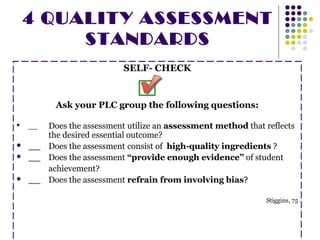
SELF- CHECK 
Ask your PLC group the following questions: 
 __ Does the assessment utilize an assessment method that reflects 
the desired essential outcome? 
 __ Does the assessment consist of high-quality ingredients ? 
 __ Does the assessment “provide enough evidence” of student 
achievement? 
 __ Does the assessment refrain from involving bias?? 
Stiggins, 75
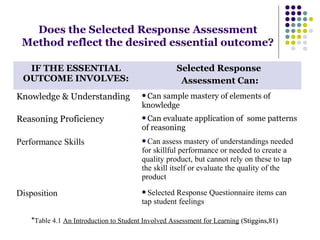
Does the Selected Response Assessment 
Method reflect the desired essential outcome? 
IF THE ESSENTIAL 
OUTCOME INVOLVES: 
Selected Response 
Assessment Can: 
Knowledge & Understanding Can sample mastery of elements of 
knowledge 
Reasoning Proficiency Can evaluate application of some patterns 
of reasoning 
Performance Skills Can assess mastery of understandings needed 
for skillful performance or needed to create a 
quality product, but cannot rely on these to tap 
the skill itself or evaluate the quality of the 
product 
Disposition Selected Response Questionnaire items can 
tap student feelings 
*Table 4.1 An Introduction to Student Involved Assessment for Learning ((SSttiiggggiinnss,,8811))
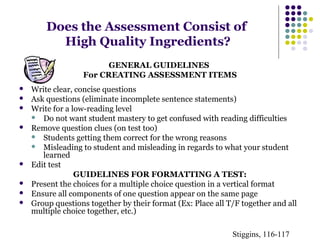
Does the Assessment Consist of 
High Quality Ingredients? 
GENERAL GUIDELINES 
For CREATING ASSESSMENT ITEMS 
 Write clear, concise questions 
 Ask questions (eliminate incomplete sentence statements) 
 Write for a low-reading level 
 Do not want student mastery to get confused with reading difficulties 
 Remove question clues (on test too) 
 Students getting them correct for the wrong reasons 
 Misleading to student and misleading in regards to what your student 
learned 
 Edit test 
GUIDELINES FOR FORMATTING A TEST: 
 Present the choices for a multiple choice question in a vertical format 
 Ensure all components of one question appear on the same page 
 Group questions together by their format (Ex: Place all T/F together and all 
multiple choice together, etc.) 
Stiggins, 116-117
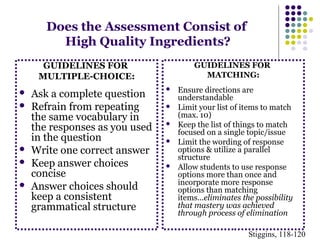
Does the Assessment Consist of 
High Quality Ingredients? 
GUIDELINES FOR 
MULTIPLE-CHOICE: 
 Ask a complete question 
 Refrain from repeating 
the same vocabulary in 
the responses as you used 
in the question 
 Write one correct answer 
 Keep answer choices 
concise 
 Answer choices should 
keep a consistent 
grammatical structure 
GUIDELINES FOR 
MATCHING: 
 Ensure directions are 
understandable 
 Limit your list of items to match 
(max. 10) 
 Keep the list of things to match 
focused on a single topic/issue 
 Limit the wording of response 
options & utilize a parallel 
structure 
 Allow students to use response 
options more than once and 
incorporate more response 
options than matching 
items...eliminates the possibility 
that mastery was achieved 
through process of elimination 
Stiggins, 118-120
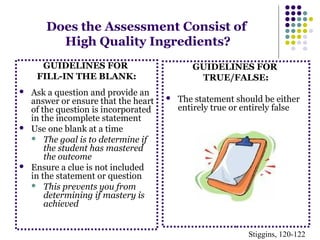
Does the Assessment Consist of 
High Quality Ingredients? 
GUIDELINES FOR 
FILL-IN THE BLANK: 
 Ask a question and provide an 
answer or ensure that the heart 
of the question is incorporated 
in the incomplete statement 
 Use one blank at a time 
 The goal is to determine if 
the student has mastered 
the outcome 
 Ensure a clue is not included 
in the statement or question 
 This prevents you from 
determining if mastery is 
achieved 
GUIDELINES FOR 
TRUE/FALSE: 
 The statement should be either 
entirely true or entirely false 
Stiggins, 120-122
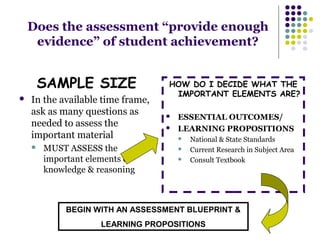
Does the assessment “provide enough 
evidence” of student achievement? 
SAMPLE SIZE 
 In the available time frame, 
ask as many questions as 
needed to assess the 
important material 
 MUST ASSESS the 
important elements of 
knowledge & reasoning 
HOW DO I DECIDE WHAT THE 
IMPORTANT ELEMENTS ARE? 
 ESSENTIAL OUTCOMES/ 
 LEARNING PROPOSITIONS 
 National & State Standards 
 Current Research in Subject Area 
 Consult Textbook 
BEGIN WITH AN ASSESSMENT BLUEPRINT & 
LEARNING PROPOSITIONS
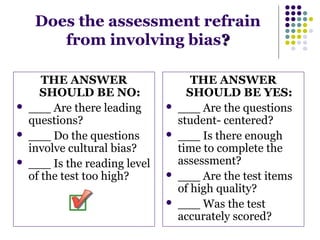
Does the assessment refrain 
from involving bias?? 
THE ANSWER 
SHOULD BE NO: 
 ___ Are there leading 
questions? 
 ___ Do the questions 
involve cultural bias? 
 ___ Is the reading level 
of the test too high? 
THE ANSWER 
SHOULD BE YES: 
 ___ Are the questions 
student- centered? 
 ___ Is there enough 
time to complete the 
assessment? 
 ___ Are the test items 
of high quality? 
 ___ Was the test 
accurately scored?
REFERNCES 
Stiggins, R. (2008). An Introduction to 
student-involved assessment for learning, 5th 
ed. Columbus, Ohio: Pearson. 
Stiggins, R. (2008). Weblinks. In An 
Introduction to student-involved assessment 
for learning, 5th ed. (chapter 5). Retrieved 
from 
http://wps.prenhall.com/chet_stiggins_stud 
ent_5/72/18643/4772626.cw/index.html

Selected Response Assessment

  • 1.
    SELECTED RESPONSE ASSESSMENT WORKSHOP Prepared by the Office of Assessment & Analysis October 14, 2014
  • 2.
    OBJECTIVES By theend of today’s workshop, you will:  Be able to evaluate the quality of a written assessment by applying the 4 quality standards  Be able to determine if a test is built of high-quality ingredients  Collaborate with your division/PLC groups to:  Apply the four quality standards to the creation or revision of an assessment
  • 3.
    4 QUALITY ASSESSMENT STANDARDS SELF- CHECK Ask your PLC group the following questions:  __ Does the assessment utilize an assessment method that reflects the desired essential outcome?  __ Does the assessment consist of high-quality ingredients ?  __ Does the assessment “provide enough evidence” of student achievement?  __ Does the assessment refrain from involving bias?? Stiggins, 75
  • 4.
    Does the SelectedResponse Assessment Method reflect the desired essential outcome? IF THE ESSENTIAL OUTCOME INVOLVES: Selected Response Assessment Can: Knowledge & Understanding Can sample mastery of elements of knowledge Reasoning Proficiency Can evaluate application of some patterns of reasoning Performance Skills Can assess mastery of understandings needed for skillful performance or needed to create a quality product, but cannot rely on these to tap the skill itself or evaluate the quality of the product Disposition Selected Response Questionnaire items can tap student feelings *Table 4.1 An Introduction to Student Involved Assessment for Learning ((SSttiiggggiinnss,,8811))
  • 5.
    Does the AssessmentConsist of High Quality Ingredients? GENERAL GUIDELINES For CREATING ASSESSMENT ITEMS  Write clear, concise questions  Ask questions (eliminate incomplete sentence statements)  Write for a low-reading level  Do not want student mastery to get confused with reading difficulties  Remove question clues (on test too)  Students getting them correct for the wrong reasons  Misleading to student and misleading in regards to what your student learned  Edit test GUIDELINES FOR FORMATTING A TEST:  Present the choices for a multiple choice question in a vertical format  Ensure all components of one question appear on the same page  Group questions together by their format (Ex: Place all T/F together and all multiple choice together, etc.) Stiggins, 116-117
  • 6.
    Does the AssessmentConsist of High Quality Ingredients? GUIDELINES FOR MULTIPLE-CHOICE:  Ask a complete question  Refrain from repeating the same vocabulary in the responses as you used in the question  Write one correct answer  Keep answer choices concise  Answer choices should keep a consistent grammatical structure GUIDELINES FOR MATCHING:  Ensure directions are understandable  Limit your list of items to match (max. 10)  Keep the list of things to match focused on a single topic/issue  Limit the wording of response options & utilize a parallel structure  Allow students to use response options more than once and incorporate more response options than matching items...eliminates the possibility that mastery was achieved through process of elimination Stiggins, 118-120
  • 7.
    Does the AssessmentConsist of High Quality Ingredients? GUIDELINES FOR FILL-IN THE BLANK:  Ask a question and provide an answer or ensure that the heart of the question is incorporated in the incomplete statement  Use one blank at a time  The goal is to determine if the student has mastered the outcome  Ensure a clue is not included in the statement or question  This prevents you from determining if mastery is achieved GUIDELINES FOR TRUE/FALSE:  The statement should be either entirely true or entirely false Stiggins, 120-122
  • 8.
    Does the assessment“provide enough evidence” of student achievement? SAMPLE SIZE  In the available time frame, ask as many questions as needed to assess the important material  MUST ASSESS the important elements of knowledge & reasoning HOW DO I DECIDE WHAT THE IMPORTANT ELEMENTS ARE?  ESSENTIAL OUTCOMES/  LEARNING PROPOSITIONS  National & State Standards  Current Research in Subject Area  Consult Textbook BEGIN WITH AN ASSESSMENT BLUEPRINT & LEARNING PROPOSITIONS
  • 9.
    Does the assessmentrefrain from involving bias?? THE ANSWER SHOULD BE NO:  ___ Are there leading questions?  ___ Do the questions involve cultural bias?  ___ Is the reading level of the test too high? THE ANSWER SHOULD BE YES:  ___ Are the questions student- centered?  ___ Is there enough time to complete the assessment?  ___ Are the test items of high quality?  ___ Was the test accurately scored?
  • 10.
    REFERNCES Stiggins, R.(2008). An Introduction to student-involved assessment for learning, 5th ed. Columbus, Ohio: Pearson. Stiggins, R. (2008). Weblinks. In An Introduction to student-involved assessment for learning, 5th ed. (chapter 5). Retrieved from http://wps.prenhall.com/chet_stiggins_stud ent_5/72/18643/4772626.cw/index.html