 By:
 IKA DEWI.K 201212500558
 SANTI 201212500490
 NURYANTI 201212500659
 TENDRI SAGITA.P 201212500491
While speaking is a production skill
that can be directly and empirically
observed,those observation are
invariably colored by the accuracy and
effectiveness of a test-taker’s listening
skill, which necessarily compromises
the reliability and validity of an or
production test
 Immitative
At the end of an continuum oif types of speaking
perfomance is the ability to simply parrot-
back(imitate) a word or phrase or possibly a sentence.
 Intensive
A second type of speaking frequently employed in
assessment contexts is the production of short streches
of oral language designed to demonstrate competence
in a narrow band grammatical,phrasal,lexical,or
phonological relationship (such as prosodic elements-
intonation,sterss,rhythm,juncture)
 Responsive
Responsive assessment tasks include interaction
and test comprehension but at the somewhat
ilimited level of very short conversations,standard
greetinggs and small talks,simple questions and
comments,and the like.the stimulus is almost
lways a spoken prompt (in order to preserve
authenticity), with perhaps only one or two
follow-up questions or retorts.
 Interactive
The difference between responsive and interactive
speaking is the length and complexity of
interaction,which sometimes includes multiple
exchange and/or multiple participants
 Extensive (monologue)
Extensive oral production task include
speeches,oral presentation,and story telling,during
which the opportunity for oral interaction from
listeners is either highly limited ( perhaps to non
verb responses) or ruled out together
 Microskills
 Produce differences among English phonemes and allophonic
variants.
 Produce chunks of language of different lengths.
 Produce English stess patterns,words in stressed and unstressed
positions,rhytmic structure, and intonation contours.
 Produce reduced forms of words and phrases.
 Use an adequate number of lexical units (words) to accomplish
pragmatic purposes.
 Produce fluent speech at different rates of delivery.
 Monitor one’s own oral production and use various strategic
devices-pauses,fillers,self-corrections,backtracking-to enhance the
clarity of the message or summarize it.
 Use grammatical word classes (nouns,verbs,etc), system
(e.g.,tense,agreement,pluralization), word order,pattern,rules and
elliptical forms.
 Produce speech in natural constituents: in apprppriate
phrases,pause group,breath groups,anda sentence constituents.
 Express a particular meaning in different grammatical forms.
 Use cohesive devices in spoken discourse.
 Macroskills
 Appropriately accomplish communicate function according
to situations,participants,and goals.
 Use appropriate
styles,registers,implicature,redundancies,pragmatic
conventions,conversations rules,floor-keeping and –
yealding,interrupting,and other sociolingustic features in
face-to-face conversations.
 Convey links and connection between events and
communicate such relations of vocal and peripheral
ideas,events and feelings,new information and given
informations,generalization and exemplification.
 Convey facial features,kinestics,body language,and other
non verbal cues along with verbal language.
 Develop and use a battery of speaking,strategies,such as
emphasizing key words,rephrasing,providing a context for
interpreting the meaning of words,appealing for help,and
accurately assessing how well your interlocutor is
understanding you.
immitative speaking
 An occasional phonologically focused
repetition task is warranted as long as
repetition tasks are not allowed to accupy a
dominant role in an overall oral production
assessment,and as long as you artfully avoid a
negative washback effect
 Example:Test-takers hear : repeat after me:
Beat[pause] bit [pause]
Bat [pause] vat [pause] etc.
Test-takers repeat the stimulus.
Phonepass Test
 The Phonepass test elicits computer-assessted
oral production over a telephone.Test-takers
read aloud,repeat sentences,say words,and
answer questions.With a downloadable test
sheet as a reference.test takers are directed to
telephone a designated number and listen for
directions.The test has five sections.
 Example:
Part A:
Test Takers read aloud selected sentences from among those printed on the test sheet.
Examples:
1. Traffic is a huge problem in Southern Califirnia
2. The endless city has no coherant mass transit system
3. Sharing rides was going to be solution to rush-hour traffic
Part B:
Test-takers repeat sentences dictated over the phone.
Examples: “leave town on the next train”
Part C:
Test takers answer questions with a single word or a short phrase of two or three words.examples: “would you
get water from a bottle or a newspaper?”
Part D:
Test-Takers hear three words group in random order and must link them in a correctly ordered
sentence.example:was reading/my mother/a magazine.
Part E:
Test-Takers have 30 seconds to talk about their opinion about some topic that is dictated over the phone.Topics
senter of family,preference,and choices.
INTENSIVE SPEAKING
 At the intensive level,Test-Takers are prompted
to produce short streches of discourse (no more
than a sentence) through which they
demonstrate linguistic ability at a specified
level of language.
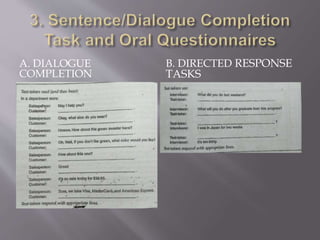
 Directed Response Tasks
 The test administrator elicits a particular
grammatical form or a transformation of a
sentence.Some tasks are clearly mechanical and
not communicative,but they do require
minimal processsing of meaning in order to
produce the correct grammatical output
 Example:
Test-Takers hear: Tell me he went home
Tell me that you like Rock music
Tell me that you aren’t interested in Tennins
Read-Aloud Tasks
 Intensive reading-aloud tasks include reading
beyond the sentence level up to a paragraph or
two. This technique is easily administered by
selecting a passage that incorporates test specs
and by reording the Test-Takers output;The
scoring is relatively easy because all of the Test-
Takers oral production is controlled.Because of
the results of reserarch on the PhonePass
test,reading aloud may actually be surprisingly
strong indicator of overall oral production
ability
Sentence/dialogue Completion Task and Oral
Questionarry
 Another technique of targeting intensive aspect
of language requires tesr-takers to read
dialogue in which one speaker’s lines have
been ommited.Test-takers are first given time
to read through the dialogue to get its gist and
to think about appropriate line to fill in.Then as
the tape,teacher,or test administrator produces
one part orally,the test-taker responds.
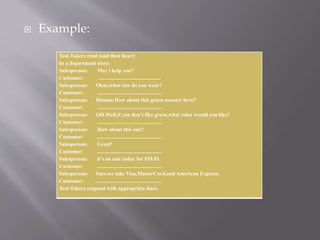
 Example:
Test-Takers read (and then hear):
In a department store:
Salesperson: May i help you?
Customer: ...............................................
Salesperson: Okay,what size do you wear?
Customer: ................................................
Salesperson: Hmmm.How about this green sweater here?
Customer: ................................................
Salesperson: OH.Well,if you don’t like green,what color would you like?
Customer: .................................................
Salesperson: How about this one?
Customer: .................................................
Salesperson: Great!
Customer: .................................................
Salesperson: it’s on sale today for $39.95.
Customer: .................................................
Salesperson: Suer,we take Visa,MasterCard,and American Express.
Customer: ..................................................
Test-Takers respond with appropriate lines.
A. DIALOGUE
COMPLETION
B. DIRECTED RESPONSE
TASKS
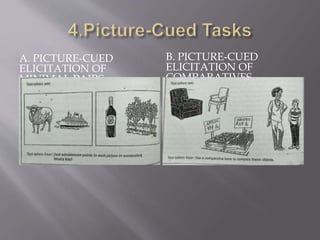
A. PICTURE-CUED
ELICITATION OF
MINIMAL PAIRS
B. PICTURE-CUED
ELICITATION OF
COMPARATIVES
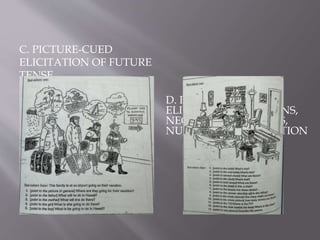
C. PICTURE-CUED
ELICITATION OF FUTURE
TENSE
D. PICTURE-CUED
ELICITATION OF NOUNS,
NEGATIVE RESPONSES,
NUMBERS AND LOCATION
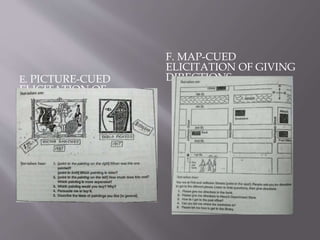
E. PICTURE-CUED
ELICITATION OF
RESPONSES AND
DESCRIPTION
F. MAP-CUED
ELICITATION OF GIVING
DIRECTIONS
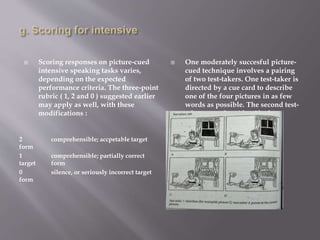
 Scoring responses on picture-cued
intensive speaking tasks varies,
depending on the expected
performance criteria. The three-point
rubric ( 1, 2 and 0 ) suggested earlier
may apply as well, with these
modifications :
2 comprehensible; accpetable target
form
1 comprehensible; partially correct
target form
0 silence, or seriously incorrect target
form
 One moderately succesful picture-
cued technique involves a pairing
of two test-takers. One test-taker is
directed by a cue card to describe
one of the four pictures in as few
words as possible. The second test-
taker must then identify the
picture.
Translation is a meaningful communicative device
in contexts, where the English user is calle on to be
an interpreter. Also, translation is a well-proven
communication strategy for learners of a second
language. Under certain constraints, then, it is not
far-fetched to suggest translation as a device to
check oral production.
1. QUESTION AND
ANSWER
 Question eliciting open-
ended responses
 Elication of questions
from the test-taker
2. Giving Instruction and
Directions
 Eliciting instructions or
directions
3. PARAPHRASING
 Paraphrasing a story
 Paraphrasing a phone
message
 Somewhere staddling responsive, interactive,
and extensive speaking task lies another
popular commercial oral production
assessment, the test of spoken english (TSE).
 The TSE is a 20-minute audiotaped test of oral
language ability within an academic or
professional environment
specifications for the TSE represent the discourse and
pragmatic contexts assessed in each administration
 1. describe something phsycal
 2. narrate from presented material
 3. summarize information of the speaker’s own
choice
 4. give directions based on visual materials
 5. give instructions
 6. give an opinion
 7. support an opinion
 8. compare/ contrast
 9. hypothesize
 10. function interactively
 11. define
15 different specifics takst in collecting background data from native
and non-active speakers of english
 1. giving a personal description
 2. describing a daily routine
 3. suggesting a gift and supporting one’s choice
 4. recommending a place to visit and supporting one’s choice
 5. giving directions
 6. describing a favorite movie and supporting one’s choice
 7. telling a story from pictures
 8. hypothesizing abaout future actions
 9. hypothesizing about a preventative action
 10. making a telephone call to the dry cleaner
 11. describing an important news event
 12. giving an opinion about animals in the zoo
 13. defining a technical term
 14. describing information in a graph and speculating about its
implications
 15. giving details about a trip schedule.
 Part A
 Test-takers see : a map of a town
 Test-takers hear : imagine that we are colleagues. The
map below is of a neighboring town that you have
suggested I visit. You will have 30 seconds to study the
map. Then I’ll ask you some questions about it.
 1. choose one place on the map that you think I should
visit and give me some reason why you recommend
this place
 2. I’d like to see a movie. Please give me directions
from movie theater
 3. one for you favorite movies is playing at the theater.
Please tell me about the movie and why you like it.
 Part B
 Test-takers see:
 A series of six pictures depicts a asequence of
events. In the series, painters have just painted
a park beach. Their WET psint sign blows
away. A man approaches the bench, sits on it,
and starts reading a newspaper, he quickly
discovers his suit has just gotten wet paint on it
and then rushers to the dry cleaner.
 Part B
 Test-takers see:
 A series of six pictures depicts a asequence of events. In
the series, painters have just painted a park beach.
Their WET psint sign blows away. A man approaches
the bench, sits on it, and starts reading a newspaper, he
quickly discovers his suit has just gotten wet paint on it
and then rushers to the dry cleaner.

 Test-takers hear
 Now please look at the six pictures below. I’d like you
to tell me the story that the pictures show, starting with
picture number 1 and going through picture number 6.
 Part C
 Test-takers hear ;
 Now I’d like to hear you ideas about the
variety of topics. Be sure to say as much as you
can in responding to each question. After I ask
each question, you may take a few seconds to
prepare you answear, and then begin speaking
when you’re ready.
 Part D
 Test-takers see
 A graph showing an increase in world population over
a hall-century of time.

 Test-takers hear ;
 this graph present the actual and projected percentage
of the world population living in cities from 1950 to
2010. Describe to me the information given in the
graph
 now discuss what this information might mean for the
future.

 Part E
 Test-takers see
 A printed litinerary for one-day bus tour of washington d.c
on which four relatively simple pieces of onformation (date,
departure, time) have been crossed out by hand and new
handwritten information added.
 Test-takers hear
 12. now please look at the information below about a trip to
washington, DC that has been organized for the members of
the forest city historical society. Imagine that yoy are the
president of this organization. At the last meeting you have
out a schedule for the trip, but there have been some
charges. You must remind the members about the details of
the trip and tell them about the changes indicated on the
schedule. In your presentation, do not just read the
information printed, but presesnt is as if you were talking to
a group of people. You will have one minute to plan your
presentation and will be told when to begin speaking.
 Interview
 Roleplay
 Discussion and conversations
 Games
 The OPI is the result of a historical progression
of revisions under the auspices of several
agencies, including the educational testing
service and the American council on teaching
foreign language
 Oral presentation
 Picture cued story telling
 Retelling a story, news event
 Translation (of extended prose)

Assessing speaking assignment

  • 2.
     By:  IKADEWI.K 201212500558  SANTI 201212500490  NURYANTI 201212500659  TENDRI SAGITA.P 201212500491
  • 3.
    While speaking isa production skill that can be directly and empirically observed,those observation are invariably colored by the accuracy and effectiveness of a test-taker’s listening skill, which necessarily compromises the reliability and validity of an or production test
  • 4.
     Immitative At theend of an continuum oif types of speaking perfomance is the ability to simply parrot- back(imitate) a word or phrase or possibly a sentence.  Intensive A second type of speaking frequently employed in assessment contexts is the production of short streches of oral language designed to demonstrate competence in a narrow band grammatical,phrasal,lexical,or phonological relationship (such as prosodic elements- intonation,sterss,rhythm,juncture)
  • 5.
     Responsive Responsive assessmenttasks include interaction and test comprehension but at the somewhat ilimited level of very short conversations,standard greetinggs and small talks,simple questions and comments,and the like.the stimulus is almost lways a spoken prompt (in order to preserve authenticity), with perhaps only one or two follow-up questions or retorts.
  • 6.
     Interactive The differencebetween responsive and interactive speaking is the length and complexity of interaction,which sometimes includes multiple exchange and/or multiple participants  Extensive (monologue) Extensive oral production task include speeches,oral presentation,and story telling,during which the opportunity for oral interaction from listeners is either highly limited ( perhaps to non verb responses) or ruled out together
  • 7.
     Microskills  Producedifferences among English phonemes and allophonic variants.  Produce chunks of language of different lengths.  Produce English stess patterns,words in stressed and unstressed positions,rhytmic structure, and intonation contours.  Produce reduced forms of words and phrases.  Use an adequate number of lexical units (words) to accomplish pragmatic purposes.  Produce fluent speech at different rates of delivery.  Monitor one’s own oral production and use various strategic devices-pauses,fillers,self-corrections,backtracking-to enhance the clarity of the message or summarize it.  Use grammatical word classes (nouns,verbs,etc), system (e.g.,tense,agreement,pluralization), word order,pattern,rules and elliptical forms.  Produce speech in natural constituents: in apprppriate phrases,pause group,breath groups,anda sentence constituents.  Express a particular meaning in different grammatical forms.  Use cohesive devices in spoken discourse.
  • 8.
     Macroskills  Appropriatelyaccomplish communicate function according to situations,participants,and goals.  Use appropriate styles,registers,implicature,redundancies,pragmatic conventions,conversations rules,floor-keeping and – yealding,interrupting,and other sociolingustic features in face-to-face conversations.  Convey links and connection between events and communicate such relations of vocal and peripheral ideas,events and feelings,new information and given informations,generalization and exemplification.  Convey facial features,kinestics,body language,and other non verbal cues along with verbal language.  Develop and use a battery of speaking,strategies,such as emphasizing key words,rephrasing,providing a context for interpreting the meaning of words,appealing for help,and accurately assessing how well your interlocutor is understanding you.
  • 9.
    immitative speaking  Anoccasional phonologically focused repetition task is warranted as long as repetition tasks are not allowed to accupy a dominant role in an overall oral production assessment,and as long as you artfully avoid a negative washback effect  Example:Test-takers hear : repeat after me: Beat[pause] bit [pause] Bat [pause] vat [pause] etc. Test-takers repeat the stimulus.
  • 10.
    Phonepass Test  ThePhonepass test elicits computer-assessted oral production over a telephone.Test-takers read aloud,repeat sentences,say words,and answer questions.With a downloadable test sheet as a reference.test takers are directed to telephone a designated number and listen for directions.The test has five sections.
  • 11.
     Example: Part A: TestTakers read aloud selected sentences from among those printed on the test sheet. Examples: 1. Traffic is a huge problem in Southern Califirnia 2. The endless city has no coherant mass transit system 3. Sharing rides was going to be solution to rush-hour traffic Part B: Test-takers repeat sentences dictated over the phone. Examples: “leave town on the next train” Part C: Test takers answer questions with a single word or a short phrase of two or three words.examples: “would you get water from a bottle or a newspaper?” Part D: Test-Takers hear three words group in random order and must link them in a correctly ordered sentence.example:was reading/my mother/a magazine. Part E: Test-Takers have 30 seconds to talk about their opinion about some topic that is dictated over the phone.Topics senter of family,preference,and choices.
  • 12.
    INTENSIVE SPEAKING  Atthe intensive level,Test-Takers are prompted to produce short streches of discourse (no more than a sentence) through which they demonstrate linguistic ability at a specified level of language.
  • 13.
     Directed ResponseTasks  The test administrator elicits a particular grammatical form or a transformation of a sentence.Some tasks are clearly mechanical and not communicative,but they do require minimal processsing of meaning in order to produce the correct grammatical output  Example: Test-Takers hear: Tell me he went home Tell me that you like Rock music Tell me that you aren’t interested in Tennins
  • 14.
    Read-Aloud Tasks  Intensivereading-aloud tasks include reading beyond the sentence level up to a paragraph or two. This technique is easily administered by selecting a passage that incorporates test specs and by reording the Test-Takers output;The scoring is relatively easy because all of the Test- Takers oral production is controlled.Because of the results of reserarch on the PhonePass test,reading aloud may actually be surprisingly strong indicator of overall oral production ability
  • 15.
    Sentence/dialogue Completion Taskand Oral Questionarry  Another technique of targeting intensive aspect of language requires tesr-takers to read dialogue in which one speaker’s lines have been ommited.Test-takers are first given time to read through the dialogue to get its gist and to think about appropriate line to fill in.Then as the tape,teacher,or test administrator produces one part orally,the test-taker responds.
  • 16.
     Example: Test-Takers read(and then hear): In a department store: Salesperson: May i help you? Customer: ............................................... Salesperson: Okay,what size do you wear? Customer: ................................................ Salesperson: Hmmm.How about this green sweater here? Customer: ................................................ Salesperson: OH.Well,if you don’t like green,what color would you like? Customer: ................................................. Salesperson: How about this one? Customer: ................................................. Salesperson: Great! Customer: ................................................. Salesperson: it’s on sale today for $39.95. Customer: ................................................. Salesperson: Suer,we take Visa,MasterCard,and American Express. Customer: .................................................. Test-Takers respond with appropriate lines.
  • 17.
  • 18.
    A. PICTURE-CUED ELICITATION OF MINIMALPAIRS B. PICTURE-CUED ELICITATION OF COMPARATIVES
  • 19.
    C. PICTURE-CUED ELICITATION OFFUTURE TENSE D. PICTURE-CUED ELICITATION OF NOUNS, NEGATIVE RESPONSES, NUMBERS AND LOCATION
  • 20.
    E. PICTURE-CUED ELICITATION OF RESPONSESAND DESCRIPTION F. MAP-CUED ELICITATION OF GIVING DIRECTIONS
  • 21.
     Scoring responseson picture-cued intensive speaking tasks varies, depending on the expected performance criteria. The three-point rubric ( 1, 2 and 0 ) suggested earlier may apply as well, with these modifications : 2 comprehensible; accpetable target form 1 comprehensible; partially correct target form 0 silence, or seriously incorrect target form  One moderately succesful picture- cued technique involves a pairing of two test-takers. One test-taker is directed by a cue card to describe one of the four pictures in as few words as possible. The second test- taker must then identify the picture.
  • 22.
    Translation is ameaningful communicative device in contexts, where the English user is calle on to be an interpreter. Also, translation is a well-proven communication strategy for learners of a second language. Under certain constraints, then, it is not far-fetched to suggest translation as a device to check oral production.
  • 23.
    1. QUESTION AND ANSWER Question eliciting open- ended responses  Elication of questions from the test-taker 2. Giving Instruction and Directions  Eliciting instructions or directions 3. PARAPHRASING  Paraphrasing a story  Paraphrasing a phone message
  • 24.
     Somewhere staddlingresponsive, interactive, and extensive speaking task lies another popular commercial oral production assessment, the test of spoken english (TSE).  The TSE is a 20-minute audiotaped test of oral language ability within an academic or professional environment
  • 25.
    specifications for theTSE represent the discourse and pragmatic contexts assessed in each administration  1. describe something phsycal  2. narrate from presented material  3. summarize information of the speaker’s own choice  4. give directions based on visual materials  5. give instructions  6. give an opinion  7. support an opinion  8. compare/ contrast  9. hypothesize  10. function interactively  11. define
  • 26.
    15 different specificstakst in collecting background data from native and non-active speakers of english  1. giving a personal description  2. describing a daily routine  3. suggesting a gift and supporting one’s choice  4. recommending a place to visit and supporting one’s choice  5. giving directions  6. describing a favorite movie and supporting one’s choice  7. telling a story from pictures  8. hypothesizing abaout future actions  9. hypothesizing about a preventative action  10. making a telephone call to the dry cleaner  11. describing an important news event  12. giving an opinion about animals in the zoo  13. defining a technical term  14. describing information in a graph and speculating about its implications  15. giving details about a trip schedule.
  • 27.
     Part A Test-takers see : a map of a town  Test-takers hear : imagine that we are colleagues. The map below is of a neighboring town that you have suggested I visit. You will have 30 seconds to study the map. Then I’ll ask you some questions about it.  1. choose one place on the map that you think I should visit and give me some reason why you recommend this place  2. I’d like to see a movie. Please give me directions from movie theater  3. one for you favorite movies is playing at the theater. Please tell me about the movie and why you like it.
  • 28.
     Part B Test-takers see:  A series of six pictures depicts a asequence of events. In the series, painters have just painted a park beach. Their WET psint sign blows away. A man approaches the bench, sits on it, and starts reading a newspaper, he quickly discovers his suit has just gotten wet paint on it and then rushers to the dry cleaner.
  • 29.
     Part B Test-takers see:  A series of six pictures depicts a asequence of events. In the series, painters have just painted a park beach. Their WET psint sign blows away. A man approaches the bench, sits on it, and starts reading a newspaper, he quickly discovers his suit has just gotten wet paint on it and then rushers to the dry cleaner.   Test-takers hear  Now please look at the six pictures below. I’d like you to tell me the story that the pictures show, starting with picture number 1 and going through picture number 6.
  • 30.
     Part C Test-takers hear ;  Now I’d like to hear you ideas about the variety of topics. Be sure to say as much as you can in responding to each question. After I ask each question, you may take a few seconds to prepare you answear, and then begin speaking when you’re ready.
  • 31.
     Part D Test-takers see  A graph showing an increase in world population over a hall-century of time.   Test-takers hear ;  this graph present the actual and projected percentage of the world population living in cities from 1950 to 2010. Describe to me the information given in the graph  now discuss what this information might mean for the future. 
  • 32.
     Part E Test-takers see  A printed litinerary for one-day bus tour of washington d.c on which four relatively simple pieces of onformation (date, departure, time) have been crossed out by hand and new handwritten information added.  Test-takers hear  12. now please look at the information below about a trip to washington, DC that has been organized for the members of the forest city historical society. Imagine that yoy are the president of this organization. At the last meeting you have out a schedule for the trip, but there have been some charges. You must remind the members about the details of the trip and tell them about the changes indicated on the schedule. In your presentation, do not just read the information printed, but presesnt is as if you were talking to a group of people. You will have one minute to plan your presentation and will be told when to begin speaking.
  • 33.
     Interview  Roleplay Discussion and conversations  Games
  • 34.
     The OPIis the result of a historical progression of revisions under the auspices of several agencies, including the educational testing service and the American council on teaching foreign language
  • 35.
     Oral presentation Picture cued story telling  Retelling a story, news event  Translation (of extended prose)