By Madiha Batool .
For the purpose of guiding
SPEAKING
• IT IS A PRIMARY MODE OF COMMUNICATION.
• IT IS A PRODUCTIVE SKILL.
• IT PRESENTS CONTEXTUALIZED PRACTICE.
• IT PRESENTS PERSONALIZE LANGUAGE.
• IT DEFINES SOCIAL USE OF LANGUAGE.
• Speaking" is the process of building and sharing
meaning through the use of verbal and non-
verbal symbols, in a variety of context”.
(Chaney , 1998. )
Challenges of the testing speaking
1. The interaction of speaking and listening.
2. Elicitation techniques.
3. Scoring.
Speaking is the product of creative construction of linguistic
strings.
If we want to check certain spoken grammatical categories then
Stimulus we design should be related with that.
If task is open-ended the freedom of choice given to test takers
create challenge in scoring procedure.
In productive performance, oral and written must be specified.
Examples :
Picture-series task, variety of ways to tell story, elicit story
Sequences e.t.c.
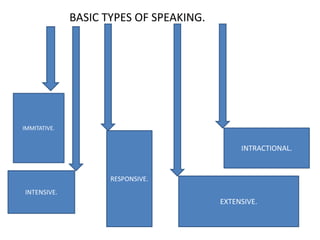
BASIC TYPES OF SPEAKING.
INTENSIVE.
RESPONSIVE.
EXTENSIVE.
INTRACTIONAL.
IMMITATIVE.
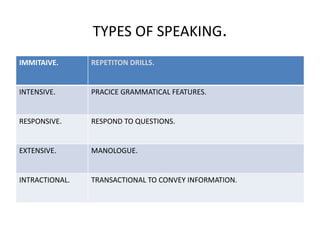
TYPES OF SPEAKING.
IMMITAIVE. REPETITON DRILLS.
INTENSIVE. PRACICE GRAMMATICAL FEATURES.
RESPONSIVE. RESPOND TO QUESTIONS.
EXTENSIVE. MANOLOGUE.
INTRACTIONAL. TRANSACTIONAL TO CONVEY INFORMATION.
1.Imitative: (parrot back) Testing the ability to imitate a word, phrase,
sentence. Pronunciation is tested. Examples: Word, phrase, sentence
repetition.
2. Intensive: The purpose is producing short stretches of oral language. It
is designed to demonstrate competence in a narrow band of grammatical,
phrasal, lexical, phonological relationships (stress / rhythm / intonation)
3.Responsive: (interacting with the interlocutor) include interaction and
test comprehension but somewhat limited level of very short conversations,
standards greetings, small talk, simple requests and comments, and the like.
4. Interactive: Difference between responsive and interactive speaking is
length and complexity of interaction, which includes multiple exchanges /or
multiple participant.
5. Extensive (monologue) : Extensive oral production tasks include
speeches, oral presentations, story-telling, during which the opportunity for
oral interaction from listeners is either highly limited (perhaps to nonverbal
responses) or ruled out together.
 IMITATIVE SPEAKING. ( PARROT
BACK )
Testing the ability to imitate a word,phrase,sentence
relating with:
1. Pronunciation.
2. Suprasegmentals.
3. Comprehension w. r. t. learner.
DESIGNING IMITATIVE SPEAKING
ASSESSMENT TASKS.
CLT PERSCPECTICTIVE IS THAT MEANINGFUL
COMMUNICATION NECESSARY.
UNNECESSARY REPETITION DISCARDED.
REPETION W.R.T. STIMULUS SUCH AS
INTOBATION PRODUCTION TESTS.
UNNECESSARY REPETITON IS NOT MUCH
ALLOWED DUE TO EFFECT OF NEGATIVE
WASHBACK.
STEPS.
PHONEPASS TEST.
IT HAS HIGH CONSTRUCT VALIDITY.
IT ELICIT COMPUTER ASSISTED ORAL
PRODUCTION OVER A TELEPHONE.
SCORING.
COMUTERIZED SCORING.
MORE VALIDATION.
HIGH RELIABILITIES.
HIGH CORRELATION STATICS.
ACTIVITIES RELATED WITH TEST
TAKERS.
READING ALOUD
REPEAT SENTENCES.
SAY WORDS.
ANSWER QUESTIONS.
LISTEN FOR DIRECTIONS.
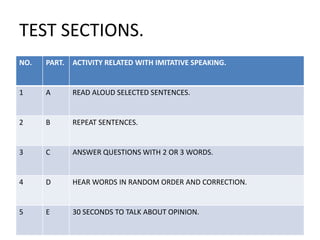
TEST SECTIONS.
NO. PART. ACTIVITY RELATED WITH IMITATIVE SPEAKING.
1 A READ ALOUD SELECTED SENTENCES.
2 B REPEAT SENTENCES.
3 C ANSWER QUESTIONS WITH 2 OR 3 WORDS.
4 D HEAR WORDS IN RANDOM ORDER AND CORRECTION.
5 E 30 SECONDS TO TALK ABOUT OPINION.
ADVANTAGES OF PHONEPASS TEST.
1. INCREASED PERFORMANCE FOR FUTURE BASE OPI.(
ORAL PROFICIENCY INTERVIEW )
2. TEST TAKER’S OUTPUT IS CONTROLLED.
3. SPEECH RECOGNITION TECHNOLOGY IS AVAILABLE.
4. ACHIEVEMENT IS OBTAINED ACCORDING TO
OBJECTIVES.
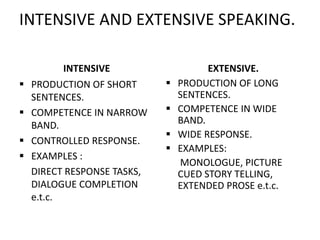
INTENSIVE AND EXTENSIVE SPEAKING.
INTENSIVE
 PRODUCTION OF SHORT
SENTENCES.
 COMPETENCE IN NARROW
BAND.
 CONTROLLED RESPONSE.
 EXAMPLES :
DIRECT RESPONSE TASKS,
DIALOGUE COMPLETION
e.t.c.
EXTENSIVE.
 PRODUCTION OF LONG
SENTENCES.
 COMPETENCE IN WIDE
BAND.
 WIDE RESPONSE.
 EXAMPLES:
MONOLOGUE, PICTURE
CUED STORY TELLING,
EXTENDED PROSE e.t.c.
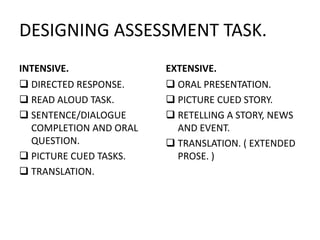
DESIGNING ASSESSMENT TASK.
INTENSIVE.
 DIRECTED RESPONSE.
 READ ALOUD TASK.
 SENTENCE/DIALOGUE
COMPLETION AND ORAL
QUESTION.
 PICTURE CUED TASKS.
 TRANSLATION.
EXTENSIVE.
 ORAL PRESENTATION.
 PICTURE CUED STORY.
 RETELLING A STORY, NEWS
AND EVENT.
 TRANSLATION. ( EXTENDED
PROSE. )
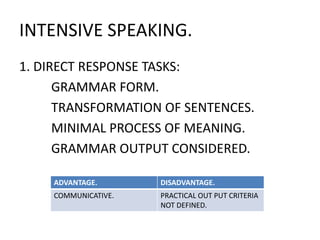
INTENSIVE SPEAKING.
1. DIRECT RESPONSE TASKS:
GRAMMAR FORM.
TRANSFORMATION OF SENTENCES.
MINIMAL PROCESS OF MEANING.
GRAMMAR OUTPUT CONSIDERED.
ADVANTAGE. DISADVANTAGE.
COMMUNICATIVE. PRACTICAL OUT PUT CRITERIA
NOT DEFINED.
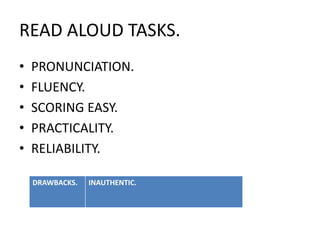
READ ALOUD TASKS.
• PRONUNCIATION.
• FLUENCY.
• SCORING EASY.
• PRACTICALITY.
• RELIABILITY.
DRAWBACKS. INAUTHENTIC.
SENTENCE/DIALOGUE COMPLETION
• PRODUCE OMITTED LINES.
• WORDS IN A DIALOGUE.
• THINK ABOUT LINES TO FILL IN.
DRAWBACK. DIFFICULTY IN ABILITY TO TRANSFER FROM
WRITTEN TO SPOKEN ENGLISH.
IN AUTHENTIC NATURE.
PICTURE_CUED TASKS.
• PRODUCTION BY USING PICTURE.
• DESCRIPTION LEVEL.
• VISUAL STIMULUS.
• ELABORATIVE.
DRAWBACK. SCORING MAY BE PROBLEMATIC.
TRANSLATION.
• TARGET LANGUAGE TO NATIVE LANGUAGE.
• SCORING IS SPECIFIED.
• RULES ARE FOLLOWED STRICALLY.
EXTENSIVE SPEAKING.
• ORAL PRESENTATION:
It would not be uncommon to be called on to present a report, a
paper, a marketing plan, a sales idea, a design of new product, or a
method. Once again the rules for effective assessment must be
invoked:
a- specify the criterion,
b-set appropriate tasks,
c- elicit optimal output,
d-establish practical, reliable scoring procedures.
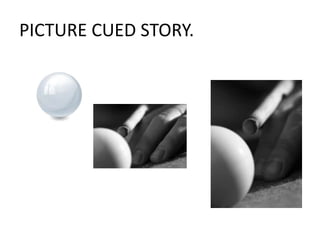
Scoring is the key assessment challenge. Picture –Cued Story-Telling
techniques for eliciting oral production is through visual pictures,
photographs, diagrams, and charts. consider a picture or series of
pictures as a stimulus for a longer or description. Criteria for scoring
need to be clear about what it is you are hoping to assess
PICTURE CUED STORY TELLING.
• INTERESTING.
• ELLABORATIVE.
• VISUAL STIMULUS.
• LOGICAL SEQUENCING.
DRAWBACK. SCORING CRITERIA IS UNCLEARED.
PICTURE CUED STORY.
DRAWBACK.
• SCORING CRITERIA IS UNCLEARED.
• STANDARDS ARE NOT DEFINED.
• PERCEPTION OF LEARNER INVOLVES.
RETELLING STORY,NEWS,EVENT.
• RETELL.
• STRESS.
• PATTERNS.
• EXPRESSIONS.
• INTRACTION.
DRAWBACK. INTENDED CRITERIA OF A STORY.
TRANSLATION.
• LONGER TEXT.
• SYNOPSIS OF A STORY.
• CONTROLLED CONTENT.
• DISCOURSE FEATURE.
DRAWBACK. SPECIALIZED SKILL NEEDED.

Assessing speaking

  • 1.
    By Madiha Batool. For the purpose of guiding
  • 2.
    SPEAKING • IT ISA PRIMARY MODE OF COMMUNICATION. • IT IS A PRODUCTIVE SKILL. • IT PRESENTS CONTEXTUALIZED PRACTICE. • IT PRESENTS PERSONALIZE LANGUAGE. • IT DEFINES SOCIAL USE OF LANGUAGE. • Speaking" is the process of building and sharing meaning through the use of verbal and non- verbal symbols, in a variety of context”. (Chaney , 1998. )
  • 3.
    Challenges of thetesting speaking 1. The interaction of speaking and listening. 2. Elicitation techniques. 3. Scoring. Speaking is the product of creative construction of linguistic strings. If we want to check certain spoken grammatical categories then Stimulus we design should be related with that. If task is open-ended the freedom of choice given to test takers create challenge in scoring procedure. In productive performance, oral and written must be specified. Examples : Picture-series task, variety of ways to tell story, elicit story Sequences e.t.c.
  • 4.
    BASIC TYPES OFSPEAKING. INTENSIVE. RESPONSIVE. EXTENSIVE. INTRACTIONAL. IMMITATIVE.
  • 5.
    TYPES OF SPEAKING. IMMITAIVE.REPETITON DRILLS. INTENSIVE. PRACICE GRAMMATICAL FEATURES. RESPONSIVE. RESPOND TO QUESTIONS. EXTENSIVE. MANOLOGUE. INTRACTIONAL. TRANSACTIONAL TO CONVEY INFORMATION.
  • 6.
    1.Imitative: (parrot back)Testing the ability to imitate a word, phrase, sentence. Pronunciation is tested. Examples: Word, phrase, sentence repetition. 2. Intensive: The purpose is producing short stretches of oral language. It is designed to demonstrate competence in a narrow band of grammatical, phrasal, lexical, phonological relationships (stress / rhythm / intonation) 3.Responsive: (interacting with the interlocutor) include interaction and test comprehension but somewhat limited level of very short conversations, standards greetings, small talk, simple requests and comments, and the like. 4. Interactive: Difference between responsive and interactive speaking is length and complexity of interaction, which includes multiple exchanges /or multiple participant. 5. Extensive (monologue) : Extensive oral production tasks include speeches, oral presentations, story-telling, during which the opportunity for oral interaction from listeners is either highly limited (perhaps to nonverbal responses) or ruled out together.
  • 7.
     IMITATIVE SPEAKING.( PARROT BACK ) Testing the ability to imitate a word,phrase,sentence relating with: 1. Pronunciation. 2. Suprasegmentals. 3. Comprehension w. r. t. learner.
  • 8.
    DESIGNING IMITATIVE SPEAKING ASSESSMENTTASKS. CLT PERSCPECTICTIVE IS THAT MEANINGFUL COMMUNICATION NECESSARY. UNNECESSARY REPETITION DISCARDED. REPETION W.R.T. STIMULUS SUCH AS INTOBATION PRODUCTION TESTS. UNNECESSARY REPETITON IS NOT MUCH ALLOWED DUE TO EFFECT OF NEGATIVE WASHBACK.
  • 9.
    STEPS. PHONEPASS TEST. IT HASHIGH CONSTRUCT VALIDITY. IT ELICIT COMPUTER ASSISTED ORAL PRODUCTION OVER A TELEPHONE. SCORING. COMUTERIZED SCORING. MORE VALIDATION. HIGH RELIABILITIES. HIGH CORRELATION STATICS.
  • 10.
    ACTIVITIES RELATED WITHTEST TAKERS. READING ALOUD REPEAT SENTENCES. SAY WORDS. ANSWER QUESTIONS. LISTEN FOR DIRECTIONS.
  • 11.
    TEST SECTIONS. NO. PART.ACTIVITY RELATED WITH IMITATIVE SPEAKING. 1 A READ ALOUD SELECTED SENTENCES. 2 B REPEAT SENTENCES. 3 C ANSWER QUESTIONS WITH 2 OR 3 WORDS. 4 D HEAR WORDS IN RANDOM ORDER AND CORRECTION. 5 E 30 SECONDS TO TALK ABOUT OPINION.
  • 12.
    ADVANTAGES OF PHONEPASSTEST. 1. INCREASED PERFORMANCE FOR FUTURE BASE OPI.( ORAL PROFICIENCY INTERVIEW ) 2. TEST TAKER’S OUTPUT IS CONTROLLED. 3. SPEECH RECOGNITION TECHNOLOGY IS AVAILABLE. 4. ACHIEVEMENT IS OBTAINED ACCORDING TO OBJECTIVES.
  • 13.
    INTENSIVE AND EXTENSIVESPEAKING. INTENSIVE  PRODUCTION OF SHORT SENTENCES.  COMPETENCE IN NARROW BAND.  CONTROLLED RESPONSE.  EXAMPLES : DIRECT RESPONSE TASKS, DIALOGUE COMPLETION e.t.c. EXTENSIVE.  PRODUCTION OF LONG SENTENCES.  COMPETENCE IN WIDE BAND.  WIDE RESPONSE.  EXAMPLES: MONOLOGUE, PICTURE CUED STORY TELLING, EXTENDED PROSE e.t.c.
  • 14.
    DESIGNING ASSESSMENT TASK. INTENSIVE. DIRECTED RESPONSE.  READ ALOUD TASK.  SENTENCE/DIALOGUE COMPLETION AND ORAL QUESTION.  PICTURE CUED TASKS.  TRANSLATION. EXTENSIVE.  ORAL PRESENTATION.  PICTURE CUED STORY.  RETELLING A STORY, NEWS AND EVENT.  TRANSLATION. ( EXTENDED PROSE. )
  • 15.
    INTENSIVE SPEAKING. 1. DIRECTRESPONSE TASKS: GRAMMAR FORM. TRANSFORMATION OF SENTENCES. MINIMAL PROCESS OF MEANING. GRAMMAR OUTPUT CONSIDERED. ADVANTAGE. DISADVANTAGE. COMMUNICATIVE. PRACTICAL OUT PUT CRITERIA NOT DEFINED.
  • 16.
    READ ALOUD TASKS. •PRONUNCIATION. • FLUENCY. • SCORING EASY. • PRACTICALITY. • RELIABILITY. DRAWBACKS. INAUTHENTIC.
  • 17.
    SENTENCE/DIALOGUE COMPLETION • PRODUCEOMITTED LINES. • WORDS IN A DIALOGUE. • THINK ABOUT LINES TO FILL IN. DRAWBACK. DIFFICULTY IN ABILITY TO TRANSFER FROM WRITTEN TO SPOKEN ENGLISH. IN AUTHENTIC NATURE.
  • 18.
    PICTURE_CUED TASKS. • PRODUCTIONBY USING PICTURE. • DESCRIPTION LEVEL. • VISUAL STIMULUS. • ELABORATIVE. DRAWBACK. SCORING MAY BE PROBLEMATIC.
  • 19.
    TRANSLATION. • TARGET LANGUAGETO NATIVE LANGUAGE. • SCORING IS SPECIFIED. • RULES ARE FOLLOWED STRICALLY.
  • 20.
    EXTENSIVE SPEAKING. • ORALPRESENTATION: It would not be uncommon to be called on to present a report, a paper, a marketing plan, a sales idea, a design of new product, or a method. Once again the rules for effective assessment must be invoked: a- specify the criterion, b-set appropriate tasks, c- elicit optimal output, d-establish practical, reliable scoring procedures. Scoring is the key assessment challenge. Picture –Cued Story-Telling techniques for eliciting oral production is through visual pictures, photographs, diagrams, and charts. consider a picture or series of pictures as a stimulus for a longer or description. Criteria for scoring need to be clear about what it is you are hoping to assess
  • 21.
    PICTURE CUED STORYTELLING. • INTERESTING. • ELLABORATIVE. • VISUAL STIMULUS. • LOGICAL SEQUENCING. DRAWBACK. SCORING CRITERIA IS UNCLEARED.
  • 22.
  • 23.
    DRAWBACK. • SCORING CRITERIAIS UNCLEARED. • STANDARDS ARE NOT DEFINED. • PERCEPTION OF LEARNER INVOLVES.
  • 24.
    RETELLING STORY,NEWS,EVENT. • RETELL. •STRESS. • PATTERNS. • EXPRESSIONS. • INTRACTION. DRAWBACK. INTENDED CRITERIA OF A STORY.
  • 25.
    TRANSLATION. • LONGER TEXT. •SYNOPSIS OF A STORY. • CONTROLLED CONTENT. • DISCOURSE FEATURE. DRAWBACK. SPECIALIZED SKILL NEEDED.