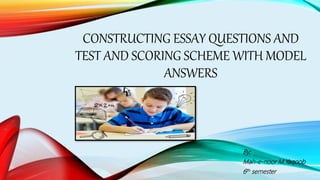
CONSTRUCTING ESSAY QUESTIONS AND
TEST AND SCORING SCHEME WITH MODEL
ANSWERS
By;
Mah-e-noor M.Yaqoob
6th semester
ESSAY TYPE QUESTIONS
• Detail answers and free responses
• Check the higher order thinking.
• check Complex ideas and thinking level
• Freedom of thought and freedom of expressions.
• Understanding level and critical writing skills are check.
• An old technique I which detail answers are asked(open
ended)
• Variety of learning outcomes
ESSAY TYPE QUESTIONS
STALNAKER'S DEFINITION
•Compose rather than selection of response.
•More than one sentence.
•Pattern of responses from different dimension.
• Information to judge the accuracy and quality
responses.
•Moreover, systematic and detail information
ESSAY TYPE TEST
• useful for checking the ability of critical thinking.
• Objective questions only check memory.
• The words which cognitively challenge students thinking are;
1. Knowledge
2. comprehension
3. Application
4. Analysis
5. Synthesis
6. Evaluation
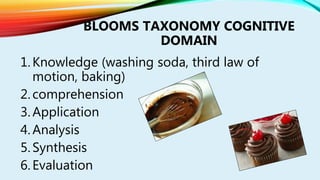
BLOOMS TAXONOMY COGNITIVE
DOMAIN
1.Knowledge (washing soda, third law of
motion, baking)
2.comprehension
3.Application
4.Analysis
5.Synthesis
6.Evaluation
1.KNOWLEDGE
• LOTS (lower order thinking skills)
• Use to remember the information the key word used are;
Recall
Define
 Arrange
 List
Label
 Identify,
 Match,
 Reproduce
Q Identify the importance of the
curricular and co-curricular
activities for students?
COMPREHENSION
• Describe
• Explain
• Recognize
• Translate or restate
• Classify with example
APPLICATION
• Apply
• Illustrate
• Interpreted
• solve
• Predict
• Utilize
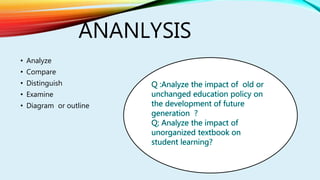
ANANLYSIS
• Analyze
• Compare
• Distinguish
• Examine
• Diagram or outline
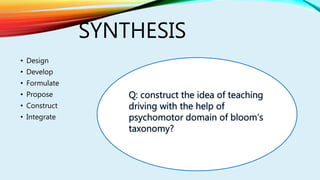
SYNTHESIS
• Design
• Develop
• Formulate
• Propose
• Construct
• Integrate
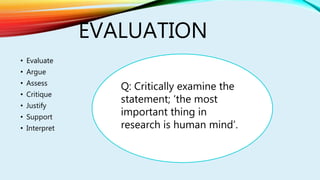
EVALUATION
• Evaluate
• Argue
• Assess
• Critique
• Justify
• Support
• Interpret
Q: Critically examine the
statement; ‘the most
important thing in
research is human mind’.
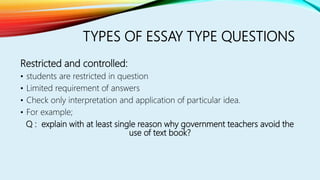
TYPES OF ESSAY TYPE QUESTIONS
Restricted and controlled:
• students are restricted in question
• Limited requirement of answers
• Check only interpretation and application of particular idea.
• For example;
Q : explain with at least single reason why government teachers avoid the
use of text book?
Expended question
• Unlimited information knowledge, judgement and integrated skills are
developed.
• Students could share bulk of knowledge.
• For example :
Q : Compare and contrast the material and non-material culture with
suitable example?
Q : analyze the issues in Pakistani culture and it effect on education?
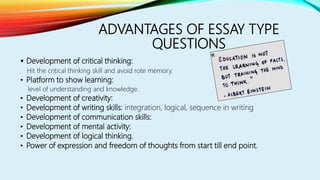
ADVANTAGES OF ESSAY TYPE
QUESTIONS
 Development of critical thinking:
Hit the critical thinking skill and avoid rote memory.
• Platform to show learning:
level of understanding and knowledge.
• Development of creativity:
• Development of writing skills: integration, logical, sequence in writing
• Development of communication skills:
• Development of mental activity:
• Development of logical thinking.
• Power of expression and freedom of thoughts from start till end point.
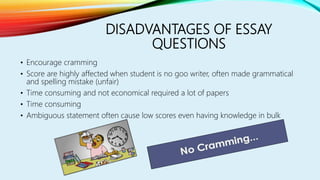
DISADVANTAGES OF ESSAY
QUESTIONS
• Encourage cramming
• Score are highly affected when student is no goo writer, often made grammatical
and spelling mistake (unfair)
• Time consuming and not economical required a lot of papers
• Time consuming
• Ambiguous statement often cause low scores even having knowledge in bulk
SCORING SCHEME
• Scoring key in advance, which include certain main points to be consider.
• Features of the answer to be evaluated and weight the material(no of ideas)
Features are as follow;
• Content (+)
• Comprehensive (-)
• Logical organization(+)
• Irrelevant material(-)
• Grammar and spelling(+)
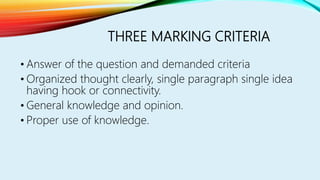
THREE MARKING CRITERIA
• Answer of the question and demanded criteria
• Organized thought clearly, single paragraph single idea
having hook or connectivity.
• General knowledge and opinion.
• Proper use of knowledge.
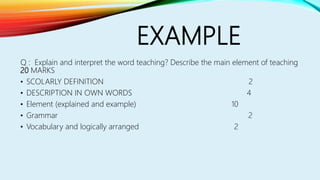
EXAMPLE
Q : Explain and interpret the word teaching? Describe the main element of teaching
20 MARKS
• SCOLARLY DEFINITION 2
• DESCRIPTION IN OWN WORDS 4
• Element (explained and example) 10
• Grammar 2
• Vocabulary and logically arranged 2
REFERENCES
• http://www.studygs.net/teaching/tsttak4a.htm
• https://testing.byu.edu/handbooks/WritingEffectiveEssayQuestions.pdf
• www.Slide share.com
ESSAY TYPE TEST

ESSAY TYPE TEST

  • 2.
    CONSTRUCTING ESSAY QUESTIONSAND TEST AND SCORING SCHEME WITH MODEL ANSWERS By; Mah-e-noor M.Yaqoob 6th semester
  • 3.
    ESSAY TYPE QUESTIONS •Detail answers and free responses • Check the higher order thinking. • check Complex ideas and thinking level • Freedom of thought and freedom of expressions. • Understanding level and critical writing skills are check. • An old technique I which detail answers are asked(open ended) • Variety of learning outcomes
  • 4.
    ESSAY TYPE QUESTIONS STALNAKER'SDEFINITION •Compose rather than selection of response. •More than one sentence. •Pattern of responses from different dimension. • Information to judge the accuracy and quality responses. •Moreover, systematic and detail information
  • 5.
    ESSAY TYPE TEST •useful for checking the ability of critical thinking. • Objective questions only check memory. • The words which cognitively challenge students thinking are; 1. Knowledge 2. comprehension 3. Application 4. Analysis 5. Synthesis 6. Evaluation
  • 6.
    BLOOMS TAXONOMY COGNITIVE DOMAIN 1.Knowledge(washing soda, third law of motion, baking) 2.comprehension 3.Application 4.Analysis 5.Synthesis 6.Evaluation
  • 7.
    1.KNOWLEDGE • LOTS (lowerorder thinking skills) • Use to remember the information the key word used are; Recall Define  Arrange  List Label  Identify,  Match,  Reproduce Q Identify the importance of the curricular and co-curricular activities for students?
  • 8.
    COMPREHENSION • Describe • Explain •Recognize • Translate or restate • Classify with example
  • 9.
    APPLICATION • Apply • Illustrate •Interpreted • solve • Predict • Utilize
  • 10.
    ANANLYSIS • Analyze • Compare •Distinguish • Examine • Diagram or outline
  • 11.
    SYNTHESIS • Design • Develop •Formulate • Propose • Construct • Integrate
  • 12.
    EVALUATION • Evaluate • Argue •Assess • Critique • Justify • Support • Interpret Q: Critically examine the statement; ‘the most important thing in research is human mind’.
  • 13.
    TYPES OF ESSAYTYPE QUESTIONS Restricted and controlled: • students are restricted in question • Limited requirement of answers • Check only interpretation and application of particular idea. • For example; Q : explain with at least single reason why government teachers avoid the use of text book?
  • 14.
    Expended question • Unlimitedinformation knowledge, judgement and integrated skills are developed. • Students could share bulk of knowledge. • For example : Q : Compare and contrast the material and non-material culture with suitable example? Q : analyze the issues in Pakistani culture and it effect on education?
  • 15.
    ADVANTAGES OF ESSAYTYPE QUESTIONS  Development of critical thinking: Hit the critical thinking skill and avoid rote memory. • Platform to show learning: level of understanding and knowledge. • Development of creativity: • Development of writing skills: integration, logical, sequence in writing • Development of communication skills: • Development of mental activity: • Development of logical thinking. • Power of expression and freedom of thoughts from start till end point.
  • 16.
    DISADVANTAGES OF ESSAY QUESTIONS •Encourage cramming • Score are highly affected when student is no goo writer, often made grammatical and spelling mistake (unfair) • Time consuming and not economical required a lot of papers • Time consuming • Ambiguous statement often cause low scores even having knowledge in bulk
  • 17.
    SCORING SCHEME • Scoringkey in advance, which include certain main points to be consider. • Features of the answer to be evaluated and weight the material(no of ideas) Features are as follow; • Content (+) • Comprehensive (-) • Logical organization(+) • Irrelevant material(-) • Grammar and spelling(+)
  • 18.
    THREE MARKING CRITERIA •Answer of the question and demanded criteria • Organized thought clearly, single paragraph single idea having hook or connectivity. • General knowledge and opinion. • Proper use of knowledge.
  • 19.
    EXAMPLE Q : Explainand interpret the word teaching? Describe the main element of teaching 20 MARKS • SCOLARLY DEFINITION 2 • DESCRIPTION IN OWN WORDS 4 • Element (explained and example) 10 • Grammar 2 • Vocabulary and logically arranged 2
  • 20.