UNIVERSIDAD CATÓLICA DE LA SANTÍSIMA CONCEPCIÓN
FACULTAD DE EDUCACIÓN
Departamento de Lenguas
SPEAKING TEST DESING
ASSESSMENT
Teacher
Gabriela Sanhueza
José Miguel Casanueva H.
Makarena Sánchez C.
Concepción, June 2014
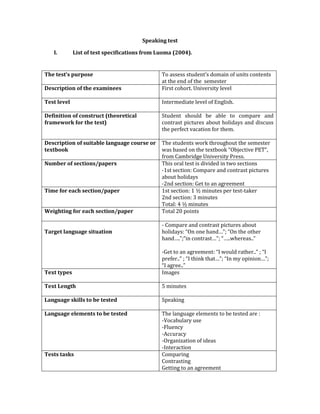
Speaking test
I. List of test specifications from Luoma (2004).
The test’s purpose To assess student’s domain of units contents
at the end of the semester
Description of the examinees First cohort. University level
Test level Intermediate level of English.
Definition of construct (theoretical
framework for the test)
Student should be able to compare and
contrast pictures about holidays and discuss
the perfect vacation for them.
Description of suitable language course or
textbook
The students work throughout the semester
was based on the textbook “Objective PET”,
from Cambridge University Press.
Number of sections/papers This oral test is divided in two sections
-1st section: Compare and contrast pictures
about holidays
-2nd section: Get to an agreement
Time for each section/paper 1st section: 1 ½ minutes per test-taker
2nd section: 3 minutes
Total: 4 ½ minutes
Weighting for each section/paper Total 20 points
Target language situation
- Compare and contrast pictures about
holidays: “On one hand…”; “On the other
hand….”;“in contrast…”; “…..whereas..”
-Get to an agreement: “I would rather..” ; “I
prefer..” ; “I think that…”; “In my opinion…”;
“I agree..”
Text types Images
Text Length 5 minutes
Language skills to be tested Speaking
Language elements to be tested The language elements to be tested are :
-Vocabulary use
-Fluency
-Accuracy
-Organization of ideas
-Interaction
Tests tasks Comparing
Contrasting
Getting to an agreement
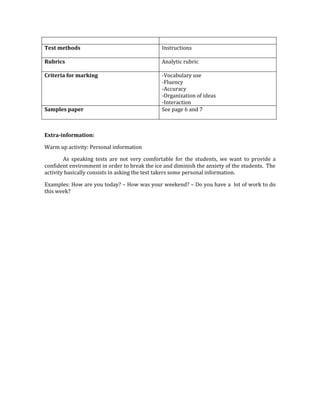
Extra-information:
Warm up activity: Personal information
As speaking tests are not very comfortable for the students, we want to provide a
confident environment in order to break the ice and diminish the anxiety of the students. The
activity basically consists in asking the test takers some personal information.
Examples: How are you today? – How was your weekend? – Do you have a lot of work to do
this week?
Test methods Instructions
Rubrics Analytic rubric
Criteria for marking -Vocabulary use
-Fluency
-Accuracy
-Organization of ideas
-Interaction
Samples paper See page 6 and 7
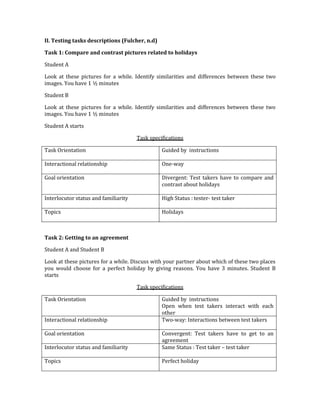
II. Testing tasks descriptions (Fulcher, n.d)
Task 1: Compare and contrast pictures related to holidays
Student A
Look at these pictures for a while. Identify similarities and differences between these two
images. You have 1 ½ minutes
Student B
Look at these pictures for a while. Identify similarities and differences between these two
images. You have 1 ½ minutes
Student A starts
Task specifications
Task Orientation Guided by instructions
Interactional relationship One-way
Goal orientation Divergent: Test takers have to compare and
contrast about holidays
Interlocutor status and familiarity High Status : tester- test taker
Topics Holidays
Task 2: Getting to an agreement
Student A and Student B
Look at these pictures for a while. Discuss with your partner about which of these two places
you would choose for a perfect holiday by giving reasons. You have 3 minutes. Student B
starts
Task specifications
Task Orientation Guided by instructions
Open when test takers interact with each
other
Interactional relationship Two-way: Interactions between test takers
Goal orientation Convergent: Test takers have to get to an
agreement
Interlocutor status and familiarity Same Status : Test taker – test taker
Topics Perfect holiday
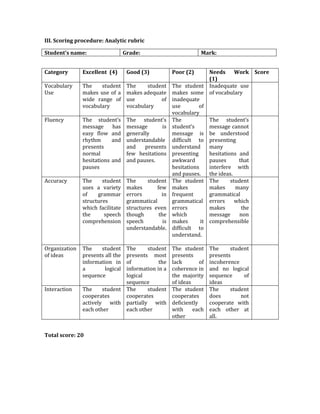
III. Scoring procedure: Analytic rubric
Student’s name: Grade: Mark:
Category Excellent (4) Good (3) Poor (2) Needs Work
(1)
Score
Vocabulary
Use
The student
makes use of a
wide range of
vocabulary
The student
makes adequate
use of
vocabulary
The student
makes some
inadequate
use of
vocabulary
Inadequate use
of vocabulary
Fluency The student’s
message has
easy flow and
rhythm and
presents
normal
hesitations and
pauses
The student’s
message is
generally
understandable
and presents
few hesitations
and pauses.
The
student’s
message is
difficult to
understand
presenting
awkward
hesitations
and pauses.
The student’s
message cannot
be understood
presenting
many
hesitations and
pauses that
interfere with
the ideas.
Accuracy The student
uses a variety
of grammar
structures
which facilitate
the speech
comprehension
The student
makes few
errors in
grammatical
structures even
though the
speech is
understandable.
The student
makes
frequent
grammatical
errors
which
makes it
difficult to
understand.
The student
makes many
grammatical
errors which
makes the
message non
comprehensible
Organization
of ideas
The student
presents all the
information in
a logical
sequence
The student
presents most
of the
information in a
logical
sequence
The student
presents
lack of
coherence in
the majority
of ideas
The student
presents
incoherence
and no logical
sequence of
ideas
Interaction The student
cooperates
actively with
each other
The student
cooperates
partially with
each other
The student
cooperates
deficiently
with each
other
The student
does not
cooperate with
each other at
all.
Total score: 20
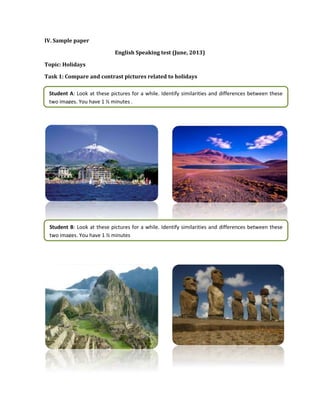
IV. Sample paper
English Speaking test (June, 2013)
Topic: Holidays
Task 1: Compare and contrast pictures related to holidays
Student A: Look at these pictures for a while. Identify similarities and differences between these
two images. You have 1 ½ minutes .
Student B: Look at these pictures for a while. Identify similarities and differences between these
two images. You have 1 ½ minutes
Task 2: Getting to an agreement
Student A and Student B: Look at these pictures for a while. Discuss with your partner about
which of these four places you would choose for a perfect holiday by giving reasons. You have 3
minutes
Student B starts

Speaking assessment test

  • 1.
    UNIVERSIDAD CATÓLICA DELA SANTÍSIMA CONCEPCIÓN FACULTAD DE EDUCACIÓN Departamento de Lenguas SPEAKING TEST DESING ASSESSMENT Teacher Gabriela Sanhueza José Miguel Casanueva H. Makarena Sánchez C. Concepción, June 2014
  • 2.
    Speaking test I. Listof test specifications from Luoma (2004). The test’s purpose To assess student’s domain of units contents at the end of the semester Description of the examinees First cohort. University level Test level Intermediate level of English. Definition of construct (theoretical framework for the test) Student should be able to compare and contrast pictures about holidays and discuss the perfect vacation for them. Description of suitable language course or textbook The students work throughout the semester was based on the textbook “Objective PET”, from Cambridge University Press. Number of sections/papers This oral test is divided in two sections -1st section: Compare and contrast pictures about holidays -2nd section: Get to an agreement Time for each section/paper 1st section: 1 ½ minutes per test-taker 2nd section: 3 minutes Total: 4 ½ minutes Weighting for each section/paper Total 20 points Target language situation - Compare and contrast pictures about holidays: “On one hand…”; “On the other hand….”;“in contrast…”; “…..whereas..” -Get to an agreement: “I would rather..” ; “I prefer..” ; “I think that…”; “In my opinion…”; “I agree..” Text types Images Text Length 5 minutes Language skills to be tested Speaking Language elements to be tested The language elements to be tested are : -Vocabulary use -Fluency -Accuracy -Organization of ideas -Interaction Tests tasks Comparing Contrasting Getting to an agreement
  • 3.
    Extra-information: Warm up activity:Personal information As speaking tests are not very comfortable for the students, we want to provide a confident environment in order to break the ice and diminish the anxiety of the students. The activity basically consists in asking the test takers some personal information. Examples: How are you today? – How was your weekend? – Do you have a lot of work to do this week? Test methods Instructions Rubrics Analytic rubric Criteria for marking -Vocabulary use -Fluency -Accuracy -Organization of ideas -Interaction Samples paper See page 6 and 7
  • 4.
    II. Testing tasksdescriptions (Fulcher, n.d) Task 1: Compare and contrast pictures related to holidays Student A Look at these pictures for a while. Identify similarities and differences between these two images. You have 1 ½ minutes Student B Look at these pictures for a while. Identify similarities and differences between these two images. You have 1 ½ minutes Student A starts Task specifications Task Orientation Guided by instructions Interactional relationship One-way Goal orientation Divergent: Test takers have to compare and contrast about holidays Interlocutor status and familiarity High Status : tester- test taker Topics Holidays Task 2: Getting to an agreement Student A and Student B Look at these pictures for a while. Discuss with your partner about which of these two places you would choose for a perfect holiday by giving reasons. You have 3 minutes. Student B starts Task specifications Task Orientation Guided by instructions Open when test takers interact with each other Interactional relationship Two-way: Interactions between test takers Goal orientation Convergent: Test takers have to get to an agreement Interlocutor status and familiarity Same Status : Test taker – test taker Topics Perfect holiday
  • 5.
    III. Scoring procedure:Analytic rubric Student’s name: Grade: Mark: Category Excellent (4) Good (3) Poor (2) Needs Work (1) Score Vocabulary Use The student makes use of a wide range of vocabulary The student makes adequate use of vocabulary The student makes some inadequate use of vocabulary Inadequate use of vocabulary Fluency The student’s message has easy flow and rhythm and presents normal hesitations and pauses The student’s message is generally understandable and presents few hesitations and pauses. The student’s message is difficult to understand presenting awkward hesitations and pauses. The student’s message cannot be understood presenting many hesitations and pauses that interfere with the ideas. Accuracy The student uses a variety of grammar structures which facilitate the speech comprehension The student makes few errors in grammatical structures even though the speech is understandable. The student makes frequent grammatical errors which makes it difficult to understand. The student makes many grammatical errors which makes the message non comprehensible Organization of ideas The student presents all the information in a logical sequence The student presents most of the information in a logical sequence The student presents lack of coherence in the majority of ideas The student presents incoherence and no logical sequence of ideas Interaction The student cooperates actively with each other The student cooperates partially with each other The student cooperates deficiently with each other The student does not cooperate with each other at all. Total score: 20
  • 6.
    IV. Sample paper EnglishSpeaking test (June, 2013) Topic: Holidays Task 1: Compare and contrast pictures related to holidays Student A: Look at these pictures for a while. Identify similarities and differences between these two images. You have 1 ½ minutes . Student B: Look at these pictures for a while. Identify similarities and differences between these two images. You have 1 ½ minutes
  • 7.
    Task 2: Gettingto an agreement Student A and Student B: Look at these pictures for a while. Discuss with your partner about which of these four places you would choose for a perfect holiday by giving reasons. You have 3 minutes Student B starts