Downloaded 77 times

![1. Optiwave Introduction[2]
Optiwave Software is very useful one . It helps in Simulation of the optic-circuits , which can then to be
used by design engineers to evaluate the effect of different parameters and the efficiency of the
designed system. It also helps the marketing teams of component and system vendors to powerfully
and cost-effectively demonstrate their products .It reduces the investment cost incurred for the
research as the software offers conditions close to the real one. This software is widely used because
of the features offered by it, following are few of them
FEATURES:
A) Graphical user interface :
A comprehensive Graphical User Interface (GUI) controls the optical component layout, component
models, and presentation graphics. The Performer Control window provides simple, easy-to-use button
controls for simulation control.
B) Mixed signal Representation :
OptiSystem handles mixed signal formats for optical and electrical signals in the Component Library.
OptiSystem calculates the signals using the appropriate algorithms related to the required simulation
accuracy and efficiency.
C) Quality and performance algorithms :
In order to predict the system performance, OptiSystem calculates parameters such as BER and Q-
Factor using numerical analysis or semi-analytical techniques for systems limited by inter symbol
interference and noise.
D) Advanced visualization tools :
Advanced visualization tools produce Oscilloscope, and Eye diagrams. Also included are WDM analysis
tools listing signal power, gain, noise figure.
2. LASER :
Laser is a device which emits amplified light signal, amplified through the process of stimulated
emission, that is why LASER is named after LIGHT AMPLIFICATION STIMULATED EMISSION RADIATION
.The light emitted by the laser is monochromatic , directional and coherent in nature.
As we know optical links for data flow offered much more advantages
over the conventional metal links and are being used as transmission medium. As only light can flow
through these links we require an electro-optic converter at sending end and optic-electro converter at
receiving end for signal conversion. We require a source which can convert high frequency electrical
signal to optical domain. Laser is the best known Modulation source of optical light , which can be
coupled to the optical link with lower losses .Generally two techniques in for Modulation are defined :-](https://image.slidesharecdn.com/ofcreportnew-140626032433-phpapp02/85/Optiwave-Semiconductor-LASER-Modulation-Response-3-320.jpg)
![1. External Modulation : A continuous Wave Laser is used to emit light , and external modulator
Switches the Light “ON” or “OFF”
2. Direct Modulation : The Driving Signal is fed to Laser and Light is emitted when
“MARK” is to sent and no light when “SPACE” it be sent .
Figure 1. (a) : The Driving current to Laser is the Modulating signal, so it turns Laser On and Off (b) : Driving
current to Laser is constant and Light thus emitted is modulated by external modulator
Important parameters consideration about the laser to be used:
1. Speed : The speed of operation is required to be high as input data frequency is high ,so the laser
should be able to switch between states immediately
2. Extinction Ratio: It is the ratio of the power level corresponding to “MARK” to the power level
corresponding to “SPACE”
ER=P1/P0
P1 – Power Level for MARK
P0 – Power Level for SPACE
The value of ER should be high for easy recognition of MARK and SPACE , otherwise if high power is
transmitted but ER is less , the power transmitted is useless as probability of error at receiver is much
more. Power Penality at Output is δER = 10 log10 [(ER+1)/(ER-1)]
3. Frequency Chirp[3,5]: When an external field is applied as driving signal which forces changes in the
charge density in the laser medium resulting in the changes in the refractive index and hence the phase
of the output changes with time](https://image.slidesharecdn.com/ofcreportnew-140626032433-phpapp02/85/Optiwave-Semiconductor-LASER-Modulation-Response-4-320.jpg)
![Some Important aspects of DML :
1. Turn on delay[6] :
If we try to achieve Space in below the threshold current and mark above threshold , so when ever
there is change in state like from Space to mark so sufficient current needs to be injected to fulfil the
condition for the population inversion and it incorporates some delay, which is given by equation
Td = τo ln [(I1-I0)/(I1-Ith) ]
I1 – Driving Current for mark
I0 - Driving Current for space
Ith - Threshold Current
2. Extinction Ratio:
There is trade-off between speed of operation and Extinction Ratio possible, as more the Extinction
Ratio lesser is the speed of operation possible and lesser is Extinction ratio, more is the speed of
operation possible, but in case of Lower Extinction ratio power penalty is more.
3. Bandwidth
The Bandwidth denotes the Data rate and delay in a DML limits the data rate, more is the Bias current
more carriers injected, hence lesser the delay more the data rate more the bandwidth
Δf = [3Gn (Ib-Ith) / 4π2 e ]1/2
Gn - constant related to the rate of stimulated emission on the carrier number
Ib - Bias current
Ith - Threshold current
e – elementary charge
4. Relaxation Oscillation
When Laser is subjected to change state between Mark and Space, oscillations occur at the output
power known as Relaxation Oscillations. But , these oscillations are under-damped and steady state is
attained , the damping depends upon the input current higher the current higher the damping , the
origin if these oscillations is interplay between injected charge and the emitted photons.
4. PROJECT:
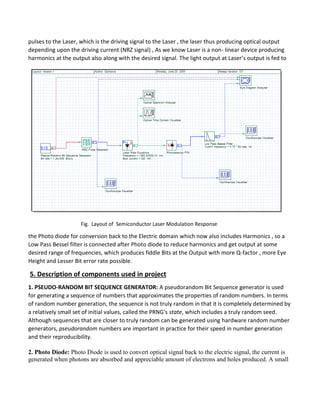
This project is based on laser emission the nature of the optical power output from the Laser
depending upon various parameters of the Laser and the Input signal is observed. So in Circuit we use
a pseudo-random sequence generator, which produces sequence which is only known to sender and
receiver and purely random to others, Non-return-to-zero pulse generator is used which feeds NRZ](https://image.slidesharecdn.com/ofcreportnew-140626032433-phpapp02/85/Optiwave-Semiconductor-LASER-Modulation-Response-6-320.jpg)
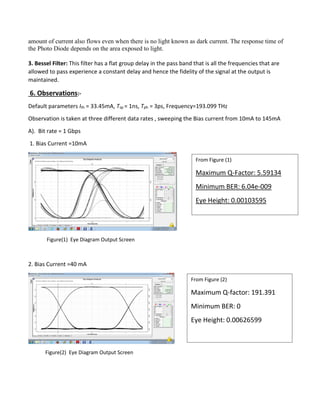
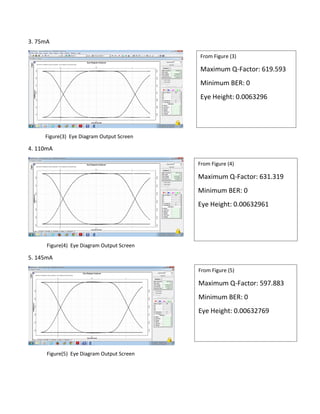
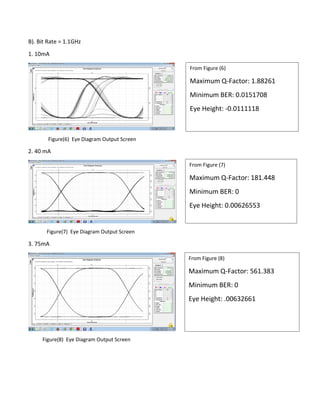
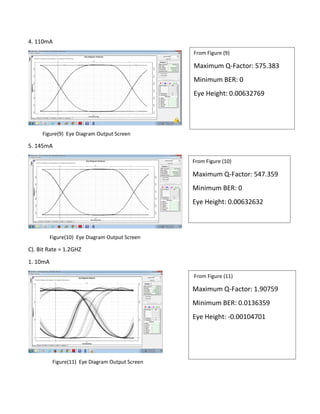
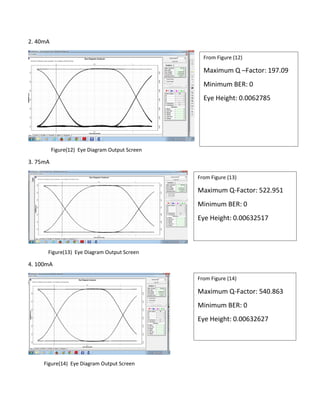
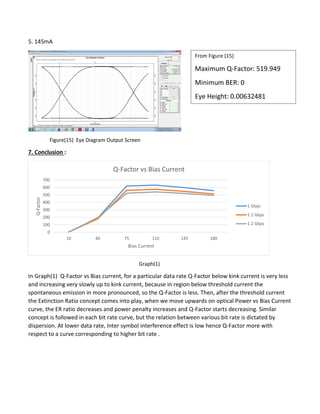
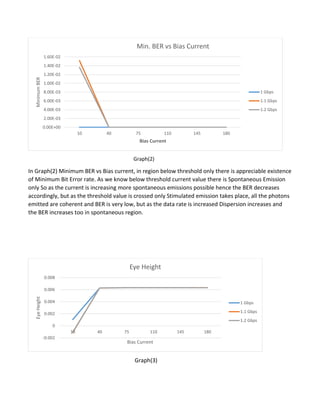

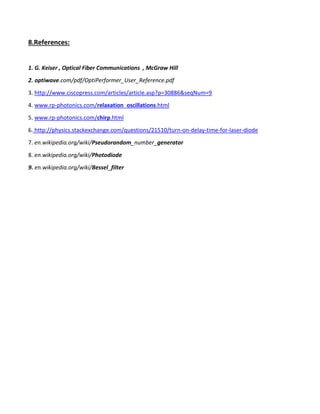

This document summarizes a student project on laser modulation response using Optiwave simulation software. The project involves: 1. Generating a pseudorandom bit sequence to drive a laser, producing an optical output. 2. Using a photodiode to convert the optical signal back to electrical, introducing harmonics. 3. Applying a Bessel filter to reduce harmonics and obtain the desired output signal quality in terms of eye height, Q-factor and bit error rate. The document discusses laser modulation types, components used like the pseudorandom sequence generator, photodiode and Bessel filter, and observations on the laser's optical output response to modulation.


